


Bipolar disorder is a mental health condition involving episodes of unusually elevated or irritable mood and increased energy, often alongside periods of depression. The distinction is a change in sleep, activity, judgment and everyday functioning over time, not simply feeling happy and sad. Effective treatment addresses both current episodes and the risk of future ones, so the full history matters even when today’s main problem is depression.
A useful starting question is, “Has there been a distinct period when my mood and energy changed together, and what happened to daily life?” A single argument, a busy weekend or a difficult personality does not answer that question. Neither a photograph nor an online symptom score can establish a diagnosis.
This overview connects the main types, the assessment process and the different jobs of treatment. Its practical focus is making a clinical conversation more useful and bringing existing medicine information into that conversation. Detailed early-warning plans and specialist comparisons have different jobs and should not be mistaken for the diagnosis itself.
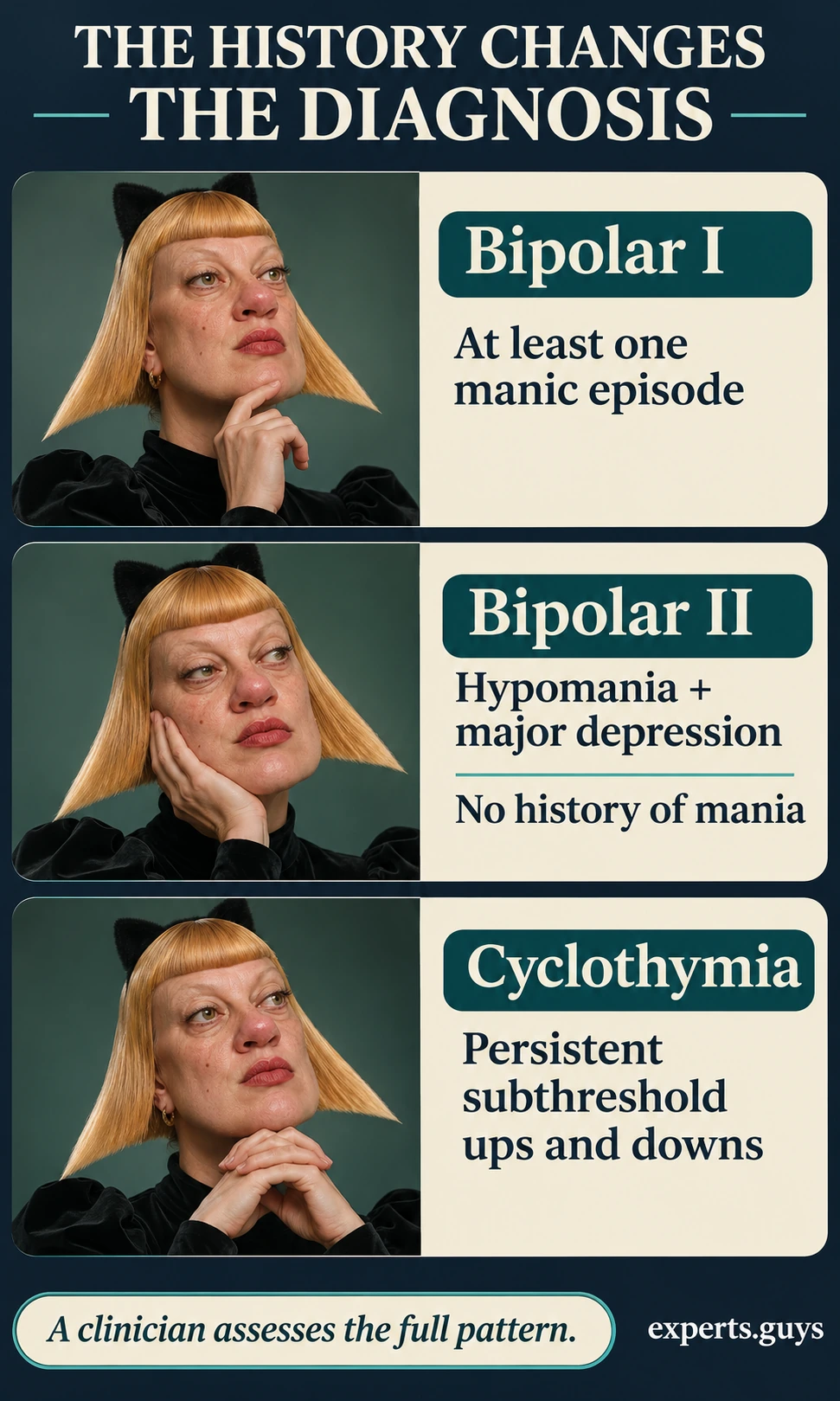
The main distinction is the kind of episode in the person’s history. Bipolar I does not require a previous depressive episode, while bipolar II requires both hypomania and major depression and no history of mania. These are clinical distinctions, not a ranking of how much someone deserves help.
| Pattern | What establishes the distinction | What it does not mean |
|---|---|---|
| Bipolar I | At least one manic episode; depression may also occur. | The person must alternate predictably between a high and a low. |
| Bipolar II | Hypomania and major depression, without a manic episode. | A harmless or less disabling version of bipolar I. |
| Cyclothymic disorder | Persistent periods of elevated and depressive symptoms below full episode thresholds, with additional duration criteria. | Ordinary changes of mood or a diagnosis from a few uneven days. |
Which changes count as a bipolar episode?
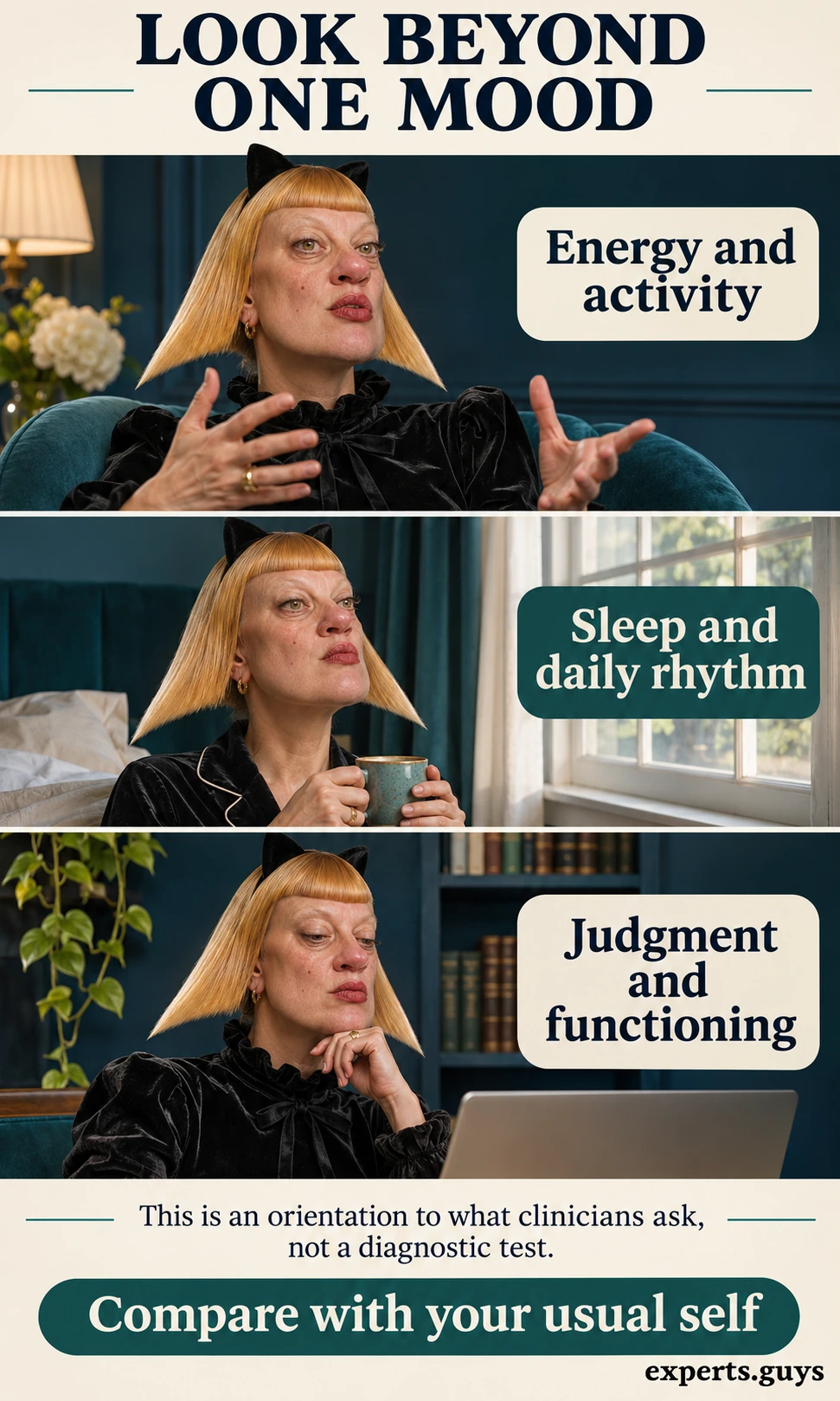
A mood episode is a sustained change from someone’s usual state, involving a cluster of symptoms and a meaningful change in activity or functioning. Mood alone is too narrow a lens. The same outward behavior can reflect different causes, so assessment examines what changed together, how long it lasted, how severe it became and what else was happening.
Mania may involve unusually elevated mood, marked irritability, increased activity, fast speech, racing thoughts, inflated confidence, distractibility and risky decisions. Reduced need for sleep is especially informative: someone may sleep much less yet feel unusually energized. This differs from lying awake and feeling exhausted the next morning, although either problem can warrant care.
The clinical boundary also involves consequences. Mania can markedly disrupt work, relationships or safety, sometimes requiring hospital treatment; psychosis can occur. Hypomania involves a clear change in mood and energy that others can notice, but it does not cause the marked impairment, need for hospitalization or psychotic features that define the manic level of severity. A period that felt productive can still be relevant to the history.
Major depression involves persistent low mood or loss of interest together with other changes such as disrupted sleep, reduced energy, difficulty thinking, appetite changes, guilt or hopelessness. It can affect basic self-care as well as work. Depression by itself does not establish bipolar disorder: the history of elevated or activated episodes is what changes the diagnostic picture.
Common diagnostic frameworks use at least a week for mania, or a shorter period when hospitalization is necessary; hypomania generally lasts at least four consecutive days, and major depression at least two weeks. These time windows accompany other criteria. They are not instructions to wait, and a serious change lasting less time still deserves assessment.
The NIMH guide to bipolar disorder explains why symptoms must be considered alongside their course and impact. A useful description connects sleep, pace and decisions within the same period. For example, “I slept far less, felt unusually driven and made commitments I would normally reconsider” conveys more than “I had a good week.” The example illustrates a question for assessment, not proof of an episode.
Before interpreting any label, separate the following observations from the conclusion you might be tempted to draw. This helps keep an assessment open to other explanations while still taking substantial changes seriously.
- Change from usual: compare with the person’s own baseline, rather than another person’s temperament.
- Changes occurring together: ask whether mood, energy, sleep and activity shifted during the same period.
- Consequences: include disrupted responsibilities, relationships, basic care or judgment.
- Context: medicines, substance use, physical illness and severe sleep disruption can affect the explanation.
- Safety: dangerous or rapidly worsening symptoms take priority over naming the exact episode.
Mixed features complicate the familiar picture of a cheerful high and a sad low. Depressive symptoms can occur alongside activation or other manic symptoms. Someone may be distressed and energized at the same time, so visible activity does not necessarily indicate recovery. Clinicians assess the particular combination rather than assuming that every restless depression is bipolar disorder.
Rapid cycling has a specific meaning: four or more distinct mood episodes within a year. It does not simply mean changing feelings several times during one afternoon. Short-term fluctuations may still be important, but using the wrong label can hide the information a clinician actually needs about episode boundaries and recovery between them.
Periods between episodes vary. Some people regain their usual mood and functioning, while others have residual symptoms or need longer to rebuild concentration, routines and confidence. Being well at the appointment does not erase a convincing history; remaining tired after an episode does not automatically establish a new episode.
The practical takeaway is to describe the whole change before naming it. If irritability is the main concern within a low-mood period, the separate guide to irritability during bipolar depression explores that narrower question. Irritability alone is not enough to identify the condition.
Appearance is not diagnostic evidence. Clothing, hairstyle, creativity and how expressive someone looks do not establish mania, depression or any bipolar subtype. The examples in this article use one recurring person to make comparisons easier to follow; the clinical distinctions come from history and functioning.
Look across the same period rather than collecting isolated behaviors from different years. A remembered sleepless night, an unrelated purchase and a later sad month cannot simply be added together as if they were one episode. Timing gives the symptoms their clinical meaning.
How are bipolar types and the diagnosis worked out?
Diagnosis is based on a clinical assessment of the lifetime pattern, including episodes that may never have prompted treatment. There is no routine blood test, scan or online quiz that independently confirms bipolar disorder. Physical examination and tests can help investigate other explanations or establish a safe starting point for treatment.
For bipolar I, a qualifying manic episode is central, whether or not a major depressive episode has occurred. For bipolar II, both hypomania and major depression are needed, without a manic episode. If a person previously diagnosed with bipolar II later has mania, the clinician reassesses the diagnosis. That change describes new evidence about the illness, not a personal failure.
Cyclothymia describes a longer-standing pattern of elevated and depressive symptoms that do not meet full episode criteria. The pattern generally needs to persist for at least two years in adults, or one year in children and adolescents, with additional requirements about symptom persistence and symptom-free periods. A clinician must also consider whether another explanation fits better; a long stretch of stress-related mood changes is not automatically cyclothymia.
The assessment usually covers previous highs and lows, sleep changes, activity, spending or other consequential behavior, family history, physical health and prescribed or nonprescribed substances. With permission, information from a trusted person may help clarify changes that were difficult to notice at the time. Their observations add a perspective; they do not replace the person’s own account.
The exact causes remain incompletely understood. Genetic vulnerability, biological processes and environmental influences can contribute, but no single gene or life event explains every case. A family history raises concern without making the outcome inevitable. Likewise, a stressful event may precede an episode without proving that the event caused the disorder.
Depression is often what brings someone to care. Earlier periods of unusually high energy may have been remembered as confidence, success or simply getting things done. An assessment therefore needs room for periods the person did not dislike. Asking about those periods is not an attempt to turn every positive experience into an illness.
| Assessment question | Why it matters | Useful detail |
|---|---|---|
| What was different from usual? | A longstanding trait differs from a distinct episode. | A concrete example of changed sleep, activity or behavior. |
| When did the changes occur together? | Timing helps distinguish a symptom cluster from unrelated events. | Approximate beginning, duration and return toward baseline. |
| What else could explain the change? | Physical conditions, medicines and substances can mimic or complicate symptoms. | Existing diagnoses and the products actually being taken. |
| What happened to daily functioning? | Impact helps establish severity and treatment needs. | Missed responsibilities, changed judgment or difficulty with basic care. |
Tell the episode story without keeping a diary
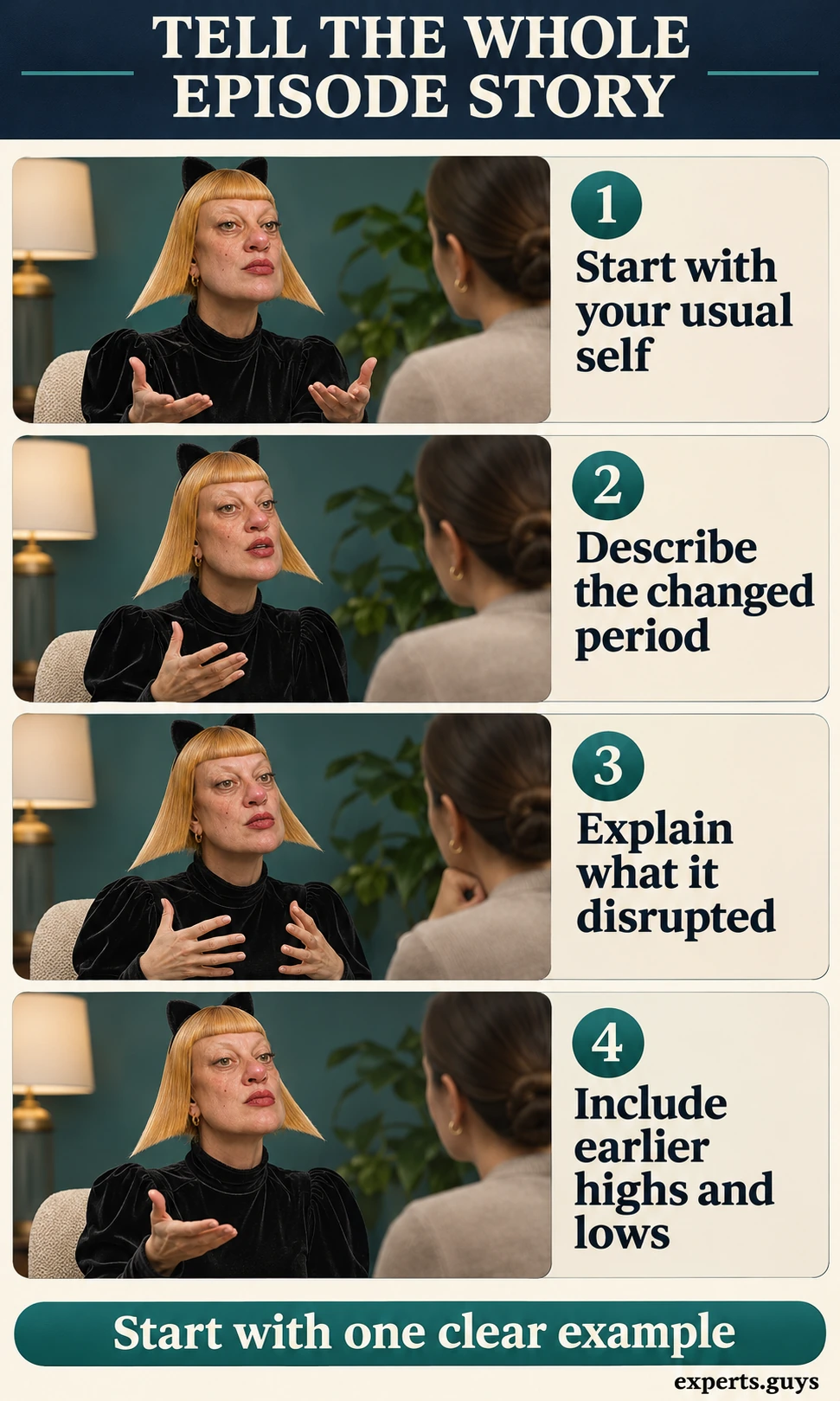
Use this short spoken sequence during an assessment, or with a trusted supporter who will accompany you. It is a communication aid, not a diagnostic exercise, and no new record is required. Choose one distinct period you remember; an approximate account is more useful than invented precision. Sit comfortably and use your usual communication support if speaking is difficult.
- Start with your usual self. Describe your normal sleep, activity and responsibilities before that period.
- Describe the changed period. Explain which changes occurred together and roughly how long they continued. Say when you are unsure.
- Explain what it disrupted. Give one consequence, such as missed work, spending unlike your usual choices, or difficulty managing basic care.
- Include earlier highs and lows. Mention previous periods even if they felt enjoyable or did not lead to treatment. Let the clinician ask the follow-up questions.
For an illustrative example, someone might say, “I usually need a full night’s sleep and keep a steady work pace. During that period I slept far less, kept starting new projects and made commitments I could not sustain. I later had a long low period.” The useful result is a clearer history to discuss, not a conclusion reached at home.
A common mistake is trying to present a perfectly coherent story and leaving out uncertain details. Say “I am not sure whether this happened before or after the medicine changed” instead. The easier version is one clear example plus permission for a trusted person to add what they observed. Existing records can help if already available, but producing a new log is not a condition of being heard.
Other conditions need careful consideration. Thyroid problems, substance effects, some prescribed medicines, ADHD, anxiety and other mental health conditions can overlap with parts of the presentation. Some can coexist with bipolar disorder. A clinician considers whether the symptoms are episodic, longstanding, linked to a substance or better explained by another condition, rather than choosing a diagnosis from one shared feature.
If someone else first noticed a change, use the separate guide to responding when others notice bipolar warning signs for that initial conversation. Here, the goal is different: bring the lifetime pattern into a clinical assessment. You do not have to agree on a label before agreeing that the change deserves attention.
Children and adolescents need an age-appropriate specialist assessment. Changes in sleep, irritability and activity must be understood alongside development, family context and other possible conditions. Adult examples cannot simply be turned into a checklist for a child. A young person also needs their own account heard, with support and safeguarding suited to their age; one person’s retrospective story does not establish another family member’s diagnosis.
It is reasonable to ask what remains uncertain after an initial appointment. The clinician may need more history or follow-up before deciding which diagnosis best fits. You can ask what possibilities are being considered and which findings would change the explanation. Uncertainty should come with a plan for the current difficulties rather than a requirement to cope alone until a label is settled. The immediate care need and the final diagnostic wording are related questions, but they are not always resolved at the same visit.
Why does treatment change between an episode and recovery?
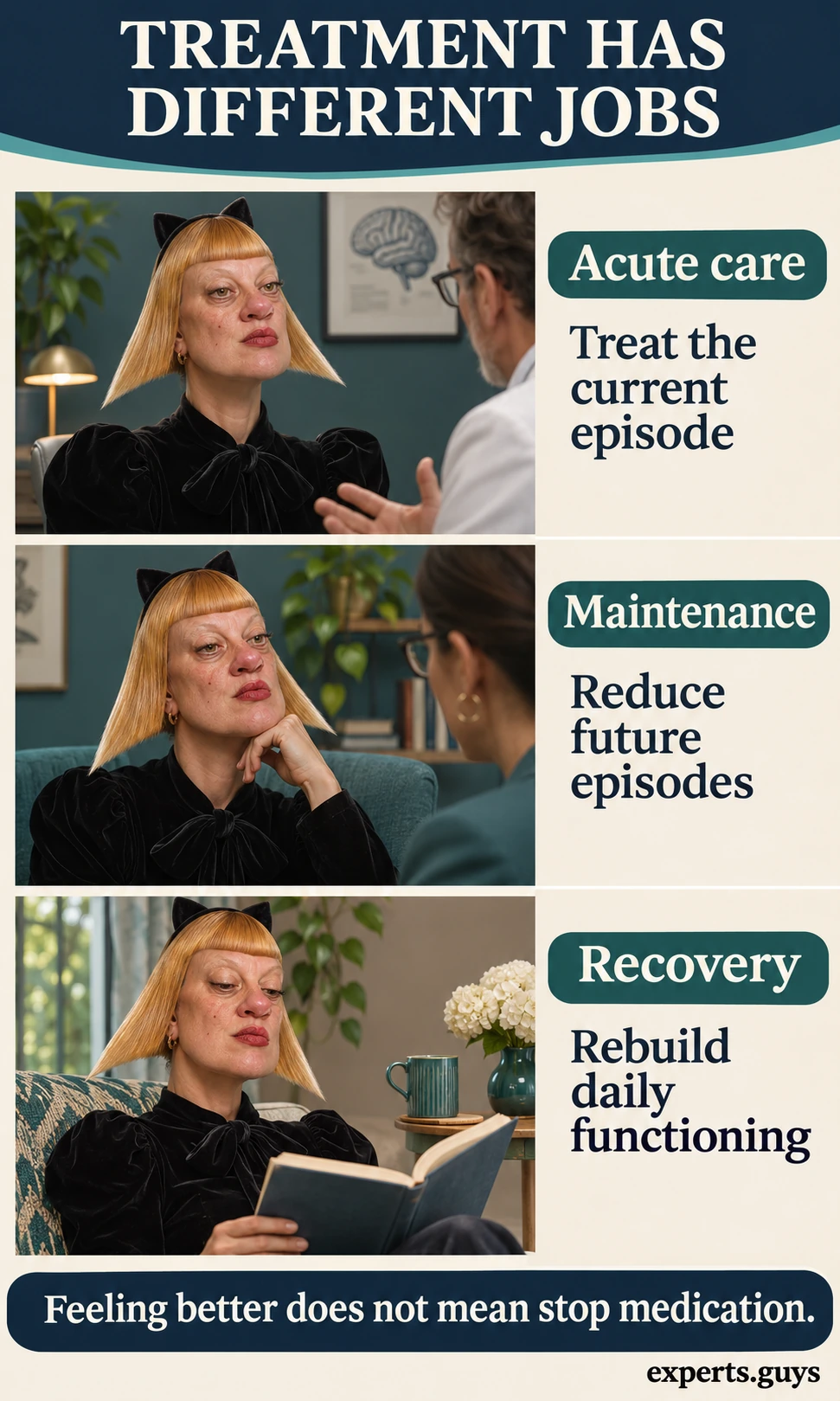
Treatment has different jobs at different stages: address the current episode, reduce recurrence and support everyday functioning. A medicine or therapy useful for one job may not be the right choice for another. Treatment also depends on prior response, side effects, other health conditions, pregnancy considerations, preferences and access to follow-up.
During an acute episode, the immediate priority may be sleep, severe mood symptoms, impaired judgment or safety. Maintenance treatment aims to reduce future episodes even when the person feels well. Recovery may include rebuilding concentration, relationships and confidence after the most obvious symptoms have settled. These needs can overlap rather than occurring in neat consecutive stages.
Mood stabilizers and certain antipsychotic medicines are common parts of care. The word “antipsychotic” names a medicine class; its use in bipolar disorder does not mean that every person taking it has psychosis. Some medicines have evidence for mania, some for bipolar depression and some for longer-term prevention. The choice requires an individualized discussion, not selecting from a list of drug names.
Antidepressants need particular care because treating bipolar depression is not identical to treating depression without a history of mania or hypomania. Antidepressant treatment can trigger activation or mood switching in some people, and antidepressant monotherapy is generally avoided, particularly in bipolar I. If you are already taking an antidepressant, discuss a concerning change promptly with the prescriber instead of abruptly stopping or adjusting it yourself.
Psychological treatment can support understanding of the condition, recognition of changes, relationships and day-to-day functioning alongside medication. Family-focused approaches and interpersonal and social rhythm therapy have specific roles; CBT can also be adapted to the person’s needs. The explanation of CBT for depression and anxiety introduces some therapy principles, but its activity examples are not a substitute for bipolar-specific treatment.
Medication review includes more than whether mood has improved. Depending on the medicine, the care team may monitor blood levels, kidney or thyroid function, weight, blood pressure or metabolic measures. The schedule is medicine-specific. NICE’s bipolar treatment recommendations distinguish the episode being treated from longer-term care and describe the monitoring required for particular medicines.
Lithium is one example where blood testing and interaction checks matter. Dehydration, illness and some medicines can alter its safety. The practical rule is to ask the prescriber or pharmacist about new medicines, nonprescription products and significant illness, rather than assuming that something sold without a prescription is compatible. Follow the individual instructions you have been given; this overview cannot determine a dose or interpret a blood result.
- Clarify the job: ask whether the current treatment is aimed at an acute episode, preventing recurrence, or both.
- Make tolerability part of care: describe side effects and their effect on daily life rather than silently abandoning treatment.
- Know the follow-up: establish who will review response, arrange relevant checks and respond if symptoms worsen.
- Discuss pregnancy early: some medicines have substantial reproductive risks; obtain specialist advice when planning pregnancy or if pregnancy occurs.
- Keep changes supervised: do not start, stop or change prescribed treatment using an article or someone else’s prescription.
Prepare original medicine packs for a review
This practical task fits a routine medication appointment when you are unsure whether the clinician knows everything you take. The aim is to make existing information available, including nonprescription products, following the principle of bringing original medicine containers to a review. It is an everyday preparation method, not a treatment for an episode. Do not delay urgent care to collect packaging, and leave medicines in their usual safe storage until you are preparing to attend.
- Keep products identifiable. At an accessible surface, gather the original labeled packs or closed containers for medicines you currently take. Do not empty tablets into an unmarked container.
- Include nonprescription products. Add the original packs for relevant vitamins, herbal remedies and other products. Tell the clinician about anything missing rather than guessing its contents.
- Pack them safely for the appointment. Put the closed packs in a suitable bag, following their storage requirements. Keep them away from children and anyone who should not have access.
- Check the plan together. Show the products to the clinician or pharmacist and ask what each is for, what checks are needed and whom to contact about problems. Continue to follow prescribed instructions unless the treating professional changes them.
For example, a person may routinely take a prescribed mood medicine and occasionally use a nonprescription pain reliever. Bringing both original packs lets the pharmacist check the actual products instead of relying on a remembered color or a partial brand name. The NHS guidance on lithium interactions shows why nonprescription medicines and supplements can matter.
If gathering or carrying the packs is difficult, ask a trusted person for help with your permission. If a product must stay refrigerated, is too bulky, or is unavailable, ask the pharmacy or clinic how to provide the existing medicine information safely; do not disrupt storage requirements for this example. For a remote appointment, have the packs within comfortable reach rather than transporting them.
The common error is treating preparation as permission to sort out the regimen alone. Keep products in their original containers and leave decisions about doses or combinations to the relevant professional. Completion means that the products and any uncertainties have been shown or described, and the next review responsibility is clear. It does not require an immediate improvement in mood.

Some people with severe or treatment-resistant episodes may be offered specialist treatments such as electroconvulsive therapy. That decision involves the severity and urgency of the illness, previous treatment and an informed discussion of benefits and risks. A general overview should not promise that any one intervention will work or imply that needing specialist care represents failure.
Shared decision-making includes discussing what matters most to the person. Someone may be especially concerned about daytime alertness, the practical burden of appointments, or how treatment fits their work and family responsibilities. Naming that concern helps the clinician compare appropriate options and explain trade-offs. It is more informative than treating all side effects as equally acceptable or assuming that a treatment used by a friend will fit the same priorities.
When care moves between services, clarify who now holds each responsibility. A specialist may advise on treatment while a primary care clinician or another service arranges some follow-up, depending on the local system. A prescription alone does not explain who will review a new problem or organize necessary checks. If the arrangement is unclear, asking the existing team to clarify it is a concrete way to reduce a gap in care without creating a new monitoring task for yourself.
What helps daily life without turning support into surveillance?
Helpful support makes treatment and ordinary life more manageable while preserving the person’s participation in decisions. Regular routines, appropriate sleep and practical assistance can support care, but they are not substitutes for treatment of an episode. The useful question is what specific obstacle can be reduced, not whether someone is complying with an idealized routine.
Sleep disruption can be both part of an episode and a factor that complicates stability. A regular schedule may help, but a person who suddenly needs far less sleep and becomes unusually driven needs assessment, not simply another bedtime suggestion. Avoid self-prescribed sleep deprivation, intense light treatment or other attempts to force a mood change. Discuss schedule disruptions such as shift work with the care team when they are relevant.
Alcohol and recreational substances can complicate symptoms, treatment and assessment. Be honest with the clinician about what is used and when; concealing it makes interpretation harder. If dependence is present, stopping some substances abruptly can be dangerous, so a safe plan may be needed. This article does not provide a withdrawal regimen.
Offer one concrete piece of help
When there is no immediate safety emergency, a supporter can make an offer small enough to accept or decline. Choose a private, comfortable setting, ask permission to discuss practical help and keep the exchange unhurried. Sit or position yourself at a comfortable shared level where possible. The purpose is collaboration, not examining the person for signs or forcing agreement.
- Ask, “Would a lift to your appointment help?” or offer another specific task the person actually needs.
- Wait for the answer and clarify the boundaries: what help, when, and whether the supporter should attend or simply provide transport.
- Respect a refusal unless an immediate safety situation requires urgent help. Offer to revisit the practical question later rather than turning it into an argument.
The easier version is a brief offer with no expectation of a long conversation. If speaking is inaccessible, use the person’s preferred communication method. The observable result is an agreed piece of help or a clearly respected decision, not a changed mood. This example illustrates supportive communication; it is not a separately validated treatment technique.

Supporters also need boundaries. Being caring does not require taking sole responsibility for another adult’s treatment, providing round-the-clock observation or managing risk alone. A care plan can clarify who is involved and which changes require professional input. Where consent and capacity issues arise, local clinical and legal processes matter; a family disagreement cannot resolve them by itself.
After an episode, a person may feel less distressed before attention, confidence or stamina has returned. Returning immediately to every previous obligation can conceal those remaining difficulties. At follow-up, distinguish mood symptoms from what remains hard in daily life: sustained concentration, a full working day, social confidence or managing routine tasks. Recovery should be assessed in terms that matter to the person.
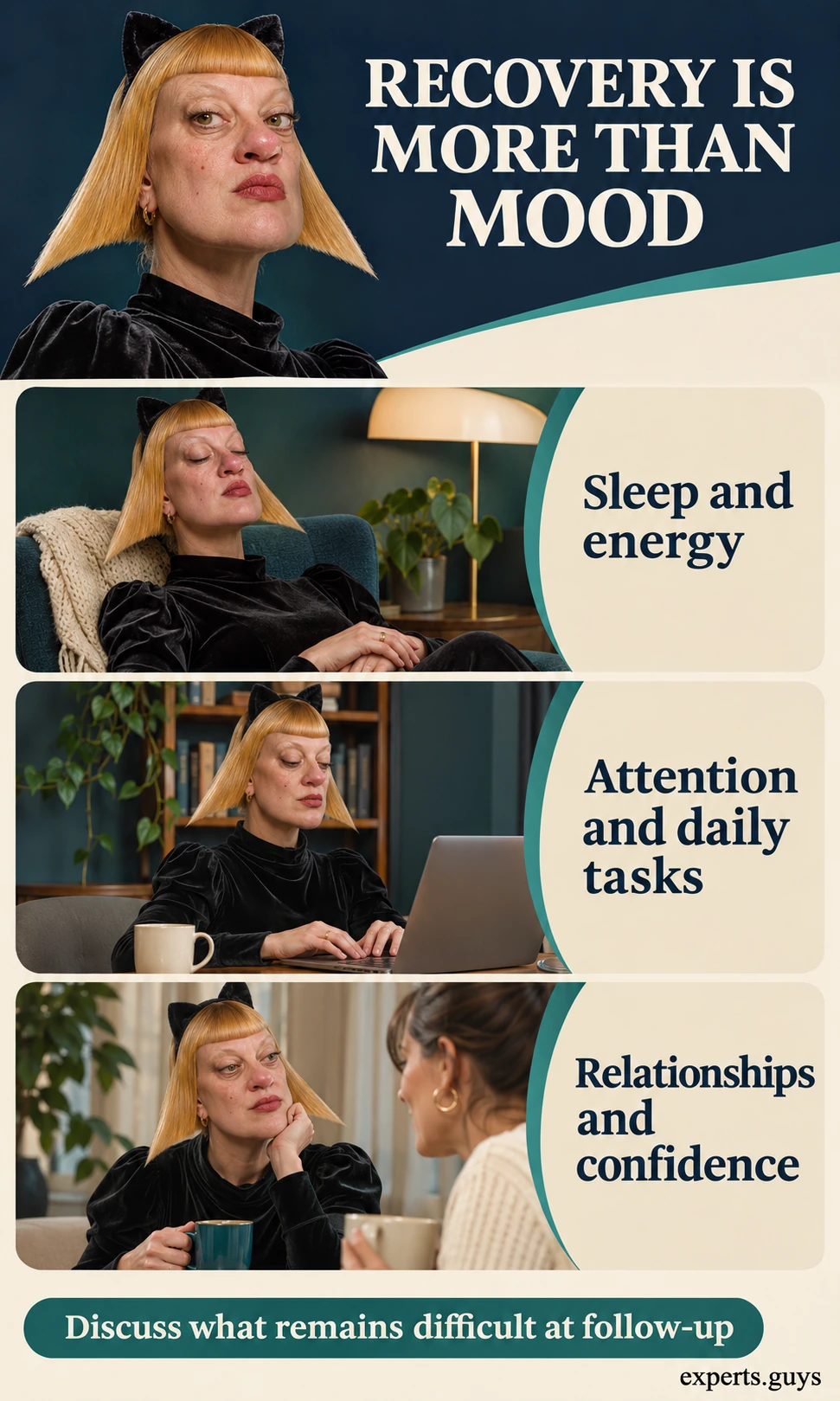
For an illustrative example, someone may be sleeping more consistently and no longer making impulsive decisions, yet still find a long work meeting difficult to follow. That is useful information for the next review. It does not automatically mean treatment has failed or that the person should push harder; it identifies a remaining functional problem to assess.
A sustainable plan also has to be accessible. If cost, transport, language, appointment availability or medication supply is getting in the way, say which barrier is present. The clinic or pharmacist may be able to help identify available options. The practical goal is continuity of appropriate care, not a perfect record of routines or a promise never to have another difficult period.
Frequently asked questions
Can someone have bipolar disorder without depression?
Yes. A qualifying manic episode can establish bipolar I even without a major depressive episode. Depression is common but is not required for that diagnosis. Bipolar II has a different definition: hypomania and major depression, without a history of mania.
Does a family history mean I will develop bipolar disorder?
No. Family history is relevant to assessment but does not determine an individual outcome. Many influences contribute, and a relative’s diagnosis does not make ordinary changes in your own mood evidence of an illness.
Can bipolar disorder be diagnosed during a stable period?
Yes. A clinician can assess past episodes and the overall course even when current mood is stable. Existing clinical records and observations from a trusted person, shared with appropriate permission, can help clarify that history.
Can a blood test rule out bipolar disorder?
No routine blood test can independently confirm or rule out bipolar disorder. Tests may help identify physical conditions that resemble mood symptoms or check whether a proposed medicine can be used safely.
Is every change after starting an antidepressant proof of bipolar disorder?
No. Activation or other changes after starting treatment need assessment, including timing, severity and persistence. Tell the prescriber promptly about unusual energy, reduced sleep need or risky behavior. Do not diagnose yourself or adjust the medicine without guidance.
Does feeling well mean maintenance treatment is no longer needed?
Not necessarily. Staying well may be one purpose of the current treatment. Any decision about reducing or stopping it should consider the history, risks, preferences and a supervised plan rather than a good day or a symptom-free appointment.
Bring the pattern and the treatment purpose together
Bipolar disorder is understood through episodes and their effects over time, not a single mood, appearance or checklist. The most useful next step is to explain one clear period of change, include earlier highs as well as lows, and clarify what the current treatment is meant to do. If you already take medicines, make the actual products available at review; if safety is uncertain, urgent care comes first.