
Cognitive behavioral therapy (CBT) can help depression and anxiety by changing patterns of thinking and behavior that keep daily life difficult. When low energy and fear overlap, reducing the effort of an activity and learning about its feared consequences are different jobs. A useful starting point is one safe, manageable action whose workload and social demands can be adjusted separately.
Consider helping someone prepare a couple of clean hand towels for use. A full basket may feel exhausting, while the possibility of being judged for working slowly may make even one towel feel threatening. Doing less work could address the first obstacle without resolving the second.
The practical example below uses one small shared household task to explain how CBT connects an interpretation, an action and an observation. It suits an adult who wants to take part, can handle a light cloth comfortably and has a trusted, willing person available. It illustrates treatment principles; folding towels is not an independently established treatment for either condition.
The treatment plan still depends on assessment, severity, safety, other conditions and your preferences. Depression accompanied by anxiety symptoms can need a different emphasis from a separate anxiety disorder with co-occurring depression. There is no universal rule that everyone should treat fear first or increase activity before anything else.
| What makes the task difficult? | What can change? | What remains important? |
|---|---|---|
| The amount of effort | Use a smaller amount, a seated setup or help with carrying | Keep a meaningful contribution if you want one |
| Fear of a particular response | Choose a manageable interaction and discuss the prediction | Use a safe person and an appropriate treatment plan |
| Both effort and fear | Change one demand at a time where feasible | Avoid treating exhaustion as proof that the fear is true |
| Actual danger, pain or significant worsening | Pause and address safety or clinical needs | Completing the activity is not the priority |
Why can one activity feel exhausting and threatening?
CBT looks at how a situation, its meaning, emotional and physical responses, and subsequent actions affect one another. Depression can reduce interest and make ordinary demands feel harder; anxiety can add a prediction of threat or failure. These influences can combine, but the same outward behavior does not reveal which one is most important.
In the towel example, declining the activity might avoid physical effort, anticipated criticism, an unpleasant relationship, or several things at once. The next useful question is what makes participation difficult in this particular situation. A working explanation, sometimes called a formulation, should help identify what needs adapting.

Try one manageable shared task
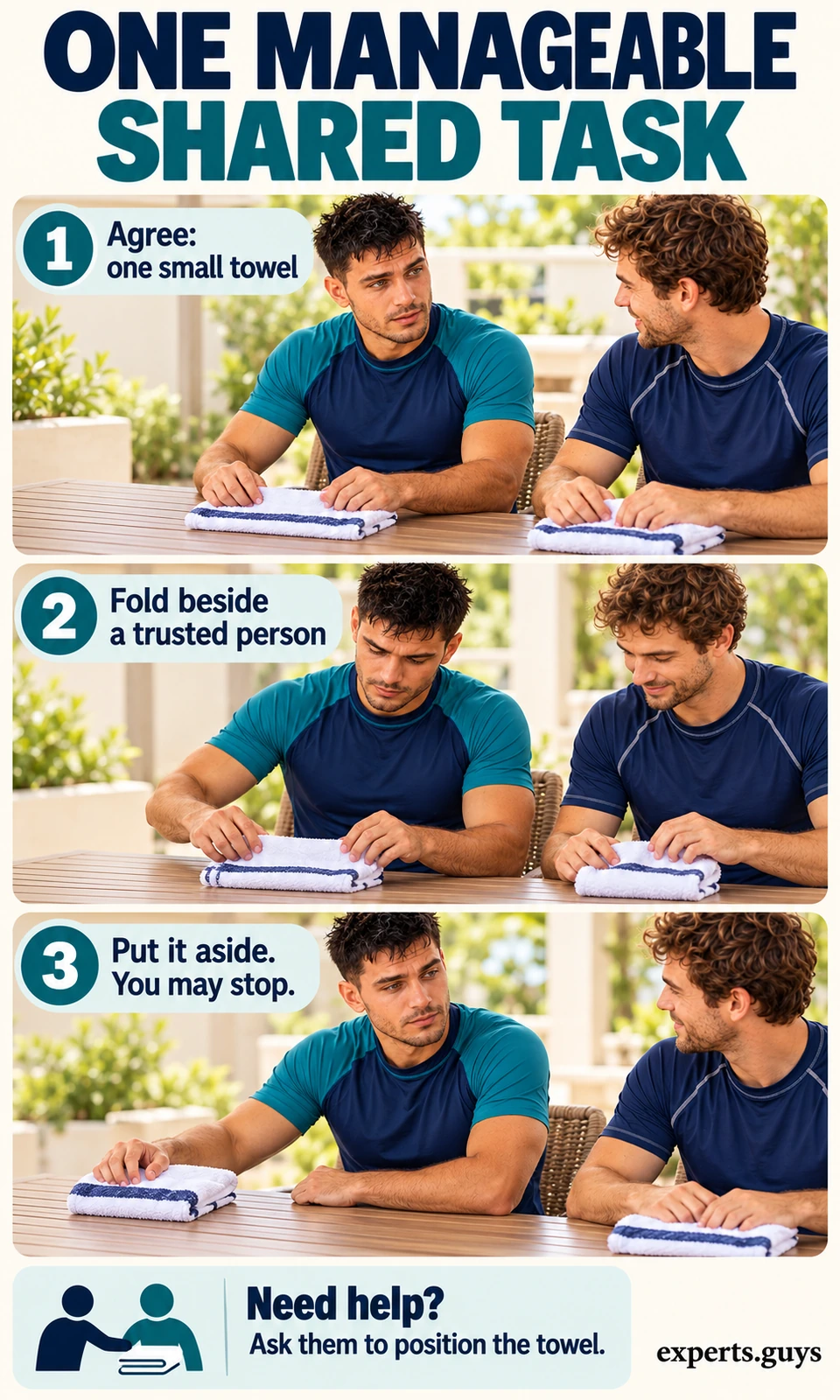
Choose an ordinary action that has a purpose you recognize and an endpoint you can see. Here, the purpose is preparing a clean towel for use while taking part beside someone you trust. The other person should agree to the activity and avoid turning it into an assessment of your speed or neatness.
- Set up within comfortable reach: use a stable, dry table and a comfortable seated or standing position. Put one clean, light hand towel in front of you; ask the companion to handle any carrying that would strain you.
- Agree the contribution and endpoint: say, “I will fold this one while you do yours.” Spread the towel on the table, bring one edge over to the opposite edge, and fold again if that is the useful size for storage.
- Complete that contribution: put the folded towel in the agreed place on the table. You can finish there; completing one towel does not commit you to the rest of the basket.
Keep the towel close enough that you do not need to lean or reach painfully. If a full fold is difficult, the companion can position or partly fold it so you can finish the manageable part; receiving more help is also a valid choice. The observable result is a useful contribution attempted within your limits, even if your mood does not lift.
A common mistake is treating the companion as an examiner who must watch silently or judge the result. Working alongside each other can make the situation more ordinary, and you can choose a different trusted person if this one feels critical or controlling. Taking part is optional, and the activity remains a choice.
For the broader treatment background, see cognitive behavioural therapy for depression. This example concentrates on the interaction between physical effort and fear, rather than providing another general exercise collection. The distinction matters because adapting one demand may leave the other unchanged.
How can you lower the workload without avoiding every social demand?
Lowering workload can make participation accessible without requiring every uncomfortable feeling to disappear first. The aim is not to manufacture anxiety, but to avoid assuming that physical exhaustion and fear always need the same response. An agreed task should respect both your health limits and the specific learning it is meant to support.
Manageable activity is one part of established behavioral approaches to depression, including those described in CCI’s depression resources. Anxiety-focused work can instead examine avoidance and feared outcomes. Combining those ideas requires a clear rationale, not simply asking someone to do a larger or more intimidating task.
Change the workload first when effort is the obstacle
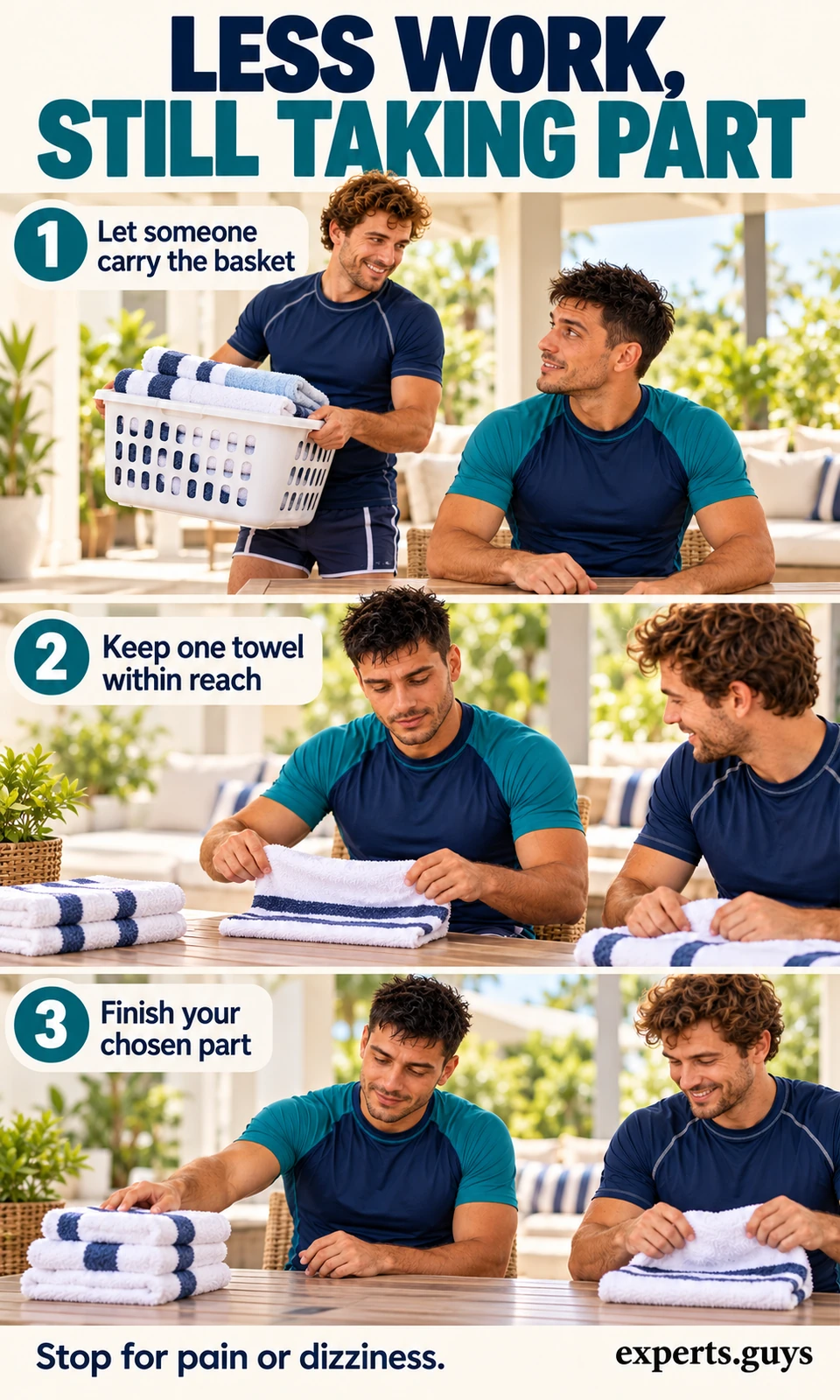
- Remove the demanding part: let the companion move the basket or handle the remaining towels. Keep just one light towel on the accessible work surface.
- Keep the contribution you chose: fold the small towel beside the companion, with assistance if needed. If shared participation is the intended practice, reducing the load does not automatically require moving to a separate room.
- Stop at the agreed endpoint: place your towel aside and notice whether the smaller amount was physically manageable. Include pain, dizziness, delayed fatigue or other effects rather than counting completion alone.
The number of towels is an example of reducing scope, not a recommended activity dose. Persistent fatigue may also relate to physical illness, sleep, medication or disability and should not automatically be explained by depression. New or significant symptoms need assessment, and a therapist can adapt the task around established health needs.
If the small amount is manageable but being beside the person remains difficult, that gives the conversation a clearer focus. It does not prove an anxiety disorder or mean you should push harder. Keeping the workload small can make it easier to discuss the social barrier without adding uncertainty about your ability.
Keep the task small when the social step changes
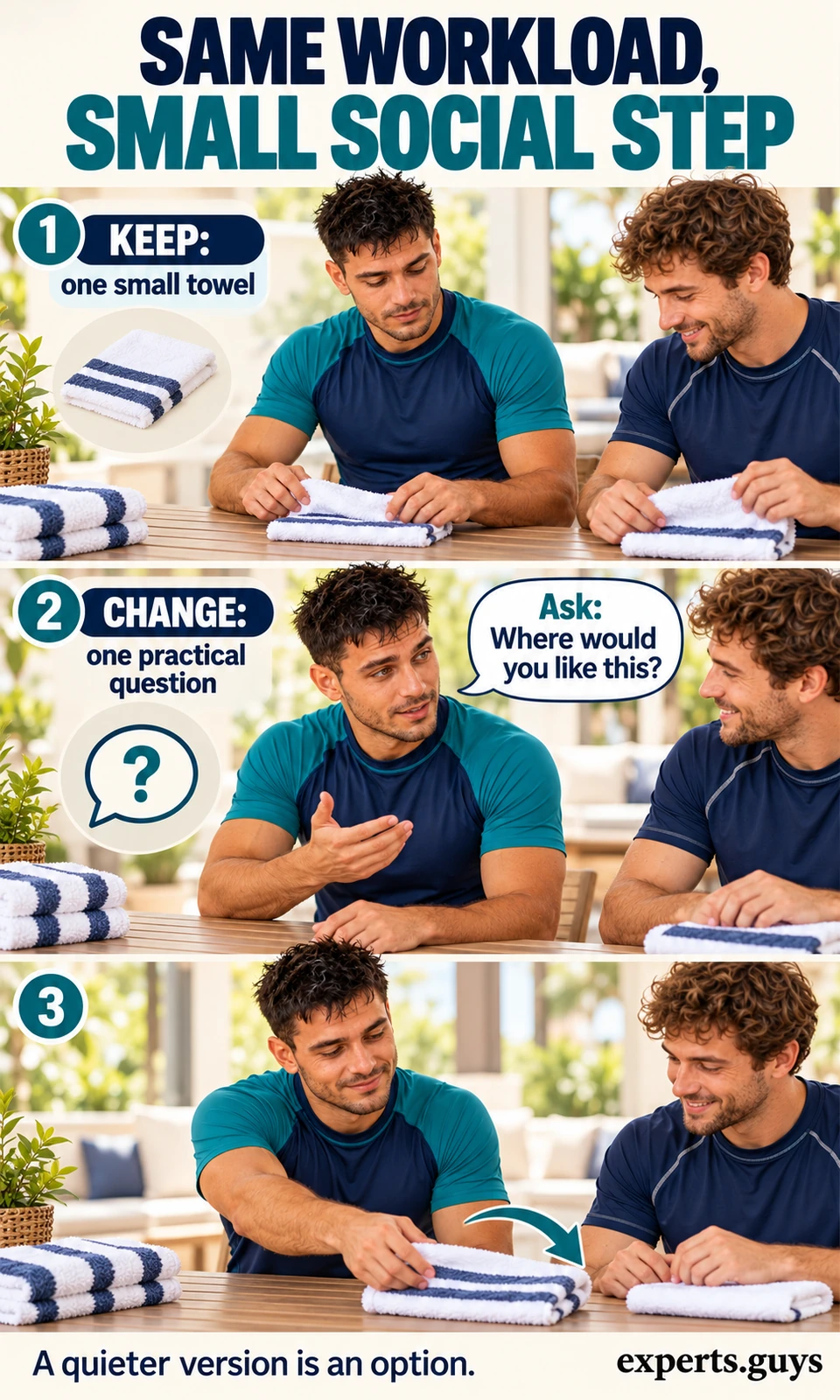
A quiet shared task and a task that includes speaking can involve different social demands. If fear of an ordinary interaction is relevant, discuss a small change within the same manageable activity. Do not increase the physical workload and the interaction at the same time merely to make the exercise more challenging.
- Keep the physical contribution the same: use one accessible towel rather than adding more work. Agree the interaction beforehand if you are practising as part of treatment.
- Choose one relevant interaction: for example, ask, “Where would you like this towel?” Then place it in the indicated spot within comfortable reach, or let the companion move it.
- Leave room for choice: a quieter version can remain appropriate when speaking is too demanding or inaccessible. Use your usual communication support if needed, and discuss a more suitable practice rather than forcing speech.
This is an ordinary social example, not a self-directed treatment protocol for trauma, OCD, severe panic or other complex difficulties. Guidance on behavioral experiments for social anxiety places manageable practice within a broader understanding of the problem. Your clinician can help decide whether this type of task fits your needs and the person you are with.
The larger CBT techniques and worksheets guide covers choosing among different exercises. Here, the useful skill is changing the workload and the interaction separately while keeping the purpose of participation. For this activity, one clear purpose is more useful than combining several tasks at once.
How does a physical action help CBT examine a prediction?
An action can provide information that a discussion alone cannot, but only about what actually occurred. If you fold a towel beside someone, you can observe what they say or do; you cannot directly inspect their private opinion. A single experience also cannot establish that all social situations are safe or that a feared outcome will never happen.
Make the prediction specific enough to observe
Before an agreed attempt, you might say, “I expect this person to criticize me for being slow.” During the manageable shared task, the relevant observation is whether they make a critical comment, continue their own work, offer help or do something else. A thought such as “They secretly think I am useless” cannot be tested merely by studying their expression.
The pictured example shows the companion continuing their own task without criticizing the pace. That is one possible result, not an expected response every reader should obtain. If the person actually criticizes or intimidates you, address that interaction rather than forcing a reassuring interpretation.
You can explain the prediction aloud before the activity and describe the result afterward. Neither a record nor a numerical anxiety score is required for this illustration; if your actual treatment uses particular measures, agree their role with the clinician. What matters is the connection between the original question and the purpose of the task.

Keep practical support and discuss what it does
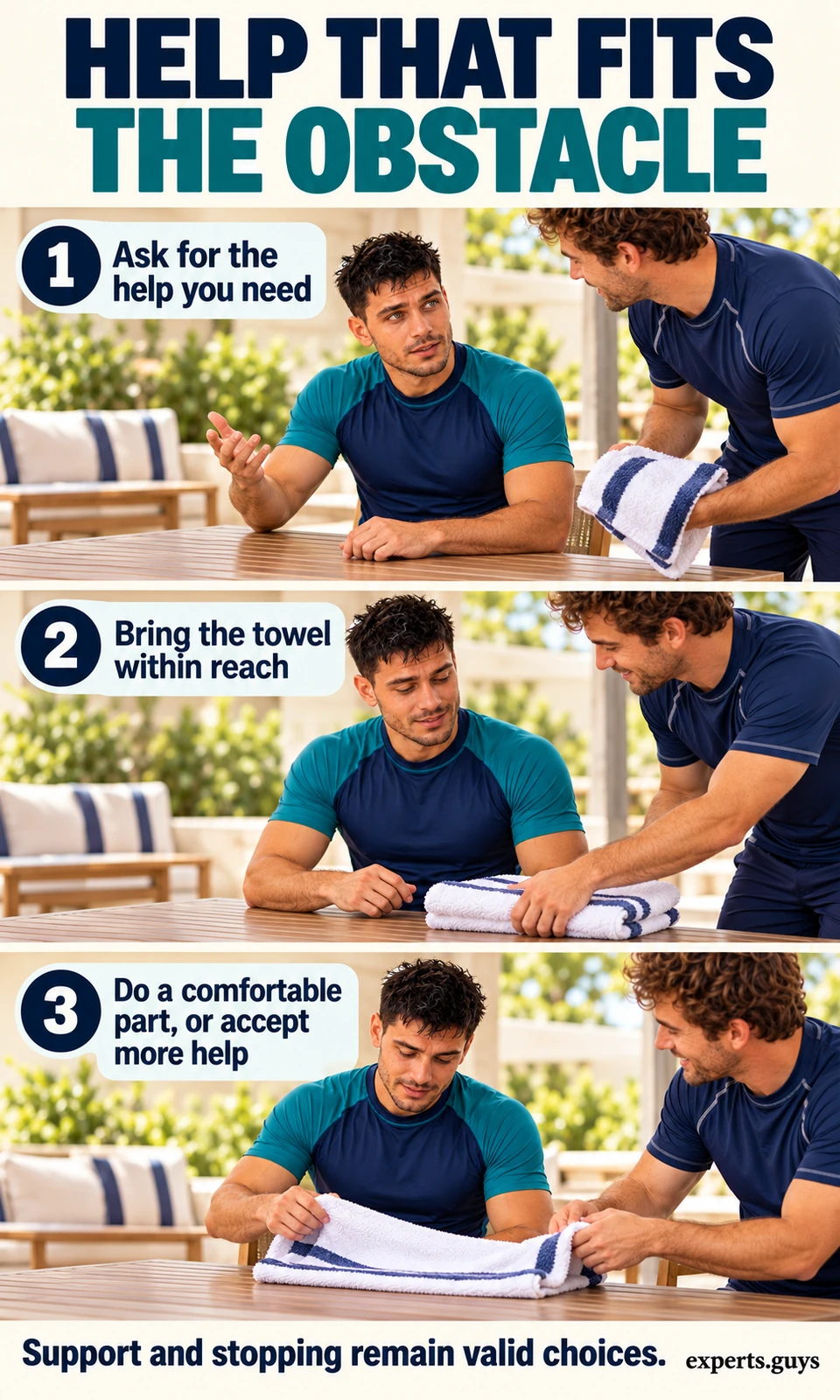
Help with carrying, reaching, communication or fatigue can make an activity accessible. It should not automatically be removed because the task includes learning about anxiety. Your need for assistance and your wish to take part are both relevant, and independence is not the measure of success.
For example, the companion can bring the towel close while you do a comfortable part of the fold. If even that part is unsuitable, you can accept more help or stop without turning the activity into a failed test. The useful discussion is which support makes your chosen participation possible.
Repeated reassurance intended to eliminate every doubt can have a different function from practical assistance. The distinction concerns why help is used; it cannot be determined just by looking at the person or object involved. CCI’s explanation of safety behaviors supports examining that function in the individual situation.
Keep actual safety precautions, accessibility aids and care arrangements. This household example does not justify reducing medication checks, mobility support, equipment precautions or protection from a real threat. If the difference between necessary support and reassurance is unclear, explore it in treatment before changing it.
What if you complete the action but still feel low or anxious?
Completing a practical action and feeling better are different outcomes. A person may take part while still feeling flat, tired or worried, and another person may feel calmer while remaining unable to manage ordinary activities. Neither pattern should be reduced to a single pass-or-fail verdict about CBT.
Look at the action, the cost and the feelings
For the example, the action is folding and setting aside a small towel with another person nearby. Its cost might include manageable effort, excessive exhaustion, pain or distress; the feelings might be unchanged or different. A useful spoken description is, “I did my part, still felt anxious, and needed help with the basket.”
That description supports a more informative review than either “I succeeded, so I must be well” or “I still felt anxious, so nothing counted.” Review the pattern across care discussions rather than repeatedly checking your mood throughout the task. You and the clinician can decide whether the next step is repetition, a useful adjustment, or a different approach.

Pause and resize when the attempt does not fit
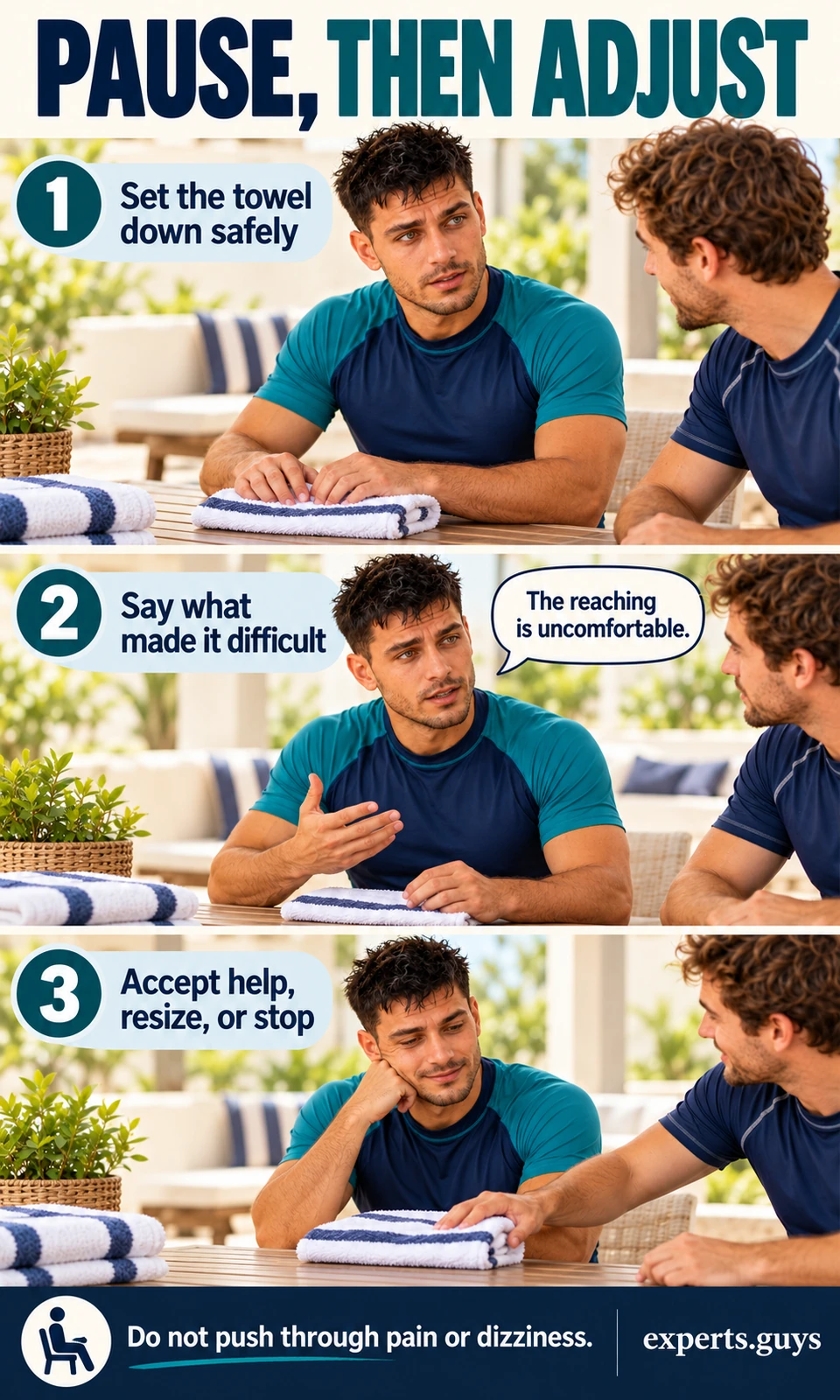
- Set the task down safely: rest the towel and your hands on the work surface instead of forcing more effort. Stop for pain, dizziness, significant worsening or an unsafe interaction.
- Explain the obstacle: “Reaching is painful,” “The amount is too much,” and “I am worried about being judged” point to different changes. You can use your normal communication method or simply ask to pause.
- Choose what happens next: bring the towel closer, let the companion do the demanding part, return to a quieter agreed version, or end the attempt. If this is treatment practice, tell the clinician what made it unsuitable before deciding to intensify it.
Adjustments should follow the obstacle rather than become a rule that the next attempt must be harder. For someone with fluctuating health, the appropriate amount can vary; a smaller contribution may still fit the purpose. Finishing safely can include accepting help or stopping when necessary.
| What you notice | A useful interpretation question | Possible discussion |
|---|---|---|
| The smaller workload helps, but fear remains | Which social prediction is still active? | Keep effort manageable while reviewing the feared interaction |
| The interaction feels easier, but exhaustion continues | Is the physical demand or another health issue still limiting? | Adapt activity and assess persistent symptoms |
| An attempt is completed with worsening afterward | Was the cost acceptable and sustainable? | Reduce, pause or reconsider the plan |
| The person behaves critically or coercively | Is this an actual relationship or safety problem? | Address the situation rather than treating it as imagined fear |
A full treatment review also considers symptoms, daily functioning, health and safety; one folded towel cannot determine treatment effectiveness. NIMH’s psychotherapy guidance supports discussing treatment goals and a plan that is not helping. If the approach remains unsuitable, the types of psychotherapy for depression comparison can help frame that conversation.
Frequently asked questions
Does CBT require me to replace every negative thought with a positive one?
No. CBT can examine whether an interpretation is accurate, what an action is doing and whether a different response would help. Real criticism, illness or unsafe circumstances need an appropriate response rather than forced optimism.
Do I need a companion to benefit from CBT?
No. The shared-task example is one way to explain interacting demands, not a requirement for treatment. If nobody safe and willing is available, discuss a relevant alternative or an appropriate rehearsal with your therapist instead of involving someone unsafe.
Is this activity meant to replace medication or a course of therapy?
No. It illustrates how a behavioral task can be adapted within an appropriate plan. Discuss medication questions with the prescriber and do not change a prescription based on how an activity went.
Does CBT only address anxiety about other people?
No. CBT can be adapted for different anxiety problems, and this example illustrates only one everyday social situation. Panic, OCD, trauma-related difficulties and generalized worry can require different assessment and treatment work.
How quickly should both depression and anxiety improve?
There is no timetable that applies to everyone. Ask how progress will be reviewed and how to raise worsening symptoms before the next scheduled appointment. Treatment should respond to your overall needs, not depend on completing a fixed number of household tasks.
Summary
When depression and anxiety overlap, CBT can help distinguish an activity’s effort from its feared consequences and adapt the work accordingly. Choose a useful action, keep it manageable, and pay attention to what actually happens without demanding an immediate change in mood. The next step should fit the barrier, your safety and your capacity to take part.