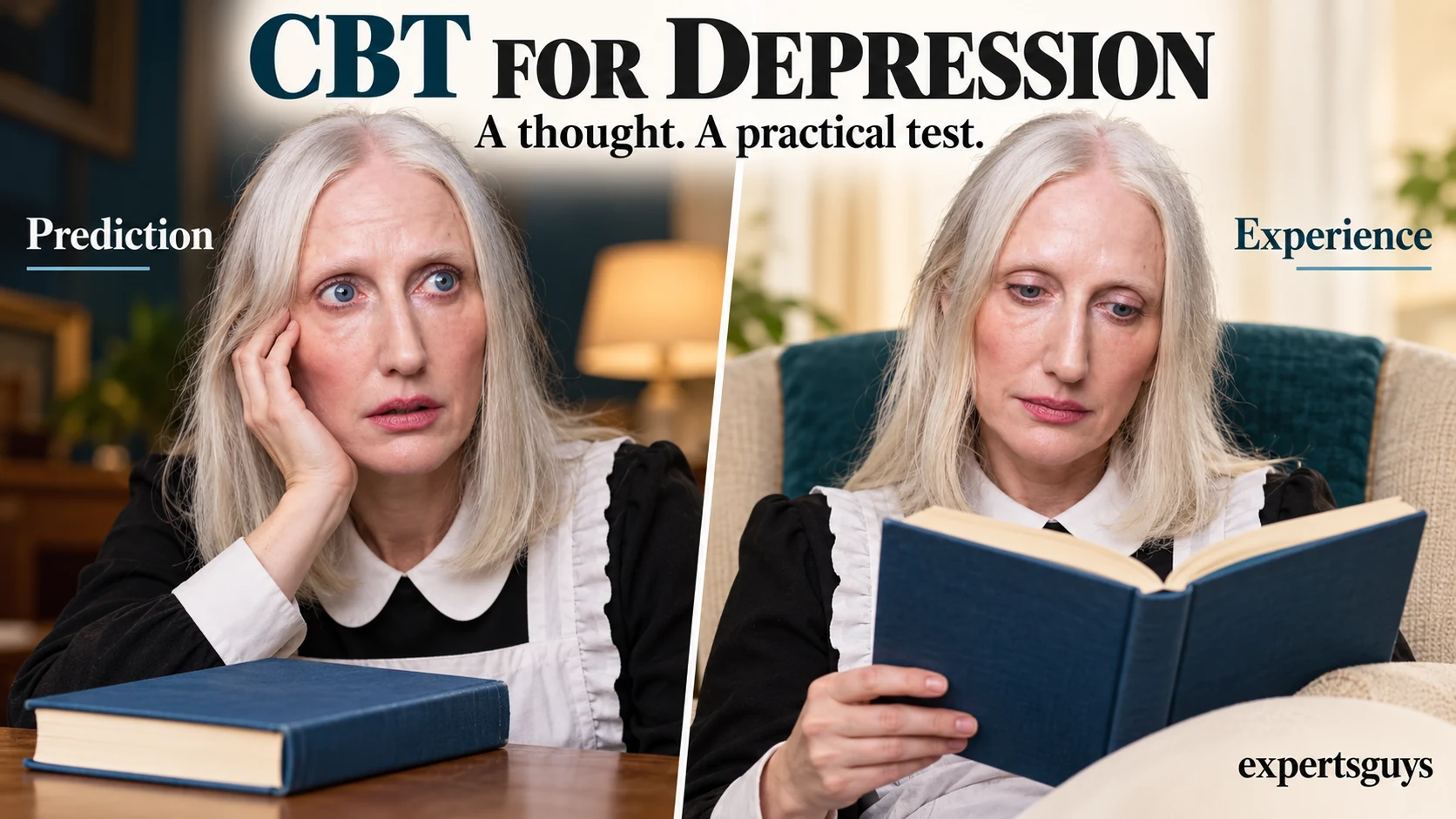
Cognitive behavioural therapy (CBT) for depression helps you examine how thoughts, emotions and actions affect one another, then practise different responses. A useful task connects to a difficulty in your life and is adjusted to what you can currently manage. It is not a demand to think positively or complete perfect homework.
The NHS describes CBT as a collaborative therapy that can include questioning unhelpful beliefs and changing avoided behaviour. Sessions may be individual, group-based or guided self-help. The approach and support should fit your needs.
This guide focuses on the gap between understanding CBT and being able to practise it when concentration or energy is limited. The worked example is returning to a familiar book: setting up a short attempt, reducing the demand when needed and interpreting the result fairly. It is an everyday illustration of CBT principles, not a validated concentration test or a stand-alone depression treatment.
You do not need a journal, phone, printer or timer for this example. If you already have a therapist, agree that the task fits your treatment. If you are choosing between therapies, the psychotherapy comparison explains the broader options.
| What you need to know | What it means in practice |
|---|---|
| What CBT works on | Specific patterns that maintain distress or make valued activities harder to approach. |
| What practice should do | Help you learn something relevant from a manageable experience. |
| What counts as completion here | An agreed attempt and stopping point, even if your mood does not improve. |
| What an unsuccessful attempt means | The task, support or care plan may need changing; it is not a verdict on you. |
What does CBT change beyond “thinking positively”?
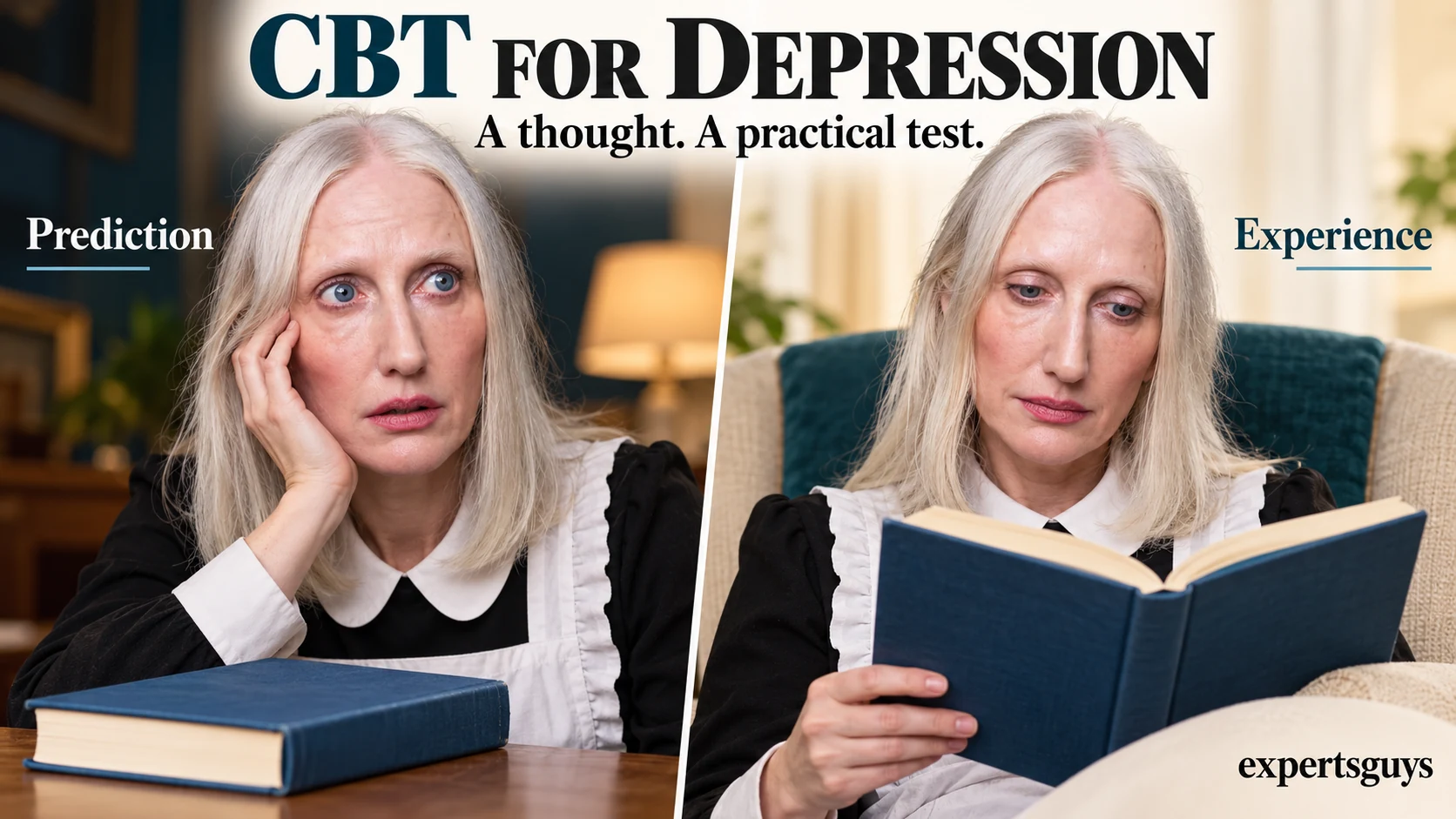
A thought can influence what you do without being the whole cause of depression. Imagine that reading has become difficult. “I will not take in anything, so there is no point opening the book” may lead you to avoid it completely. Avoidance then leaves you with little fresh experience to compare with that prediction. CBT can examine this pattern while taking the concentration problem seriously.
The Beck Institute’s description of CBT emphasizes collaboration, an evolving understanding of the person’s difficulties and action plans tailored to their goals. The therapist helps decide which part of a pattern is useful to work on. You are not expected to select the right technique from a long menu by yourself.
A behavioural experiment asks a specific question through an appropriate action. The Centre for Clinical Interventions explains how avoiding a situation can prevent a negative prediction from being tested. The aim is to learn from what happens, including mixed or difficult outcomes. It is not to arrange a guaranteed success or prove that every concern is mistaken.
An accurate difficulty needs an accurate response. If the print is inaccessible, the problem is not solved by arguing with yourself. If depression is affecting everyday functioning, a tiny task does not replace treatment. For a wider overview of approaches, see the CBT techniques guide; here, the specific job is making one practice task usable without losing its learning purpose.
How can you turn a CBT idea into a manageable real-world task?
Use the reading example only if reading is something you want to return to and the material is accessible to you. Choose familiar, low-stakes material rather than a contract, medicine instructions, traumatic content or urgent work. If reading was never meaningful to you, this example is a poor fit; a therapist can help choose a relevant activity instead.
Start with a small question: “With a manageable passage and the support I need, can I take in any part of this?” That question is narrower than “Can I concentrate normally?” You are exploring a starting point for practice, not measuring intelligence, diagnosing depression or deciding whether you deserve help.
- Choose something you actually want to resume: in this example, a familiar book already available to you.
- Open it to a short, ordinary passage. Agree on a stopping point, such as the end of a short paragraph; a single sentence is also a reasonable starting version.
- Say the question to yourself if helpful, then try the task. There is no requirement to write down the prediction.
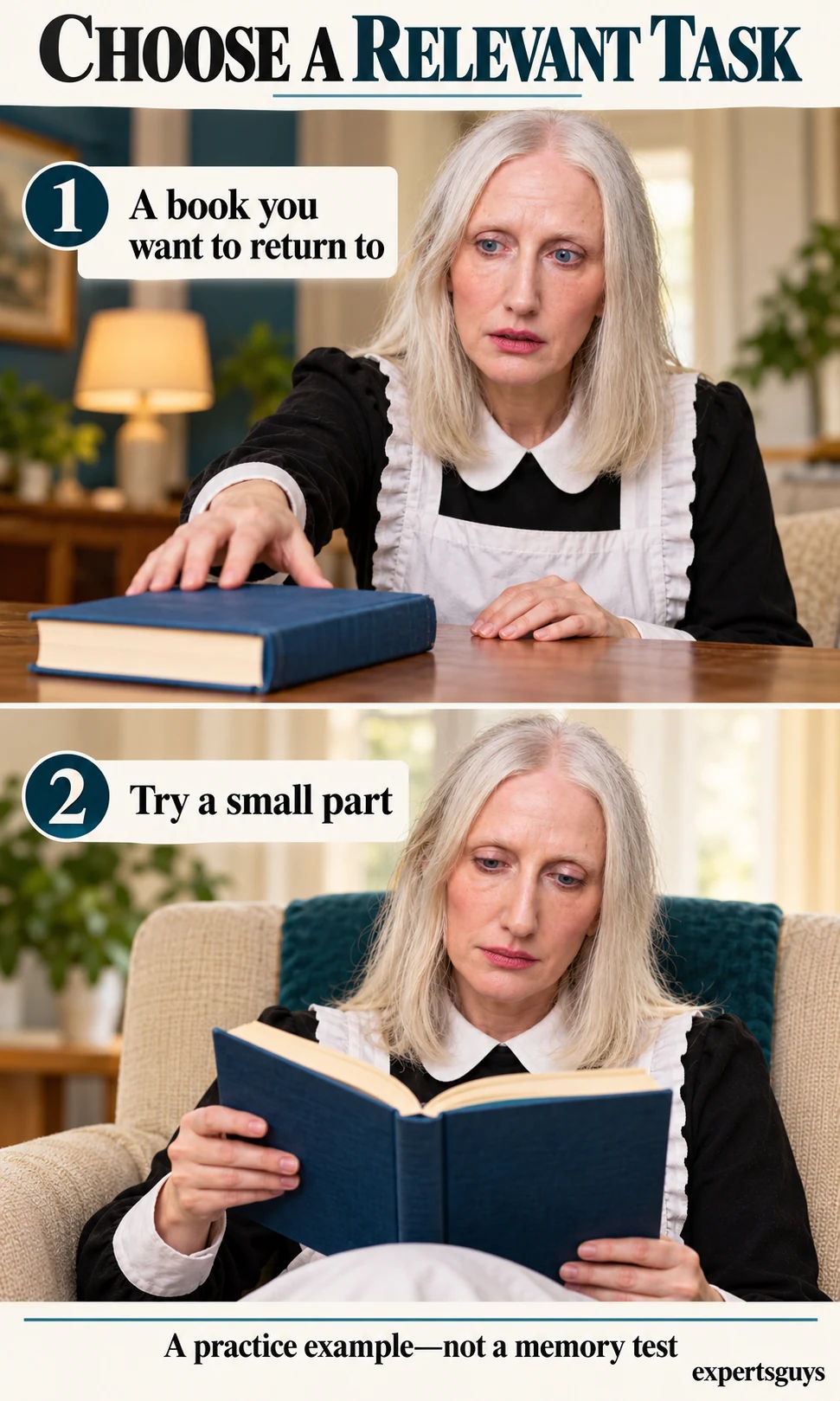
Set the book where you can read without straining to hold it. A comfortable chair, a table or a cushion on your lap may help, depending on your needs. Make sure the print is visible and the light is comfortable. These are access adjustments, not a prescribed posture or treatment technique.
If you normally use glasses, magnification or another reading aid, keep using it. Identify where the passage ends before beginning so “a small attempt” does not quietly become “finish the chapter.” You can start with the smaller version immediately rather than first proving that a larger one is too hard.

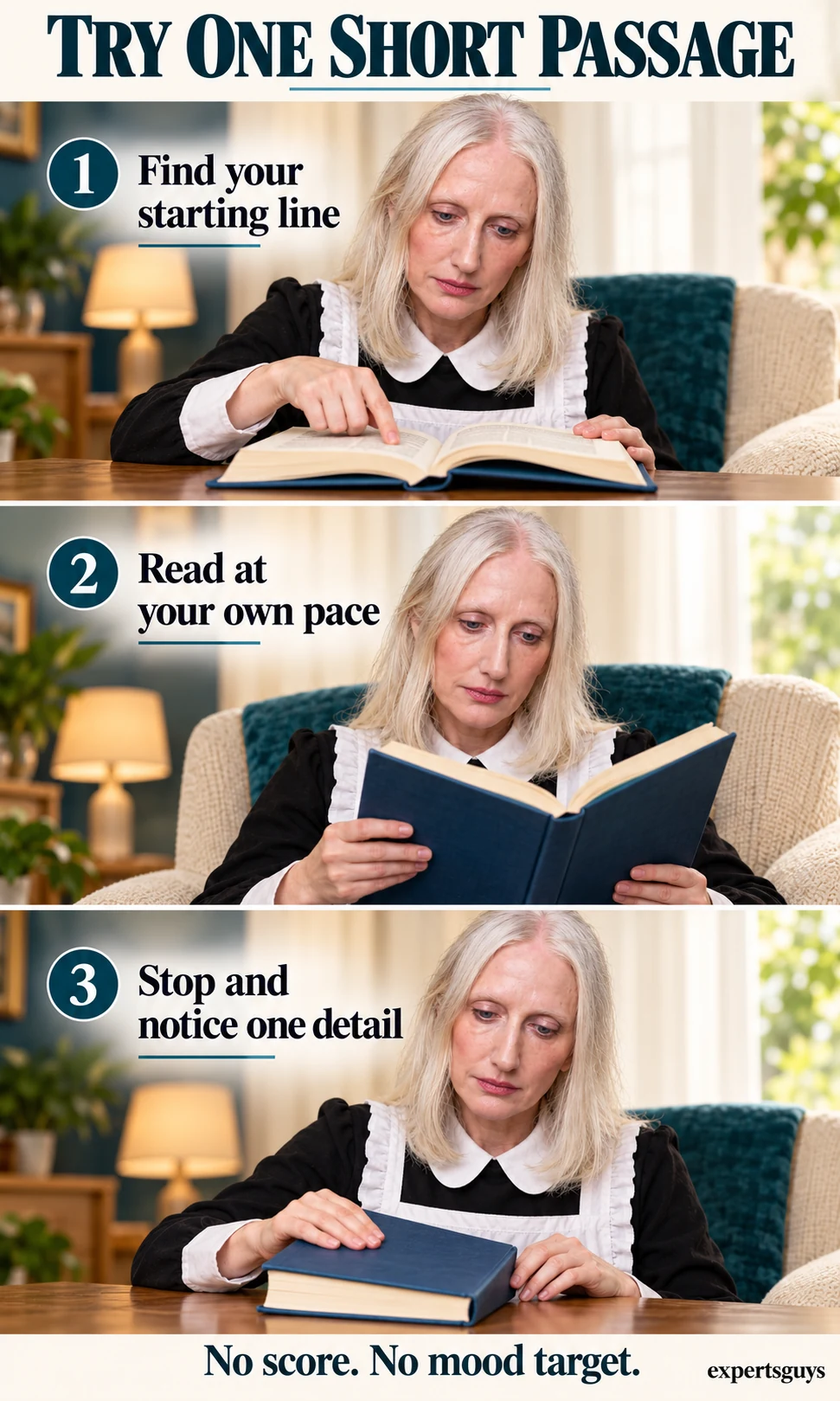
- Find the starting line and read the agreed passage at your own pace. You may follow the line with a fingertip if that helps and is comfortable.
- Stop at the agreed point, or earlier if the task becomes uncomfortable or distressing. Do not turn rereading into an endurance challenge.
- Notice whether any part made sense. You may name one detail to yourself, without a score or a written record. “I could not follow it today” is also a valid observation.
Completion means you attempted the agreed part and stopped appropriately. It does not require finishing a page, remembering every detail or feeling more cheerful. For example, understanding that a character entered a room is a specific observation; it is not evidence that all concentration difficulties have disappeared.
This differs from simply adding an activity to the day: the task has a learning question, and the conclusion stays tied to the actual conditions. For broader help with rebuilding activity and reducing avoidance, the behavioural activation guide develops that approach. You do not need to repeat its full activity programme here.
What if concentration or energy makes the practice too difficult?
Change the demand before you turn difficulty into self-criticism. A common trap is repeatedly starting a whole paragraph or chapter again, then concluding that nothing is possible. The larger repetition may be adding effort without answering the small question you began with.
The correction is to pause, choose one sentence and try that smaller unit when it feels manageable. Keep your place with a finger if useful; do not force a hand position or continue through pain. If even this is too much, close the book. The practical result can be recognizing that the current task needs more support.
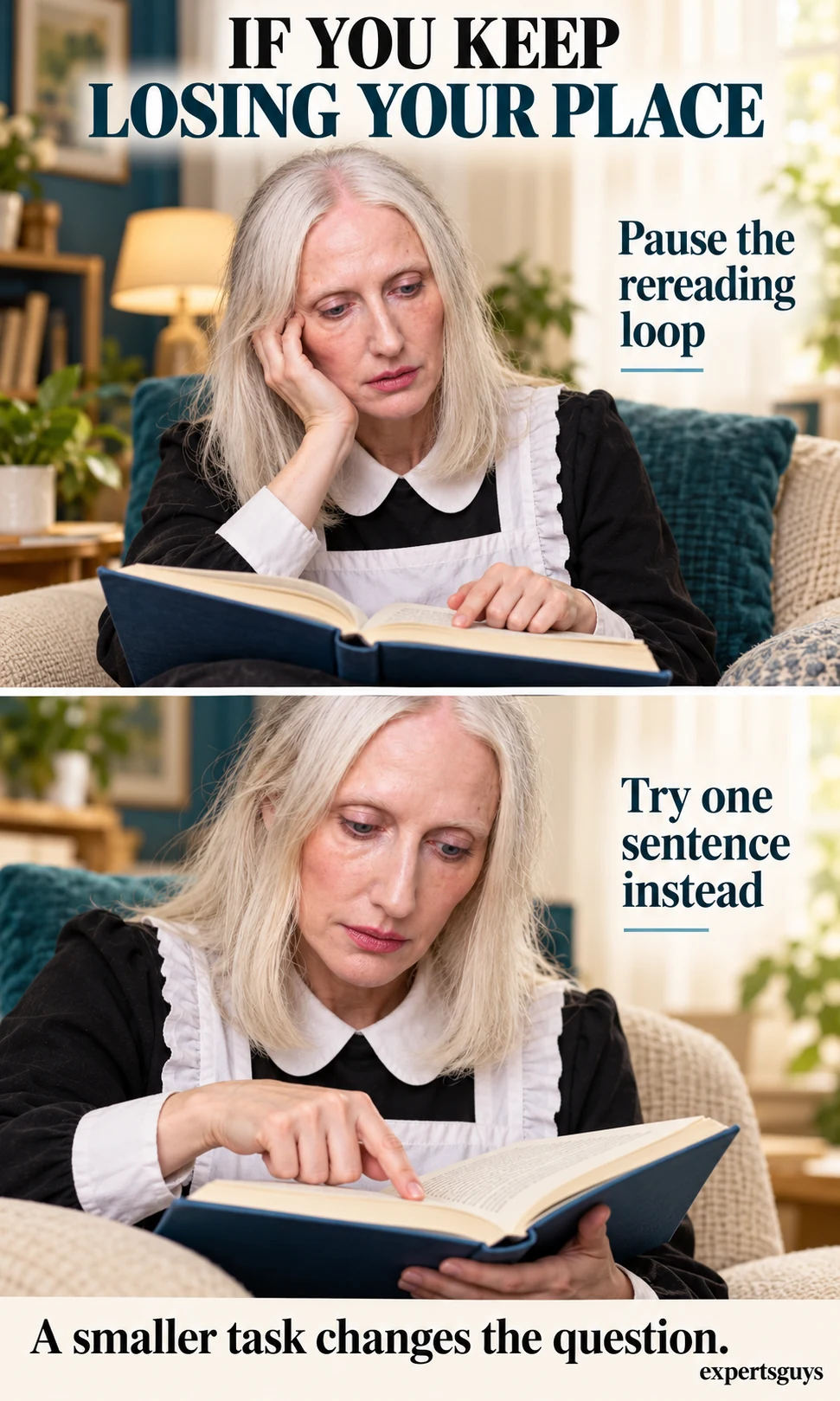
Reducing a paragraph to a sentence changes the task. Understanding the sentence does not prove you can now read a chapter, and struggling with the paragraph does not prove you cannot understand any text. Use the result to choose a realistic next version rather than making a global claim about your ability.
A supported version is possible if you want it and a trusted person is available. Sit where you can both see the passage. Ask them to read a short part aloud while you follow the words, then stop together. They should not quiz you, speed you up or insist on another attempt. Agree that you can pause at any point.
If nobody is available, you can keep the independent version smaller or leave the supported attempt for a therapy session. Accessible audio can serve an access need if it is already appropriate for you, but you do not need to buy equipment or install an app. Listening with support explores a different task from independent reading, so describe the result that way.

The book, shorter passage and shared reading are parts of one worked example, not three new treatments. They show how the question and the conditions must stay connected. Beck Institute guidance on action plans describes practice as something developed collaboratively for the person’s life outside sessions; an assignment that cannot be used deserves discussion.
CBT Practice Check
A4 PDF edition · v2.0.3
Find a manageable version of the reading example.
This is educational guidance for the example in this article, not a symptom assessment or treatment programme. If you cannot stay safe, seek emergency help now.
No account, health notes or tracking. This check does not save or send your selections. You can leave the screen and use the steps without recording anything.
Start with a relevant task
If returning to a familiar book matters to you, choose a short passage and a clear stopping point. Use your usual reading aids. The result is an attempt, not a mood target.
Use the steps without this check
Support the book and make the print visible. Try one short passage, then stop. If it is too demanding, try one sentence or ask for supported reading if wanted. Notice what happened without a score. An unworkable task belongs in the care conversation; worsening symptoms need a care review.
What can the result tell you—and when should the plan change?
Keep the interpretation as small as the observation. One attempt can show that a particular version was workable today or that it remained too demanding. It cannot establish the cause of a concentration problem, predict recovery or prove that CBT as a whole will or will not help.
| What happened | A proportionate interpretation | Next step |
|---|---|---|
| You understood a detail from a short passage. | Some engagement was possible under these conditions. | Keep a manageable version; discuss any increase in demand rather than assuming you must read more immediately. |
| You followed the passage only when someone read aloud. | Shared reading was more accessible in this attempt. | Keep the support if useful; do not describe this as independent reading. |
| You could not follow the passage. | The current version did not work today. | Stop and discuss a different demand, access adjustment or task with your therapist. |
| Function or distress is worsening. | The care plan needs attention beyond this exercise. | Contact your treating professional promptly; use urgent care when safety is at risk. |
A more accurate conclusion might be “I followed one sentence with the book supported” rather than “I am fine now.” Or it might be “This remained too hard, so we need to change the plan” rather than “I failed therapy.” The wording matters because it preserves both the genuine difficulty and the possibility of an appropriate adjustment.

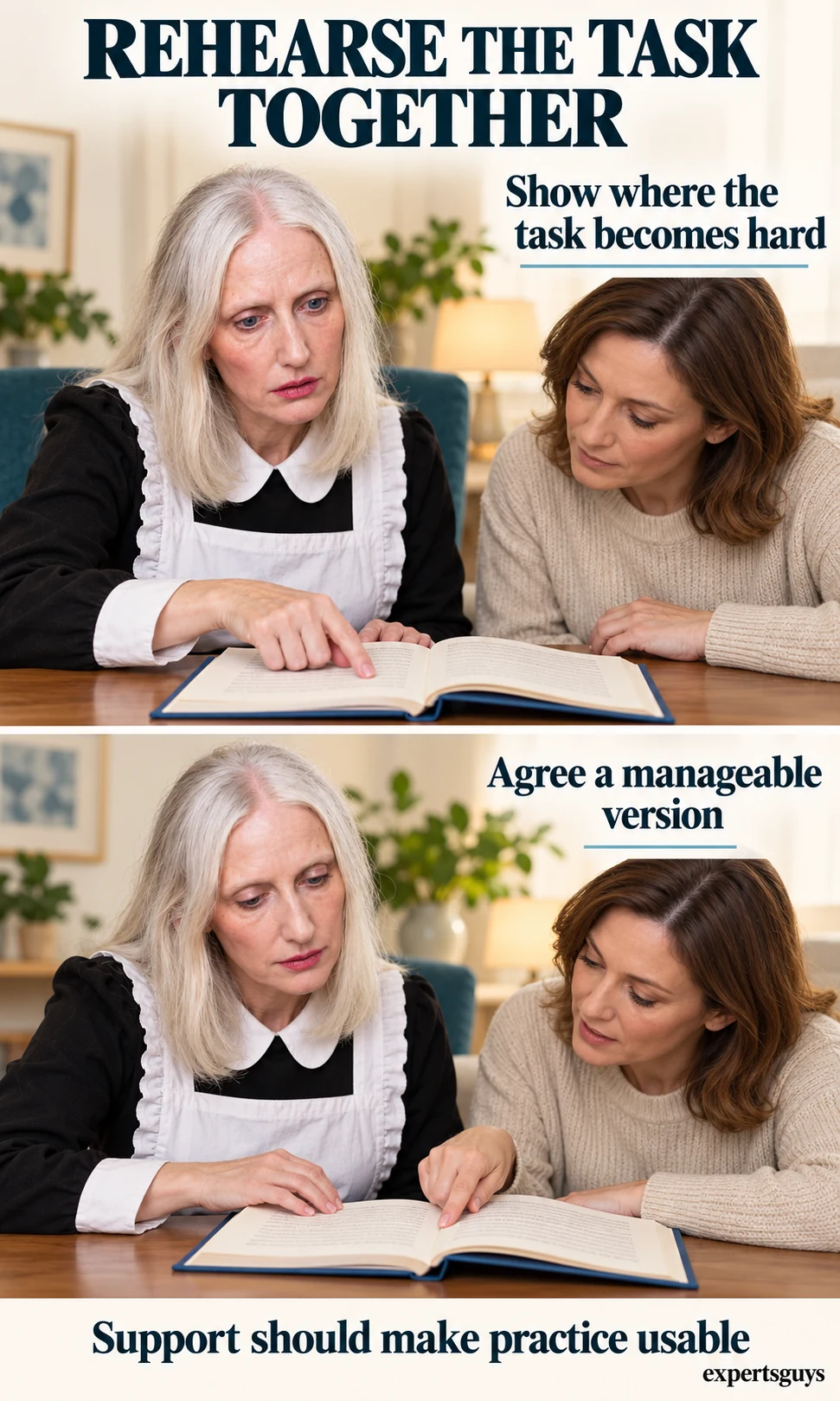
If you are in CBT, bring the difficulty into the session as an actual example. You can show where you lost the thread and ask to rehearse a manageable version together. The therapist may change the task, clarify its purpose or choose a different approach. You do not have to complete a log before asking for help.
- Show or describe the point where the task became difficult.
- Ask what the task is intended to help you learn.
- Rehearse the smaller or supported version together if appropriate.
- Agree when to review it and how to seek help if your condition worsens.
If remembering the example is hard, bringing the book is optional; saying “I could not follow the passage” is enough to start the conversation. A session should not become a test of whether you can produce a perfect account. Ask for an explanation or demonstration in a format you can use.
Depression can involve difficulty concentrating, remembering or making decisions, but these problems can have other explanations. The NIMH depression overview describes assessment and treatment based on individual needs. New, persistent or worsening cognitive difficulties deserve clinical attention rather than repeated home testing. The cognitive slowing guide explains that symptom question in more detail.
If CBT is not helping, discuss the fit, goals and support with your treating professional. Depression care may include psychotherapy, medication or a combination, depending on the person. Do not stop prescribed treatment because of the result of this example. The NIMH psychotherapy guide explains why treatment progress and concerns belong in an ongoing conversation.
Get urgent help when safety is at risk. If you may act on thoughts of harming yourself, cannot stay safe or develop sudden severe confusion, contact local emergency services or go to an emergency department. Do not delay care to finish the exercise. For worsening symptoms without immediate danger, contact your treating clinician promptly.
Frequently asked questions
Do I have to write down my thoughts for CBT?
No single recording format suits everyone. Some therapists use written tasks, but practice can also involve discussion, rehearsal and real-world activity. If writing is a barrier, ask how to preserve the learning purpose in a format you can use. The reading example here requires no record.
Does the exercise count if I still feel depressed afterward?
Yes, an agreed attempt can be completed without an immediate mood change. Notice what you could do and what support was needed. That observation is useful for adjusting practice, but it is not a measure of recovery.
What if I know my negative thought is true?
CBT does not require denying real hardship. A therapist can help separate the established difficulty from broader conclusions and decide whether practical support, a different response or another treatment focus is needed. Do not use an experiment to expose yourself to danger or invalidate an accurate concern.
Is reading a treatment for depression?
The example illustrates how a CBT task can be made manageable and interpreted carefully. Reading one passage has not been presented here as a treatment programme, a cognitive test or a substitute for care. The activity should fit your interests and treatment goals.
How long should I keep trying a task that does not work?
There is no required number of attempts in this example. Stop if it becomes painful, distressing or repeatedly unworkable. Discuss the obstacle and whether to change the task or support. Worsening symptoms require a care review, not more persistence with the exercise.
Summary
Useful CBT practice links a specific difficulty to a manageable action and a fair interpretation. In this example, that means setting up a short reading attempt, reducing the demand or adding support when needed, and stopping without turning the result into a judgment about yourself. Bring an unworkable task back into the care conversation; adapting practice is part of making it useful.