Dysthymia is the older name commonly used for persistent depressive disorder (PDD), a long-lasting depressive condition. “Chronic” describes its course, not a verdict that you cannot improve. The useful next step is to understand what treatment should change in your life and how you will recognise whether it is helping.
What does dysthymia mean, and is it always mild?
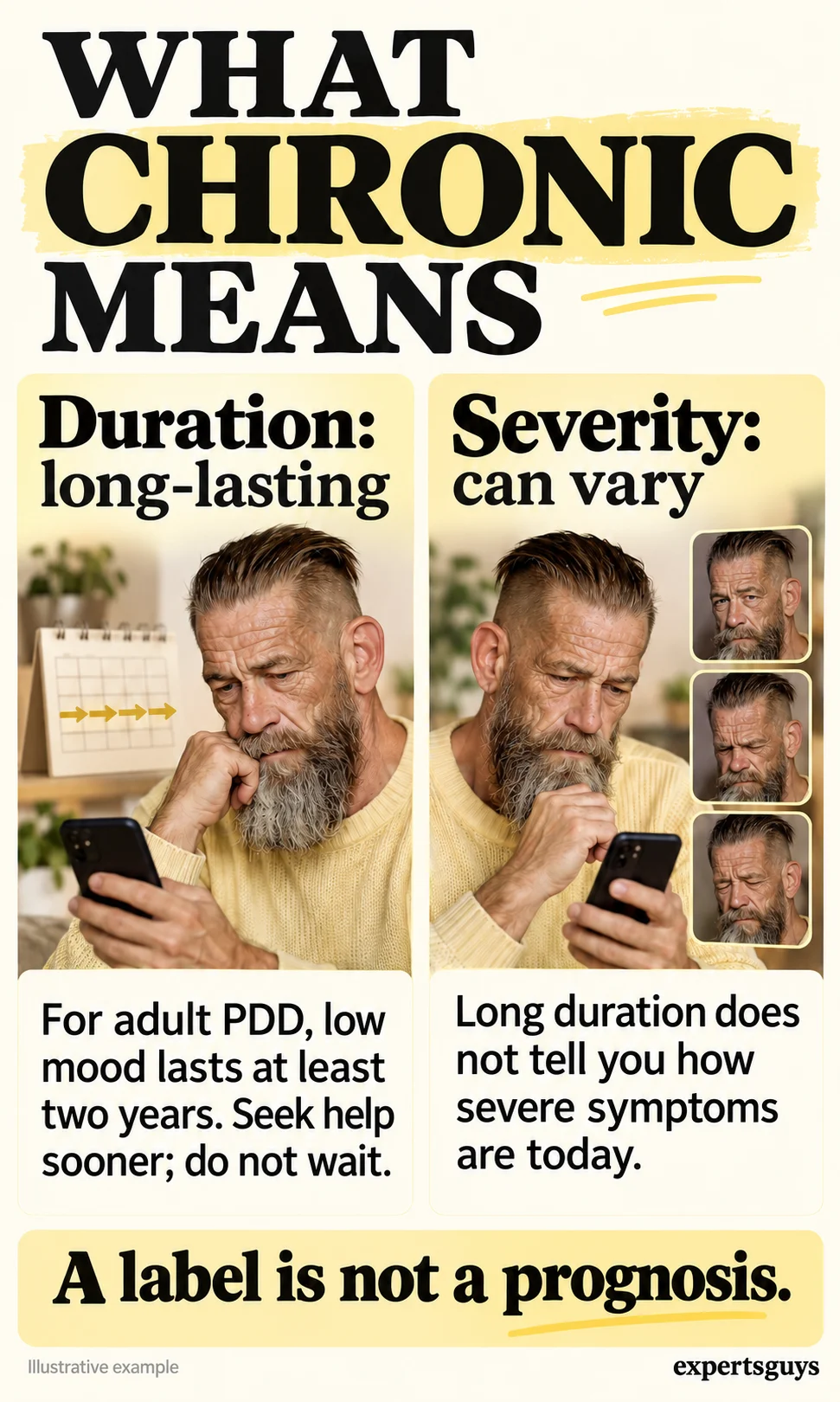
Persistent depressive disorder involves a sustained pattern of depressed mood, with other symptoms such as low energy, altered sleep or appetite, low self-esteem, poor concentration or hopelessness. In adults, the characteristic duration is at least two years; in children and adolescents it is at least one year, and irritability may replace depressed mood. These are assessment criteria, not a waiting period before you can receive help.
The word chronic does not tell you how severe today feels. A persistent condition can coexist with periods of greater depressive severity, and continuing to work does not prove that symptoms are mild. The practical question is how much distress, lost enjoyment and difficulty the person is experiencing now.
A diagnosis also requires the wider clinical picture. Physical illness, medicines, substance use and a history of elevated or unusually irritable mood can change the assessment. For the fuller diagnostic framework, see persistent depressive disorder DSM criteria; this article concentrates on treatment expectations and follow-through.
| Term | What it tells you | What it does not tell you |
|---|---|---|
| Dysthymia / PDD | A persistent depressive pattern is being considered or described. | The right treatment for a particular person. |
| Chronic depression | Depressive symptoms have continued over a long period. | That recovery is impossible or symptoms are always mild. |
| Partial improvement | Some difficulties have eased while others remain. | That treatment is finished or should be abandoned. |
| Recent worsening | The current situation has changed. | That the change can safely wait because depression is longstanding. |
There is no single proven cause that explains every case of PDD. Depression can reflect interacting biological, psychological and environmental influences, rather than a personal weakness or a simple shortage of one chemical. Treatment therefore needs to fit the person and the problems maintaining their difficulty, not just the diagnostic word.
Long duration can make change harder to notice because the comparison point is often another difficult week. A useful treatment conversation separates symptom relief, everyday functioning and quality of life. That distinction prevents “I still feel low” from hiding an improvement worth keeping, or “I am doing more” from hiding distress that still needs attention.
How can you choose a useful treatment direction?
Talking therapy, medication or a combination may be considered after assessment. Preferences, previous response, symptom severity, other health conditions and practical access all matter. No image, symptom list or webpage can select the right prescription or establish which approach will work for you.
For chronic depressive symptoms, evidence supports several psychological and medication approaches, but it does not establish one universally best combination. The NICE explanation of chronic-depression treatment evidence describes limitations in the research, including combination-treatment evidence. The methods below are practical communication aids adapted for this article, not seven independent treatments or a validated recovery programme.
Choose one daily-life treatment target
Use this when “I want to feel better” is true but too broad to guide a review. Pick one difficulty you would genuinely value changing, then agree with your clinician whether it is a suitable early target. A target gives the conversation a shared reference without making you responsible for curing yourself through effort.
- Open a private phone note, or use voice dictation if typing is tiring; first consider whether your device syncs notes to an account other people can access.
- Name one difficulty in ordinary language, such as “I withdraw even when I want company.”
- Add one possible useful change: “I would like to join one short conversation without feeling I must perform.”
- Discuss whether that change fits the treatment and what an easier starting point could be.
The conversation example is illustrative, not a target everyone should meet. A common mistake is choosing a productivity demand imposed by someone else; replace it with a change you value and can discuss honestly. If even a short conversation is too much, the first target might simply be telling the clinician that social contact feels overwhelming, with no activity quota attached.

Check the fit before committing to a course
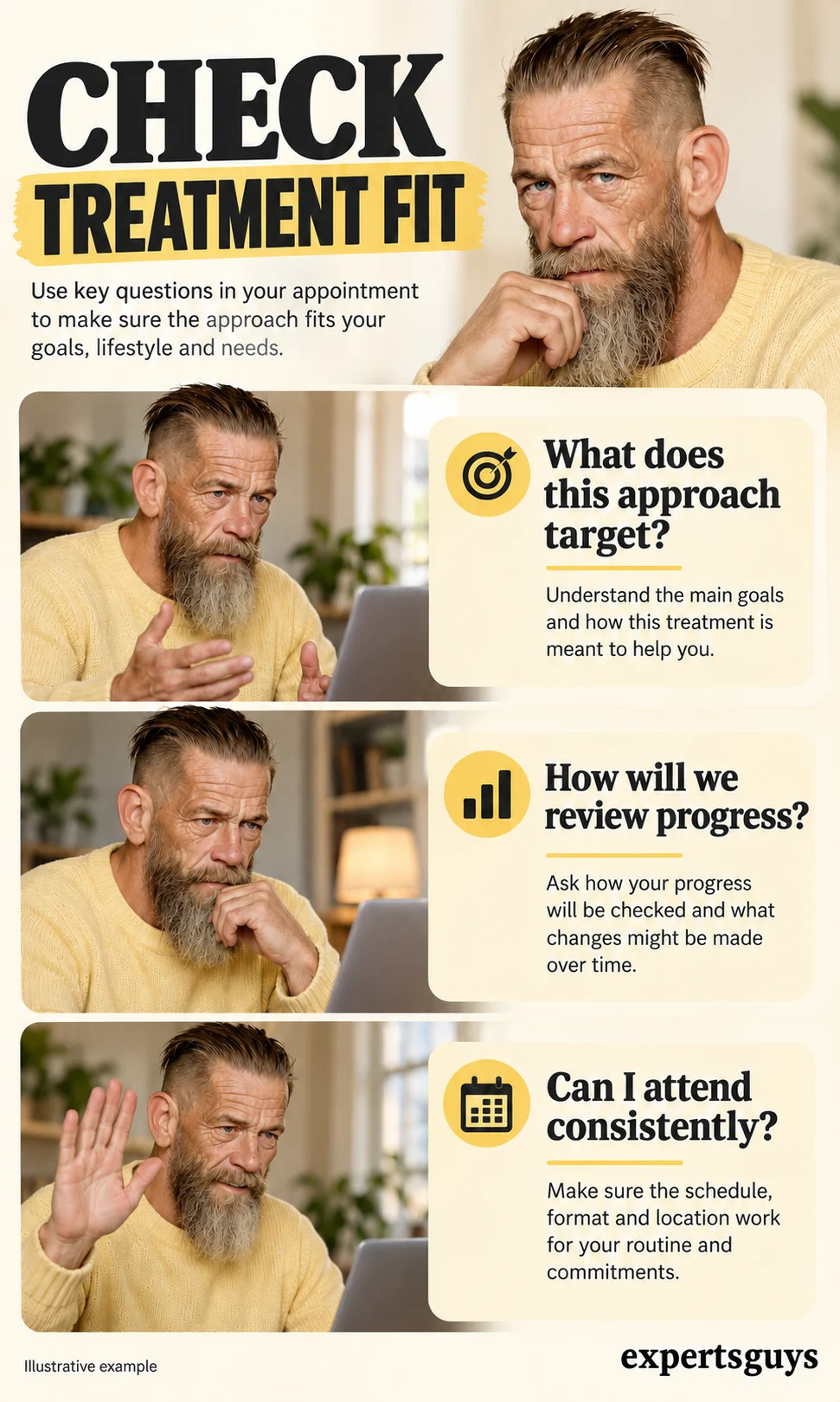
Use a brief introductory conversation to understand the proposed approach and whether you can realistically attend. Ask what it targets, how progress will be reviewed and how sessions or between-session practice will work. NIMH’s psychotherapy guidance also highlights trust, qualifications and a clear discussion of goals.
- Ask: “Which part of my difficulty is this approach intended to help?”
- Ask: “How will we decide whether it is helping, and what happens if it is not?”
- Check appointment format, cost, privacy, language access and the provider’s relevant qualifications.
- State one constraint before agreeing: for example, shift work or no private room for video sessions.
For example, an otherwise suitable weekly video appointment may be impractical if you share a room and cannot speak freely. Ask about another time, format or service rather than promising attendance you cannot maintain. The checkpoint is a plan you understand and can access; a friendly first conversation alone does not establish effectiveness, and feeling unable to ask questions is worth raising.
What should you do when progress is partial or stalled?
A review should distinguish what changed, what remains difficult and what prevented the plan from being carried out. These are different problems and may require different responses. A disappointing week cannot by itself prove a treatment has failed, but a long history is not a reason to tolerate worsening indefinitely.
Compare change in two directions
Use this at the agreed review instead of judging everything by today’s mood. In a phone note, make two short lines: “easier than before” and “still difficult,” using the same daily-life target you discussed earlier. This is an editorial comparison aid rather than a symptom scale, diagnostic test or measure of remission.
- Recall one concrete example from before treatment or the last review; if you cannot remember, say that rather than inventing a baseline.
- Describe one recent comparable situation and whether it was easier, unchanged or harder.
- Add what remains difficult, even if another part improved.
- Bring both observations to the agreed review; seek advice earlier for deterioration or concerning effects.
An illustrative example is: “Starting dinner takes less effort, but I still get little enjoyment from eating with my family.” Avoid converting that observation into a percentage recovered or treating it as proof that the treatment caused the change. If recall is poor, compare a single recent example with your clinician and agree what to notice next, rather than starting an exhausting daily tracking routine.

Remove an access barrier before blaming yourself
Use this when sessions, practice or follow-up repeatedly do not happen. Identify the point where the plan breaks down, then ask for one feasible adjustment. Solving an access problem allows treatment to take place; it is not evidence that the underlying depression is solved.
- Name the specific obstacle: travel, appointment cost, timing, privacy, language or instructions that feel too complicated.
- Ask the service about one alternative, such as a different appointment time, simpler instructions or remote care when suitable and available.
- Confirm the next appointment or agreed action in your phone calendar, including how to contact the service if the arrangement fails.
For example, “The bus journey means I miss sessions; is a remote review suitable?” is more actionable than “I am bad at therapy.” Do not assume remote care is always available or appropriate, and do not treat a scheduling problem as a reason to stop prescribed treatment. If organising the request is overwhelming, ask a trusted person to help make the call with your permission; success means a workable next step, not perfect attendance forever.

Make a treatment-concern message specific
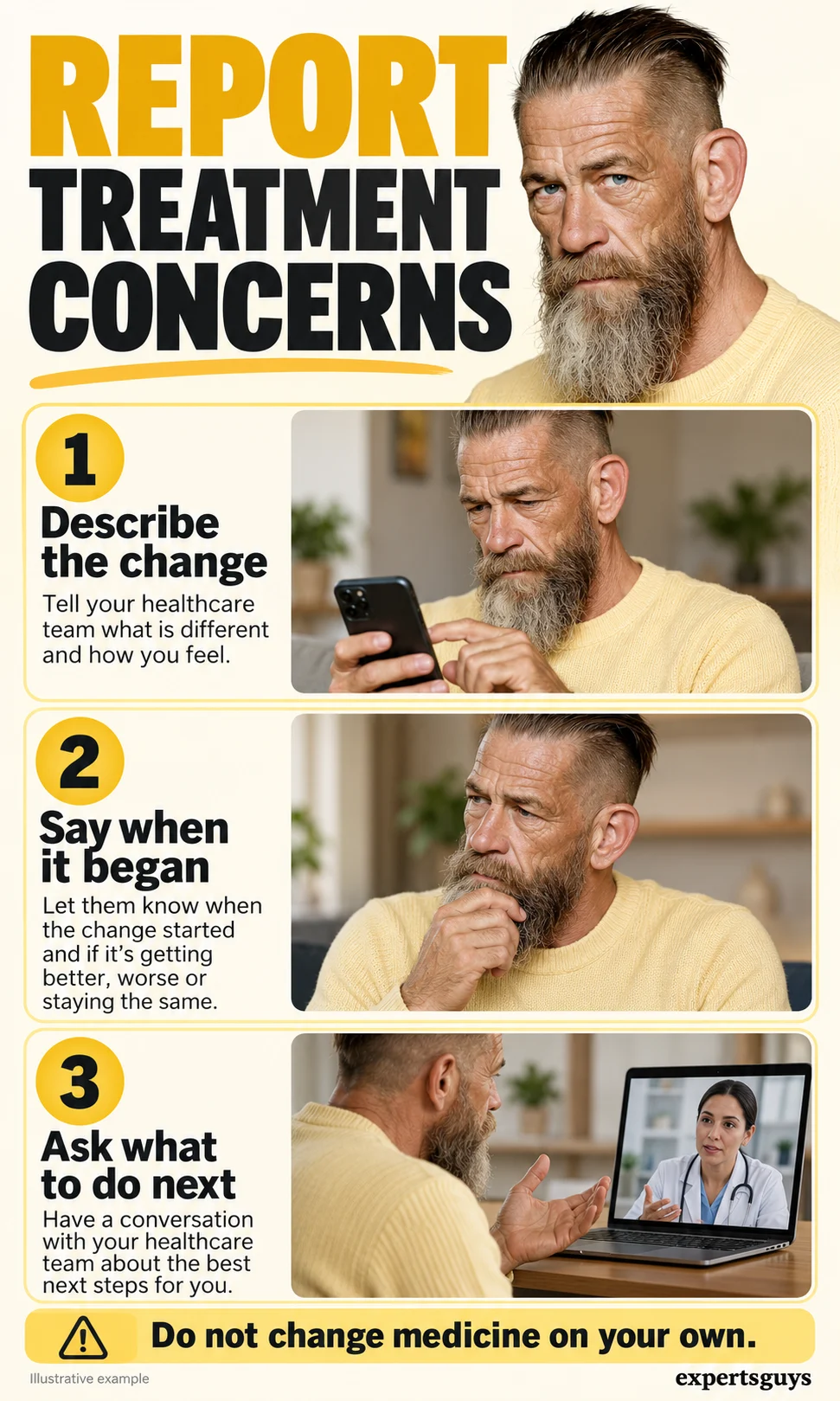
Use this when a new symptom, unwanted effect or confusing instruction makes you unsure how to continue. Describe the change, when it began and its impact, then ask your prescriber or treatment team what to do next. A clear message helps them assess the concern without you deciding on your own whether it is a medicine effect, the condition or something else.
- Use the service’s agreed contact route and say what changed in plain language.
- Include when it started and any relevant treatment change, without asserting that one caused the other.
- Explain the practical impact and ask how soon the concern needs review.
- Follow the agreed instructions; do not start, stop, skip or change doses based on this article.
For example: “Since the recent change I have felt much sleepier and cannot safely concentrate at work; what should I do today?” Do not drive or operate machinery when impaired, and do not rely on an unmonitored inbox for urgent problems. If the concern is severe, rapidly worsening or involves safety, use urgent care rather than waiting for a routine reply; for non-urgent concerns, ask the service what response time to expect.
Antidepressants commonly take several weeks to show their full effect, and some symptoms may improve before mood does. The NIMH medication overview explains why response and unwanted effects need monitoring, including when treatment begins or changes. A review timetable should come from your prescriber, with earlier contact for concerns rather than an instruction to endure them until a fixed date.
| What you notice | What to bring to the review | Useful question |
|---|---|---|
| Some improvement, but important symptoms remain | One easier task and one continuing difficulty. | What should we keep, and what still needs attention? |
| Little change despite following the plan | What treatment you actually received and for how long. | Should we reconsider the approach or reassess other contributors? |
| Missed care because of practical obstacles | The specific point of failure. | What adjustment would make this plan accessible? |
| New or worsening concerns | The change, timing and effect on daily life. | How urgently should this be assessed? |
How can support and follow-up make recovery more manageable?
Support is more usable when people know what is being asked of them. Follow-up is more usable when you know when it happens and how to request help sooner. These arrangements support professional care while leaving room for preferences, changing needs and days when you have less capacity.
Turn general support into one agreed action
Use this when someone says “let me know if you need anything” but you cannot turn that offer into help. Choose one manageable request and make it easy for the other person to accept, decline or suggest another time. A concrete request reduces guesswork without making that person responsible for monitoring or treating you.
- Choose a person you trust and a form of contact that feels comfortable.
- Send or say one bounded request: “Could you join me for a short walk this weekend?”
- Agree what works for both of you, with an easier alternative such as a short phone call.
- Afterward, consider whether the contact felt supportive; adjust the request rather than forcing the same activity.
A short walk is an example, not an exercise prescription or a requirement to feel cheerful. If walking is inaccessible, ask for a seated visit, help arranging transport or company during an administrative task. A common mistake is assuming a delayed reply means rejection; avoid turning that uncertainty into a conclusion about your worth, and use another support route if the person is unavailable.

Keep a review route when you start feeling better
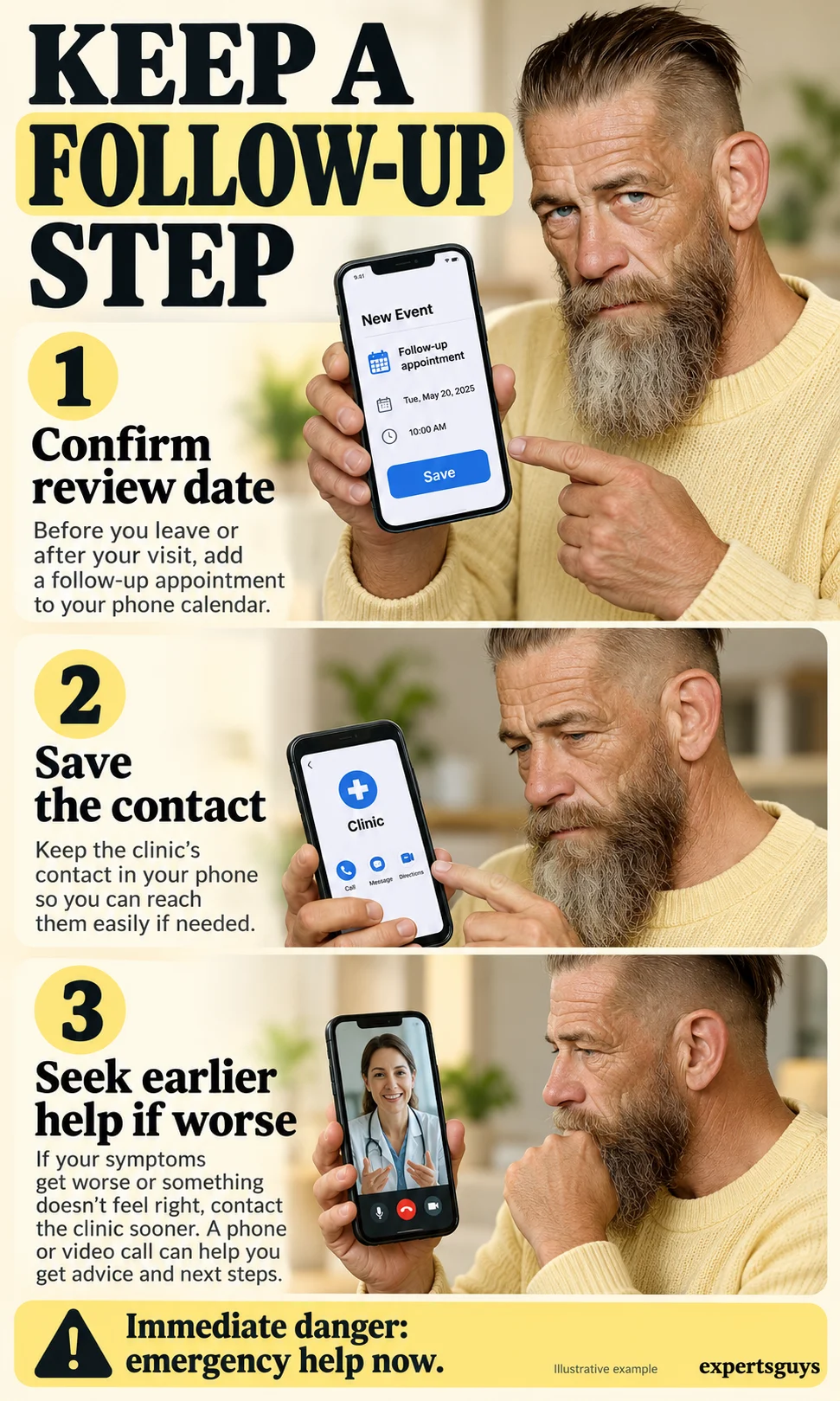
Use this before leaving a treatment appointment, especially when some improvement makes follow-up feel less important. Confirm the next review date, save the appropriate contact and ask what changes should bring the review forward. The aim is continuity, not an expectation that you must constantly watch yourself for danger.
- Put the agreed review date in your phone calendar; use a neutral event title if privacy matters.
- Save the service’s contact and check when it is monitored.
- Ask what to do if symptoms worsen, treatment becomes difficult to follow or unwanted effects appear.
- Keep the plan accessible; if you feel well enough to reduce treatment, discuss that decision rather than making medication changes alone.
For example, save “health review” rather than a diagnosis on a calendar that appears on a shared screen. If reminders increase anxiety, use one appointment reminder or ask a trusted person for a consensual reminder instead. The arrangement is working when you know your next contact and how to seek earlier advice; it cannot replace emergency help when immediate safety is at risk.
You do not need to complete all seven approaches at once. Choose the one matching the current sticking point: an unclear goal, uncertain treatment fit, mixed progress, an access obstacle, a treatment concern, limited support or missing follow-up. If recognising the long-term pattern is still your main concern, the separate dysthymia signs and mood-history guide covers that earlier step.
Questions about chronic depression and recovery
Does a better day mean the diagnosis was wrong?
A better day does not by itself settle whether a persistent depressive disorder is present. Clinicians assess the longer course and the wider history, including periods of improvement. Enjoy the better day without using it to invalidate difficulties that still need care.
Is “high-functioning depression” a separate diagnosis?
It is an informal description, not a standalone formal diagnosis. It may describe someone who maintains visible responsibilities while experiencing substantial difficulty. Tell your clinician about distress and life outside work as well as what you can still accomplish.
Does one disappointing treatment mean nothing will work?
No single disappointing experience establishes that every treatment will fail. The next review can examine whether the approach fitted the problem, whether access was adequate and whether other contributors need assessment. Avoid promising yourself a particular outcome, but keep the discussion open to a different plan.
Can I use these steps for a child or teenager?
The treatment-review examples here are written for adults. Children and teenagers need assessment and care appropriate to their age, with family involvement and privacy handled carefully. An adult’s medication plan or follow-up schedule should not be transferred to a younger person.
A useful next step
Dysthymia describes a persistent depressive pattern, but it does not tell the whole story of severity, treatment or recovery. Choose one current treatment question and one example that explains why it matters to you. Bring that question to the next appropriate conversation, with earlier help if your condition or safety changes.
Sources and further reading
- MedlinePlus: Persistent depressive disorder — terminology, symptoms and assessment.
- NIMH: Depression — depression types, treatment and support.