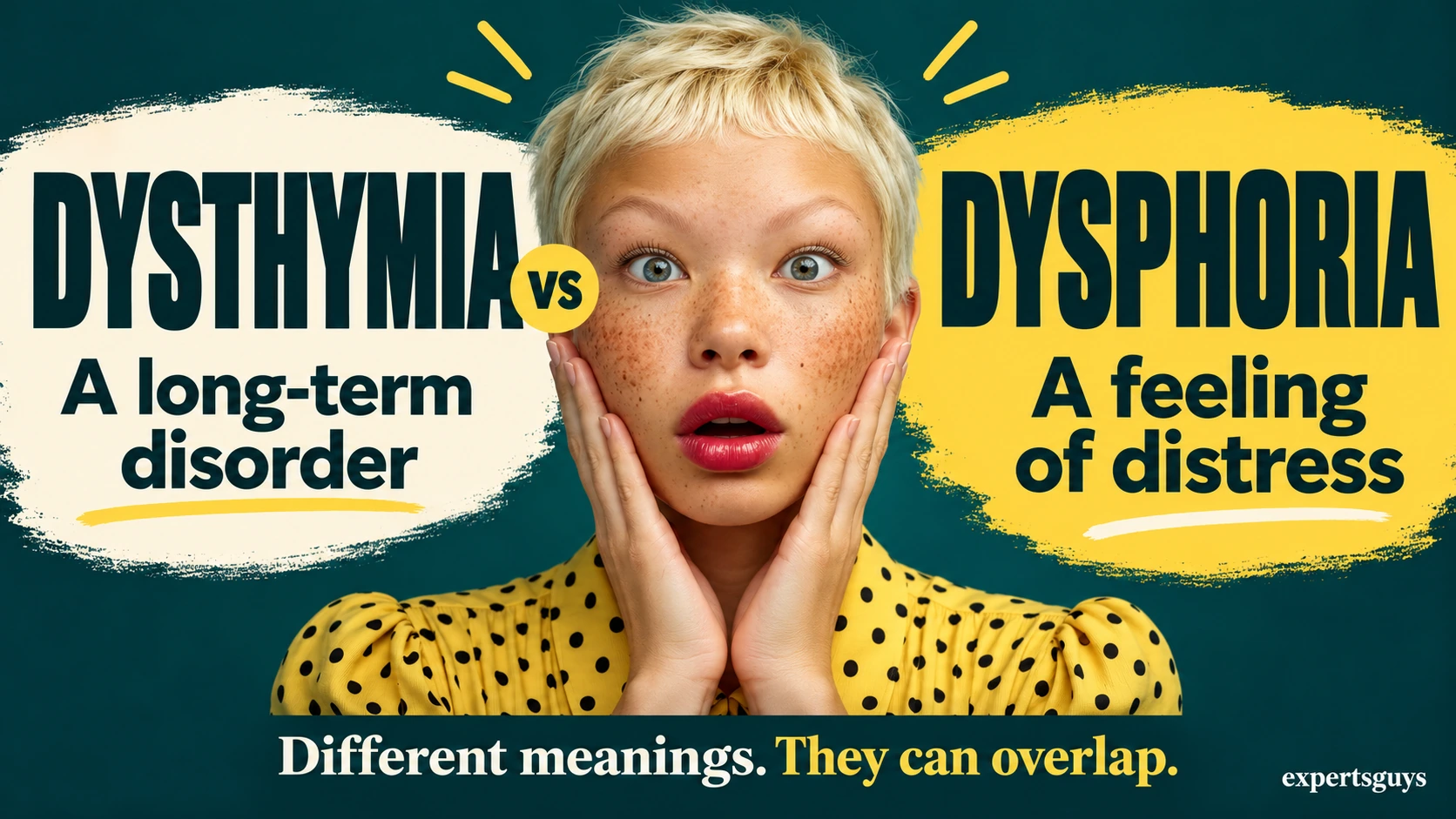
Dysthymia is a term for a long-lasting depressive disorder, commonly discussed as persistent depressive disorder (PDD), while dysphoria describes a distressing or deeply unpleasant mood. They answer different questions and can occur together, so choosing between the words cannot tell you what condition you have or how urgently you need support.
The useful distinction is between a pattern assessed over time and the quality of a feeling. Someone may describe distress accurately without knowing its cause; equally, a clinical diagnosis describes more than how someone feels at one appointment.
| Question | Dysthymia / PDD | Dysphoria |
|---|---|---|
| What kind of term is it? | A depressive-disorder term; PDD is the broader DSM diagnostic category. | A description of distress, discontent or an unpleasant mood. |
| Does time matter? | The long-term course is central to assessment. | The word alone specifies no diagnostic duration. |
| Does it mean mild? | No. Persistent difficulties can be disabling. | No. A description of a feeling does not grade its seriousness. |
| Can both apply? | Yes: a person with PDD may feel dysphoric. | Yes: dysphoric feelings can occur within a depressive disorder. |
| What should change your next step? | Symptoms, impact, history and safety. | Context, persistence, impact and safety – not the word alone. |
Can dysthymia and dysphoria happen together?
Yes. A person may have an established long-term depressive disorder and also experience dysphoria. The first term concerns the clinical pattern; the second describes something about the mood within that pattern. Neither word automatically replaces the other.
The psychological meaning of dysphoria centers on discontent and agitation. In ordinary clinical explanation, people may describe that experience as feeling miserable, uneasy or deeply dissatisfied. The exact experience still needs clarification rather than a guess based on the label.
- Disorder: a clinician evaluates a pattern against diagnostic requirements and other possible explanations.
- Mood description: a word communicates how an experience feels, without establishing its cause.
- Both together: the description may add detail to the assessed disorder rather than create a second competing diagnosis.
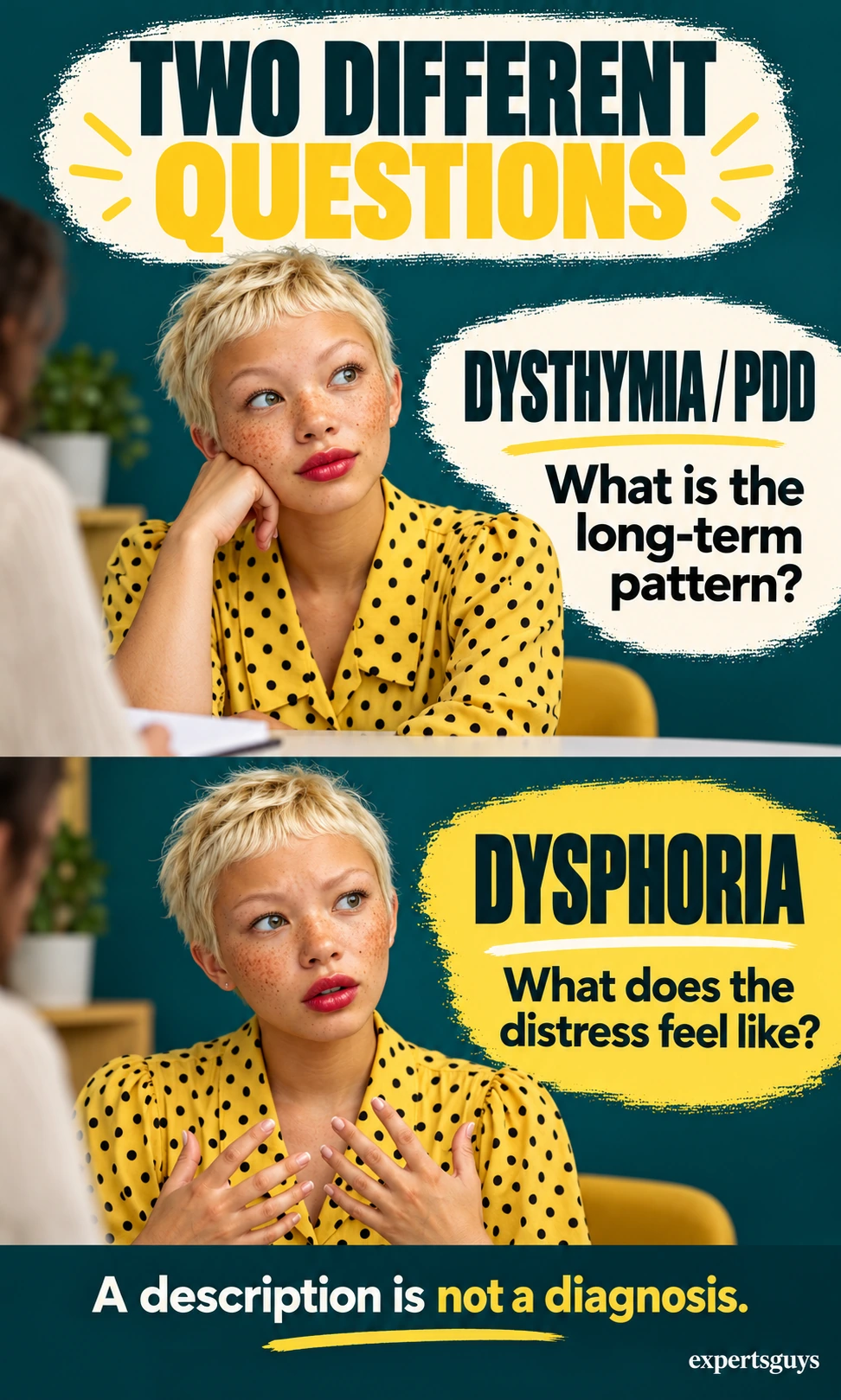
Why the either-or question can mislead
Imagine an illustrative conversation: “My doctor has discussed persistent depression, but today I mainly feel agitated and unhappy.” It would be misleading to conclude that dysphoria has replaced depression. A change in the language used for a feeling may simply add detail; a change in the clinical picture needs assessment.
The reverse mistake is assuming that distress establishes PDD. Feeling dysphoric after a difficult event does not reveal a two-year history, a qualifying symptom pattern or the exclusions a clinician needs to consider. A familiar word can be useful for describing an experience while remaining insufficient for explaining it.
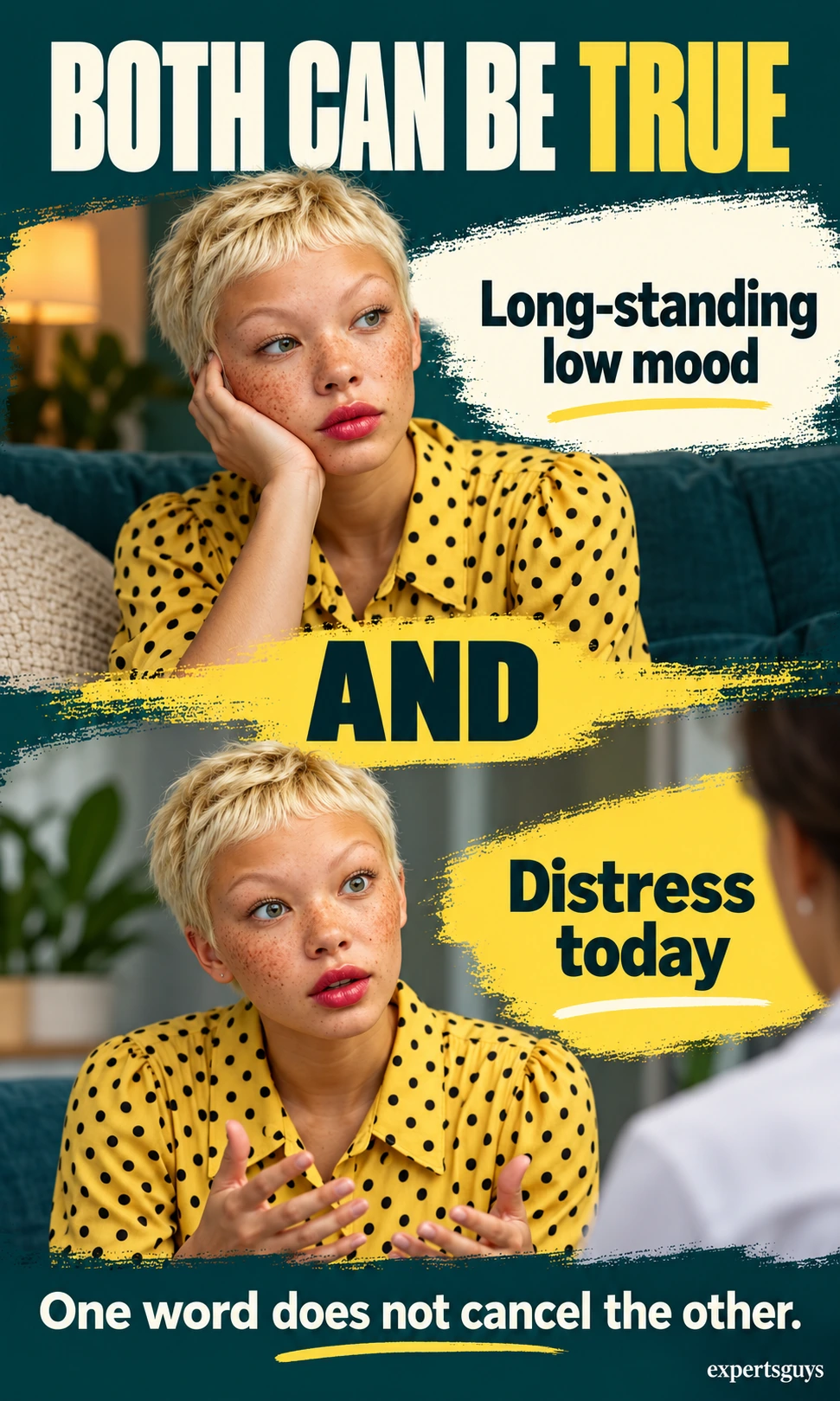
The broader distinction between a feeling and an assessed disorder is covered in clinical depression versus everyday uses of depression. Here, the additional point is that dysthymia and dysphoria occupy different levels of description, so their coexistence is not a contradiction.
How do duration, severity and better days change the comparison?
Duration helps define PDD; it does not determine whether distress deserves attention. Dysphoria has no single duration threshold built into the word. A short, severe deterioration may need faster help than a longstanding, stable difficulty, even before anyone establishes a diagnosis.
For adults, the DSM-based PDD criteria summarized in the MSD Manual include depressed mood for most of the day, more days than not, for at least two years, with at least two associated symptoms. For children and adolescents, the duration is at least one year; mood may be irritable. These are assessment criteria, not instructions to wait before seeking care.
| Assessment detail | What it adds |
|---|---|
| Associated symptoms | Appetite or sleep changes, low energy, low self-esteem, concentration or decision difficulties, or hopelessness. |
| Continuity | Within the qualifying period, symptoms have not been absent for more than two months at a time. |
| Impact and context | Clinically significant distress or impaired functioning, with other explanations considered. |
| Wider history | Previous mood elevation, medicines, substances and physical health can change the interpretation. |
Counting time without considering the rest of the assessment produces false certainty. “I have felt this way for years” is useful information, but it does not establish which condition accounts for the experience. The symptom pattern, its effect on life and possible alternative explanations remain necessary.
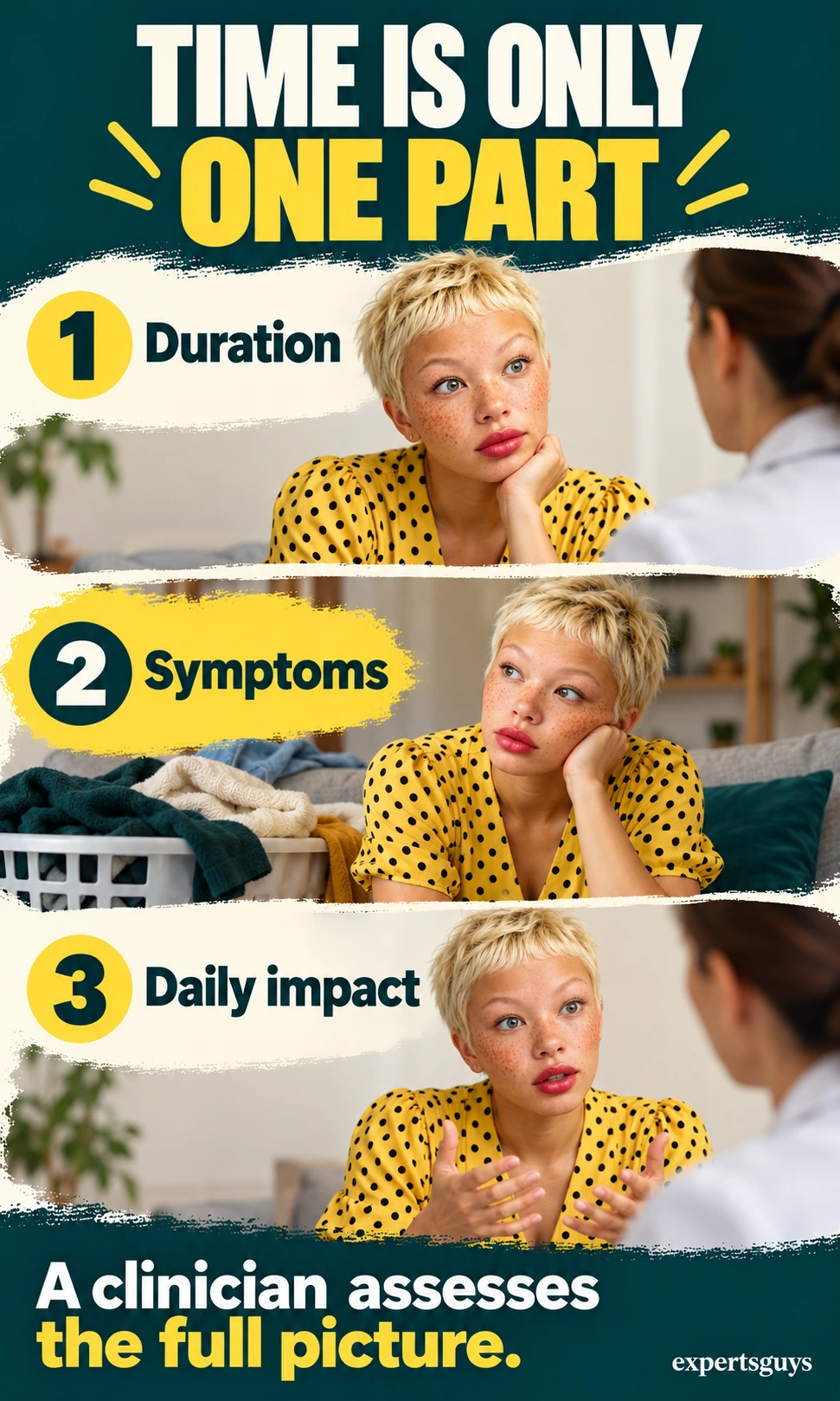
Persistent does not mean identical every hour
Symptoms can vary while a longer depressive pattern remains. The clinical overview of persistent depressive disorder describes a fluctuating course and the possibility of major depressive episodes. That is why the shorthand “mild depression forever” can misrepresent both severity and change.
A better afternoon is meaningful in its own right, but it cannot summarize an entire history. In an illustrative example, someone enjoys lunch with a friend yet continues to struggle on most days. The pleasant experience should not be dismissed as fake, and it should not be used as proof that the wider difficulty is absent.

The converse also matters: one especially difficult moment does not establish a persistent disorder. Compare like with like – a longer pattern with a longer pattern, and a current experience with its immediate context. Keep an uncertain starting date uncertain rather than forcing a precise timeline to fit a label.
Does dysphoria always mean depression, gender dysphoria or PMDD?
No. Dysphoria alone does not identify any one of those conditions. A qualifying word or a wider clinical context can change its meaning substantially. Reading only the shared fragment can erase the very information that distinguishes the conditions.
Gender dysphoria concerns clinically significant distress related to incongruence between experienced gender and assigned sex. It is not another name for a generally unhappy mood, and being transgender is not itself a psychiatric diagnosis. Not all transgender people experience gender dysphoria.
Premenstrual dysphoric disorder involves significant symptoms linked to the menstrual cycle. Timing and the fuller symptom pattern matter; the word dysphoric does not make PMDD interchangeable with PDD. If symptoms have a recurring menstrual relationship, that context belongs in an assessment rather than being reduced to “I feel low.”
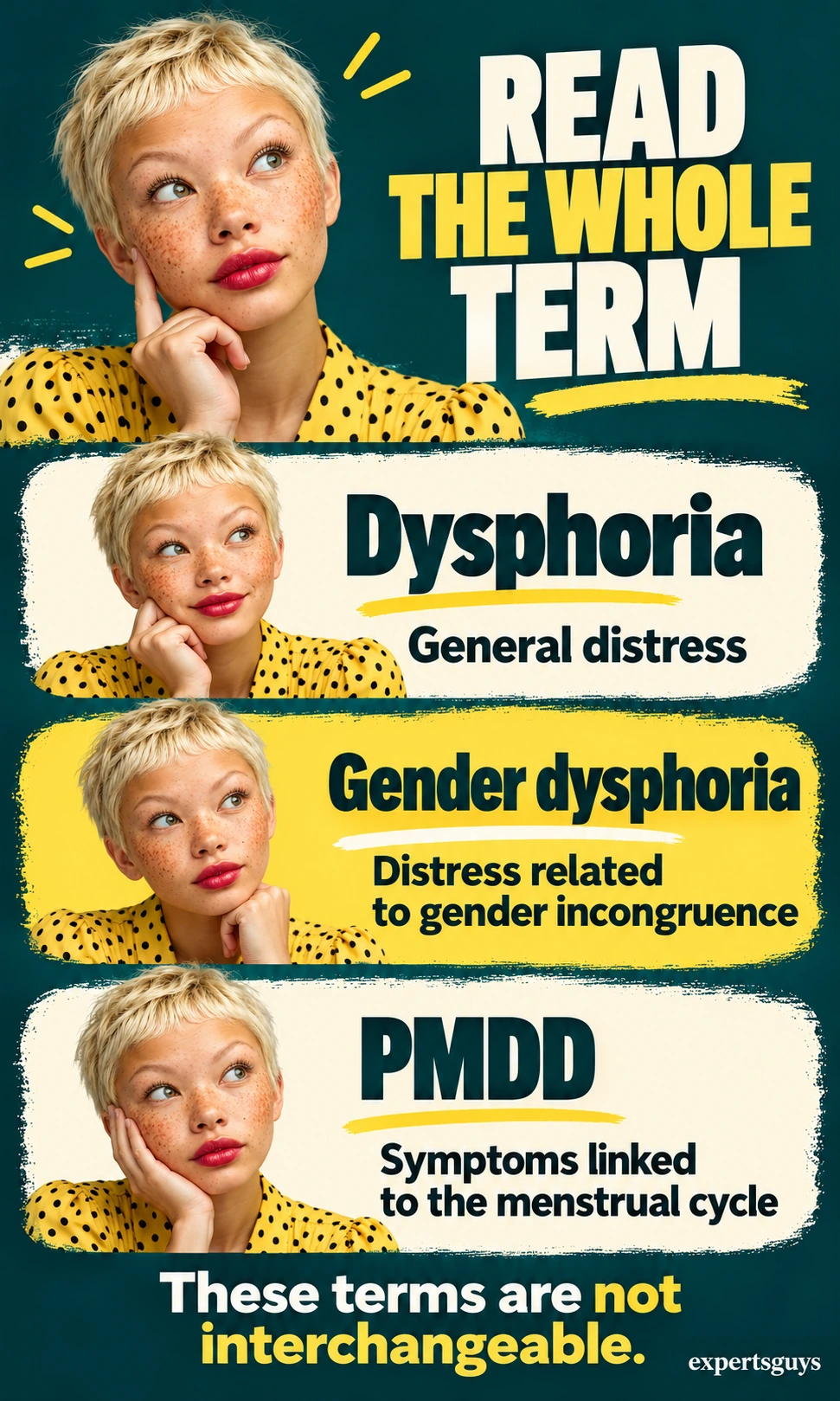
A recurring menstrual pattern belongs in a focused assessment. The PMDD appointment-preparation guide owns the more specific question of documenting a menstrual pattern when that is clinically useful. A severe problem should not wait for a completed record.
Why sleep and energy provide different information
Distress can also occur alongside patterns that need assessment beyond unipolar depression. Feeling exhausted after poor sleep differs from needing much less sleep while feeling unusually energized, driven or irritable. The NIMH explanation of bipolar symptoms describes reduced need for sleep and changes in energy and behavior; distress alone does not establish bipolar disorder.
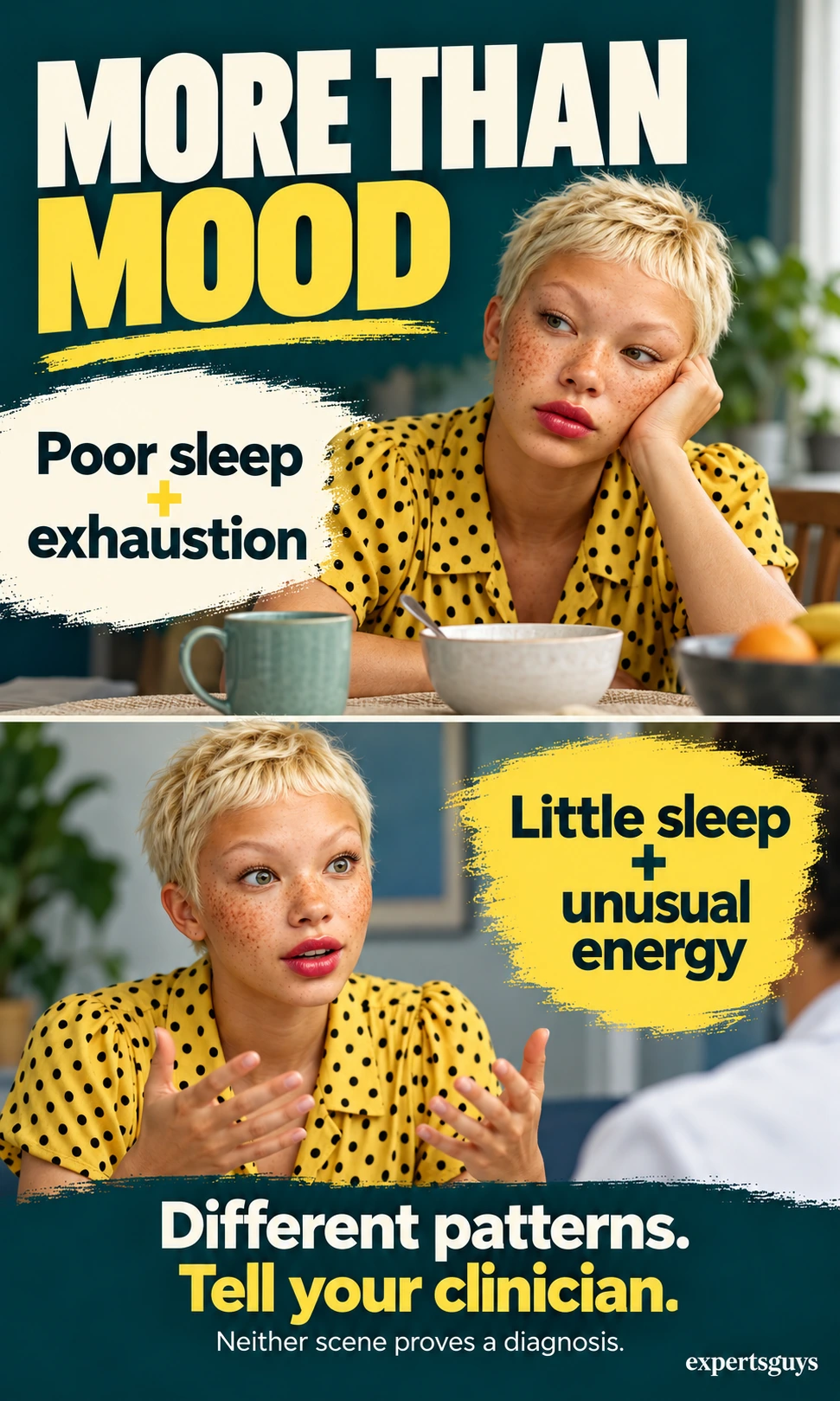
The useful takeaway is to preserve the surrounding facts, not to select a new label from a list. “Dysphoric” does not tell a clinician whether unusual energy, medication changes or another relevant context is present. If a new pattern is developing rapidly, its change from your usual state matters more than finding a perfect synonym.
What should you do when these words appear in your care?
Ask how the description relates to the assessment already being discussed. You do not need to prove that one word is correct and the other wrong. The most useful outcome is understanding whether the clinician is describing a feeling, identifying a persistent disorder, or still working out the explanation.
A brief spoken clarification for this specific confusion
Use this when dysthymia, PDD and dysphoria seem to conflict in a conversation. No materials or record are required. Ask while seated or positioned comfortably; an interpreter or trusted supporter can help you communicate if you want one. This is a communication example, not a diagnostic exercise.
- Ask about the relationship: “When you say dysphoria, are you describing how I feel within the longer depressive pattern, or considering something different?”
- Add the missing contrast: describe whether this distress is new or familiar and one way it affects ordinary life. If the timing is unclear, say that rather than guessing.
- Confirm the consequence: “Does this change the assessment or the next step?” Ask for any unfamiliar part of the answer in plain language.
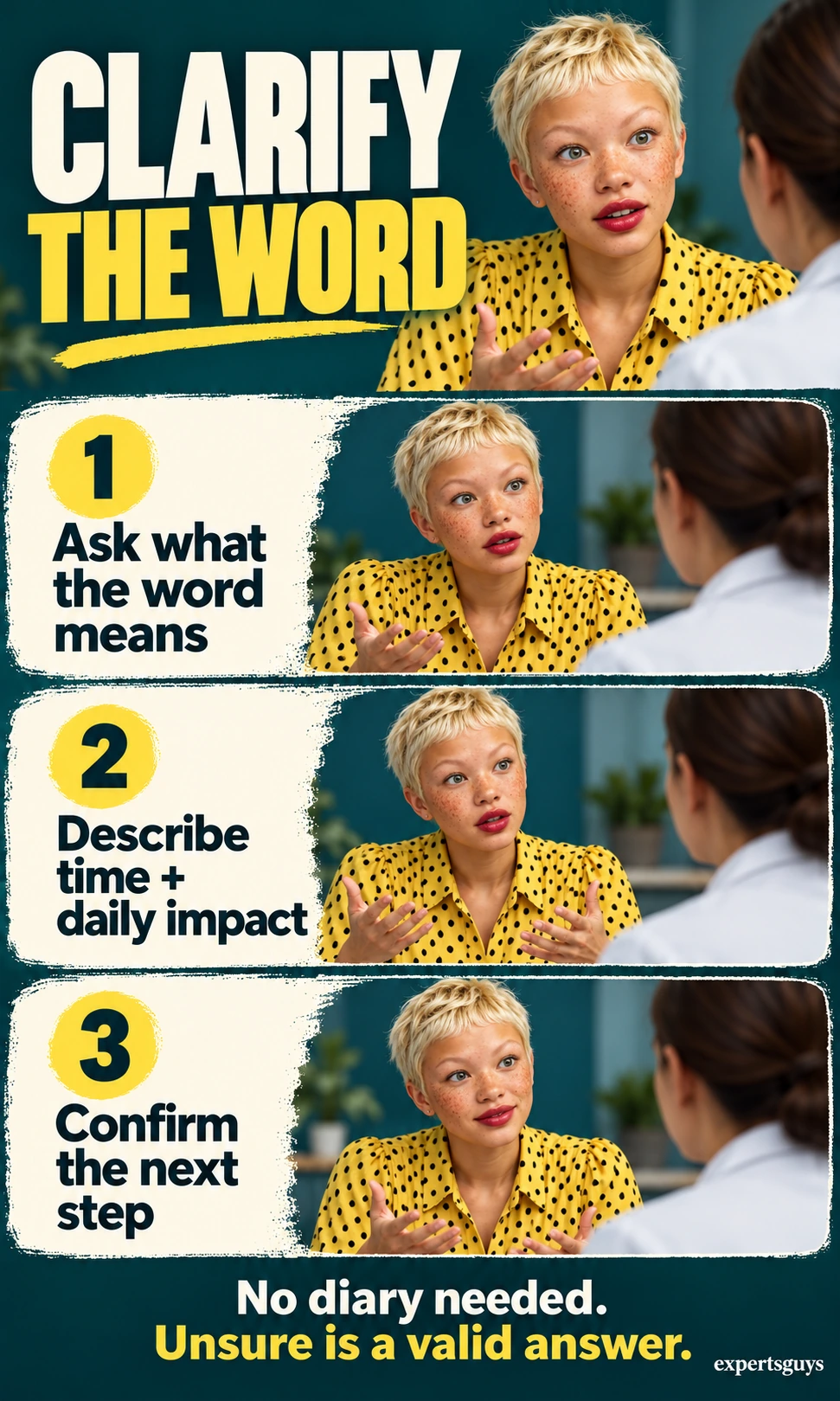
Worked example: “We discussed persistent depression before. This week I feel more agitated and have stopped joining meals. Does dysphoria describe that feeling, and does this change what we do next?” This is an illustrative script, not evidence of a particular diagnosis. A clinician can ask follow-up questions to distinguish a wording issue from a meaningful change.
Easier version: ask only, “How do these two words fit together for me?” The mistake to avoid is treating a new adjective as proof that the original assessment was wrong. Completion means you understand the explanation and the next action – not that you feel better immediately. If the answer remains unclear, say which part you did not understand; the linked guide to clinical depression covers the wider appointment conversation.
Choose the urgency from what is happening
A comprehensive depression assessment considers severity, course, daily functioning and wider history rather than symptom counting alone. Bring a new deterioration to the appropriate service even if you have not reached a duration threshold. An existing diagnosis does not make every later change part of the same problem.
| Situation | Appropriate response |
|---|---|
| Immediate danger or inability to stay safe | Use local emergency services or the nearest emergency department now; ask someone nearby for support if possible. |
| New suicidal thoughts, rapid worsening, inability to meet basic needs, or marked unusual energy with little sleep | Seek urgent professional assessment. Use emergency care if safety is uncertain or danger becomes immediate. |
| Distress that persists, worsens or limits ordinary life | Arrange an assessment with primary care or a qualified mental health professional; describe the impact without waiting for a self-diagnosis. |
| Only the terminology is unclear, with no urgent change | Ask the treating clinician how the terms relate to the assessment and the plan. |
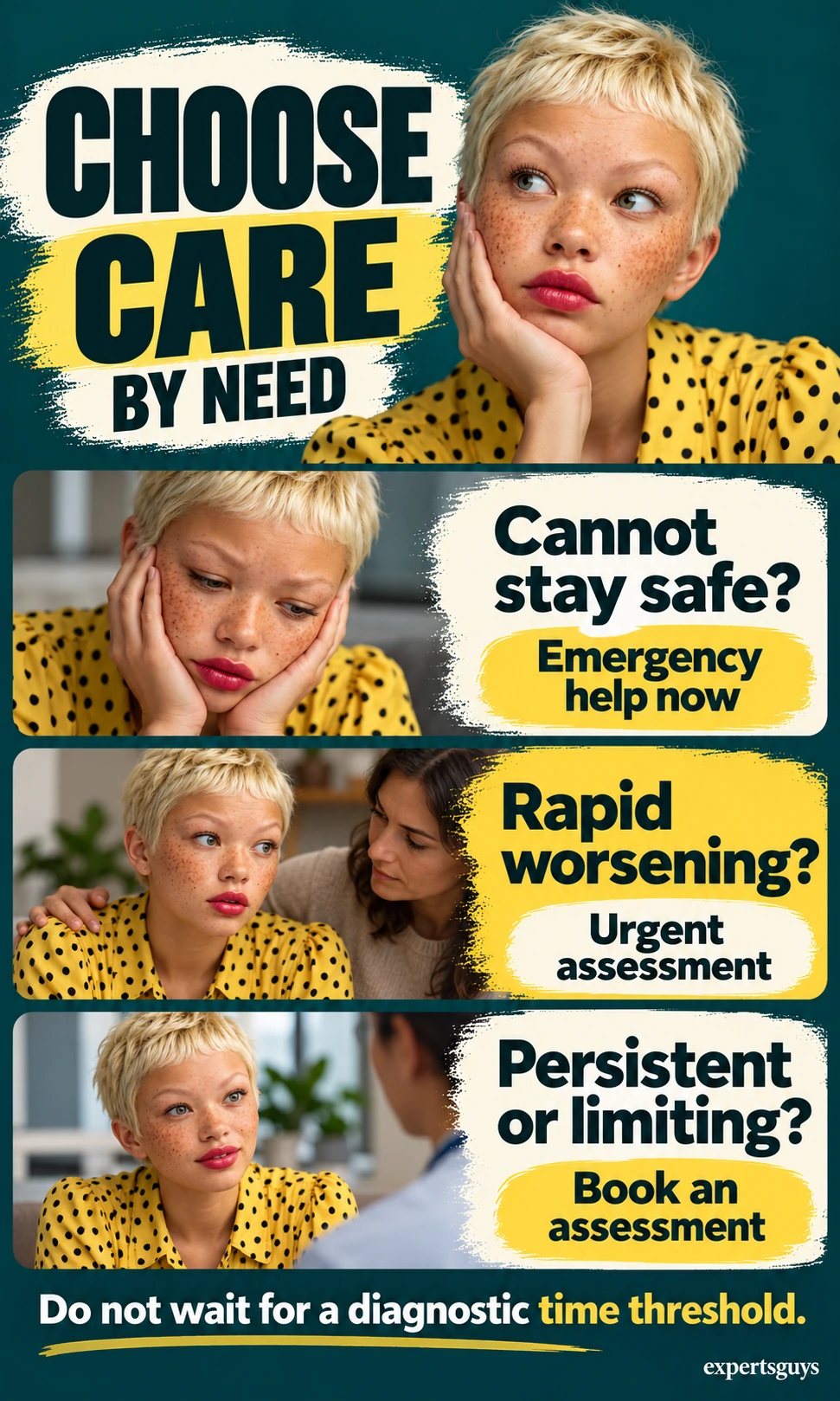
Treatment follows the assessed problem, not the word dysphoria in isolation. Depression care can include psychological treatment, medication or a combination, depending on the situation. Do not start, stop or alter prescribed medication to test which label fits; discuss changes and unwanted effects with the prescriber.
Frequently asked questions
Is dysphoria the opposite of dysthymia?
No. They are not opposite ends of one scale. Dysthymia concerns a persistent depressive disorder, while dysphoria describes an unpleasant mood. A person can experience both, and the intensity of a feeling cannot determine the diagnosis.
Is anhedonia another word for dysphoria?
No. Anhedonia means reduced interest or pleasure; dysphoria concerns an unpleasant or distressed mood. Someone may describe loss of enjoyment, distress, or both. These descriptions contribute information but do not establish a condition by themselves.
Does dysphoria become dysthymia after two years?
Not automatically. Duration does not transform one word into the other. PDD requires a qualifying depressive pattern and a clinical assessment that considers impact and alternative explanations. Distress deserves attention before any diagnostic time threshold if it is worsening or interfering with life.
Is dysthymia still a term clinicians use?
Yes. Terminology differs across diagnostic systems and clinical settings. In DSM-based practice, persistent depressive disorder brought together earlier dysthymic disorder and chronic major depression categories. Ask which diagnosis is meant in your own care rather than assuming that every use of the older word has exactly the same scope.
The distinction to keep
Dysthymia describes a persistent depressive-disorder pattern; dysphoria describes the quality of distress. Neither the intensity of one moment nor the wording in isolation settles the assessment. Keep the time pattern and context intact, clarify how the terms relate, and choose care according to safety and daily impact.
This information supports understanding and a conversation about care; it does not provide an individual diagnosis.