
Dysthymia is an older name associated with persistent depressive disorder, a form of depression marked by a long-lasting pattern of low mood. If low mood has become your usual background, describe its duration and effect on daily life to a healthcare professional rather than treating it as a fixed part of your personality. You do not need to wait years before asking for help.
What dysthymia means today
The word dysthymia still appears in older records, search results, and conversations about chronic depression. Current descriptions usually use persistent depressive disorder, or PDD. The terminology matters when you read about a diagnosis, but recognizing your own difficulties does not require choosing the correct clinical label first.
For adults, a persistent pattern typically involves low mood on most days for at least two years; for children and adolescents, the duration is at least one year and the mood may be irritable. These duration requirements belong to a clinical assessment, not a waiting period for treatment. A shorter history can still deserve attention. MedlinePlus explains the duration and associated symptoms.
Duration alone cannot establish the diagnosis. A clinician needs the wider history, including other symptoms, periods of improvement, physical health, substances, and previous episodes of unusually elevated or irritable mood. A calendar can help you explain that history, but it cannot replace the assessment.
When low mood feels like your normal personality
A long-standing pattern can be difficult to describe because you may have stopped comparing it with feeling well. Instead of asking whether you are naturally negative, ask what has become harder and how much effort ordinary days require. That shift gives an appointment a practical starting point without assuming that every unhappy feeling is a disorder.
- Write an approximate starting point, even if you only remember a season or life stage.
- Describe any periods when you felt substantially better, including how long they lasted.
- Give one recent example of an affected routine, relationship, or work task.
- Mention changes that other people noticed, while keeping your own account central.
Imagine an adult who still completes work assignments but spends evenings unable to start meals, return messages, or enjoy an activity they once valued. That is an illustrative situation, not a diagnostic example. The useful observation is the change in daily functioning, including the effort required to maintain appearances.
Likewise, someone who says they have always been quiet may have a temperament preference, a mood problem, both, or another explanation. The question is not whether quietness itself is unhealthy. It is whether persistent distress or reduced functioning needs support, and what a fuller history reveals.
Symptoms to describe without scoring yourself
Persistent low mood may occur with altered sleep or appetite, low energy, poor self-esteem, hopelessness, or difficulty concentrating. Tell a clinician which experiences are present and how they affect you. Counting familiar symptoms on a webpage is not enough to distinguish PDD from other conditions.
Use ordinary examples rather than forcing yourself into medical wording. You might describe rereading a short email several times, lying awake despite being tired, or cancelling plans because everything feels effortful. Those examples help communicate your experience without claiming what caused it.
A short record can also make an appointment easier when you worry about forgetting details. Keep it limited to observations you can explain, and mark uncertain dates as uncertain. You do not need a complete life history or a perfectly consistent daily diary to start a conversation.
| Observation | What to record or discuss |
|---|---|
| Beginning and course | Approximate onset, whether low mood is frequent, and any meaningful better periods. |
| Sleep and appetite | What changed from your usual pattern; avoid assuming that one change identifies the cause. |
| Energy and concentration | A concrete example of what takes more effort or has become difficult to finish. |
| Daily functioning | Effects on work, self-care, relationships, or enjoyment, including tasks you still manage. |
| Other context | Medicines, alcohol or other substances, physical illness, and previous mood episodes to discuss. |
Persistent low mood and major depression can overlap
Major depression is commonly described by an episode lasting at least two weeks, while PDD describes a longer-lasting pattern. Some people with a persistent history also experience a major depressive episode. The labels are not a reliable way to rank how much a particular person is suffering. NIMH outlines common depression types.
A person can have a long history and then experience a recent worsening that changes the urgency of care. Record that change separately instead of compressing everything into “I have always felt this way.” Explain what has worsened, approximately when it changed, and whether you are managing basic needs.
For a broader explanation of the diagnosis, read persistent depressive disorder. This page concentrates on recognizing the history and communicating it. A diagnostic label should come from an assessment that considers the whole picture.
What else a clinician may need to consider
Tell your clinician about periods of unusually high or irritable mood, increased activity, impulsive behavior, or needing much less sleep than usual without feeling tired. These details can change the assessment and treatment discussion. They should not be hidden because you booked the appointment for low mood. NIMH describes bipolar mood episodes.
Physical illness, medicines, and substance use can also influence how you feel. A healthcare professional may recommend an examination or tests when your history suggests another contributor. Bring the information you have rather than ordering a broad set of tests or changing medicines on your own.
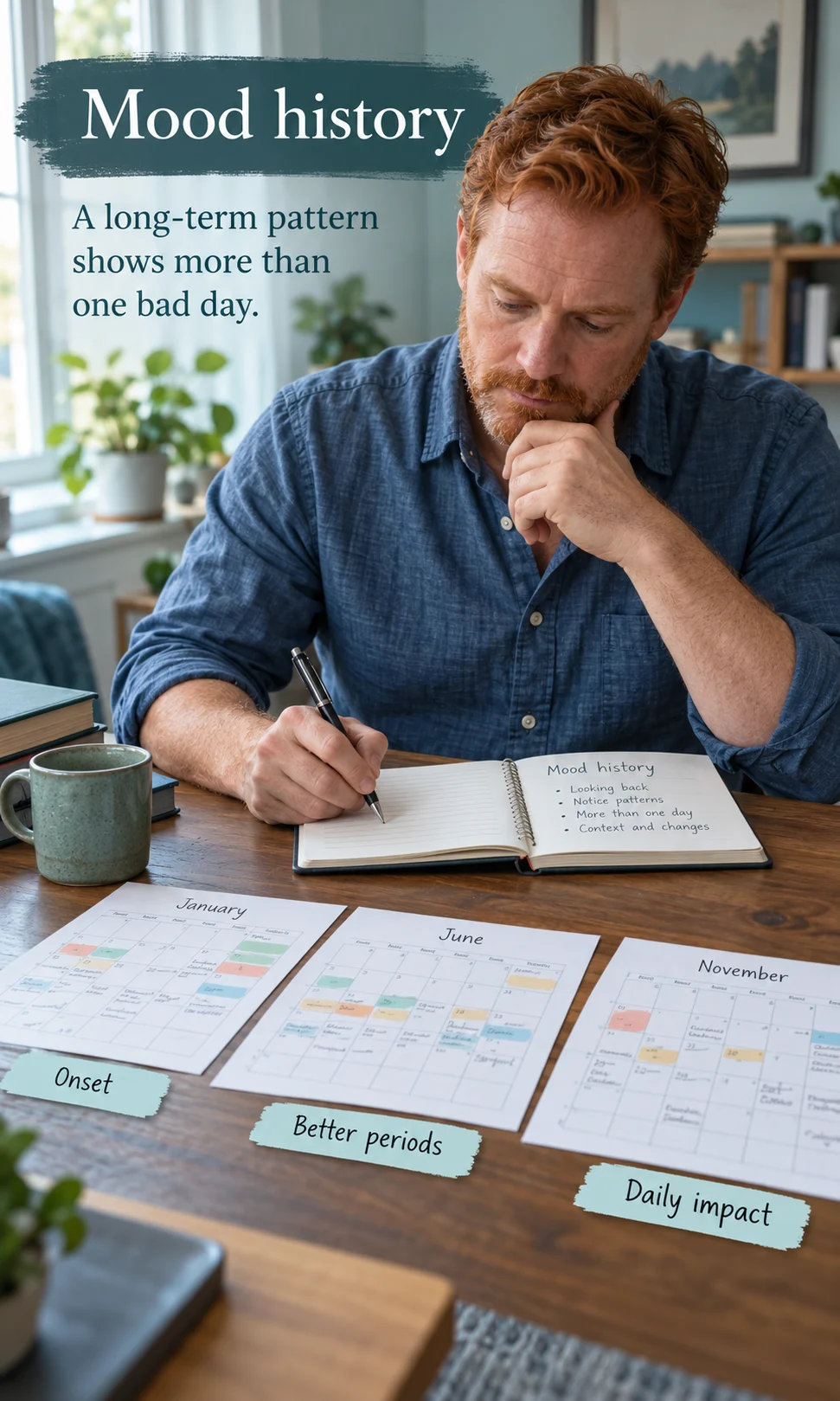
Make a mood history you can actually use
Start with three pieces: an approximate beginning, any better periods, and the most meaningful daily-life changes. A remembered event can anchor the timeline when an exact date is unavailable. Write “not sure” when necessary; uncertainty is useful information rather than a failed entry.
Then separate a long-standing difficulty from a new one. For example, a history of low motivation and a recent change in sleep may need different follow-up questions. The depression and sleep problems guide can help you find words for the sleep pattern, while your clinician evaluates its meaning.

Prepare your appointment summary
Mood History Studio turns a few observations into a brief discussion sheet. It does not calculate whether you have dysthymia, choose a medicine, or assess suicide risk. Use it to prepare for a conversation; incomplete memories should not prevent you from booking care.

Put your experience into words
Mood History Studio
Create a short history to discuss with a healthcare professional.
This does not diagnose depression or assess suicide risk. It organizes your notes. You do not need a complete history to seek care. Entries stay in this page's memory; they are not sent or saved by this experience. Printing may leave a copy on your device.
Need urgent help? If you cannot stay safe, contact local emergency services now. In the U.S., call or text 988 for crisis support; call 911 for immediate danger. Outside the U.S., use local emergency or crisis services. Do not wait for a summary.
If the controls do not work, write down onset, better periods, daily-life changes, medicines and your main question, then bring those notes to an appointment.
Your appointment summary
These are your observations, not clinical findings. Bring them to a healthcare professional.
What to discuss next
Ask how your history will be assessed, which care options may fit your needs, when to follow up and what to do if symptoms worsen. Mention any periods of unusually elevated mood or needing much less sleep without feeling tired.
Related reading: persistent depressive disorder · depression and sleep problems.
What treatment conversations can cover
Treatment may involve talking therapy, medication, or both, depending on the assessment and your preferences. Cognitive behavioral therapy is one established option; other approaches may address relationships or patterns of activity. Ask what the proposed treatment targets and how progress will be reviewed. The NHS describes depression treatment options.
If medication is discussed, bring your current medicine and supplement list and mention previous benefits or side effects. Ask whom to contact if symptoms worsen or unwanted effects become difficult. Do not start, stop, or alter a prescription using the article or the appointment sheet as instructions.
Daily routines can support treatment, but a routine should not become another test you feel you have failed. Pick one manageable action and discuss whether a structured approach is suitable. The behavioral activation for depression article explains how activity-based support can fit into care.

When to seek help sooner
Arrange an appointment when low mood keeps recurring, persists, or affects your life. Ask for earlier advice if symptoms worsen or you are struggling to eat, sleep, or care for yourself. You do not have to demonstrate a particular duration before your concerns are worth hearing.
Questions about dysthymia
Is dysthymia the same as persistent depressive disorder?
Dysthymia is an older term commonly associated with persistent depressive disorder. Current terminology covers a persistent depressive pattern that a clinician evaluates using the full history. The term alone does not describe every detail of an individual diagnosis.
Can I have dysthymia and still work?
Continuing to work does not rule out a depressive disorder. Explain the effort involved and what happens outside work, including self-care and relationships. A clinician considers both distress and functioning rather than judging health by productivity alone.
Should I wait two years before asking for help?
No. The duration used in diagnosing PDD is not a requirement for accessing support. Seek advice when low mood persists, worsens, or affects your daily life.
Can the appointment summary tell me whether I have PDD?
No. It organizes your observations without a diagnostic score or probability. Bring it to a healthcare professional who can assess the history and consider other explanations.
Does a long history mean I cannot improve?
A long history does not make improvement impossible. Treatment and follow-up can help, although progress varies between people. Discuss what a useful change would look like in your everyday life and how your care will be adjusted.
Your next appointment: a short checklist
- Book care based on the difficulty you are experiencing now.
- Bring approximate dates, better periods, and one or two concrete daily-life examples.
- Include medicines and supplements, previous treatment, and any unusually elevated mood episodes.
- Ask about the assessment, treatment choices, follow-up, and what to do if things worsen.
You do not need to prove that your experience fits the word dysthymia before speaking to someone. A concise, honest account gives the appointment a useful starting point. The next step is a conversation about your needs, not a perfect record.
Sources and further reading
- MedlinePlus: Persistent depressive disorder — terminology, history, and assessment.
- NIMH: Depression — types and access to care.
- NIMH: Bipolar disorder — mood history relevant to assessment.
- NHS: Depression treatment — therapy and medication discussions.