
Depression after intensive care is more likely in people with previous mental-health difficulties, and research in prolonged critical illness also links later depressive symptoms with frightening ICU experiences and feelings of helplessness. These factors are reasons to pay attention, not a forecast that depression will happen. The useful next step is to describe changes since ICU and make sure someone is responsible for reviewing them.
A long recovery can involve weakness, disturbed sleep, memory difficulties and emotional distress at the same time. An ICU survivor does not have to decide which problem explains everything before asking for help. This guide focuses on the transition from intensive care to follow-up, rather than repeating general depression coping exercises.
What predicts depression after prolonged intensive care?
The strongest practical distinction is between a risk factor and a current symptom. A risk factor suggests that follow-up deserves attention; a current change describes what is happening now. Neither a difficult ICU memory nor the length of a hospital stay can establish major depressive disorder by itself.
In one cohort of 131 patients who needed long-term ventilation, 23 people (17.6%) had full or subthreshold major depression at follow-up. Assessments occurred three and six months after transfer from acute to post-acute ICU. Helplessness, recalled traumatic experiences and acute or post-traumatic stress were associated with depression; the combined outcome must not be described as 17.6% having a confirmed full disorder.
That was a selected group, not every ICU survivor, and follow-up losses limit how confidently the result can be generalized. An association also does not prove that one experience caused depression. Most importantly, the findings do not provide a validated personal risk calculator.
The broader post-intensive care syndrome framework includes new or worsened physical, thinking and mental-health difficulties. Previous depression or anxiety can increase vulnerability, but people without that history can develop problems too. ICU survival and emotional recovery are different outcomes, so leaving hospital does not settle the mental-health question.
Find the discharge details without guessing
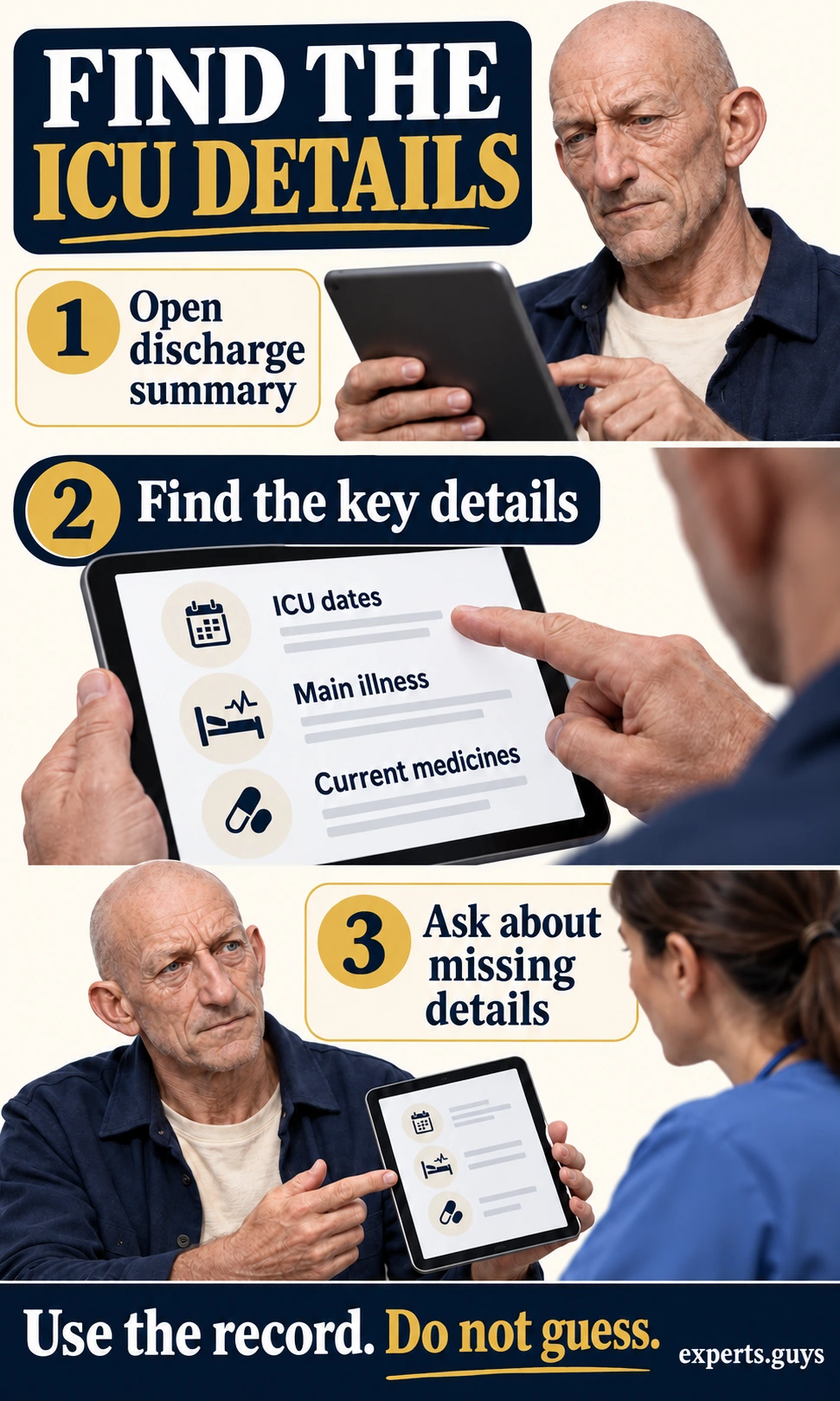
Start here if the ICU episode is blurred or different relatives remember different details. A discharge summary gives the follow-up team a shared starting point and avoids making you reconstruct events from memory. Use the patient portal or a downloaded hospital document; a relative can help with your permission.
- Open the hospital discharge summary on a phone or tablet.
- Locate ICU dates, the main illness and the discharge medicine list. Mark anything you cannot find as unknown.
- Ask the discharging team for missing details or for an explanation of unfamiliar wording.
Example: “I know I needed a ventilator, but I do not know how long” is useful and honest. Do not turn uncertain memories into exact dates. If accessing the portal is tiring, ask the clinic to retrieve the summary; the checkpoint is that the information is available, not that you personally complete every administrative step.
Compare with your own pre-ICU baseline
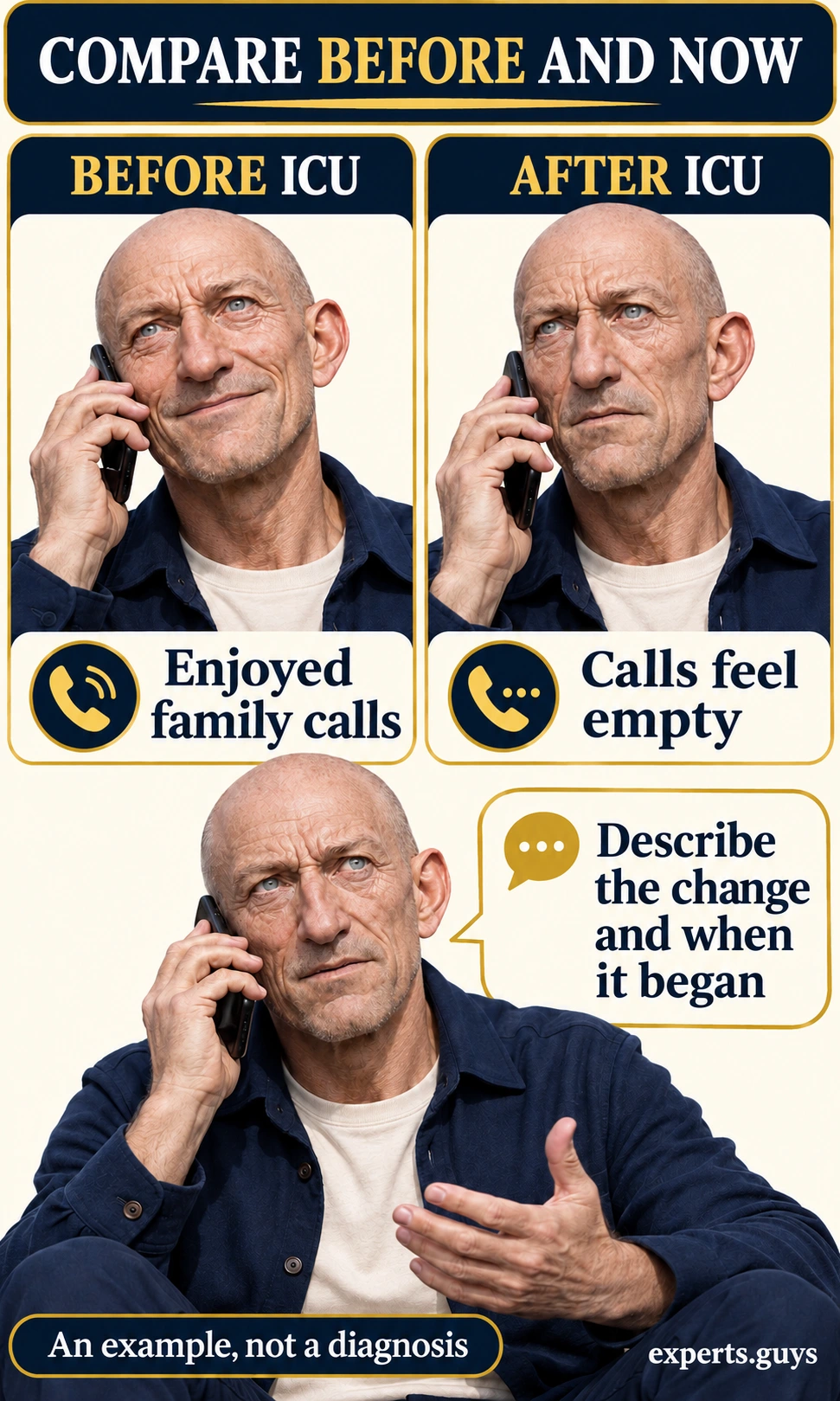
A change is easier to explain when it has a familiar reference point. Choose one activity that mattered before admission, such as a family call, and describe what is different now. This is a communication aid rather than a daily scoring exercise.
- Choose one familiar activity from before ICU.
- Use a short phone note or voice-to-text entry to describe the current difference.
- Add when you first noticed it, or say that the timing is uncertain.
Example: “Before ICU I looked forward to calls; now I can manage the conversation but feel no enjoyment.” Avoid comparing yourself with another survivor or an assumed recovery deadline. If typing is difficult, say the sentence aloud to a trusted person and check that their wording reflects yours.
For the wider relationship between a long-term illness and mood, see depression and chronic illness. The extra issue here is the ICU transition: missing memories, frightening experiences and several teams handing over responsibility. Keep those details visible when arranging care.
How do you distinguish depression from physical recovery or ICU distress?
You usually cannot resolve that distinction from one symptom at home. A clinician considers mood, interest, duration, daily functioning, medical problems and medicines together. The NIMH depression guide describes a persistent pattern that includes low mood or loss of interest; two weeks is a diagnostic time frame, not a rule to delay help when someone is deteriorating.
| What you notice | What it can and cannot tell you | Useful response |
|---|---|---|
| Tiredness or disrupted sleep | Can occur during physical recovery and depression; alone it does not distinguish them. | Describe the physical limitation and any emotional change separately. |
| Loss of enjoyment or persistent hopelessness | Makes a mental-health assessment relevant, even when physical recovery is progressing. | Explain duration and an example of daily impact. |
| Nightmares, intrusive ICU memories or avoidance | Raises a separate trauma-related question; it is not automatically depression. | Mention both mood and trauma symptoms without forcing a detailed retelling. |
| Sudden confusion or abrupt disorientation | Should not be assumed to be depression or ordinary forgetfulness. | Seek immediate medical assessment. |
Physical rehabilitation progress can hide emotional difficulty if appointments only ask about walking or strength. Conversely, slow physical progress is not proof of depression. The NHS guidance on sudden confusion identifies an important exception: an abrupt change needs urgent assessment rather than a routine mood discussion.
Separate the barrier from the activity
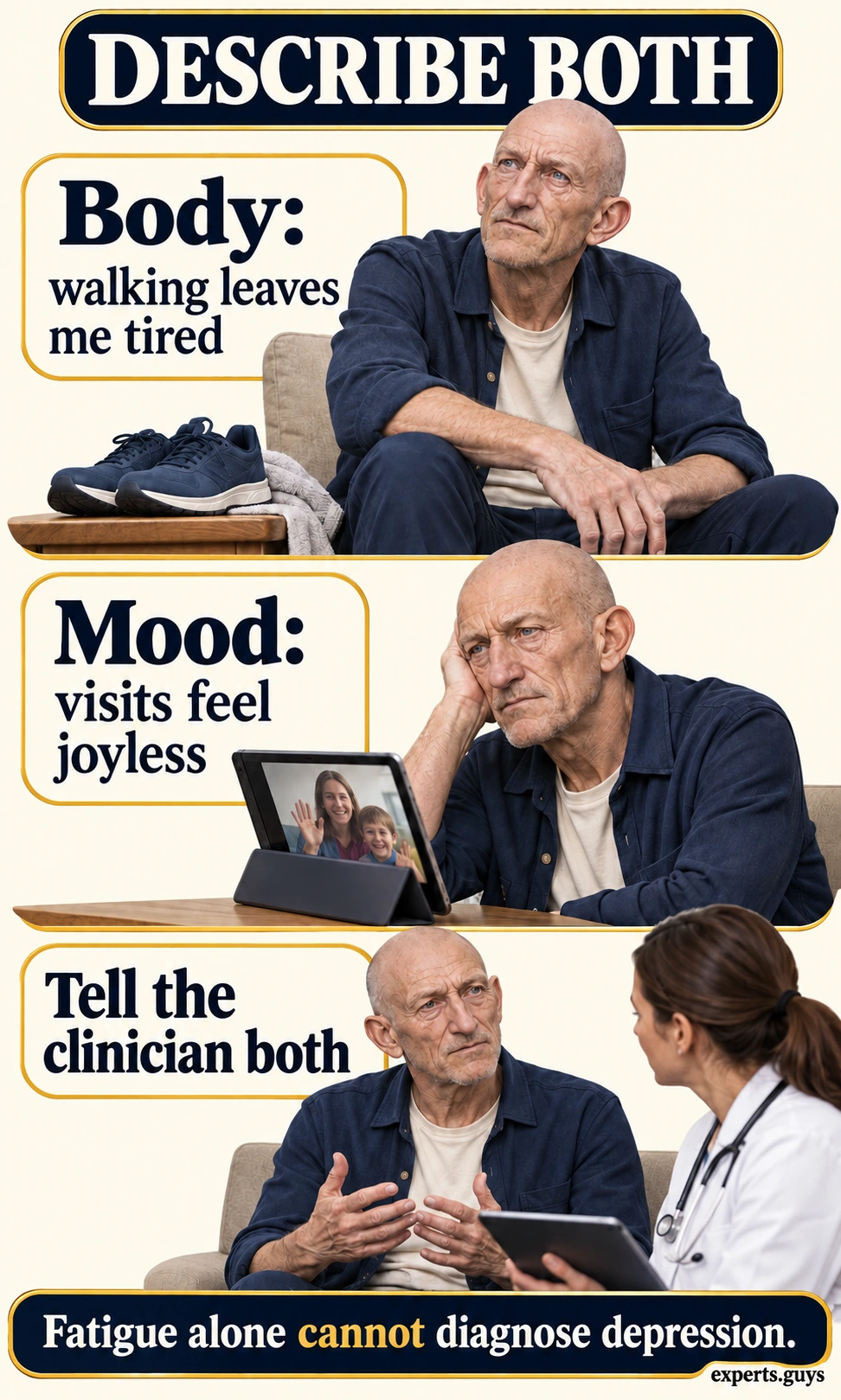
Use this when “I cannot do anything” feels accurate but leaves the care team unsure what is stopping you. Take one ordinary activity and distinguish physical capacity from interest or enjoyment. Both barriers can be present, and neither needs to be minimized to make the other credible.
- Name one activity, such as a short visit with family.
- Describe the body barrier: for example, sitting upright is exhausting.
- Describe the emotional barrier, if present: for example, the visit feels empty even when it is physically manageable.
Checkpoint: your description should allow the clinician to ask about both barriers. Do not test your limits by pushing through exertion to prove a mood problem; follow your rehabilitation advice. If it is difficult to separate the two, say “both seem involved” and use depression fatigue vs normal tiredness for the general distinction, not an ICU recovery test.
Mention frightening memories without forcing a retelling
Use this if alarms, dreams or memories from intensive care interfere with sleep, appointments or a sense of safety. The immediate communication task is to describe their effect, not to prove that every remembered event happened exactly as recalled. Memory gaps and uncertainty can be part of the conversation.
- Start with the effect: “Nightmares about ICU are making sleep difficult.”
- Ask whether the review can include trauma symptoms as well as mood.
- Request a pause or a different way to communicate if the discussion becomes overwhelming.
Example: “I can explain what happens afterward, but I am not ready to describe the memory.” Avoid having relatives insist on a detailed retelling or an unplanned ICU visit as a way to fix the distress. A written message, shorter appointment or support person can make the conversation manageable; the goal is to communicate the concern, not to carry out trauma therapy yourself.

Check the transition between medicine lists
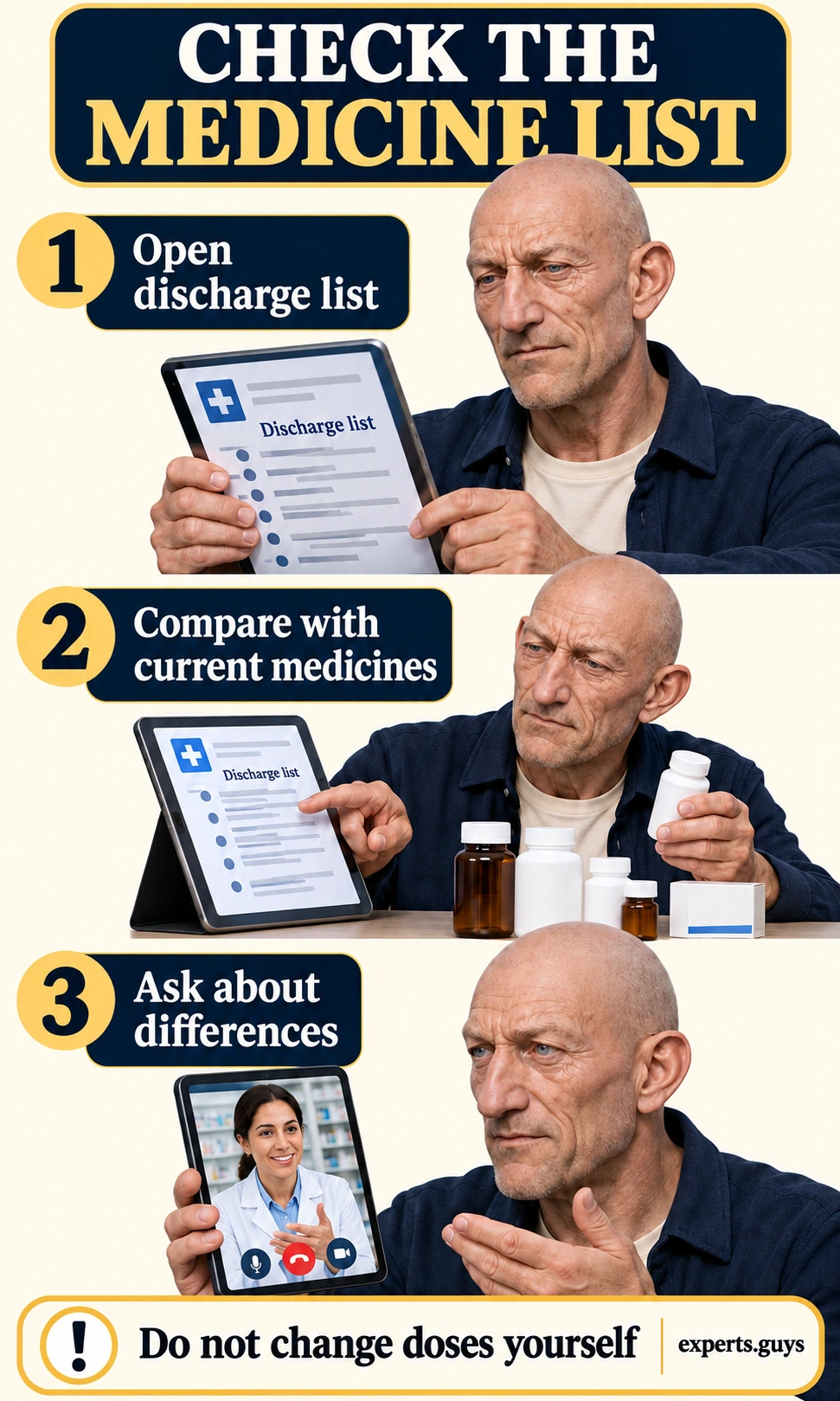
Hospital discharge, rehabilitation and primary care can each produce a medicine list. If the lists differ, that is a question to resolve rather than a reason to select the version that feels right. A comparison also helps the clinician understand whether a symptom appeared around a treatment change.
- Open the discharge list and place your current medicine containers nearby, including non-prescription products.
- Compare names, instructions and any changes you were told to make.
- Ask the prescriber or pharmacist about discrepancies, and explain any concerning symptoms. Do not stop, restart or change doses yourself.
Example: “This appears on the discharge list but not on the rehabilitation list; which instruction is current?” If the list is too complex, ask for a formal medicine reconciliation and bring the containers. The useful outcome is one confirmed current list and a contact for questions, not your own conclusion about which medicine caused a mood change.
When should you request a post-ICU review?
Request a review when mood or interest changes persist, worsen or interfere with recovery and daily life. Earlier contact is appropriate when eating, essential treatment or safe self-care is becoming difficult. A scheduled recovery appointment should not be treated as a waiting period that prevents you reporting a new concern.
UK NICE rehabilitation guidance describes review around two to three months after critical-care discharge for people who needed structured support. Services and timing differ elsewhere. Ask your own team what follow-up is arranged, rather than assuming the hospital automatically booked it.
Request a review that includes the ICU experience
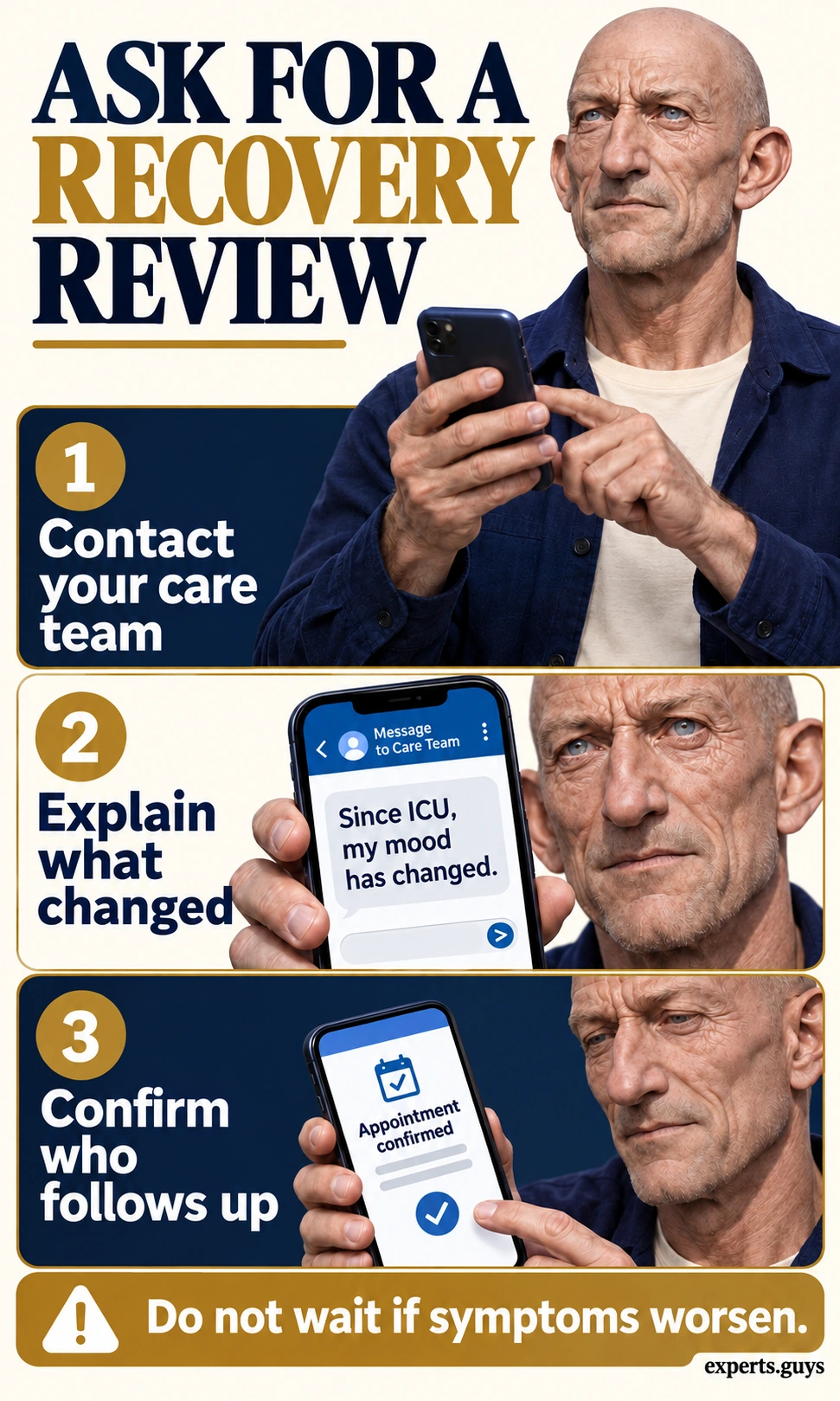
Start with the discharge contact, primary-care clinician or existing ICU recovery service. Make the reason specific enough that the appointment can cover mental health alongside physical recovery. You do not need a confirmed diagnosis to make this request.
- Contact the relevant team by its usual non-emergency route.
- Say: “Since ICU, my mood or interest has changed, and it is affecting [one example]. Can my recovery review include mental health?”
- Ask which clinician will review the concern and how you will hear back.
Common failure: sending “I am tired” without mentioning ICU or the emotional change can leave out the problem you most want addressed. If a portal is difficult to use, call or ask an authorized supporter to help. If symptoms are worsening, call for advice instead of waiting for a routine message reply.
If there is no dedicated ICU clinic, primary care can still start an assessment and coordinate referrals. Depending on the findings, care may involve psychological treatment, medication, rehabilitation or a combination. Ask how the proposed support fits with current physical treatment; a general wellness reviewer is not a substitute for that clinical assessment.
How can you prevent the concern getting lost between care teams?
A useful handoff is short enough to read and specific enough to act on. It connects the ICU episode, the change you notice, a daily-life example and the question you want answered. The practical test is whether someone is named to respond, not whether you produced an elaborate symptom diary.
Build one concise digital handoff
Use the Post-ICU Visit Summary below if several teams are involved or you lose your train of thought during appointments. It produces a conversation outline from your selections, without deciding what caused the symptoms. Leave names, addresses and identification numbers out of the free-text fields.
- Select the recovery concern and whether you know the discharge details.
- Add one short daily-life example and the contact already arranged, if any.
- Create the summary, check its wording, then copy it or open the A4 version to save as PDF for your appointment.
Example: “Since leaving ICU, I avoid calls because they feel overwhelming; I do not know who is checking my recovery.” If a screen is tiring, a supporter can enter your words with permission, or you can use the sentence directly. Do not spend time completing the summary when urgent help is needed; an incomplete but accurate account is better than a polished guess.

Post-ICU Visit Summary
Connect your recovery concern with the next care conversation.

For appointment preparation only. No diagnosis, depression score or treatment advice. This component keeps entries in page memory, without sending or storing them. Copying, downloading, printing or opening a search shares information only through the action you choose. Other website services have their own privacy practices.
Need urgent help? Sudden confusion, severe breathing difficulty or inability to stay safe needs immediate medical help. Contact your local emergency service. Do not wait for this summary or a portal reply.
Your visit summary
Find and compare a suitable service
Start with your discharge contact or primary-care clinician. An ICU recovery clinic may also help coordinate care. Search results are not vetted recommendations.
Compare three services using ICU experience, appropriate professional registration, referral requirements, accessibility, cost and appointment availability. Confirm these directly; no ratings or availability are supplied here.
Close the gap after the appointment
Before the conversation ends, confirm what happens next and how to make contact sooner. This is especially useful when the ICU team, rehabilitation team and primary care are different services. It prevents “someone will call” from being the entire follow-up arrangement.
- Confirm the named team, the next action and the expected contact date.
- Put that date and the contact route in your phone calendar; add a reminder if useful.
- Ask what to do if no reply arrives, and which changes mean you should call earlier.
Example: “If I have not heard by the agreed date, which number should I call?” Do not assume an automatic portal receipt means a clinician has reviewed the concern. If memory is a barrier, ask for the plan in an accessible message and consider a trusted supporter; depression and memory problems covers the broader issue, while new post-ICU cognitive changes still need their own assessment.

Frequently asked questions
Does chronic critical illness mean chronic depression?
No. Chronic critical illness describes a prolonged medical course, not the duration or type of a depressive disorder. The two terms refer to different problems and should not be used interchangeably.
Can depression appear after an initially encouraging recovery?
Yes, a new concern can become noticeable after discharge or while other aspects of recovery improve. An earlier reassuring appointment does not make a later change irrelevant. Describe what is different now and request review.
Should a family member complete a depression questionnaire for the survivor?
A relative can share observed changes and help with communication, with consent where possible. Their observations should not silently replace the survivor’s own answers on a self-report questionnaire. Ask the assessing clinician how to handle communication or cognitive difficulties.
Does feeling helpless mean I caused the depression?
No. Feeling powerless during serious illness is not a moral failing or evidence that you caused a later disorder. Research associations should guide supportive assessment, not blame.
Is an online risk score useful after ICU?
A general score cannot reliably calculate your personal chance of depression from ICU duration or a difficult memory. Screening questionnaires may support a clinician’s assessment, but a diagnosis requires context. This page’s summary deliberately provides no score.
Your next step
Choose the unresolved issue that would make the next care conversation easier: missing discharge information, an unclear change or no named follow-up contact. Use the matching method above and bring the result to your care team. Progress here means the concern is understood and has a next action, not that you have diagnosed yourself or recovered on a deadline.