Depression can affect the mouth in ways that are easy to overlook. Someone may know that brushing matters, have a toothbrush within reach and fully intend to use it, yet still struggle to begin. Low energy, disrupted routines, difficulty initiating everyday tasks, appetite changes and reduced attention to self-care can all influence what happens to oral health over time. The National Institute of Mental Health explains that depression can interfere with ordinary daily activities, including eating, sleeping and working, and those functional changes can extend into routines that rarely receive much thought when a person is feeling well.
The relationship can become more complicated when medication, dry mouth, diet and dental attendance are added to the picture. Some medicines used to treat depression can reduce saliva production, while prolonged gaps in brushing or interdental cleaning can give plaque more opportunity to remain around the teeth and gumline. A person may also postpone a dental appointment because arranging it feels overwhelming, because treatment costs are worrying, or because they feel embarrassed about how long it has been since their last visit. These factors do not affect everyone with depression, and having dental problems does not mean depression is necessarily the cause.
What makes this relationship especially important is that oral care can develop its own feedback loop. A routine becomes harder to maintain, the mouth begins to feel different, embarrassment or discomfort increases, and returning to normal care may then feel more difficult than it did at the beginning. Understanding that sequence creates a more useful starting point than simply telling someone to “brush more.” The practical question is how to protect oral health while daily capacity is reduced and how to restart care before a temporary disruption becomes a larger dental problem.
Can Depression Affect Your Oral Health?
Yes. Depression can affect oral health indirectly through changes in daily functioning, self-care, eating patterns, medication effects and use of dental services. The connection is therefore broader than whether a person remembers to brush twice a day. A difficult depressive period may alter several parts of the oral-health routine at once, including when brushing happens, how thoroughly it is completed, whether interdental cleaning continues, what someone eats or drinks, and whether emerging dental symptoms receive professional attention.
This distinction matters because depression should not be described as though it automatically damages teeth. Tooth decay, gum disease, dry mouth, tooth pain and other oral problems have many possible causes, and the presence of depression does not establish why a particular dental condition developed. What depression can do is change some of the conditions surrounding oral care. The National Institute of Dental and Craniofacial Research notes that inadequate oral hygiene can occur among people with mental health disorders and also identifies psychotropic medications as one of several factors that can contribute to oral-health problems.
It is also possible for two people with depression to have very different dental experiences. One person may continue brushing consistently but develop troublesome dry mouth after starting a medication. Another may have no medication-related dryness but find that evening brushing disappears when sleep, motivation and daily structure deteriorate. Someone else may maintain home care reasonably well yet keep postponing a dental visit because making the appointment, travelling there or discussing neglected teeth feels overwhelming. Looking at the individual pathway is more useful than assuming there is one typical “depression mouth.”
Depression Can Disrupt the Routine Around Brushing
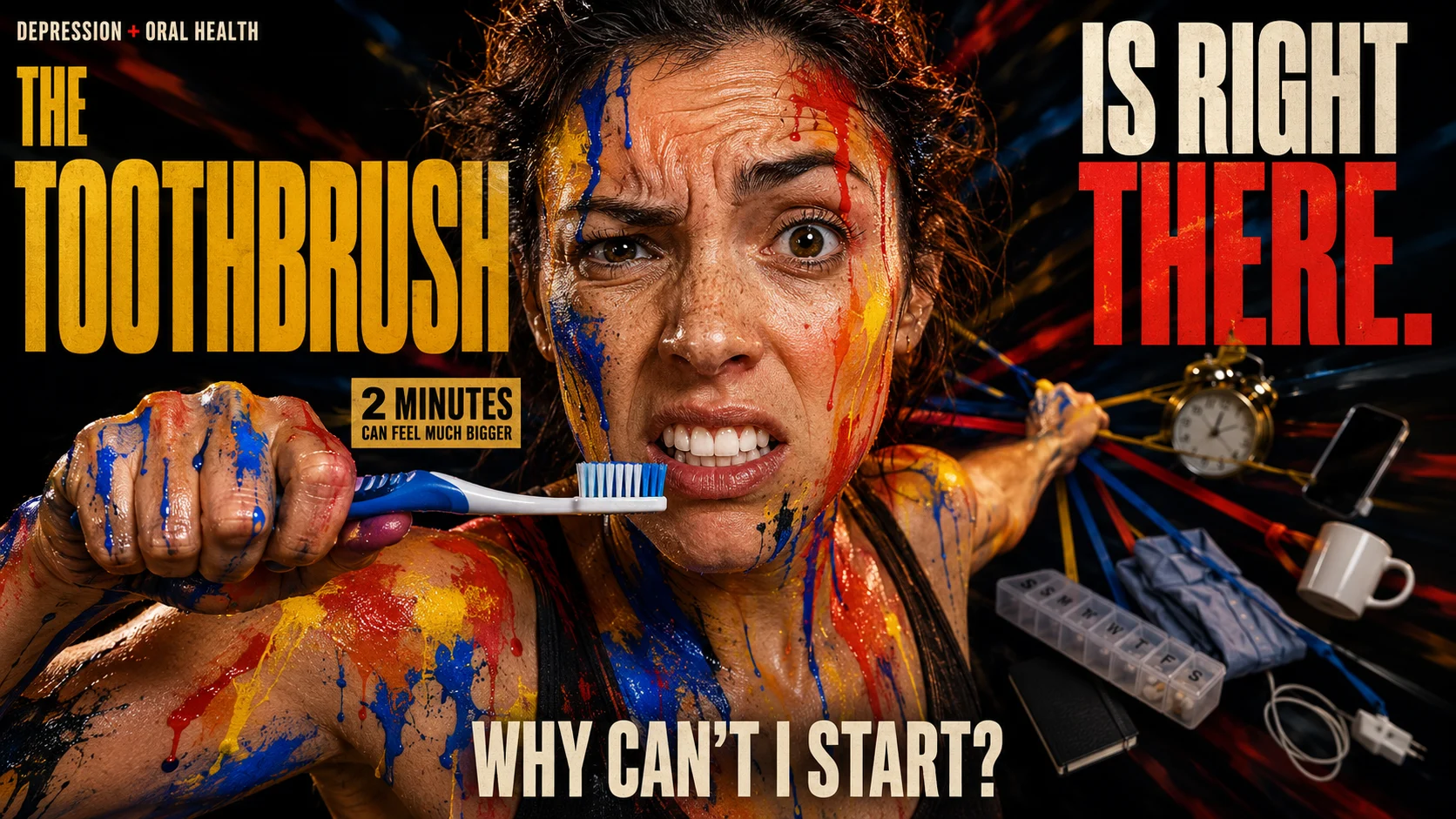
Brushing is often described as a two-minute activity, but the toothbrush is only one part of the task. A person first has to notice that it is time to brush, interrupt whatever they are doing, get up, go to the bathroom, gather what they need, begin the action, continue long enough to clean the teeth adequately and then repeat the process later. When depression interferes with energy, concentration, motivation or the ability to initiate ordinary activities, failure can occur anywhere along that sequence.
This explains why advice based solely on the small amount of time brushing takes can feel disconnected from the person’s actual difficulty. The problem may appear at the point of initiation rather than during the brushing itself. Someone may lie in bed thinking about brushing for considerably longer than the task would take, or stand in the bathroom with the toothbrush nearby while being unable to move from intention into action. Similar initiation problems can occur with showering, preparing food, answering messages and other apparently simple activities, which is why understanding why depression can make simple tasks feel hard helps put oral-care difficulties into a wider functional context.
Changes in routine can also accumulate quietly. Missing one nighttime brush is very different from having evening care become inconsistent for weeks, especially if morning routines are disrupted at the same time. The person may not consciously decide to stop caring for their teeth. Instead, the routine can gradually lose the environmental cues and repetition that previously made it almost automatic.
Knowing You Should Brush and Being Able to Start Are Different Processes
Knowledge alone does not guarantee action. A person can understand the consequences of plaque, own appropriate oral-care products and genuinely want to protect their teeth while still struggling with the mental steps required to begin. This can be particularly confusing because the task looks so ordinary from the outside, which may lead someone to interpret difficulty brushing as laziness or lack of concern rather than as part of a broader change in functioning.
Several depression-related difficulties can converge at this point. Reduced motivation may weaken the sense of reward attached to completing the routine, while problems with planning or task initiation can make the first movement disproportionately difficult. If brushing is one of many activities that have become difficult to start, the wider pattern may be worth considering rather than judging the oral-care problem in isolation. The distinction is explored more deeply in the guides to loss of motivation in depression and depression and executive dysfunction.
There is also an important practical consequence. When initiation is the main bottleneck, making the routine more elaborate can accidentally increase the barrier. A person who already struggles to pick up a toothbrush may feel even less able to begin when the expected routine expands into brushing, flossing, mouthwash, tongue cleaning and several additional steps. Oral-health recommendations still matter, but rebuilding capacity may require separating what needs professional attention from what can be restored gradually.
Why Can Brushing Your Teeth Feel So Difficult During Depression?
The difficulty is rarely explained by a single symptom. Depression can affect energy, interest, concentration, decision-making, movement, sleep and the structure of the day, and those effects can converge around a routine that normally requires almost no conscious planning. A person may therefore experience an unusual mismatch between the objective size of the task and the subjective effort required to perform it. That mismatch is one reason brushing can become a particularly frustrating example of how depression affects daily life.
Low energy is one possible contributor, especially when getting out of bed, standing at the sink or completing a bedtime routine already feels physically demanding. Yet fatigue does not explain every case. Some people have enough physical energy to move around the house but repeatedly fail to initiate the specific action of brushing. Others begin and stop quickly because concentration is poor, sensory sensations feel unpleasant, or they are trying to get back into bed as quickly as possible.
Timing also matters. Toothbrushing is commonly attached to morning and nighttime routines, exactly the parts of the day that may become unstable when depression affects sleep. Oversleeping can compress the morning until basic tasks are rushed or skipped, while irregular bedtimes can remove the predictable evening cue that previously triggered oral care. Once those cues disappear, brushing requires more deliberate decision-making at a time when the person’s capacity to make and act on small decisions may already be reduced.
The Two-Minute Task Is Often Larger Than Two Minutes
Calling brushing a two-minute task measures the movement of the toothbrush, not the complete behavioral sequence required to make brushing happen. The real sequence begins earlier: noticing the need, changing location, finding the toothbrush and toothpaste, tolerating the sensory experience, completing the brushing and returning the items afterward. When each transition demands conscious effort, the routine can feel much larger than its clock time suggests.
This is especially relevant when several tasks compete for limited capacity. A person who is struggling to eat, shower, respond to work, manage medication and get through the day may start prioritizing only what feels immediately unavoidable. Toothbrushing has an unfortunate characteristic in this situation: skipping it once usually produces no immediate crisis. That delay between the missed action and possible consequences makes it easier for oral care to slide down the priority list during a period when attention is already narrowed to getting through the next few hours.
Over time, the delayed consequence can become part of the problem. The absence of immediate pain may allow the routine to remain inconsistent until sensitivity, bleeding, bad breath, visible plaque or another change makes the mouth harder to ignore. By then, embarrassment may be added to the original difficulty initiating care, creating another reason to avoid looking closely at the teeth or arranging a dental appointment.
Task Paralysis Can Appear at the Bathroom Sink
Some people describe a particularly frustrating experience: they reach the bathroom, see the toothbrush and still do not begin. This is different from forgetting. The task is visible and the intention may be present, yet there is a delay between deciding to act and actually moving into the action. When similar episodes happen across other daily activities, depression and task paralysis can provide useful context for understanding why intention and execution sometimes separate.
The experience can also become self-reinforcing. Standing at the sink and failing to brush may trigger frustration or self-criticism, which makes the bathroom itself feel like evidence of another unfinished responsibility. The next attempt then carries more emotional weight than the previous one. A routine that once happened almost automatically can begin to feel like a test of whether the person is “doing well enough,” even though oral care is better approached as a health behavior that can be rebuilt.
Recognizing this pattern changes the practical question. Instead of asking why someone cannot force themselves through a supposedly easy task, it becomes more useful to identify where the sequence is breaking down. The answer may be getting to the bathroom, starting the brush, tolerating the sensation, remembering at a consistent time, or repeating the behavior the next day. Each failure point calls for a somewhat different way of rebuilding the routine.
What Oral-Health Changes Can Become More Likely?
When oral care becomes inconsistent, the effects do not necessarily appear immediately, and there is no fixed timeline that applies to everyone. Existing dental health, saliva flow, diet, fluoride exposure, smoking, medications, medical conditions and the duration of the disruption can all influence what happens next. The most useful approach is therefore to understand the main areas that may change without assuming that every person with depression will develop them.
Plaque is one of the central issues. It continually forms on teeth, and regular brushing and interdental cleaning help control its accumulation. When plaque remains around the gumline, gums can become inflamed and may bleed, while prolonged plaque exposure also contributes to the conditions in which tooth decay can develop. The National Institute of Dental and Craniofacial Research explains gum disease as beginning when plaque builds up on teeth and around the gums, which is one reason a prolonged change in oral hygiene deserves attention rather than shame.
Tooth Decay Risk Depends on More Than Brushing
Reduced brushing can matter, but decay risk cannot be understood from brushing frequency alone. Tooth decay develops through interactions involving oral bacteria, fermentable carbohydrates, time, tooth susceptibility, saliva and protective factors such as fluoride. A depressive episode may influence several of these conditions together if brushing becomes less regular while eating patterns, sugary drinks or snacking frequency also change.
This is why someone who has missed brushing should avoid assuming that irreversible damage has already occurred, while also avoiding the opposite assumption that nothing matters until a tooth hurts. Dental disease can progress without dramatic early symptoms. If a person has had a prolonged period of disrupted care, a dental examination can establish what is actually happening rather than leaving them to estimate the condition of their teeth from appearance alone.
Bleeding Gums Should Not Automatically Be Blamed on Depression
Depression may help explain why oral hygiene has changed, but it does not provide a diagnosis for bleeding gums. Plaque-related gingival inflammation is common, yet bleeding can occur in different circumstances and persistent oral changes deserve appropriate dental assessment. Depression should therefore remain part of the context rather than becoming a catch-all explanation for every symptom that develops in the mouth.
This distinction becomes particularly important when somebody has started brushing again after a period of inconsistent care and notices bleeding. The reaction may be to stop because brushing appears to be making the problem worse. A dentist or dental hygienist can assess the gums, determine whether professional cleaning or treatment is needed and provide advice suited to the person’s actual oral condition rather than relying on a general rule.
Dry Mouth Can Change the Oral Environment
Dry mouth deserves separate attention because it can develop even when somebody continues brushing consistently. Saliva helps keep the mouth comfortable, assists with swallowing, washes food particles from oral surfaces and contributes to the processes that protect tooth enamel. When saliva production falls, the mouth may feel sticky or unusually dry, swallowing dry foods can become harder, taste may change, and the protective environment around the teeth can also change.
Medication is one possible reason. The National Institute of Dental and Craniofacial Research explains that medicines used for depression can cause dry mouth, along with many medications used for other health conditions. The American Dental Association’s guidance on xerostomia also identifies antidepressants among prescription medicines that can contribute to or worsen oral dryness. This means someone can maintain reasonably good brushing habits and still develop an oral-health issue during treatment that deserves attention.
Dry mouth matters because saliva contributes to the balance between mineral loss and repair at the tooth surface. When saliva is reduced, eating, speaking and wearing dentures may become less comfortable for some people, while the risk environment for tooth decay and certain oral infections can increase. Persistent dryness therefore deserves more than repeated sips of water without investigation, particularly when it begins after a medication change or is accompanied by new dental symptoms.
At the same time, a dry mouth should not automatically be blamed on an antidepressant. Dehydration, diabetes, Sjögren’s disease, radiation treatment to the head or neck, other medications and additional medical factors can also contribute. If the timing suggests that a medicine could be involved, the safer approach is to discuss the symptom with the prescriber, dentist or another appropriate healthcare professional rather than stopping or changing prescribed medication independently.
Bad Breath May Have Several Causes at the Same Time
Bad breath can become another source of embarrassment when oral care has been difficult, but its cause is not always straightforward. Plaque accumulation, food debris, dry mouth, smoking, some foods and oral disease can all contribute, and persistent bad breath may require dental assessment. Depression can influence some of these surrounding factors without being the direct cause of the odor itself.
Dry mouth is particularly relevant because saliva normally helps clear material from the mouth. If oral dryness occurs at the same time as less frequent brushing, reduced interdental cleaning or changes in eating patterns, several contributors can overlap. Someone may then assume that the problem reflects a permanent deterioration in their teeth when the actual picture is more complicated and potentially manageable.
Embarrassment can create a second problem. A person who becomes worried about their breath may avoid close conversations or a dental examination precisely when professional assessment would be useful. Treating bad breath as information about the mouth rather than evidence of personal failure makes it easier to investigate what is actually contributing to it.
Jaw Clenching and Teeth Grinding Need Their Own Assessment
Some people who are dealing with depression also notice jaw tension, clenching, tooth wear or morning jaw discomfort. These symptoms should be handled carefully because several factors can contribute, including sleep-related bruxism, awake clenching, stress, medication effects, bite-related concerns and temporomandibular disorders. Depression alone cannot establish why somebody is grinding or clenching their teeth.
The distinction matters when tooth wear, jaw pain or headaches are becoming more noticeable. The National Institute of Dental and Craniofacial Research describes temporomandibular disorders as a group of conditions involving the jaw joints and muscles that control jaw movement. Persistent jaw symptoms, restricted movement, significant pain or concerns about tooth wear are better evaluated directly than folded automatically into a depression explanation.
A person may therefore have several oral-health pathways occurring together. Brushing may have become inconsistent because daily functioning is reduced, while dry mouth develops from medication and jaw tension has another contributing factor. Looking at these problems separately prevents one diagnosis from being used to explain every change in the mouth.
Diet Changes During Depression Can Affect the Mouth Too
Oral health is influenced by what happens between brushing sessions as well as by brushing itself. Depression can change appetite in different directions. Some people lose interest in food, while others eat more frequently, rely increasingly on convenient foods or find themselves grazing through the day because preparing complete meals feels difficult. Drinks can change too, particularly when someone is using coffee, sweetened beverages or other easily accessible options to get through periods of low energy.
For the teeth, the pattern of exposure can matter alongside the type of food. Oral bacteria can use sugars and other fermentable carbohydrates and produce acids that contribute to mineral loss from tooth enamel. The National Institute of Dental and Craniofacial Research’s explanation of the tooth-decay process describes this balance between acid-related mineral loss and the protective roles of saliva and fluoride. Frequent eating or drinking patterns can therefore become relevant when a depressive episode also changes brushing and saliva flow.
This does not mean that somebody experiencing depression needs another rigid set of food rules. If preparing meals already feels difficult, adding guilt about every snack may make self-care harder rather than more sustainable. A more useful approach is to notice whether oral-care changes are occurring alongside unusually frequent sugary drinks, repeated snacking, reduced water intake or other patterns that may be worth discussing with a dentist or healthcare professional.
The Frequency of Exposure Can Matter as Much as the Food Itself
A single food choice provides only part of the picture. Someone who slowly sips a sugary or acidic drink over a long period creates a different pattern of tooth exposure from someone who consumes the same drink within a meal. This is one reason dental conversations about diet can be more useful when they examine the rhythm of the day rather than simply dividing foods into “good” and “bad.”
Depression can disrupt that rhythm. Formal meals may disappear, sleeping hours may shift and food may be eaten whenever enough energy becomes available. If oral care is also becoming inconsistent, the mouth may spend more of the day under conditions that differ from the person’s previous routine. Identifying that pattern can reveal a change that would be missed by asking only whether they are brushing.
There is also a practical advantage to thinking this way. If someone currently has very limited capacity, they may not be able to transform their diet, sleep schedule and oral routine simultaneously. Recognizing which behavior has changed most significantly can help them decide what deserves attention first and what can be rebuilt later.
Depression Can Change Whether You Go to the Dentist
Home care is only one part of oral health. Depression can also interfere with arranging and attending dental appointments, particularly when booking requires phone calls, planning transport, dealing with costs, completing forms or facing a treatment plan that already feels intimidating. A person may continue telling themselves that they will make the appointment “tomorrow” while weeks or months pass.
Avoidance does not necessarily mean the person is unconcerned about their teeth. Sometimes the opposite is true. They may be thinking about the problem frequently while feeling unable to complete the steps required to address it. If depression has also made decision-making more difficult, choosing a dentist, comparing appointment times, deciding whether a symptom is serious enough to mention and agreeing to treatment can become additional points where progress stops.
Dental embarrassment adds another layer. Someone who has stopped brushing consistently may imagine that the dental team will judge them, especially if they previously received repeated advice about home care. The longer the delay lasts, the more embarrassing returning can feel. This can turn a relatively ordinary missed appointment into a much larger emotional obstacle.
Dental Avoidance Can Become Its Own Feedback Loop
The cycle can begin with something minor. A person postpones an examination because getting through the week already feels difficult. Later they notice bleeding, sensitivity, bad breath or visible changes and become more worried about what the dentist might find. That worry increases avoidance, which delays assessment again and gives uncertainty more time to grow.
Eventually, the imagined dental situation may become worse than the known one. Without an examination, the person has no reliable way to distinguish a problem that needs straightforward preventive care from one that requires treatment. They may picture extensive damage, high costs or criticism from the dental team despite having no clear information about the condition of their mouth.
Breaking this loop often starts with obtaining information rather than solving every dental problem in one visit. When booking, a person can say that maintaining oral care has been difficult and that they would like an assessment of what needs attention first. A dental team can then examine the current situation, identify priorities and discuss treatment in stages when appropriate. The goal of the first step is to replace uncertainty with a clearer picture.
Shame Can Delay Care After the Original Depression Symptoms Improve
An overlooked problem is that dental avoidance may continue even after someone begins functioning better in other areas. Their sleep may stabilize, work may become more manageable and they may restart household routines, yet the dental appointment remains untouched because it has accumulated its own layer of embarrassment. At that stage, depression may no longer be the main reason the appointment is being postponed.
This distinction matters because recovery in one area does not automatically reset every neglected task. Some consequences of a difficult period require deliberate repair later. Dental care may be one of them, particularly if the person associates returning with having to explain what happened.
A practical way forward is to treat the appointment as a health assessment rather than a confession. The dentist needs enough information to understand current symptoms, medications and relevant history, but the person does not need to prove that they maintained a perfect routine before being entitled to care. The useful question is what the mouth needs now.
Is Poor Oral Health Always Caused by Depression?
No. Depression can contribute to changes in oral care, but dental symptoms should not automatically be attributed to mental health. Tooth pain, bleeding gums, persistent dry mouth, oral sores, bad breath, sensitivity and changes in chewing can arise for many reasons, some of which require their own dental or medical assessment.
Dry mouth illustrates the problem particularly well. Depression treatment may contribute in some people, yet the National Institute of Dental and Craniofacial Research lists several other causes of dry mouth, including Sjögren’s disease, diabetes, radiation treatment and numerous medications. A person who assumes every new oral symptom is “just depression” could overlook information that would change what should happen next.
The same caution applies in the opposite direction. Developing a cavity or gum problem does not prove that someone’s depression has become severe, and the condition of a person’s teeth cannot be used as a reliable measure of their mental state. Some people maintain meticulous oral care during severe depression, while others experience dental difficulties for reasons unrelated to depression. Oral health is one part of the functional picture, not a diagnostic test.
When Oral-Care Difficulty Is Part of Broader Self-Neglect
There is an important difference between occasionally missing brushing and a much broader deterioration in basic care. If oral hygiene problems occur alongside difficulty obtaining food, taking essential medication, maintaining a safe home environment, washing, changing clothes or meeting other basic needs, the issue extends beyond dentistry. The wider pattern may be better understood in the context of depression and self-neglect.
This distinction helps keep the response proportionate. A person who has missed several brushing sessions may primarily need a realistic way to restart and, depending on symptoms, routine dental care. Someone whose basic needs are becoming consistently unmet may require broader support because the dental issue is only one visible part of a larger decline in functioning.
Oral health can therefore act as a useful signal without being treated as proof of anything by itself. A sudden change from a previously stable routine can prompt the question of what else has become harder. That question may reveal sleep disruption, appetite changes, worsening motivation, medication side effects, financial barriers or a broader loss of daily structure that also deserves attention.
What If You Have Not Brushed Your Teeth for Several Days?
If brushing has stopped for several days, the most useful response is usually to restart rather than spend additional time calculating how badly the teeth may already have been affected. The condition of the mouth cannot be determined accurately from the number of missed brushing sessions alone. Existing dental health, diet, saliva, fluoride exposure and other factors all influence risk, and significant symptoms deserve professional assessment regardless of how long the routine has been disrupted.
General preventive guidance from the American Dental Association recommends brushing twice daily with fluoride toothpaste for two minutes and cleaning between the teeth daily. That remains the general destination. For someone whose depression has made the routine collapse, however, the immediate behavioral challenge may be getting from no brushing back to the first completed brushing session. A temporary reduced-capacity strategy can help create that bridge without pretending that an incomplete routine provides the same protection as recommended ongoing care.
Start With One Completed Brushing Session
The first goal can be deliberately narrow: put fluoride toothpaste on the toothbrush and complete one brushing session. Someone who has been repeatedly thinking, “I need to get back to brushing morning and night, start flossing again, fix my diet and book a dentist,” may be carrying several separate tasks every time they look at one toothbrush. Reducing the immediate decision to the action available now can make initiation more manageable.
The aim is not to redefine one brushing session as sufficient long-term oral care. It is to remove the idea that restarting only counts if the entire routine is restored immediately. Once the first session happens, the next useful question is when another session can be attached to a repeatable point in the person’s day.
If brushing causes pain, persistent bleeding or another concerning symptom, the response should not simply be to push harder or brush more aggressively. Dental assessment may be needed to determine what is happening. Restarting home care and obtaining professional evaluation can happen alongside each other.
Build Repetition Before Adding Complexity
When capacity is limited, consistency can be easier to rebuild when the routine has one recognizable cue. For one person that might be immediately after the first bathroom visit in the morning. For another, nighttime may be more realistic because their mornings are highly disrupted. The eventual goal remains an appropriate oral-care routine, but choosing a reliable starting cue can be more useful than repeatedly planning an ideal schedule that never begins.
After brushing becomes more consistent, other parts of home care can be restored rather than demanding everything on the first day. The American Dental Association notes that cleaning between the teeth provides additional plaque and gingivitis reduction when combined with toothbrushing. A dentist or dental hygienist can also recommend interdental products and techniques that fit the person’s teeth, gums, dexterity and existing dental work.
This gradual approach is especially relevant when oral care is only one of several routines being rebuilt after depression. Trying to repair sleep, diet, exercise, household tasks, dental care and social activity simultaneously can turn recovery into a long list of tests. Oral care is more likely to become sustainable when it is returned to ordinary life rather than treated as another project that must be performed perfectly.
A Reduced-Capacity Oral-Care Plan for Difficult Days
An ideal oral-care routine and a realistic routine during a severe depressive period may temporarily look different. General guidance from the American Dental Association recommends brushing twice a day for two minutes with fluoride toothpaste and cleaning between the teeth daily. That remains the preventive goal. When someone is currently brushing rarely or not at all, however, insisting that every part of the ideal routine must return at the same time can make the starting point feel even larger.
A reduced-capacity plan is best understood as a bridge back toward regular care. It does not make one short brushing session equivalent to a complete daily routine, and it should not be used to postpone assessment of pain, swelling or other dental problems. Its value is behavioral: it creates a practical response for the days when the choice feels less like “perfect brushing versus imperfect brushing” and more like “can I do anything for my mouth today?”
The most useful starting level depends on where the routine is actually failing. Someone who reaches the bathroom but cannot initiate brushing has a different problem from someone who consistently forgets because their sleep schedule has shifted. A person with severe dry mouth may need professional advice in addition to rebuilding brushing, while someone experiencing significant tooth pain needs dental assessment rather than a more complicated self-care routine.
| Current situation | Useful immediate goal | What comes next |
|---|---|---|
| Brushing has stopped altogether | Complete one brushing session with fluoride toothpaste | Choose a realistic cue for the next session and begin rebuilding repetition |
| Brushing happens occasionally | Attach brushing to one dependable part of the day | Work toward the recommended morning and evening routine |
| Brushing is consistent but other care has disappeared | Protect the brushing routine that is already working | Reintroduce interdental cleaning and personalized dental recommendations |
| Pain, swelling or another concerning change is present | Arrange appropriate dental assessment | Follow the treatment and home-care plan based on what the examination finds |
Make the First Step Smaller Without Pretending It Is the Final Standard
During depression, reducing friction can sometimes be more useful than increasing motivation. Keeping the toothbrush and fluoride toothpaste easy to see, avoiding unnecessary decisions about which product to use, or placing oral-care supplies where the routine naturally happens can remove small points of resistance. These adjustments seem minor when viewed individually, but a task that is already difficult to initiate becomes harder when several tiny decisions have to be made first.
The same principle applies to timing. Someone with a severely disrupted bedtime may repeatedly fail if brushing is tied only to “before bed,” because bedtime itself no longer occurs at a predictable hour. Attaching the routine to another stable event, such as the first bathroom visit after waking or another dependable part of the evening, can provide a clearer cue while the larger daily schedule is being rebuilt.
It is still important to keep the destination visible. The reduced-capacity version exists to help someone move toward regular evidence-based oral care rather than permanently redefine what adequate prevention looks like. Once the first behavior becomes more dependable, additional steps can return gradually instead of competing for attention on the first difficult day.
Do Not Turn a Missed Routine Into an All-or-Nothing Decision
One missed morning does not erase the value of brushing that evening. Likewise, a difficult week does not mean someone has to wait until Monday, a new month or a dramatic improvement in mood before restarting. All-or-nothing thinking can make oral care unusually vulnerable because a small interruption becomes interpreted as evidence that the entire routine has failed.
The mouth also does not operate according to psychological reset points. Plaque continues to form whether the person feels they are “back on track” or not, which means the next useful action has value even when the preceding routine was inconsistent. NIDCR guidance on oral hygiene explains the role of regular brushing and cleaning between teeth in removing plaque and protecting the gums, giving a practical reason to resume care without waiting for a perfect restart.
This way of thinking can help with other depression-related routines as well. The goal becomes returning to the next useful behavior rather than proving that the previous interruption never happened. For someone already managing reduced motivation or difficulty initiating tasks, that distinction can prevent oral care from becoming another source of accumulated guilt.
When Should You Speak With a Dentist?
A period of disrupted brushing does not automatically create an emergency, but some oral changes should not be managed solely by trying harder at home. Persistent toothache, increasing sensitivity, gum swelling, recurring bleeding, a broken tooth, a loose adult tooth, persistent dry mouth, difficulty chewing, unexplained oral changes or symptoms that are getting worse are reasonable reasons to contact a dental professional. A dentist can examine the teeth and gums directly and distinguish problems that need treatment from concerns that can be managed with preventive care and monitoring.
Pain is particularly important because the absence of pain does not guarantee that no disease is present, while persistent or worsening pain should not be normalized because someone has been depressed. NIDCR information on tooth decay explains that early decay may produce no symptoms, while more advanced decay can cause toothache or sensitivity. If infection develops, an abscess can produce pain, facial swelling and fever, which changes the urgency of the situation.
Someone who has avoided dental care for a long time may be tempted to inspect the mouth repeatedly and estimate how much treatment will be required before making an appointment. Appearance alone cannot provide that answer. Dental examination and, when appropriate, imaging allow the dentist to establish what is actually happening and decide which problems need to be addressed first.
Pain That Keeps Returning Deserves an Explanation
Temporary sensitivity after certain foods or drinks can have many causes, but recurring tooth pain should not simply be absorbed into the background of a difficult depressive period. When depression already consumes much of someone’s attention, it can become surprisingly easy to live around another symptom rather than investigate it. The person may chew on the opposite side, avoid cold drinks or take repeated pain relief while postponing the underlying dental problem.
That pattern can create a false sense that the symptom is manageable because the person has adapted to it. Adaptation does not reveal the cause. Decay, a cracked tooth, gum problems, infection and other dental conditions can produce pain, and the appropriate response depends on what the examination finds.
This is another place where depression can influence oral health indirectly. The mental-health condition may not be causing the painful tooth, but reduced capacity can affect how long the person waits before seeking care. Separating those two questions helps prevent an important dental symptom from being dismissed as part of the depressive episode.
Swelling and Signs of Infection Need More Urgent Attention
Swelling around a tooth, gum, face or jaw should be taken seriously, especially when it is increasing or accompanied by fever or feeling unwell. Dental infections can spread beyond the original tooth, so the practical response is different from the response to simply realizing that brushing has been inconsistent. The American Dental Association’s guidance on dental pain and swelling emphasizes professional management of pulpal and periapical dental pain and intraoral swelling rather than relying on antibiotics or self-treatment as a substitute for appropriate dental care.
A particularly important safety distinction involves swelling that interferes with breathing, swallowing or speaking. The NHS guidance on dental abscesses advises emergency care when substantial mouth swelling or related symptoms make breathing, speaking or swallowing difficult. A mental-health article should be very clear about this because depression-related avoidance should never become a reason to delay care when airway symptoms or rapidly worsening swelling are present.
If uncertainty is the main barrier, contacting a dentist and describing the symptoms can be more useful than trying to decide alone whether the problem is “bad enough.” The purpose of triage is to determine urgency. Someone does not need to know the dental diagnosis before asking for professional help.
What If Depression Makes the Dental Appointment Feel Impossible?
For some people, rebuilding home care is easier than arranging professional care. A dental appointment contains more variables: choosing a clinic, calling or booking online, deciding what to say, travelling there, managing costs, sitting through an examination and hearing what treatment might be needed. If depression has already made ordinary planning difficult, the appointment can become a cluster of tasks rather than one task.
The most effective way to reduce that burden is often to separate the stages. The first action might simply be identifying the dental practice or opening the booking page. The next might be requesting an examination rather than trying to predict the entire treatment plan in advance. If a friend, partner or family member is appropriately involved, practical support with transport, scheduling or remembering the appointment can also reduce the amount of executive work required from the person who is struggling.
There is no requirement to arrive at the dentist with an impressive explanation for why care became inconsistent. Useful information includes current symptoms, how long they have been present, medications being taken, relevant medical history and any particular difficulties that may affect treatment. A straightforward statement that depression has made regular oral care difficult can give the dental team important context without turning the visit into a moral evaluation.
Tell the Dental Team What Is Making Care Difficult
A person may assume that saying “I have not been brushing properly” is enough, but the specific barrier can affect what advice is useful. Someone struggling mainly with dry mouth may need a different discussion from someone whose main problem is forgetting at night. Another person may be brushing but unable to tolerate flossing because the gums bleed, while someone else may be avoiding the bathroom routine altogether.
Explaining the practical problem gives the dental professional a better chance to individualize recommendations. The American Dental Association’s home oral-care guidance recognizes that home-care recommendations may need to be personalized according to individual risk and circumstances. The goal is therefore to identify a routine that protects oral health while taking the person’s actual barriers into account.
Medication information belongs in this conversation too. If dry mouth, clenching or another oral symptom appeared after starting or changing medication, tell both the dentist and the prescribing clinician. Do not stop an antidepressant or alter the dose solely because of an oral symptom without speaking with the appropriate prescriber, since the mental-health consequences of changing treatment also need to be considered.
Ask for Treatment Priorities Instead of Trying to Solve Everything at Once
Someone returning after a long absence may imagine that every problem will need to be addressed immediately. In reality, assessment allows a dentist to identify what is urgent, what can be scheduled later and what may simply need monitoring or preventive attention. Asking “What needs attention first?” can turn a frightening collection of unknown problems into an ordered plan.
This is particularly useful when cost or limited capacity is part of the avoidance. A treatment plan may contain several stages, and understanding which stage protects health most urgently can make decision-making easier. It also creates an opportunity to ask about available options, expected appointments and what can reasonably be done at home between visits.
The same principle can reduce emotional overload. The patient does not have to mentally complete every future dental procedure while sitting in the waiting room for the first examination. The first appointment can have one job: establish the condition of the mouth and identify the next decision.
Oral Health Can Reflect Daily Functioning Without Measuring Depression Severity
A sudden decline in oral care can be useful information about how daily functioning has changed. Someone who previously brushed automatically and now misses most evenings may want to notice whether other routines have shifted at the same time. Meals, medication organization, showering, laundry, responding to messages and leaving the house may reveal a broader pattern that is more informative than the toothbrush alone.
The interpretation needs restraint. Poor oral hygiene does not establish a depression diagnosis, and the appearance of somebody’s teeth cannot tell us how severe their depression is. People differ in routines, dental history, access to care, medications and the ways depression affects them. A person with severe depression may continue brushing meticulously, while another person’s first visible functional change may be that basic self-care routines begin disappearing.
This makes oral care useful as a personal comparison over time. The question is less “What does this say about people with depression?” and more “What has changed from my own usual level of functioning?” A noticeable shift can provide context for discussing symptoms with a clinician, particularly when it appears alongside other changes in sleep, appetite, concentration, motivation or ability to manage ordinary responsibilities.
A Toothbrush Can Reveal Where the Daily Sequence Is Breaking
The useful signal may be surprisingly specific. Someone who remembers brushing but cannot get out of bed is experiencing a different barrier from someone who reaches the sink, picks up the brush and then freezes before starting. Another person may brush in the morning but never at night because evenings have lost all structure. Treating these experiences as one generic problem called “poor hygiene” hides information that could help with the solution.
The same approach can be applied to depression and personal hygiene. A shower that has become difficult, clothes that are no longer being changed regularly and a toothbrush that remains unused may share some underlying barriers, but each routine also contains different sensory, physical and organizational demands. Understanding those differences prevents the broader hygiene article from having to carry the entire oral-health topic.
Oral care deserves its own investigation because the consequences can continue after mood begins to improve. A disrupted bedroom routine might recover quickly once energy returns, whereas untreated decay, gum disease or prolonged dry mouth can require dental attention. The mouth therefore sits at an important intersection between mental-health functioning and physical healthcare.
The Goal Is to Protect the Mouth Without Turning Oral Care Into Another Test
Depression already creates enough opportunities for ordinary activities to feel like measures of personal competence. Oral care becomes harder when every missed brushing session is interpreted as evidence of failure, because shame adds emotional resistance to a task that was already difficult to initiate. A more useful response is to identify what has changed, restart the next manageable protective action and obtain professional care when symptoms or prolonged disruption make assessment appropriate.
This approach preserves two important truths at the same time. Recommended oral hygiene still matters, and persistent dental problems should not be minimized. Capacity also fluctuates during depression, so the path back to consistent care may require simplifying the immediate action, rebuilding cues and addressing dry mouth, diet, medication effects or dental avoidance as separate problems rather than demanding one sudden transformation.
The mouth can recover from many temporary disruptions, but there is no advantage in waiting for motivation to become perfect before taking the next useful step. Brushing today, contacting a dentist about pain, mentioning persistent dry mouth to a clinician or booking an overdue examination are different actions with different purposes. Choosing the action that matches the current problem is more practical than asking one routine to solve everything.
When Oral-Care Problems May Mean Depression Needs More Support
A change in toothbrushing does not tell us how severe depression is, but a broader decline in everyday functioning can be important. If brushing has become difficult at the same time as eating regularly, taking prescribed medication, washing, getting dressed, attending work or appointments, or maintaining a reasonably safe living environment, the oral-care problem may be one part of a larger deterioration. The National Institute of Mental Health explains that depression can interfere with daily activities, including sleeping, eating and working, so changes across several areas deserve more attention than an isolated missed routine.
The direction of change matters as much as the individual behavior. Someone who has always brushed inconsistently presents a different situation from a person who previously maintained their teeth without thinking about it and has now stopped brushing for days at a time. A sudden departure from someone’s usual level of functioning can provide useful information about what is happening more broadly, particularly when other depression symptoms have intensified or ordinary responsibilities are becoming increasingly difficult to manage.
This is where oral health connects with the more serious end of depression and self-neglect. Dental care may be one of the first routines to slip, or it may deteriorate alongside food, medication, personal hygiene and the home environment. The distinction is useful because the response should match the scale of the problem. Rebuilding a toothbrushing cue may help when the disruption is narrow, while a wider decline in basic needs may require support that goes beyond oral-care strategies.
Look at What Else Has Changed Around the Same Time
A toothbrush can sometimes reveal a change that the person has not yet put into words. If evening brushing disappeared when bedtime became irregular, the main disruption may be connected to sleep and routine. If brushing, showering and meal preparation all became difficult together, reduced daily capacity may be affecting several self-care activities. If brushing remains consistent but persistent dry mouth developed after a medication change, the problem points toward a different pathway that needs its own discussion.
Looking at these patterns prevents the oral-health problem from being oversimplified. Depression can affect motivation, concentration, energy, decision-making and the organization of ordinary actions, but those effects do not appear in exactly the same combination for everyone. Identifying what changed first, what still works and which part of the routine repeatedly fails can provide a clearer starting point than trying to label the entire situation as poor hygiene.
The same approach can help when rebuilding other parts of daily life. The goal of rebuilding daily routines after depression is usually more sustainable when routines are restored according to the person’s actual bottlenecks rather than according to an idealized schedule. Oral care can fit into that process as one concrete health behavior with a clear purpose, rather than becoming another measure of whether recovery is happening quickly enough.
Repeated Failure to Restart Is Information, Not a Reason to Add More Pressure
There is a point at which repeatedly promising to “do better tomorrow” stops providing useful information. If someone has tried to restart brushing many times and the routine continues to collapse, the next question should be what keeps interrupting the sequence. Perhaps mornings are too rushed, nighttime brushing is tied to a bedtime that no longer exists, the taste or sensation has become unpleasant, dry mouth is making the mouth uncomfortable, or the person reaches the sink but experiences the same initiation difficulty that affects other tasks.
Adding stricter goals without understanding that failure point can make the routine more emotionally loaded. Each missed session becomes another reminder of an expectation that is not being met, while the practical obstacle remains unchanged. A more useful approach is to change one variable and observe whether the routine becomes easier. That might mean moving the toothbrush to a more visible location, attaching brushing to a more reliable part of the day, simplifying product choices or asking a dentist for help with discomfort that has made brushing unpleasant.
If the inability to manage ordinary self-care is becoming persistent or expanding into other essential areas of life, the oral-health problem should not be treated as though the toothbrush itself is the main issue. Discussing the broader change with a healthcare professional can help establish whether depression symptoms, medication effects, another health problem or a combination of factors needs attention.
Mental Health Treatment and Dental Care May Need to Work in Parallel
Improving depression does not necessarily repair every oral-health consequence that developed while someone was unwell. Mood, energy and motivation may begin to improve while plaque-related gum problems, an untreated cavity, persistent dry mouth or an overdue dental examination still require separate attention. This is why mental-health treatment and dental treatment should be viewed as parallel forms of care when both are needed.
The reverse is also true. Treating a painful tooth can remove one source of discomfort, but it does not automatically restore the routines or functioning affected by depression. Someone may leave the dentist with the immediate dental problem treated and still struggle to brush consistently that evening. Understanding the difference prevents either professional pathway from being expected to solve a problem outside its scope.
Coordination becomes especially useful when medication may be affecting the mouth. The National Institute of Dental and Craniofacial Research notes that medicines used for depression can contribute to dry mouth, but altering psychiatric medication involves considerations well beyond oral symptoms. A dentist can assess the mouth and recommend measures suited to the dental situation, while the prescriber can consider the medication history, mental-health response and available treatment options. The person should not have to choose independently between protecting their teeth and maintaining effective depression treatment.
Do Not Stop Antidepressant Medication Because Your Mouth Feels Dry
Persistent dry mouth can be uncomfortable enough that someone starts wondering whether medication is worth continuing. That decision should not be made from an oral-health symptom alone. Many medicines can reduce saliva, and the timing, dose, other medications, hydration, medical conditions and severity of the dryness all affect how the problem should be interpreted.
A useful first step is to report the symptom clearly. Tell the prescriber when the dryness began and whether it followed starting a medicine, increasing a dose or adding another medication. Tell the dentist as well, particularly if there has been increased sensitivity, new decay, difficulty swallowing dry foods, mouth discomfort or changes in the gums. This gives both sides of the healthcare picture information that may influence the management plan.
The aim is to manage the oral problem without destabilizing treatment that may be helping the depression. Depending on the cause and severity, management may involve reviewing medication, addressing another cause of dry mouth, modifying oral-care strategies or using measures recommended by a dentist or clinician. The appropriate choice depends on the individual situation, which is why self-directed medication changes are a poor substitute for that assessment.
What Should You Tell Your Dentist About Depression?
You do not need to provide a detailed personal history simply to justify receiving dental care. The information that matters is the information that may affect examination, treatment, medication decisions, communication or your ability to follow the care plan. If depression has made brushing inconsistent, saying so gives the dentist useful context. If dry mouth began after a medication change, that timing is relevant. If anxiety, low energy or difficulty processing several instructions at once makes appointments harder, mentioning that can help the dental team communicate in a more workable way.
An up-to-date medication list is particularly useful because medicines taken for mental and physical health can have implications for dental care. Include prescribed medicines and other products the dental team asks about rather than relying on memory during the appointment. If the treatment plan feels overwhelming, ask which problems are most urgent, which can reasonably wait and what home care matters most before the next visit.
A useful dental conversation might therefore cover the condition of the mouth and the person’s capacity to manage the recommendations. A technically ideal routine that cannot currently be followed provides less practical protection than a plan that identifies the most important actions, explains why they matter and creates a route toward fuller care. Individualized dental advice should still come from the professional who has examined the mouth, because the right priorities depend on the person’s teeth, gums, saliva, existing restorations and current disease risk.
You Can Ask the Dental Team to Prioritize the Plan
Returning after a long gap can feel overwhelming because the person may imagine that every possible dental problem has to be discussed and treated immediately. An examination allows those concerns to be sorted into priorities. Some issues may need prompt treatment, others can be scheduled, and some may only require preventive care or monitoring. Knowing the difference can substantially reduce uncertainty.
This is especially valuable when depression has made decisions difficult. Instead of leaving the appointment with a long undifferentiated list, ask which issue needs attention first and what would happen if it were delayed. Then ask what comes after that. Turning treatment into an ordered sequence can make a complicated plan easier to understand without minimizing the importance of completing necessary care.
The same principle applies to home care. If the dentist recommends several changes, ask which action would provide the most important immediate benefit in your situation. Once that becomes more consistent, additional recommendations can be integrated as capacity allows. Dental advice does not need to lose clinical rigor simply because the implementation is staged.
Can Better Oral Care Improve Depression?
Taking care of the mouth can remove discomfort, restore a sense of routine and reduce some worries about teeth or breath, but brushing should not be presented as a treatment for depression. Depression is a health condition with its own assessment and treatment considerations. Improving oral hygiene is valuable because the mouth deserves care, not because a toothbrush can substitute for mental-health treatment.
There can still be meaningful psychological benefits to restoring a neglected routine. Completing a manageable act of self-care may provide structure to part of the day, and treating painful or embarrassing dental problems can remove burdens that were adding stress to an already difficult period. Those benefits are worth recognizing without turning them into claims that dental care cures depression.
The relationship may therefore move in both directions at the level of daily experience. Depression can make oral care harder, while oral discomfort, visible dental problems or embarrassment may add another source of distress and avoidance. The useful response is to address each part according to what it needs: mental-health symptoms through appropriate mental-health care, and dental disease or oral symptoms through appropriate dental assessment and prevention.
Feeling Better Does Not Automatically Restore an Oral-Care Habit
Habits can remain disrupted after the original reason for the disruption has started to improve. A person may return to work, begin cooking again and feel more interested in social activities while still forgetting to brush at night. The old cue may have disappeared during the depressive period, meaning the behavior now requires deliberate rebuilding instead of simply returning on its own.
This is one reason oral care can be included intentionally when daily routines are being reconstructed. Rather than waiting to see whether brushing becomes automatic again, choose a dependable cue and make the sequence easy to repeat. Once the behavior occurs reliably, it requires less daily negotiation and can gradually return to being an ordinary part of life.
The same principle helps avoid an unrealistic expectation of recovery. Functional improvements often return at different speeds. Restoring one routine does not prove that every other difficulty has resolved, and one routine that remains difficult does not erase progress elsewhere. Oral care deserves attention because of its health consequences, while still being treated as one piece of a much larger recovery process.
Professional Perspective: Follow the Pathway, Not Just the Toothbrush
When depression and oral health intersect, concentrating only on brushing frequency can hide the part of the problem that most needs attention. The useful clinical and practical question is what changed around the brushing. Was the routine disrupted because mornings disappeared, because initiation became difficult, because the mouth became dry, because eating patterns changed, because dental treatment was avoided, or because basic self-care was deteriorating more broadly?
Once that pathway is identified, the next decision becomes clearer. A routine problem can be approached by rebuilding cues and reducing friction. Persistent dry mouth deserves investigation of possible causes and management. Pain, swelling, gum problems or other dental symptoms may require examination. Broad deterioration in self-care may signal that the person’s depression and overall functioning need additional attention.
This pathway-based view also reduces the risk of moralizing oral health. Two people can both say, “I have not been brushing properly,” while needing very different forms of help. One may primarily need a realistic restart strategy. Another may need treatment for dental disease that developed over time, while a third is struggling with a larger pattern of self-neglect. The visible behavior is similar, but the decision that follows is different.
The Most Useful Question Is What Has Changed From Your Normal
There is no single appearance, brushing pattern or dental history that identifies depression. A more informative comparison is with the person’s own baseline. If oral care used to happen automatically and now requires repeated effort, that change deserves attention. If dental appointments were previously manageable and are now repeatedly postponed, the avoidance itself may be useful information about current functioning.
This does not mean monitoring every missed brushing session as a mental-health warning sign. Daily life varies, people occasionally skip routines, and dental habits differ considerably. The pattern becomes more meaningful when the change persists, appears alongside other functional difficulties or creates consequences that the person still feels unable to address.
The practical response can then remain proportionate. Restart the oral-care action that can be restarted, arrange dental assessment for problems that need examination, discuss persistent medication-related symptoms with the relevant professional, and pay attention when difficulty caring for the mouth is one part of a much broader loss of basic functioning. Oral health becomes easier to manage when it is treated as useful health information rather than a judgment about how well someone is coping.
What Can Make Brushing Easier Without Lowering the Standard of Care?
When depression interferes with oral care, the most useful adjustments are usually the ones that remove unnecessary friction while preserving the purpose of brushing. A simpler setup can make the routine easier to start without pretending that oral-health recommendations no longer matter. The toothbrush still needs to clean the teeth effectively, fluoride toothpaste still matters for decay prevention, and ongoing dental problems still need professional assessment. The adjustment is in how the routine is made accessible when energy, attention or task initiation is limited.
Visibility can matter more than people expect. A toothbrush stored inside a cabinet may disappear from awareness when the morning is rushed or the evening routine is disorganized, while one placed somewhere obvious can provide a useful environmental cue. The same principle applies to toothpaste, interdental products and any dentist-recommended items. If several products are scattered around different locations, consolidating the routine can reduce the number of decisions required before brushing begins.
Comfort also matters. Someone who has become sensitive to a very strong toothpaste flavor, an uncomfortable brush head or excessive foaming may start delaying brushing because the sensory experience itself has become unpleasant. That does not mean every discomfort should be solved through trial and error. Persistent pain, gum problems, mouth sores or significant sensitivity deserve dental assessment, but ordinary product preferences can still influence whether a routine is easy enough to repeat.
An Electric Toothbrush May Help Some People, but It Does Not Solve Initiation
An electric toothbrush can reduce some of the manual effort involved in brushing and may be useful for people who prefer the sensation, have limited dexterity or benefit from built-in timing features. For someone whose main barrier is getting started, however, changing the toothbrush may not address the underlying problem. A powered brush sitting unused on the counter is no more protective than a manual brush sitting unused beside it.
The practical question is whether the device removes a real barrier. If keeping track of brushing time is difficult, a timer may help. If hand movement is physically tiring, powered brushing may reduce some of the effort. If the main difficulty is reaching the bathroom, remembering the routine or moving from intention into action, the solution probably needs to address that part of the sequence instead.
A dentist or dental hygienist can also help determine whether a particular brush design is appropriate when there are gum problems, orthodontic appliances, implants, crowns or other dental considerations. The most expensive or technologically advanced brush is not automatically the most useful one. The best option is the one that can be used consistently and correctly for the person’s actual oral-health needs.
Keep Oral Care Physically Close to the Routine You Already Have
Depression can make small transitions surprisingly costly. Walking to another room, opening a cupboard, finding toothpaste and deciding which product to use may each be minor actions, yet together they can become enough to delay the task. Keeping oral-care supplies in a predictable and accessible place reduces those transitions.
This principle should remain practical rather than obsessive. The bathroom is still the natural location for most people, and there is no need to redesign the home around a toothbrush. The point is to notice whether the existing setup adds avoidable steps. If brushing regularly happens after medication, for example, placing a visual cue nearby may help connect the two routines without requiring another reminder system.
For someone rebuilding several daily habits at once, environmental design can be more reliable than repeatedly asking for willpower. The room can support the behavior by making the next step obvious. Over time, the cue may become less important as the routine becomes automatic again.
What Should You Do About Dry Mouth During Depression Treatment?
Persistent dry mouth deserves its own plan because simply brushing more often does not replace the protective role of saliva. The National Institute of Dental and Craniofacial Research explains that saliva helps control harmful germs, protects against tooth decay and supports chewing and swallowing. When the mouth remains unusually dry, managing the cause and protecting the teeth become separate priorities.
Start by considering when the dryness began and what changed around that time. A new medication, dose adjustment, another prescription, reduced fluid intake or a medical condition may all be relevant. Bring that information to the dentist and the clinician responsible for the medication rather than assuming the cause from timing alone. A dry mouth that persists deserves assessment even when the person feels reasonably certain that medication is involved.
Management may include measures recommended by the dentist or clinician to increase comfort and reduce oral-health risk. The appropriate approach depends on the cause, severity and condition of the mouth. Because persistent dry mouth can increase the risk of decay and oral infections, someone experiencing it may need more individualized preventive advice than a person with normal saliva flow.
Do Not Wait for Thirst to Tell You Whether the Mouth Is Dry
Dry mouth and thirst are related experiences, but they are not identical. Someone can feel that the mouth is sticky, have difficulty speaking for long periods, wake with an unusually dry mouth or need frequent sips while eating without necessarily describing themselves as generally thirsty. Paying attention to oral symptoms can therefore reveal a problem that would otherwise be dismissed as ordinary dehydration.
Saliva changes can also alter how the mouth feels during brushing. Toothpaste may seem stronger, the tongue may feel rougher and food may stick more easily around the teeth. These sensations can make oral care less pleasant, which may further reduce motivation to brush during depression. What appears to be another behavioral problem can therefore have a physical component.
If the mouth is consistently dry, mention it specifically rather than simply saying that brushing has become uncomfortable. The distinction gives the dentist and prescriber more useful information and can prevent the problem from being treated solely as a matter of motivation.
Can Depression Affect Gum Health?
Depression can contribute indirectly to conditions that influence gum health, particularly when plaque control becomes less consistent. Plaque that remains around the gumline can irritate the gums and contribute to gingivitis, which may involve redness, swelling or bleeding. The National Institute of Dental and Craniofacial Research explains that gingivitis can develop when plaque is allowed to build up along the gumline.
That relationship should still be described carefully. Depression does not automatically cause gum disease, and bleeding gums should not be diagnosed from a mental-health history. Smoking, diabetes, oral-hygiene patterns, medications, genetics and other factors can influence gum health. A dentist or dental hygienist can evaluate whether inflammation is present and determine what kind of cleaning or treatment is appropriate.
The practical importance lies in what happens when someone notices bleeding after restarting brushing. The sight of blood can make them believe they are damaging the gums and encourage them to stop. In some situations, inflamed gums bleed because plaque has accumulated around them, but persistent or substantial bleeding deserves professional evaluation rather than a general assumption about the cause.
Gum Problems Can Make the Restart Feel Harder Than the Original Routine
A person who returns to brushing after a long gap may find that the mouth now feels different. The gums may be tender, brushing may produce bleeding and interdental cleaning may feel uncomfortable. This can make the restart emotionally harder because the person receives immediate negative feedback from a behavior they are trying to restore.
The response should avoid two extremes. Stopping all cleaning because the gums bleed can allow plaque to remain, while brushing aggressively in an attempt to remove everything at once can irritate tissues. Gentle, appropriate oral hygiene combined with professional assessment when bleeding persists is a more useful path.
This is another reason a dental examination can be valuable after prolonged disruption. The person does not have to guess whether the gums simply need improved plaque control, professional cleaning or treatment for a more advanced problem. The examination turns uncertainty into a clearer plan.
Can Depression Lead to More Cavities?
Depression may increase cavity risk indirectly in some people because several protective behaviors and risk factors can change at the same time. Brushing may become less regular, fluoride exposure may fall, snacking may become more frequent, sugary drinks may be consumed over longer periods and dry mouth may reduce the protective effects of saliva. The combination matters more than any single behavior considered alone.
The National Institute of Dental and Craniofacial Research explains the tooth-decay process as an ongoing balance between mineral loss and repair. Bacteria in dental plaque use sugars and starches to produce acids, while saliva and fluoride help support processes that protect and repair enamel. Depression can influence that environment without being the direct biological cause of every cavity.
This distinction helps avoid oversimplification. Someone who develops decay during a depressive period should not conclude that depression permanently damaged their teeth, and someone who maintained brushing should not assume they were fully protected if severe dry mouth or frequent sugar exposure developed at the same time. Individual risk depends on the complete oral-health picture.
A Cavity May Begin Before It Hurts
Waiting for pain before seeking dental care can be especially risky when depression already makes appointments difficult. Early tooth decay can develop without obvious symptoms, and the person may assume that everything is fine because eating and drinking are still comfortable. By the time pain appears, the condition may have progressed further.
This does not mean everyone who missed brushing needs urgent dental treatment. It means symptoms are an imperfect way to measure dental status. Someone who has had a long interruption in care, has known dental problems or has not attended routine examinations for a substantial period may benefit from having the mouth assessed rather than waiting for discomfort to provide the signal.
That information can also reduce anxiety. Many people who have avoided dental care imagine the worst possible outcome. An examination may identify problems that need treatment, but it may also show that some feared damage has not occurred. Either result is more useful than uncertainty.
What About Flossing When Brushing Already Feels Difficult?
Interdental cleaning remains an important part of oral care because a toothbrush does not clean every surface between teeth effectively. However, someone who has lost the entire routine may find the idea of restoring brushing and flossing simultaneously overwhelming. The appropriate goal is to rebuild toward complete care without allowing the full list of recommendations to prevent any care from happening.
If brushing is currently absent, restoring regular brushing may be the first behavioral priority while the person also follows any urgent recommendations from their dentist. Interdental cleaning can then be reintroduced in a way that is realistic and suited to the person’s teeth. The American Dental Association explains that cleaning between the teeth can help remove plaque that toothbrush bristles do not reach.
The method does not have to be identical for everyone. Traditional floss, interdental brushes, water-based devices and other aids may be appropriate in different circumstances. A dentist or dental hygienist can advise which method fits the spacing between teeth, existing dental work, dexterity and gum condition. The goal is effective cleaning, not loyalty to one particular product.
If Flossing Feels Like the Step That Breaks the Whole Routine, Separate It Temporarily
Some people abandon brushing because they have mentally linked it to completing the entire oral-care sequence. They think that if they do not have the energy to floss as well, there is little point brushing. This creates an avoidable all-or-nothing barrier.
Brushing still has value even when another part of the routine is temporarily inconsistent. The long-term aim remains a complete oral-care plan, but separating tasks while rebuilding can prevent one difficult step from eliminating the behavior that is currently achievable. Once brushing becomes more dependable, interdental cleaning can be attached to another consistent point in the day if doing everything at once remains too demanding.
This distinction is especially useful for someone emerging from a period of depression and task paralysis. When several steps are mentally fused into one large task, breaking the sequence into smaller actions can reveal that the barrier belongs to one particular step rather than to oral care as a whole.
How Can Family or Partners Help Without Creating More Shame?
Support can be useful when depression has disrupted oral care, but the way support is offered matters. Repeated reminders such as “Have you brushed yet?” can easily start to feel like monitoring, particularly when the person already knows they are struggling. The result may be more shame, defensiveness or avoidance rather than greater consistency.
Practical support often works better when it reduces friction. A partner might help book an overdue appointment after being asked, provide transport, pick up toothpaste or sit nearby while the person gets through an evening routine. The useful question is what kind of help would make the next action easier rather than what kind of pressure might force it to happen.
Respect also matters. Oral hygiene is personal, and adults should retain as much control over their care as possible. Support should therefore be collaborative unless the person’s safety or ability to meet basic needs has deteriorated to a point where broader professional assistance is needed.
Avoid Turning the Bathroom Into a Daily Performance Review
When someone is depressed, repeated checking can make an ordinary health behavior feel like a test they are expected to pass. If they brush, they receive approval. If they miss it, another conversation follows. Over time, that dynamic can transfer additional emotional weight onto the routine.
A more useful approach is to discuss the pattern at a calmer moment. Ask whether the problem is remembering, starting, discomfort, exhaustion, lack of supplies or something else. Once the barrier is known, support can target that specific issue instead of repeatedly monitoring the outcome.
This approach preserves dignity while still taking oral health seriously. The aim is to make care more possible, not to make someone feel observed every time they walk into the bathroom.
What If You Feel Embarrassed About Showing a Dentist Your Teeth?
Embarrassment after a long gap in oral care can become intense enough to keep someone away from the dentist even when they are worried about pain or visible changes. The person may rehearse what the dentist will think, imagine being criticized or assume that their mouth is unusually bad. These predictions can become more powerful than the actual information available.
Dental professionals routinely see people with different levels of oral disease, long gaps between appointments, dental anxiety, medication effects and difficulties maintaining home care. The purpose of an examination is to identify what is present and what should happen next. A patient benefits more from accurately explaining their situation than from trying to make the history sound better.
If embarrassment is likely to interfere with the appointment, it can help to prepare one simple sentence in advance: depression has made regular oral care difficult, and you want to understand what needs attention now. That gives the dental team context without requiring a long explanation while the patient is already anxious.
The Condition of Your Teeth Is Information for Treatment
Dental findings are clinically useful information. Plaque, decay, gum inflammation, broken restorations and other problems help the dentist determine what should be treated and how urgently. They are not a score of how disciplined or deserving a patient has been.
Viewing the examination this way can reduce some of the emotional burden of returning. The dentist needs to know what exists today, regardless of how it developed. Once that information is available, the conversation can move toward treatment, prevention and what the patient can realistically maintain.
For someone who has been avoiding the appointment for months because of shame, obtaining that information may be one of the most valuable steps in breaking the cycle. The uncertainty ends, priorities become visible and the next decision becomes more concrete.
Can Oral Health Recover After a Difficult Period of Depression?
Many oral-health routines can be rebuilt, and some early changes can improve when effective home care and professional prevention are restored. Inflamed gums caused by gingivitis can improve with appropriate plaque control and professional care, and very early enamel mineral loss may sometimes be stopped or reversed before a cavity forms. The exact outlook depends on what has happened in the mouth, which is why an examination is more informative than estimating damage from the number of missed brushing sessions.
Some conditions require treatment rather than simply improved brushing. A cavity that has progressed, advanced gum disease, a cracked tooth or another structural dental problem will not disappear because the person has regained motivation. Rebuilding the routine protects the future, while dental treatment addresses problems that already require intervention.
This distinction can actually make recovery feel more manageable. The person does not need the toothbrush to repair everything. Home care has one job, professional treatment has another, and mental-health care addresses a different part of the situation. When those roles are separated, the path forward becomes clearer.
Progress Is Better Measured by Stability Than by a Perfect Streak
A person rebuilding oral care may be tempted to count consecutive perfect days and interpret a missed session as starting over. That measurement can create unnecessary fragility. A more useful question is whether the routine is becoming increasingly stable across several weeks and whether missed sessions are easier to recover from.
The difference is important. Someone who once went many days without brushing and now brushes consistently on most days has changed the trajectory of the routine, even if occasional difficulties remain. The next objective is to close the remaining gaps and continue toward the recommended standard rather than declaring the effort unsuccessful.
Dental health benefits from repeated protective behavior over time. A sustainable routine that survives difficult days is therefore more valuable than an intense restart that lasts briefly and collapses because it required too much effort to maintain.
The Practical Goal Is to Make Oral Care Ordinary Again
During a difficult depressive period, brushing can become loaded with meaning. It can represent everything that is not getting done, the fear of dental consequences, embarrassment about self-care and frustration that such a familiar task now requires conscious effort. Recovery becomes easier when brushing gradually loses that symbolic weight and returns to being an ordinary health behavior.
That process may begin with one completed brushing session, a better cue, treatment for dry mouth, an overdue examination or support with an appointment. The correct first step depends on why oral care became difficult. Once that barrier is identified, the routine can be rebuilt around reality rather than around guilt.
The longer-term destination is straightforward: consistent evidence-based oral care, appropriate dental prevention and treatment, and mental-health support when depression continues to interfere with basic functioning. Getting there may require several different professionals and several small changes rather than one dramatic reset. What matters is that oral health stops being postponed until the person feels completely well enough to deal with it.
When Oral Health Needs More Urgent Attention
Most problems caused by an interrupted oral-care routine do not suddenly become emergencies, but depression can make it easier to postpone symptoms that would normally prompt action. Someone who is already struggling to organize meals, sleep, work or appointments may keep adapting around tooth pain or swelling because arranging dental care feels like another task they cannot manage. The risk is that a problem requiring treatment can continue while the person becomes increasingly accustomed to living around it.
Persistent toothache, worsening sensitivity, swelling around a tooth or gum, a broken tooth, a loose adult tooth, recurrent bleeding, difficulty chewing, or oral symptoms that continue to worsen should prompt dental advice rather than repeated attempts to manage the problem through brushing alone. Improved home care is valuable, but it cannot diagnose what is happening beneath the surface of a tooth or gum. A dental examination can establish whether the problem involves decay, infection, gum disease, damaged dental work or another cause that needs specific treatment.
Swelling deserves particular attention because dental infections can occasionally extend beyond the immediate tooth. The NHS guidance on dental abscesses advises emergency assessment when swelling makes breathing, speaking or swallowing difficult, as well as when there is substantial swelling in the mouth or involvement around the eye. These situations are different from an overdue routine checkup and should not be postponed while waiting for depression symptoms or motivation to improve.
Depression Can Change How Long Someone Tolerates a Dental Problem
A person experiencing depression may become very good at accommodating discomfort. They begin chewing on the opposite side, stop drinking cold beverages, sleep in a different position or repeatedly use temporary pain relief while telling themselves they will make an appointment when they have more energy. Each adaptation can make the situation feel temporarily manageable while leaving the underlying problem unchanged.
This can be particularly difficult when the pain fluctuates. A tooth may hurt intensely for a period and then become quieter, which can feel like evidence that the problem has resolved. Changes in pain alone cannot reliably establish what has happened inside the tooth. If significant pain has been recurring, professional assessment remains useful even when the symptom is less noticeable on the day an appointment becomes available.
The practical threshold should therefore be based on the problem rather than the person’s current willingness to deal with it. Depression can explain why arranging care feels difficult, but it should not become the reason an important dental symptom remains unexamined.
A Simple Decision Guide: What Does Your Mouth Need Next?
When several oral-health concerns appear during depression, it can be difficult to know which one deserves attention first. The person may be thinking simultaneously about missed brushing, dry mouth, an overdue checkup, bleeding gums and a tooth that occasionally hurts. Treating all of those concerns as one problem creates unnecessary overload because they do not require exactly the same response.
A better approach is to separate the situation according to what is actually happening. Some problems primarily involve rebuilding daily behavior. Others suggest that the mouth needs professional assessment. Medication-related symptoms may require communication between dental and medical professionals, while emergency symptoms require a faster response. The table below is intended as an orientation tool rather than a diagnosis.
| What is happening? | What may need attention? | Useful next step |
|---|---|---|
| Brushing has become inconsistent but there is no significant pain or swelling | Routine disruption or difficulty initiating the task | Restart brushing, establish a reliable cue and work back toward the recommended routine |
| The mouth remains persistently dry | Medication effects, another health condition or another contributor to reduced saliva | Tell the dentist and appropriate medical professional, especially if the symptom began after a medication change |
| Bleeding, sensitivity or discomfort continues after oral care restarts | A dental or gum problem that cannot be determined from symptoms alone | Arrange a dental examination rather than repeatedly changing the home routine |
| There is persistent or recurring tooth pain | Decay, infection, damage or another condition requiring assessment | Contact a dentist and describe the symptoms |
| Oral care has deteriorated alongside eating, medication management, washing or other basic needs | A broader decline in daily functioning | Address the dental needs while also discussing the broader functional change with an appropriate healthcare professional |
| Swelling interferes with breathing, speaking or swallowing | Potentially serious dental infection or swelling | Seek emergency medical care |
The value of this framework is that it prevents every oral-health problem from being treated as a motivation problem. If the main issue is initiation, changing the routine may help. If the problem is a painful tooth, the appropriate next step is dental assessment. If medication-associated dry mouth is suspected, increasing determination at the bathroom sink will not answer the medication question. Matching the response to the problem reduces unnecessary effort and makes it easier to identify which professional, if any, needs to be involved.
What If You Can Only Do One Thing for Your Mouth Today?
When capacity is severely limited, the answer depends on what is happening in the mouth. If there are no urgent symptoms and brushing has simply fallen out of the routine, completing a brushing session with fluoride toothpaste is a practical place to begin. The National Institute of Dental and Craniofacial Research recommends brushing twice daily with fluoride toothpaste and regularly cleaning between the teeth, but someone returning from almost no oral care may need to rebuild toward that standard rather than wait until they feel capable of restoring everything at once.
If there is significant pain or swelling, the most valuable action may instead be contacting a dentist. If the mouth has become persistently dry after a medication change, telling the relevant clinician and dentist may matter more than purchasing another oral-care product. If basic self-care has deteriorated across several areas, asking for broader support may be more important than trying to solve the entire problem through one bathroom routine.
This is why a universal “one thing” recommendation can be misleading. The smallest useful action is the one that addresses the main problem present today. For some people that is picking up the toothbrush. For others it is making the appointment they have postponed for months.
Do the Next Useful Action, Then Reassess
Oral care becomes overwhelming when every possible future task is mentally loaded into the present moment. Someone notices they have not brushed and immediately begins thinking about cavities, gum disease, flossing, dry mouth, the dentist, treatment costs and how long it has been since their last examination. The toothbrush becomes attached to an entire imagined dental future.
Separating the next action from the later decisions can reduce that burden. Brush now if brushing is the current task. Book an assessment if a dental problem needs assessment. Discuss persistent dry mouth if dryness is the unresolved problem. The decisions that come afterward can be made with more information.
This approach also makes it easier to recover after another difficult day. A missed session becomes one interruption rather than proof that the entire plan has failed. The person returns to the next useful action instead of rebuilding the whole system from the beginning.
What the Mouth Can Tell You About Recovery
Oral care can provide a practical window into how everyday functioning is changing over time. A person who once needed considerable effort just to pick up the toothbrush may eventually notice that brushing happens without an internal debate. Later, interdental cleaning may return, dental appointments may feel manageable again and the bathroom routine may become ordinary enough that it no longer attracts much attention.
Those changes can be meaningful, but they should not be turned into a depression score. Recovery is uneven, and people regain different abilities at different times. Someone may be brushing reliably while still struggling with work or social activity. Another person may feel emotionally better but continue to have difficulty rebuilding nighttime routines. Oral care can show one area of functional improvement without being used to judge the entire course of depression.
It is also possible for oral health to need continued attention after daily functioning improves. If a depressive period contributed to missed appointments or prolonged dry mouth, the consequences may require dental treatment even when brushing has returned to normal. Behavioral recovery and dental recovery can therefore move on different timelines.
A Routine Becoming Automatic Again Is an Important Change
Healthy routines often feel effortless because much of the sequence happens automatically. A person does not consciously decide each evening whether toothbrushing deserves to occur; it simply follows another familiar part of the day. Depression can disrupt that automaticity and force the person to make decisions about tasks that previously required little thought.
As recovery progresses, one useful sign is that the decision begins disappearing again. The person enters the bathroom and brushes without negotiating with themselves for twenty minutes. The toothbrush stops representing a large unfinished responsibility and becomes an ordinary object again.
That shift is worth protecting. Once a routine becomes dependable, unnecessary complexity should not be added merely because the person feels they must compensate for the difficult period. Follow the oral-care plan recommended for their needs, maintain dental appointments and allow the routine to remain ordinary.
Questions Worth Asking Yourself Before You Blame Depression
Depression may genuinely be contributing to oral-care difficulty, yet using it as the explanation for every mouth-related change can obscure other problems. A short self-review can help separate the behavioral, dental and medication pathways before the person decides what to do next.
Consider when the oral-care change began and whether it occurred alongside a wider change in functioning. Notice whether the difficulty lies in remembering, starting, tolerating the sensation or completing the routine. Ask whether a medication changed around the time dry mouth, clenching or another symptom appeared. Pay attention to symptoms that continue even after brushing becomes more consistent.
It is also worth asking when the mouth was last examined professionally. Someone who has not attended a dentist for several years has more uncertainty about current dental status than someone who recently received an examination and has experienced only a short interruption in brushing. Depression can explain part of the history, but the condition of the mouth still needs to be established on its own terms.
Are You Treating a Dental Problem as a Motivation Problem?
This is one of the most important blind spots in the entire topic. Someone may repeatedly try to improve their brushing because a tooth hurts, assuming they allowed the mouth to become “bad” during depression. Better plaque control is useful, but if the tooth has decay, a fracture, infection or another condition requiring treatment, increasing motivation will not resolve the underlying problem.
The reverse can happen too. A person may repeatedly book dental cleanings while the main reason home care keeps collapsing is severe difficulty initiating everyday activities. The dentist can treat the mouth, but the behavioral problem remains. Each professional can help with part of the situation, and neither side should be expected to explain everything.
A useful question is therefore: If motivation suddenly returned tomorrow, would this oral problem still need assessment or treatment? If the answer may be yes, the dental component deserves attention in its own right.
Professional Recommendations for Protecting Oral Health During Depression
Protecting oral health during depression works best when prevention, symptom awareness and realistic implementation are considered together. Continue moving toward regular brushing with fluoride toothpaste and appropriate interdental cleaning, while recognizing that a severely disrupted routine may need to be rebuilt in stages. Keep oral-care products accessible, use predictable cues and identify the exact point where the sequence tends to fail rather than repeatedly increasing the amount of pressure placed on the person.
Persistent physical symptoms deserve their own investigation. Dry mouth, recurring pain, swelling, ongoing gum bleeding, significant sensitivity or problems chewing should not automatically be explained by depression. Medication information should be shared with dental professionals when relevant, and prescribed antidepressant medication should not be stopped or altered independently because an oral symptom develops.
Dental attendance is equally important. If embarrassment has become the reason for postponing an appointment, the person may benefit from treating the first visit as an information-gathering step rather than mentally committing to every possible procedure beforehand. Ask what needs attention first, what can wait, what the dentist recommends at home and what would change the urgency of the plan.
The final principle is to watch the wider pattern of functioning. If difficulty brushing is appearing alongside major problems eating, taking necessary medication, maintaining personal hygiene or meeting other basic needs, the response should extend beyond oral-care techniques. Dental care can address the mouth while mental-health care and practical support address the wider decline.
Depression and Oral Health: What Matters Most
Depression can affect oral health through several routes at once. Brushing and interdental cleaning may become less consistent, eating and drinking patterns may change, medications can contribute to dry mouth, dental appointments may be postponed, and embarrassment can make returning to care increasingly difficult. None of these pathways means that every person with depression will develop dental disease, and none allows the condition of someone’s teeth to be used as a measure of how depressed they are.
The most useful approach is to identify the pathway operating in the individual situation. A routine that has disappeared needs rebuilding. Persistent dry mouth needs its possible causes considered. Dental symptoms need dental assessment. A broader decline in essential self-care may indicate that more support is needed for depression and daily functioning.
There is also no requirement to wait until everything else in life feels stable before caring for the mouth again. Oral care can restart while depression is still being treated. Dental appointments can happen while motivation remains imperfect. A person can take one useful action without first proving that the entire routine will now be maintained flawlessly.
The toothbrush may be a small object, but the difficulty surrounding it can reveal a much larger story about energy, initiation, routines, medication, avoidance and daily capacity. Understanding that story makes it possible to respond with something more useful than blame: identify what has changed, address what requires professional care, and rebuild the protective routines that can become ordinary again.
Frequently Asked Questions About Depression and Oral Health
Can depression make you stop brushing your teeth?
Yes. Depression can make brushing harder to maintain when it affects energy, motivation, concentration, daily structure or the ability to initiate ordinary tasks. Someone may understand that brushing matters and intend to do it while still repeatedly postponing the action.
The most useful question is where the routine is breaking down. Forgetting, being unable to get out of bed, reaching the sink but struggling to start, and avoiding brushing because the mouth hurts are different problems. If brushing difficulty is occurring alongside major changes in eating, personal hygiene, medication management or other basic activities, the wider change in functioning may also deserve attention.
What should I do if I have not brushed my teeth for several days?
Restart with a normal, gentle brushing session using fluoride toothpaste rather than trying to compensate by brushing aggressively. Several missed sessions do not tell you exactly what has happened to your teeth, because dental risk also depends on plaque, diet, saliva, fluoride exposure and your existing dental health.
After the first session, make the next one easier to repeat by choosing a dependable cue and keeping your oral-care supplies accessible. The National Institute of Dental and Craniofacial Research recommends brushing twice daily with fluoride toothpaste and regularly cleaning between the teeth. If pain, swelling, persistent bleeding or significant sensitivity is present, a dental examination may be more important than simply increasing brushing.
How long can you go without brushing before your teeth are damaged?
There is no reliable number of hours or days after which everyone’s teeth suddenly become damaged. Plaque continually forms on teeth, but the development of tooth decay and gum problems depends on several factors including diet, saliva flow, fluoride exposure, existing dental disease and how long oral hygiene remains disrupted.
If brushing has been missed, restarting now is more useful than trying to calculate a damage deadline. A prolonged interruption, particularly when combined with dental symptoms or a long gap between examinations, is a good reason to ask a dentist to establish the actual condition of the mouth.
Can antidepressants cause dry mouth?
Yes, some antidepressants can contribute to dry mouth. The American Dental Association identifies antidepressants among medications associated with xerostomia, or persistent oral dryness. Reduced saliva can make the mouth uncomfortable and may change the conditions that normally help protect the teeth.
Antidepressants are not the only possible cause. Other medicines, dehydration and several medical conditions can also contribute. If dry mouth began after starting or changing medication, tell the prescribing clinician and dentist rather than stopping or changing the antidepressant independently.
Can depression cause cavities?
Depression is better understood as a possible indirect contributor to cavity risk rather than a direct universal cause of cavities. During depression, brushing may become less consistent, fluoride exposure may fall, snacking or sugary drinks may become more frequent, dental visits may be delayed, and some medications may contribute to dry mouth.
These factors can change the oral environment in which tooth decay develops. A cavity still needs to be assessed as a dental condition, and depression alone cannot determine why a particular tooth developed decay.
Can depression cause bleeding gums?
Depression does not directly diagnose or explain bleeding gums. One possible pathway is that depression makes plaque removal less consistent, allowing more plaque to remain around the gumline and contributing to gingival inflammation.
Bleeding can have different causes, so persistent or substantial bleeding deserves dental assessment. If bleeding appears when brushing is restarted after a long gap, avoid responding by brushing aggressively or abandoning brushing completely. A dentist or dental hygienist can examine the gums and determine what care is needed.
Is brushing once a day enough when depression is severe?
If the immediate alternative is no brushing at all, completing one brushing session is a useful protective action. It should be treated as a temporary reduced-capacity bridge rather than the long-term oral-care standard.
The general goal remains brushing twice daily with fluoride toothpaste and using appropriate interdental cleaning. Someone currently managing one session can first make that session dependable, then identify where a second session can realistically return. This approach avoids turning an imperfect day into a reason to stop caring for the mouth altogether.
Can mouthwash replace brushing if I am too depressed to brush?
Mouthwash should not generally be treated as a permanent substitute for brushing because rinsing does not provide the same mechanical plaque removal as brushing the teeth. Some mouthrinses have useful roles when recommended for particular dental needs, but they are usually additions to an oral-care routine rather than replacements for it.
If brushing repeatedly feels impossible, identify why. Difficulty initiating the task may require a behavioral adjustment, while pain, mouth sores, severe sensitivity or physical limitations may require dental advice. Solving the actual barrier is more useful than quietly replacing brushing with a different product indefinitely.
Should I tell my dentist that depression has affected my oral care?
Yes, when it is relevant to your oral health or treatment. You can simply explain that depression has made regular oral care or dental attendance difficult. This gives the dental team useful context without requiring you to provide a detailed personal account of your mental-health history.
Also provide an accurate medication list and mention symptoms such as persistent dry mouth, clenching or changes that appeared after a medication adjustment. If a treatment plan feels overwhelming, ask the dentist which problem needs attention first, what can wait and what home-care action matters most before the next appointment.
Can a dentist tell that you have depression by looking at your teeth?
No. A dentist may observe plaque accumulation, dry mouth, gum inflammation, tooth wear, untreated decay or a long interruption in dental care, but none of these findings proves that someone has depression. Each can have multiple explanations.
Oral changes become more informative when combined with the person’s history. If someone reports that brushing, eating, sleeping and other daily routines changed during the same depressive period, the dental findings can be understood within that context. The teeth themselves cannot diagnose depression or measure its severity.
When should dental problems during depression be treated urgently?
Persistent or worsening tooth pain, increasing swelling, a broken tooth, a loose adult tooth, significant gum problems or other worsening oral symptoms should be discussed with a dentist. Home brushing cannot determine the cause of these problems or replace treatment when treatment is needed.
Swelling that affects breathing, speaking or swallowing requires urgent medical attention. Depression may explain why seeking care feels difficult, but it should not become a reason to delay assessment when symptoms suggest a potentially serious dental infection or other urgent condition.
What to Remember About Depression and Oral Health
Depression can make oral care difficult through a surprisingly wide chain of events. The problem may begin with brushing that becomes harder to initiate, but it can extend into disrupted meals, frequent snacking, reduced fluoride exposure, medication-related dry mouth, postponed dental appointments and growing embarrassment about returning to care. Different people experience different parts of this chain, so the most useful response begins by identifying which pathway is actually operating.
The first priority is to separate routine problems from problems that need professional assessment. If brushing has simply become inconsistent and there are no concerning symptoms, rebuilding the routine is useful. Persistent dry mouth, recurring pain, ongoing bleeding, swelling or other oral changes deserve their own attention. A severe decline in several areas of basic self-care may also indicate that the dental problem is occurring within a wider deterioration in functioning and that additional mental-health or practical support should be considered.
There is no benefit in waiting until depression has completely resolved before caring for the mouth. Brushing can restart on an imperfect day. A dental appointment can be booked before motivation feels normal. Dry mouth can be discussed while antidepressant treatment continues. Necessary dental treatment can happen while other daily routines are still being rebuilt.
The most useful goal is therefore neither perfection nor compensation for everything that happened during a difficult period. It is to protect the mouth from this point forward while finding out whether anything already needs treatment. Once brushing, professional dental care and mental-health support are given their appropriate roles, oral health becomes much easier to approach as a manageable health issue rather than another judgment about how well someone is coping.
Medical and Dental Disclaimer
This article provides general educational information and does not diagnose depression, dental disease, medication side effects or any other medical condition. Oral symptoms can have many causes, and individual dental risk depends on factors that cannot be assessed through an article. A dentist or other qualified healthcare professional can provide advice based on an examination, medical history, medications and individual circumstances.
Do not stop or change prescribed antidepressant medication because of dry mouth or another oral symptom without discussing the change with the prescribing healthcare professional. Persistent tooth pain, swelling, gum problems, dry mouth or other concerning oral changes should be appropriately assessed. Swelling that affects breathing, speaking or swallowing requires urgent medical attention.