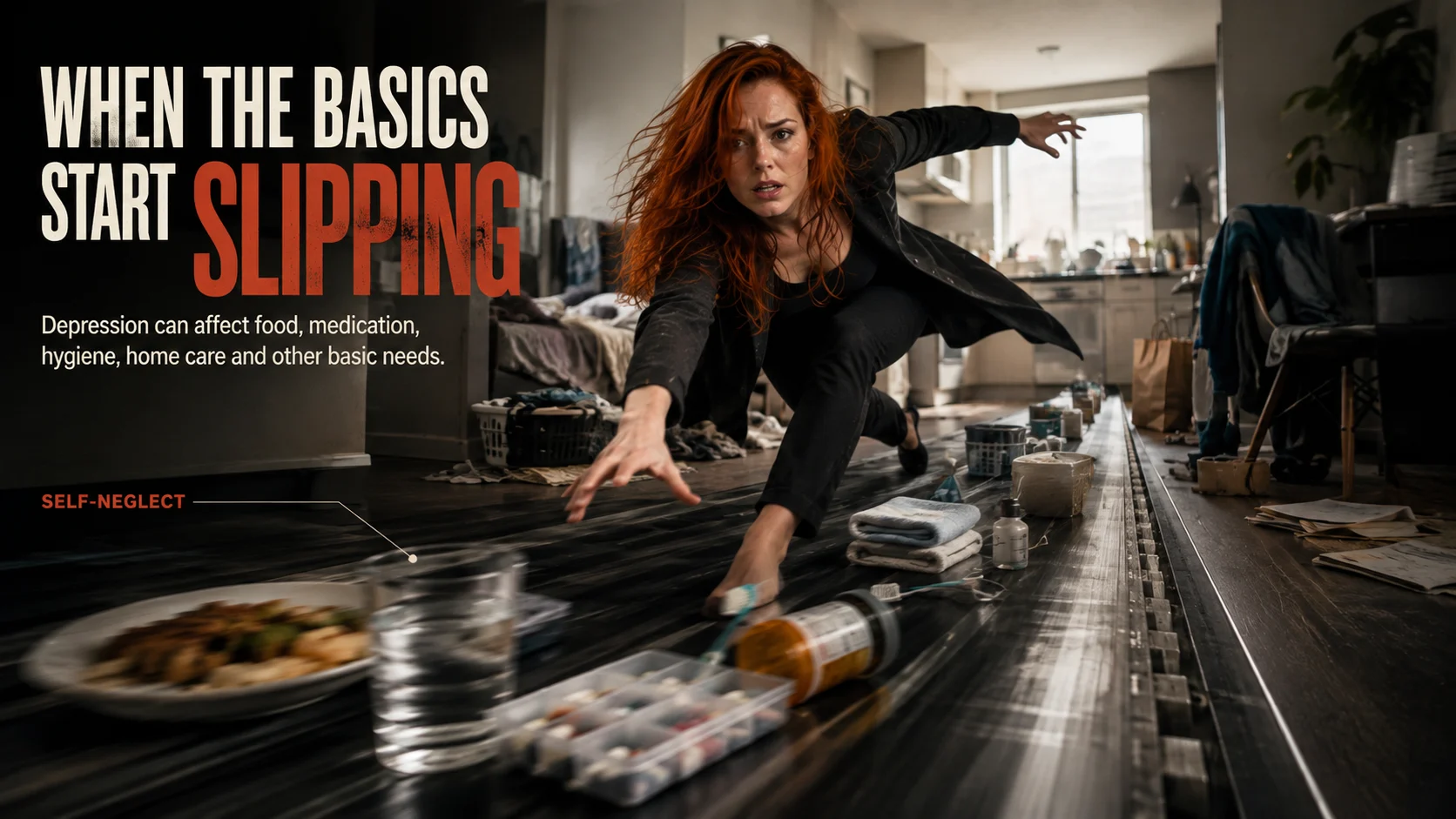
A missed shower or an untidy kitchen does not tell you much by itself. The more concerning pattern begins when several parts of ordinary care start disappearing together. Meals become irregular because preparing food feels impossible. Prescribed medication is repeatedly forgotten or left uncollected. Laundry accumulates until there are few clean clothes available. Bills, appointments, household repairs and health concerns remain untouched even when the person knows they matter. What once looked like a collection of separate unfinished tasks can gradually become a wider loss of day-to-day functioning.
Depression can contribute to this kind of self-neglect. The National Institute of Mental Health explains that depression can become severe enough to affect daily activities such as sleeping, eating and working. Low energy, reduced interest or pleasure, difficulty concentrating, slowed thinking, changes in appetite and feelings of hopelessness can all make ordinary care harder to initiate and sustain. When those difficulties spread across food, hydration, medication, hygiene, health needs and the home environment, the issue has moved beyond a single neglected routine.
Self-neglect also deserves careful language. It is an observable pattern of reduced care, rather than a diagnosis that automatically means someone has depression. The Social Care Institute for Excellence guidance on self-neglect describes self-neglect broadly in terms of serious difficulty caring for personal hygiene, health or surroundings, and related failures to obtain services or manage important personal affairs. Depression is one possible contributor, but physical illness, cognitive problems, substance use, other mental health conditions, disability, severe stress, poverty, isolation and problems accessing care can create similar outward signs.
This distinction matters because someone can be depressed without neglecting basic needs, and someone who is self-neglecting may have several causes that need to be understood. The useful question is therefore larger than “Why is this person not taking care of themselves?” It is: Which essential parts of life are no longer being maintained, what is making those tasks fail, and is the person’s health or safety beginning to depend on outside help?
Safety note: If someone is unable to maintain adequate food or fluids, is repeatedly missing medication that is important for a serious medical condition, cannot remain reasonably safe in the home, appears confused or medically unwell, or is at risk of harming themselves, the situation needs prompt professional assessment rather than waiting for motivation to return.
What Does Self-Neglect Mean When Someone Has Depression?

Self-neglect describes a deterioration in the person’s ability or willingness to meet important needs that protect health, safety and basic daily functioning. That may include washing and changing clothes, yet the concept extends much further. Nutrition, hydration, medication, medical appointments, safe living conditions, household sanitation, essential paperwork and the ability to obtain necessary supplies can all become part of the picture.
This broader definition is important for the depression cluster because depression and personal hygiene is a narrower issue. Someone may postpone showering, brushing their teeth or washing their hair because depression has made those activities unusually demanding while they are still eating, taking medication, paying bills and maintaining a reasonably safe home. That pattern deserves attention, but it does not automatically mean the person’s whole system of self-care is collapsing.
Self-neglect becomes a more useful description when deterioration spreads into several essential areas or when one failure has significant consequences. A refrigerator that contains very little usable food carries a different meaning from leaving a few dishes unwashed. Forgetting one vitamin is different from repeatedly missing medication whose timing matters. A basket of laundry waiting several days is different from having no clean clothes or bedding available. Context, duration, consequences and the person’s usual level of functioning matter far more than whether a home appears conventionally tidy.
One Neglected Task Does Not Define the Pattern
People sometimes use the term self-neglect too quickly. A difficult week, illness, bereavement, heavy workload or temporary exhaustion can leave almost anyone with an unwashed floor, takeaway containers on the counter or a pile of clothes waiting to be folded. There is also enormous variation in how people organize their homes and personal routines. A judgement based mainly on neatness can therefore miss the real clinical and practical issue.
A better way to look at the pattern is to ask what has changed from the person’s own baseline. Someone who normally cooks several times a week may now be eating crackers or skipping meals because opening the refrigerator creates another decision they cannot manage. Someone who has always disliked housework may still be functioning normally if essential areas remain usable and safe. Someone else may have a fairly tidy-looking apartment while quietly missing meals, medication and medical appointments. Self-neglect is often easier to recognize through lost function and accumulating consequences than through appearance alone.
This is one reason the home should not become the only measure. Depression-related self-neglect can remain largely invisible when the person is still able to present well at work or during brief social contact. The private deterioration may be happening in the bathroom, refrigerator, medication routine, bedroom, unopened mail and cancelled appointments. By the time other people notice obvious environmental deterioration, the person may already have been struggling with less visible forms of basic care for weeks or months.
The Pattern Matters More Than the Mess
A useful way to think about self-neglect is as a network of essential activities rather than a cleanliness score. Food supports energy and physical health. Medication may control an existing illness. Clean clothes, oral care and bathing protect comfort, dignity and sometimes health. A functioning kitchen and bathroom allow other care to happen. Appointments and prescription refills connect the person to services that may prevent a manageable problem from becoming more serious.
When depression disrupts several parts of this network, the effects can reinforce one another. Eating poorly may leave the person with even less energy for laundry or shopping. A badly disrupted sleep schedule can make appointments harder to attend. Accumulated dishes can make preparing food feel more complicated, so meals become even less regular. Shame about the condition of the home may then make someone reluctant to allow a friend, relative, clinician or repair worker inside.
This is where a page about self-neglect needs to go beyond describing symptoms. The important problem is functional accumulation. Each unfinished task changes the starting conditions for the next task. Washing one plate is relatively small. Washing it when the sink is already full requires clearing space first. Cooking a meal becomes harder when groceries have not been purchased. Taking medication becomes less reliable when sleep, meals and the usual daily cues have disappeared. A person may therefore experience a genuine increase in task difficulty even though the individual activities look simple from the outside.
Why Can Depression Cause Basic Self-Care to Break Down?
Depression does not usually remove knowledge of what needs to be done. Many people remain painfully aware that they should eat, shower, collect a prescription, wash bedding or respond to an important letter. The difficulty often occurs between knowing and doing. Symptoms can interfere with initiation, sequencing, energy, concentration, reward and the ability to keep repeating actions day after day.
That gap is easy for other people to misread. Reminders such as “just take a shower” or “just put a load of washing on” describe the physical action while overlooking the mental steps around it. A shower may require getting out of bed, finding clean clothes, tolerating the physical effort, adjusting the water, washing and drying, dealing with wet hair and putting everything away afterward. Grocery shopping involves identifying what is needed, deciding what to buy, leaving the home, navigating the shop, paying, carrying the food back and later turning those ingredients into meals. When several of those processes are impaired, an apparently basic activity can stop occurring reliably.
Low Energy Can Change the Cost of Ordinary Tasks
Fatigue and reduced energy are common features of depression. The NHS overview of depression in adults includes persistent tiredness, disturbed sleep and appetite changes among the physical ways depression can present. When energy is substantially reduced, people often protect whatever functioning feels most unavoidable. Work, childcare or a fixed appointment may consume what little capacity is available, while private tasks are repeatedly postponed.
This can create a misleading picture in which the person appears capable because they are still completing one highly structured responsibility. What disappears first may be everything surrounding that responsibility: cooking, cleaning, changing bedding, answering messages, making appointments or maintaining personal care. The remaining function does not prove that the neglected activities would be easy if the person tried harder. It may mean that the person’s available capacity is being spent in one place.
Physical heaviness and psychomotor slowing can add another layer. Someone may experience dressing, standing in the shower, preparing food or walking to a shop as unusually effortful. The task has not objectively become longer, yet the subjective and physical cost of completing it may have changed considerably.
Executive Dysfunction Can Interrupt the Sequence Before the Task Begins
Some self-care problems are less about physical exhaustion and more about organizing action. Depression can affect concentration, memory and decision-making, which are also reflected in the symptom descriptions provided by the National Institute of Mental Health. These difficulties can interact with executive functions needed to initiate, sequence and complete multi-step activities.
A person may stand in the kitchen and know they need to eat while being unable to convert that need into the next action. They may open the refrigerator, see several possibilities, feel unable to choose, close the door and return to bed. Medication can be present on the table while the normal cue to take it has disappeared. Laundry may be gathered without ever reaching the washing machine because another step interrupts the sequence.
The distinction is explored more deeply in depression and executive dysfunction, while depression and task paralysis focuses on situations where the person feels stuck at the point of starting. For self-neglect, the concern is what happens when these initiation failures repeatedly affect essential care. An isolated unfinished task is frustrating. Repeated failures involving eating, medication, hygiene or home safety can eventually create real health consequences.
Reduced Reward Can Make Maintenance Harder to Repeat
A large share of personal care consists of maintenance rather than one-time achievements. Dishes become dirty again. Clothes need washing again. Food needs buying again. Medication has to be taken again tomorrow. For people whose depression includes markedly reduced interest or pleasure, these repetitive activities can lose much of the small sense of reward or completion that normally helps everyday routines continue.
This does not mean that chores are supposed to be enjoyable. Most people do not derive strong pleasure from taking out rubbish or changing sheets. Everyday behavior is still supported by small rewards such as relief, comfort, predictability, satisfaction, anticipation of a meal, or the feeling that a task has been settled. When those signals become weak, repetitive maintenance may feel unusually empty and difficult to sustain.
That distinction also helps separate self-neglect from the narrower question of motivation. Depression and loss of motivation explains why wanting an outcome and being able to initiate behavior do not always move together. In self-neglect, the practical question is what happens when that motivational disruption reaches needs that cannot be postponed indefinitely.
Self-Neglect Can Affect More Than Personal Hygiene
Personal hygiene is often the first example people think of when depression and self-care are discussed. It is visible, familiar and easy to describe. Yet a person can continue showering while neglecting nutrition, medication or medical care. Another person may stop brushing their teeth long before their home deteriorates. Someone else may maintain clothing and grooming for work while privately surviving on very little food and sleeping in bedding that has not been changed for a long time.
A useful assessment therefore looks across several domains rather than asking only whether someone is bathing. Food and hydration matter because depression can change appetite and make shopping or meal preparation difficult. The NHS guidance on coping with depression specifically notes that some people lose interest in eating and may lose weight, while others experience the opposite pattern. Health management matters because missed prescriptions, unaddressed symptoms and cancelled appointments can allow existing conditions to worsen. Environmental care matters because kitchens, bathrooms, walkways, heating, waste and household repairs can eventually affect safety and the ability to complete other routines.
The severity is therefore determined less by whether one particular behavior is present and more by the overall pattern: How many essential needs are slipping? How long has the change lasted? What consequences are appearing? Can the person still correct problems when they become important? Is the environment making the next basic task harder?
Those questions move the discussion away from judgement and toward useful decisions about what kind of support may now be needed.
Food and Hydration May Be Among the First Essential Needs to Slip

Eating can deteriorate in several ways during depression. Some people lose appetite and no longer feel much internal pull toward food. Others still feel hunger but cannot organize shopping, decide what to eat, prepare a meal, wash the dishes needed to make it, or repeat the process several times a day. The practical result may look similar from the outside – meals become smaller, less frequent, less varied, or increasingly dependent on whatever requires almost no preparation.
This is where it helps to separate appetite from food access and task capacity. A person may say “I’m not hungry” when part of the difficulty is that eating has become a chain of decisions they do not have enough capacity to complete. Someone may own food but still eat very little because everything requires preparation. Another person may eat adequately when someone else provides a meal, yet struggle significantly when responsible for feeding themselves. That difference can reveal an important functional problem that a simple question about appetite would miss.
The NHS guidance on malnutrition notes that reduced appetite and a lack of interest in food and drink can occur alongside tiredness, weakness and poor concentration. Those symptoms can also interact with depression, creating a difficult cycle in which inadequate nourishment leaves the person with less physical capacity for the tasks that would improve the situation. Unplanned weight loss, increasing weakness, clothes becoming noticeably looser, or repeatedly going long periods without meaningful food deserve more attention than whether meals look nutritionally ideal.
The Important Question Is Whether the Person Can Reliably Feed Themselves
There is a practical difference between occasionally ordering takeaway because cooking feels exhausting and reaching a point where there is no dependable way to obtain enough food. The second pattern may involve an empty refrigerator, groceries repeatedly spoiling because they are never prepared, inability to shop, difficulty managing money for essentials, or dependence on snacks that happen to be within reach.
A useful assessment therefore asks what happens on a difficult day. Is there food that can be eaten with very little preparation? Can the person order groceries, accept food from someone else, or use another workable route when cooking is beyond their capacity? Are meals being skipped because of low appetite, because the kitchen has become unusable, because there is no food available, or because the sequence from hunger to eating keeps breaking down? Those situations may require different kinds of support even though all of them can produce the same statement: “I haven’t really eaten.”
This is also why moral language around food can be especially unhelpful. The immediate priority during a period of substantial self-neglect is often dependable nourishment, not culinary perfection. A simple meal that the person can actually obtain and eat may be more useful than an ambitious meal plan that adds shopping, preparation, washing and decisions to an already overloaded day.
Hydration Can Become a Separate Safety Issue
Drinking may receive less attention because it appears simpler than preparing food, yet hydration can also deteriorate when routines disappear. A person may remain in one part of the home for long periods without a drink nearby, stop noticing thirst until it becomes strong, sleep through much of the day, or avoid the kitchen because dealing with the environment feels overwhelming.
The NHS information on dehydration lists warning signs such as thirst, dark yellow urine, urinating less often, dizziness, tiredness and a dry mouth. More concerning symptoms can require urgent medical advice. If a person is becoming unusually drowsy, confused, persistently dizzy, unable to keep fluids down, or showing other signs of significant dehydration, the situation should be treated as a health problem rather than simply another self-care task that can wait.
For someone supporting a depressed person, putting a drink within easy reach can be useful because it removes several steps from the task. The broader principle matters throughout self-neglect: when essential care is failing, reducing the distance between the person and the action may be more effective than repeatedly explaining why the action is important.
Medication Problems Can Turn Self-Neglect Into a Medical Risk
Medication introduces a different level of concern because the consequences of missed doses vary widely. Forgetting an occasional low-risk medicine is not equivalent to repeatedly missing treatment for epilepsy, diabetes, cardiovascular disease, severe asthma or another condition where interruption could have significant consequences. Antidepressants and some other medicines can also produce problems when doses are missed or treatment is stopped abruptly, depending on the medication and circumstances.
Depression can interfere with medication routines in several ways. The person may forget whether they have taken a dose, lose the daily cue that previously reminded them, stop collecting prescriptions, sleep through the usual time, feel too overwhelmed to arrange a refill, or become increasingly disengaged from their health. Sometimes the medication remains sitting visibly on a table. The barrier is still real because remembering, deciding and acting are separate parts of the process.
The NICE guidance on medicines adherence recommends discussing adherence without judgement and finding out what kind of support the person would prefer. That approach fits particularly well when depression is involved. Repeated questions such as “Why didn’t you take it?” can produce defensiveness or shame without revealing what actually failed. A more useful investigation looks for the broken step: Was the medicine unavailable? Was it forgotten? Was the schedule confusing? Were side effects creating reluctance? Did the person intentionally stop because of a concern they had not discussed?
Do Not Guess What to Do After a Missed Dose
There is no universal missed-dose rule that is safe for every medicine. Instructions depend on the drug, dose and timing. If someone has missed medication, the patient information leaflet, pharmacist, prescriber or other appropriate clinician should be used to determine what to do next rather than improvising a catch-up schedule.
This becomes particularly important when several doses have been missed, the medicine has withdrawal implications, the medication controls a serious condition, or the person cannot clearly remember what they have taken. The NHS medicines guidance for carers also cautions against taking a double dose later simply to compensate for a missed one unless specific professional instructions say otherwise.
Medication self-neglect therefore needs two responses at the same time. The immediate medication question needs safe clinical advice, while the recurring functional problem needs attention so the same failure is less likely tomorrow. That may involve simplifying cues, arranging repeat prescriptions, using a pill organizer when appropriate, linking medication to a reliable daily activity, or involving another person with the individual’s agreement. The exact system should fit the medication and the person rather than assuming one reminder method works for everyone.
Medical Appointments and Physical Symptoms Can Also Be Neglected

Self-neglect sometimes becomes visible through what is no longer being followed up. Dental pain persists without an appointment. A prescription runs out. A wound is ignored. Letters requesting tests remain unopened. A person repeatedly cancels appointments because getting dressed, travelling, waiting and explaining the problem feel overwhelming. Symptoms that would once have prompted action become part of the background.
This can be particularly difficult because depression may alter expectations about the future. If someone feels hopeless, exhausted or detached from themselves, preventing a problem that might worsen next month may have very little psychological pull today. Reduced concentration can also make healthcare administration difficult: remembering dates, locating documents, arranging transport, responding to calls and following instructions may all become barriers.
The outward behavior can resemble indifference, yet the underlying process may involve several different failures. Some people are afraid of what a clinician might find. Some feel ashamed that they allowed a problem to progress. Others intend to book an appointment every day and repeatedly fail at the initiation stage. A useful response depends on identifying which barrier is operating instead of treating every missed appointment as the same behavior.
When physical symptoms are new, worsening or potentially serious, they should not automatically be attributed to depression. Depression can coexist with physical illness, medication effects and other medical conditions. The role of a mental-health explanation is to help understand why care may be harder to access, not to make unexplained physical symptoms less worthy of assessment.
The Home Can Gradually Stop Supporting Daily Life
A deteriorating home is one of the most visible forms of self-neglect, but appearance alone can be misleading. Some people naturally tolerate more clutter than others. A home does not need to look professionally organized to be healthy or functional. The more useful question is whether the environment still allows essential activities to happen safely.
A kitchen can become functionally impaired when there is no clear place to prepare food, the sink cannot easily be used, rubbish prevents normal cleaning, or there are few clean dishes available. A bedroom may become harder to use when clean bedding is unavailable or objects block access around the bed. A bathroom problem becomes more significant when there are no clean towels, basic toiletries have run out, or accumulated items make bathing difficult.
Research summarized by the Social Care Institute for Excellence on self-neglect treats the condition of the environment as one possible component of self-neglect alongside personal care and health. This broader framing helps avoid a common mistake: assuming the visible clutter is the whole problem. The environment may actually be the accumulated record of hundreds of smaller failures involving energy, initiation, decision-making, shopping, cleaning, disposal and maintenance.
Clutter Can Become Both a Result and a New Barrier

Once the environment becomes harder to use, yesterday’s unfinished task increases the cost of today’s task. A full sink means preparing breakfast begins with washing something. Laundry on the floor means walking across the room takes more attention. An overflowing bin means disposing of one new item first requires dealing with the entire bag. Unopened mail creates a growing pile in which the genuinely important letter becomes harder to identify.
This creates a form of practical friction. The person is no longer beginning each task from a neutral starting point. They are beginning from the consequences of previous incomplete tasks, which makes apparently small activities increasingly complicated. That distinction can help family members understand why telling someone to “do one thing at a time” may still be difficult when one thing now contains several prerequisite steps.
It also explains why a small amount of practical help can sometimes have disproportionate value. Clearing one safe path, creating one usable food-preparation surface, washing enough clothes for several days, or removing accumulated rubbish may reduce the number of steps required for future care. The goal is not to produce a perfect home in one afternoon. It is to restore enough function that ordinary care becomes more reachable again.
When Does Depression-Related Self-Neglect Become Serious?

There is no single number of missed showers, meals or household tasks that marks a universal threshold. Severity depends on consequences, persistence, the person’s baseline, their ability to recover when something becomes important, and whether essential health or safety needs are being compromised. A person may have an untidy home and remain medically safe, while another person in a tidy apartment may be experiencing significant nutritional or medication-related self-neglect.
The Social Care Institute for Excellence safeguarding guidance identifies self-neglect as particularly concerning when lack of care threatens health or safety, when personal health and surroundings are substantially neglected, or when the person is failing to access needed services. This is a useful way to think about escalation because it focuses on impact rather than appearance.
Several changes deserve closer attention when they persist or worsen:
- food intake has become consistently inadequate or there is significant unintended weight loss
- fluid intake is poor enough that signs of dehydration are appearing
- important medication is repeatedly missed, unavailable or being taken unpredictably
- necessary medical or dental care is repeatedly avoided despite worsening symptoms
- the kitchen, bathroom, heating, electricity or sleeping area is no longer reasonably usable
- rubbish, spoiled food, blocked walkways, fire hazards or sanitation problems are creating safety concerns
- the person is becoming increasingly isolated because they do not want anyone to see the condition of themselves or the home
- essential money, bills, prescriptions or supplies are no longer being managed
- the person appears increasingly confused, weak, medically unwell or unable to explain how basic needs are being met
The presence of one item does not automatically define severity. The pattern becomes more concerning when several domains are deteriorating together, consequences are accumulating, and the person has decreasing ability to correct the situation independently.
A Useful Test Is to Ask What Happens If Nothing Changes for Another Week
Looking only at today’s situation can underestimate the direction of travel. A half-empty refrigerator may not be dangerous today, but what happens if no groceries are obtained for another week? Missing one appointment may have limited consequences, but what if every follow-up continues to be cancelled? A cluttered hallway may still be passable, but is the pathway becoming narrower as new items accumulate?
This forward-looking question helps distinguish inconvenience from an emerging risk. It also avoids waiting until conditions become extreme before support is considered. Self-neglect often develops incrementally. There may never be a dramatic moment when the person suddenly stops caring for themselves. Instead, ordinary safeguards quietly disappear one after another until maintaining food, medication, hygiene, healthcare and a usable home requires more capacity than the person currently has.
The same principle applies in the opposite direction. If one small intervention changes the trajectory – groceries arrive, medication becomes organized, clean bedding is available, an appointment is attended – the person’s remaining capacity may become easier to use. Serious self-neglect therefore does not always require solving every problem simultaneously. It requires identifying which failures are carrying the greatest health or safety consequences and which practical obstacles are making the rest of daily life unnecessarily difficult.
How to Help Someone Who Is Self-Neglecting Without Shaming Them

Helping someone with self-neglect can be difficult because the visible problem often creates an understandable urge to act immediately. A relative sees food containers accumulating, realizes medication has been missed, or discovers that the refrigerator is nearly empty and wants to fix everything at once. The person who is struggling may experience that same intervention as exposure, criticism or loss of control, especially if they already feel ashamed about how far things have deteriorated.
The NHS guidance on helping someone with depression recommends listening without judgement, staying in contact and offering practical support. That approach is particularly important with self-neglect because shame can become another barrier to accepting help. Statements about how someone “should” be living may increase defensiveness without solving the reasons food, medication, hygiene or household care have become difficult.
A more useful starting point is to describe what you have noticed and connect it to wellbeing. “I’ve noticed there doesn’t seem to be much food here, and I’m concerned you may not be eating enough” is more informative than “You have let yourself go.” “Would it help if I came with you to collect the prescription?” gives the person something concrete to accept or decline. The goal is to understand where functioning is breaking down and reduce the most important barriers without turning the person’s life into a project being managed around them.
Start With Health and Safety Before Appearance
When several needs have deteriorated, the most visible problem may not be the most important one. A large pile of laundry immediately attracts attention, yet inadequate fluids, interrupted medication, lack of food, unsafe heating, a worsening wound or an untreated medical condition may carry greater immediate consequences. Cleaning the home first can therefore produce a dramatic visual improvement while leaving the more serious risk unchanged.
A practical order of attention begins with what could cause harm if it continues. Is the person drinking enough? Is there usable food? Are important medicines available and being managed safely? Is there a clear route through the home? Are the bathroom, sleeping area, electricity and heating usable? Is there a medical problem that has been ignored? Once immediate risks have been identified, less urgent maintenance can be tackled without making the entire situation feel like one enormous task.
This approach also protects the person’s dignity. A supporter does not need to restore the apartment to their own standard of tidiness before useful care can begin. Making one food-preparation surface usable, ensuring several simple meals are available or clearing one safe pathway may improve daily functioning more than spending hours reorganizing possessions that are not currently causing harm.
Offer Specific Help Instead of Saying “Let Me Know If You Need Anything”
Broad offers of help sound kind, but they place another decision on someone who may already be struggling to identify and organize the next step. A person experiencing depression-related executive dysfunction may genuinely appreciate the offer while being unable to convert “anything” into a specific request. The result can be that both people wait, even though practical assistance would have been welcome.
Specific choices reduce that burden. Someone might ask whether it would help to bring two easy meals, sit nearby while a prescription refill is arranged, drive the person to an appointment, take one bag of rubbish out, or run one load of laundry. Each offer describes a bounded action with a visible beginning and end. The person still has control over whether to accept it, but they do not have to design the support from scratch.
This principle can also reveal what kind of difficulty is operating. If someone readily eats food that is delivered but cannot shop or cook, food preparation may be the main barrier rather than appetite. If medication becomes reliable when a daily reminder is introduced, the problem may be cueing rather than opposition to treatment. If someone refuses all help involving the home but accepts support with appointments, shame or privacy may be influencing which forms of assistance feel tolerable.
Restore Function Before Trying to Restore the Whole Routine
When self-neglect has become substantial, attempting to rebuild an ideal daily routine immediately can create more failure. A plan that includes showering every morning, cooking three balanced meals, exercising, cleaning the apartment, answering all correspondence and maintaining a perfect sleep schedule may look healthy on paper while requiring far more capacity than the person currently has. Repeatedly failing such a plan can reinforce the belief that recovery is impossible.
A more workable approach is to restore the functions that allow other functions to happen. A usable kitchen makes eating easier. Clean clothes reduce one barrier to leaving the home. A charged phone makes appointments and support accessible. Medication placed within an established routine may become easier to remember. Removing rubbish from one essential area can make the next household task less complicated.
This is a different objective from creating an aesthetically tidy life. During significant self-neglect, the first measure of progress is whether the person can eat, drink, sleep, take essential medication safely, use the bathroom, move through the home, access healthcare and obtain basic supplies with less friction than before. Once those functions become more reliable, broader routines have something stable to build upon.
Use a Minimum-Care Day When Capacity Is Very Low
Some days will allow more activity than others. A person who can shop, shower and clean on one day may have very little capacity the next morning. Treating every day as though the same amount of functioning should be available can make self-care plans brittle. A minimum-care day provides a lower level of essential maintenance for periods when symptoms are particularly heavy.
The minimum should be based on the person’s actual health needs rather than a universal checklist. It might involve obtaining enough fluid, eating something accessible, handling medication according to the prescribed plan, keeping one safe route through the home and responding to a health issue that cannot safely wait. Optional household tasks can be deferred when necessary, while essential needs receive the available energy first.
This approach should not become permanent acceptance of worsening self-neglect. Its purpose is to prevent a difficult day from turning into several days of accumulated consequences. When capacity improves, more of the routine can return. When minimum care cannot be maintained repeatedly, that is useful information in itself because it suggests the person may need more support than a self-directed routine can provide.
Why Cleaning Everything at Once Can Backfire
A dramatic clean-up can sometimes be necessary when there is an immediate environmental hazard, but as a general response it may solve the appearance of self-neglect without changing the mechanisms that created it. If someone else removes every bag, washes every dish, reorganizes every cupboard and replaces all supplies in one day, the home may look transformed. The person may still be unable to initiate laundry, buy food, manage medication or dispose of rubbish once the helper leaves.
There can also be an emotional cost when belongings are moved or discarded without meaningful agreement. The person may feel invaded, embarrassed or afraid that accepting future help means losing control over their environment. This can damage the relationship that might otherwise become one of the strongest routes back to regular support.
The better question is what intervention will make tomorrow easier. Washing every item in the home may be less useful than ensuring there are enough clean clothes for several days. Completely reorganizing the kitchen may be unnecessary if clearing the sink and one work surface restores the ability to prepare food. The intervention should reduce functional obstacles while preserving as much participation and choice as the person’s condition allows.
Doing a Task Together Can Be More Useful Than Taking It Away
Some people benefit from another person’s presence even when they do not need that person to perform the entire task. Sitting at the table while an appointment is booked, folding clothes together, accompanying someone to the grocery shop or beginning the first few minutes of cleaning alongside them can reduce initiation demands. The action becomes shared without making the struggling person a passive observer.
This can be particularly helpful where depression and task paralysis are contributing to self-neglect. The person may know what needs doing and even have enough physical energy once the task begins, yet remain repeatedly stuck before initiation. A supporter can sometimes provide structure, momentum and a defined stopping point without becoming permanently responsible for the activity.
The balance will vary. Someone who is medically unwell or experiencing severe depression may temporarily need much more direct practical help. Someone else may regain confidence faster when they retain an active role. Support should therefore respond to actual functioning rather than following a fixed rule about how independent a depressed person ought to be.
Self-Neglect Should Not Automatically Be Explained as Laziness
“Laziness” is a poor clinical explanation because it says very little about why a necessary activity is repeatedly not occurring. Two people can leave the same dishes unwashed for entirely different reasons. One simply prefers to do them tomorrow and remains comfortable with that decision. Another is distressed by the growing pile, thinks about it repeatedly, attempts to start several times and feels increasingly overwhelmed as the kitchen becomes harder to use.
The difference becomes clearer when consequences appear. A person who freely chooses not to vacuum this week may still be functioning normally. Someone who repeatedly goes without food because the kitchen can no longer be used, misses necessary medication, cannot obtain clean clothes or avoids medical care despite worsening symptoms is facing a different problem. Calling the pattern laziness risks replacing investigation with judgement.
Depression may contribute through low energy, psychomotor slowing, executive dysfunction, diminished reward, impaired concentration, hopelessness or combinations of these factors. Other causes can produce similar functional deterioration, which is why significant self-neglect should not be attributed to depression solely because the person has a history of low mood.
A Person Can Care Deeply and Still Be Unable to Act Reliably
One of the most painful features of self-neglect is that awareness may remain intact. Someone may be embarrassed about their teeth, frightened about missing medication, upset by the condition of their bedroom and worried that they are eating badly. They may spend substantial mental energy thinking about these problems without converting that concern into consistent action.
This mismatch can create intense self-criticism. The person sees the evidence of unfinished care every day and interprets it as proof of personal failure. Shame consumes more energy, visitors become harder to tolerate, and asking for help becomes increasingly uncomfortable. The original functional problem is then joined by an interpersonal problem: the person begins hiding the evidence that would allow others to understand how much support is needed.
Recognizing this pattern does not mean removing all responsibility from the individual. It means choosing interventions that address the actual barrier. Responsibility becomes useful when it is paired with a realistic route to action rather than used as another reason for the person to feel ashamed.
Self-Neglect Can Become Hidden Behind High Functioning
A person does not need to appear obviously incapacitated for meaningful self-neglect to be occurring. Some people continue attending work, answering professional messages or caring for other people while progressively reducing care for themselves. Structured obligations may survive because deadlines, external expectations and other people’s needs create cues that private self-care lacks.
The cost becomes visible after the public part of the day ends. The person returns home and does not cook, shower or change clothes. Weekends disappear into sleep and recovery. Medical appointments are postponed because missing work feels impossible. Groceries are repeatedly ordered at the last moment, medication runs out, unopened mail grows and the home gradually becomes harder to manage.
This pattern can delay recognition because other people see evidence of competence. A colleague sees someone arriving at meetings and assumes the rest of life is functioning similarly. A relative receives a carefully composed message and does not see the refrigerator, medication supply or bedroom. The person’s remaining areas of performance can therefore mask the extent to which basic private needs are deteriorating.
Look for the Cost of Maintaining the Part That Still Works
Instead of asking only whether someone can still work or meet responsibilities, it can be useful to ask what those responsibilities are costing. Does the person spend every non-working hour recovering? Are meals, hygiene, laundry or appointments routinely sacrificed to maintain employment? Does a single obligation consume nearly all of the day’s available capacity?
This distinction is particularly relevant when productivity hides depression. Continued productivity can coexist with significant impairment elsewhere. The fact that one highly structured domain remains intact does not establish that the person has enough capacity for everything else.
If self-neglect is developing behind apparently competent functioning, intervention may need to happen before public performance collapses. Waiting until the person can no longer work can mean waiting until several private systems have already been deteriorating for a long time.
When Professional Assessment Becomes Important
Professional help is appropriate when self-neglect is persistent, worsening, causing significant distress or affecting health and safety. It becomes particularly important when several essential needs are deteriorating together, when the person cannot reliably reverse the pattern despite trying, or when depression appears severe enough to interfere substantially with ordinary daily functioning.
The NICE guideline on depression in adults emphasizes assessing how depression affects personal, social and occupational functioning rather than looking only at the number of symptoms. A useful clinical assessment may therefore explore mood alongside sleep, appetite, concentration, energy, daily functioning, physical health, medications, alcohol or drug use, social circumstances and safety. The purpose is to understand the whole pattern rather than assume that every neglected task has the same explanation.
Assessment is also valuable because self-neglect can have contributors other than depression. Physical illness, chronic pain, cognitive decline, medication effects, substance use, psychosis, severe anxiety, trauma, neurodevelopmental difficulties, mobility limitations and social conditions can change a person’s ability to care for themselves. Sometimes several factors are present at once. Treating depression alone may therefore improve part of the problem while leaving important practical or medical barriers unresolved.
Treatment May Need to Address Both Depression and the Consequences Around It
Treatment for depression can include psychological therapies, medication, supported self-help and other approaches depending on severity, previous treatment, preferences and clinical circumstances. The NHS overview of depression treatment explains that recommended treatment varies according to the type and severity of depression. A clinician can help determine which options are suitable for an individual rather than assuming that one treatment pathway fits everyone.
When self-neglect is already substantial, treating the depression and restoring everyday functioning may need to happen in parallel. Therapy does not immediately wash bedding, replenish food or resolve a missed prescription. Practical support does not by itself address a depressive episode. Someone may therefore need clinical treatment while relatives, community services or other appropriate support help stabilize the parts of daily living that have already deteriorated.
This distinction can prevent unrealistic expectations. A person may begin treatment and still need help with meals or appointments for some time. Improvement is rarely proven by whether the apartment becomes perfect. More meaningful early signs include eating more reliably, missing fewer essential tasks, responding to health needs sooner, maintaining a usable living space and recovering the ability to correct small problems before they accumulate.
When Someone Refuses Help
Refusing assistance does not automatically mean that someone is incapable of making decisions. Adults may make choices about their own lives that relatives or professionals strongly disagree with. At the same time, severe self-neglect can raise difficult questions when there is concern that illness, cognitive impairment or another condition is affecting the person’s ability to understand, weigh or carry out decisions related to their care.
The Social Care Institute for Excellence guidance on mental capacity, liberty and autonomy emphasizes respect for autonomy where there is no evidence that a person lacks decision-making capacity. Capacity and safeguarding law differ between jurisdictions, so families should not try to make legal judgements themselves based simply on how unusual or risky someone’s choices appear. Where there is substantial concern about capacity, serious neglect or immediate safety, appropriate health, social-care or emergency services should be asked to assess the situation.
If the person has capacity and is refusing broad help, maintaining contact may still be valuable. A rejected offer to clean the apartment does not mean every form of support will be rejected. The person may accept groceries, transport, help contacting a doctor or simply regular visits. Preserving trust can create opportunities for later intervention that disappear if every interaction becomes an argument about the condition of the home.
Concern Should Escalate When the Person Can No Longer Keep Themselves Safe
There is an important difference between living in a way that others dislike and being unable to maintain basic safety. Concern becomes more urgent when food or fluids are seriously inadequate, significant medication is being mismanaged, untreated illness is worsening, the person cannot safely move around the home, utilities needed for basic living are unavailable, fire or sanitation risks are substantial, or confusion and physical deterioration are increasing.
The Social Care Institute for Excellence overview of safeguarding and self-neglect describes self-neglect as particularly relevant when lack of self-care threatens personal health and safety. In situations where danger appears immediate, waiting for the person to become more motivated is not an adequate safety plan. The appropriate response depends on the nature of the risk and local services, but urgent medical or safeguarding assessment may be necessary.
Self-neglect should also be considered alongside suicide and self-harm risk when depression is severe. Someone can neglect themselves without wanting to die, and the two should never be treated as interchangeable. However, expressions of wanting to die, active suicidal thinking, recent self-harm, inability to stay safe or rapidly worsening mental state require urgent mental-health assessment regardless of how tidy the home appears.
Recovery From Self-Neglect Usually Happens Unevenly
Improvement rarely means every part of daily life returns at the same speed. A person may begin eating more consistently while the apartment remains disorganized. Medication may become reliable before personal hygiene improves. Someone may attend medical appointments again but still depend on prepared food because shopping and cooking remain difficult. These differences matter because recovery can be underestimated when people look only at the most visible part of the problem.
The first improvements are often functional rather than dramatic. The refrigerator contains usable food again. A prescription is collected before it runs out. Clean clothes are available even though the rest of the laundry is unfinished. One kitchen surface remains usable. An appointment that would previously have been cancelled is attended. These changes may look small compared with the overall amount of unfinished care, yet they indicate that important systems are beginning to work again.
This is also why expecting a sudden return to someone’s previous standard can create unnecessary pressure. Self-neglect may have accumulated over weeks or months, and the consequences often have to be unwound gradually. Restoring basic function first gives the person a more stable starting point from which broader routines can be rebuilt.
Progress Is Better Measured by Reliability Than Perfection
A useful recovery question is not whether someone completed a task once. It is whether essential care is becoming more dependable across ordinary and difficult days. Preparing one elaborate meal after several days of barely eating may be encouraging, but having several simple foods available that can be eaten consistently may represent a more meaningful improvement in daily functioning.
The same distinction applies to the home. A large clean-up can create a visually impressive result, yet the stronger sign of recovery is whether rubbish is removed before it becomes overwhelming, dishes remain usable, laundry does not repeatedly reach crisis point and basic supplies are replaced before they run out. Reliability reduces the amount of accumulated work that tomorrow’s version of the person has to face.
Medication and healthcare follow the same pattern. One attended appointment is useful. A developing system for noticing symptoms, arranging follow-up and collecting medication before it runs out suggests that self-management is becoming more stable. Recovery therefore involves restoring the ordinary maintenance loops that prevent small problems from becoming larger ones.
Prioritize the Needs That Carry the Greatest Consequences
When several areas have deteriorated, trying to repair everything simultaneously can make it difficult to know where to begin. A more useful approach is to rank needs by consequence rather than by visibility. The untidy living room may be the first thing another person notices, while inadequate food, missed medication or an untreated medical problem may deserve attention sooner.
A practical priority system can separate needs into three broad levels. The first includes issues that can affect health or immediate safety, such as inadequate fluids, important medication problems, serious physical symptoms, dangerous household conditions or inability to obtain food. The second includes functions that make other care possible, such as a usable kitchen, clean clothes, working utilities, transport to appointments and access to basic supplies. The third includes lower-risk maintenance and organization that can usually wait until the first two levels are more stable.
| Priority | Examples | Why It Matters |
|---|---|---|
| Health and safety first | Food, fluids, important medication, urgent medical problems, heating, electricity, safe movement through the home | Failure can create direct medical or safety consequences and may require professional help. |
| Restore essential function | Clean clothes, usable bathroom, clear food-preparation area, groceries, phone access, transport, prescription collection | These functions reduce the number of barriers surrounding everyday care. |
| Rebuild maintenance | General cleaning, organizing belongings, routine paperwork, deeper household maintenance | These tasks matter, but many can wait until immediate needs and core daily functions are more stable. |
This framework is deliberately practical rather than diagnostic. It helps prevent the common situation in which the most noticeable mess becomes the focus while less visible health needs continue deteriorating. It also gives supporters a way to make the situation smaller: identify the highest-consequence failure, improve that area, then reassess what has become easier.
One Restored Function Can Unlock Several Others
Some interventions create benefits beyond the task itself. Clearing one section of the kitchen may make breakfast possible, which may improve energy for an appointment later that day. Having clean clothes available may reduce one reason for avoiding the pharmacy. Charging the phone may allow the person to respond to a clinician, order groceries and remain connected to someone providing support.
These relationships matter because self-neglect is often treated as a collection of separate failures. In practice, the failures can be connected. An unusable kitchen affects food. No food may affect energy. Low energy may make bathing or shopping harder. Avoiding visitors because of the condition of the home can reduce social support. A small improvement at an important point in this chain may therefore produce more value than several unrelated tasks completed at once.
When deciding what to do first, ask which improvement would remove the greatest amount of friction from the rest of the day. The answer may be surprisingly modest. It could be making the bed usable, placing water within reach, arranging a grocery delivery, setting up the next prescription or clearing a path between the bedroom and bathroom.
Personal Hygiene Is Part of Self-Neglect, but It Should Not Define the Whole Problem
Personal hygiene deserves attention because bathing, oral care, grooming and clean clothing can all deteriorate during depression. However, treating hygiene as the main measure of self-neglect can create both false reassurance and unnecessary judgement. Someone may shower regularly while eating very little and repeatedly missing medication. Another person may go several days without showering while continuing to eat, manage treatment and maintain a safe home.
The narrower hygiene problem is explored in depression and personal hygiene, where the focus is on why showering, brushing teeth, changing clothes and grooming become difficult. The self-neglect question begins when the wider system of basic care needs to be examined. Food, hydration, health management, household function and the ability to obtain essential services become equally important.
This distinction also protects the site from turning one symptom into a label for severity. Poor grooming may be distressing without representing the most medically significant problem. Conversely, a person who appears well groomed may still be experiencing serious deterioration behind closed doors. The assessment should follow function rather than appearance.
A Cleaner Appearance Does Not Always Mean the Person Is Doing Better
People often learn which signs of difficulty are visible to others and concentrate their remaining capacity on those areas. Someone may wash their hair before work, wear clean clothes and appear composed while privately skipping meals, sleeping on an unmade bed and postponing medical care. The social presentation is real, but it represents only one part of functioning.
This can be especially relevant when the person’s job or family role requires them to look organized. Maintaining that outward standard may consume a disproportionate amount of energy. When they return home, there may be very little capacity left for food preparation, cleaning or medication management. The absence of visible neglect in public therefore should not be used to dismiss what the person reports about their private functioning.
A better question is whether maintaining the outward appearance has become sustainable. If doing so repeatedly requires sacrificing essential needs elsewhere, the person may still need substantial support even though casual observers would not recognize the problem.
Common Responses That Can Make Self-Neglect Harder to Address
Well-intended reactions can sometimes increase the barriers around self-neglect. One common response is to focus heavily on willpower. Telling someone that the situation would improve if they simply became more disciplined assumes the main barrier is unwillingness. That explanation may miss reduced energy, cognitive difficulty, task initiation problems, physical illness, hopelessness or other factors that require a different response.
Another problem is overwhelming the person with a complete list of everything that needs attention. A relative may notice the laundry, kitchen, bathroom, unopened mail, groceries and missed appointments and describe all of them in one conversation. The list may be accurate, yet hearing the entire backlog at once can make the problem feel even less manageable. Prioritizing one or two high-value actions creates a clearer starting point.
Shame is particularly counterproductive. Comments about smell, appearance, laziness or the state of the home may cause someone to hide the problem more carefully rather than improve it. Once concealment begins, the person may stop inviting people inside, avoid healthcare visits and become less willing to discuss food or medication. The supporter then loses access to information that could have helped identify whether the situation was becoming dangerous.
Do Not Treat Every Form of Help as Equally Useful
Cleaning is one of the most obvious ways to help, but it may not address the most important barrier. Someone might benefit more from transportation to a medical appointment, grocery delivery, help making a phone call, arranging prescription collection or sitting with them while they begin a task. Useful support responds to the point where functioning is actually failing.
The person should also be involved wherever possible. If someone else reorganizes an entire kitchen according to their own system, the space may become visually better while becoming harder for the person to navigate. If possessions are discarded without discussion, future help may be refused because accepting support now feels associated with losing control.
The most effective practical assistance usually has a defined purpose. Restore one usable area. Make several days of food accessible. Get essential medication back on track. Clear a hazard. Create clean clothing for the immediate future. Once that purpose has been achieved, the next priority can be chosen rather than assuming the whole home must be solved before the intervention counts as successful.
How to Rebuild Daily Care After a Period of Self-Neglect
Rebuilding works better when routines are designed for the person’s current capacity rather than their best historical period. Someone who previously cooked every night may temporarily need meals that require almost no preparation. Someone who once maintained a detailed morning routine may begin with washing, medication and clean clothes before adding anything else. Simplification can protect essential care while symptoms remain significant.
The broader rebuilding process is explored in how to rebuild daily routines after depression. In the context of self-neglect, the first objective is to prevent essential needs from repeatedly reaching crisis point. That may involve stocking foods that remain easy to eat on low-capacity days, creating a reliable medication system, reducing the amount of clothing that needs active management, arranging recurring deliveries or putting commonly needed items where they are easy to see and reach.
A routine becomes useful when it survives imperfect days. Systems that depend on high motivation, strong memory and several consecutive decisions are vulnerable when depression worsens. Systems with fewer steps, visible cues and backup options require less capacity to maintain.
Build Backups for the Days When the Main Routine Fails
A useful self-care system assumes that difficult days will occur. Instead of relying on one ideal way of meeting each need, establish a lower-effort alternative. If cooking is the normal plan, keep simple food available for days when cooking does not happen. If medication is normally linked to breakfast, consider what reminder will work when breakfast is skipped. If laundry is usually done on a particular day, keep enough clean essentials that one missed cycle does not immediately create a crisis.
The same approach applies to healthcare and support. Save important contact numbers where they can be found easily. Keep transportation alternatives in mind for appointments. Arrange repeat prescriptions or reminders where clinically appropriate. If one trusted person already understands the pattern, agreeing in advance on what kind of check-in is acceptable can reduce the effort required to ask for help when symptoms worsen.
Backups are not evidence that the person expects to fail. They acknowledge that depression can fluctuate. A resilient routine has enough flexibility to continue protecting basic needs even when the person’s available energy and concentration change.
Signs That Self-Neglect May Be Improving
Improvement can often be recognized before the person feels fully recovered. Essential tasks begin happening before they become urgent. Food is obtained before supplies are exhausted. The person notices that medication is running low and arranges more. A missed shower does not turn into a prolonged period without personal care because the routine restarts sooner.
Another positive sign is reduced accumulation. One unfinished task remains one task rather than becoming the prerequisite for several more. A few dishes are washed before the sink becomes unusable. Laundry is handled before clean clothing runs out. Mail is opened often enough that important items can be identified. These changes indicate that the person is recovering some ability to prevent small problems from multiplying.
Help may also become easier to accept. Shame can decrease as the situation becomes less overwhelming, allowing the person to tell someone when food is running low or when an appointment feels difficult. This willingness to involve other people can be an important protective factor because support is available earlier rather than only after conditions have become severe.
A Setback Does Not Automatically Mean the Whole Recovery Has Failed
Depression fluctuates, and self-care may fluctuate with it. A difficult week can lead to more dishes, skipped routines or cancelled plans even after meaningful improvement. The key question is whether the person can recognize the change and return to basic maintenance sooner than before.
Recovery becomes more fragile when one setback rapidly recreates the previous pattern. If several difficult days lead immediately to inadequate food, missing medication and an unusable home, the system may need stronger backups or additional support. If the person can maintain essential care despite reduced capacity, the underlying routine is becoming more resilient.
Looking at the direction over several weeks is usually more useful than evaluating one day. Sustainable improvement is often quiet: fewer emergencies, fewer essential items running out, less accumulation, faster correction of problems and more willingness to ask for help before the situation becomes overwhelming.
When Self-Neglect Is a Signal That Depression Needs Reassessment
A noticeable decline in basic care can be useful clinical information. If someone who previously managed food, medication, hygiene and their home begins losing several of those functions, the change may indicate that depression has worsened or that another problem is affecting them. This is particularly important when the decline is new, rapid or significantly different from the person’s usual pattern.
Reassessment can also help when treatment has improved mood without restoring functioning. Someone may report feeling less distressed yet remain unable to manage meals, appointments or medication. Another person may become more active while still struggling with concentration and executive functioning. These differences can influence what kind of support remains useful.
Self-neglect should therefore be discussed openly with a clinician rather than treated as an embarrassing household issue that sits outside mental healthcare. Information about eating, medication, hygiene, appointments, home conditions and the ability to complete daily tasks can help show how depression is affecting real-world functioning. The practical consequences are part of the clinical picture, even when they happen outside the consulting room.
A Sudden Change Deserves Particular Attention
Gradual deterioration can occur with depression, but an abrupt decline in someone’s ability to care for themselves should prompt consideration of other explanations as well. Physical illness, medication changes, neurological problems, substance use, severe sleep disruption and other psychiatric conditions can alter functioning quickly.
This is especially important when self-neglect appears together with new confusion, unusual behavior, marked weakness, severe agitation, hallucinations, significant memory changes or other symptoms that are not typical for the person. A previous diagnosis of depression should not become an automatic explanation for every new change.
When the pattern is unclear, professional assessment helps separate what may be depression-related from what requires a different medical or mental-health response. The aim is to understand why functioning changed rather than simply attach another label to the visible consequences.
The Most Useful Question Is What the Person Can No Longer Reliably Maintain
Self-neglect becomes easier to understand when the focus shifts away from whether someone appears untidy and toward what parts of life have stopped functioning reliably. Can they obtain enough food? Can they drink adequately? Can they manage important medication? Can they use the bathroom and sleeping area safely? Can they respond when a physical health problem develops? Can they keep the home functional enough that basic care remains possible?
These questions provide a more accurate picture than appearance alone. They also make it easier to identify where support should begin. Someone may need help with one narrow bottleneck, such as grocery shopping. Another person may have deterioration across several domains and need clinical assessment alongside practical support.
Depression-related self-neglect can become serious because ordinary needs do not stop accumulating when the person has less capacity to manage them. The earlier that pattern is recognized, the more opportunity there is to restore basic function before food, medication, health care or the home environment develops into a larger safety problem. Progress usually begins by making the next essential action more reachable, then building enough reliability that the person no longer has to restart daily life from crisis conditions.
Self-Neglect Can Have Causes Other Than Depression
Depression is one possible explanation for deteriorating self-care, but it should not become the automatic explanation whenever someone stops eating properly, misses medication or allows their home to deteriorate. Similar outward patterns can emerge from physical illness, chronic pain, cognitive problems, mobility limitations, substance use, psychosis, severe anxiety, trauma, financial hardship, social isolation or difficulty accessing appropriate services. Several factors may also occur together, particularly when someone already has a long-term health condition.
The distinction matters because the intervention changes with the cause. Someone who cannot prepare meals because severe arthritis makes standing painful has a different problem from someone who physically can cook but cannot initiate the sequence during a depressive episode. A person repeatedly missing medication because they cannot remember whether it was taken may need a different assessment from someone who remembers the medication clearly but has stopped taking it because of unwanted side effects. Looking only at the final behavior can hide these important differences.
The Social Care Institute for Excellence overview of self-neglect treats self-neglect as a broad problem involving health, hygiene, surroundings, personal affairs and access to services rather than tying it to one psychiatric diagnosis. That broader perspective is useful here. Depression may help explain why functioning has declined, but the person still needs to be assessed as a whole person with physical, psychological, environmental and social circumstances that may be influencing what is happening.
A New or Rapid Decline Should Not Simply Be Blamed on Depression
Long-standing depression can produce gradual deterioration, but a sudden change deserves particular attention. Someone who was independently managing food, medication and household tasks and then becomes unable to do so over a short period may have another medical or mental-health problem contributing to the change.
New confusion, unusual drowsiness, marked weakness, dramatic personality change, hallucinations, significant memory difficulty, severe agitation or an abrupt inability to manage ordinary activities should not automatically be interpreted as worsening motivation. Depending on the circumstances, these changes can warrant prompt medical assessment.
A history of depression can sometimes create diagnostic overshadowing, where new difficulties are attributed too quickly to the existing mental-health condition. The safer approach is to ask what has changed, how quickly it changed and whether the new pattern fits the person’s usual experience of depression.
How Depression-Related Self-Neglect Differs From Nearby Problems
Several concepts in the depression cluster overlap with self-neglect, but they should not be treated as interchangeable. Understanding the difference helps determine what kind of article, support or professional assessment is most relevant.
| Problem | What It Mainly Describes | When It Becomes Relevant to Self-Neglect |
|---|---|---|
| Personal hygiene difficulty | Difficulty showering, brushing teeth, washing hair, changing clothes or grooming | When reduced hygiene forms part of a wider deterioration involving other essential needs or begins creating health consequences |
| Loss of motivation | Reduced drive or difficulty feeling pulled toward an activity | When repeated motivational difficulty prevents essential care from happening reliably |
| Executive dysfunction | Problems initiating, planning, sequencing, switching or organizing action | When organizational failures repeatedly interfere with meals, medication, appointments, household care or other necessities |
| Task paralysis | Feeling unable to begin a task despite knowing it needs to be done | When being stuck at the starting point repeatedly causes important care to accumulate or disappear |
| Self-neglect | A broader deterioration in maintaining personal health, basic needs, surroundings or necessary support | It becomes the central concern when the consequences extend across essential functioning or begin threatening health and safety |
This distinction keeps the concepts connected without collapsing them into one another. Depression and personal hygiene owns the narrower problem of washing and grooming. Depression and executive dysfunction explains difficulties organizing and initiating action. Depression and task paralysis examines what happens when a person becomes stuck before starting. Self-neglect is the broader functional outcome that can emerge when difficulties such as these begin affecting basic needs repeatedly.
The Same Person May Experience Several of These Problems at Once
These categories are useful for understanding the problem, but real life is rarely divided neatly between them. Someone may have very little motivation to cook, executive difficulty deciding what meal to make, physical fatigue when standing in the kitchen and task paralysis once several dishes have accumulated. The eventual outcome is that they do not eat adequately.
The point of separating the mechanisms is not to assign every missed meal to one category. It is to identify where intervention might reduce the burden. If the main obstacle is decision overload, fewer food choices may help. If the obstacle is physical fatigue, food requiring very little preparation may be more realistic. If the kitchen itself has become unusable, restoring one preparation area may change the task more than another reminder to eat.
This mechanism-first approach is particularly useful when the person says, “I don’t know why I can’t do it.” Instead of assuming unwillingness, the situation can be broken down into what happens immediately before the task stops.
The Self-Neglect Cascade: How Small Failures Can Become a Larger Functional Problem
One of the most important features of self-neglect is that unfinished tasks do not remain isolated. They change the environment in which the next task has to occur. A missed grocery trip means there is less food tomorrow. An unwashed pan removes one cooking option. Several missed laundry cycles reduce the supply of clean clothing. An unopened letter can become a missed appointment. A missed prescription request can become a medication interruption.
This creates what can be described as a self-neglect cascade. The first problem increases friction around the next activity, which increases the chance that another activity will also fail. The cascade may develop slowly enough that the person adapts to each stage without recognizing how much overall functioning has changed.
Consider a person who begins skipping evening meals because cooking feels exhausting. Energy falls further, so grocery shopping becomes harder. Fewer groceries mean more reliance on whatever food remains in the home. Dishes accumulate because there is less energy for cleaning. The kitchen then becomes harder to use, which makes preparing food even more difficult. The visible problem may eventually look like a messy kitchen, even though the deeper process began with reduced energy and disrupted eating.
The Strongest Intervention May Be the One That Interrupts the Cascade
This is why the largest task is not automatically the best place to begin. If one intervention removes a bottleneck that affects several other activities, it can create disproportionate improvement.
Suppose the kitchen is preventing adequate food intake. Clearing one work surface, washing several essential dishes and arranging low-preparation food may restore eating without requiring the entire apartment to be cleaned. If medication is being missed because mornings have become completely unstructured, a pharmacist or prescriber may be able to help identify an appropriate adherence strategy rather than expecting the person to rebuild their whole morning routine first.
The useful question is: Which problem is currently making the greatest number of other problems harder? Finding that point can transform a huge backlog into a smaller decision about what should happen first.
When a Messy Home Is Not Self-Neglect
Self-neglect should not become a clinical-sounding label for any home that another person considers untidy. People differ widely in organization, cleanliness, possessions and domestic routines. Some live comfortably with clutter while maintaining food, medication, hygiene, finances, healthcare and a safe physical environment.
The distinction becomes clearer when function is examined. Can food be prepared safely? Is there access to the bed, bathroom and exits? Are essential utilities working? Is waste being managed well enough to avoid significant health or safety problems? Can the person obtain what they need? Is the environment interfering with medication, eating, mobility or medical care?
A home can therefore look unconventional without necessarily reflecting serious self-neglect. Conversely, a visually tidy home cannot rule self-neglect out. Someone may have very few possessions and keep surfaces clear while quietly failing to eat, missing treatment or avoiding necessary healthcare.
The Person’s Previous Baseline Provides Valuable Context
Change is often more informative than a snapshot. If someone has always kept clothes on a chair, that habit alone tells us little. If someone who previously managed a functional home now cannot dispose of rubbish, replace food or keep the bathroom usable, the change may be clinically and practically meaningful.
Baseline also helps prevent unfair comparisons between people. The relevant standard is not whether someone meets another person’s preferred housekeeping routine. It is whether important daily functions have deteriorated and whether those changes are producing consequences.
This same principle applies to appearance, eating patterns and organization. The question should remain grounded in health, safety and function rather than conformity.
What Family Members May Notice Before the Person Talks About It
Self-neglect can remain hidden because people often feel ashamed of the areas where they are struggling. Family members may therefore notice indirect changes before receiving a clear explanation. Invitations to the person’s home are repeatedly declined. Video calls happen from the same carefully controlled part of a room. The person stops suggesting meals together, wears the same clothing more often or says they are too busy for appointments that previously would have mattered.
Other clues can appear through practical problems. Medication is unexpectedly running out. Important letters remain unanswered. Food deliveries become increasingly irregular. A person who previously cooked begins relying almost entirely on a few foods that require no preparation. Household problems remain unfixed because allowing someone into the home feels too exposing.
None of these observations proves that self-neglect is occurring. They become more meaningful when several changes appear together or when they represent a significant departure from the person’s previous functioning.
Curiosity Usually Reveals More Than Inspection
Someone who is worried may be tempted to inspect the refrigerator, question every missed dose or catalogue everything wrong with the home. That approach can quickly make the person feel monitored rather than supported.
Open questions often produce more useful information. Asking “What part of eating has been hardest lately?” may reveal that there is food but no energy to prepare it. Asking “What usually happens when it’s time to take the medication?” can reveal whether the problem is memory, timing, side effects or availability. Asking “Which part of the apartment is making everyday life hardest?” may identify a specific obstacle that is more important than the overall appearance.
The aim is to understand the mechanism and consequences. Once those are clearer, practical support becomes more precise.
What a Clinician Needs to Know About Self-Neglect
People sometimes minimize self-neglect during appointments because describing the details feels embarrassing. Saying “I’ve been struggling with self-care” may not communicate the functional severity of the situation. Specific examples are more informative.
A clinician may benefit from knowing how often the person is eating, whether weight has changed unintentionally, whether important medication is being missed, how often personal care is happening, whether the home remains usable, whether medical appointments have been avoided and what essential tasks the person can no longer complete reliably. The timeline also matters. A pattern that has gradually developed over several months may suggest something different from a dramatic decline over several days.
The NICE guideline on depression in adults recommends considering the degree of functional impairment as part of understanding depression and planning care. Describing what has actually stopped happening gives the clinician more information than relying only on a general statement such as “My depression is worse.”
Bring the Consequences, Not Just the Symptoms
Symptoms such as low mood, fatigue and poor concentration matter, but their consequences show how strongly the illness is affecting everyday life. “I feel exhausted” becomes more clinically informative when accompanied by “I have eaten once a day for the last week because I cannot prepare food.” “My concentration is bad” gains context when the person explains that they have repeatedly forgotten medication or missed appointments.
This can also help separate different problems that initially sound similar. If someone has appetite but cannot organize a meal, that is different from having almost no appetite. If they want to take medication but repeatedly forget it, that differs from intentionally stopping because of side effects. If they want to shower but cannot initiate the process, the mechanism may differ from avoiding the bathroom because of pain or another physical problem.
Specific functional information gives treatment and support planning somewhere concrete to begin.
Professional Perspective: Treat Self-Neglect as a Functional Pattern, Not a Character Judgement
The most useful way to understand depression-related self-neglect is to examine the system of daily living that has stopped working. Food, fluids, medication, personal hygiene, appointments, household maintenance and essential administration each depend on a chain of smaller actions. Depression can weaken several links in those chains at the same time.
This perspective changes the questions being asked. Instead of “Why don’t you care enough to do this?” the investigation becomes “Where does this activity break down?” Instead of deciding that the person needs to clean the whole apartment, attention moves toward the function whose failure currently carries the greatest consequence. Instead of waiting for motivation to return before offering practical help, unnecessary steps can be removed while appropriate treatment addresses the depression itself.
The strongest response usually combines respect for autonomy with realistic attention to risk. A person should retain as much control and participation as their circumstances allow. At the same time, inadequate food or fluids, dangerous medication problems, untreated illness and an unsafe home cannot be reduced to lifestyle preferences when health is being threatened. The Social Care Institute for Excellence emphasizes relationship-building, understanding the individual and balancing autonomy with risk in work involving self-neglect.
Recovery is therefore better measured by restored function than by appearance. The important change is that essential needs start happening reliably again, problems are corrected before they become crises, and the person has enough support to prevent difficult days from recreating the entire pattern.
When to Get Help Rather Than Waiting for Self-Care to Improve
Professional support should be considered when depression symptoms persist, everyday functioning is deteriorating, or self-neglect is becoming difficult to reverse without help. The NHS guidance on depression advises seeking medical help when depressive symptoms persist for most of the day, every day, for more than two weeks, particularly when they are affecting work, relationships or other parts of life.
The threshold should be lower when basic health and safety are involved. Significant dehydration, prolonged inadequate food intake, serious medication problems, rapidly worsening physical illness, inability to use essential parts of the home safely or major confusion require more urgent attention. The type of help depends on what is happening, but these situations should not be left solely to a future plan to become more motivated.
Self-neglect occurring alongside suicidal thoughts or an inability to remain safe also changes the urgency. Self-neglect and suicidal intent are different problems, and one should never be assumed from the other. However, when someone expresses thoughts of suicide or self-harm, appears unable to protect themselves, or shows a rapidly worsening mental state, urgent professional assessment is appropriate.
The Goal Is to Make Basic Care Reachable Again
Depression-related self-neglect can look like a collection of unrelated failures: an empty refrigerator, several missed doses, dirty clothes, an unusable kitchen, unopened mail and another cancelled appointment. Viewed separately, each task can appear small enough that the solution should be obvious. Viewed as a connected system, it becomes easier to understand how reduced energy, impaired concentration, executive difficulty, loss of reward and accumulated practical barriers can make several essential needs fail together.
The response should follow the same logic. Identify what carries the greatest consequence, restore the functions that make other care possible, reduce unnecessary steps and involve professional help when health or safety is deteriorating. Progress does not require the person’s life to become perfectly organized before it counts. It begins when food, fluids, medication, hygiene, healthcare and the home become dependable enough that the next difficult day no longer pushes everything back toward crisis.
Self-neglect deserves attention because basic needs continue whether or not depression leaves someone with enough capacity to manage them. Recognizing that gap early creates more options: treatment can be reassessed, practical support can begin, environmental barriers can be reduced and the person can remain involved in decisions about how their daily life is rebuilt.
A Practical Self-Neglect Check-In: What Is Actually Failing Right Now?
When someone feels overwhelmed by the condition of their life, looking at everything at once can make the situation appear impossible to repair. A more useful check-in separates the problem into essential areas and asks one practical question about each: Is this need being met reliably enough to protect health and basic functioning? The purpose is not to produce a score or diagnose the person. It is to identify which parts of daily living have become unstable and which one deserves attention first.
Food is one area to examine. Has the person eaten enough over the last several days, or are meals becoming increasingly irregular because shopping, preparation or appetite has deteriorated? Hydration should be considered separately because someone may be eating occasionally while drinking very little. Medication matters when prescribed treatment is being forgotten, allowed to run out or intentionally stopped without discussing concerns with the relevant clinician. Personal care, sleep, medical follow-up and the ability to use essential areas of the home also belong in the picture.
The most informative part of the check-in is often the relationship between these areas. A person may initially describe the problem as “I cannot keep the apartment clean,” yet further discussion reveals that the kitchen has become difficult to use, which is affecting meals, which is lowering energy, which is making household tasks even harder. Another person may appear to have mainly a medication problem, while the real bottleneck is a collapsed morning routine caused by severe sleep disruption. The purpose of separating the domains is to locate the point where one difficulty is beginning to destabilize several others.
Food and Hydration
Ask whether usable food is currently available and whether the person is actually eating it. A stocked refrigerator does not necessarily mean nutrition is adequate if everything requires preparation the person cannot manage. Likewise, frequent takeaway does not automatically mean food needs are being neglected if it provides adequate and reliable nourishment during a difficult period.
Hydration deserves its own question: Is water or another suitable drink accessible throughout the day, and is the person drinking regularly enough? If someone spends most of the day in bed or on a sofa, placing drinks within easy reach can remove several unnecessary steps. Persistent signs of dehydration or inability to maintain fluids need medical attention rather than another self-care plan.
Medication and Health Care
Ask whether essential medicines are available, taken according to the prescribed plan and being refilled before they run out. If the answer is unclear, the next step may involve checking instructions with a pharmacist or prescriber rather than trying to reconstruct the schedule from memory.
Health care also includes appointments, dental problems, new physical symptoms and follow-up that has been repeatedly postponed. The question is whether the person can still respond when something important changes. If an untreated condition is worsening because arranging care feels impossible, practical assistance with the appointment may be just as important as discussing depression itself.
Personal Care
Look at whether bathing, oral care, clean clothing and basic grooming are happening often enough to maintain comfort and health. The aim is not to impose a cosmetic standard. Someone may reasonably reduce the frequency or complexity of routines during a severe depressive period while still maintaining essential care.
If hygiene is the main difficulty while food, medication, healthcare and household safety remain relatively stable, the narrower guidance in depression and personal hygiene may be more relevant. When hygiene is one of several deteriorating systems, the wider self-neglect pattern deserves attention.
The Home Environment
Ask whether essential spaces still work. Can the person safely reach the bathroom and bed? Is there somewhere to prepare food? Can rubbish leave the home? Is clean clothing available? Are heating, electricity and water functioning? Are entrances and exits reasonably accessible?
A home can be cluttered and still functional. The concern increases when the environment begins preventing other care from happening. At that point, restoring one usable zone may matter more than trying to achieve a complete clean-up.
Basic Administration and Access to Essentials
Self-neglect can also appear through the quiet disappearance of administrative tasks. Prescriptions are not ordered. Important letters remain unopened. Utilities or insurance issues are ignored. Groceries and toiletries run out because replacing them involves too many steps. Appointments are missed because transport was never arranged.
These activities can look less urgent than food or medication until their consequences accumulate. Identifying one administrative bottleneck can sometimes prevent several later problems. Setting up a repeat prescription, arranging grocery delivery or organizing transport may remove recurring demands from a person whose capacity is already limited.
What Should You Do First If Several Areas Are Failing?
When several parts of basic care have deteriorated, the first action should be chosen by consequence and leverage. Consequence means asking what is most likely to harm the person’s health or safety if it continues. Leverage means asking which improvement would make several other parts of daily life easier.
If fluids are seriously inadequate, hydration takes priority over reorganizing the bedroom. If important medication has run out, resolving the prescription problem may need to happen before the laundry. If the kitchen cannot be used and the person is barely eating, restoring a small food-preparation area and obtaining accessible food may improve several days at once.
A useful sequence is to stabilize immediate health needs, restore one or two essential functions, and then rebuild maintenance gradually. This keeps the intervention proportionate to the person’s current capacity. It also avoids the common mistake of using the most visible problem as the starting point when another less visible failure carries greater risk.
Step 1 – Identify Anything That Cannot Safely Wait
Look first for inadequate food or fluids, important medication problems, urgent physical symptoms, serious sanitation problems, blocked exits, dangerous household conditions or an inability to remain reasonably safe. These issues may require professional or emergency assistance depending on their severity.
Do not spend the first several hours making the home look better if a more important health problem is being missed. A clean countertop has limited value if the person remains dehydrated, medically unwell or without necessary medication.
Step 2 – Create One Functional Base
Once immediate risks have been addressed, restore one small part of the environment that supports daily care. This could be a usable section of the kitchen, a clean sleeping area, a clear path to the bathroom or a bedside area containing water, medication and a charged phone.
A functional base reduces the number of decisions the person must make before basic care can happen. It also creates a visible point of stability in an environment that may otherwise feel unmanageable.
Step 3 – Reduce the Number of Steps Around Essential Tasks
If eating requires shopping, cooking, washing dishes and cleaning the kitchen first, the task may be too demanding during a severe depressive period. Accessible food, grocery delivery or help preparing several simple meals can shorten that sequence.
The same principle applies to personal care, laundry, appointments and medication. The question is not how the routine would ideally work when the person is well. The question is how many unnecessary steps can be removed while symptoms remain significant.
Step 4 – Add One Reliable Backup
Every essential need should have a fallback when possible. Keep some food available that requires little preparation. Make sure medication management does not depend on one easily disrupted cue. Have a person who can help with transport or groceries. Keep enough basic clothing available that one missed laundry day does not immediately create another crisis.
A backup changes the consequences of a difficult day. The routine can bend without completely collapsing.
Step 5 – Reassess After the First Improvement
Once one bottleneck has been reduced, the situation may look different. Better nutrition may improve energy. A usable kitchen may reduce reliance on expensive or irregular food. A successful medical appointment may address symptoms that were worsening the depression. The next priority should therefore be chosen after seeing what the first intervention changed.
This is one reason rigid recovery plans can fail. The system is interconnected. Improving one part can reveal that another problem is smaller than expected, while also exposing a different barrier that previously could not be seen clearly.
When the Person Lives Alone
Living alone does not cause self-neglect, and many people with depression continue caring for themselves independently. However, living alone can remove some of the external cues that make deterioration easier to notice. There may be no one else opening the refrigerator, seeing that medication is running out, noticing that rubbish has stopped leaving the home or recognizing that the person has been wearing the same clothes for several days.
Isolation can also allow each difficult task to be postponed without immediate consequences for another person. A meal can be skipped because nobody else expects dinner. The bathroom can remain unused because no one asks whether the person is ready to go out. An appointment can be cancelled without anyone knowing. Over time, the absence of external structure can amplify problems with initiation and routine.
This does not mean someone who lives alone needs constant supervision. A small amount of predictable contact may be enough to provide helpful structure. Regular phone calls, shared meals, grocery delivery, scheduled visits or agreed check-ins can make changes visible earlier while still respecting independence.
Regular Contact Works Better When It Has a Purpose
A vague “How are you?” may repeatedly produce “fine,” particularly when the person feels embarrassed about what is happening. More specific but respectful questions can reveal functioning without turning the interaction into an inspection.
Someone might ask whether there is enough food for the next few days, whether a prescription has been collected, whether an upcoming appointment still feels manageable or whether any part of the home has become difficult to use. The goal is to create an opening for practical information rather than demand an emotional disclosure every time.
Consistency matters because self-neglect can fluctuate. One successful week does not guarantee that the next one will be equally manageable. Regular contact makes deterioration easier to recognize before several systems fail simultaneously.
When the Person Is Caring for Someone Else
Self-neglect can be particularly difficult to recognize in people who continue meeting another person’s needs. A parent may ensure that children are fed while barely eating themselves. A caregiver may keep another person’s medication organized while allowing their own prescription to run out. Someone may maintain a dependent relative’s appointments while repeatedly cancelling their own.
This pattern can create the impression that the person still has plenty of functioning because they are completing complex responsibilities. In reality, externally required tasks may be consuming nearly all available capacity. The person’s own needs become the flexible part of the day, so those are the tasks that repeatedly disappear.
Support may therefore need to examine workload as well as motivation. If every improvement plan adds another personal responsibility without reducing any existing demand, the person may have nowhere to obtain the energy needed to maintain it. Help with caregiving, transport, meals or household duties can sometimes protect self-care more effectively than adding another routine to an already overloaded schedule.
Can Self-Neglect Improve as Depression Improves?
Yes. When depression is a major contributor, improvement in mood, energy, concentration, initiation or sleep can make daily care easier to maintain. Someone who previously could not organize a meal may begin shopping again. Medication becomes easier to remember because daily routines return. Household problems are addressed earlier because starting tasks requires less mental effort.
The timing is rarely identical across every area. Symptoms may improve before the backlog created during the depressive period has been resolved. A person can therefore feel somewhat better while still living with the practical consequences of months of reduced functioning.
This is where how to rebuild daily routines after depression becomes especially relevant. Once basic care is reasonably stable, rebuilding routines can shift from crisis prevention toward sustainability. The objective becomes creating a daily structure that protects essential needs even when energy varies.
Treatment Progress and Functional Recovery Are Related but Separate
A reduction in depressive symptoms is important, yet functioning deserves its own attention. Someone may report less sadness while still struggling to eat consistently, organize appointments or restore their home. Another person may become more active without regaining reliable concentration.
Functional questions can therefore be useful during treatment follow-up. What has become easier? What still repeatedly fails? Which tasks now happen independently? Where is outside help still necessary? These questions show whether improvements in symptoms are translating into everyday life.

Frequently Asked Questions About Depression and Self-Neglect
Is self-neglect a symptom of depression?
Self-neglect can occur when depression interferes substantially with the ability to maintain food, hydration, medication, personal hygiene, healthcare, household safety or other basic needs. It is better understood as a possible functional consequence of depression rather than a symptom that everyone with depression develops. Self-neglect can also have other causes, so a significant change in daily functioning should be considered in the wider medical, psychological and social context.
Why do people stop taking care of themselves when they are depressed?
Depression can make self-care difficult through reduced energy, disrupted sleep, poor concentration, executive difficulties, diminished motivation, physical heaviness and a weaker sense of reward from completing repetitive tasks. A person may still understand that they need to eat, shower, collect medication or clean the kitchen while struggling to initiate and sustain those actions. When several difficulties occur together, ordinary care can gradually become less reliable.
Is poor personal hygiene the same as self-neglect?
Poor personal hygiene can be one part of self-neglect, but the two are not identical. Hygiene difficulties mainly involve activities such as showering, brushing teeth, washing hair, grooming and changing clothes. Self-neglect is broader and may also involve inadequate food or fluids, missed medication, avoided healthcare, an unsafe home environment or failure to obtain essential supplies. The wider pattern becomes more important when several basic needs are deteriorating together.
Can someone with depression look well groomed and still be self-neglecting?
Yes. Some people use much of their available energy to remain presentable for work, family responsibilities or social contact while private areas of daily life deteriorate. They may continue showering and wearing clean clothes while skipping meals, allowing medication to run out, avoiding medical appointments or struggling to maintain their home. Appearance alone is therefore an unreliable measure of how well someone is managing basic needs.
Is a messy home always a sign of depression-related self-neglect?
No. People have different standards of organization, and clutter by itself does not establish self-neglect or depression. The more useful questions are whether essential spaces remain usable, whether the environment creates health or safety risks and whether it interferes with eating, sleeping, hygiene, medication or mobility. A noticeable decline from the person’s usual level of functioning can be more meaningful than whether the home meets someone else’s preferred standard of tidiness.
Can depression cause someone to forget or stop managing medication properly?
Depression can interfere with concentration, memory, routine and the executive steps involved in medication management. Someone may forget doses, lose track of whether medication was taken, fail to request a refill or struggle to collect a prescription. Other people intentionally stop medication because of side effects or concerns. Because medicines differ significantly, repeated missed doses or medication interruptions should be discussed with a pharmacist, prescriber or other appropriate clinician rather than managed with a general catch-up rule.
What should you do first when several areas of self-care are failing?
Start with the needs that carry the greatest health or safety consequences. Adequate fluids, usable food, important medication, urgent physical symptoms, safe access through the home and essential utilities generally deserve attention before lower-risk cleaning or organization. After immediate concerns are stabilized, restoring one functional area such as a usable kitchen surface, clean clothing or reliable prescription access can make several other tasks easier.
How can you help someone who is self-neglecting without embarrassing them?
Use specific observations and practical offers rather than criticism. Asking whether someone would like help collecting a prescription, obtaining groceries or clearing one usable area is usually more constructive than commenting on how they look or how the home should be maintained. Where possible, involve the person in decisions and preserve their control over belongings and routines. Practical support is most useful when it removes a genuine barrier while protecting dignity and autonomy.
When does self-neglect become serious enough to need professional help?
Professional assessment becomes increasingly important when self-neglect is persistent, worsening or affecting several essential areas of life. Concern is greater when food or fluid intake is inadequate, important medication is repeatedly missed, untreated health problems are worsening, necessary appointments cannot be managed or the home is becoming unsafe or unusable. A rapid change in someone’s ability to care for themselves also deserves assessment because depression is only one possible cause.
When can depression-related self-neglect become an emergency?
Urgent help may be needed when there is severe dehydration, inability to obtain adequate food, dangerous medication problems, serious untreated illness, major confusion, substantial household danger or an inability to remain physically safe. Suicidal thoughts, recent self-harm, an inability to stay safe or a rapidly worsening mental state also require urgent professional assessment. The appropriate response depends on the specific danger and the health or emergency services available where the person lives.
Can depression-related self-neglect improve?
Yes. When depression is an important contributor, treatment and practical support can make basic care easier to maintain. Improvement may happen unevenly, with food, medication or appointments stabilizing before the home or personal routines fully recover. A useful sign of progress is increasing reliability: essential needs are handled before they become crises, small problems are corrected earlier and difficult days no longer cause several areas of daily life to collapse at once.
Can self-neglect have causes other than depression?
Yes. Physical illness, chronic pain, cognitive impairment, mobility difficulties, medication effects, substance use, psychosis, severe anxiety, trauma, social isolation, disability, financial hardship and difficulty accessing services can all contribute to reduced self-care. Several factors can occur together. New, rapid or unusual deterioration should therefore not automatically be attributed to an existing diagnosis of depression.
Final Perspective
Depression-related self-neglect deserves more attention than the familiar image of someone who has stopped showering or cleaning. The serious end of the problem involves the systems that keep a person physically safe and able to live from day to day. Eating, drinking, medication, medical care, hygiene, usable living spaces and access to essential supplies can all deteriorate when depression substantially reduces the capacity needed to maintain them.
The pattern should be judged by function, change and consequence rather than appearance. A cluttered room may be relatively low risk while an empty refrigerator or repeatedly missed medication carries much greater significance. A person who looks composed in public may still be losing important private routines. Someone who understands exactly what needs to be done may still be unable to initiate and sustain the actions required to do it.
The most productive response is to identify what is failing, decide which failure carries the greatest consequence, reduce the barriers around that need and seek professional help when basic health or safety is being compromised. Restoring everything at once is rarely necessary. Restoring enough function that food, medication, personal care and the home stop repeatedly reaching crisis point is a meaningful beginning.
When those basic systems become dependable again, the person has something much more useful than a temporarily tidy environment. They have a daily life that is beginning to support them again.