




Rage is an intense surge of anger, and it can occur alongside mental-health conditions without identifying any one disorder. What matters is the wider pattern, the change from the person’s usual behavior and whether anyone is unsafe. During an escalating confrontation, protecting space comes before deciding what the anger means.
If there are threats, an assault, a weapon, serious injury or an immediate risk of harm, move to safety if possible and contact local emergency services. Sudden confusion also needs immediate medical help. The practice below is for an early, manageable rise in anger or a calm rehearsal; it is not a way to manage a dangerous confrontation alone.
What can rage tell you about mental health?
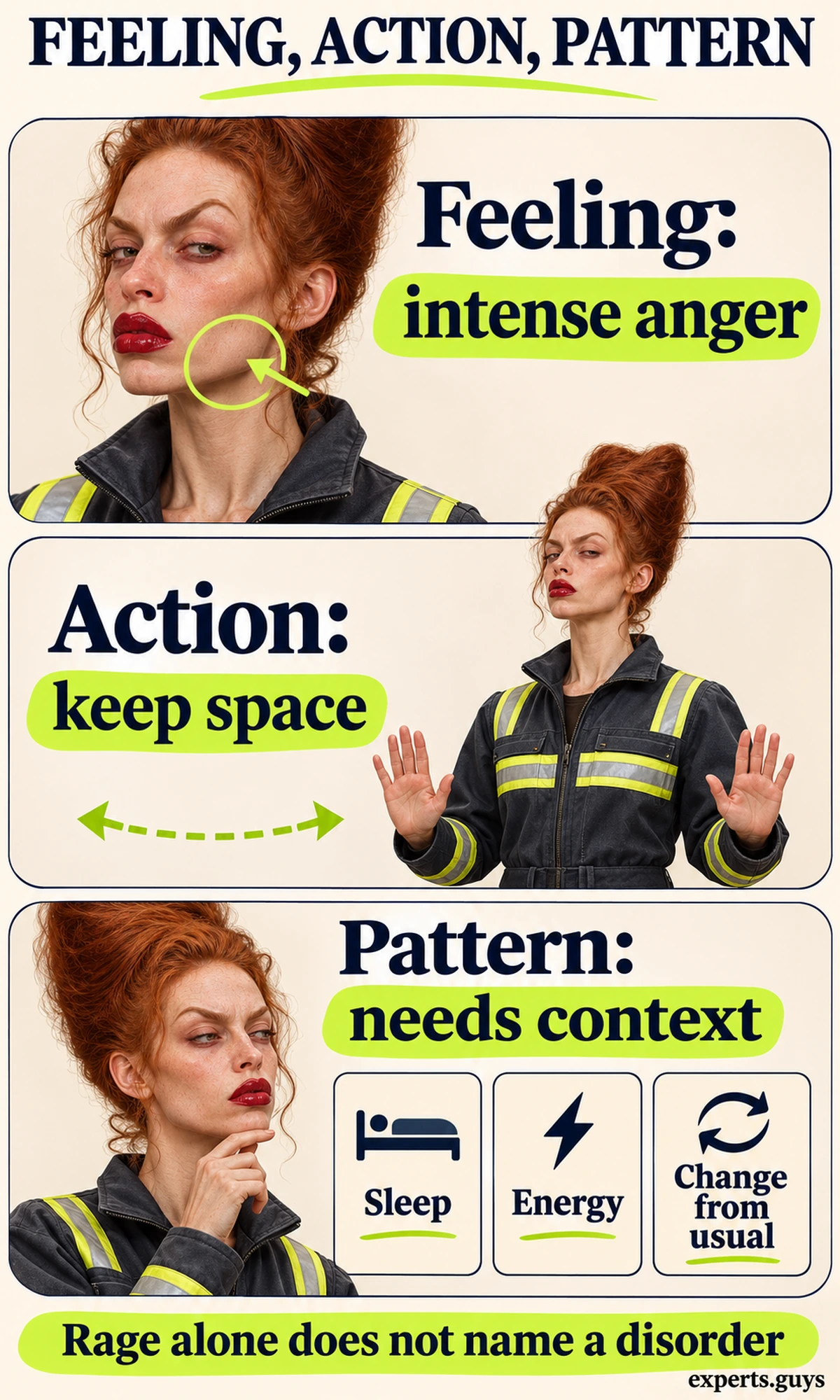
Rage tells you that an emotion or reaction has become intense; it does not tell you its cause. Someone can feel furious without acting aggressively, and someone can intimidate another person without shouting. Separating the feeling from the behavior makes the next decision more accurate: understand the distress, address the action and assess the broader pattern when needed.
The word itself is not a precise clinical measurement. People use it for a brief internal surge, a prolonged argument, a verbal outburst or physical aggression. Before comparing diagnoses, clarify what actually happened. “I felt overwhelmed and left the conversation” describes a different problem from “I followed someone into another room and blocked the door,” even if both experiences are called rage.
Irritability is also different from an outburst. It describes being more easily annoyed or frustrated; it may persist quietly between obvious arguments. A person who has been unusually irritable for weeks needs their wider experience understood, while an isolated outburst still deserves attention to its consequences. Neither the volume of a voice nor the intensity of a feeling establishes a diagnosis.
- Feeling: what did the person experience internally, as far as they can describe it?
- Action: were there insults, pursuit, threats, damage or physical contact?
- Pattern: is this new, recurrent or part of a wider change in sleep, energy or daily functioning?
- Safety: can everyone leave or decline the conversation without being prevented?
Why a small trigger can have a large impact
The event immediately before an outburst may be only one part of the picture. Poor sleep, pain, ongoing conflict or a threatening interpretation can make the same request harder to tolerate. That does not mean the request was wrong, or that the reaction was inevitable. It means that the visible trigger and the conditions surrounding it should not be confused.
For example, imagine someone being asked to turn down a television after a difficult day. The request is ordinary, but the person hears it as another criticism and begins advancing toward the speaker. That is an illustrative situation, not a patient history. The useful intervention at that moment is to stop the advance and leave room to disengage; proving whether the request was fair can wait.
Does understanding a cause remove responsibility?
Understanding can explain why support is needed without making harmful behavior acceptable. A diagnosis does not authorize shouting someone down, threatening them or preventing them from leaving. Equally, a mental-health label should not be used to dismiss a legitimate complaint. The content of a disagreement and the conduct during it are separate matters, and both can require a response.
Someone receiving anger does not have to establish a medical cause before setting a boundary. “I will not continue while you are threatening me” addresses behavior without diagnosing the other person. A person experiencing rage can take the same approach toward themselves: “I need to stop moving closer” is a usable action even when the cause remains uncertain.
Use descriptions that preserve what is known. Saying that someone slammed a door identifies an action; saying they did it because of bipolar disorder adds an explanation that may not be established. Accurate language helps people discuss the impact without turning a guess about the cause into a fact. It also keeps an assessment open to information that contradicts the first assumption.
| Term | Meaning and limit |
|---|---|
| Intense anger | Describes: A powerful emotional experience. Does not establish: A particular mental illness or an intention to harm. |
| Irritability | Describes: A lower tolerance for annoyance or frustration. Does not establish: That every disagreement is a symptom. |
| Aggression | Describes: Behavior that threatens, intimidates or harms. Does not establish: The diagnosis behind the behavior. |
| A change from usual | Describes: A difference in mood, sleep, energy, judgment or functioning. Does not establish: A diagnosis without assessment and context. |
Why the wider pattern is more useful than a label
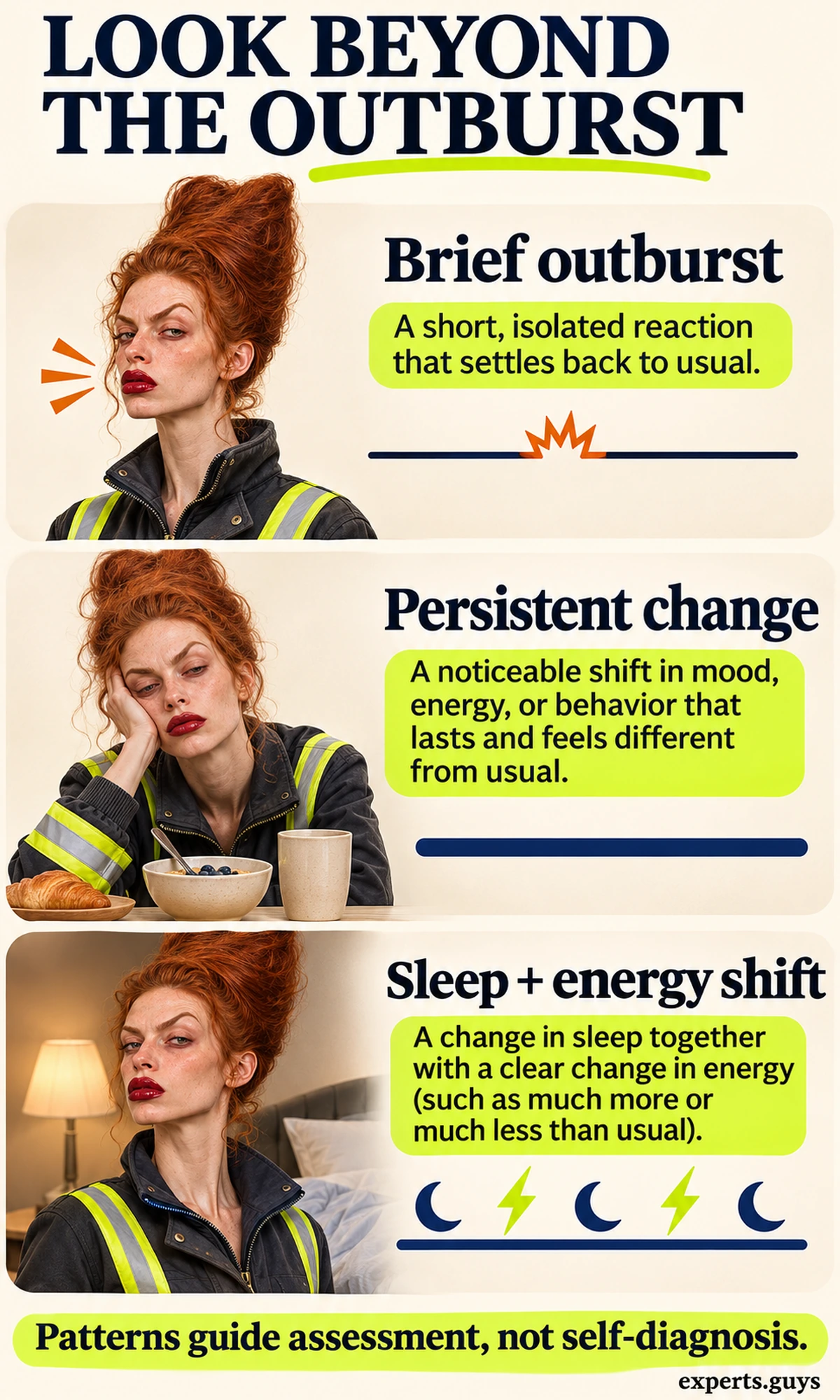
After immediate safety is addressed, compare what is happening now with the person’s ordinary functioning. Does the difficulty exist only within a particular conflict, or has it spread across sleep, work, appetite, relationships and judgment? These are questions for understanding and assessment, not a request to complete a diary. A clear spoken example is often more useful than a vague claim that someone is “always angry.”
The related explanation of anger and irritability in depression covers the narrower relationship with persistent low mood. This page instead focuses on what rage can and cannot tell you across several possible explanations, and on interrupting the physical escalation of a confrontation.
The distinction is practical rather than semantic. If the main problem is distress, the person needs help understanding and managing it. If the main problem is intimidation, the affected person also needs protection and independent choices. When both exist, treating the distress and protecting others are parallel responsibilities; one should not be postponed until the other is completely resolved.
What if the rage stays inside?
An internal surge can be distressing even when nobody else notices. Someone may feel a racing urge to argue while remaining silent or leaving the room appropriately. They can still benefit from assessment if the experience is recurrent, frightening or disruptive. The absence of shouting does not make the distress trivial, just as the presence of anger does not establish aggression.
Be specific about the obstacle. “I cannot concentrate after a surge of anger” calls for understanding the emotional and functional pattern; “I am afraid I might hit someone” requires immediate attention to safety. These statements should not be treated as interchangeable. A person does not have to wait for visible damage before asking for support, and an article cannot determine risk from how composed they look.
Which conditions can involve anger, and what distinguishes them?
Depression, trauma-related difficulties, bipolar mood episodes and several other conditions can involve anger or irritability. Recurrent impulsive outbursts may also be assessed for intermittent explosive disorder. These possibilities overlap, so the useful distinctions involve accompanying symptoms, course, developmental history and alternative causes rather than a match to an angry facial expression.
Depression: look beyond whether the person appears sad
Depression can include irritability, frustration and increased anger alongside loss of interest, low mood or reduced functioning. The NIMH description of depression includes these less obvious changes. Anger alone is insufficient; the question is whether it sits within a persistent depressive pattern that affects everyday life.
For an adult who is exhausted and no longer enjoys familiar activities, a sharp response may be one visible part of a larger difficulty. That differs from assuming that an angry person must be secretly depressed. It also leaves room for other explanations, such as pain, sleep problems or a relationship in which the person is being mistreated. A clinical assessment can consider these together rather than requiring one tidy story.
Bipolar disorder: anger does not equal mania
An irritable mood can occur during mania or hypomania, but the accompanying change in energy and activity matters. Sleeping much less while feeling unusually energized, talking faster or making uncharacteristically risky decisions is different from sleeping badly and feeling depleted. The NIMH bipolar disorder overview explains mood episodes as broader changes, rather than isolated moments of anger.
“Bipolar rage” and “bipolar meltdown” are informal phrases, not separate diagnoses. They cannot establish whether someone is manic, depressed or experiencing something unrelated. A stressful event can accompany an episode without explaining the entire episode, and a brief argument does not reveal its duration. For the specific low-mood context, see irritability during bipolar depression.
Trauma and PTSD: threat can remain central
After trauma, some people experience persistent arousal and react strongly to reminders or perceived danger. The VA explanation of anger and trauma describes how bodily tension, behavior and beliefs can interact. This is one possible mechanism, not evidence that every angry response reflects trauma or that everyone with PTSD behaves aggressively.
The practical implication is to avoid treating an argument as a test of whether someone “really” feels threatened. You can recognize that the experience is intense while keeping a boundary around conduct. If a situation is genuinely unsafe, the answer is safety rather than persuading the person that their threat perception is mistaken. Trauma-focused treatment and anger-management support address different parts of the problem when both are present.
Intermittent explosive disorder: a recurrent pattern needs assessment
Intermittent explosive disorder involves recurrent impulsive aggressive outbursts that are disproportionate to the situation and cause distress or impairment. The Mayo Clinic overview describes verbal and physical forms. A clinician must consider other mental-health conditions, substances and medical explanations; a single dramatic incident cannot settle the diagnosis.
ADHD, BPD and other explanations
With ADHD, anger may accompany difficulty shifting attention or managing frustration, but the developmental attention and activity pattern remains central. When the recurring difficulty is an interruption during a task, the separate guide to handling interruptions without snapping provides that specific demonstration. It is not a substitute for assessing newly escalating aggression.
Borderline personality disorder can involve intense anger within a broader pattern of difficulties with emotions, self-image and relationships. It should not be inferred from a difficult argument or used as an insult. The distinction between that longer-standing pattern and bipolar mood episodes is developed in BPD versus bipolar disorder; some people have both conditions, and neither is defined by violence.
Alcohol, other substances, medication effects and physical illness also belong in the assessment. A newly agitated person who is confused, disoriented or physically unwell needs a different response from someone describing a familiar frustration pattern. Do not assume that an existing psychiatric diagnosis explains every new behavior, and do not change prescribed medication on your own in response to an outburst.
Why the order of changes matters
Suppose an adult has always found interruptions frustrating, but now also sleeps far less, speaks much faster and takes unusual financial risks. Calling the entire change “the same old temper” loses information. Conversely, one sleepless night after a painful argument does not establish a mood episode. The assessment needs the sequence and the broader course, not a diagnosis chosen from whichever symptom feels most dramatic.
The same caution applies to events between outbursts. Returning to ordinary activity does not erase the impact of an incident, while persistent difficulty between incidents may reveal a larger problem. Describe what is actually different rather than interpreting every pleasant moment as proof of wellness or every irritated moment as evidence of illness. Several contributors may coexist, and identifying one does not automatically exclude the others.
How do you interrupt escalation without cornering anyone?
At an early, manageable stage, stop the movement that makes the argument harder to leave: advancing, following or blocking. This is the lead skill here because physical proximity can become the problem before either person has found the right words. Practise the sequence when calm; do not wait for a dangerous incident to rehearse it.
The recommendation is an everyday adaptation of established anger-management principles, not a separately validated treatment protocol. The SAMHSA anger-management manual includes timeouts and advance agreements about ending or postponing a heated discussion. Here the emphasis is on making that pause physically possible, while preserving each person’s freedom to disengage.
Stop the approach: a calm rehearsal
Choose a clear, level area with no stairs or obstacles immediately behind you. No equipment is needed, and no one needs to pretend to be threatening. If you hold something, put it down safely before practising; do not rehearse with hot liquids, sharp objects or an object that could be thrown. The demonstration begins with ordinary standing distance, not a staged confrontation.
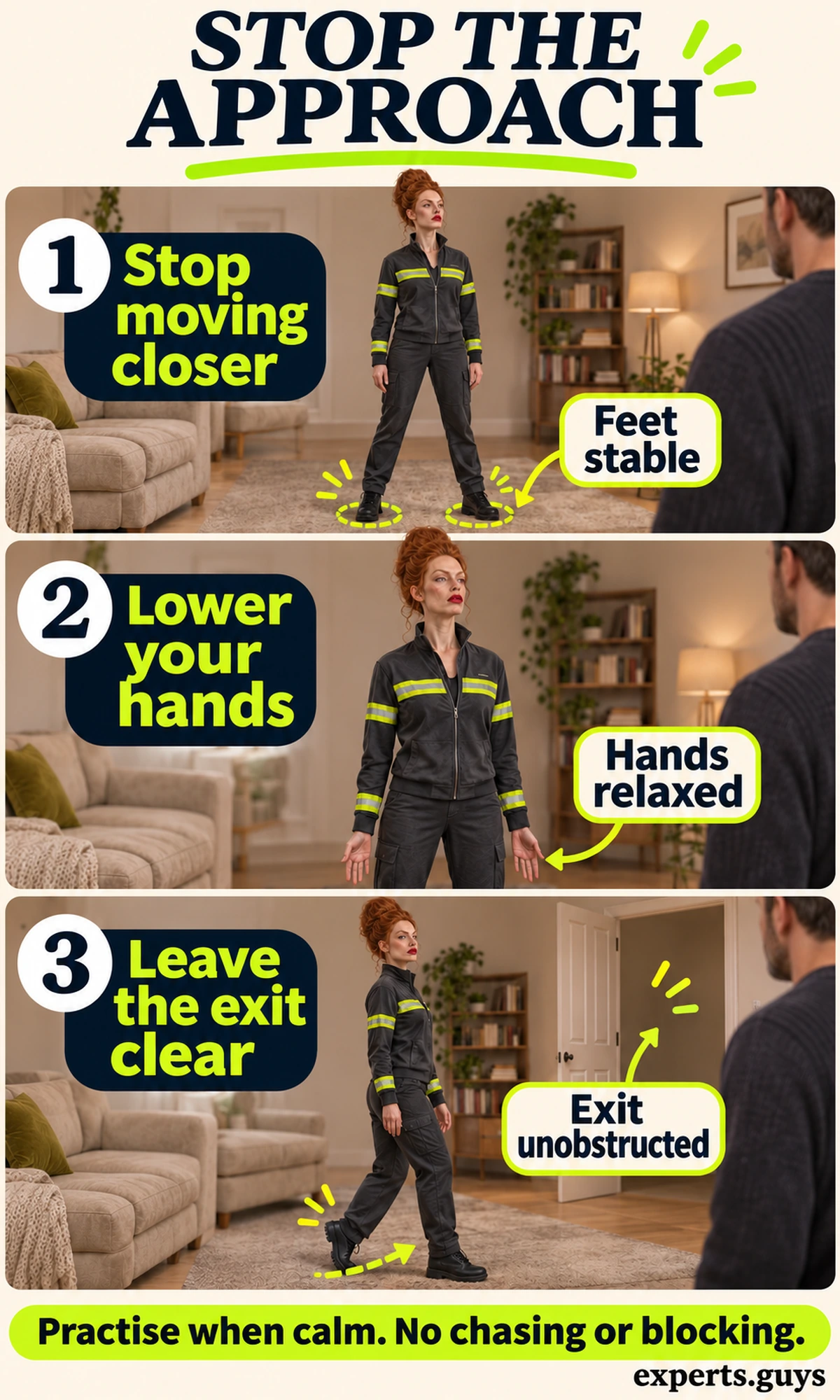
- Stop moving closer. Notice where your feet are and end the forward movement without a sudden lunge or dramatic gesture.
- Lower your hands. Let them rest naturally at your sides without pointing, touching the other person or reaching for their belongings.
- Leave the exit clear. If safe and comfortable, take a small step away into clear space. Do not stand in a doorway or between the other person and their route out.
Completion means the approach has stopped and the other person’s route remains available. You may still feel angry. Do not repeat the movement until you feel calm or expect it to make another person stay. The physical checkpoint is modest and observable: no advancing, no contact and no blocked exit.
If stepping backward is difficult because of pain, balance or mobility limitations, do not force it. Remain stable and stop approaching; the other person can use their own clear route. A seated rehearsal can practise keeping hands relaxed and not wheeling or leaning into someone’s space. No version requires closing your eyes, abandoning a mobility aid or moving toward an unsafe surface.
Make a pause real rather than continuing elsewhere
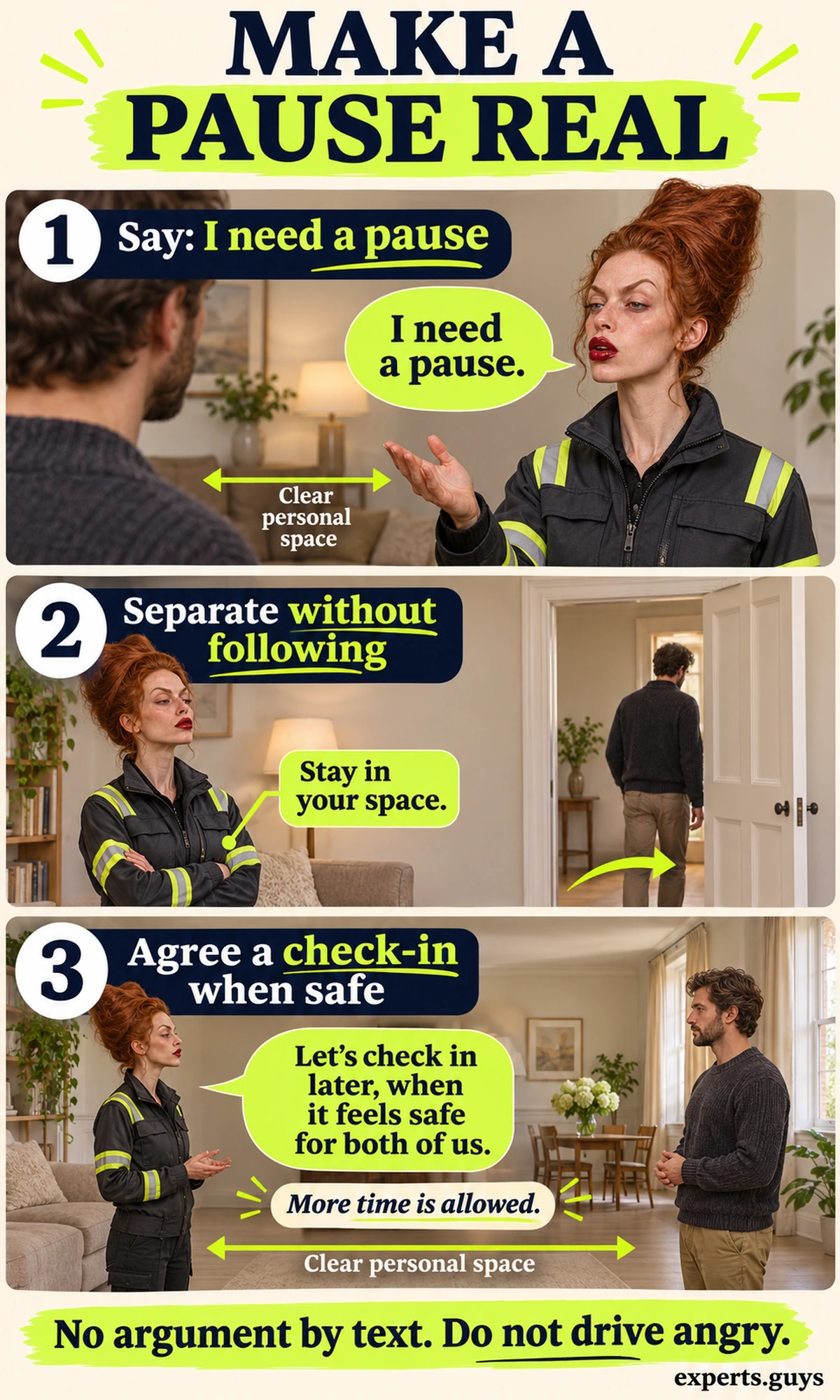
Use one short sentence when it is safe to speak: “I need to pause this conversation.” You do not have to explain the diagnosis, defend the feeling or secure agreement about who started it before stopping. In an ongoing safe relationship, discuss a check-in arrangement during a calm period so that a pause is not mistaken for an invitation to follow and finish the argument.
The sequence is simple: state the pause, allow separation without pursuit, and agree a check-in when both people can safely choose it. A check-in is an opportunity to decide whether talking is possible, not a deadline by which someone must be ready. If more time is needed, communicate that when safe; nobody owes immediate re-entry into a frightening exchange.
Do not carry the same confrontation into messages, repeated calls or a car journey. Moving rooms while sending accusations has changed the location without ending the exchange. Avoid driving while angry. If a child or another dependent person needs supervision, preserve essential care and use an agreed capable handover where available; a pause never authorizes leaving someone without needed support.
For a lower-demand version, postpone the disputed topic while remaining in the necessary safe setting. You might say, “I can continue supervising, but I cannot discuss this now.” That is appropriate only where remaining is safe. If someone is threatening or preventing you from leaving, this is no longer a mutual communication exercise; prioritize safety and outside help.
If you are the person receiving the anger
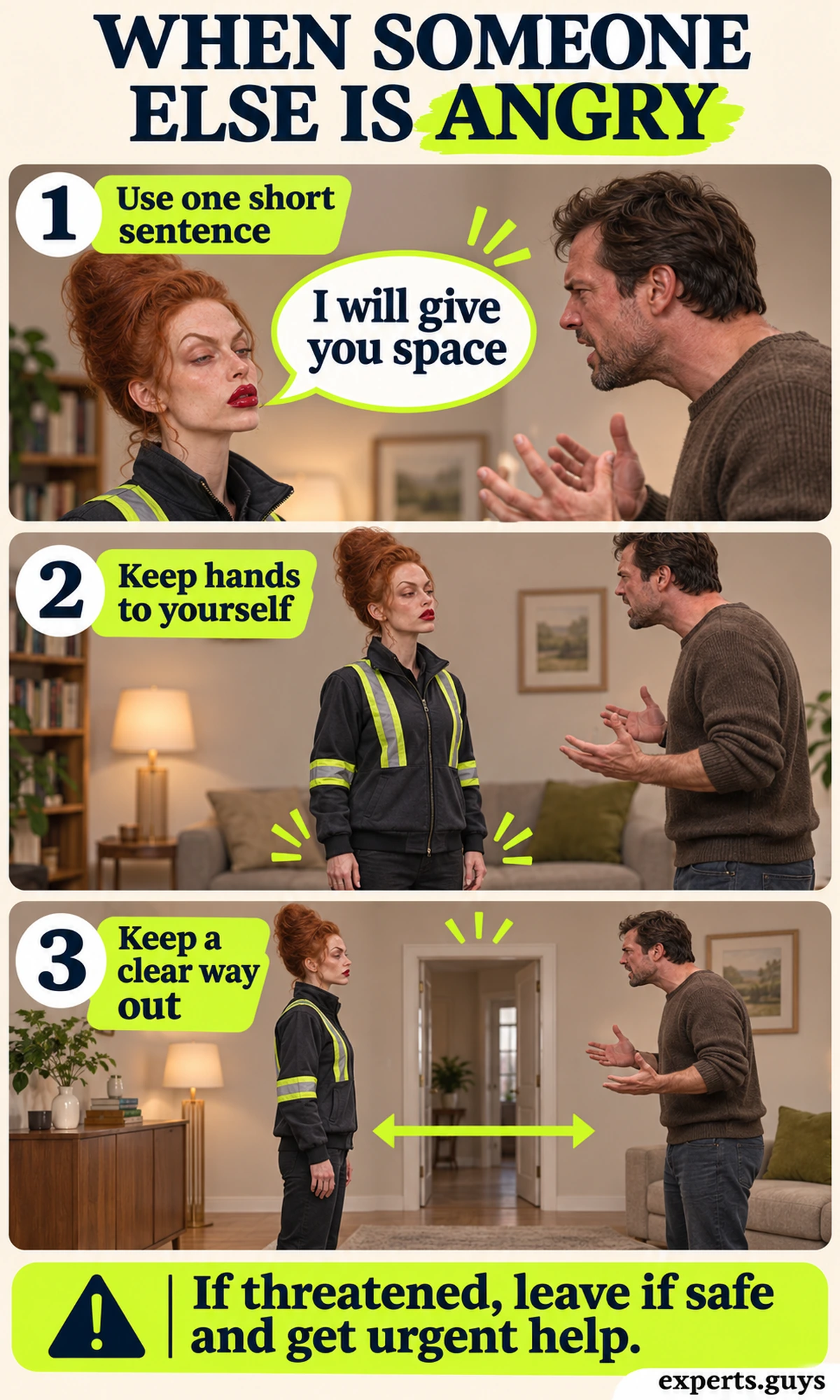
You can reduce your own participation in an escalating exchange without taking responsibility for another adult’s behavior. Use a short statement such as “I will give you space,” keep your hands to yourself and preserve a clear way out. You do not need to maintain eye contact, touch the person to soothe them or stand close enough to demonstrate that you care.
Avoid following someone to demand the last word, standing across a doorway or reaching for their phone. A familiar hug may be unwanted during anger, and physical reassurance is not necessary for a useful pause. The aim is room to disengage, not managing the person’s body or preventing them from showing emotion.
- Say one short sentence if speaking is safe; avoid a lecture or a rapid series of questions.
- Keep your hands to yourself and give space rather than touching, restraining or steering the person.
- Keep your own exit available. If you feel threatened, leave if safe and obtain urgent local help.
If you cannot speak easily, do not force a script. Creating distance or contacting help may matter more than completing the words. Someone with limited mobility should not be expected to move quickly or negotiate an obstacle during a confrontation. Plan accessible support separately when calm, and do not treat a missed step as causing someone else’s aggression.
What if the person follows, blocks or demands an answer?
Do not keep repeating a relationship exercise in the hope of earning permission to leave. Pursuit, blocked exits and threats change the problem from a disagreement to a safety concern. Where possible, move toward a safer place and contact appropriate help. Do not try to take a weapon away, restrain the person or prove that you are unafraid.
In a relationship involving coercion or repeated violence, a shared timeout agreement may not protect the affected person. Private safety planning with an appropriate domestic-abuse service can address practical constraints that a general article cannot know. Joint conversation practice should never be made a condition of obtaining support, and the person being harmed does not have to accept a medical explanation before seeking protection.
An illustrative example: the doorway matters more than the television
Return to the television disagreement. The person experiencing the surge stops walking forward, lowers their hands and moves away from the doorway. The other person says they will give space and leaves without being followed. The immediate result is an interrupted approach and an available exit, not agreement about the television or proof that the underlying condition has improved.
If the first person instead follows and says, “You cannot leave until you hear me,” the pause has failed even if their voice becomes quieter. That comparison explains the priority: a safer outcome depends on conduct, not a performance of calm. The original issue can be revisited only when both people freely choose a conversation.
Common mistakes that undermine the pause
A pause becomes a demand when it comes with conditions such as “You may leave after admitting you are wrong.” It becomes pursuit when one person keeps appearing in the next room to add another point. It becomes punishment when access to money, transport or necessary belongings is withheld until the other person returns. None of those actions follows the demonstration, even if someone calls it an anger-management technique.
The correction is to return to the observable purpose: an exchange has stopped and each person retains choices. That does not require deciding that both people contributed equally to the conflict. A mutual disagreement and one-sided intimidation are different situations, and a general communication method should not blur that distinction. Where the pattern is coercive, independent support takes priority over practising together.
What should happen after the immediate surge passes?
Once immediate danger has ended, decide whether to postpone the conversation, resume by agreement or seek assessment of a recurring or changing pattern. Feeling less angry is useful, but it does not automatically restore safety or trust. The person affected by the outburst may need more time, independent support or a different setting before any discussion is possible.
Resume only by agreement
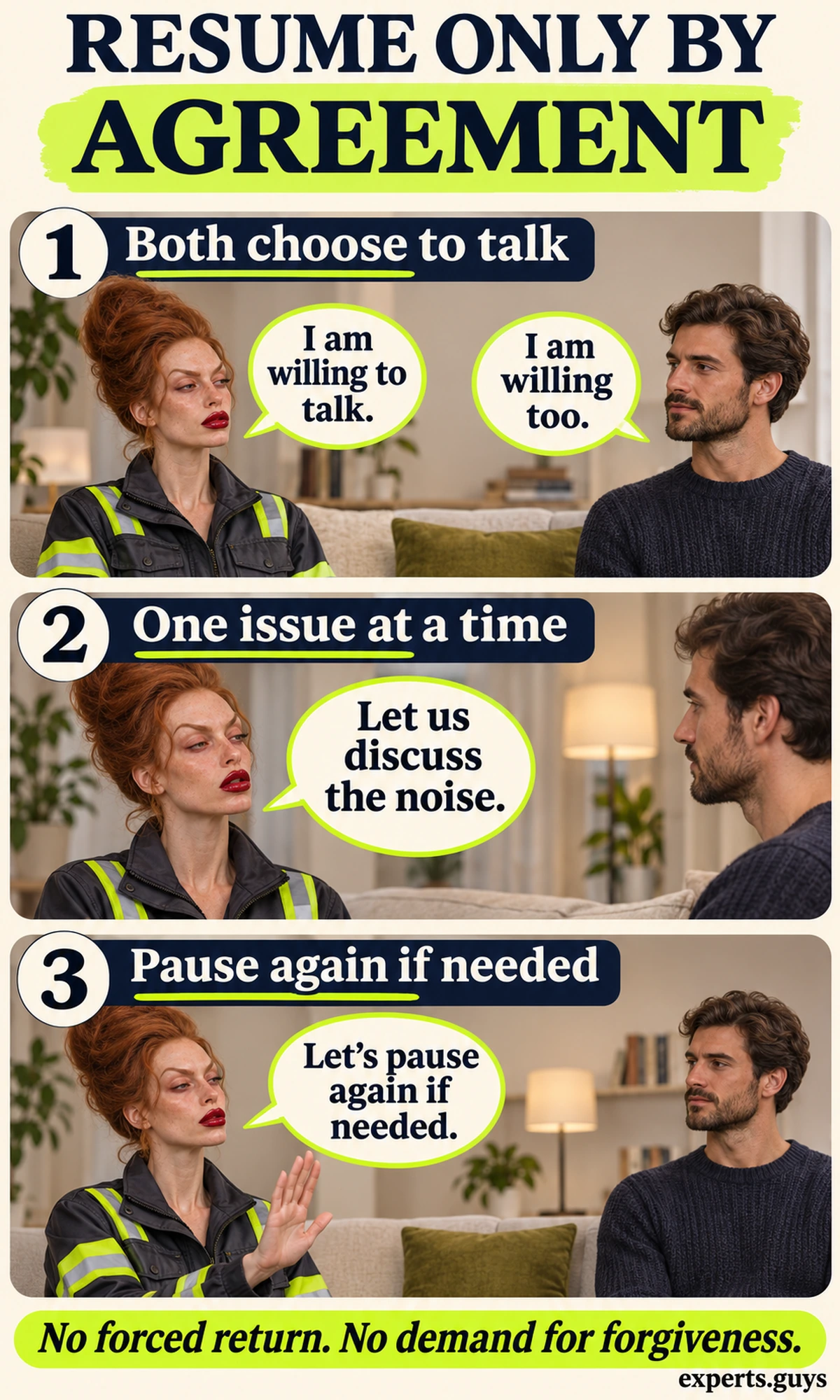
Ask whether the other person is willing to talk rather than announcing that the break is over. If both choose to continue, take one issue at a time and allow either person to pause again. Keep the same physical space that made disengagement possible. An agreement to discuss noise is not agreement to revisit every past argument.
For a manageable disagreement, the practical sequence is: confirm mutual willingness, name the single issue and stop again if the exchange starts escalating. An easier option is agreeing only when to reconsider the topic. Completion is a mutually chosen next step, including postponement; it is not a solved relationship problem or immediate forgiveness.
The ability to hear a full sentence without interrupting can help you notice readiness, but it is not a safety test. Someone can speak softly while making threats, and someone can still sound upset while respecting another person’s choices. Pay attention to whether refusal and departure remain possible, rather than using a calm tone as permission to continue.
Choose assessment based on the wider change
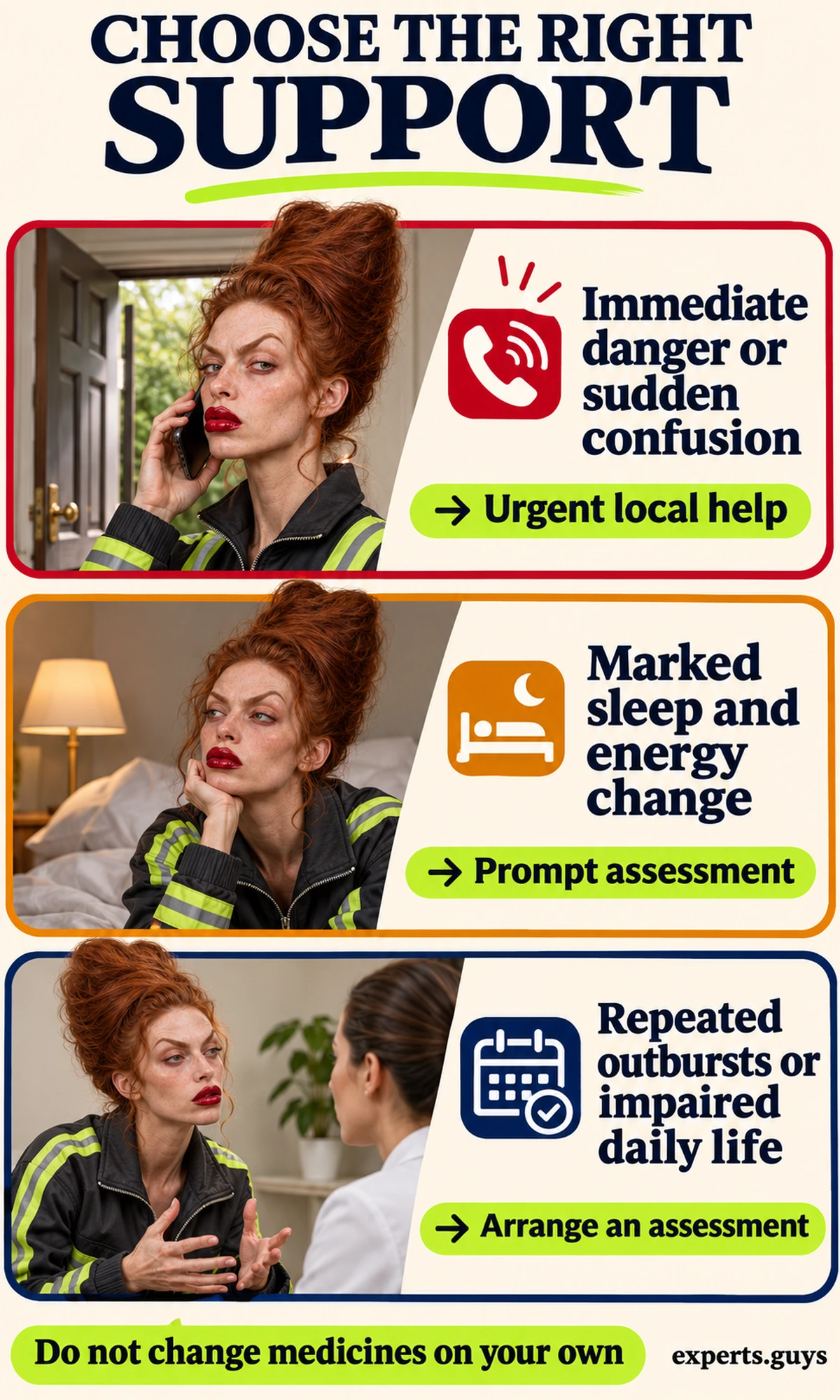
Arrange an assessment when outbursts recur, become harder to interrupt, damage relationships or interfere with work, school or daily life. A primary care clinician can consider physical and medication contributors and help direct mental-health care. A mental-health professional can assess the pattern and discuss appropriate treatment; seeking that assessment does not require first choosing your own diagnosis.
Marked changes in sleep, energy, judgment or behavior deserve prompt attention, especially when they are unusual for the person. New hallucinations or rapidly escalating behavior also need urgent assessment. Sudden confusion requires immediate medical help, as the NHS guidance on delirium makes clear; it should not be dismissed as temper or an ordinary psychiatric symptom.
Describe a concrete recent event verbally: what changed, what the person did, how it affected others and what else was different in sleep, energy or functioning. Mention medicines, recent dose changes, substances and relevant physical symptoms. You do not need a perfect chronology, a completed worksheet or a collection of recordings before asking for help. Another person’s observations can contribute with consent where appropriate.
Choose a provider who can address the actual question rather than promising to eliminate rage in a fixed number of sessions. Ask about relevant professional registration, experience assessing the accompanying symptoms and arrangements if the situation worsens. If a family member wants advice, their own support needs can be discussed separately; they do not need to become the other person’s therapist or share private concerns in a joint appointment.
What treatment can address that a pause cannot
A pause interrupts an exchange; it does not treat a mood episode, trauma-related disorder or recurrent impulsive aggression. Treatment depends on the assessed problem and may involve psychotherapy, medication or both. For example, bipolar care and treatment for BPD have different priorities. Choosing a medicine from the word “rage” would bypass the information needed to prescribe safely.
Anger-focused therapy can work on recognizing early cues, interpreting situations more accurately and expanding the available behavioral responses. When trauma or a mood disorder is involved, the treatment plan may need to address that condition as well. The exact household rehearsal in this article is an editorial application of broader principles, not a replacement for individualized therapy or evidence that practicing it cures an illness. The guide to how CBT works in practice explains the separate role of agreed treatment tasks and review.
Questions people still ask
Can someone have rage attacks only at home?
Yes, behavior can vary by setting, demands and relationships. That difference does not prove a diagnosis, establish that the distress is invented or excuse harm at home. Describe the actual settings and consequences during assessment without assuming that functioning elsewhere settles the cause.
Is feeling ashamed afterward proof that the outburst was involuntary?
No. Regret describes what someone feels afterward; it does not establish a diagnosis or determine the cause of the behavior. A useful response involves sustained changes and appropriate support, while allowing the affected person to make their own choices about contact and safety.
Should children be judged by the same examples as adults?
No. Developmental stage, communication, sleep, family context and functioning across settings matter. Severe, repeated or dangerous outbursts warrant an age-appropriate assessment, rather than applying adult labels or assuming that anger establishes childhood bipolar disorder. Adults remain responsible for providing safety and suitable support.
Does having a diagnosis mean anger is always part of it?
No. People with a mental-health condition also experience ordinary disagreement, injustice and frustration. Evaluate a new change on its own merits instead of dismissing every concern as a symptom or assuming the diagnosis explains new aggression.
Choose the next action that fits
- During early escalation, stop advancing and leave the other person’s route clear.
- Use a pause only where separation is safe, and do not follow the argument into another room or a stream of messages.
- Resume only by mutual choice; postponement can be the completed next step.
- Bring recurrent outbursts or a wider change in functioning to an assessment, without needing to diagnose yourself first.
- Treat immediate danger and sudden confusion as urgent situations rather than opportunities to practise.









