
Borderline personality disorder (BPD) and bipolar disorder can both involve intense emotions and impulsive behavior, but they describe different patterns: BPD centers on persistent difficulties with emotion regulation, self-image and relationships, while bipolar disorder involves distinct episodes of altered mood, energy and activity. The most useful comparison looks at what changes together, how long the change lasts and what happens between episodes; some people have both conditions.
| What to compare | BPD | Bipolar disorder |
|---|---|---|
| Overall pattern | Long-standing difficulties with emotions, sense of self and relationships. | Distinct mood episodes involving a change in energy or activity. |
| Timing | Emotional shifts may unfold over hours to a few days; the broader pattern lasts much longer. | Manic, hypomanic and depressive episodes have defined clinical features and duration requirements. |
| Context | Rejection, perceived abandonment or relationship stress may be particularly relevant. | Stress and sleep disruption can also trigger episodes; a trigger does not exclude bipolar disorder. |
| Sleep and energy | Poor sleep can occur, but reduced need for sleep is not a defining feature. | Unusually little need for sleep with increased energy can occur in mania or hypomania. |
| Care priority | Structured psychotherapy addressing core difficulties. | Medication commonly plays a central role, alongside psychological and practical support. |
If there is immediate danger, an overdose, serious self-injury or an inability to stay safe, contact local emergency services or go to an emergency department now. Do not wait to decide which diagnosis fits. New hallucinations, delusions or rapidly escalating behavior also need urgent clinical assessment.
What patterns distinguish BPD from bipolar disorder?
The phrase “mood swings” hides several different experiences. It can describe a sudden surge of shame after a disagreement, a sustained period of unusually high energy, or a prolonged loss of interest and motivation. Those experiences can look similar in a brief conversation, but their course and accompanying changes carry different information. The comparison works best when it moves beyond how intense an emotion feels.
BPD is not a judgment about someone’s character. Its clinical pattern can include unstable self-image, intense relationship difficulties, fear of abandonment, impulsivity, emptiness and difficulty regulating emotions. Not everyone has every feature, and distress may be expressed quietly rather than through visible conflict. Neither an unusual personality nor a difficult relationship is enough to establish the disorder.
Bipolar disorder is not simply alternating between being happy and sad. Mania and hypomania involve a noticeable change in mood together with increased energy or activity. The mood may be irritable rather than cheerful. Bipolar depression can involve low mood, loss of interest and impaired functioning; depression by itself does not establish bipolar disorder.
Why duration helps, but does not decide
In BPD, intense emotional changes commonly last hours and sometimes days. The important distinction is between the length of an individual emotional shift and the longer-standing pattern of difficulties. A brief surge of distress does not mean the underlying problem is brief, and a period of feeling better does not mean the person was pretending to be distressed.
For bipolar disorder, standard diagnostic descriptions distinguish hypomania lasting at least four consecutive days, mania lasting at least one week or any duration when hospitalization is necessary, and major depression lasting at least two weeks. These are parts of a full clinical assessment, not a stopwatch test: the required symptoms, degree of change, impact and alternative explanations also matter. Shorter or unclear patterns can still warrant assessment.
Rapid cycling has a specific meaning in bipolar disorder: at least four mood episodes in a year. It does not simply mean several emotional changes in one afternoon. Equally, mixed features can involve depressive and manic symptoms together, so a person does not have to move neatly from a cheerful phase to a sad phase. The clinical overview of bipolar disorder explains why the course of symptoms matters.

Less sleep is not always less need for sleep
Someone with insomnia may sleep poorly and spend the next day exhausted, wishing they could rest. Someone developing mania or hypomania may sleep much less than usual while feeling unusually energized or driven. The number of hours alone cannot distinguish those experiences. A meaningful account includes how the person felt afterward and whether speech, thinking, activity or judgment changed at the same time.
Do not test this distinction by deliberately staying awake. Sleep deprivation can worsen mental health and make the pattern harder to interpret. Shift work, caring responsibilities, pain, substances and medication changes can complicate sleep and energy. If your question is how to recognize an unfamiliar cluster of changes, the separate guide to early bipolar indicators covers that recognition task.

A relationship trigger does not rule bipolar disorder in or out
Sensitivity to rejection or abandonment may be prominent in BPD, but a relationship event is not a diagnostic switch. People with bipolar disorder also have relationships, react to stressful events and can develop episodes after stress. Conversely, not every difficult emotion in someone with BPD has an obvious trigger. The useful question is how the immediate event fits into the wider history.
Consider two illustrative situations. In one, a disagreement is followed by an intense emotional reaction that changes as the situation develops. In another, a disagreement occurs during several days of markedly altered sleep need, energy and activity. The argument is present in both stories, but it carries different weight. Neither story establishes a diagnosis; each suggests different follow-up questions.

- Compare the person with their own usual pattern. A naturally energetic manner is different from a clear, sustained change.
- Separate the event from the surrounding period. What happened immediately before distress is only part of the history.
- Consider the practical impact. Changes affecting work, safety, relationships or basic needs deserve attention even before their cause is clear.
Can someone have both BPD and bipolar disorder?
Yes. BPD and bipolar disorder can coexist, and finding evidence for one does not automatically explain every difficulty. An assessment may need to consider recurring relationship and self-image problems alongside distinct periods of changed mood and energy. This is why forcing every experience into a single label can leave important needs unaddressed.
Overlap also makes diagnosis harder. Impulsivity, irritability, depression and suicidal distress are not exclusive to either condition. A clinician considers when they occur, what accompanies them and whether they persist outside identifiable mood episodes. Trauma-related conditions, anxiety, ADHD, substance effects and physical-health problems can also complicate the picture. A short online comparison cannot reliably separate all of these possibilities.
The practical consequence is that care should have more than one target when necessary. Stabilizing a mood episode may not resolve long-standing relationship distress; learning emotional regulation skills may not adequately treat mania. Asking which difficulty each part of a care plan addresses is more useful than treating a second diagnosis as a contradiction.

Bipolar I, bipolar II and BPD are not severity rankings
Bipolar I includes a manic episode. Bipolar II includes hypomanic and major depressive episodes without a history of mania. The “II” label does not mean the illness has little impact: depressive episodes can be highly disabling. BPD is a separate diagnostic category, not a milder form of bipolar disorder or an intermediate step between bipolar I and II.
A change in diagnosis can reflect a fuller history rather than anyone having been dishonest. A person may initially seek help only during depression and later recognize a past period of unusual activation. Another may find that difficulties continue between presumed episodes. It is reasonable to ask what new information changed the formulation, which uncertainties remain and what difference that makes to treatment.
How is the difference assessed without reducing you to a checklist?
Assessment examines the course of difficulties across time, rather than judging someone from one emotional appointment. A clinician may explore previous mood episodes, relationship and self-image patterns, family history, medical conditions, substances, medicines and the effect on everyday functioning. There is no single blood test, brain scan or online quiz that establishes the distinction for an individual.
A primary-care clinician can help arrange an appropriate assessment, and a psychiatrist or another suitably trained mental-health professional can evaluate the pattern in more depth. Ask whether the service has experience with both mood disorders and personality difficulties. A questionnaire may help organize a clinical conversation, but its score is not a diagnosis and should not replace the history.
A no-writing way to explain the pattern
If you feel safe enough for a planned appointment, use the following three-part verbal explanation to make the history easier to follow. It is a communication aid, not a validated test or treatment exercise. Sit or stand however you are comfortable; no equipment, diary or exact dates are required. Choose one period that you remember reasonably well rather than trying to reconstruct your entire life at once.
- Before: describe your usual sleep, energy and everyday functioning before that period. For example: “Normally I need a full night of sleep and can keep my usual pace.”
- During: explain what changed together, roughly how long it continued and what became difficult or risky. Mention the surrounding situation without assuming it caused everything.
- Between: explain what settled afterward and what remained, including relationship distress, emptiness or other difficulties outside the more obvious change.
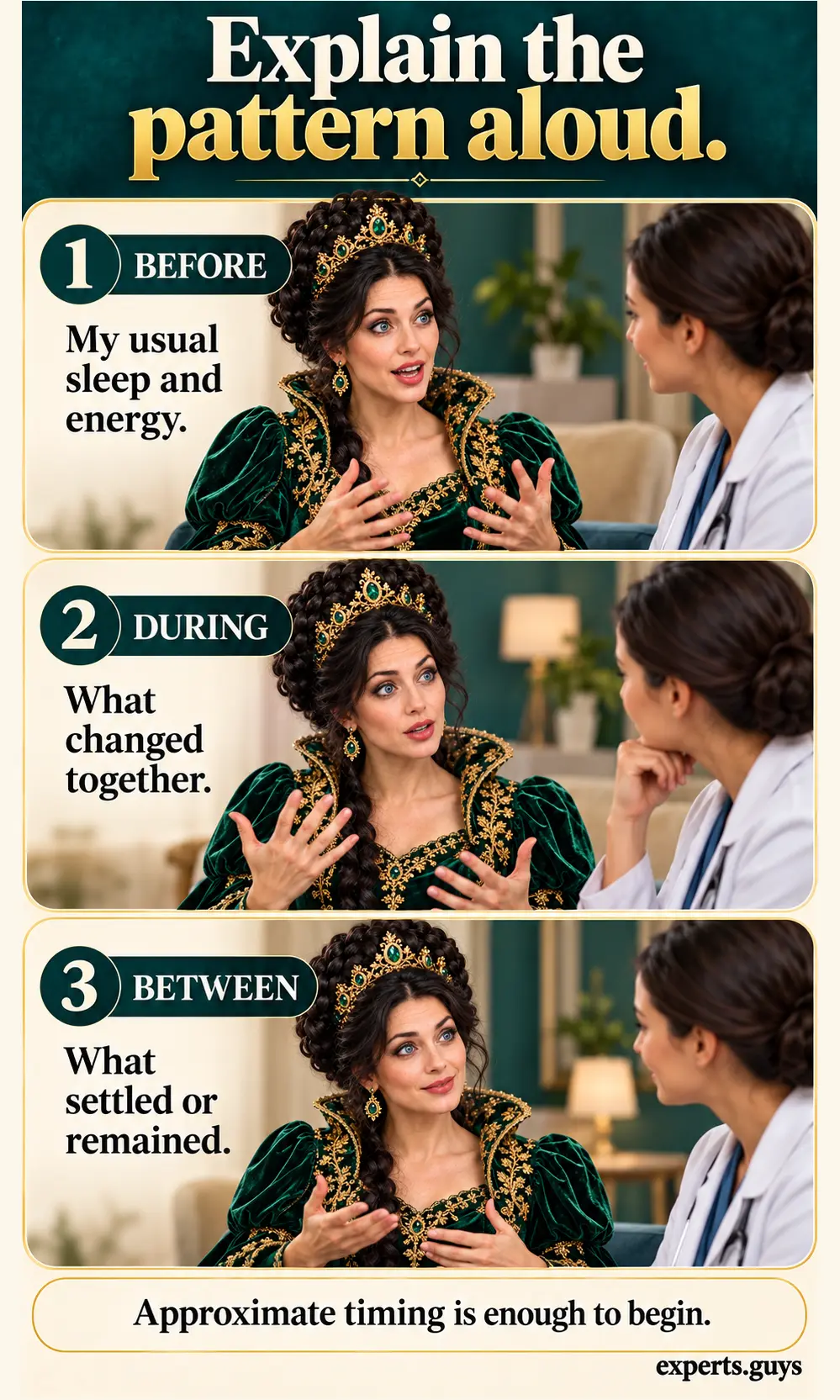
An easier version is to begin with one contrast: “This was different from my usual pattern because…” and let the clinician guide the next questions. If memory is uncertain, say so; an honest approximation is more useful than an invented date. Communication aids or an interpreter remain appropriate when needed, and you can ask for one question at a time. The useful result is a clearer account, not a perfect performance or an immediate label.
The common mistake is fitting the account to the diagnosis you expect: leaving out energized periods because you think only depression matters, or leaving out persistent distress because it does not fit an episode. Include what you actually experienced and distinguish it from what you suspect it means. Do not delay care until the sequence feels complete; it is a starting point for questions, not a requirement for receiving help.
With your agreement, a trusted person can contribute observations that you might not have noticed. They should describe what they saw rather than speak for your feelings, and you can ask to speak privately with the clinician. If your main difficulty is responding to someone else’s concern, the guide to when others notice bipolar warning signs addresses that conversation separately.
How do treatment and immediate support differ?
Why treatment priorities differ
Structured psychotherapy is central to BPD care. Approaches such as dialectical behavior therapy can help address emotion regulation, distress and relationship difficulties within a broader treatment programme. The work is more substantial than a single coping tip, and it should be delivered by a suitably trained professional. Many people improve meaningfully over time; the diagnosis does not make someone incapable of recovery.
Medication is not the main treatment for BPD itself. It may be considered for a co-occurring condition or a specific, time-limited target alongside psychotherapy, with regular review of benefit and harm. The APA treatment recommendations emphasize structured psychotherapy and careful medication review. A long list of possible drugs is not a substitute for an individualized plan.
Bipolar treatment commonly places medication at the center of managing and preventing mood episodes, with psychotherapy, education and support around daily rhythms also playing roles. The appropriate treatment depends on the current episode, previous response, physical health, side effects and personal circumstances. Do not start, stop or adjust a prescribed medicine to test which diagnosis is correct; discuss concerns with the prescriber.
When both conditions are present, the plan can address both sets of needs. A useful care discussion identifies the purpose of each treatment, how improvement will be judged and who coordinates changes. Receiving psychotherapy does not prove BPD, and receiving a medicine sometimes called a mood stabilizer does not prove bipolar disorder. Treatment names cannot replace diagnostic reasoning.

When help should be urgent
Urgency depends on safety and the speed or severity of deterioration, not on winning agreement about a label. Someone who appears energetic may still be in serious distress. Someone whose distress follows an argument may still need immediate help. A diagnostic duration threshold is never an instruction to wait while a situation becomes unsafe.
| Situation | Appropriate response | Do not wait for |
|---|---|---|
| Recurring difficulties affecting daily life, without immediate danger | Arrange a clinical assessment. Explain the pattern and impact. | A completed diary or certainty about BPD versus bipolar disorder. |
| New psychosis, rapidly escalating activation, or increasingly unsafe behavior | Seek urgent clinical assessment; use emergency care if safety is uncertain. | Four days or a full week of symptoms. |
| Immediate danger, inability to stay safe, overdose or serious self-injury | Contact local emergency services or go to an emergency department now. | An agreed diagnosis or another online comparison. |

Where an individualized crisis plan already exists, follow it and use the agreed care contacts. If the situation has become more dangerous than the plan anticipated, seek emergency help. A trusted companion may assist when wanted and safe, but supporters should not put themselves in danger or try to manage a severe crisis alone.
Frequently asked questions
Does “quiet BPD” mean a different diagnosis?
“Quiet BPD” is an informal description, not a separate standard diagnosis. It usually refers to distress that is directed inward or is less visible to other people. Quiet behavior does not establish BPD, and visible conflict is not required for someone to need assessment.
Can a person have BPD without a history of trauma?
Yes. Trauma can be relevant, but a disclosed trauma history is not required for BPD. Causes are complex, and neither a trauma history nor its absence can decide the diagnosis. You should not feel pressured to supply a particular explanation to make your distress legitimate.
Does getting better after reassurance prove BPD?
No. Reassurance can affect distress in many situations. A single response cannot establish a personality disorder or exclude a mood episode; the surrounding symptoms and longer-term course still matter.
Can BPD turn into bipolar disorder?
They are distinct conditions, so BPD is not a stage that inevitably becomes bipolar disorder. A person may later receive a different or additional diagnosis as their experiences and history become clearer. Ask what evidence supports the change rather than assuming one condition transformed into the other.
Should I stop an antidepressant if I suspect bipolar disorder?
Do not change it on your own. Contact the prescriber promptly if you develop unusual activation, markedly reduced sleep need or a striking behavior change, and seek urgent care if symptoms are escalating or safety is uncertain. The prescriber can assess the symptoms and guide any medication changes.
The distinction to take with you
BPD and bipolar disorder are distinguished by the wider pattern, not by who feels emotions more strongly. Timing, sleep need, energy, functioning and what happens between periods all help make the account clearer. Describe those differences honestly, keep space for more than one explanation, and match the next step to your current safety and needs.