



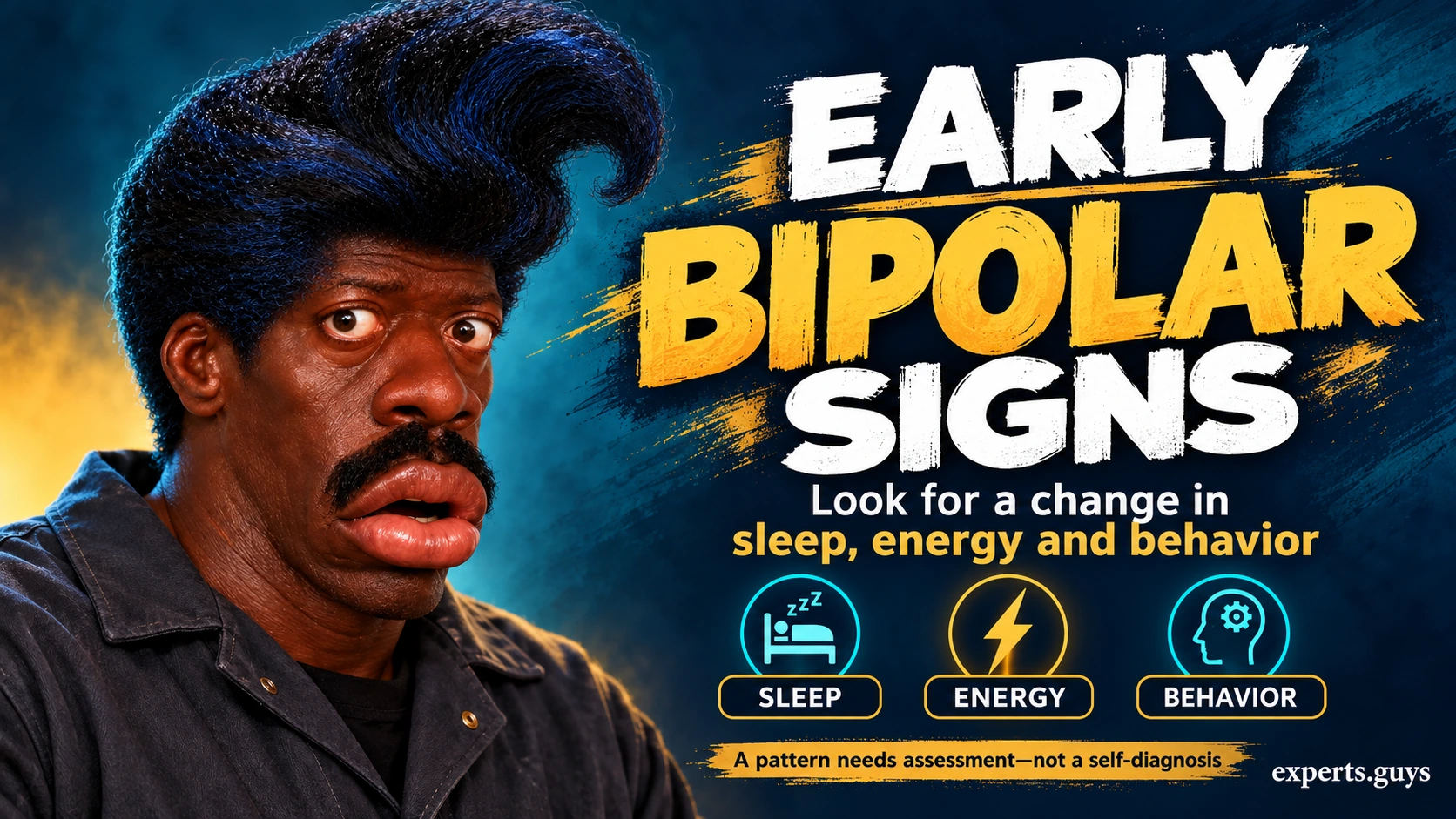
Bipolar disorder involves distinct episodes of changed mood, energy and activity, rather than ordinary ups and downs. Early indicators can include much less need for sleep, unusually fast speech or increased activity, and decisions that are out of character; the important clue is a change from your usual pattern, not one symptom. A new cluster of these changes deserves assessment, but it cannot establish a diagnosis by itself.
Get urgent help now if you cannot stay safe, may act on thoughts of harming yourself or someone else, or have severe confusion. Contact local emergency services or go to an emergency department; do not wait to complete the comparisons below. New hallucinations, delusions or rapidly escalating behavior also need urgent clinical assessment.
This guide focuses on noticing a possible first pattern, before a diagnosis is established. If you already have bipolar disorder and are looking for your own relapse signals, use your agreed care plan and the separate guide to early warning signs of a bipolar mood episode.
The most useful first question is whether several things changed during the same period: sleep need, pace, mood, judgment and everyday functioning. A lifelong habit of talking quickly is different from suddenly speaking much faster while sleeping less and taking on unusual commitments. Consider the whole change, including what other people notice.
| What you notice | What makes it worth discussing | What it does not establish |
|---|---|---|
| Less sleep | Feeling unusually energized despite much less sleep than usual | That one short night is hypomania |
| Faster pace | Speech, thoughts and activity all becoming noticeably faster | That enthusiasm or a busy week is a disorder |
| Different judgment | Spending, commitments or risk taking that depart from your usual boundaries | That one regretted choice proves bipolar disorder |
| Low mood or withdrawal | A sustained change in enjoyment, energy or ability to manage daily life | Whether depression is bipolar or unipolar |
| Others notice a change | Specific observations from someone who knows your usual behavior | That someone else can diagnose you |
Which early changes are more informative than ordinary mood swings?
A distinct period of altered sleep need, energy and behavior is more informative than a single mood description. “Happy,” “irritable” and “sad” describe experiences shared by many conditions and by people without a disorder. What changes the clinical question is the accompanying pattern and its effect on the person’s life.
- Speech and thought: talking much faster than usual, frequently changing topics, or finding thoughts difficult to slow.
- Activity and confidence: an unusual surge of projects, social activity or certainty about unrealistic plans.
- Judgment: purchases, commitments or other choices that are markedly different from the person’s usual decisions.
- Functioning: disruption at work, home or school, or concern from people who know the person well.
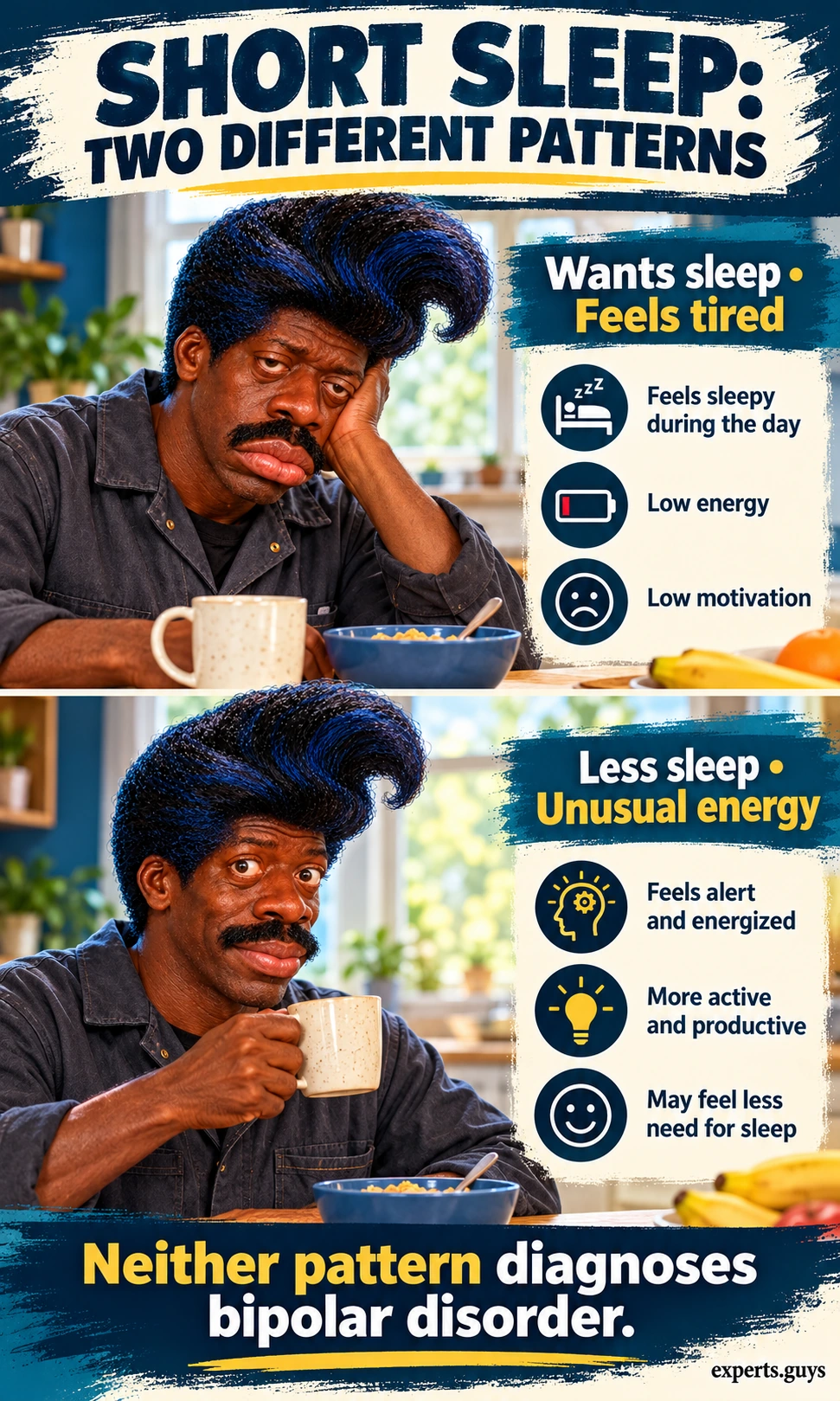
Less sleep is not the same as less need for sleep
After a difficult night, someone with insomnia may want more sleep and feel exhausted. A reduced need for sleep means sleeping much less than usual while feeling unexpectedly rested or energized. That distinction is worth explaining, especially when speech, confidence or activity also changes; it is not a home diagnostic test.
For example, an adult who sleeps poorly before an exam and struggles to stay awake the next day has described sleep loss with fatigue. An adult who starts sleeping far less, feels unusually driven and takes on many new tasks has described a different pattern. These are illustrative comparisons, not patient cases, and both people may need help for their sleep difficulties.
Look for changes that travel together
Mood elevation does not always look cheerful. Irritability or feeling driven can be prominent, and a productive-feeling period can be easy to dismiss. The NIMH overview of bipolar disorder describes changes in activity, sleep, thinking and behavior alongside mood symptoms.
Imagine a usually cautious person who begins several overnight projects and makes expensive commitments during the same short-sleep period. The question is not whether each project is a bad idea; it is why the person’s pace, sleep and judgment changed together. A single shopping trip, expressive personality or creative hairstyle has no diagnostic meaning.

Why can depression be noticed first?
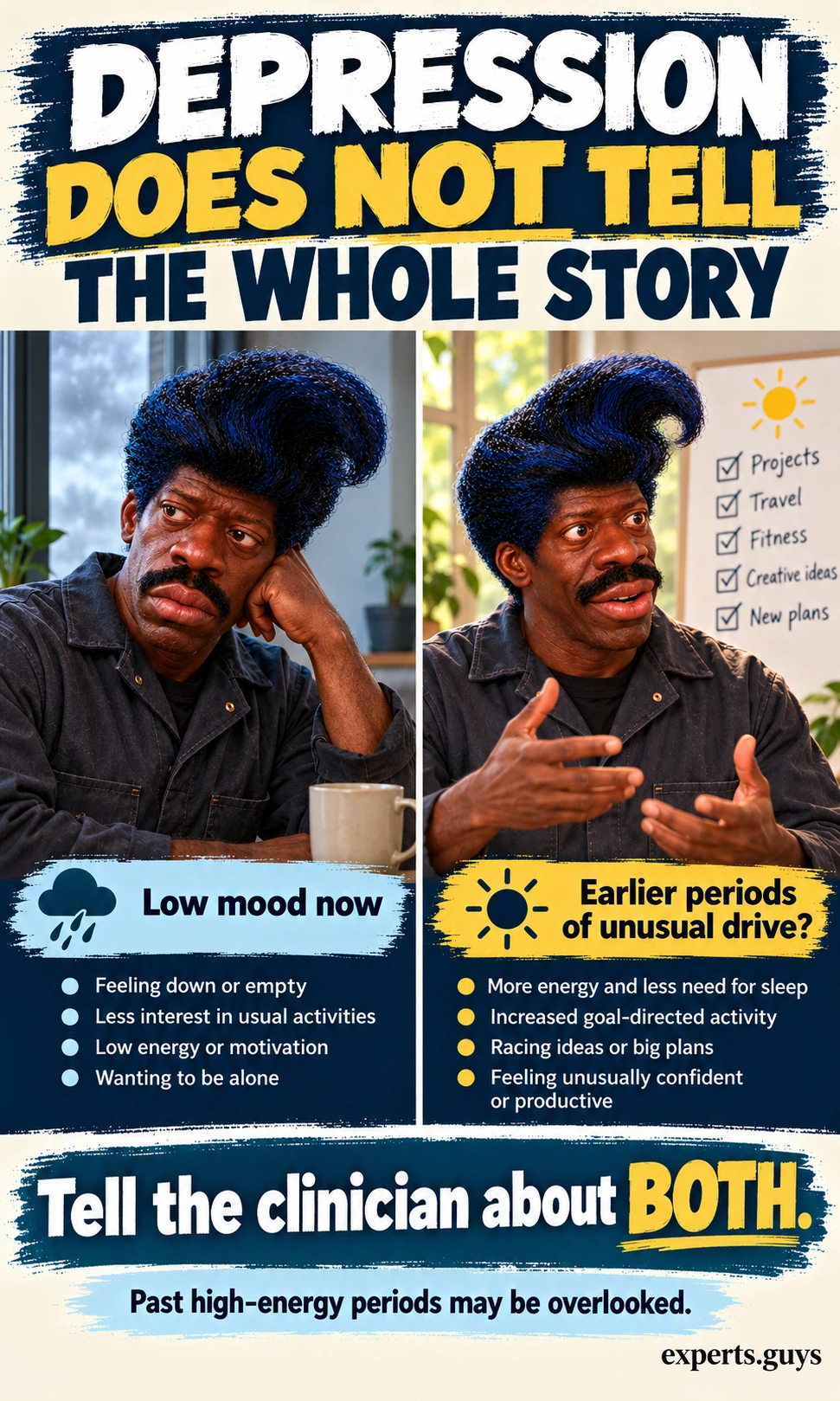
People often seek care when they feel low, while an earlier unusually energized period may have seemed welcome or unremarkable. Describing only today’s distress can therefore leave out information that matters to the assessment. It is useful to mention earlier periods of markedly different energy even if you did not experience them as a problem.
Depression alone does not identify bipolar disorder. Low mood, loss of pleasure and fatigue can have several explanations, and a clinician needs the wider history. For the broader comparison, see how depression, anxiety and bipolar patterns differ; this page concentrates on what makes a first change worth assessing.
Can high energy and low mood occur together?
Yes. A mood episode can include depressive symptoms alongside some symptoms of activation, a combination described as mixed features. Feeling hopeless while unusually restless or driven should not be dismissed because it does not match a cheerful stereotype of mania. The American Psychiatric Association’s bipolar Q&A explains this overlap; the combination still requires clinical interpretation.
What else can resemble early bipolar signs?
Sleep disruption, anxiety, substances, medicines and physical illness can produce overlapping changes. The timing and the person’s longer history help separate possibilities. Finding a plausible trigger does not automatically rule bipolar disorder in or out, and more than one problem can be present.
| Possible context | Useful distinction | What to explain at assessment |
|---|---|---|
| Stress or anxiety | Feeling unable to sleep is different from feeling little need for it | Whether worry, fatigue or unusual drive accompanied the sleep change |
| Longstanding attention difficulties | A longstanding pattern differs from a distinct new episode | What is familiar and what has recently changed |
| Medicine or substance exposure | A change after an exposure needs review; timing alone does not prove cause | What was started, stopped or changed and approximately when |
| Physical illness | Some medical conditions can resemble mood symptoms | New physical symptoms and relevant health history |
| Travel or disrupted routine | Sleep opportunity may have changed for practical reasons | Whether energy and behavior also became unusual |
The NICE assessment recommendations include lifetime patterns, functioning, physical health, medicines and information from a family member or carer where appropriate. Those details help explain why a short online checklist cannot replace a full assessment. Share what you know; uncertainty about exact dates is acceptable.

What if symptoms started after a medicine change?
Tell the prescriber promptly about new unusual energy, sharply reduced sleep need or marked changes in behavior. Do not stop, restart or alter a prescribed medicine to test your own explanation. A medication review considers the medicine, the underlying condition and other possible contributors together; it is not simply a choice between “side effect” and “bipolar disorder.”
Does family history settle the question?
No. Family history can increase suspicion and is relevant to assessment, but it is not a diagnosis or a prediction that someone will inevitably develop the condition. Conversely, not knowing of an affected relative does not settle the question. Describe known history accurately rather than guessing labels for relatives who were never assessed.
Are the signs different in teenagers?
In young people, changes must be interpreted against development, usual behavior and the demands of school and home. Persistent impairment or striking changes in sleep, energy and judgment should not be written off as puberty. Equally, irritability alone should not become a bipolar label. The NIMH guide for children and teens emphasizes a careful evaluation because symptoms overlap with other conditions.
A parent can describe a concrete change, such as a teenager’s sleep and activity becoming very different from their usual pattern, without deciding what it means. A clinician experienced with children and adolescents can assess development and other explanations. The adult comparisons on this page are not a pediatric screening instrument.
What should you do before a diagnosis is clear?
Choose the next step by severity, safety and how quickly the change is developing. You do not need to prove a diagnosis before asking for help. A primary-care clinician can start an assessment and arrange specialist care; suspected mania or a rapidly deteriorating presentation needs urgent assessment rather than a routine wait.
| Situation | Next step | Do not wait for |
|---|---|---|
| Immediate danger, inability to stay safe or severe confusion | Use local emergency services or an emergency department now | A symptom count or an appointment slot |
| New psychotic symptoms, rapidly escalating energy or increasingly unsafe behavior | Seek urgent clinical assessment; use emergency care if safety is uncertain | A full week of symptoms |
| A new, persistent or recurring change without immediate danger | Arrange assessment and explain what changed from your usual self | Perfect dates or a completed diary |

Duration criteria are not instructions to delay care
Diagnostic criteria consider duration as well as symptom pattern and severity. In DSM-based descriptions, mania generally lasts at least one week, or any duration when hospitalization is necessary; hypomania generally lasts at least four consecutive days. These are parts of a clinical definition, not deadlines you must reach before seeking help, and duration alone never establishes an episode.
Bipolar I requires a manic episode; depression is common but not required. Bipolar II requires hypomania and major depression, without a history of mania. Hypomania does not include psychosis or the marked impairment characteristic of mania. The American Psychiatric Association’s explanation of bipolar disorders provides the distinctions; a clinician applies them to the whole presentation.
Describe the change without keeping a diary
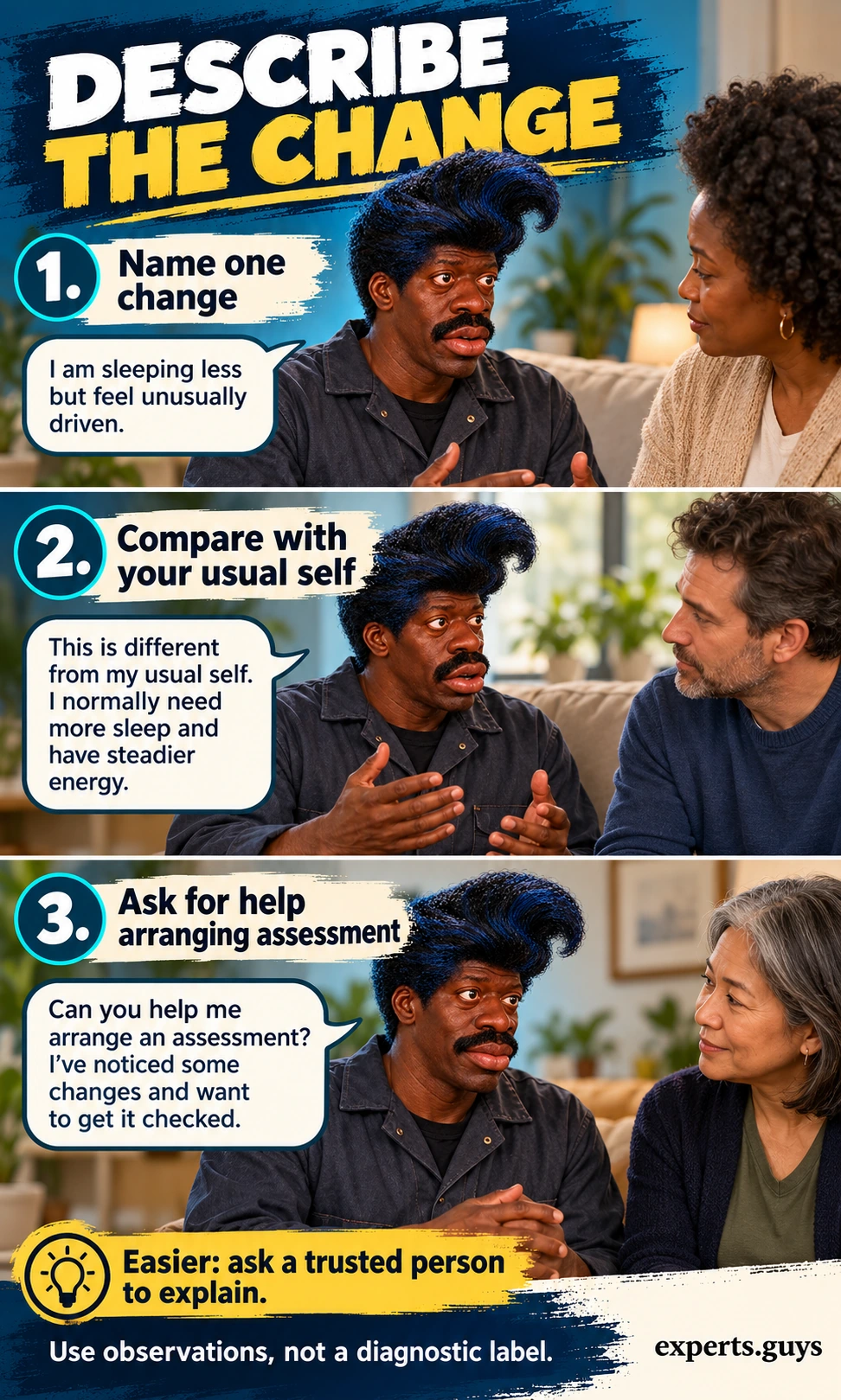
Use a brief spoken description when you or a trusted person need to explain why an assessment is needed. This is a communication aid, not a diagnostic interview. Choose someone you feel safe with, or use the same wording directly with the clinician; there is no need to prepare a written record first.
- Name one observable change: “I am sleeping less but feel unusually driven.”
- Compare it with your usual self: “I normally need more sleep and have steadier energy.” Include approximately when the change began if you know.
- Ask for a concrete next step: “Can you help me arrange an assessment?” Mention any immediate safety concern at the start rather than saving it for the end.
Illustrative example: an adult who cannot explain a recent change asks a sibling to join the appointment and describe what they have observed. The useful outcome is that the change reaches the clinician, not that the sibling agrees on a diagnosis. Avoid arguments about whether the person is “really bipolar”; observable details are more useful than labels.
Easier version: say, “Something is different from my usual self, and I need help explaining it,” then let a trusted person help, with your agreement. Different people can assist at different stages. If no one is available, start directly with the service. Do not delay urgent help while looking for the perfect wording.
An assessment may include physical-health checks and further appointments, rather than an immediate label. Ask what the current working explanation is, what would change it and when to return if symptoms worsen. Once the diagnosis is clearer, bipolar treatment options belong to a separate discussion about phase-specific care, benefits and monitoring.
How can you make the immediate environment easier to manage?
If ordinary noise feels overwhelming, reduce one avoidable source of stimulation while arranging appropriate help. This is a small comfort measure, not a way to diagnose or stop mania. It fits a safe situation in which the person wants a quieter environment; it must not delay the urgent response described above.
Make one space quieter while arranging help
Start with a safe, accessible place already available to you. Keep enough light to move comfortably, leave the route clear and avoid moving heavy furniture. Calming environments and reduced stimulation appear in NICE guidance for mania or hypomania; the household sequence below is an illustrative adaptation, not a separately tested treatment.
- Switch off one sound source. If comfortable and safe, turn off a radio or television that is adding to the noise. Do not interfere with essential alarms or another person’s necessary equipment.
- Choose a quieter spot. Move to an existing comfortable seat if you can do so safely. Stay where you are if movement is difficult; reducing noise alone is enough.
- Pause with support. If wanted and available, ask one calm trusted person to stay nearby while the next care step is arranged. There is no required posture, breathing pattern or time target.
Illustrative example: a radio is playing while several conversations compete for attention. Turning off the radio and sitting with one supportive person removes one source of noise. Completion means the space is quieter and support remains available; it does not require a better mood or prove that symptoms are resolving.
Easier version: ask someone else to switch off the sound while you remain seated. Do not force someone to sit, isolate them, block exits or insist on silence. If the change feels worse, stop and choose a tolerable setting. Worsening agitation, confusion or difficulty staying safe changes the priority to urgent help.

The common mistake is turning a helpful adjustment into a test: “If you calm down, nothing serious is happening.” Comfort does not rule out illness, and remaining distressed does not mean someone failed. Keep the observation separate from the care decision. For ongoing support after immediate needs are addressed, the guide to choosing mental health counseling explains a different task from urgent assessment.
Frequently asked questions
Can a blood test confirm bipolar disorder?
No blood test by itself confirms bipolar disorder. Tests may help investigate other causes or physical-health concerns, while diagnosis relies on a clinical assessment of symptoms and history. A normal test result does not settle every possible explanation.
Does rapid cycling mean moods change every few minutes?
No. Rapid cycling refers to four or more distinct mood episodes within a year. Moment-to-moment changes in emotion are not automatically separate episodes; a clinician considers the overall pattern and episode criteria.
Can someone seem well between episodes?
Yes. A person may have periods of relatively stable mood between episodes, although the course varies. A well-looking day does not erase an important past episode, and a past episode does not mean every future emotion is a symptom.
Is a new energetic period in later life worth assessing?
Yes. A new marked change in later life deserves assessment, including possible medication, physical-health or neurological contributors. It should not be dismissed as personality or assumed to be bipolar disorder without considering alternatives.
A useful first step
Look for a distinct change from the person’s usual sleep, energy and behavior, then choose an assessment route that matches the severity. Explain one concrete change rather than assigning a label. A quieter space can support comfort while help is arranged, but safety and clinical assessment remain separate decisions.









