
Cognitive behaviour therapy (CBT), also called cognitive behavioural therapy, helps people understand and change patterns in thinking and behaviour. A useful CBT task has a clear purpose, an explanation you recognise and a review of what happened. If an instruction is unclear, ask to see the relevant step and show or explain it back before practising independently.
This guide explains the CBT process for adults and teaches one participation skill: checking an agreed task through demonstration and teach-back. The skill checks communication; it does not replace assessment or make a task clinically appropriate. The household object in the illustrations makes the sequence visible and is not a recommended treatment exercise.
| Part of CBT | Useful question | What it contributes |
|---|---|---|
| Assessment | Is CBT suitable for this difficulty? | A choice of treatment based on needs, preferences and context. |
| Shared explanation | What may keep the difficulty going? | A working account that you can question and revise. |
| Purposeful practice | What are we trying to learn or change? | A task connected to that explanation. |
| Review | What happened, and what follows? | A decision informed by learning, symptoms and daily life. |
What is cognitive behaviour therapy actually trying to change?
CBT works with links between what happens, how a person interprets it, their feelings and bodily responses, and what they do next. The focus is an individual pattern rather than a rule that all distress comes from thinking incorrectly. Real illness, unsafe circumstances and practical pressures still require appropriate attention.
A shared explanation is often called a formulation. It identifies possible triggers and maintaining factors while making room for relevant history, strengths and context. It is a working explanation, so a mismatch should lead to further discussion rather than an instruction to accept it.
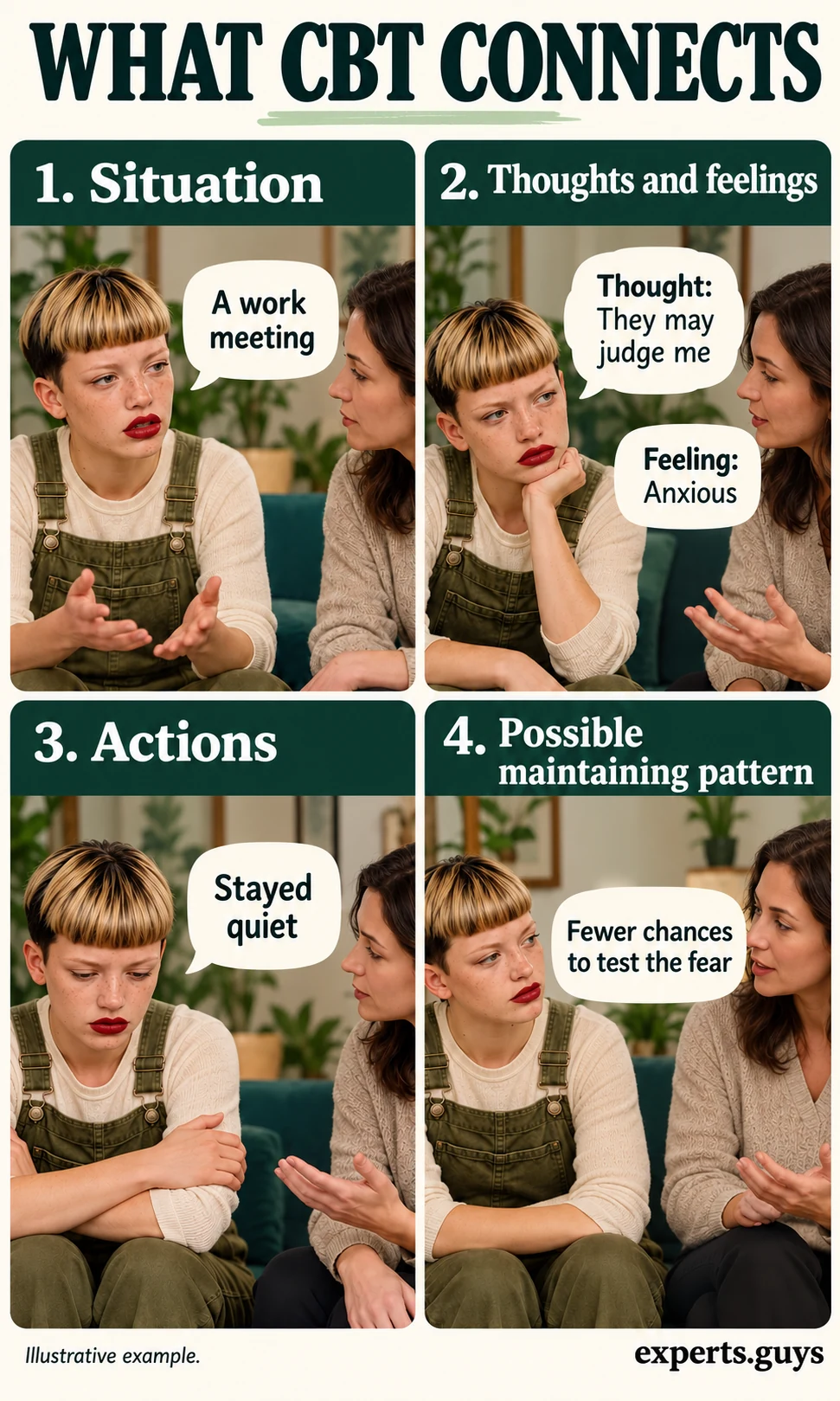
For example, someone may repeatedly postpone an ordinary task because the instructions feel uncertain. That observation alone does not tell you whether the barrier is fear, fatigue, an access need or an unclear explanation. Assessment helps distinguish these possibilities before a therapist chooses what to do.
CBT can involve individual, group or guided formats, and it may take place face to face or remotely. The NHS overview of CBT describes assessment, different formats and practice between sessions. Session frequency and course length vary; ask what your service offers and how the plan will be reviewed.
If your question is how approaches differ, the separate types of psychotherapy for depression comparison explains the broader choices. This page concentrates on how CBT moves from an explanation to understandable practice. It does not select a treatment from a single symptom.
How does an agreed task become useful CBT practice?
An activity becomes purposeful practice when you understand why it has been chosen and what question it addresses. Merely completing an activity does not tell you whether it addressed the relevant difficulty. The therapist should connect the work to your goals and the shared explanation of the problem.
The BABCP explanation of CBT describes a collaborative approach with agreed goals and practice. Collaboration includes questioning a rationale that does not fit your experience. Agreement should allow discussion of preferences, feasibility and safety rather than simply mean complying with instructions.
- Purpose: what are we trying to understand or change?
- Action: what exactly have we agreed to try?
- Boundary: what would make us pause or seek clarification?
- Review: what could the result tell us, and what could it not tell us?

Consider a purely illustrative demonstration using a small towel. A therapist could show a fold so that a person can demonstrate whether the instruction was understood. That would check communication about the fold; it would not establish that folding treats depression, that perfectionism caused the difficulty or that therapy has succeeded.
The distinction matters when a physical action looks simple from the outside. A task can be physically manageable yet have an unclear purpose, while a clearly explained task can still be inappropriate for a person’s condition. Both the rationale and the practical fit need attention.
For a catalogue of specific exercises, use CBT techniques and worksheets. That page already covers behavioural experiments, graded tasks and reducing unnecessary checks. Choose any technique within an appropriate plan rather than turning every ordinary activity into an experiment.
How can you check understanding without a worksheet?
Ask to see the part of an agreed task you cannot picture, then show or explain your understanding. This gives both people something concrete to clarify before independent practice. You do not need to save a recording, complete a diary or demonstrate perfect performance.
The AHRQ teach-back guidance describes checking understanding through a person’s own explanation and, where useful, showing an action. Here that communication principle is adapted to discussing an already agreed CBT task. It is not a separate CBT treatment, a test of intelligence or evidence that teach-back alone improves depression.
Watch, try and clarify one agreed step
Use this when the task’s purpose has been agreed but the instruction remains difficult to follow. Set up a comfortable accessible space with only the materials the actual task requires, and ask the therapist to demonstrate within their competence. No particular posture, device or household object is necessary for the communication skill.
- Ask for one demonstration. Say, “Could you show me the part you mean?” Watch the relevant action and ask about the point that is unclear.
- Show or explain your version. Say, “Let me check that I understood.” Repeat the agreed step if safe and comfortable, or describe it in your own words.
- Compare the understanding. Ask whether your version matches the intended task. Have the therapist clarify the difference before adding more instructions.
- Agree what follows. Confirm the next action and the circumstances in which you should pause or contact the service.
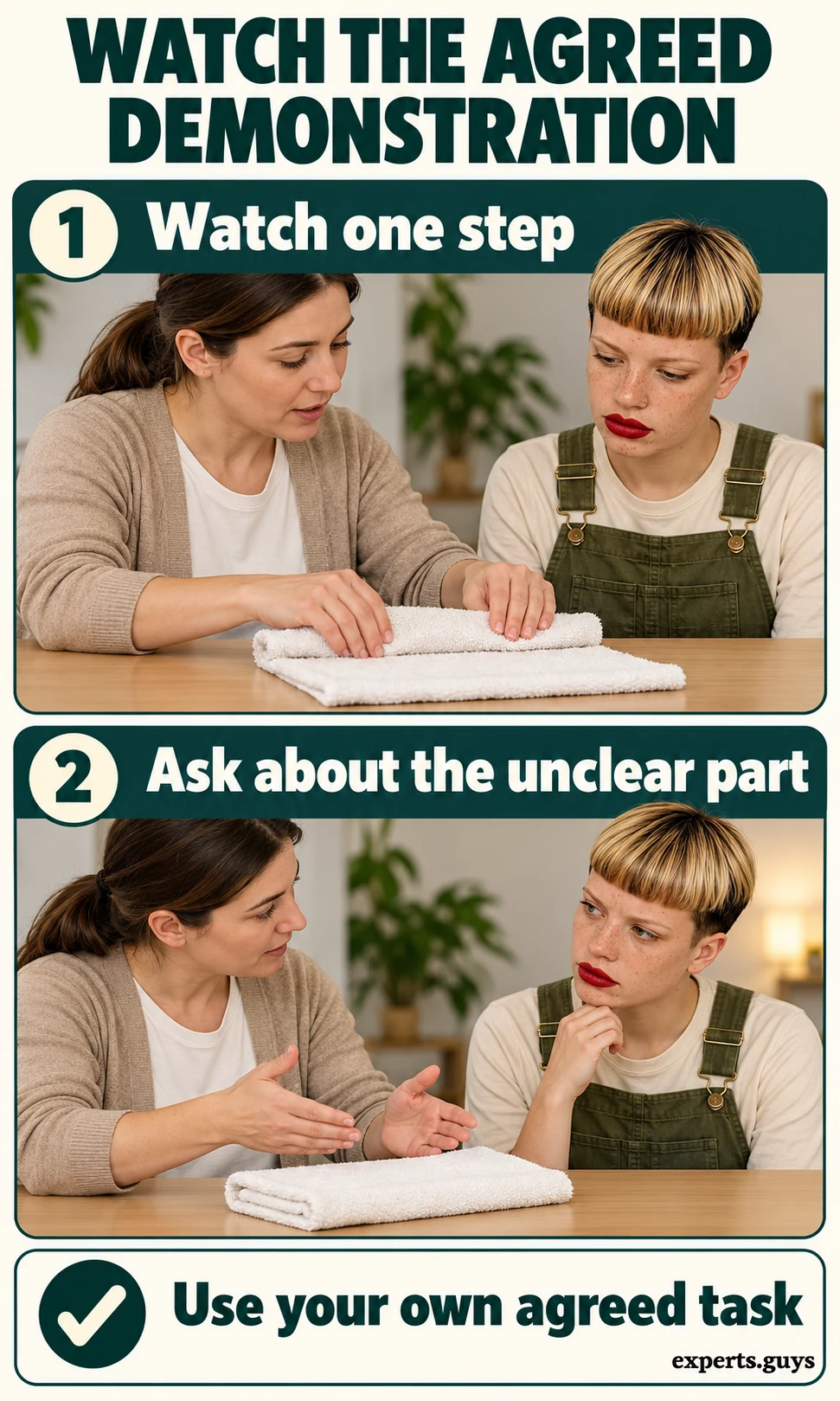
In the towel illustration, the therapist demonstrates one fold while the person watches. The person then tries that fold and says what they understood, so a difference in instruction becomes visible. In real care, use the task agreed for your own difficulty; there is no reason to introduce towel folding just because it appears here.

A common mistake is copying the movement while still being unsure why it was chosen. Another is saying “yes” because asking again feels embarrassing. Correct this by naming the specific uncertainty, such as “I can copy the action, but I do not understand what I am meant to notice.”
An easier version is to watch only the first part or explain it aloud instead of performing it. If pain, fatigue, sensory needs or mobility make the setup difficult, agree an accessible demonstration or another communication format. Stop if the action causes pain or significant distress; do not treat pushing through symptoms as proof of engagement.
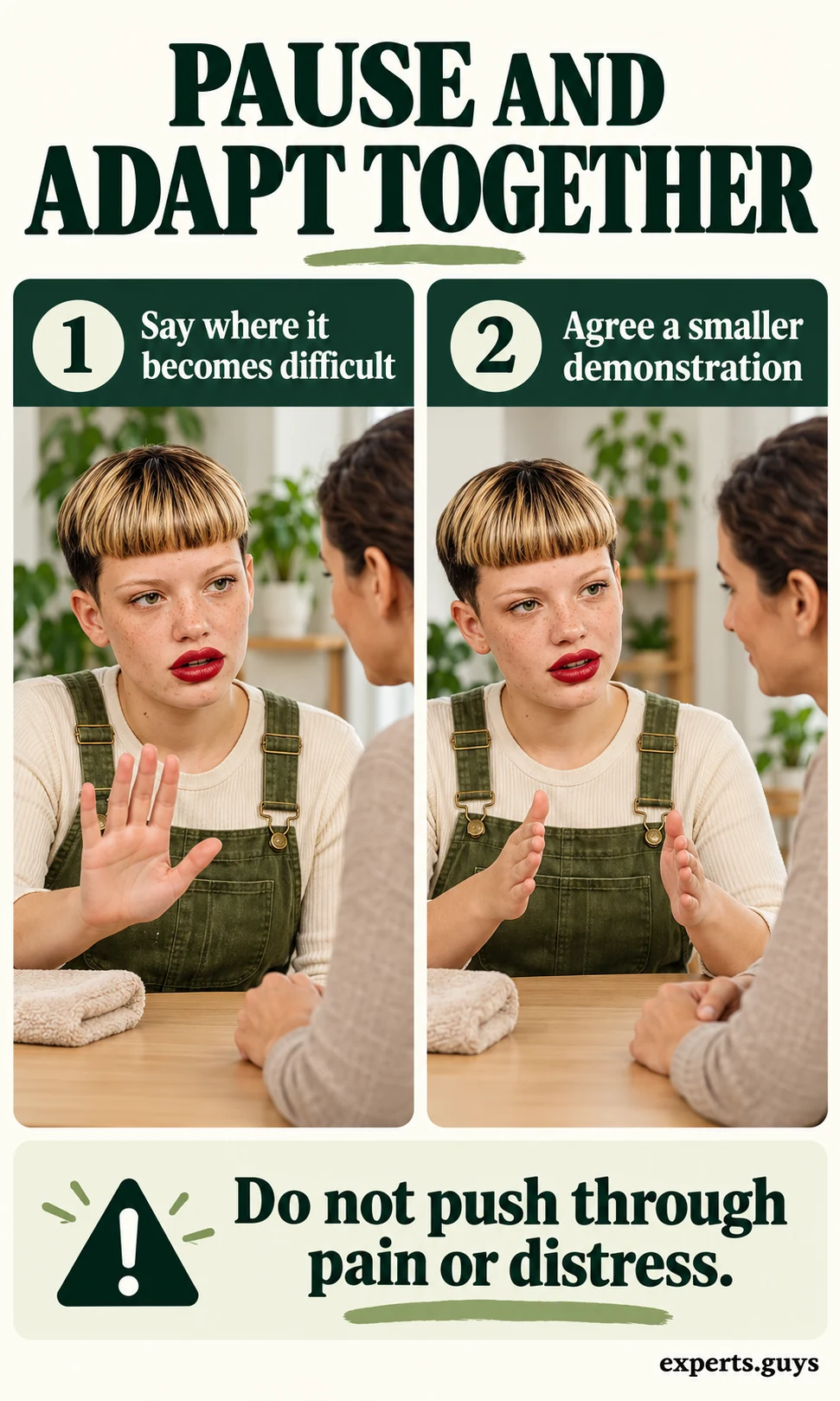
The observable result is a shared understanding of the next step and its purpose, or a clearly identified question that still needs resolving. It is acceptable for the task to remain unagreed while that question is addressed. Clinical review is needed if the difficulty reflects a treatment mismatch rather than unclear communication.
General questions about speaking up and using appointment time are covered in talk therapy for depression. The narrower action here is a live check of an already proposed task. It does not require designing a new exercise or rehearsing a distressing scenario independently.
What should you review after trying a task?
Review what you did, what the task actually showed and how things are going beyond that single action. These are related questions, but they are not interchangeable. A correct demonstration can coexist with ongoing symptoms or a need to change the treatment plan.

The ABCT guide to CBT explains collaborative goals and learning through practice. The information from a task should feed back into the shared explanation and the next decision. An unexpected result or a barrier can be useful information rather than a reason to blame yourself.
In the illustration, completing the fold supports a narrow conclusion: the person could show that action in that setting. It does not show how the person would manage a different task at home or whether symptoms have improved. A fair review keeps the conclusion within the evidence instead of turning one attempt into a verdict.
- If the instruction is still unclear: identify the step and ask for another explanation or an accessible demonstration.
- If the action is understood but does not fit: discuss the rationale and circumstances before repeating it.
- If symptoms worsen: contact the service sooner and describe the change, rather than waiting to complete more practice.
- If the course is ending: agree what to continue, how to recognise a need for further help and the actual contact route.

Progress may include changes in symptoms, functioning and the ability to use relevant skills, rather than one completed task. The NIMH psychotherapy guidance recommends discussing goals, how progress will be assessed and what happens if improvement is not occurring. Persistent or worsening difficulties deserve a treatment review, including consideration of other contributing conditions.
If choosing a service is the unresolved issue, mental health counseling covers provider questions. During an existing course, confirm your own service’s arrangements for concerns, missed appointments and follow-up. A routine message or an article exercise is not an emergency response.
Frequently asked questions
Does CBT mean thinking positively?
CBT aims for a useful and accurate understanding of thoughts and actions in context. It is not a demand to feel cheerful or deny real problems. A helpful task should have a rationale that fits the difficulty being treated.
Will CBT ignore my past?
Relevant past experiences can be discussed when they help explain current difficulties. CBT commonly focuses on patterns that can be worked on in the present. Ask how your history fits the shared explanation rather than assuming it must be excluded.
Is teach-back a CBT exercise for depression?
Teach-back is a way to check communication and understanding. This article adapts it to clarifying a task already agreed with a therapist. It is not presented as a stand-alone treatment for depression.
Do I need to fold a towel?
No. The towel makes a demonstration easy to see in the illustrations. Use the task and materials relevant to your actual care, or explain the instruction aloud when a physical demonstration is unnecessary or unsuitable.
Can CBT be used with medication?
Yes, CBT can be part of care that also includes medication. The appropriate combination depends on the condition, needs and clinical advice. Do not change prescribed medication because an individual task went well or badly.
What if I cannot show the task?
Say what prevents the demonstration and ask for an accessible way to clarify it. A spoken explanation, an interpreter or a smaller demonstration may be useful depending on the need. Difficulty performing a task is not the same as a lack of understanding or willingness.
Summary
CBT connects an individual explanation of a difficulty with purposeful practice and review. If an agreed instruction is unclear, ask to see the relevant step and show or explain your understanding before practising independently. Leave knowing the purpose, the next action and when to pause or ask for help.