CBT techniques and worksheets help you examine a specific thought or behavior, practise a different response and learn from what happens. Choose one exercise that matches the difficulty in front of you, rather than trying all 25. These digital-friendly examples support practice; they do not replace assessment or a course of therapy.
The useful question is “What would this exercise help me decide or do?” A thought worksheet can test an interpretation, while a behavioral exercise can test a prediction through action. If you already have a therapist, use the approach you have agreed together.
| Your immediate difficulty | Start with | Useful completion |
|---|---|---|
| A conclusion feels like a fact | 1. Fact or interpretation | Separate the event from its meaning |
| You can name the thought but keep debating it | 4. Evidence balance or 13. Behavioral experiment | A fair response or a safe, observable test |
| A necessary task never starts | 11. Graded task | One manageable action |
| You keep checking or polishing a harmless task | 14. Extra-check reduction or 15. Good-enough standard | Test a prediction without skipping necessary checks |
| The same worry interrupts everything | 16. Problem-solving or 17. Worry postponement | An action for a real problem, or a return to the present task |
| Practice is becoming another source of pressure | 25. Review and adapt | One adjustment, a pause or appropriate support |
How do you choose a useful CBT worksheet?
Choose by the job, not the worksheet’s length. Start with observation when the situation is unclear, evidence checking when a belief is specific, and a safe behavioral experiment when only action can provide new information. A longer record is not automatically a better exercise.
A worksheet is a structure for practice, not a treatment by itself. The NHS explanation of CBT describes assessment and work with a therapist to change unhelpful patterns of thinking and acting. The exercises below are related skills and worksheet formats, not 25 separate therapies or a prescribed sequence.
Use a private phone note, a document on your device or the practice workspace below. Choose a low-intensity example and avoid identifiable details about other people. You can also think through a prompt without keeping a record if saving it would not change your next action.
All examples here are illustrative, not patient case histories. The first three exercises distinguish an event, its meaning and the response it brings; they can be used separately or together when that distinction is unclear. If you need to trace a repeating depression pattern in depth, use the cycle of depression worksheet instead of extending this selection exercise into a daily diary.
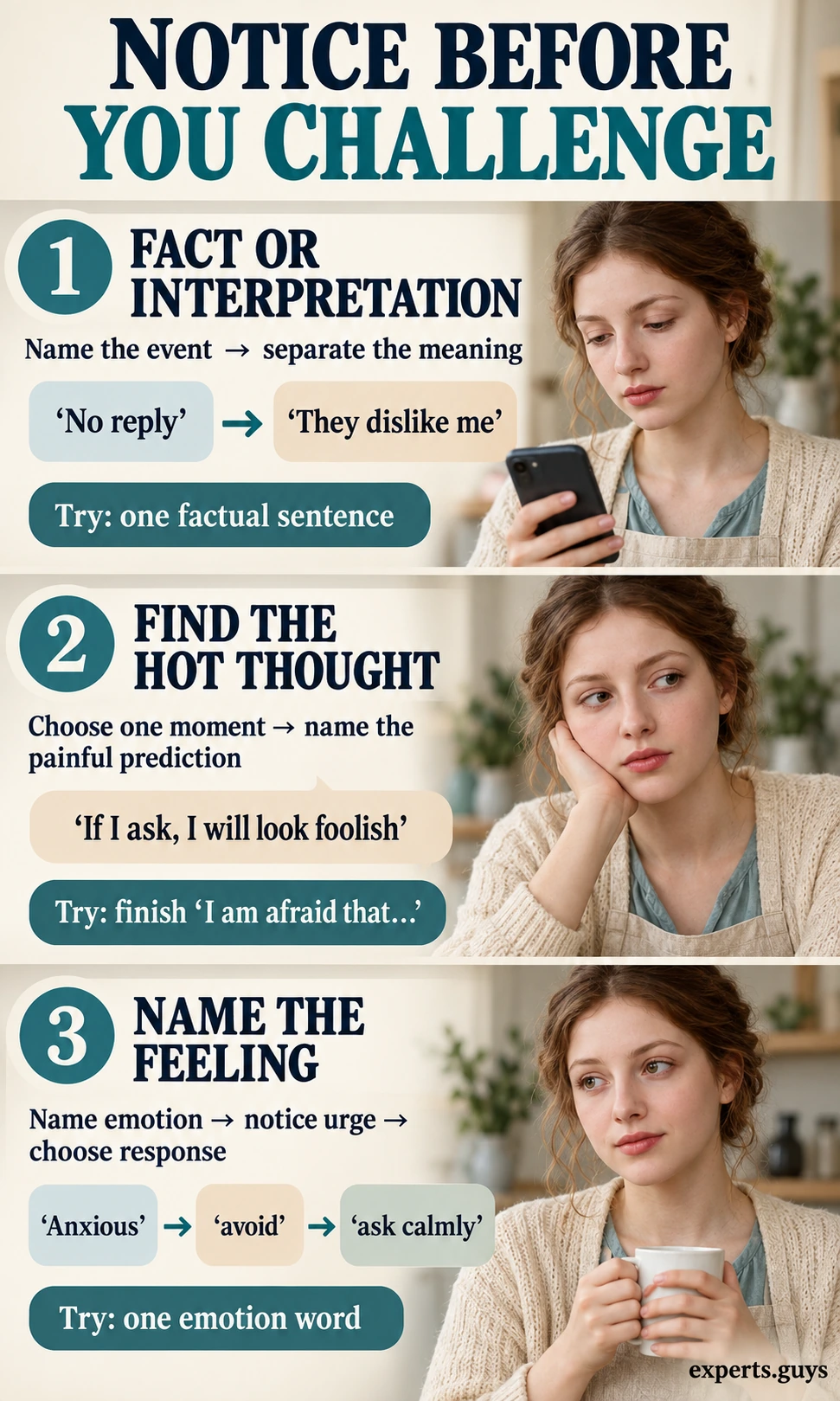
1. Separate a fact from an interpretation
Use this when a message, expression or delay seems to prove something about you. Separating an observation from its meaning creates room to check an assumption without denying the event.
- Open a private note and describe one event as a camera could capture it.
- Put your interpretation beside it, then identify what information is still missing.
- Choose a proportionate response to the known facts.
Illustrative example: A friend has not replied since lunch. “They dislike me” is an interpretation; “no reply yet” is the observation. You continue your afternoon instead of sending repeated apologies.
- Common mistake: Replacing one guess with a reassuring guess still leaves you guessing. Allow “I do not know yet.”
- Easier option: Type only the factual sentence.
Completion and next step: Finish when you can distinguish the event from its meaning; seek clarification only if it is useful.
2. Identify the hot thought
Choose this when you have several worries but cannot tell which prediction is driving the reaction. The most emotionally charged meaning gives a thought exercise a specific target; a whole day of worries is too broad.
- Choose a mild, recent moment rather than a traumatic memory.
- Complete “At that moment, I was afraid that…” in a private note.
- Select one testable prediction and decide whether it needs evidence checking or a safe behavioral test.
Illustrative example: Before asking a question, “I will look foolish” matters more than “this meeting is long.” The useful target is the prediction about asking.
- Common mistake: Do not dig repeatedly for a deeper defect or use this to relive trauma. Stop if the exercise becomes overwhelming.
- Easier option: Finish the sentence aloud without saving it.
Completion and next step: A clear prediction is enough. Move to exercise 4 or 13 rather than analysing indefinitely.
| What you identified | What it can tell you | What it cannot establish |
|---|---|---|
| Observation | What happened in a specific moment | Another person’s motive |
| Prediction | What a safe test could examine | Certainty about every future event |
| Emotion | Your current experience and need | Proof that an interpretation is accurate |
3. Distinguish a feeling from an action urge
Try this when “I feel rejected” quickly becomes cancelling plans or sending an angry reply. A feeling, a conclusion and an action are related but different; noticing the distinction gives you a choice about behavior.
- Name an emotion such as sadness, anger or anxiety.
- Identify the urge it brings, without acting immediately.
- Select a response that fits the facts and your goal.
Illustrative example: You feel anxious and want to avoid a call. You decide to ask one clear question during the call instead of waiting until you feel completely calm.
- Common mistake: “They hate me” describes a belief, not an emotion. Strong emotion does not prove or disprove the belief.
- Easier option: Choose one emotion word and pause.
Completion and next step: Completion means choosing your response; the emotion does not have to disappear.
Which cognitive exercise fits the thinking problem?
Use a cognitive exercise to examine an interpretation, a prediction or a personal rule. The goal is a fairer, more workable response, not proving that every concern is irrational. Real harm, discrimination, illness and resource constraints require appropriate action and support.
The NHS thought-record exercise provides a fuller structure for examining a situation and the evidence around it. Here, choose the narrower exercise that answers your particular question. For a depression-focused collection with different daily-life uses, see 13 depression worksheets.
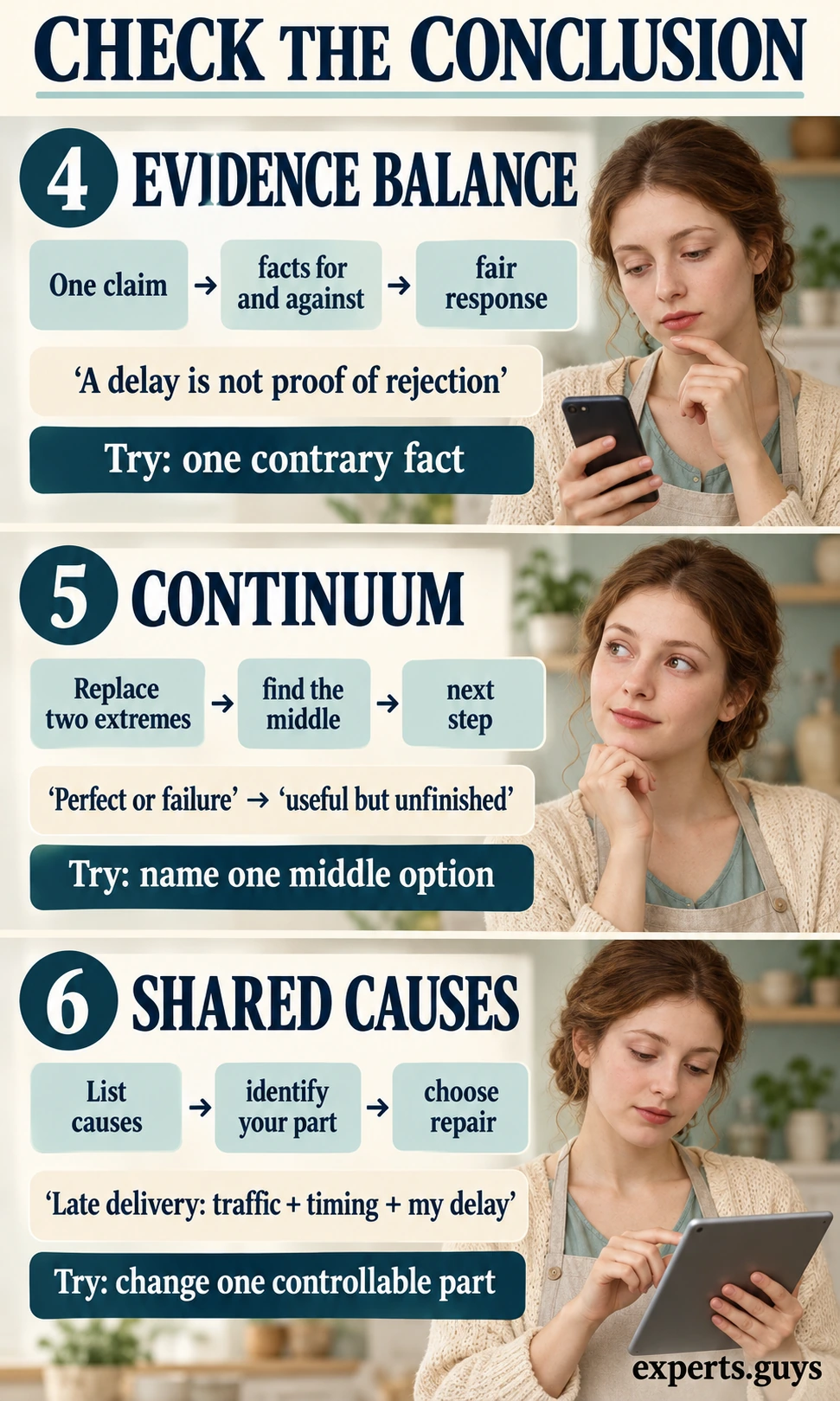
4. Balance evidence for one thought
Use this when a specific negative conclusion feels certain. Considering relevant evidence on both sides can produce a more accurate response than either self-criticism or forced positivity.
- Type one claim, then one concrete fact supporting it and one that does not fit it.
- Include uncomfortable facts; exclude guesses about another person’s mind.
- Create a balanced response and choose a useful action.
Illustrative example: “My suggestion was ignored” may fit one meeting. A colleague used another suggestion last week. A fair response is “Not every idea is accepted; I can ask what would improve this one.”
- Common mistake: Do not collect reassurance until you feel certain. The aim is a fair appraisal, not a guaranteed good outcome.
- Easier option: Find one fact that makes the original claim less absolute.
Completion and next step: Use the response once, act, and review later if new evidence arrives.
5. Replace all-or-nothing judgments with a continuum
Use this when a task can only be perfect or a failure in your mind. Describing a middle position can make a useful next improvement visible instead of discarding the whole attempt.
- Name the two extremes you are using.
- Describe a realistic middle standard in observable terms.
- Compare your work with that standard and choose one improvement.
Illustrative example: A family invitation need not be flawless or useless. “Correct date, clear place and readable wording” is an adequate middle standard, so you fix the date and send it.
- Common mistake: Avoid turning the continuum into another score of your worth. Evaluate the task, not your value as a person.
- Easier option: Name one acceptable middle option.
Completion and next step: Stop when you can identify what is adequate and what, if anything, needs changing.
6. Reattribute responsibility fairly
Choose this when you take all the blame for a shared outcome. Looking at multiple causes helps separate a repair you can make from factors you did not control.
- List the factors that contributed, including timing, systems and other people’s choices.
- Identify your actual responsibility without assigning invented precise percentages.
- Choose one repair or boundary within your control.
Illustrative example: A delivery was late because of traffic, a narrow time slot and your delayed confirmation. You can confirm earlier next time without concluding that every delay is your fault.
- Common mistake: This is not a way to excuse harm or blame yourself for abuse. Responsibility belongs with the person who causes abuse.
- Easier option: Name one outside factor and one controllable action.
Completion and next step: Complete the repair where needed; stop revisiting blame when no new information changes the action.
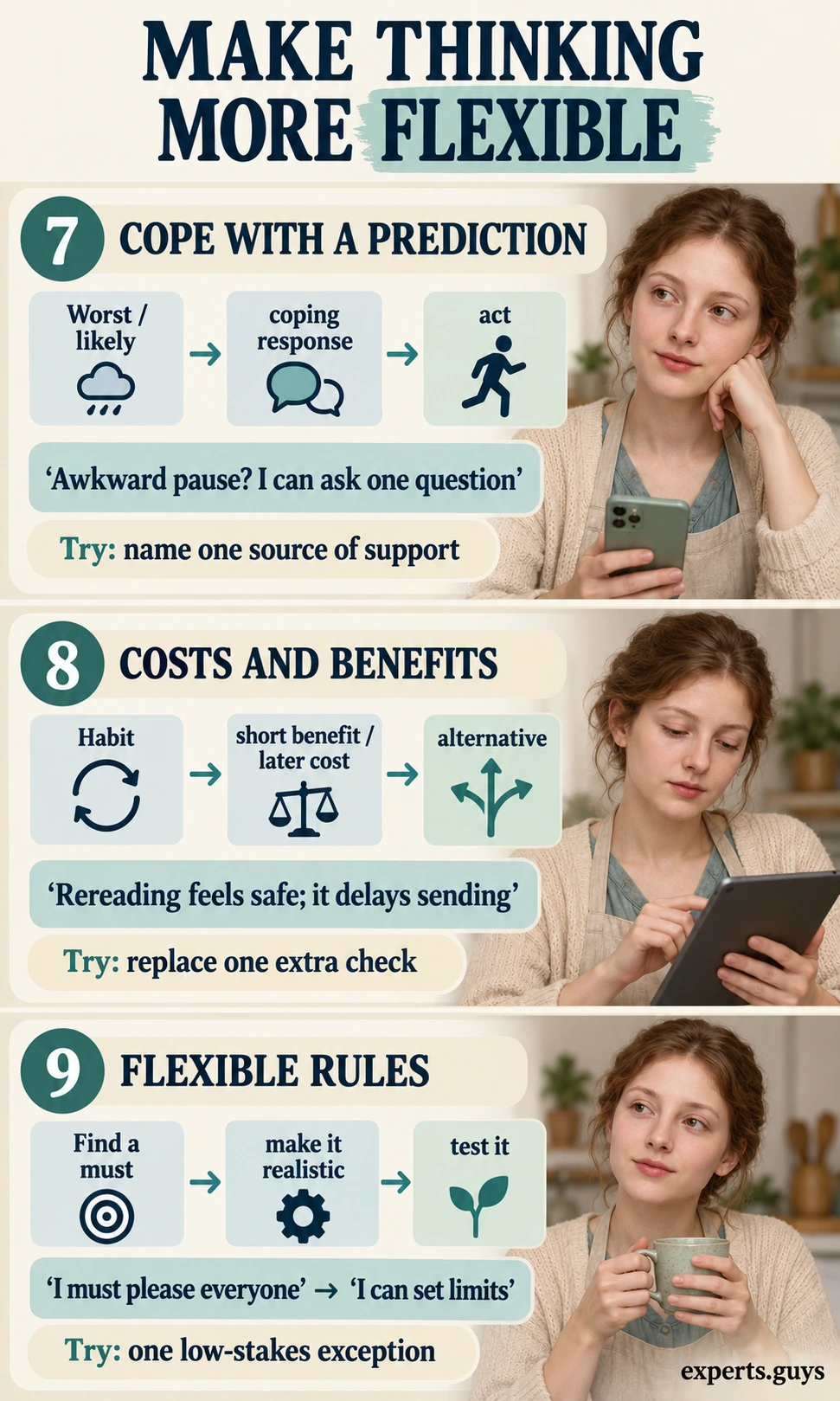
7. Pair a feared outcome with a coping response
Try this when a prediction jumps straight from discomfort to disaster. Separating what is possible from what is likely, and identifying support, makes the response more concrete.
- State the feared outcome briefly.
- Describe a plausible likely outcome using available information.
- Identify what you could do or whom you could ask if the difficult outcome happened.
Illustrative example: You fear an awkward silence on a call. A more likely outcome is a short pause; your coping response is to ask the next prepared question.
- Common mistake: Do not repeatedly imagine disasters as a reassurance ritual. Use practical safety planning for real danger.
- Easier option: Name one available source of support.
Completion and next step: Finish with a response you can use, then return to the present task.
8. Compare the short benefit with the later cost
Use this when a habit helps briefly but keeps creating another problem. An action can reduce discomfort now while costing time, connection or opportunity later.
- Name a behavior such as repeatedly rereading a casual message.
- Compare its immediate benefit with its later cost.
- Choose a small alternative and observe whether it serves the original goal better.
Illustrative example: Rereading feels safer for a moment, but the message stays unsent. You replace one extra check with sending after an ordinary proofread.
- Common mistake: Do not use a costs list to shame yourself. Include the real benefit that made the habit understandable.
- Easier option: Identify one later cost and one possible alternative.
Completion and next step: Compare what happened with the purpose of the task, not with perfect comfort.
9. Turn a rigid rule into a flexible preference
Use this when “must,” “always” or “never” leaves no room for ordinary limitations. A flexible rule can preserve what matters while allowing proportionate choices.
- Identify one rule and the situations where it causes difficulty.
- Rewrite it to include context, limits or exceptions.
- Test one harmless exception and review the result.
Illustrative example: “I must please everyone” becomes “I want to be considerate, and I can say when I am unavailable.” You decline one optional request politely.
- Common mistake: Do not weaken medical advice, legal requirements or genuine safety rules. This concerns overly rigid personal standards.
- Easier option: Try one low-stakes exception.
Completion and next step: Keep the revised rule if it is more realistic and workable; adjust it with support if guilt remains overwhelming.
How do you test a thought through behavior?
Use a behavioral exercise when the useful information comes from trying an action. Specify the prediction and observation before the attempt, keep the situation safe, and allow a mixed result. The aim is learning that guides a next step, rather than forcing anxiety away.
A task step makes an action more manageable; an experiment tests a prediction about that action. These can overlap, but they answer different questions. The CCI perfectionism resources explain experiments with checking and standards, while the examples below keep the task low-stakes and concrete.
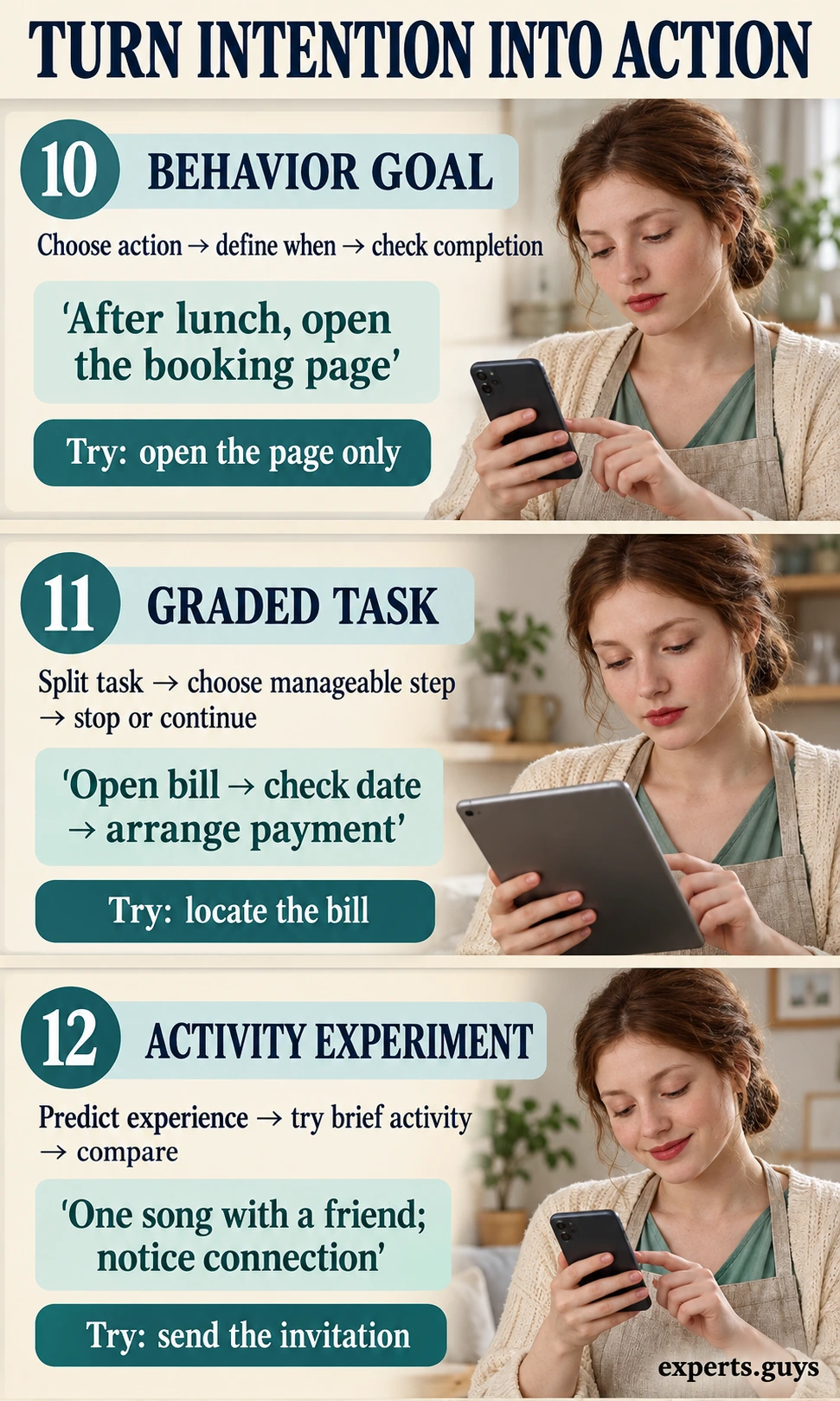
10. Set a behavioral goal you can observe
Use this when your goal is “be confident” or “stop feeling bad” and you do not know where to begin. Actions are easier to specify and practise than emotional outcomes you cannot directly command.
- Choose an action that matters to you and is within your control.
- Specify a realistic occasion and a clear stopping point.
- Check whether you attempted the action, then adjust the size if necessary.
Illustrative example: “After lunch, I will open the appointment booking page” is observable. Feeling confident is not required to complete that step.
- Common mistake: Do not make the goal depend on someone else replying or on immediate symptom relief.
- Easier option: Open the relevant page without completing the booking.
Completion and next step: If the step is manageable, choose the next one; if not, reduce it or ask for practical help.
11. Break a task into graded steps
Use this when a necessary task feels too large to start. A smaller entry step reduces the demand of beginning and reveals which obstacle actually needs support.
- Break the task into concrete actions in a phone checklist.
- Choose the first manageable action, not necessarily the whole sequence.
- Try it, then decide whether to stop, continue or request help.
Illustrative example: For a bill: locate it, check the due date, check payment options, then arrange payment. Locating it counts as the first step, not a failed version of paying it.
- Common mistake: Avoid adding so many planning steps that the checklist replaces action. Respect illness, disability and fatigue.
- Easier option: Locate the bill or open its email.
Completion and next step: Repeat a manageable step; use practical support if the obstacle is money, access or another real constraint.
12. Run a brief activity experiment
Choose this when you expect an activity to be pointless and therefore never test that expectation. Comparing an expectation with an actual experience can inform the next choice; pleasure is only one possible outcome.
- Choose a safe, accessible activity linked to connection, enjoyment or a sense of achievement.
- State what you expect, then try a brief version that fits your energy.
- Notice what actually happened and choose whether to repeat or adapt.
Illustrative example: You expect listening to one song with a friend to make no difference. Afterwards, you may notice connection even if sadness remains; that is information for the next choice, not proof of recovery.
- Common mistake: Do not fill every hour or rate yourself repeatedly. A neutral result still tells you something about fit.
- Easier option: Send an invitation or prepare the activity.
Completion and next step: Repeat if useful, simplify if tiring, or choose a different activity.
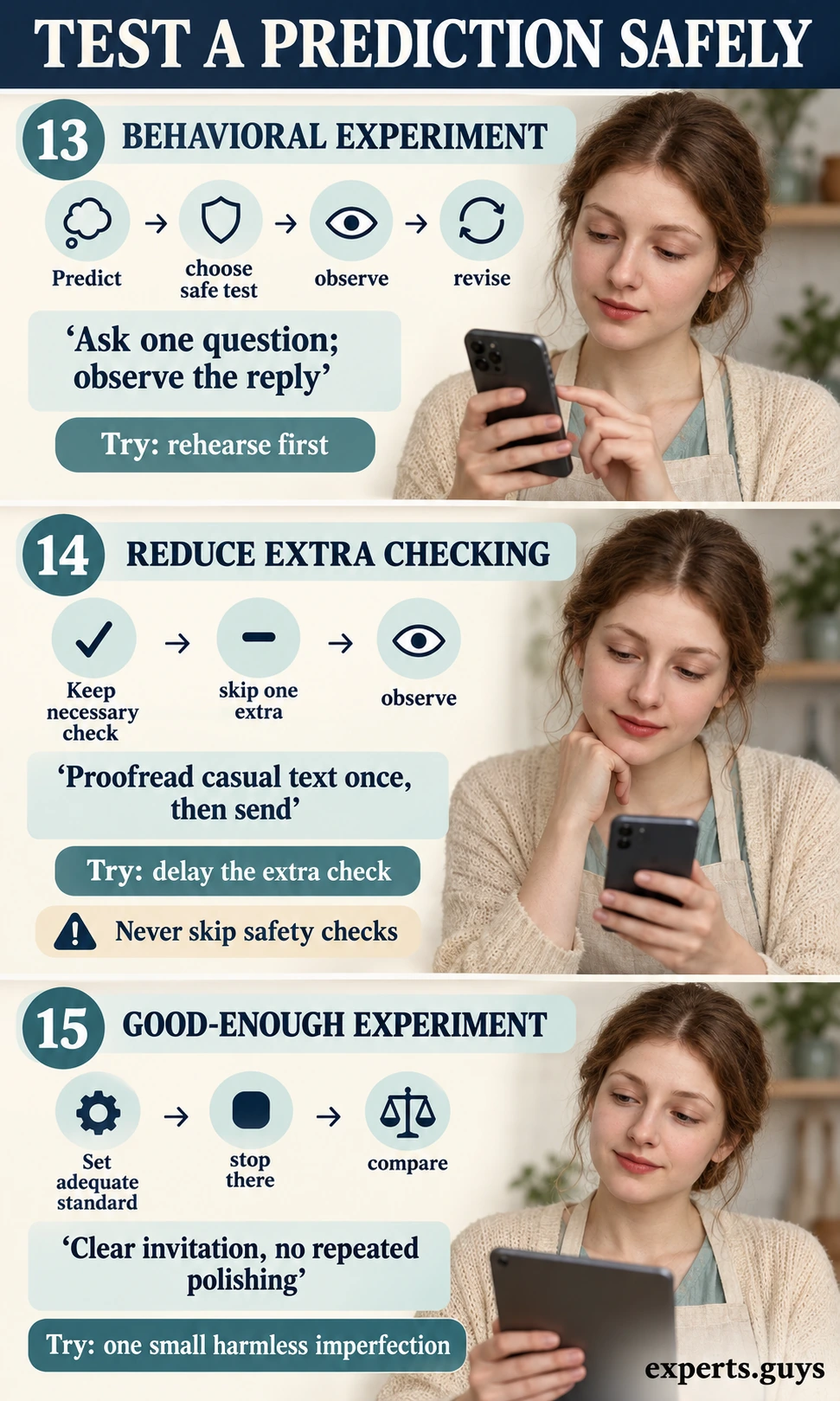
13. Design a behavioral experiment
Use this when discussion alone cannot settle a specific prediction. A planned observation can provide information that another round of mental debate cannot.
- Define a prediction that could be observed, such as a particular response to a question.
- Choose a safe, low-stakes test and decide beforehand what you will observe.
- Carry out the test, compare outcome with prediction, and record a cautious conclusion.
Illustrative example: You predict that a simple question will be mocked. You ask a trusted colleague one ordinary question and observe the response. One neutral reply challenges the certainty of the prediction without proving every future reply will be kind.
- Common mistake: Do not design a dangerous test or interpret one result as a universal verdict. Trauma work and compulsions need tailored clinical guidance.
- Easier option: Rehearse the question first.
Completion and next step: Choose one repeat or adjustment that would provide clearer information.
14. Reduce an unnecessary extra check
Use this for a low-stakes habit such as excessive proofreading of an informal message. Dropping an extra check can test whether the predicted consequence actually follows while leaving necessary checking intact.
- Identify the ordinary check the task genuinely needs.
- Choose one additional check to delay or omit.
- Complete the task and compare the outcome with your prediction.
Illustrative example: You proofread a casual invitation once, then send it instead of reopening it repeatedly. Observe what happens; do not ask several people to guarantee it was perfect.
- Common mistake: Never omit medication, financial, safeguarding or physical safety checks. If checking feels compulsive or relates to OCD, plan treatment with a qualified clinician.
- Easier option: Delay one extra low-stakes check briefly.
Completion and next step: Review learning rather than demanding certainty; seek help if distress or rituals intensify.
15. Test a good-enough standard
Choose this when perfectionism keeps a harmless task unfinished. Setting an adequate standard before starting prevents the finish line moving each time discomfort appears.
- Define what the task actually requires.
- Complete it to that standard and stop further polishing.
- Compare the feared consequence with what occurred.
Illustrative example: A casual invitation needs a correct time and location. You send a clear version without repeatedly changing the font, then observe whether the invitation did its job.
- Common mistake: Do not lower standards where errors could cause harm. Imperfection is a small experiment, not carelessness.
- Easier option: Allow one harmless formatting imperfection.
Completion and next step: Keep a standard that meets the purpose; revise it if an actual requirement was missed.
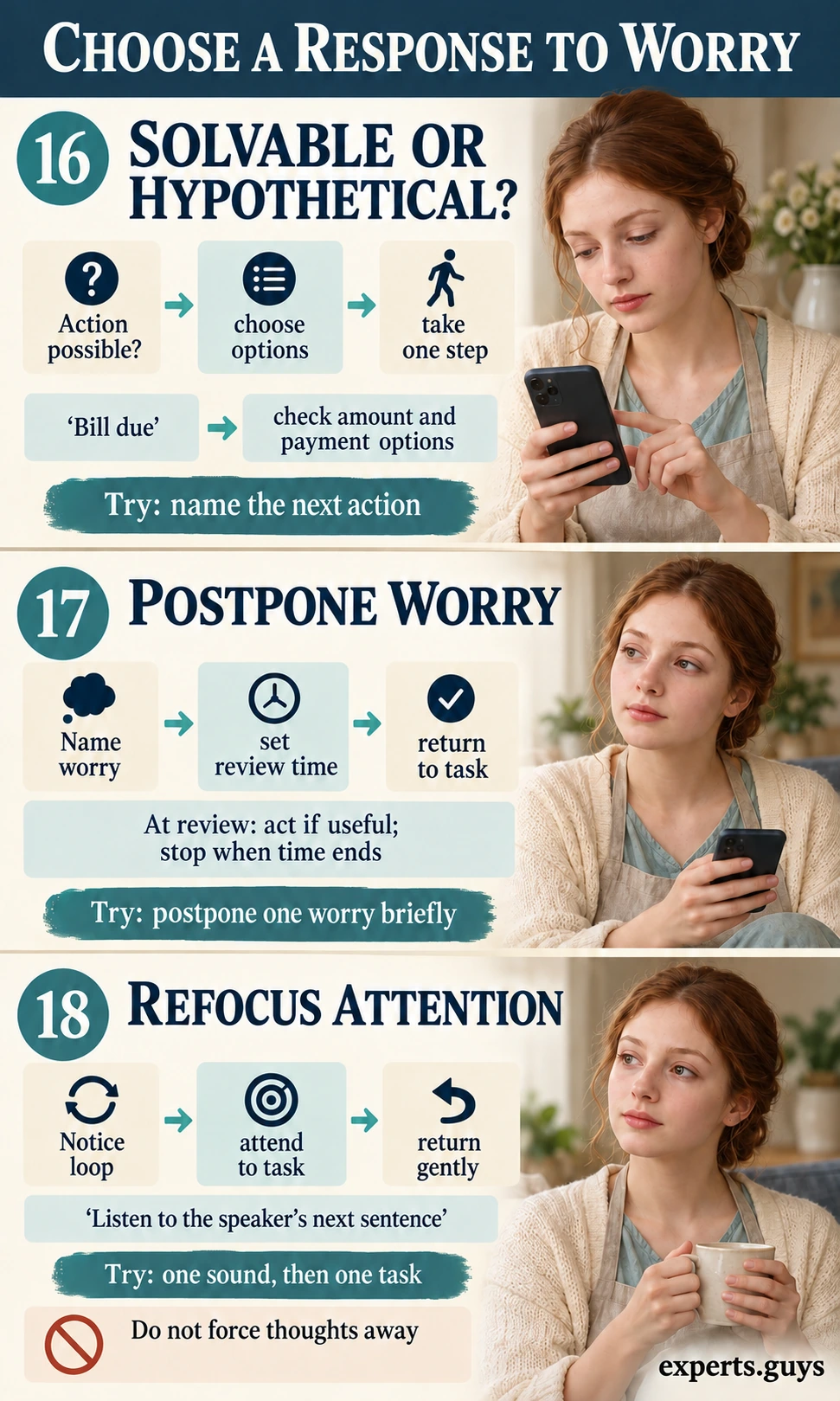
Actionable worries and hypothetical worries need different responses. The NHS guide to tackling worries describes problem-solving and setting aside worry time. Choose a brief, practical period that suits your day; stop if the routine becomes a longer bout of rumination.
16. Use problem-solving for an actionable worry
Use this when there is a current problem and an action you can take. Concrete problem-solving changes a situation; repeatedly analysing an unknowable future may not.
- Define one current problem narrowly and distinguish it from a hypothetical possibility.
- Generate a few realistic options and compare effort, consequences and feasibility.
- Choose a next action, try it and review what changed.
Illustrative example: “A bill is due” is actionable: check the amount and available payment arrangements. “What if my entire future collapses?” is too broad; return to the immediate bill.
- Common mistake: Do not treat a real resource shortage as a thinking error. Practical, financial or social support may be the useful intervention.
- Easier option: Identify only the next action.
Completion and next step: Review after the action can have an effect; use exercise 17 for worry you cannot resolve now.
17. Postpone a recurring hypothetical worry
Try this when the same unanswerable worry repeatedly interrupts your day. Postponement practises choosing when to engage with worry rather than trying to suppress every thought.
- Choose a brief review period that suits your day; a phone reminder can help.
- When the worry appears, note a short cue if useful and return to the current activity.
- At the review time, decide whether action is possible; finish the period and return to your day.
Illustrative example: You notice “What if the meeting goes badly?” while cooking. You leave a short cue for your planned review rather than debating every possible outcome beside the stove.
- Common mistake: Do not postpone a real emergency or turn the review into prolonged rumination. If it worsens distress, stop and discuss another approach.
- Easier option: Postpone one worry for a short, manageable interval.
Completion and next step: Use problem-solving for an actionable concern; let an irrelevant worry go without forcing yourself to revisit it.
18. Redirect attention to the task in front of you
Use this when you are rehearsing an interaction internally while missing the interaction itself. Attention can be redirected toward useful external information even while unwanted thoughts remain.
- Notice that attention has moved into an internal replay.
- Choose one relevant detail in the current task, such as the speaker’s next sentence.
- Return gently each time attention wanders and continue the task.
Illustrative example: During a conversation, you stop checking how you sound and listen for the other person’s main point. You ask a question about what they actually said.
- Common mistake: Do not demand a blank mind or use distraction to avoid every uncomfortable feeling. The purpose is engagement.
- Easier option: Notice one sound, then return to one task.
Completion and next step: Judge completion by returning attention, not by eliminating thoughts.
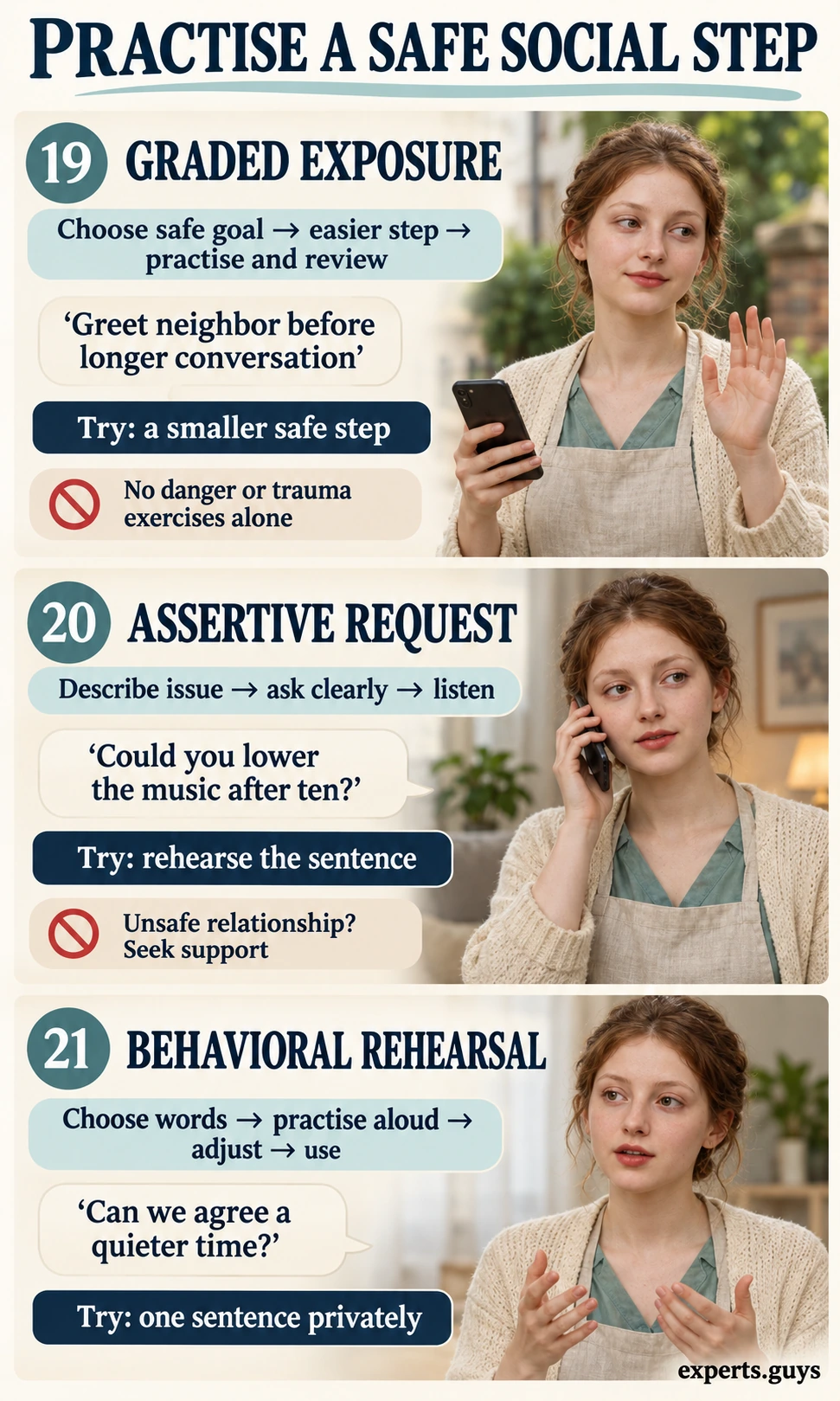
Approaching an ordinary fear is different from entering a dangerous situation. The NHS guidance on facing fears uses gradual steps rather than a sudden overwhelming challenge. If you are unsure whether self-directed practice is suitable, discuss the plan with a qualified therapist first.
19. Build a graded approach to an ordinary fear
Use this only for a genuinely safe situation that anxiety has made difficult to approach. Repeated, manageable contact can provide new learning where avoidance has prevented it.
- Define a safe goal and arrange a few steps from easier to harder.
- Choose a manageable step and decide what you will observe.
- Practise and review before deciding whether to repeat, adjust or move on.
Illustrative example: You want to talk with a neighbor. A brief greeting may come before a longer conversation; the observation is what happens during the greeting, not whether anxiety reaches zero.
- Common mistake: Do not use this for real danger, trauma memories or intense compulsions without professional guidance. Never force yourself or someone else through overwhelming distress.
- Easier option: Choose a smaller safe step or ask a therapist to help build the sequence.
Completion and next step: Repeat for useful learning; seek support if distress is severe or daily functioning is affected.
20. Make an assertive request
Use this when a clear need is going unspoken in a reasonably safe relationship. A specific, respectful request makes it easier for another person to understand what change you are asking for.
- Describe the situation without insults or mind-reading.
- State one clear request and, where helpful, why it matters.
- Listen to the response and decide what boundary or compromise is workable.
Illustrative example: “The music carries into my bedroom. Could you lower it after ten?” asks for a concrete change rather than accusing someone of never caring.
- Common mistake: An assertive sentence cannot guarantee cooperation. If you fear retaliation, prioritize safety and support instead of direct confrontation.
- Easier option: Rehearse the request privately.
Completion and next step: Completion is making a clear request; consider your options if it is refused.
21. Rehearse a difficult behavior before using it
Choose this when you know what you want to do but lose the words in the moment. Practice can reveal an overly complicated sentence or an impractical plan before the real interaction.
- Choose one sentence or short action sequence.
- Practise aloud privately or with a trusted person, optionally using a local voice memo.
- Adjust unclear wording, then use it in the appropriate real situation.
Illustrative example: You rehearse “Can we agree a quieter time?” and notice you are adding a long apology. You shorten the request so it is easier to say.
- Common mistake: Endless rehearsal can become avoidance. Choose a reasonable stopping point; protect the privacy of any recording.
- Easier option: Say the first sentence once without recording.
Completion and next step: Try the real action when safe; use what happened to improve the next rehearsal.
What should you change when practice is unhelpful?
Change the fit or size of the exercise before concluding that you failed. A vague prediction, an overwhelming step or a record that feeds rumination can make a reasonable method unhelpful in its present form. Review what the attempt actually tells you and choose one adjustment.
CBT practice is more useful when it leads to a decision, not an expanding archive of notes. If reviewing your thoughts repeatedly produces no new information, the explanation of depressive rumination and overthinking can help you distinguish reflection from a loop. A therapist can also help assess whether a different approach is appropriate.
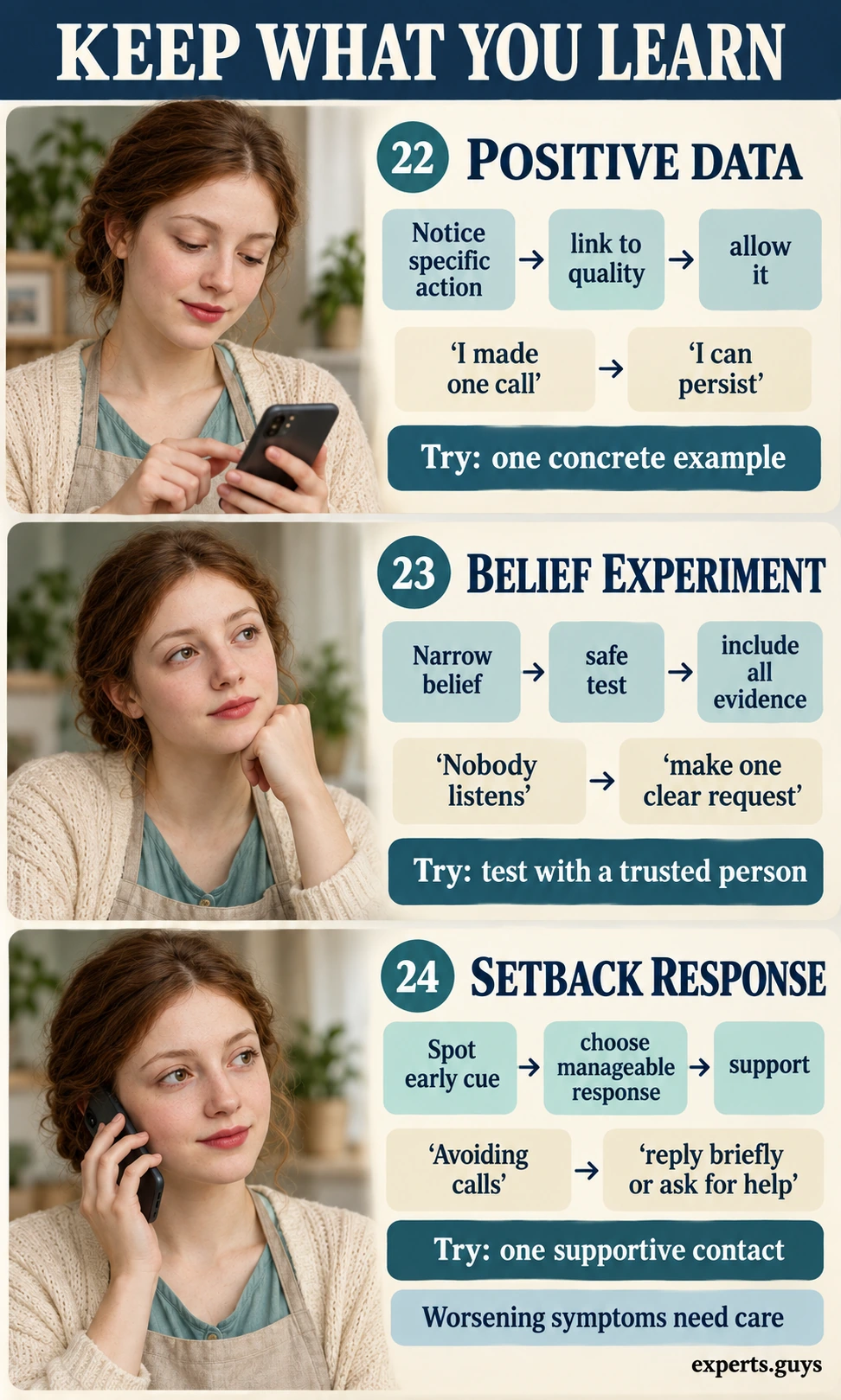
22. Keep specific evidence that a harsh label leaves out
Use this when “I never follow through” makes small actions disappear from view. A concrete record can counter selective attention, provided it changes how you judge an actual belief.
- Choose one harsh generalization to examine.
- Notice an observable action that does not fit it.
- State what the action supports without dismissing it or exaggerating it.
Illustrative example: “I made the call despite hesitation” supports “I can sometimes act while anxious.” It does not need to become “I am confident at everything.”
- Common mistake: A positivity quota can create another demand. Do not invent achievements or dismiss difficult facts.
- Easier option: Keep one specific example in a private note.
Completion and next step: Use the example when the generalization returns; stop logging if it becomes a burdensome ritual.
23. Test a narrow version of a broad belief
Use this when a general belief such as “nobody listens” persists despite isolated counterexamples. Turning a broad belief into a specific prediction allows a limited, fair test rather than an argument about your entire identity.
- Choose one mild situation and define what the belief predicts there.
- Try a safe action that could give new information.
- Include all relevant observations when updating the prediction.
Illustrative example: “Nobody listens” becomes “My trusted friend will ignore a clear request for ten minutes to talk.” You make the request and consider the actual response, including whether timing affected it.
- Common mistake: Do not deliberately expose yourself to mistreatment to test worth. Deeply distressing beliefs or trauma deserve skilled support.
- Easier option: Start with a trusted person and a small request.
Completion and next step: Treat the result as one piece of evidence; bring a persistent pattern to therapy.
24. Prepare a response to a familiar setback
Use this when stress repeatedly interrupts an otherwise useful practice. Planning a proportionate response ahead of time can reduce the decisions required when energy is low.
- Identify one personal early sign that a difficulty is returning.
- Choose a manageable response and a person or service that could help.
- Make the response easy to find and review whether the plan fits your current needs.
Illustrative example: If you begin avoiding ordinary calls, your first response might be one brief reply or asking someone to help arrange an appointment. The plan does not assume that worsening symptoms are simply a motivation problem.
- Common mistake: Do not turn a self-help plan into a reason to delay needed treatment. Changes in medication belong with the prescriber.
- Easier option: Save one supportive contact and one manageable response.
Completion and next step: Use care promptly for persistent or worsening symptoms; immediate danger requires urgent local help.
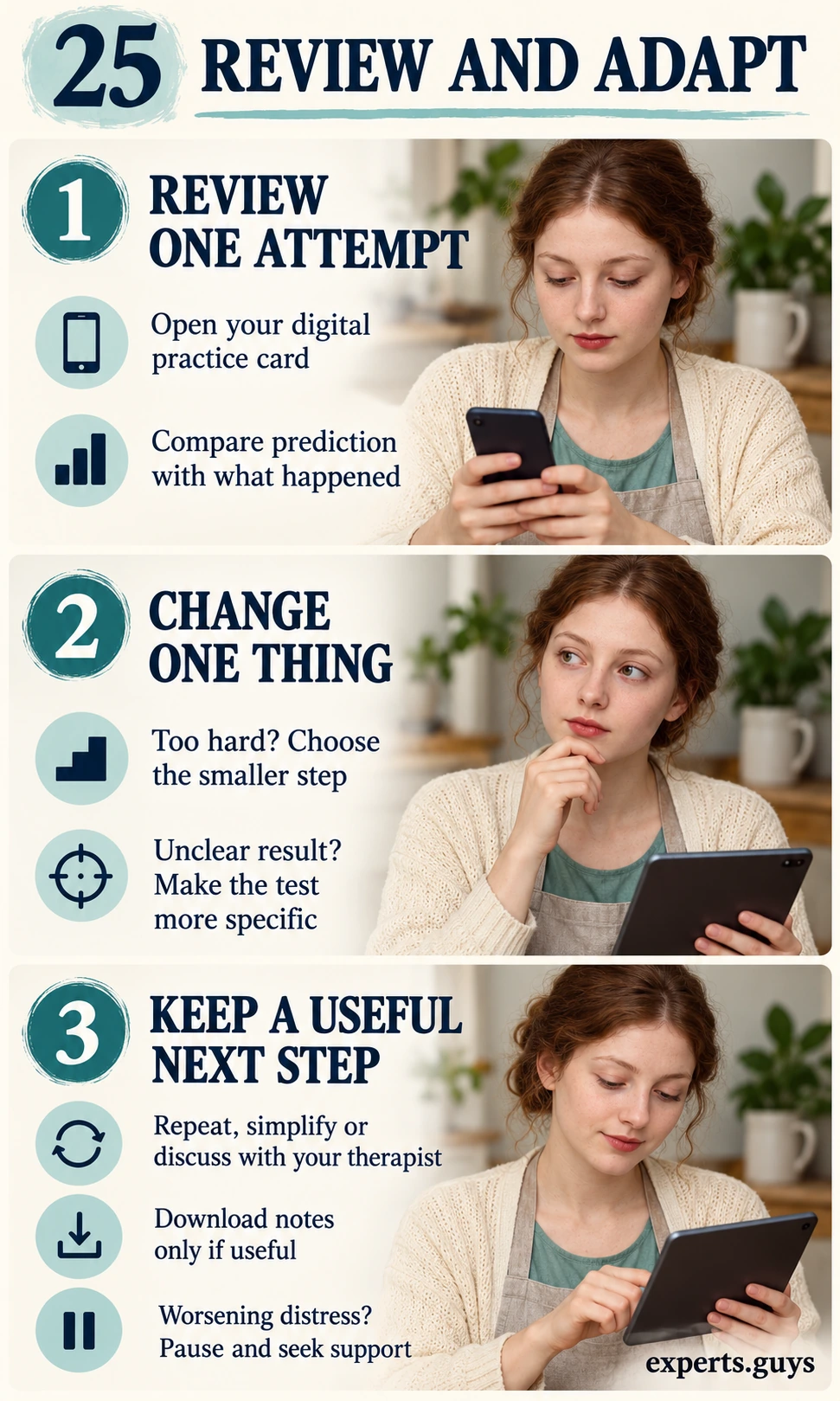
25. Review learning and adapt the exercise
Use this after an attempt, especially when the worksheet did not produce the result you expected. Review connects practice with a decision; accumulating entries without changing anything adds work without clear benefit.
- Open one completed digital practice card and compare your prediction with the observation.
- Ask whether the step was too hard, the prediction too vague, or the result genuinely mixed.
- Change one feature: repeat, simplify, make the test clearer, or discuss it with a therapist.
Illustrative example: You predicted that asking a question would lead to ridicule, but you never asked it. That is not evidence the prediction was true; the next version might begin with rehearsal or a smaller safe question.
- Common mistake: Do not judge the exercise only by immediate mood change. An unclear test needs a better design, not harsher self-criticism.
- Easier option: Choose one next step without saving another entry.
Completion and next step: Pause if practice increases distress; seek support rather than escalating the challenge alone.
Use the digital practice workspace
Select the matching exercise, read its example and enter only the short notes that help you act. Entries are optional, and the workspace does not automatically save them. Download a private copy or open the A4 action card if you want to keep the result; you can use the article’s prompts without the workspace.
CBT Practice Studio
Choose a skill, try a manageable version and keep a useful next action.
Educational practice for adults. No diagnosis, treatment score or promise of relief.

Before starting: Choose a mild, safe example. Pause if distress increases. If you may harm yourself or cannot stay safe, contact local emergency services or go to the nearest emergency department now.
This workspace does not send or automatically save your entries. Download only if you want a copy. Refreshing closes this session’s notes; browser extensions, shared devices and your site’s other scripts have their own privacy behavior.
Finding qualified CBT support
For persistent, worsening or disabling symptoms, ask a qualified mental-health professional about assessment and suitable treatment. Compare a few providers by relevant registration, experience with your concern, approach, availability and cost. A search result or star rating does not establish suitability.
Opens Google with the location you enter; no practice notes are included. Check credentials through the appropriate professional register for your country.
When the exercise needs adjusting
| What happened | What it may mean | Useful adjustment |
|---|---|---|
| You never attempted the step | The step or context was not manageable | Reduce the action; do not treat an untested prediction as confirmed |
| You completed it but still felt upset | A completed action is not an immediate mood treatment | Review the observation and decide whether the exercise fits your goal |
| You keep rewriting the “right” answer | The record may be feeding perfectionism or rumination | Pause the record and use one proportionate action or discuss it in therapy |
| The result supported part of the concern | The concern may be realistic or the context may need changing | Use practical problem-solving, boundaries or support; do not force a positive interpretation |
| Distress or functioning is worsening | Self-help may be insufficient or unsuitable | Pause and seek a qualified assessment; use urgent local care for immediate danger |
Persistent, worsening or disabling difficulties deserve assessment rather than more worksheets. When choosing support, check relevant professional registration, experience with your concern and how the practitioner reviews progress. The overview of types of psychotherapy for depression introduces other approaches to discuss, without making a worksheet score decide your treatment.
Frequently asked questions
Do I need to complete all 25 exercises?
No. Choose one that addresses a specific problem and review whether it helps you decide or act. Some exercises are related building blocks, and your therapist may combine or adapt them. Completing more sheets is not a measure of recovery.
Can I use CBT worksheets on my phone?
Yes. Use a private note, an editable document or the digital workspace here. Keep only the information that changes your next action, avoid unnecessary identifying details and consider who can access your device or backups.
What if my negative thought is partly true?
Include the accurate part instead of arguing it away. A fair response may involve repairing a mistake, asking for support or changing the situation. CBT practice should not require you to deny harm, hardship or another person’s behavior.
How quickly should an exercise work?
There is no reliable deadline for an individual self-help exercise. A first useful outcome may be a clearer prediction or an attempted action, while symptoms remain. Persistent or worsening difficulties are a reason to seek assessment, not to keep increasing the workload.
Can these exercises replace therapy or medication?
No. These are educational practice examples and cannot determine a diagnosis or treatment plan. Use them alongside professional care when appropriate, and discuss medication decisions with your prescriber.
Should I keep repeating a worksheet if it increases distress?
Pause if it makes distress worse or draws you into prolonged rumination. Choose a smaller, safer example only if that is appropriate, and discuss the reaction with a qualified professional. Seek urgent local help if you cannot stay safe.
Your next step
Choose the exercise that answers the smallest useful question in front of you. Try its easier version if necessary, then decide whether to repeat, adjust or ask for support. Keep what helps you act and learn; you do not need a perfect record.