
Start with one depression worksheet that matches the difficulty you face today, then use it to choose a small action. The 13 printable sheets below help with starting tasks, checking harsh thoughts and asking for support; they are practice aids, not a diagnosis or a replacement for treatment.
Choose a worksheet for the problem in front of you
| Your difficulty | Start here | Useful outcome |
|---|---|---|
| Starting a chore feels overwhelming | Tiny-task starter | Try, then stop |
| Nothing sounds enjoyable | Activity-choice sheet | Try a short version |
| The day is all chores or all avoidance | Daily-balance sheet | Try and adjust |
| A harsh prediction feels like a fact | Balanced-thought record | Respond fairly |
| Always and never dominate your self-talk | Thinking-style check | Make it precise |
| A mistake triggers personal attacks | Self-compassion response | Choose a helpful step |
| Several practical problems feel tangled | One-problem solution sheet | Try one first step |
| A big task has no obvious starting point | Task-breakdown sheet | Try the first |
| Reaching out feels burdensome | First-contact sheet | Send or prepare |
| Daily demands exceed your current capacity | Practical-support request | Ask and adapt |
| Eating, washing or rest is slipping | Basic-care anchor sheet | Try or ask for help |
| Old difficulties are returning | Early-support action sheet | Make contact |
| Explaining your difficulty feels overwhelming | Appointment-preparation sheet | Bring and discuss |
Use plain paper, a pen or the printable pack. Choose one sheet and give it only as much attention as you can comfortably manage. These are original editorial practice sheets based on established self-help principles, not copied clinical forms or a validated treatment programme.
Download the 13 printable depression worksheets
Worksheet Practice Studio
Choose the obstacle that best fits today to see one practice suggestion. The studio gives the same steps, example and easier option as the article. Its suggestion is a transparent editorial match, not a clinical recommendation or recovery score.
Worksheet Practice Studio
Choose today’s obstacle. Try one manageable action.
Educational practice support. Not a diagnosis, treatment recommendation or emergency service. Your selections stay in this page; no account or storage is used.
Choose an obstacle, then select “Show my next step”. Manual instructions are available in the article.
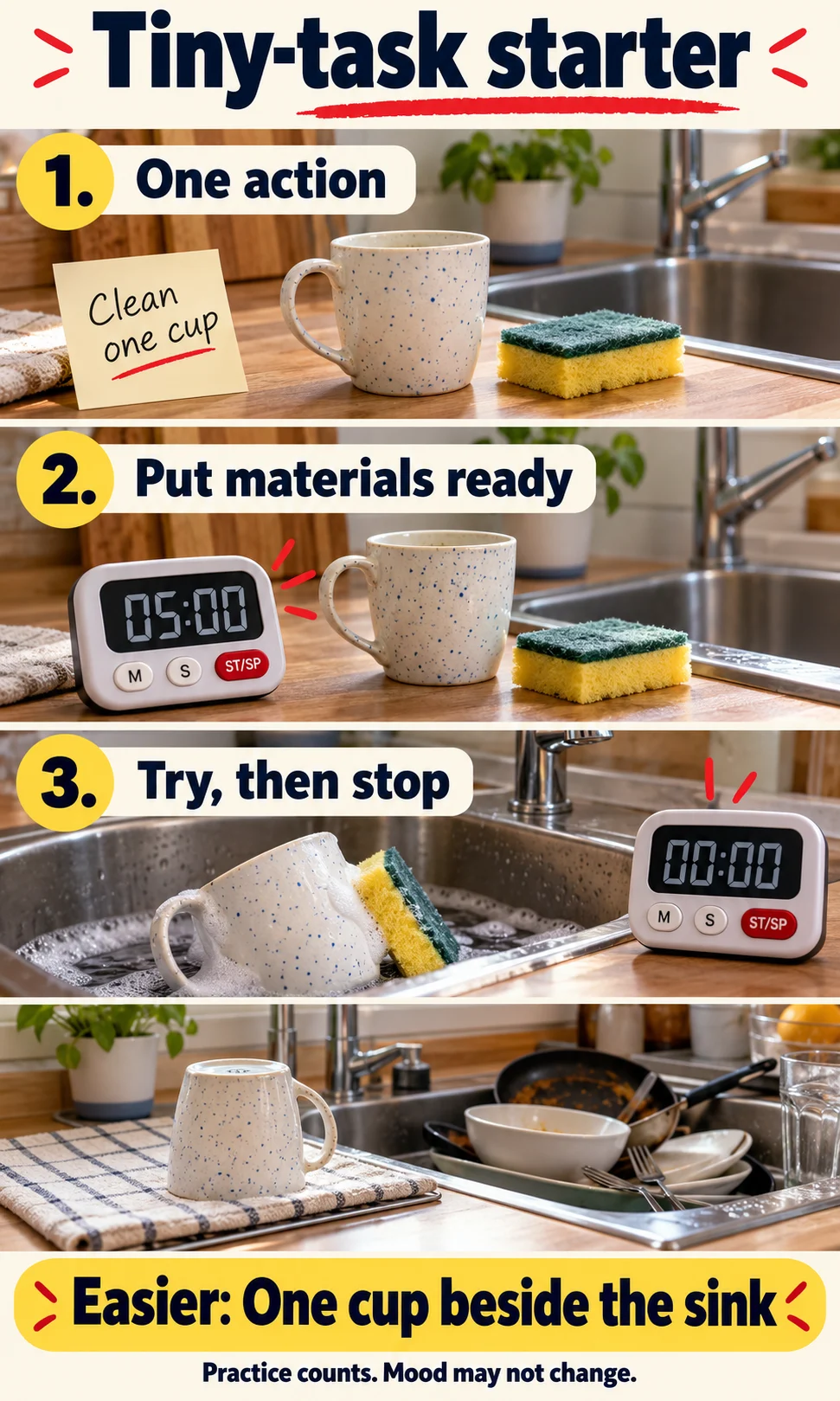
1. Tiny-task starter
When it fits: Starting a chore feels overwhelming. Use the page to turn that obstacle into one visible step. Choose the easier version if the full sequence feels like too much.
- Choose one visible action, such as washing one cup.
- Put the cup and sponge within reach; choose a timer of up to five minutes.
- Try the action, then stop or decide whether another small step fits your energy.
Illustrative example: An illustrative reader wants a clean kitchen. They choose one cup, wash it, and stop when the timer rings. The whole kitchen remains unfinished, but the chosen step is done.
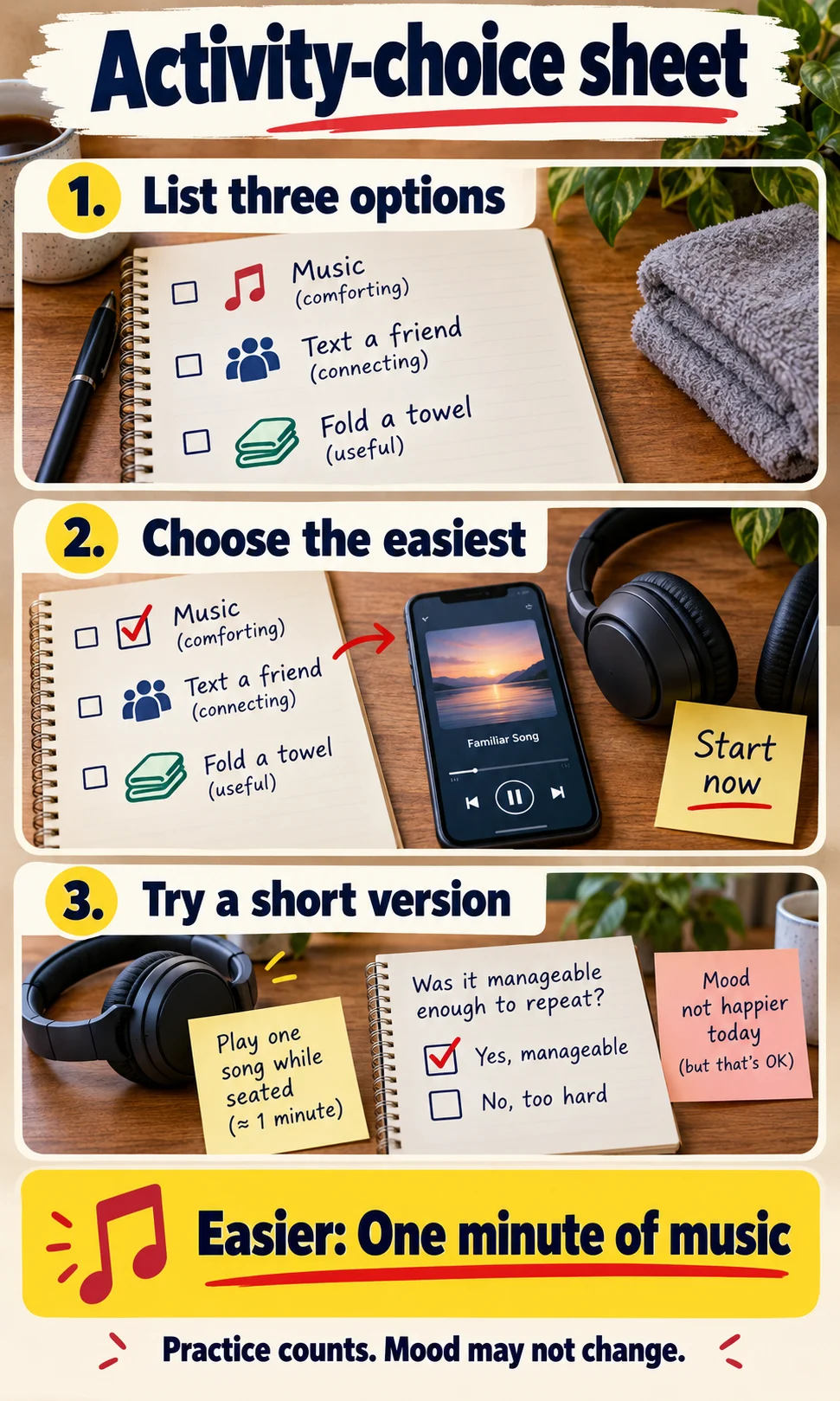
2. Activity-choice sheet
When it fits: Nothing sounds enjoyable. Use the page to turn that obstacle into one visible step. Choose the easier version if the full sequence feels like too much.
- List one comforting, one connecting and one useful activity you could safely try.
- Choose the least demanding option and decide when to begin.
- Try a short version; decide whether it was manageable enough to repeat.
Illustrative example: An illustrative reader lists music, a text to a friend, and folding a towel. They play one familiar song while seated. They do not feel happier, but choose to try music again because it was manageable.
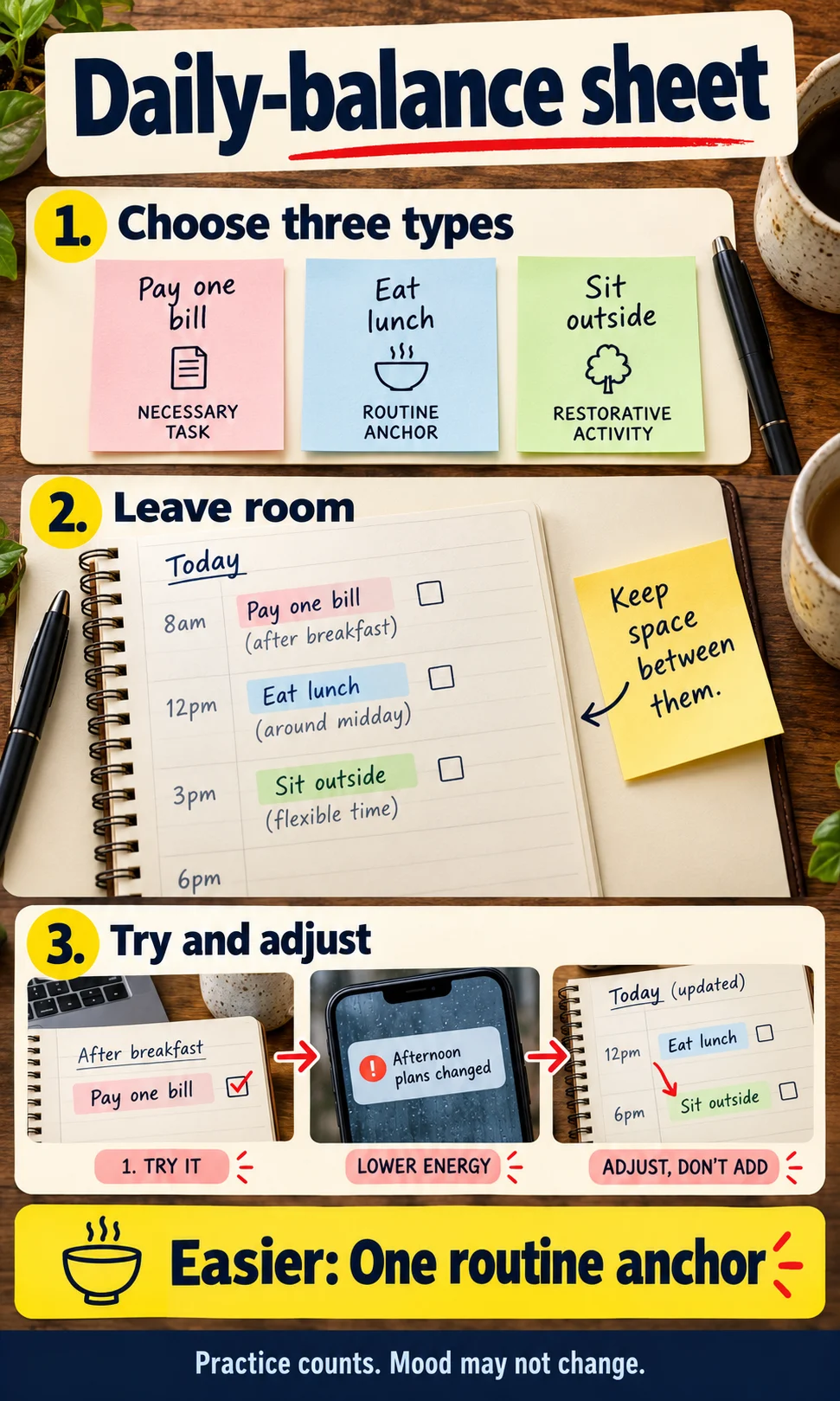
3. Daily-balance sheet
When it fits: The day is all chores or all avoidance. Use the page to turn that obstacle into one visible step. Choose the easier version if the full sequence feels like too much.
- Write one necessary task, one routine anchor and one restorative activity.
- Give each a realistic place in the day; leave space between them.
- Try the first item and revise the remaining load if your energy changes.
Illustrative example: An illustrative reader chooses paying one bill, eating lunch, and sitting outside. They pay the bill after breakfast and leave the other activities loosely scheduled. A disrupted afternoon means moving the outdoor break rather than adding more demands.
4. Balanced-thought record
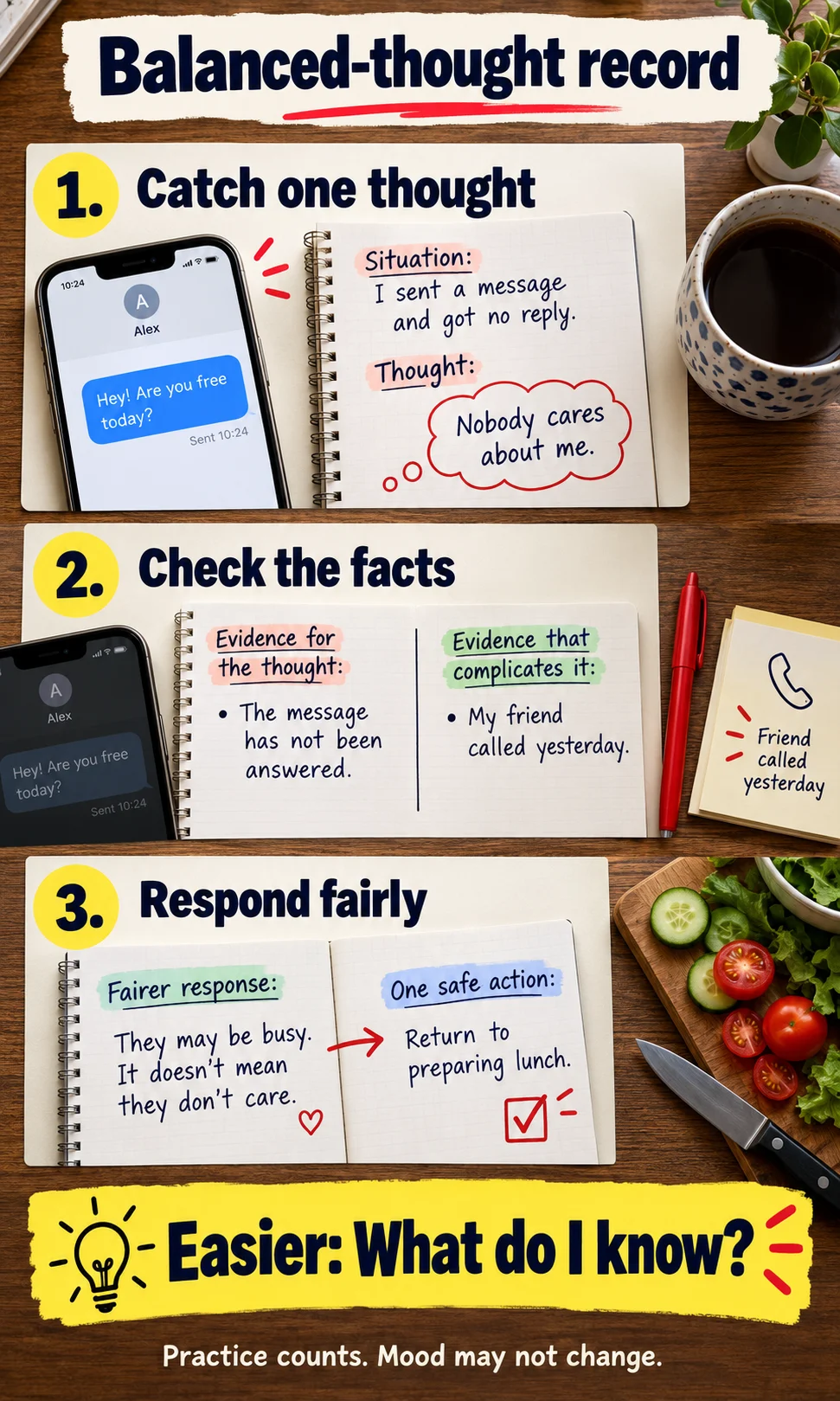
When it fits: A harsh prediction feels like a fact. Use the page to turn that obstacle into one visible step. Choose the easier version if the full sequence feels like too much.
- Write one situation and the exact thought it triggered.
- Separate evidence supporting the thought from evidence that complicates it.
- Write a fairer response and choose one safe action that fits the facts.
Illustrative example: An illustrative reader gets no reply to a message and thinks nobody cares. The only fact is that the message has not been answered; a friend called yesterday. They write that the person may be busy and return to preparing lunch.
5. Thinking-style check
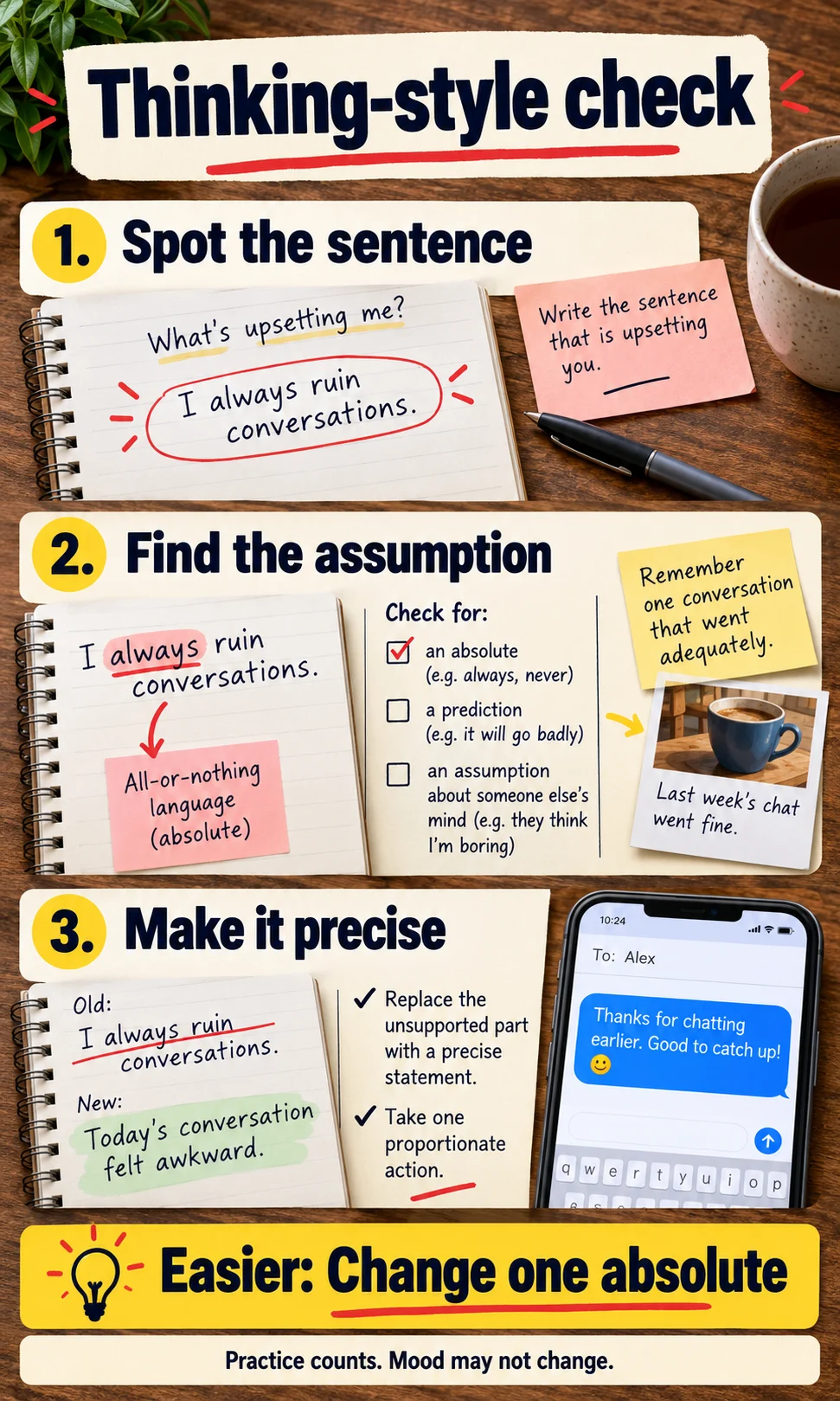
When it fits: Always and never dominate your self-talk. Use the page to turn that obstacle into one visible step. Choose the easier version if the full sequence feels like too much.
- Write the sentence that is upsetting you.
- Look for an absolute, a prediction or an assumption about someone else’s mind.
- Replace the unsupported part with a precise statement and take one proportionate action.
Illustrative example: An illustrative reader writes that they always ruin conversations. They identify all-or-nothing language and remember one conversation that went adequately. They change the sentence to today’s conversation felt awkward and send a simple follow-up.
6. Self-compassion response
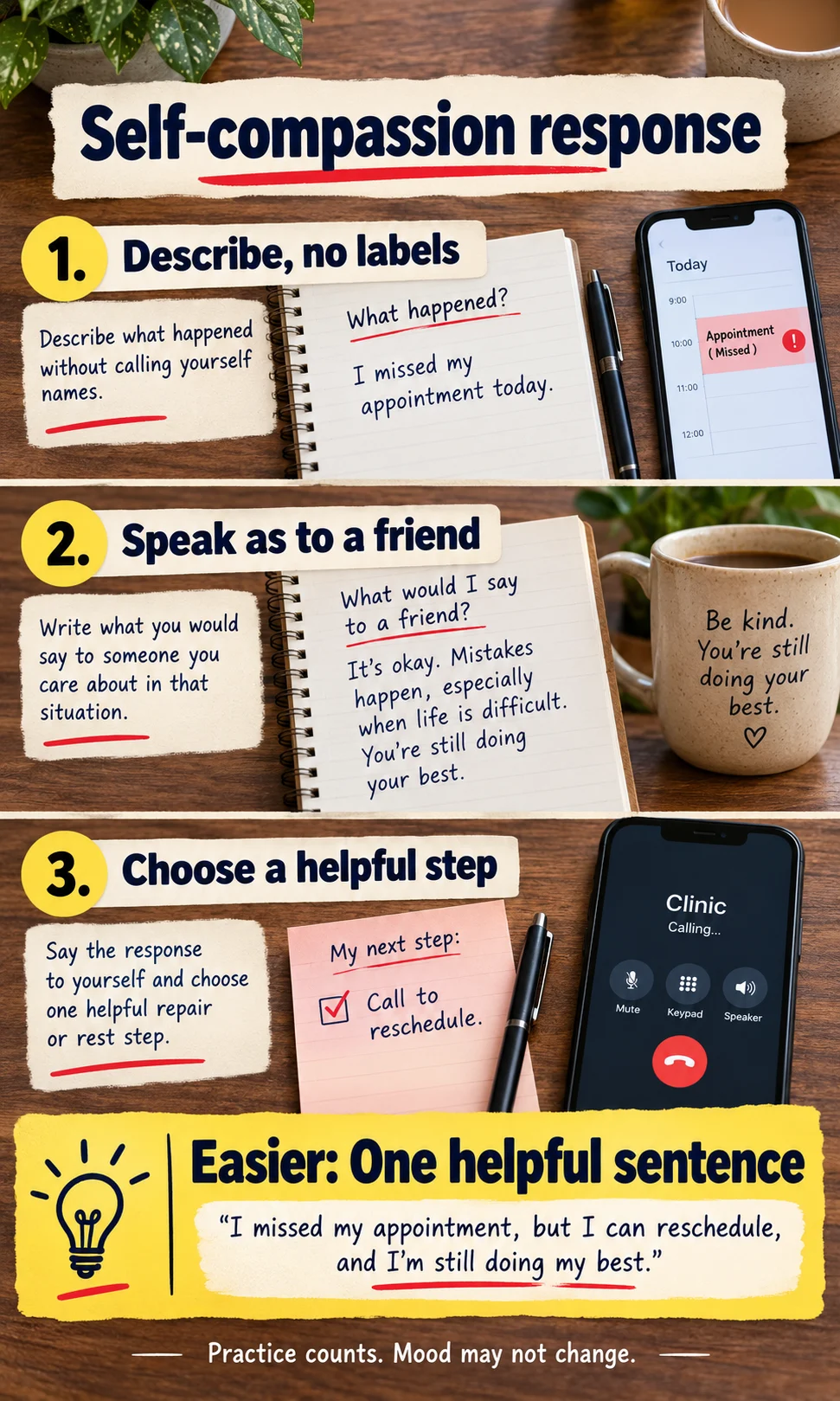
When it fits: A mistake triggers personal attacks. Use the page to turn that obstacle into one visible step. Choose the easier version if the full sequence feels like too much.
- Describe what happened without calling yourself names.
- Write what you would say to someone you care about in that situation.
- Say the response to yourself and choose one helpful repair or rest step.
Illustrative example: An illustrative reader misses an appointment. They write that they missed the appointment rather than that they are useless. They say mistakes happen when life is difficult, then call to reschedule.
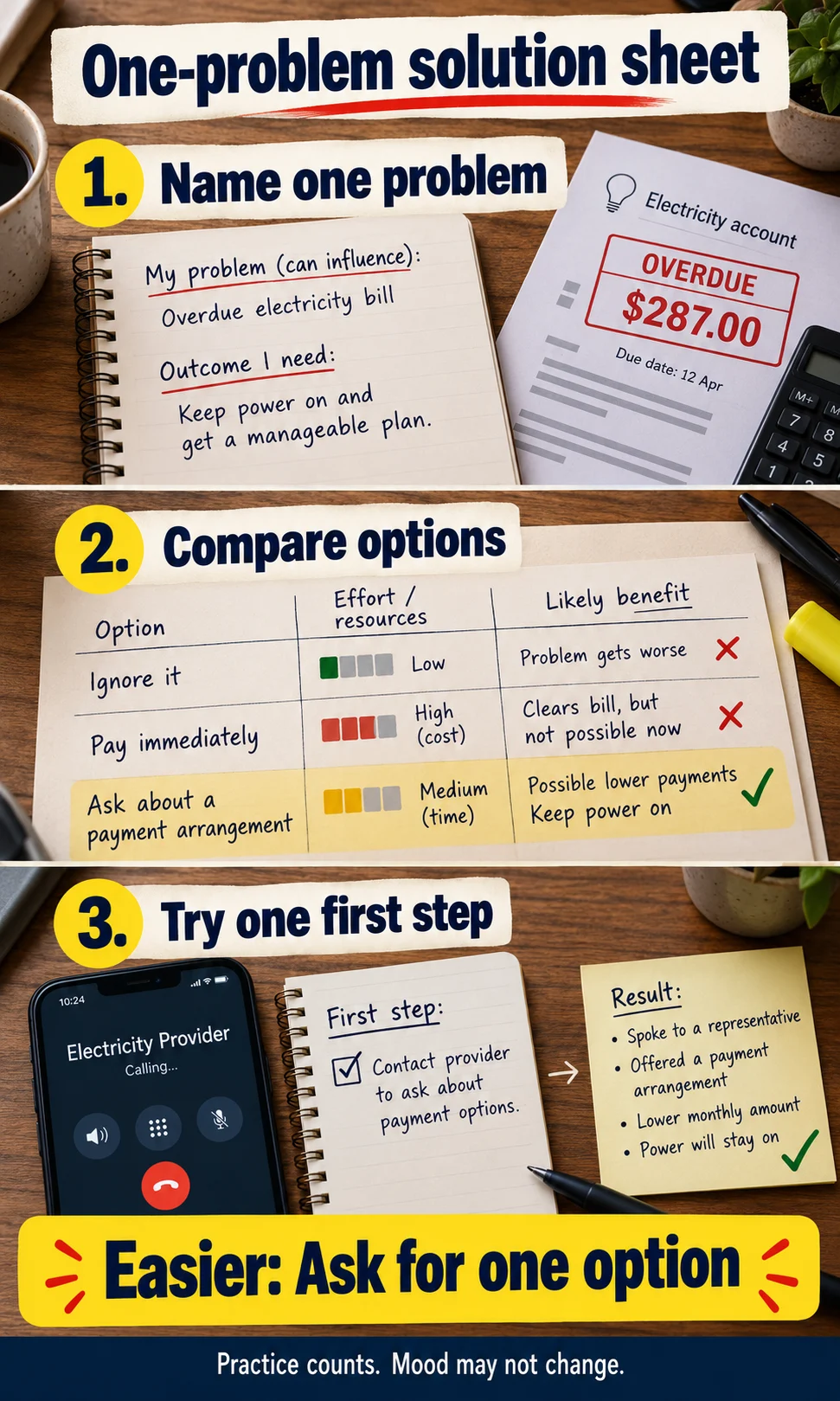
7. One-problem solution sheet
When it fits: Several practical problems feel tangled. Use the page to turn that obstacle into one visible step. Choose the easier version if the full sequence feels like too much.
- Name one problem you can influence and the outcome you need.
- List two or three possible responses and compare effort, resources and likely benefit.
- Choose one feasible first step, try it, and decide what to change.
Illustrative example: An illustrative reader is worried about an overdue bill. They compare ignoring it, paying immediately and asking about a payment arrangement. They cannot pay in full, so they contact the provider to ask about available options.
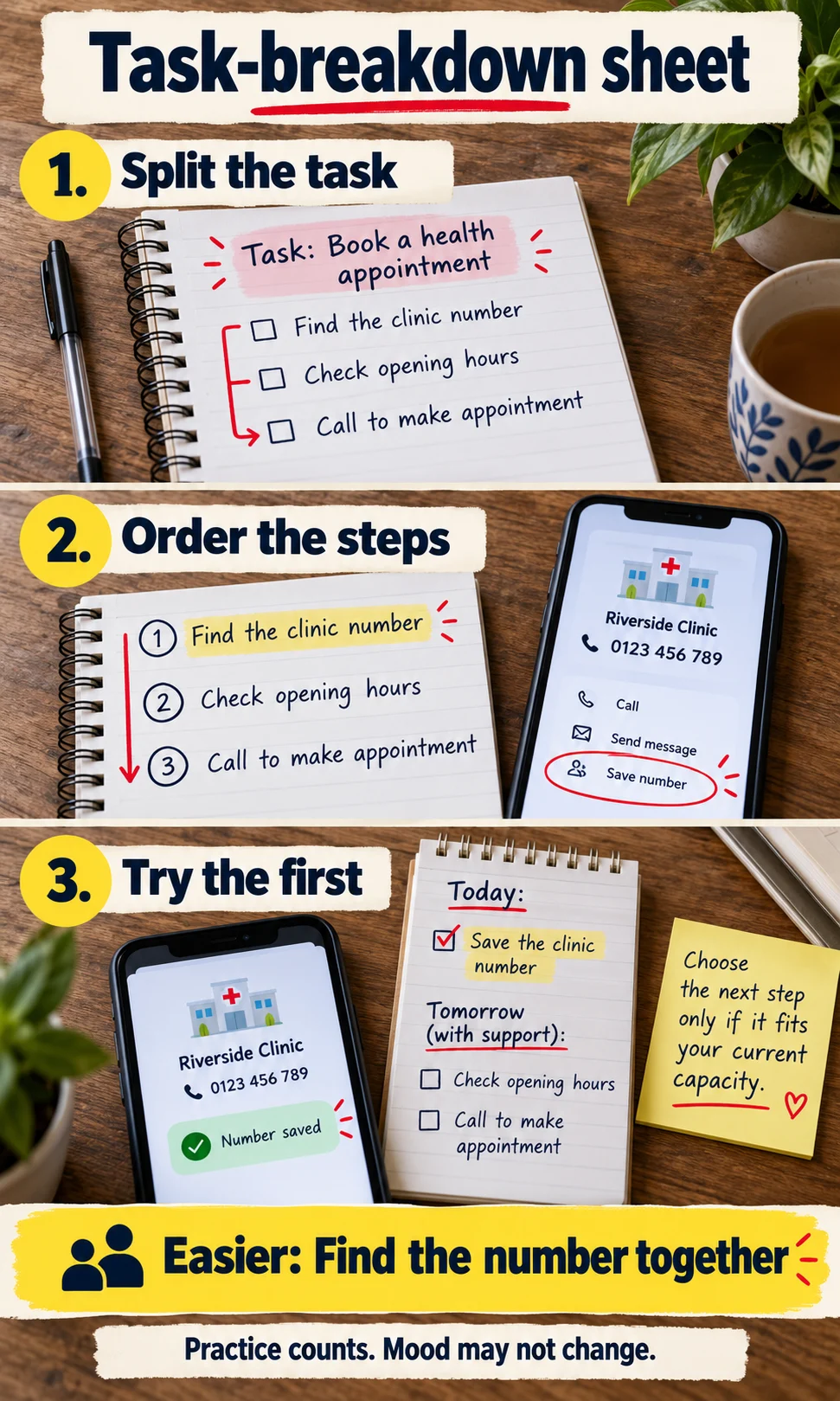
8. Task-breakdown sheet
When it fits: A big task has no obvious starting point. Use the page to turn that obstacle into one visible step. Choose the easier version if the full sequence feels like too much.
- Write the task and divide it into visible actions.
- Put the actions in a workable order and select the first small one.
- Try that action; choose the next only if it fits your current capacity.
Illustrative example: An illustrative reader needs to book a health appointment. They list finding the clinic number, checking opening hours and calling. Today they save the number; tomorrow they can make the call with support.
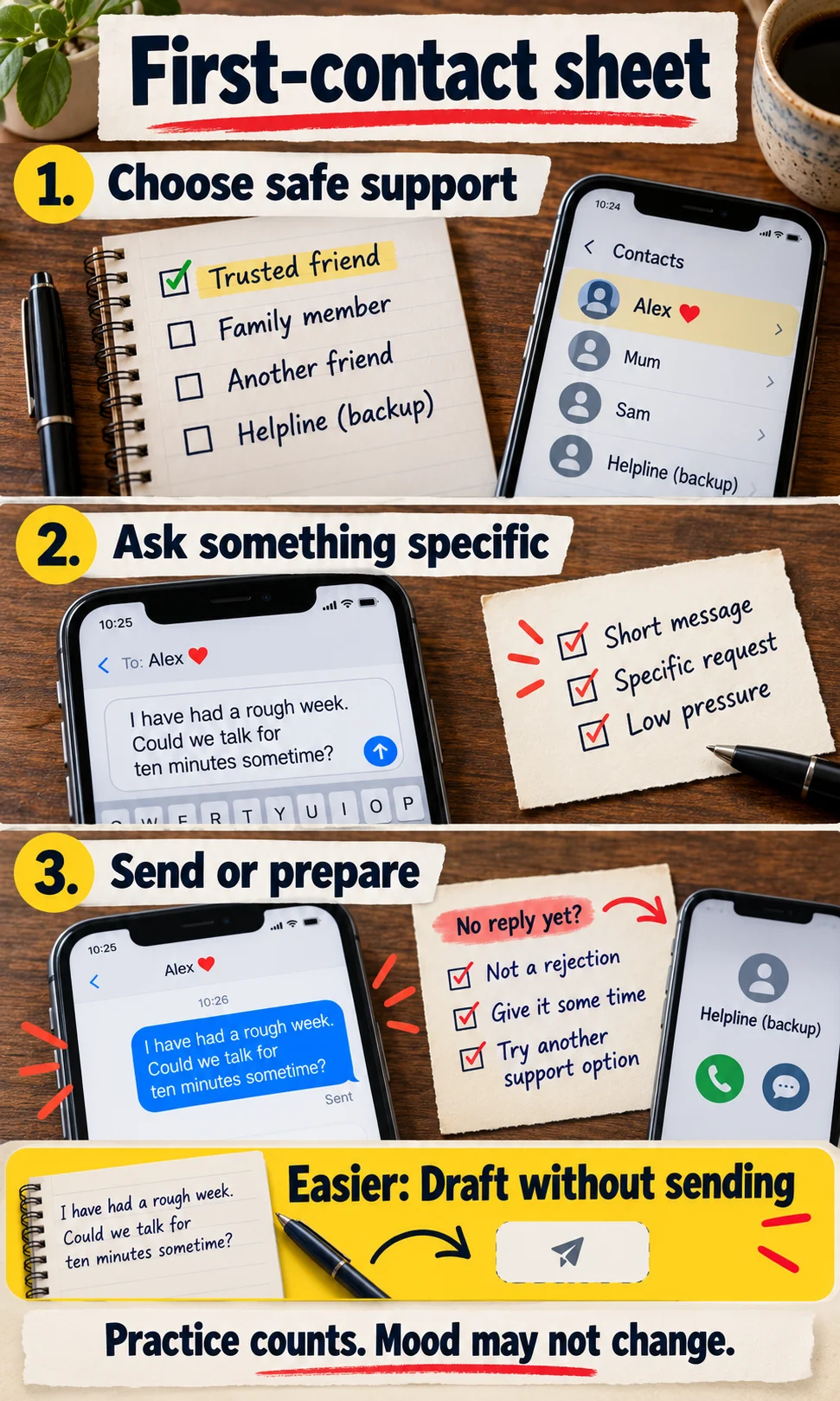
9. First-contact sheet
When it fits: Reaching out feels burdensome. Use the page to turn that obstacle into one visible step. Choose the easier version if the full sequence feels like too much.
- Choose a person or service that is reasonably safe to contact.
- Write a short message with a specific, low-pressure request.
- Send it when ready; choose another support option if there is no reply.
Illustrative example: An illustrative reader texts a trusted friend: I have had a rough week. Could we talk for ten minutes sometime? They send it and choose a helpline as a backup rather than treating a delayed reply as rejection.
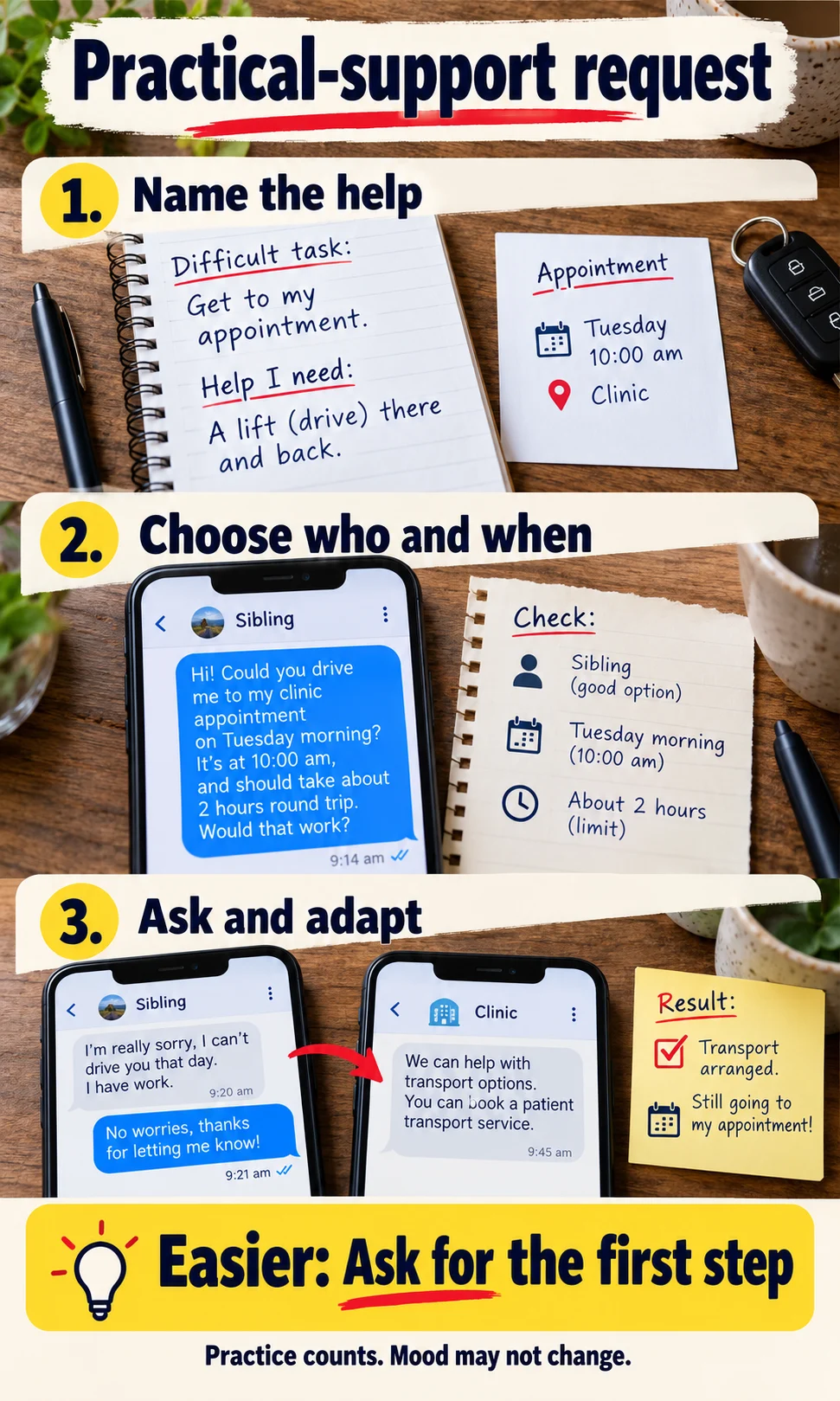
10. Practical-support request
When it fits: Daily demands exceed your current capacity. Use the page to turn that obstacle into one visible step. Choose the easier version if the full sequence feels like too much.
- Name one task that is difficult and the exact help needed.
- Choose a suitable person and specify the task, timing and limit.
- Ask, then agree an alternative if the person cannot do it.
Illustrative example: An illustrative reader needs help getting to an appointment. They ask a sibling whether they can drive them on Tuesday morning. If the sibling cannot, they ask the clinic about transport options instead of abandoning the appointment.
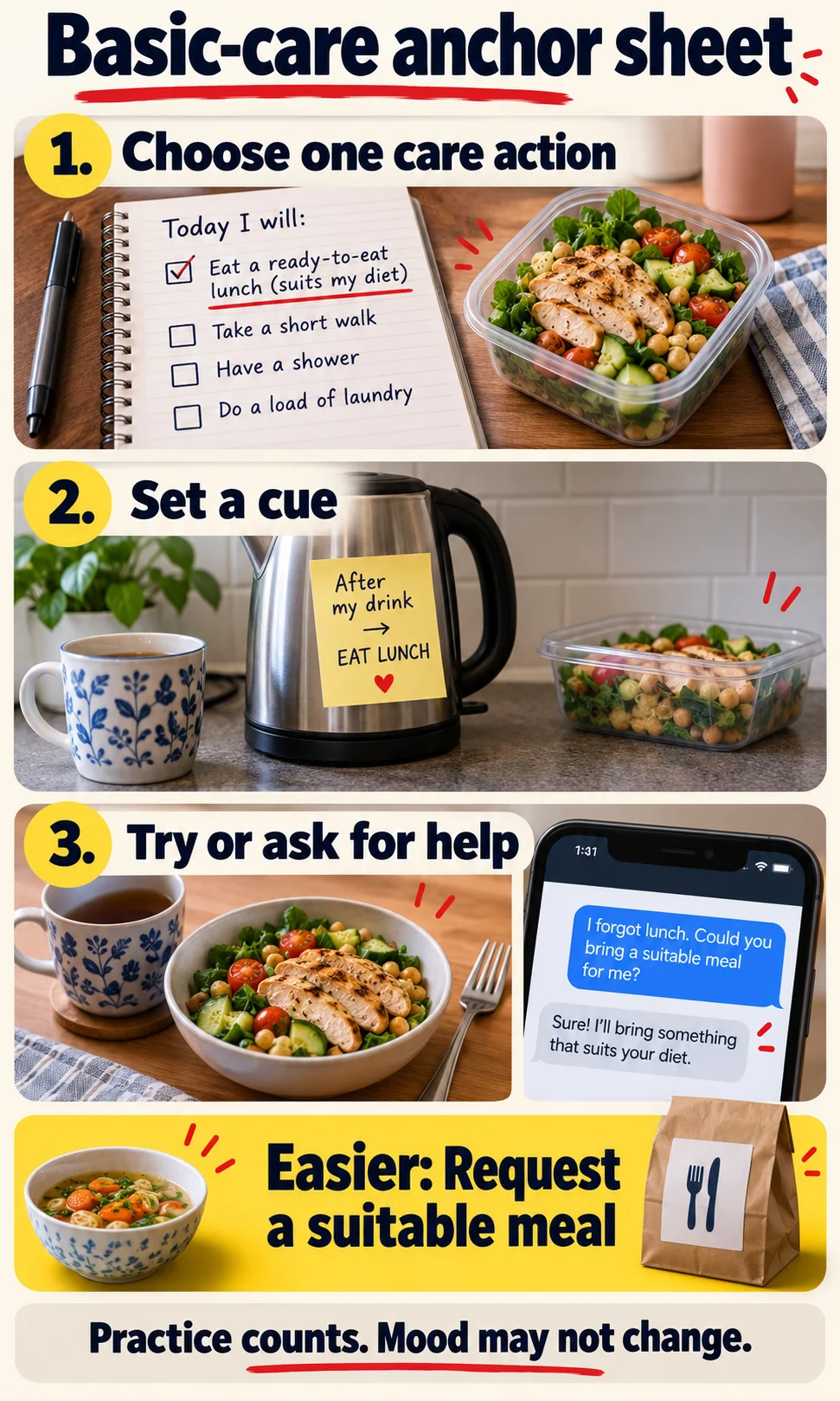
11. Basic-care anchor sheet
When it fits: Eating, washing or rest is slipping. Use the page to turn that obstacle into one visible step. Choose the easier version if the full sequence feels like too much.
- Choose one basic-care action that is appropriate for your needs.
- Attach it to an existing cue and put the needed item nearby.
- Try the smallest useful version; arrange support if basic needs remain unmet.
Illustrative example: An illustrative reader forgets lunch. They choose a familiar ready-to-eat lunch that suits their dietary needs and place a reminder by the kettle. After their midday drink, they sit down to eat.
12. Early-support action sheet
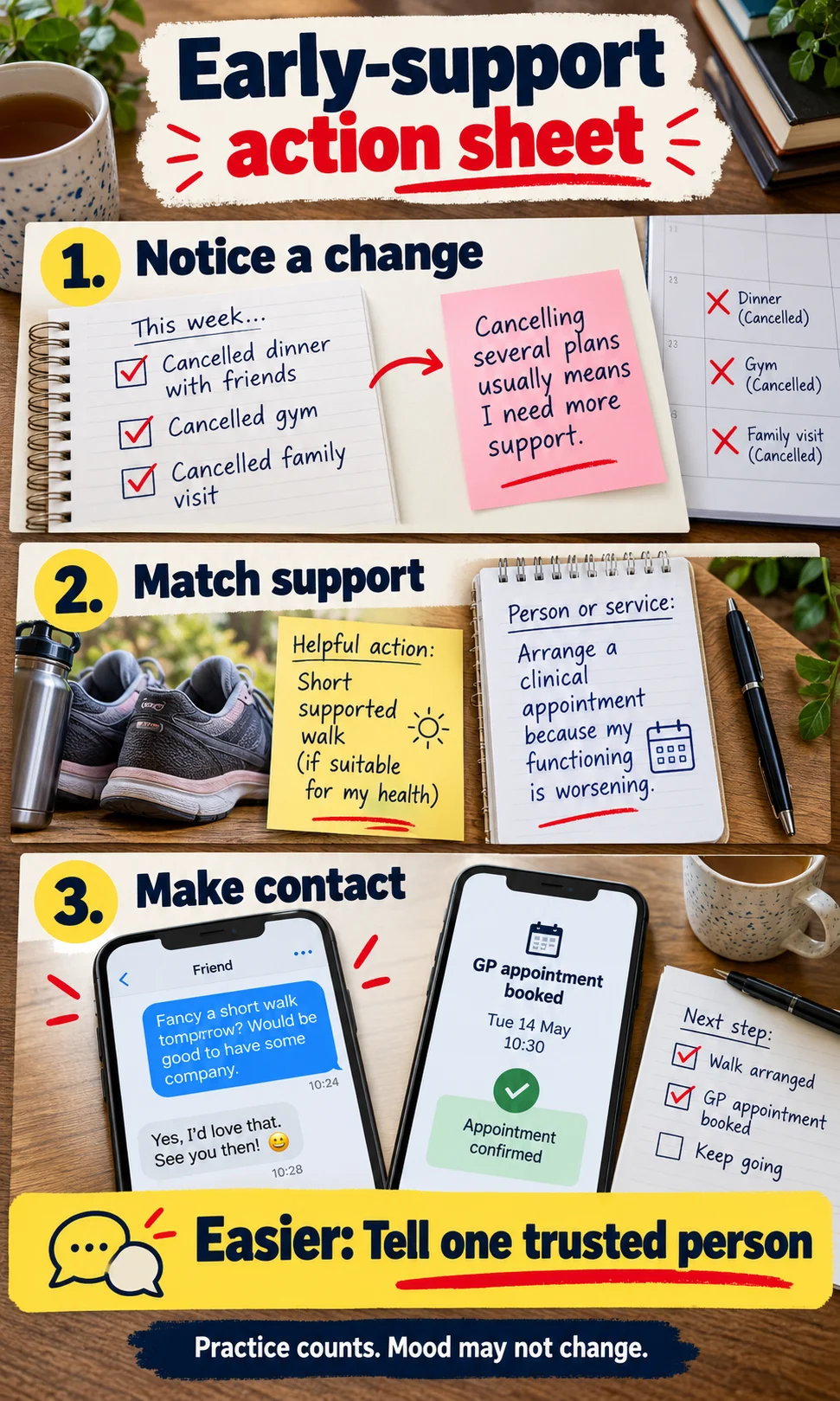
When it fits: Old difficulties are returning. Use the page to turn that obstacle into one visible step. Choose the easier version if the full sequence feels like too much.
- Name a personal change that usually means you need more support.
- Match it to one helpful action and one person or service.
- Make the contact or arrange the action rather than only recording the change.
Illustrative example: An illustrative reader notices they have cancelled several plans. They choose a short supported walk if suitable for their health and arrange a clinical appointment because their functioning is worsening. They use the sign to seek help rather than to score their recovery.
13. Appointment-preparation sheet
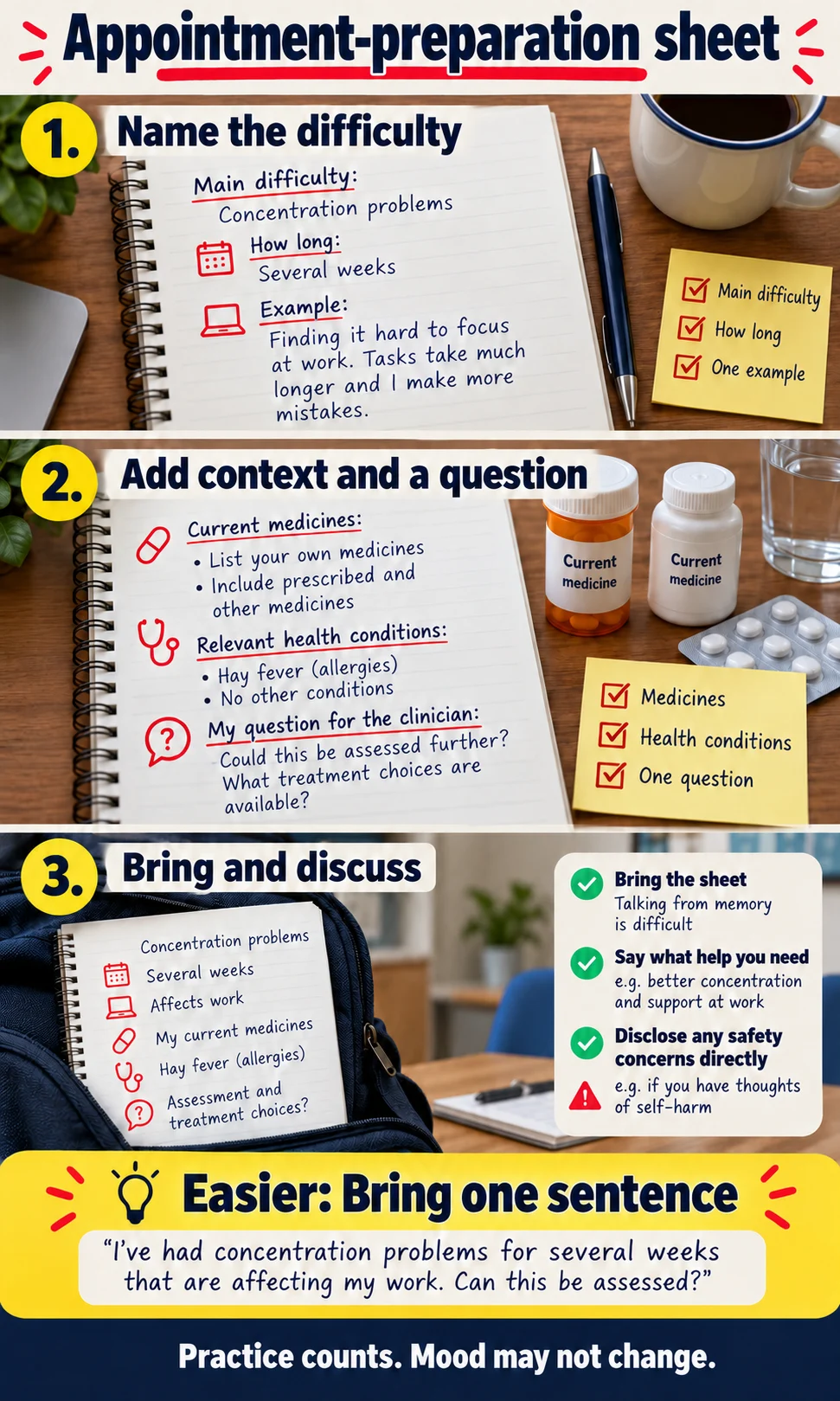
When it fits: Explaining your difficulty feels overwhelming. Use the page to turn that obstacle into one visible step. Choose the easier version if the full sequence feels like too much.
- Write the main difficulty, how long it has lasted and one daily-life example.
- Add relevant medicines, health conditions and one question for the clinician.
- Bring the sheet and say what help you need; disclose any safety concerns directly.
Illustrative example: An illustrative reader writes that concentration problems have lasted several weeks and are affecting work. They list their medicines and ask about assessment and treatment choices. They bring the page because talking from memory is difficult.
Why a worksheet can help and when it becomes extra work
A worksheet can make a vague difficulty more concrete. Separating an event from an assumption helps you respond to what is known, while breaking a task into parts makes the first action easier to see. The paper is useful when it changes the next decision; filling pages without a workable next step can simply add another demand.
The activity sheets are short adaptations of behavioural strategies, and the thought sheets adapt cognitive self-help questions. The CCI depression workbook offers a more structured sequence, while NHS self-help CBT guides explain related skills. These authorities support the underlying approaches, not a claim that this particular set of 13 sheets has been clinically tested.
If a worksheet does not help
- Too much writing: try one phrase, say it aloud or use the easier option.
- The step is still too large: reduce it to preparation, or ask for help.
- The problem is real: use practical problem solving rather than trying to argue away hardship.
- You keep going in circles: stop analysing and move to a suitable care action or support contact.
- Symptoms are worsening: seek an assessment instead of adding more worksheets.
When to get help beyond a worksheet
Arrange professional assessment if low mood is persistent, worsening or interfering with work, relationships or basic care. You do not need to finish a worksheet before asking for help. Bring the appointment-preparation sheet if explaining your situation is difficult, and keep taking prescribed medication unless your prescriber advises a change.
If you might harm yourself or cannot stay safe, contact urgent help now rather than using these exercises alone. In the United States, call or text 988; call 911 for a life-threatening emergency. Elsewhere, contact your local emergency number or crisis service, and ask a trusted person to stay with you while help is arranged.
Frequently asked questions
Are these depression worksheets free?
The 13 original worksheets in this article are free to print and practise. They are educational adaptations rather than validated assessments. You can also use the official CCI workbook linked below.
Which worksheet should I start with?
Choose the worksheet that matches today’s obstacle. Use the tiny-task starter for difficulty beginning, the balanced-thought record for a harsh assumption, or appointment preparation if symptoms are affecting daily life. Start with one page rather than completing the whole set.
Do I need to fill in every box?
No. A few words or an easier action can be enough to practise the method. The useful outcome is a manageable next step, not a perfectly completed form.
Can worksheets replace therapy or medication?
No. Worksheets can support skills practice, but they cannot diagnose depression or replace assessment and treatment. Keep following your prescribed treatment and discuss difficulties with your clinician.
What if writing makes me feel worse?
Stop the exercise and choose practical support or a brief care action instead. Repeatedly analysing distress can become unhelpful. Seek professional help if symptoms are worsening, persistent or interfering with basic needs.
Are these suitable for children or teenagers?
This set is written for adults. Younger readers should use age-appropriate resources with a trusted adult or qualified professional. Safety concerns require prompt help rather than unsupervised worksheet practice.
Choose one page, then one action
Pick the page that matches today’s obstacle and try its smallest useful step. Keep the sheet only if it helps you decide what to do next. For more detail, read behavioral activation for depression, how to stop negative self-talk or depression and task paralysis.