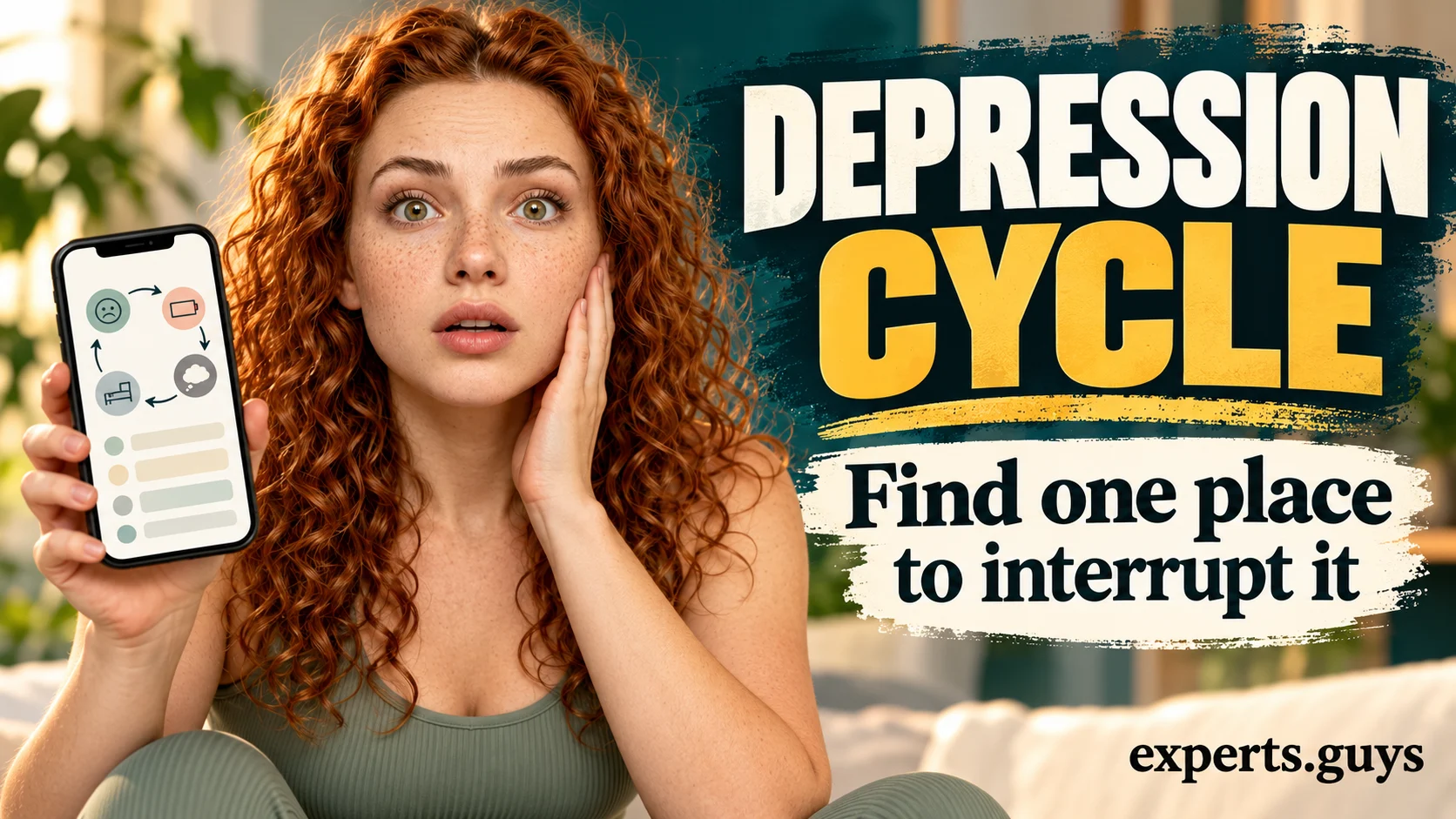
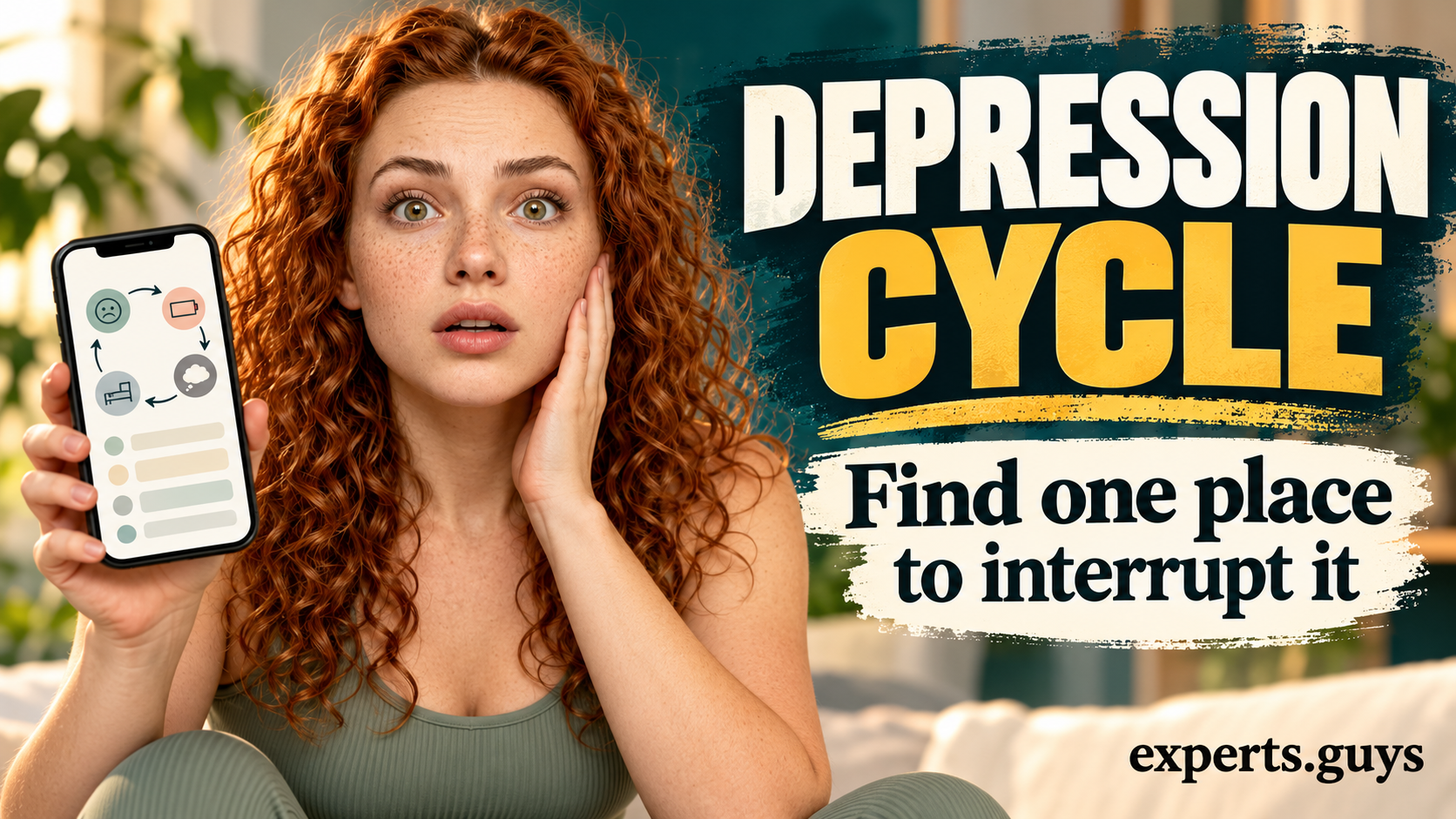
A cycle of depression worksheet helps you examine how a situation, interpretation, feeling, action and consequence may reinforce one another. Use it to trace one recent moment and choose one manageable alternative response. It is an educational reflection aid, not a diagnostic test or a substitute for treatment.
The word “cycle” here means a repeating everyday pattern, not a diagnosis of cyclical depression or bipolar disorder. Depression has multiple biological, psychological and social contributors. This worksheet examines one potentially changeable pattern without claiming that thoughts or habits explain the whole condition.
You can complete the original digital worksheet below on a phone or computer. Start with a low-intensity example and skip any field you cannot answer. There is no score, required streak or expectation that your mood must improve immediately.
What should a completed depression cycle worksheet show?
A useful entry makes a sequence understandable without assigning blame. It shows what the response achieved immediately and what happened later, then identifies one possible change. The later consequence matters because a response that feels helpful now may leave the next encounter more difficult.
| Field | Illustrative entry | What it clarifies |
|---|---|---|
| Situation | A dinner invitation arrived | The starting moment |
| Interpretation | I will disappoint them | Meaning, not established fact |
| Feeling and action | Overwhelmed; closed the chat | Experience and response |
| Now and later | Less pressure now; harder to reply later | Possible reinforcing pattern |
| Alternative and observation | Send a brief reply; note what happened | A testable next response |
This is an original editorial worksheet informed by established cognitive and behavioral principles. The Centre for Clinical Interventions depression resources explain related thought-feeling and activity patterns. Their resources and this simplified entry are not interchangeable with an individualized treatment plan.
Cycle Check Studio
Use the fields to assemble one example, then review it as a single sequence. The studio organizes what you enter and offers transparent reflection prompts; it does not interpret symptoms or recommend treatment. Entries remain in the current page unless you choose to download a copy.
Cycle Check Studio
One moment. One sequence. One next decision.
Educational reflection, not a diagnosis or treatment. No automatic saving or sending of your entries. Download only if you want a copy. Avoid identifying details.
If you cannot stay safe, use local emergency services now. Do not wait to complete this entry.
Your cycle entry
Downloads may remain on your device or cloud backup. Review before sharing.
How do you complete the worksheet without getting stuck?
1. Choose one moment, not your whole week
When everything feels tangled, begin with one recent, ordinary situation. A narrow entry is easier to examine than a verdict about your whole life. Use the digital fields below or a private note on your device; a short phrase is enough.
- Choose a moment you can recall without becoming overwhelmed.
- Enter what happened immediately before the change in mood or behavior.
- Leave unknown details blank rather than reconstructing them repeatedly.
Example: A message arrived asking whether you were coming to dinner. That is a usable starting point; “everything is going wrong” is too broad.
Correction: Avoid starting with the most painful event you have experienced. If recall becomes distressing, stop and choose a neutral daily example or work with a therapist.
Adapt and check: If typing is difficult, use a few keywords. Check that your entry describes one event rather than an entire day.

2. Separate the event from the meaning you gave it
A thought can feel convincing without being an observable event. Separating the two makes the worksheet more precise without forcing a positive interpretation. This is a labeling exercise, not a demand to prove yourself wrong.
- Put what a camera or message history could confirm in the event field.
- Put your interpretation in the thought field.
- Use “I had the thought that…” if the interpretation feels inseparable from the event.
Example: Event: “No reply yet.” Thought: “I am unwanted.” Neither silence nor a worksheet can establish what another person thinks.
Correction: Do not replace a painful guess with an equally unsupported cheerful guess. “I do not know why they have not replied” leaves room for uncertainty.
Adapt and check: Use “unclear” if you cannot separate the two today. The checkpoint is a more specific entry, not a happier belief.

3. Distinguish what you felt from what you did
Feelings and actions provide different information. “Overwhelmed” describes an experience; “closed the chat” describes behavior. Naming both helps identify an action that could change while the feeling is still present.
- Choose one emotion or body sensation, such as sadness or heaviness.
- Describe the next visible action in neutral language.
- Avoid identity labels such as lazy, broken or difficult.
Example: Feeling: overwhelmed. Action: closed the chat and did not answer. These entries explain a sequence without turning it into a character judgment.
Correction: “I failed again” is a conclusion, not a behavior. Replace it with the action that actually happened, such as leaving the message unread.
Adapt and check: If emotion words are hard to find, “uncomfortable” is enough. Check that the action could be described by someone observing the moment.

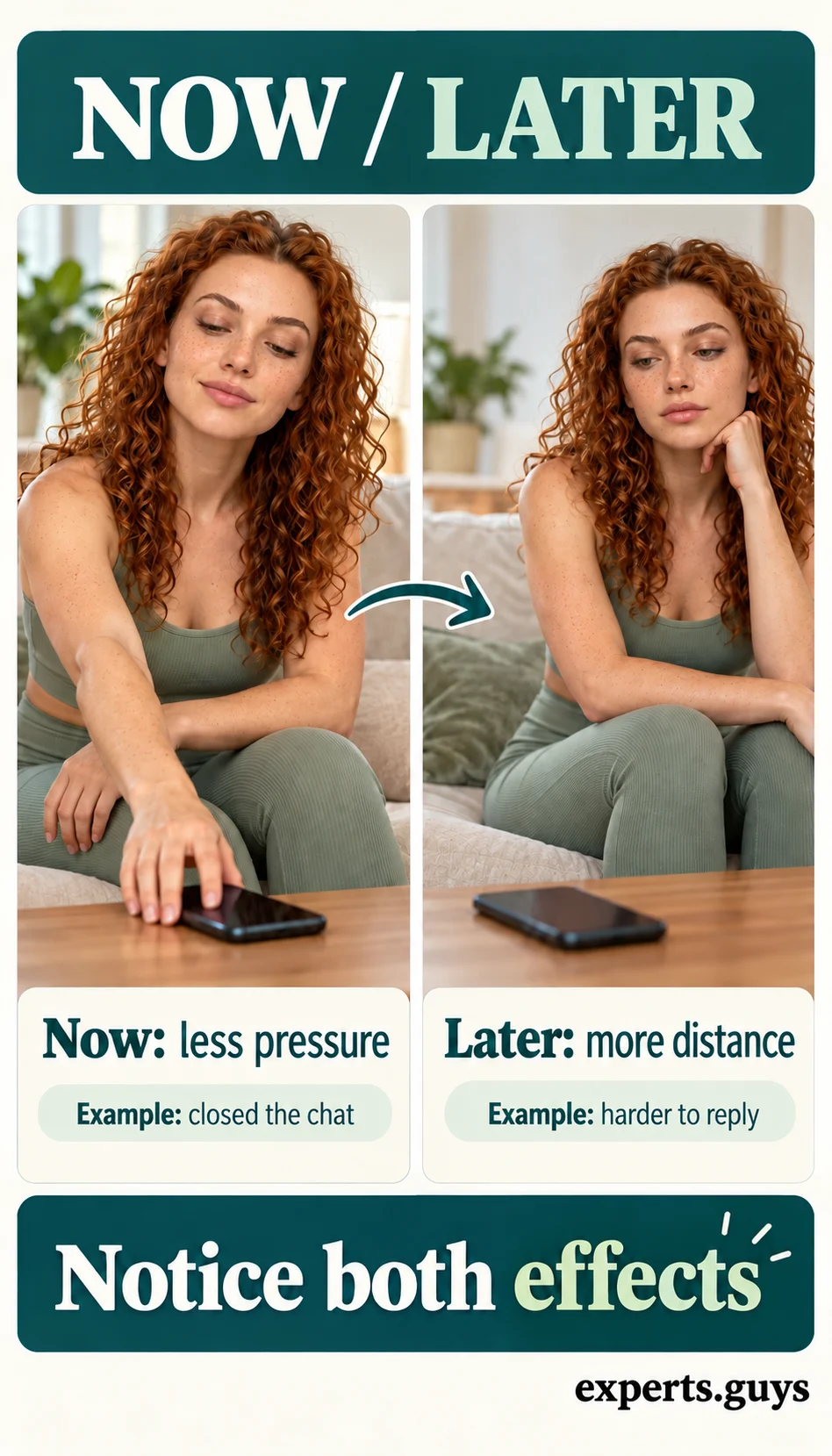
4. Compare immediate relief with the later effect
A response can reduce pressure immediately and still create difficulty later. That short-term benefit helps explain why a pattern repeats. The later effect is information about the pattern, not proof that you caused your depression.
- Enter what became easier immediately after the action.
- Add what happened later, if you know.
- Keep timing and uncertainty visible; use “not checked yet” when appropriate.
Example: Closing the chat removed the pressure to respond. Later, the unanswered invitation felt harder to reopen. This is an illustrative pattern, not an inevitable outcome.
Correction: Do not invent a later cost because the worksheet seems to expect one. Sometimes rest or a boundary helps both now and later.
Adapt and check: If you cannot assess the later effect, return after the relevant situation has unfolded. Look for a repeated relationship across examples rather than treating one entry as proof.
5. Check whether the response met a need
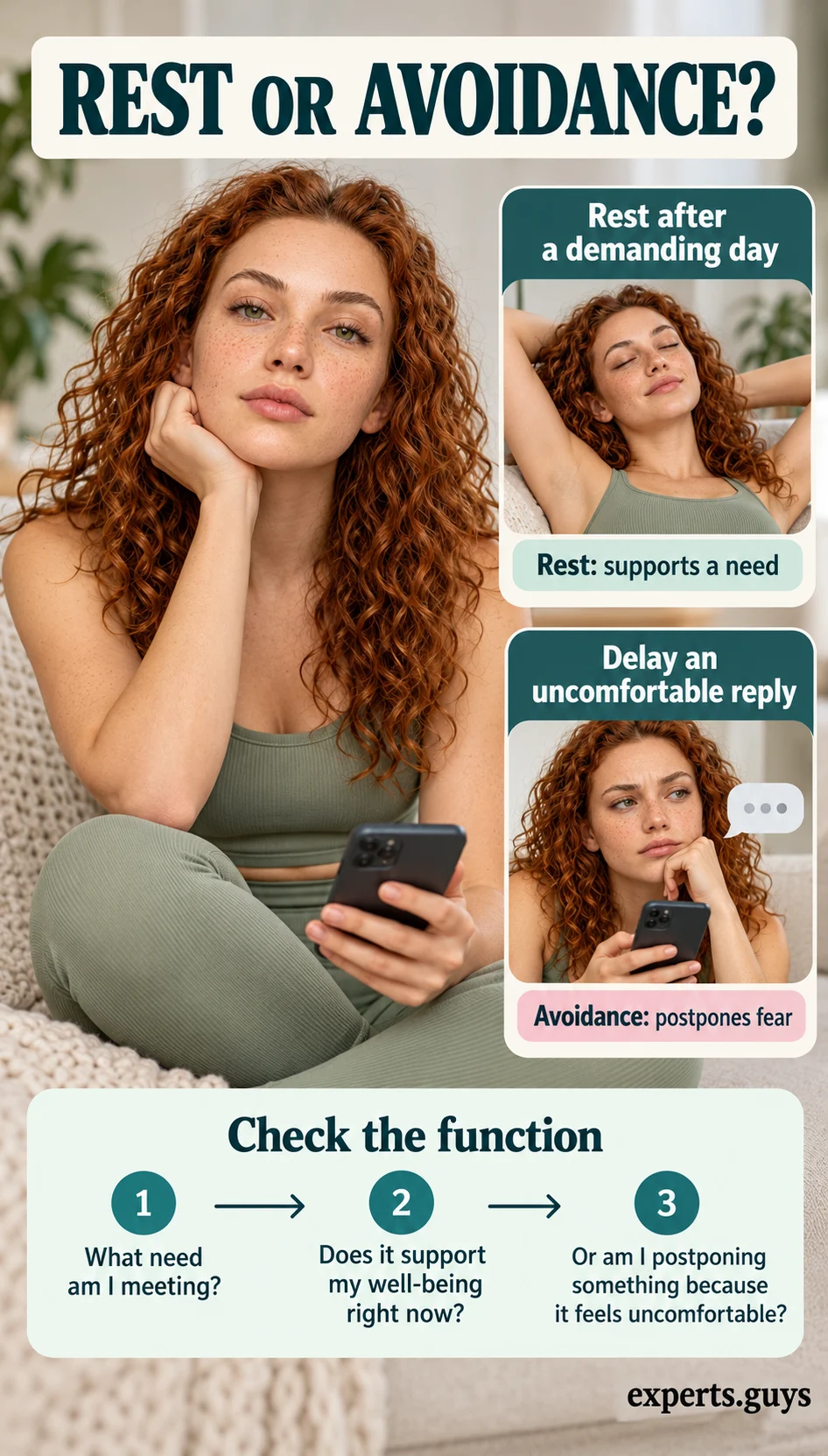
Rest, pacing and boundaries are legitimate responses to fatigue, illness and excessive demands. The same action can serve different purposes in different circumstances. Ask what the response did for you rather than sorting behavior into good and bad.
- Identify the need present: rest, safety, manageable demands or connection.
- Ask whether the response supported that need or mainly postponed a feared moment.
- Allow a mixed answer; rest and avoidance can occur together.
Example: Resting after a demanding day may be useful. Repeatedly postponing a safe reply because of anticipated rejection may leave the original pressure unresolved.
Correction: Do not use this question to push through pain, illness or an unsafe relationship. A cycle worksheet is not a reason to override physical limits or protective boundaries.
Adapt and check: If uncertain, select “mixed or unclear.” The checkpoint is a kinder, more accurate explanation of the behavior, not a rule to stay constantly active.
6. Choose one alternative response at the same point
The useful question is what could be different at one link in this particular sequence. You do not need to change the situation, eliminate sadness or repair every difficulty first. Choose an option that fits your capacity and preserves safety.
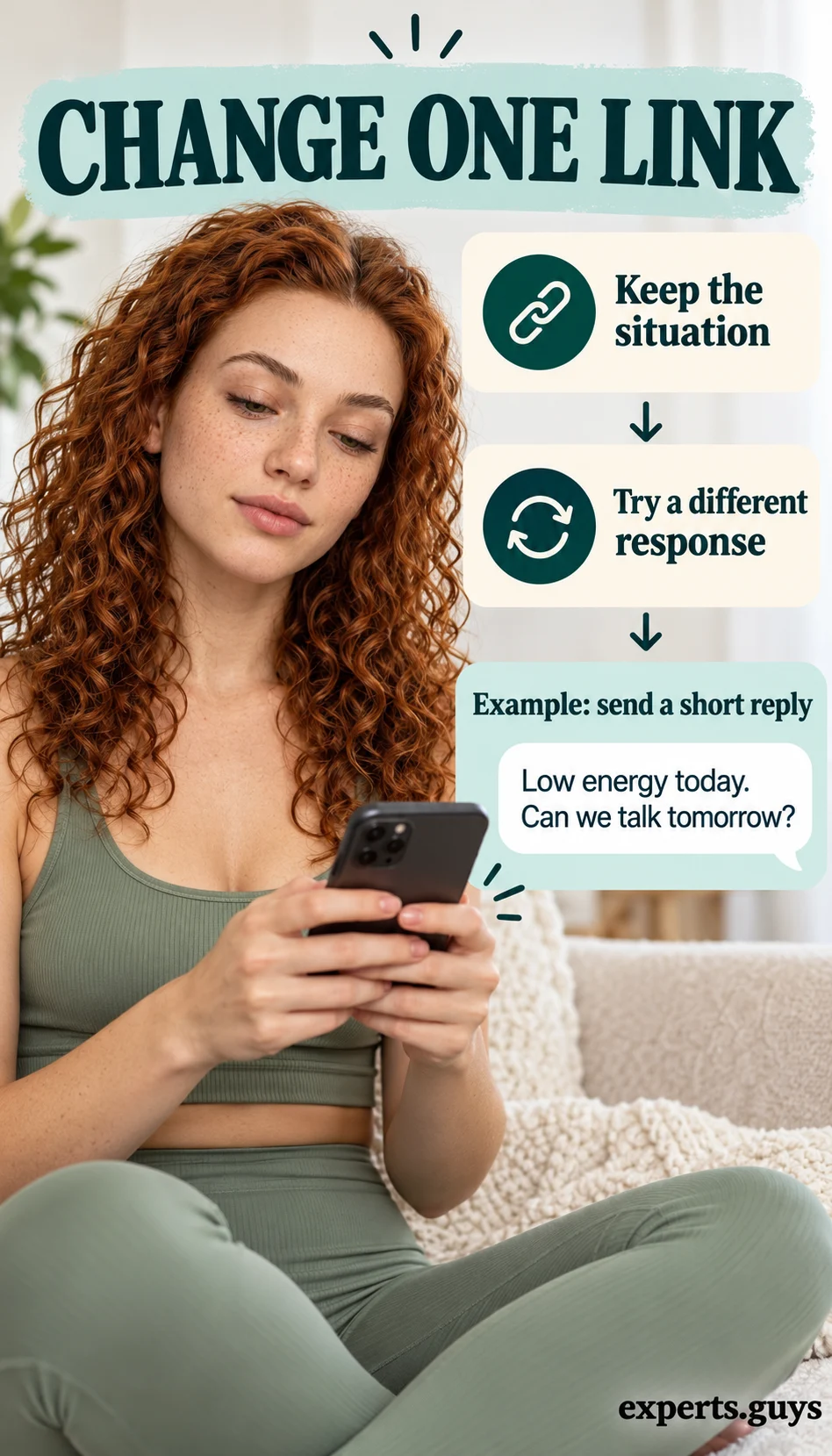
- Keep the original event visible.
- Choose one small response that meets the identified need with less avoidable later difficulty.
- Define what counts as completion before trying it.
Example: Instead of disappearing from a safe conversation, send: “Low energy today. Can we talk tomorrow?” Completion means sending or preparing that message, not receiving a reassuring reply.
Correction: Do not make another person’s reaction your success condition. Their availability and response are outside your control.
Adapt and check: If sending is too much, prepare the short reply and decide later whether to send it. For a broader treatment explanation, see behavioral activation for depression.
7. Compare a prediction with what actually happened
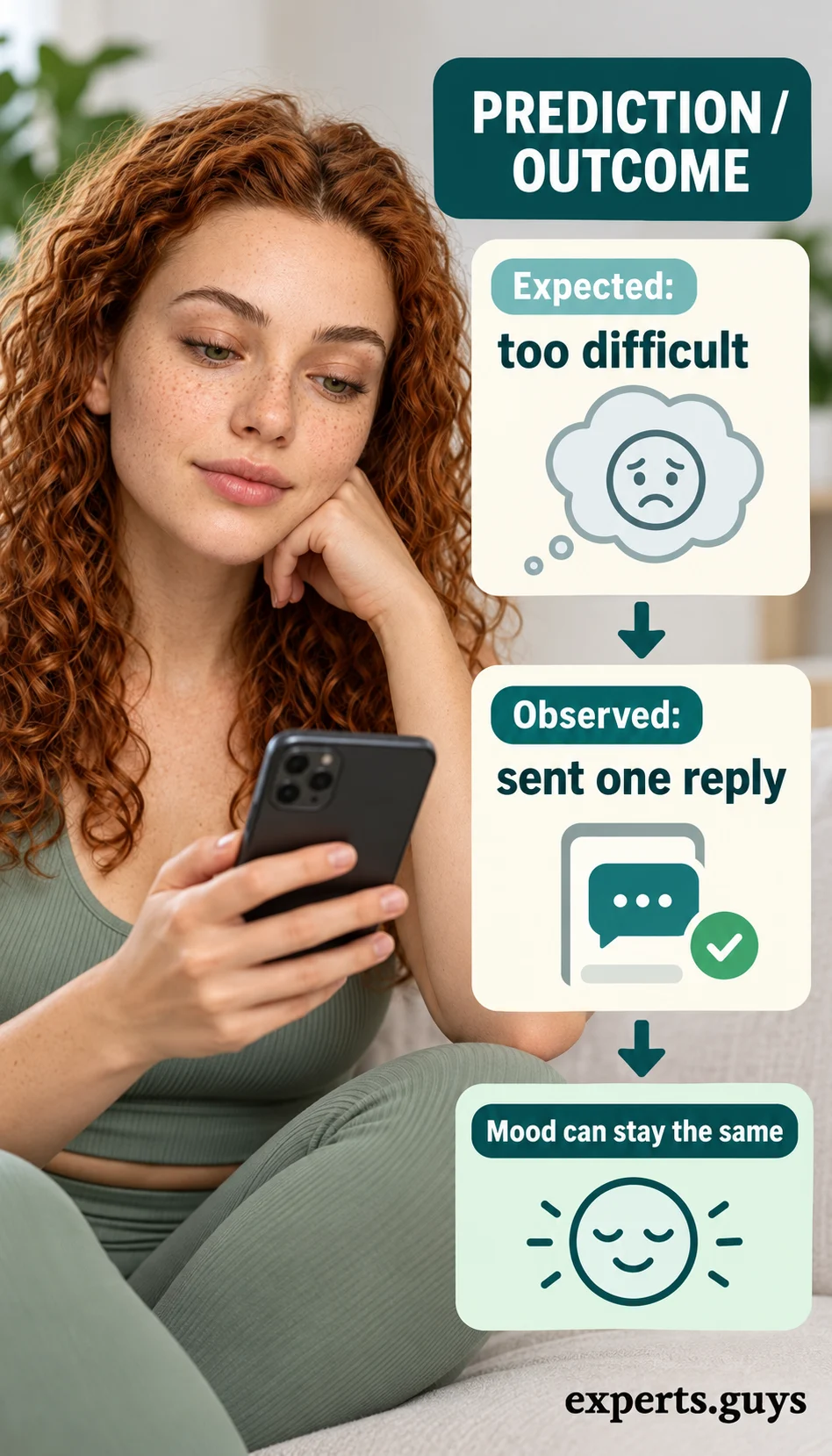
An experiment needs an observable outcome. Mood may remain low even when an action becomes possible or a practical problem becomes smaller. Keep the prediction and observation separate so the entry does not become a pass-or-fail mood test.
- Before the attempt, enter one prediction you can check.
- Afterward, enter only what you observed.
- Include unchanged or difficult outcomes rather than editing them into a success story.
Example: Prediction: “Sending a reply will be too difficult.” Observation: “I sent one sentence; my mood stayed low.” The action occurred, while the mood outcome was unchanged.
Correction: “It did nothing” can hide useful distinctions. Specify whether you mean mood, effort, connection or the practical task.
Adapt and check: If you did not attempt the action, record the obstacle without blame. Check whether the chosen response was actually small and safe enough for that moment.
8. Keep, shrink or seek support for the next attempt
A completed entry should lead to a decision rather than more analysis. A workable response can be repeated; an oversized response can be reduced. Repeated difficulty may indicate that you need practical support, a different approach or clinical care.
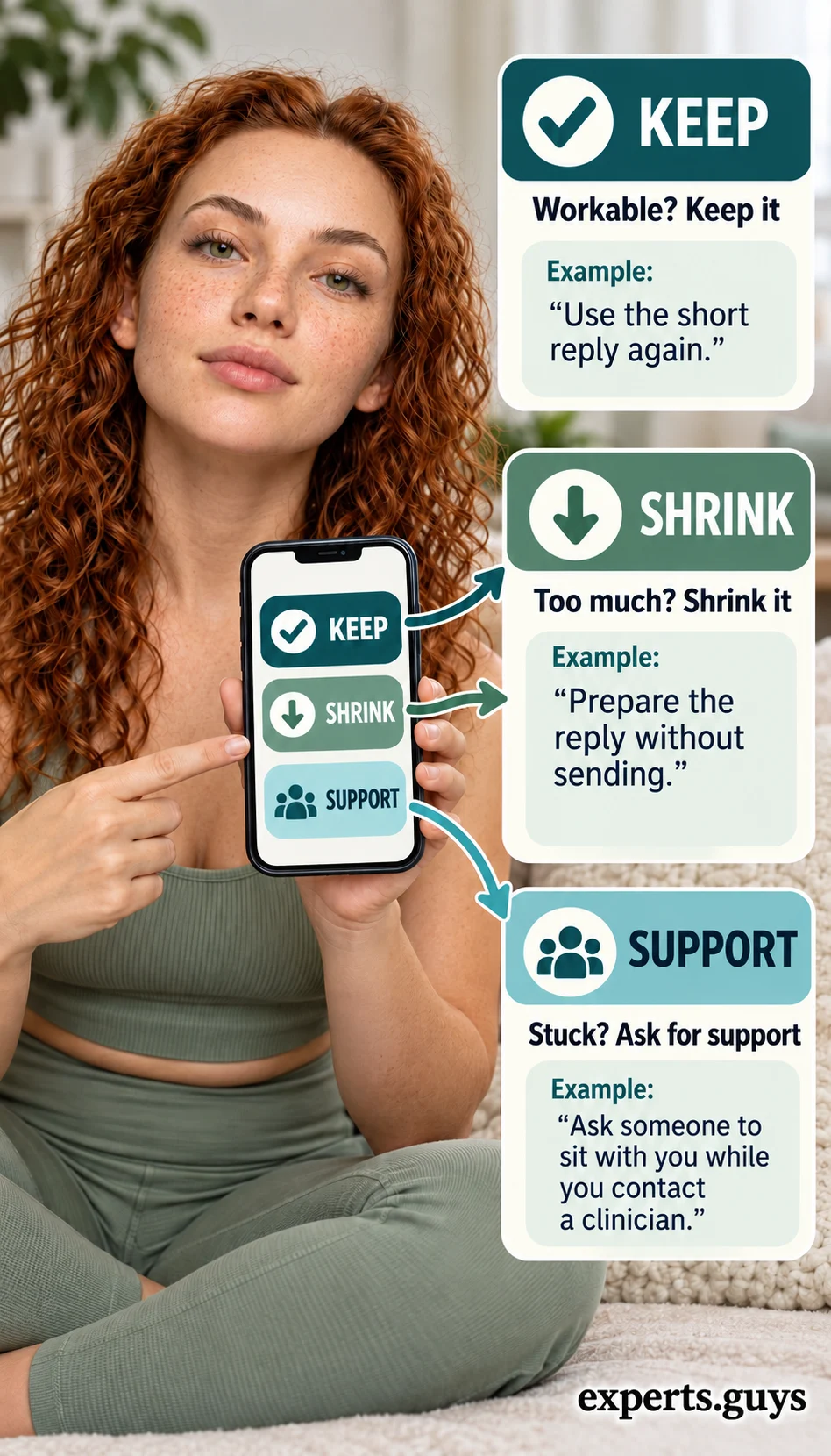
- Keep the response if it was safe and workable.
- Shrink it if the demand exceeded your capacity.
- Choose support if the pattern is persistent, worsening or difficult to manage alone.
Example: Keep: use the short reply again. Shrink: prepare it without sending. Support: ask a trusted person to sit with you while you contact a clinician.
Correction: Do not turn the worksheet into a daily streak or a measure of worth. Missing an entry does not cancel what you learned.
Adapt and check: One useful entry is enough to start a conversation. Stop if repeated checking increases rumination; the purpose is a clearer next decision, not exhaustive self-monitoring.
What if the worksheet makes you feel worse?
Repeatedly reviewing a painful situation can become another form of getting stuck. Stop if the exercise increases distress or turns into repeated checking without a new decision. You can leave the entry incomplete and return to basic needs or support instead.
| Difficulty | Useful adjustment |
|---|---|
| Every entry says “I am the problem” | Return to observable events and actions; leave identity judgments out. |
| The alternative feels impossible | Reduce the demand or identify the practical support missing. |
| Rest feels like failure | Check physical needs and safety before assuming avoidance. |
| No clear improvement | Review the size and fit of the attempt; do not infer a diagnosis or treatment failure. |
When does a repeating pattern need professional assessment?
Arrange a clinical assessment if low mood, loss of interest or related symptoms persist, worsen or interfere with daily life. Symptoms lasting around two weeks are a reason to seek assessment, but severe symptoms warrant help sooner. A clinician can also consider physical illness, medication effects and other explanations, as described in the NIMH depression guidance.
This worksheet does not distinguish recurring depressive episodes, seasonal patterns or bipolar disorder. Those questions require history across time and clinical assessment. Do not change medication based on a worksheet entry.
If your main need is choosing among different exercises, use the broader depression worksheets with examples guide. This page stays focused on understanding the sequence within one example. Structured self-help may be part of care, but the NICE depression recommendations describe support and treatment choices beyond a standalone worksheet.
Frequently asked questions
Do I have to find the original cause of depression?
No. The entry examines a recent pattern, not the original cause of an illness. You can identify a useful next response without explaining every contributor to depression.
Can I leave a field blank?
Yes. Use “unclear” or leave it empty rather than guessing. A partial example can still show what you want to discuss with a clinician.
Should I complete it every day?
There is no required frequency for this editorial worksheet. Use it when a specific repeating situation needs clarification, and stop if recording becomes burdensome or increases rumination.
Is my information saved automatically?
The supplied studio does not send entries to a server or deliberately save them between visits. Download is optional; your browser, device and the surrounding website may have their own privacy behavior. Avoid entering names or identifying details.
Can this replace a therapist’s worksheet?
No. If you are receiving care, use the format and goals agreed with your clinician. You can show them this entry and ask whether it fits your treatment.
A useful entry ends with one decision
Choose one recent moment, describe the sequence and identify one response you can reasonably test. Keep the observation separate from your judgment of yourself. The value of the worksheet is a clearer next decision, even when your mood has not changed.