

You can spend an entire day around people and still come home feeling profoundly alone. There may have been coworkers beside you, messages waiting on your phone, people talking across a dinner table, or strangers packed around you on the train. None of that necessarily creates the feeling of being understood, wanted, emotionally close or able to reach somebody when you need them. Depression can make that gap more noticeable because it may reduce energy, pleasure, concentration and the willingness or capacity to initiate contact, while also changing how a person interprets themselves and other people’s responses.
The relationship also works in more than one direction. Depression can make maintaining relationships harder, and persistent loneliness can add another layer of distress to an already difficult mood. The World Health Organization’s explanation of social connection describes loneliness as a distressing subjective experience that appears when the connections a person has do not match the connections they want or need. That distinction matters because somebody can have friends, family, colleagues and a busy calendar while still feeling disconnected.
This also means loneliness by itself does not establish that somebody has depression. People become lonely after moving, losing a relationship, changing jobs, becoming a caregiver, experiencing illness, spending long periods alone or going through other disruptions to familiar relationships. Depression becomes more important to consider when loneliness appears alongside a broader change in mood, interest, energy, sleep, concentration, self-worth or everyday functioning. The National Institute of Mental Health’s overview of depression includes loss of interest, fatigue, concentration and decision difficulties, withdrawal and isolation from family and friends among the changes that may occur with depression.
For someone caught inside this pattern, the useful question is therefore larger than “How do I meet more people?” The better question is what is making connection difficult right now? A person who wants company but cannot initiate it may need something different from somebody who avoids people because of fear of judgment, somebody who has stopped experiencing pleasure from relationships, or somebody whose social world has gradually shrunk without them noticing how much it has changed. Understanding that difference can make the next step considerably more realistic.
Can Depression Make You Feel Lonely Even When You Are Not Alone?
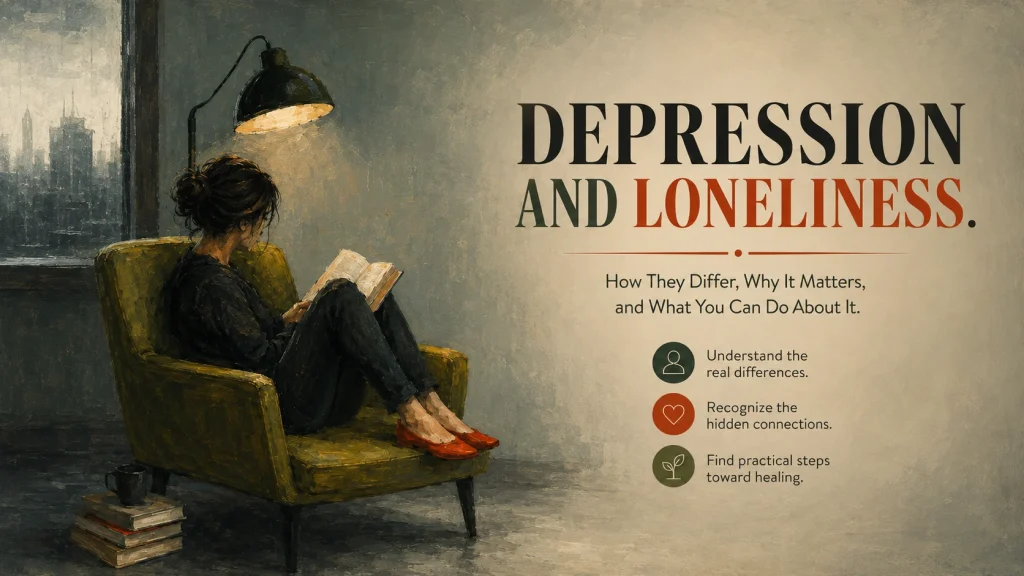
Yes. Depression can contribute to loneliness even when other people are physically present because meaningful connection depends on much more than proximity. A conversation has to be initiated or joined, attention has to remain available, another person’s warmth has to register emotionally, and the interaction has to feel worthwhile enough to repeat. Depression can interfere with several parts of that process at the same time.
Imagine sitting at a restaurant with people you genuinely care about. Everyone is speaking, laughing and exchanging stories, yet following the conversation takes unusual effort. You contribute less because forming a response feels slow, and by the time you think of something to say the discussion has already moved elsewhere. You notice your own silence, become self-conscious about it, and start wondering whether your presence matters. The evening may contain plenty of social contact while producing very little felt connection.
For another person, the difficulty begins before the meeting ever happens. A message arrives from a friend asking whether they want coffee. The person intends to answer later because they are tired, distracted or uncertain about committing. Hours become days, the unanswered message begins to feel awkward, and eventually replying seems to require an explanation as well as a decision. What initially looked like a small delay can become part of social withdrawal and depression when similar moments accumulate across several relationships.
That pattern is easy to misread from the outside. Friends may assume the person wants space. Coworkers may interpret quietness as disinterest. The person experiencing depression may look at the decreasing number of invitations and conclude that nobody really wants them around. Each side is responding to incomplete information, and the social network can become quieter without any deliberate decision to end the relationships.
This is one reason simply counting the number of people in someone’s life gives an incomplete picture of loneliness. The CDC’s explanation of social isolation and loneliness specifically distinguishes loneliness from the objective amount of social contact and notes that even someone with many friends can feel lonely. Quality, emotional accessibility, belonging and the person’s experience of those relationships matter alongside the size of the network.
Loneliness, Social Isolation and Social Withdrawal Are Different
These terms frequently appear together, although they describe different parts of the social picture. Keeping them separate is useful because each one can point toward a different problem and a different response.
A person can therefore be socially isolated without feeling lonely, particularly when solitude matches what they currently want. Someone else may experience intense loneliness while living with a partner, working in a crowded office or having frequent contact with relatives. Depression can complicate the picture further because withdrawal may begin as an attempt to conserve limited energy and eventually reduce the opportunities for satisfying contact.
The direction of change is often more informative than somebody’s absolute level of sociability. A person who has always preferred a small social circle may be functioning normally with two close relationships. A previously sociable person who has gradually stopped replying to nearly everyone presents a different pattern, even if both people technically have the same number of close contacts today. Comparing yourself with your own normal baseline can therefore reveal more than comparing the size of your social life with somebody else’s.
Why Depression Can Make Connection Feel So Difficult
Depression does not have to remove the desire for relationships. Some people still want comfort, companionship and familiarity very strongly while finding the actions required to obtain them disproportionately difficult. That conflict can be particularly painful because the person is aware of what they are missing while feeling unable to close the distance.
Several mechanisms can contribute, and they do not appear in the same combination for everyone. Low energy may make getting dressed and traveling to meet somebody feel expensive. Reduced pleasure can weaken the expectation that an interaction will feel worthwhile. Concentration problems can make conversation tiring. Harsh self-judgment can make a delayed reply or quiet evening feel like evidence that other people have lost interest. Irritability can create friction at precisely the time when the person needs support.
Understanding which of these is strongest matters because “be more social” is too vague to solve any of them.
Low Energy Can Increase the Cost of Contact
Socializing requires effort that often goes unnoticed when energy is available. You choose what to wear, travel somewhere, follow conversation, respond to questions, make decisions, tolerate noise and remain present for an uncertain amount of time. When depression is accompanied by significant fatigue, those ordinary demands can feel much larger.
This helps explain why someone may genuinely want to see a friend and still cancel shortly before leaving home. The cancellation does not necessarily reveal how much they value the relationship. Sometimes it reveals how much energy the interaction appears to require at that moment. Readers who notice that exhaustion is driving much of their withdrawal may find it useful to compare the pattern with depression fatigue vs normal tiredness, particularly when low energy is affecting work, self-care and other parts of daily life as well.
There is also an important practical difference between needing recovery and entering a withdrawal cycle. An evening alone may restore enough capacity to function better the next day. Repeatedly cancelling every form of contact for weeks may leave the person with fewer reassuring experiences, more unanswered messages and a growing sense that reconnecting will be awkward. The key question is what happens after the time alone: does capacity return, or does the threshold for re-entering social life keep getting higher?
That question prevents the article from treating rest as a problem in itself. Someone who is exhausted does not need to prove sociability by forcing themselves through every invitation. The concern becomes stronger when the pattern keeps narrowing the person’s life, the withdrawal is difficult to reverse, or other depressive symptoms are becoming more prominent at the same time.
Loss of Pleasure Can Change What You Expect From People
Depression can also affect anticipated reward. An invitation that once produced a small spark of interest may begin to feel emotionally flat before it even happens. The person remembers that they used to enjoy dinner with friends, music, sport, gaming, walking, family gatherings or weekend routines, yet the thought of doing those things now produces little expectation of pleasure.
That experience can create a misleading prediction: “There is no point going because I will not enjoy it.” Sometimes the prediction turns out to be accurate for that particular occasion. At other times, the person’s enjoyment during the activity is somewhat better than they expected beforehand. The useful observation is the gap between anticipated experience and actual experience, because it gives more information than relying only on the feeling that appears before starting.
When reduced pleasure extends far beyond relationships, why nothing feels enjoyable anymore can help place the social change within a wider anhedonia pattern. If the person still wants relationships but feels emotionally distant once they are with people, the problem may instead resemble emotional blunting or numbness. Those experiences can overlap, yet they are not identical, and distinguishing them can prevent somebody from concluding too quickly that they simply “do not care about people anymore.”
Self-Criticism Can Turn Ordinary Social Uncertainty Into Rejection
Relationships contain ambiguity. Somebody reads a message and replies six hours later. A friend sounds distracted during a call. Two coworkers go to lunch without inviting everyone. A relative cancels because their child is sick. Most people encounter moments like these without having enough information to know exactly what they mean.
When depression is accompanied by worthlessness, hopelessness or harsh self-judgment, that ambiguity may be interpreted through a more negative lens. A slow reply can begin to feel like rejection. A short conversation may seem like proof that you were boring. An invitation that never arrives can become evidence that everyone is happier without you, even when several other explanations remain possible.
The consequence can be behavioral as well as emotional. If you predict rejection before sending the message, avoiding the message provides immediate relief from uncertainty. It also removes the possibility of discovering that the other person would have been pleased to hear from you. Repeated often enough, that protective strategy can make loneliness increasingly convincing because fewer new interactions are available to challenge the prediction.
This is also where depression vs social anxiety becomes useful. A person withdrawing primarily because they expect judgment, embarrassment or scrutiny may need to think about the problem differently from someone whose main barrier is depleted energy, loss of reward or pervasive low mood. Both can avoid the same party for very different reasons.
The Depression-Loneliness Loop Can Become Self-Reinforcing
The difficult part of depression and loneliness is often the sequence rather than any single symptom. A person feels depleted and declines an invitation. The immediate relief makes staying home feel easier. Fewer interactions follow, so there are fewer moments of warmth, novelty or reassurance. The social network becomes quieter, unanswered messages begin to carry more emotional weight, and reaching out now feels harder than it did at the beginning.
Meanwhile, loneliness can affect how the person reads the quieter social environment. They may assume other people stopped contacting them because they were unwanted, even though friends may simply believe they are respecting a request for space. The person then waits for somebody else to initiate contact while friends wait for a sign that contact would be welcome. Nobody intentionally ends the relationship, yet the relationship becomes less active.
This creates an important blind spot: the absence of contact does not always reveal the absence of care. Sometimes it reflects competing assumptions, fatigue, practical distance, previous cancellations or uncertainty about what the other person wants. That possibility should not be used to dismiss genuine rejection or unhealthy relationships, but it is worth testing before treating silence as definitive evidence about your value to other people.
Breaking the cycle usually becomes more realistic when the first goal is smaller than “get my social life back.” One reply, one short meeting, one repeated low-pressure routine or one honest explanation to a trusted person can provide more useful information than an ambitious attempt to become highly social overnight. The later section on how to reconnect after depression will take that process further by separating the first contact, relationship repair and the rebuilding of a sustainable social rhythm.
What Actually Helps When Depression Makes You Feel Lonely?
The most useful response depends on what is maintaining the loneliness. If lack of opportunity is the main problem, creating more opportunities for contact may help. If depression has made every interaction feel exhausting, simply adding more social commitments can leave the person depleted and more likely to cancel. If the strongest barrier is fear of rejection, the work may involve testing assumptions about how other people will respond. When emotional numbness is prominent, the person may already be spending time with others while feeling little emotional reward from those interactions.
That is why “socialize more” is often too broad to be actionable. A better starting point is to identify the point where connection breaks down. Does the difficulty occur when an invitation arrives, when you need to leave home, during the interaction itself, or afterward when you replay the conversation and criticize everything you said? The location of the difficulty provides clues about the kind of support or adjustment that may be more useful.
There is also a difference between rebuilding social volume and rebuilding social connection. Filling several evenings with people may increase contact without creating the sense of being understood. For someone emerging from depression, one predictable conversation with a person who feels emotionally safe may provide more meaningful connection than attending a large gathering that requires hours of performance. The aim is to create enough contact for relationships to remain alive while keeping the demands realistic enough that the pattern can continue.
Start With the Smallest Form of Contact You Can Actually Repeat
When someone has withdrawn for weeks or months, a large social goal can create its own barrier. “I need to get my social life back” contains dozens of implied tasks: deciding whom to contact, explaining an absence, making plans, leaving home, following conversation and managing whatever feelings emerge afterward. A person already struggling with depression may experience that goal as another unfinished responsibility.
A smaller action has a different psychological cost. Replying to one message, sending a photograph to someone you trust, sitting with a family member for ten minutes, taking a short walk with a neighbor or joining an existing routine can reopen contact without demanding an immediate return to your previous level of sociability. The CDC guidance on improving social connectedness similarly emphasizes that small acts of connection can help build supportive relationships rather than requiring a dramatic social transformation.
The important feature is repeatability. A two-hour dinner that leaves you exhausted for the next day may be less sustainable than a twenty-minute coffee that you can manage again next week. If depression has made initiation especially difficult, recurring arrangements can reduce the number of decisions involved. Meeting the same person at the same cafe every Sunday, calling a relative during the same commute or attending a regular small group can gradually turn connection from a fresh negotiation into part of the week.
This principle also helps when someone has become stuck in depression and task paralysis. Social contact can become another task that grows in imagined complexity the longer it remains unfinished. Shrinking the entry step can make the first action more achievable without pretending that the underlying depression has disappeared.
Choose Lower-Demand Contact Before Assuming You Need More Willpower
Some social environments ask far more from a depressed person than others. A crowded dinner with unfamiliar people requires attention switching, rapid conversation, memory for names, tolerance of noise and the ability to remain socially responsive for an uncertain period. A quiet walk with one familiar person asks for something different. Both are technically social activities, but they can feel dramatically different when energy and concentration are reduced.
If you repeatedly cancel plans, it may therefore be useful to examine the format before concluding that you are incapable of connection. Shorter meetings, quieter locations, activities that do not require continuous conversation and arrangements with a clear finishing time can reduce the amount of energy needed to participate. Someone might struggle through a noisy restaurant while being perfectly capable of sitting beside a friend on a park bench.
This is especially relevant when depression overlaps with cognitive symptoms. Difficulty concentrating, slowed processing or brain fog can make group conversations harder to follow, which may leave someone feeling socially inadequate when the underlying difficulty is partly cognitive load. The experience is worth separating from a loss of affection for other people. If conversations themselves have started feeling unusually difficult to track, depression and processing speed explores that aspect in greater depth.
Reducing social demand is not the same as permanently shrinking a person’s world. It can function as a bridge. Once shorter or simpler interactions become manageable, the person can decide whether they want to expand from there rather than repeatedly attempting a level of social intensity that currently ends in cancellation.
Tell One Trusted Person What Has Been Happening
Long periods of withdrawal often create a second problem: the person starts believing they need a convincing explanation before they are allowed to reconnect. They may rehearse an apology, worry that the other person is angry, feel embarrassed about disappearing and postpone the conversation because they cannot find the perfect wording. The longer that continues, the explanation seems to require even more explanation.
A brief, honest message can interrupt that escalation. It does not need to disclose every detail of your mental health or justify every unanswered message. Something as simple as saying that you have been having a difficult period, have been quieter than usual and would like to reconnect can give the other person useful context. Their response then provides new information instead of leaving you to predict it entirely from inside your own mood.
There is a practical advantage to starting with somebody relatively safe rather than the relationship carrying the most emotional risk. If one friendship has recently been tense, beginning there may combine the difficulty of depression with unresolved conflict. A familiar person who has historically responded with steadiness can provide a lower-risk first experience of reaching outward again.
If shame is making this especially difficult, depression and feeling like a burden is relevant because people can begin withholding contact in an attempt to protect others from themselves. That belief deserves examination. Deciding that someone else would be better off without hearing from you removes their ability to decide what kind of relationship they want to have with you.
What If You Want Connection but Keep Pulling Away?
One of the more confusing depression patterns is wanting people close and simultaneously avoiding them. You may feel lonely in the evening, turn down an invitation the next morning and then feel hurt when fewer invitations arrive. From the outside, those behaviors can appear contradictory. From inside depression, they may reflect two competing needs: the desire for connection and the desire to escape effort, exposure, uncertainty or stimulation.
Understanding the immediate payoff of withdrawal can make the pattern clearer. Cancelling a plan may reduce pressure within minutes. Ignoring a message removes the need to decide what to say. Leaving a gathering early ends the work of maintaining conversation. Those short-term reductions in discomfort can reinforce avoidance even when the longer-term result is more loneliness.
This does not mean every impulse to be alone should be resisted. People need privacy, rest and periods with fewer demands, particularly when they are exhausted. The useful distinction is whether time alone restores capacity or repeatedly makes re-entry harder. If a quiet evening helps you feel more available the next day, it may be serving a healthy function. If each period of withdrawal produces more dread about answering messages and more uncertainty about whether you still belong, the pattern deserves closer attention.
A related difficulty appears when someone has become accustomed to masking depression in social settings. They may be capable of looking engaged, competent and humorous around others while experiencing the interaction as exhausting performance. In that situation, loneliness may persist because people are interacting with the person’s public presentation while the more distressed part of their experience remains largely hidden. The article on masking depression signs explores why outward sociability does not always reveal how connected someone feels internally.
Do Not Use a Bad Social Day as a Verdict on Reconnection
Early attempts to reconnect can be awkward. Conversation may feel rusty. You may become tired faster than expected, talk less than you used to or leave wondering whether the other person enjoyed seeing you. Depression can make those imperfections seem disproportionately important, especially if you approached the interaction hoping it would prove that you were finally “back to normal.”
A more useful question is whether the interaction provided any evidence worth noticing. Perhaps you felt tense for the first fifteen minutes and became more comfortable later. Perhaps enjoyment was modest but better than you predicted beforehand. Perhaps you were exhausted afterward but still glad you went. Perhaps the meeting genuinely went badly. Each of those outcomes contains different information, and none requires turning one encounter into a judgment about your entire social future.
It can help to compare what you predicted before the interaction with what actually happened. If you expected your friend to be irritated and they were warm, that discrepancy matters. If you expected three hours to be manageable and felt depleted after forty minutes, that matters too. Reconnection becomes more sustainable when the next attempt incorporates what you learned rather than simply repeating the same plan with greater determination.
This is one place where a small record can be useful without turning relationships into a performance score. Before a planned interaction, note what you expect your energy, anxiety or enjoyment to be. Afterward, record what actually happened. Over several attempts, patterns may become visible that are difficult to notice when each social decision is made inside the mood of the moment.
Loneliness Does Not Always Mean You Need More People
Another easy assumption is that the solution to loneliness is automatically a larger network. Sometimes it is. A person who recently moved, works alone and rarely encounters the same people twice may genuinely need more opportunities for repeated contact. In other cases, the person already has frequent interaction and the missing element is depth, reciprocity, trust or the ability to be known without constantly managing an image.
Consider two people who each speak to twenty people during an average week. One has a friend they can call when something goes wrong, a relative who notices changes in their mood and coworkers with whom they share genuine conversation. The other participates in dozens of interactions but feels unable to tell anyone that life has become difficult. Counting contacts would make their social lives look similar even though the experience of connection may be very different.
The World Health Organization’s work on social connection treats loneliness as a subjective experience rather than simply a count of how many people someone encounters. This is why someone can be lonely in a marriage, a family, a workplace, a university residence or a crowded city. Physical availability of other people creates the possibility of connection, but it does not guarantee emotional closeness or support.
For a person with depression, this distinction can change the next step. Someone with very few opportunities for interaction may benefit from rebuilding access to people and places. Someone who already has frequent contact may need to examine whether depression is interfering with trust, openness, responsiveness or the ability to experience closeness. The same word – loneliness – can therefore point toward quite different social problems.
Ask Whether You Need More Contact, Safer Contact or Deeper Contact
A useful personal check is to ask what you are actually missing when loneliness becomes strongest. Do you wish someone were physically present? Do you want one person who understands what has been happening? Are you missing affection, shared activity, practical support, humor, conversation or a sense of belonging somewhere? These needs can overlap, but identifying the strongest one makes the problem less abstract.
If the missing element is simply regular human presence, a recurring class, workplace routine, volunteer role, faith community, hobby group or neighborhood activity may create repeated low-pressure exposure to the same people. Familiarity matters because meaningful relationships rarely emerge from a single perfect encounter. Repeated contact gives people opportunities to recognize one another, exchange small pieces of personal information and gradually decide whether they want greater closeness.
If the missing element is emotional safety, adding strangers may do little. One existing relationship may deserve more attention. A person might need to say more honestly how they have been feeling, ask for a specific kind of support or acknowledge that they have become distant. That process can be uncomfortable, particularly when depression has already contributed to misunderstanding or irritability. Depression and relationship conflict examines what can happen when symptoms begin shaping the way two people interpret one another.
The distinction between more, safer and deeper contact can prevent frantic social expansion. Loneliness sometimes leads people to assume they need to fill every available space with interaction, which can be unsustainable if depression is already reducing capacity. A smaller number of relationships that allow greater honesty and continuity may provide more meaningful connection than a larger number of contacts that require constant performance.
Why Waiting Until You Feel Social Again Can Keep the Cycle Going
Depression often changes motivation before action. A person may wait for the desire to socialize to return before replying to anyone, accepting an invitation or leaving home. The problem is that motivation does not always arrive first. Sometimes the willingness to act appears only after an activity has begun, particularly when low mood has reduced anticipation of pleasure.
This does not justify forcing yourself through every social situation regardless of how you feel. It suggests that “I do not feel like it right now” provides only one piece of information. If previous low-demand interactions have sometimes felt better after they started, that history may justify trying another manageable one even when enthusiasm is absent beforehand.
The same idea appears in behavioral activation for depression, an approach that examines the relationship between activity, avoidance and mood. In practical terms, a person may schedule a modest action because it serves something they value rather than waiting until their mood produces spontaneous motivation. For social connection, that might mean attending the first thirty minutes of a regular gathering, walking with a friend or replying to a message before the desire to do so feels strong.
The size of the action matters. If every attempt becomes a test of whether you can behave exactly as you did before depression, the experiment becomes unnecessarily difficult. A smaller commitment makes it possible to gather information about your current capacity without turning one difficult day into another reason to withdraw.
Use an Exit Plan Instead of Avoiding the Entire Situation
Uncertainty can make plans feel heavier. If you accept a dinner invitation without knowing whether you will be expected to remain for four hours, saying yes may feel risky. A clear exit plan reduces that uncertainty.
You might tell a friend in advance that you would like to come but may stay for only an hour. You can arrange your own transport, choose a seat where leaving is easy or meet somewhere close to home. These details sound ordinary, yet they can substantially change how manageable the interaction feels when energy is unpredictable.
The exit plan also protects against the all-or-nothing pattern in which the only choices appear to be “attend normally” or “cancel completely.” There is often a middle option. You can attend briefly, leave when your capacity drops and still preserve the relationship and the routine of showing up.
Over time, the plan can change with your capacity. Someone may begin with a twenty-minute walk, later stay for coffee and eventually feel comfortable with a longer outing. Progress does not require every social interaction to become larger. The more important question is whether your choices are becoming less controlled by depression and more aligned with the relationships you actually want.
What If You Feel Lonely Because You Believe You Are a Burden?
For some people, depression changes the meaning of reaching out. A message to a friend no longer feels like an ordinary act of friendship. It begins to feel like an imposition. Asking for company seems selfish. Talking about a difficult day feels as though you are transferring your problems to someone who already has enough of their own.
Once that belief becomes strong, loneliness can deepen while the person tells themselves they are protecting everyone else. They may stop mentioning how they feel, decline help and become increasingly difficult to reach. Friends then receive fewer opportunities to respond, which can make the person’s belief appear confirmed: “Nobody is checking because nobody wants to deal with me.”
It is worth separating a feeling from the evidence available. Feeling burdensome is a real and painful experience, but the feeling cannot reliably speak on behalf of every person in your life. Other people can have limits, responsibilities and boundaries while still wanting a relationship with you. A trusted person may prefer a simple request such as “Could you sit with me for half an hour?” because it tells them what would actually help.
There is also a difference between asking one person to meet every emotional need and allowing several relationships or professional supports to play different roles. A friend may be good company without being able to provide clinical guidance. A family member may help with practical tasks. A therapist or other qualified professional can provide a setting specifically designed for discussing persistent symptoms. Spreading support appropriately can make connection feel less like placing an impossible responsibility on one person.
When Loneliness May Be Part of a Broader Depressive Episode
Loneliness deserves attention on its own, but it becomes more important to consider depression when it appears as part of a wider and persistent change. Someone may notice that they have become socially distant at the same time that activities no longer feel enjoyable, sleep has changed, concentration has deteriorated, ordinary tasks feel unusually difficult or hopelessness has become more prominent.
The National Institute of Mental Health’s depression guidance describes depression as involving a range of emotional, cognitive, behavioral and physical symptoms rather than a single feeling. It also notes that symptoms can affect everyday activities and relationships. Loneliness alone therefore should not be used as a self-diagnosis, while persistent loneliness occurring alongside several broader changes can be a reasonable reason to discuss what is happening with a healthcare professional.
Duration and functional impact matter as well. A difficult weekend after an argument is different from weeks of withdrawing from friends, struggling to work, losing interest in activities and finding ordinary responsibilities increasingly difficult. NIMH advises seeking professional help when severe or distressing mental-health symptoms persist for two weeks or more, especially when they interfere with usual activities. Its guidance on when to seek professional help includes persistent difficulties involving sleep, concentration, interest and completing usual tasks.
Professional assessment can also help when the social explanation is unclear. Depression may coexist with social anxiety, grief, chronic illness, major life changes, relationship problems or other difficulties. The goal is not to force every lonely person into a diagnosis. It is to avoid assuming that persistent withdrawal and declining functioning are simply personality changes that should be handled alone.
Professional Support Does Not Replace Human Connection
Some people hesitate to seek therapy or medical care because they believe loneliness is a social problem rather than a clinical one. The distinction is unnecessarily rigid when depression is involved. Treatment can address depressive symptoms that make connection difficult, while relationships and community can provide forms of belonging that clinical care is not designed to replace.
According to the National Institute of Mental Health’s overview of depression treatment, treatment commonly involves psychotherapy, medication or both, depending on a person’s circumstances, preferences and clinical needs. Psychotherapy can also address patterns involving thoughts, fears, relationships and difficulties functioning at home, school or work, as described in the NIMH overview of psychotherapies.
The practical implication is that improving depression and rebuilding connection can happen alongside one another. Someone does not have to become fully well before contacting a friend, and friendship does not have to carry the full responsibility for treating depression. The two forms of support can serve different purposes.
If withdrawal has lasted long enough that returning to relationships now feels unfamiliar, how to reconnect after depression provides a more focused next step. It looks at the awkward period after isolation, including how to make first contact, explain absence without overexplaining, handle relationships that changed while you were away and build a social rhythm that matches your current capacity.
The Goal Is Connection You Can Sustain
Recovering from depression-related loneliness rarely requires becoming the most sociable version of yourself. Some people genuinely prefer small social circles, substantial time alone or relationships built around quieter activities. The relevant measure is whether your current level of connection meets your needs and whether depression is making choices for you that you would prefer to make differently.
A useful sign of movement is increased flexibility. You can rest without automatically disappearing for weeks. You can decline an invitation because you genuinely do not want it rather than because answering feels impossible. You can contact someone without spending hours constructing the perfect message. You can notice an awkward conversation without treating it as proof that you no longer belong anywhere.
That kind of change may occur gradually. One message does not rebuild an entire social world, and one cancelled plan does not erase progress. The more informative pattern is what happens across time: whether contact is becoming easier to initiate, whether at least some interactions feel worthwhile, whether you have people with whom you can be more honest and whether your life is becoming less restricted by withdrawal.
Loneliness can create the impression that connection exists somewhere outside your reach, especially when depression has already narrowed energy, motivation and expectations. Rebuilding usually becomes more manageable when the problem is made specific. Identify where the connection process is breaking down, reduce the demand of the next step, use the relationships that still feel relatively safe, and bring in professional support when depressive symptoms are persistent, severe or interfering with everyday life.
Frequently Asked Questions
Can depression make you feel lonely even when people are around?
Yes. Depression can contribute to loneliness even when someone regularly sees family, friends, coworkers or other people. Low energy, reduced pleasure, concentration difficulties, withdrawal and negative beliefs about yourself or your relationships can make meaningful connection harder to experience. This is why the number of people around someone does not reliably show whether that person feels connected to them.
Is loneliness a symptom of depression?
Loneliness can occur alongside depression, but feeling lonely by itself does not mean someone has a depressive disorder. Depression usually involves a broader pattern that may include persistent low mood, loss of interest or pleasure, fatigue, concentration difficulties, sleep or appetite changes, feelings of worthlessness, withdrawal and impairment in everyday life. Loneliness deserves attention regardless of whether depression is present, especially when it has become persistent or is accompanied by significant changes in functioning.
What is the difference between loneliness and social isolation?
Loneliness describes the distressing subjective experience that your relationships or social connections do not provide what you want or need. Social isolation describes a more objective lack of relationships, regular interaction or social contact. A person can therefore spend considerable time alone without feeling lonely, while another person can have frequent contact with others and still experience intense loneliness.
Why do I push people away when I feel lonely?
Wanting connection while also withdrawing can happen when contact feels emotionally or physically demanding. Depression may reduce energy, make conversation harder to sustain, increase self-criticism or weaken the expectation that socializing will feel rewarding. Avoiding a message or cancelling a plan may provide immediate relief from pressure, but repeated withdrawal can gradually reduce contact and make reconnecting feel more difficult. Looking at what happens immediately before you pull away can help identify the strongest barrier.
Why do I feel lonely even though I have friends?
Having friends creates opportunities for connection, but friendship count does not measure emotional closeness, trust, belonging or whether you feel able to be honest about what you are experiencing. Someone may have a large social network while feeling that nobody really knows how difficult life has become. It can be more useful to ask whether you need more contact, safer contact or deeper contact than simply asking whether you have enough people around you.
Should I force myself to socialize when I am depressed?
Forcing yourself through every invitation is unlikely to be a useful standard, particularly when depression is accompanied by substantial fatigue or concentration difficulties. A more manageable approach may be to reduce the demand of the interaction by choosing a shorter meeting, a quieter location, one familiar person or an activity with a predictable finishing time. The aim is to preserve useful connection without treating exhaustion as a failure of willpower. If depressive symptoms are severe, persistent or interfering substantially with daily life, professional assessment may also be appropriate.
How do you reconnect with people after depression?
Reconnection can begin with a much smaller action than rebuilding an entire social life. One reply, a brief message acknowledging that you have been quieter, a short meeting with a trusted person or a recurring low-pressure activity can reopen contact. You do not necessarily need to explain everything that happened during the period of withdrawal. What matters more is creating a form of contact that is manageable enough to repeat and allowing relationships to develop from there.
When should I get professional help for depression and loneliness?
Consider speaking with a qualified healthcare or mental-health professional when loneliness occurs alongside persistent or distressing changes such as low mood, loss of interest, major fatigue, concentration problems, difficulty completing ordinary tasks, significant withdrawal or declining functioning. Professional assessment can help determine whether depression or another difficulty may be contributing and what type of support is appropriate. Seeking professional support does not replace friendship, family relationships or community connection because clinical care and personal relationships serve different purposes.