

Depression and social anxiety can lead to remarkably similar behavior. Someone may stop attending gatherings, avoid messages, turn down invitations, speak less at work, or spend more time alone. From the outside, it can be difficult to tell whether that withdrawal comes from fear of being judged, a loss of emotional energy and interest, or a combination of both.
The most useful distinction is usually found in what is driving the withdrawal. Social anxiety disorder centers on strong fear or anxiety in situations where a person may be scrutinized, evaluated, rejected, or embarrassed. Depression has a broader effect on mood, interest, energy, thinking, sleep, motivation, and everyday functioning, so social withdrawal may occur because connecting with people feels exhausting, unrewarding, emotionally distant, or unusually difficult. The National Institute of Mental Health overview of social anxiety disorder describes fear of scrutiny and negative evaluation as central features, while its overview of depression explains that depression can affect how a person feels, thinks, and manages daily activities.
These patterns can also occur together. A person may fear saying the wrong thing at dinner and simultaneously have so little energy or anticipated enjoyment that attending feels impossible even if the fear disappeared. That overlap is why a single behavior such as canceling plans cannot reliably tell you which condition is present.
This article is educational and cannot diagnose depression or social anxiety disorder. A qualified health professional can assess how long the symptoms have been present, what triggers them, how much they interfere with everyday life, and whether another mental or physical health condition could be contributing.
Depression vs Social Anxiety: The Main Difference
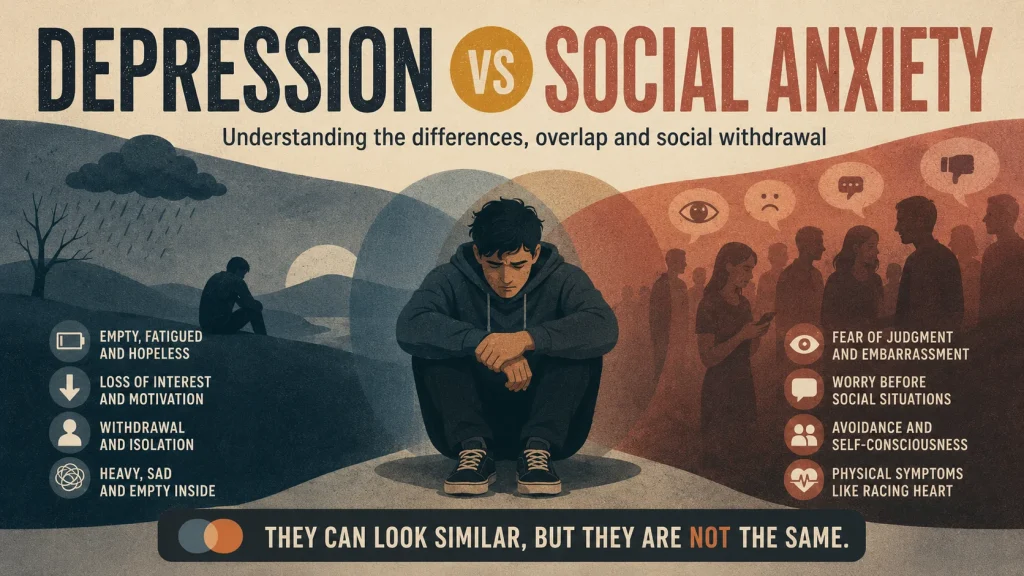
A practical way to separate depression from social anxiety is to ask what changes when the social threat is removed. Imagine that a friend you trust completely offers to spend an evening with you in a private setting where there is almost no possibility of embarrassment, unfamiliar people, public attention, or social performance. Would the desire to withdraw substantially decrease, or would you still feel depleted, disconnected, uninterested, heavy, or unable to enjoy the interaction?
That question cannot diagnose either condition, but it exposes an important difference. In social anxiety, distress tends to organize itself around social evaluation. The person may want friendship, conversation, dating, professional participation, or connection, yet become intensely self-conscious about how they will appear to other people. In depression, the difficulty often extends beyond situations involving judgment. A person may also lose interest in hobbies, struggle to start ordinary tasks, feel physically or mentally slowed, sleep differently, find decisions harder, or notice that activities that previously felt rewarding no longer produce the same emotional response.
This distinction also explains why the sentence “I don’t want to see anyone” can mean very different things. One person may actually mean, “I want to go, but I am terrified that I will look awkward.” Another may mean, “I know these people are safe, but I cannot make myself care about going.” Someone experiencing both conditions may recognize both thoughts at the same time.
The table provides orientation rather than a self-diagnosis checklist. Real experiences are often less tidy. Depression can include anxiety, social anxiety can be exhausting, and someone with social anxiety may eventually feel demoralized or isolated after repeatedly avoiding situations that matter to them. The more useful approach is to look for the pattern that appears across different settings and over time.
What Social Anxiety Usually Feels Like Around Other People
Social anxiety is more specific than simply preferring quiet places or feeling uncomfortable at a large party. Its defining concern is the possibility of social scrutiny. A person may become unusually aware of their voice, facial expression, posture, eye contact, clothing, hand movements, conversational pauses, or anything else they believe another person could evaluate negatively.
That fear can appear in obvious situations such as giving a presentation, attending a networking event, meeting a date, or entering a room full of strangers. It can also appear during ordinary interactions that seem low stakes to somebody else. The NIMH notes that activities such as talking to a cashier, asking for help, eating in front of other people, or meeting someone new can generate substantial anxiety when the person expects possible judgment or humiliation.
Someone experiencing social anxiety may therefore want a social interaction while simultaneously feeling compelled to escape it. They might rehearse what to say before making a phone call, arrive early to avoid walking into a crowded room, position themselves near an exit, avoid eye contact, speak very softly, decline opportunities that require introductions, or leave before an event has fully started. These behaviors can temporarily reduce distress, which is one reason avoidance behavior can become increasingly established over time.
Fear of Judgment Can Begin Long Before the Social Event
The difficult part of social anxiety does not necessarily begin when another person enters the room. Anticipatory anxiety can develop hours, days, or sometimes considerably earlier as the person imagines what might happen. A meeting scheduled for Friday can begin consuming attention on Monday because the mind repeatedly simulates introductions, mistakes, awkward pauses, visible anxiety, or possible criticism.
That anticipation helps explain why declining an invitation may produce immediate relief. The event disappears, so the feared evaluation disappears with it. Yet the person may still wish they had been able to attend. That mixture of relief and disappointment is different from simply having no interest in the activity.
The pattern can become especially confusing when a person is socially confident in selected circumstances. Someone may speak comfortably with close friends but feel intense anxiety with unfamiliar colleagues, authority figures, dates, customers, or groups. Another person may manage ordinary conversation reasonably well but experience severe fear when they have to perform, speak publicly, eat while being observed, or become the focus of attention.
Social Anxiety Can Continue After the Conversation Ends
For some people, leaving the social situation does not end the distress. The mind may begin reviewing the interaction in extraordinary detail: “Why did I say that?”, “Was my voice shaking?”, “Did they notice I was nervous?”, “Did that pause sound strange?”, or “Why did they look away when I was talking?”
The NIMH description of social anxiety symptoms includes analyzing one’s performance and identifying perceived flaws after interactions. This post-event review can make a relatively ordinary conversation feel like evidence of failure even when the other people involved noticed nothing unusual.
Rumination can also occur with depression, so repetitive thinking alone does not separate the two conditions. The content of the rumination provides more information. Repeatedly reviewing perceived social mistakes points more strongly toward social-evaluative anxiety, while depressive rumination may spread into themes such as guilt, hopelessness, worthlessness, failure, lost opportunities, or pessimism about the future.
What Depression Can Feel Like in Social Situations
Depression may also make a person withdraw from friends, partners, relatives, colleagues, or activities they previously enjoyed, but social judgment does not have to be the central reason. The person may know that nobody at the gathering is likely to criticize them and still feel unable to go.
A broader depressive pattern may be visible elsewhere. Activities that once created anticipation can start feeling emotionally flat. Getting dressed may require unusual effort. Answering a message can remain unfinished for hours even when the person cares about the sender. Conversation can require concentration that seems unavailable by evening, while organizing transport, choosing what to wear, deciding when to leave, and keeping up with a group can feel like an exhausting chain of demands.
This is where social withdrawal should be viewed alongside other depressive changes rather than isolated as a social symptom. If enjoyment has faded across hobbies, food, music, relationships, achievement, or other previously rewarding experiences, the distinction between anhedonia vs emotional numbness can help clarify whether the difficulty involves reduced pleasure, reduced emotional intensity, or both. Likewise, if the central experience is “I should want to do this, but I cannot make myself start,” the broader difference between loss of motivation vs laziness may be more informative than judging the behavior from the outside.
Depressive Withdrawal Can Happen Even With Safe People
One of the more revealing situations is withdrawing from someone who feels completely safe. A person may stop answering a close friend who has never judged them, avoid visiting a trusted relative, or cancel time with a partner despite having no fear of embarrassment around that person.
The reason may be difficult to explain even to the person experiencing it. Conversation feels like effort. They may worry that they have nothing to contribute, feel emotionally absent while somebody else is talking, or anticipate that an activity will require energy they do not have. In other cases, they genuinely want connection but cannot convert that desire into action.
Long periods of this pattern can create a second problem. Reduced contact can intensify feelings of disconnection, while the increasing distance can make restarting contact feel more difficult. The relationship between depression and loneliness is therefore worth examining separately because feeling lonely and having enough energy or motivation to reconnect are not always the same thing.
Loss of Interest Is Different From Fear of Participation
Consider someone who used to enjoy a weekly dinner with four close friends. If social anxiety becomes the dominant problem, the person may still imagine enjoying the meal once they feel safe, yet become preoccupied with talking, being watched, appearing nervous, saying something foolish, or failing to fit into the conversation.
If depression is the dominant problem, the person may look at the same dinner and feel very little anticipation at all. The friends may still be loved and trusted, but the emotional reward that once pulled the person toward the activity has weakened. Even the preparation required to attend may feel disproportionately demanding.
Those experiences can coexist. Someone can lose interest in social activity and also fear being judged when they do attend. This is why questions about symptoms outside social settings become important.
The Same Avoidance Can Have Completely Different Reasons
A common mistake is to interpret behavior as though it explains itself. Someone who repeatedly cancels plans may be labeled shy, antisocial, depressed, unreliable, introverted, socially anxious, or uninterested. The cancellation itself proves none of those explanations.
A more useful approach is to examine what happens immediately before the avoidance, what changes after the person escapes the situation, and what happens in comparable situations where social evaluation is absent. This moves the focus away from the visible behavior and toward the process maintaining it.
Imagine four people who all decline the same invitation. One desperately wants to attend but fears being humiliated. Another feels emotionally flat and cannot imagine enjoying the evening. A third is physically and mentally exhausted after weeks of depressive symptoms. A fourth feels depleted and also fears that the other guests will notice how quiet or withdrawn they have become. Their outward decision is identical, while the psychological pathways leading to it are substantially different.
That distinction matters because attempting to solve the wrong problem can become frustrating. Reassuring someone that “nobody is judging you” may miss the point if they are depressed and have very little capacity to participate. Encouraging rest alone may be insufficient when intense fear of evaluation is causing a person to organize more and more of life around avoidance.
Can You Have Depression and Social Anxiety at the Same Time?
Yes. Social anxiety disorder can occur alongside depression and several other mental health conditions. NIMH specifically lists depression among conditions that may co-occur with social anxiety disorder, and it notes that multiple disorders can make assessment and treatment more complex.
The interaction between the two conditions can also become self-reinforcing. A person may avoid social situations because they expect judgment, lose opportunities for connection and enjoyable activity, become increasingly isolated, and then experience a broader decline in mood. Someone who is already depressed may withdraw, lose social confidence during that period, start worrying about how noticeably different they seem, and become anxious about returning to situations they previously handled comfortably.
This overlap is one reason the question “Which one do I have?” sometimes produces an incomplete answer. A better assessment asks how much of the difficulty follows social evaluation, how much extends across non-social parts of life, whether pleasure and motivation have changed more broadly, whether anxiety begins before specific interactions, and what thoughts dominate afterward.
If isolation has continued long enough that returning to ordinary contact feels unfamiliar or difficult, how to reconnect after depression addresses the rebuilding process more directly. Reconnection may need to proceed differently when fear of scrutiny remains active, which is one reason identifying the dominant pattern still matters even when both conditions are present.
How to Tell Whether Depression or Social Anxiety Is Driving the Withdrawal
Trying to identify a single symptom that separates depression from social anxiety usually creates more confusion than clarity. Both conditions can affect concentration, sleep, confidence, relationships, work, and willingness to be around other people. A better approach is to examine the pattern across several situations and ask what changes when the circumstances change. In particular, it helps to compare situations involving strangers or evaluation with situations involving trusted people, enjoyable solitary activities, routine responsibilities, and periods when nobody else is watching.
One useful question is whether the difficulty follows you into private life. If you feel substantially better when social evaluation disappears, yet become intensely self-conscious when attention turns toward you, social anxiety may be playing a larger role. If the emotional heaviness, reduced interest, exhaustion, difficulty starting tasks, poor concentration, or sense of disconnection continues while you are alone, depression deserves closer consideration. Neither pattern proves a diagnosis, and a person experiencing both conditions may recognize elements of each.
Another clue comes from imagining that the social fear could disappear for one evening. Suppose you were guaranteed that nobody would judge you, notice your nervousness, criticize your conversation, or remember anything awkward you said. Would you genuinely want to attend the event? Someone whose main difficulty is social anxiety may feel considerably more willing once the perceived evaluation is removed. Someone in a depressive episode may still feel little desire, anticipation, emotional reward, or capacity to participate.
The reverse thought experiment can also be revealing. Imagine waking tomorrow with your energy, motivation, concentration, and capacity for pleasure restored, while your fear of social judgment remained unchanged. If meeting unfamiliar people would still feel threatening, there may be a distinct social-anxiety pattern underneath the depressive symptoms. These questions are useful for organizing your observations before speaking with a professional, although they should never be treated as a home diagnostic test.
| Situation to examine | Pattern that may point more toward depression | Pattern that may point more toward social anxiety |
|---|---|---|
| Time with someone you deeply trust | Low interest, exhaustion, emotional distance, or difficulty engaging may remain even when there is little fear of judgment. | Anxiety may decrease considerably when the person feels fully accepted and no longer expects evaluation. |
| Being completely alone | Low mood, reduced pleasure, fatigue, guilt, concentration problems, or difficulty starting activities may continue. | Immediate social-evaluation anxiety may diminish, although anticipation or post-event rumination can continue. |
| Before an unfamiliar social event | The dominant thought may be that attending requires too much effort or will bring little enjoyment. | Attention may become focused on embarrassment, scrutiny, visible nervousness, rejection, or saying something wrong. |
| After canceling plans | The person may remain flat, guilty, lonely, or exhausted without a major reduction in broader symptoms. | Removing the feared interaction may bring noticeable short-term relief even if disappointment follows. |
| Activities that involve no social attention | Interest and motivation may also decline for hobbies, household tasks, entertainment, exercise, or self-care. | Activities performed privately may remain much easier if they do not involve possible observation or evaluation. |
| Main question running through the mind | “Can I manage this?” “Why does everything feel so difficult?” or “Will I enjoy any of it?” | “What will they think of me?” “What if I embarrass myself?” or “Can they see that I am nervous?” |
This comparison becomes more useful when considered over time rather than after one uncomfortable day. Almost anyone can feel socially self-conscious in an unfamiliar environment, and temporary exhaustion can make a normally sociable person cancel plans. Clinical concern increases when the pattern persists, causes significant distress, begins narrowing important parts of life, or appears alongside a broader group of depressive or anxiety symptoms.
Physical Symptoms Can Offer Clues, but They Also Overlap
Social anxiety can become strikingly physical because the body may react to anticipated evaluation as though something threatening is about to happen. The National Institute of Mental Health description of social anxiety symptoms includes experiences such as blushing, sweating, trembling, a rapid heart rate, nausea, difficulty making eye contact, rigid posture, and speaking with an unusually soft voice when anxiety is active. These symptoms often become particularly noticeable before or during situations in which the person expects to be observed.
The physical experience of depression tends to be broader and less dependent on a particular social trigger. The National Institute of Mental Health depression guidance includes fatigue, feeling slowed down or restless, difficulty concentrating, changes in sleep or appetite, physical aches and pains, and reduced ability to manage ordinary responsibilities. Someone may therefore experience heaviness or exhaustion on a quiet Sunday morning with no social event anywhere on the calendar.
Physical symptoms still cannot separate the conditions by themselves. A person with social anxiety can feel exhausted after spending hours anticipating or managing a stressful interaction, while someone with depression can experience anxiety, agitation, or a racing mind. The important question is whether the physical response rises and falls mainly with social exposure or appears as part of a more pervasive change in mood and functioning.
If physical heaviness and slowed movement have become especially noticeable, the broader pattern of depression and physical heaviness can help explain why routine actions may begin to feel unusually effortful. A pronounced reduction in movement, gesture, facial responsiveness, or speech may also deserve separate attention because psychomotor slowing in depression involves a different process from simply feeling nervous in front of other people.
A Quiet Voice Can Have More Than One Explanation
Speaking softly is a good example of why context matters. Someone experiencing social anxiety may lower their voice because attention feels threatening, they are monitoring themselves intensely, or anxiety interferes with normal speech. Another person may speak quietly during depression because energy, speech initiation, emotional expression, or psychomotor activity has slowed.
Listening to when the voice changes can provide more useful information than the volume alone. If someone speaks normally at home but becomes markedly quieter around unfamiliar people or authority figures, social-evaluative anxiety becomes more relevant. If the voice has become softer across many settings, including conversations with trusted family members, the broader relationship between depression and a quiet voice may deserve consideration.
The same principle applies to pauses in conversation. Anxiety can create hesitation because the speaker is monitoring every possible response before saying it. Depression may contribute to longer pauses because thinking, word retrieval, motivation, or response initiation feels slower. If this change appears consistently rather than only under social pressure, depression and slowed speech explores that distinction in more detail.
Your Thoughts Before, During, and After Social Contact May Reveal More Than the Behavior
Imagine watching someone enter a crowded room, remain near the doorway for several minutes, and then leave. The visible action offers very little information. What was happening internally during those few minutes could separate several very different experiences.
A socially anxious person might be monitoring who has noticed them, whether they appear awkward standing alone, how their face looks, what they should say first, whether someone will reject them, or whether leaving too soon will itself look strange. Attention becomes pulled toward possible social consequences. Even neutral expressions on other people’s faces may become difficult to interpret when the person’s attention is already organized around the possibility of negative evaluation.
A depressed person may enter the same room and experience a different internal problem. They might recognize friends across the room and feel almost nothing, struggle to generate the effort required to walk over, lose track of the conversation once it begins, or feel as though they are performing normal engagement without actually experiencing it. If maintaining a socially acceptable appearance has become exhausting, the patterns described in masking depression signs may help explain why outward behavior can look far more functional than the person’s internal state.
The Question Afterward Is Often Different
After a social event, someone with social anxiety may repeatedly investigate their performance: whether a joke sounded foolish, whether they talked too much, whether a pause lasted too long, whether someone noticed their hands shaking, or whether another person’s expression meant disapproval. NIMH includes analysis of one’s performance and perceived flaws after social situations among the symptoms associated with social anxiety disorder.
Depressive rumination can revisit social events too, although its scope may be wider. The mind may turn toward failure, guilt, regret, hopelessness, damaged relationships, or a belief that nothing will improve. Instead of one conversation being the main object of analysis, the conversation can become evidence within a much larger negative story about the self or the future.
The distinction becomes even less tidy when both conditions are active. A person might spend an hour analyzing one awkward comment, conclude that everybody dislikes them, then shift into a broader depressive belief that relationships never work and nothing is likely to change. Professional assessment becomes especially useful when different patterns have begun feeding one another in this way.
Social Anxiety Is More Than Shyness
Shyness and social anxiety can resemble each other because both may involve discomfort with unfamiliar people or situations. The difference becomes clinically important when fear is persistent, difficult to control, causes substantial distress, and interferes with ordinary participation in work, education, relationships, or daily activities. MedlinePlus explains the distinction between social anxiety disorder and ordinary shyness, while the NHS overview of social anxiety similarly emphasizes persistent fear and interference with everyday life.
A shy person may take longer to warm up, dislike being the center of attention, or feel nervous at first while still being able to participate in situations that matter to them. Someone with social anxiety disorder may begin reorganizing life around avoiding scrutiny. They may decline a promotion because presentations are required, avoid dating despite wanting a relationship, stop attending classes that involve participation, or choose routes through daily life designed to reduce interaction.
The amount of visible confidence can also be misleading. Some people with significant social anxiety continue working, studying, presenting, dating, or attending events because circumstances require it. The internal cost may be concealed by preparation, rehearsing, safety behaviors, or prolonged recovery afterward. Being able to function therefore does not automatically mean the anxiety is minor.
Introversion Is Also Different From Social Anxiety
Introversion describes a personality tendency rather than a mental disorder. An introverted person may genuinely prefer smaller gatherings, quieter settings, deeper one-to-one conversation, or more time alone without experiencing persistent fear that other people are judging them. A socially anxious person may desperately want the same social opportunities they avoid.
The emotional aftermath can help clarify the difference. Someone who declines a large party because they prefer a quiet evening may feel satisfied with that decision and continue living in a way that fits their preferences. Someone who repeatedly declines because of social fear may experience immediate relief followed by disappointment, frustration, loneliness, or a sense that anxiety is deciding which parts of life remain available.
Introversion can coexist with either depression or social anxiety, so personality should not be used to dismiss a meaningful change. An introverted person who once enjoyed selected friendships and activities can still develop depression. They can also develop social anxiety if fear of evaluation begins restricting situations they previously handled.
Depression Can Make Someone Look Socially Anxious Even When Judgment Is Not the Main Fear
Depression can alter social behavior in ways that resemble anxiety. Someone may avoid eye contact because they feel emotionally withdrawn, speak less because conversation requires too much effort, leave gatherings early because concentration is fading, or stop initiating contact because starting almost any task has become difficult. A stranger observing those behaviors might assume the person feels socially frightened.
Self-consciousness can also increase during depression for understandable reasons. Someone who notices that their speech feels slower, personal hygiene has slipped, concentration is unreliable, or emotional expression feels different may begin worrying about whether others can see the change. The resulting anxiety is real, although it may have developed around depressive symptoms rather than representing a long-standing social anxiety pattern.
Feeling that other people would be better off without your problems can create another form of withdrawal. Someone may decline invitations because they fear being a burden rather than because they fear embarrassment in the classic social-anxiety sense. The relationship between depression and feeling like a burden is important here because guilt and perceived burdensomeness can make supportive relationships harder to access precisely when they are needed.
There are also people who remain highly productive and socially convincing during depression. They may continue attending meetings, answering messages, maintaining their appearance, and meeting deadlines while experiencing substantial symptoms privately. Understanding high-functioning depression signs can help explain why visible competence does not always reveal how someone is functioning internally.
Social Anxiety Can Eventually Affect Mood
Long-term social anxiety can place considerable pressure on the parts of life that support wellbeing. Repeatedly avoiding friendships, dating, education, presentations, career opportunities, celebrations, or everyday interactions can narrow a person’s world. The person may want connection while repeatedly losing access to situations where connection could develop.
This does not mean that social anxiety automatically turns into depression. It does mean that the conditions can become connected in a person’s life, particularly when persistent fear contributes to isolation, disappointment, reduced participation, and loss of opportunities that matter to them. NIMH notes that depression can occur alongside social anxiety disorder, which is one reason clinicians assess beyond the most obvious presenting symptom.
A useful question in this situation is which problem appeared first and how the second developed. Someone may recall years of social fear followed by a later decline in mood after life became increasingly restricted. Another person may have had little social fear until depression changed their confidence, energy, voice, concentration, or social routine. The chronology does not establish the diagnosis by itself, but it can help a clinician understand how the current pattern formed.
Avoidance Can Keep Social Anxiety Going Even When It Feels Helpful in the Moment
Avoidance makes immediate sense when a situation feels threatening. Declining the invitation, switching off the camera, avoiding the meeting, taking a different route, letting the phone ring, or leaving the gathering can rapidly reduce anxiety. That short-term change can make avoidance feel like proof that staying away was the correct decision.
The difficulty appears over time. When feared situations are repeatedly escaped, the person has fewer opportunities to learn what would actually happen if they remained, whether the feared judgment would occur, and whether anxiety could decline without escape. The life organized around avoiding distress can gradually become smaller even though each individual avoidance decision feels reasonable in the moment.
This pattern is one reason cognitive behavioral therapy is commonly used for social anxiety disorder. The National Institute of Mental Health treatment guidance for social anxiety disorder describes CBT as a well-studied psychotherapy and discusses exposure therapy as a CBT method that progressively confronts feared situations. Treatment is individualized, particularly when depression, another anxiety disorder, substance use, medication considerations, or other health issues are also present.
The same behavior may require a different interpretation during depression. A person who cannot get out of bed, initiate basic self-care, or concentrate through an ordinary conversation may need treatment that addresses the depressive episode rather than simply pushing harder into social activity. When low motivation and reduced activity have become part of the depressive cycle, behavioral activation for depression explains a structured approach used to reconnect behavior with meaningful and potentially rewarding activities.
Do Not Use One Successful Social Interaction to Rule Either Condition Out
People sometimes dismiss their own symptoms because they had one good dinner, completed a presentation, laughed with a friend, or appeared confident at work. Mental health conditions do not necessarily produce identical symptoms every hour of every day. Context, familiarity, energy, sleep, stress, perceived safety, role expectations, and the people present can all influence how difficult an interaction feels.
Social anxiety can be highly situation-specific. Someone might speak freely with two lifelong friends and become intensely distressed when talking to a manager. Another person may tolerate prepared presentations but struggle with spontaneous conversation afterward because the unpredictable social exchange feels harder than the rehearsed performance.
Depression can fluctuate as well. A person may experience temporary enjoyment or function effectively for part of a day while still having a broader pattern of depressive symptoms. The clinically important question concerns the overall pattern, duration, severity, and effect on functioning rather than whether there are occasional moments when the symptoms recede.
When Should You Consider a Professional Assessment?
A professional assessment becomes more useful when uncertainty is affecting what you do next. If social fear is repeatedly preventing you from participating in work, education, relationships, medical care, routine errands, or activities you genuinely want, the pattern deserves attention even if you have found ways to work around it. The same is true when low mood, loss of interest, fatigue, sleep changes, concentration problems, feelings of worthlessness, or difficulty managing daily responsibilities have become persistent.
Duration also matters. The National Institute of Mental Health depression guidance explains that major depression involves depressed mood or loss of interest most of the time for at least 2 weeks together with a broader clinical symptom pattern and interference in daily life. For social anxiety disorder, the National Institute of Mental Health states that the fear and anxiety pattern typically persists for at least 6 months and interferes with everyday functioning.
Those thresholds should not be interpreted as instructions to wait. A person can seek help before a formal duration criterion has been reached, particularly if symptoms are rapidly worsening, responsibilities are becoming difficult to manage, substances are being used to cope with social situations, eating or sleeping has changed substantially, or the person feels increasingly unable to function.
A clinician may also consider whether another condition could explain or contribute to what appears to be depression or social anxiety. Mental-health assessment is therefore broader than choosing between two labels. The aim is to understand the complete pattern, including onset, triggers, physical health, medications, substance use, previous episodes, family history where relevant, functional effects, and the relationship among symptoms.
What to Tell a Doctor or Mental Health Professional
You do not need to arrive knowing which diagnosis fits. In fact, bringing concrete examples is often more useful than trying to choose the label beforehand. Describe what happens before a difficult social situation, what you fear, whether you still want to participate, what happens physically, what you do to cope, how you feel after leaving, and whether similar difficulties occur when you are completely alone.
It also helps to describe changes from your own normal pattern. A person who has always preferred small groups but recently lost interest in even close friendships presents a different history from someone who has wanted a larger social life for years but repeatedly avoided it because of intense fear. Mention changes in sleep, appetite, energy, concentration, pleasure, motivation, work, self-care, relationships, alcohol or drug use, and any other symptoms that appeared around the same period.
If speaking about the problem feels difficult, write down a few recent examples beforehand. One example from a feared social situation, one from time spent with a trusted person, and one from a private activity can give the clinician useful context without requiring you to explain your entire life at once. The goal of the appointment is to make the pattern visible enough for appropriate assessment and discussion of next steps.
Treatment Depends on the Pattern, and Overlap Can Be Treated
Both depression and social anxiety disorder are treatable conditions, although the most useful treatment plan depends on the individual. Psychotherapy can be used for both, and medication may also be considered depending on symptoms, severity, previous treatment, other conditions, preferences, and clinical judgment. The National Institute of Mental Health explains treatment options for social anxiety disorder, including psychotherapy and medication, while its depression treatment guidance discusses psychotherapy, medication, and other treatments according to the person’s clinical situation.
When both conditions are present, treatment does not necessarily require choosing one and ignoring the other. A clinician can consider how depressive symptoms affect the person’s capacity to engage in treatment, how avoidance is restricting life, whether anxiety is reinforcing isolation, and which problems are causing the greatest impairment now. The order and emphasis may change as symptoms improve.
Progress may also look different from what someone expects. Improvement in social anxiety may involve attending situations that still produce some anxiety while becoming less controlled by avoidance. Improvement in depression may involve renewed interest, greater ability to initiate activities, improved concentration, more emotional responsiveness, or enough energy to reconnect before mood feels completely restored.
The Most Useful Question Is Usually “What Is Making Me Pull Away?”
The outward behavior of depression and social anxiety can be deceptively similar. Both can result in canceled plans, unanswered messages, quieter conversation, reduced eye contact, isolation, declining participation, and relationships that become harder to maintain. Watching the behavior alone leaves the most important part of the problem hidden.
The stronger clue is the process underneath it. Social anxiety tends to organize distress around scrutiny, judgment, embarrassment, rejection, or social performance. Depression tends to produce a broader alteration in mood, pleasure, energy, motivation, thinking, and functioning that can remain present even when the person is alone or surrounded by people they completely trust. When both patterns are present, the experience may shift from one mechanism to the other depending on the situation.
That is also why self-observation should focus on changes rather than labels. Notice what you expect before an interaction, which situations feel easier, whether you still want the connection you are avoiding, what happens after plans are canceled, whether private activities have also lost their pull, and how much of everyday life has begun changing around the problem. Those observations cannot replace professional assessment, but they can make the conversation about what you are experiencing considerably more precise.
Frequently Asked Questions
Can depression look like social anxiety?
Yes. Depression can lead to canceled plans, quieter conversation, reduced eye contact, less social initiation, and more time alone, all of which can resemble social anxiety from the outside. The difference often becomes clearer when you examine what is driving the withdrawal. Social anxiety tends to involve fear of scrutiny, embarrassment, rejection, or negative evaluation, while depression can reduce energy, interest, pleasure, motivation, concentration, and emotional engagement even around people who feel completely safe.
Can you have depression and social anxiety at the same time?
Yes. Depression and social anxiety disorder can occur together, and the overlap can make social withdrawal harder to interpret. Someone may genuinely want connection but fear being judged when they participate, while also having so little energy or anticipated enjoyment that preparing for the interaction feels exhausting. A professional assessment can examine which symptoms appear across everyday life, which ones are tied more closely to social evaluation, and how the two patterns may be influencing each other.
How can I tell social anxiety from being introverted?
Introversion generally reflects a preference for lower-stimulation social settings, more time alone, or smaller groups rather than an intense fear of being judged. An introverted person can choose a quiet evening and feel comfortable with that choice. Social anxiety becomes more concerning when fear repeatedly restricts activities the person wants or needs to do, such as meeting people, attending work or school events, dating, speaking publicly, asking for help, or participating in ordinary daily interactions.
Why do I avoid friends even though I feel lonely?
Loneliness and the ability to initiate social contact do not always move together. Depression can leave someone wanting closeness while making messages, travel, conversation, decisions, and emotional engagement feel unusually demanding. Social anxiety can create a different barrier when the person wants company but worries about being awkward, judged, rejected, or visibly anxious. If this pattern is persistent, looking at what happens before, during, and after social contact can provide more useful information than assuming withdrawal means a lack of interest in relationships.
Does social anxiety go away when you are with close friends?
It may become much less intense around trusted people, although that is not true for everyone. A person who feels secure with a close friend may experience far less fear of scrutiny than they would around unfamiliar people, dates, colleagues, authority figures, or groups. If low mood, emotional disconnection, lack of pleasure, fatigue, or difficulty engaging remains just as strong with trusted people and during private activities, a broader depressive pattern may also need consideration.
Can social anxiety make you depressed?
Social anxiety and depression can occur together, and years of restricted participation, isolation, disappointment, or lost opportunities may affect mood for some people. However, it would be too simple to assume that social anxiety automatically causes depression. The timing of symptoms, wider mood changes, other health factors, and individual history all matter. If both social fear and depressive symptoms are present, assessment should consider the complete pattern rather than assuming one diagnosis fully explains the other.
Is CBT used for both depression and social anxiety?
Cognitive behavioral therapy is used in the treatment of both conditions, although the therapeutic focus can differ. For social anxiety disorder, treatment may address feared social situations, patterns of thinking about evaluation, avoidance, and gradual exposure to situations the person has been avoiding. Depression treatment may focus on depressive thinking and behavior, reduced activity, coping patterns, and rebuilding engagement with meaningful or rewarding parts of life. Treatment should be individualized rather than selected from a symptom comparison alone.
When should I get help for depression or social anxiety?
Consider speaking with a health or mental health professional when symptoms persist, cause significant distress, interfere with relationships, school, work, self-care, medical care, or ordinary daily activities, or make important parts of life increasingly difficult to access. You do not need to determine the diagnosis before asking for help. If you are experiencing thoughts of suicide or self-harm, feel unable to stay safe, or believe there is an immediate danger, seek urgent local emergency or crisis support rather than waiting for a routine appointment.