



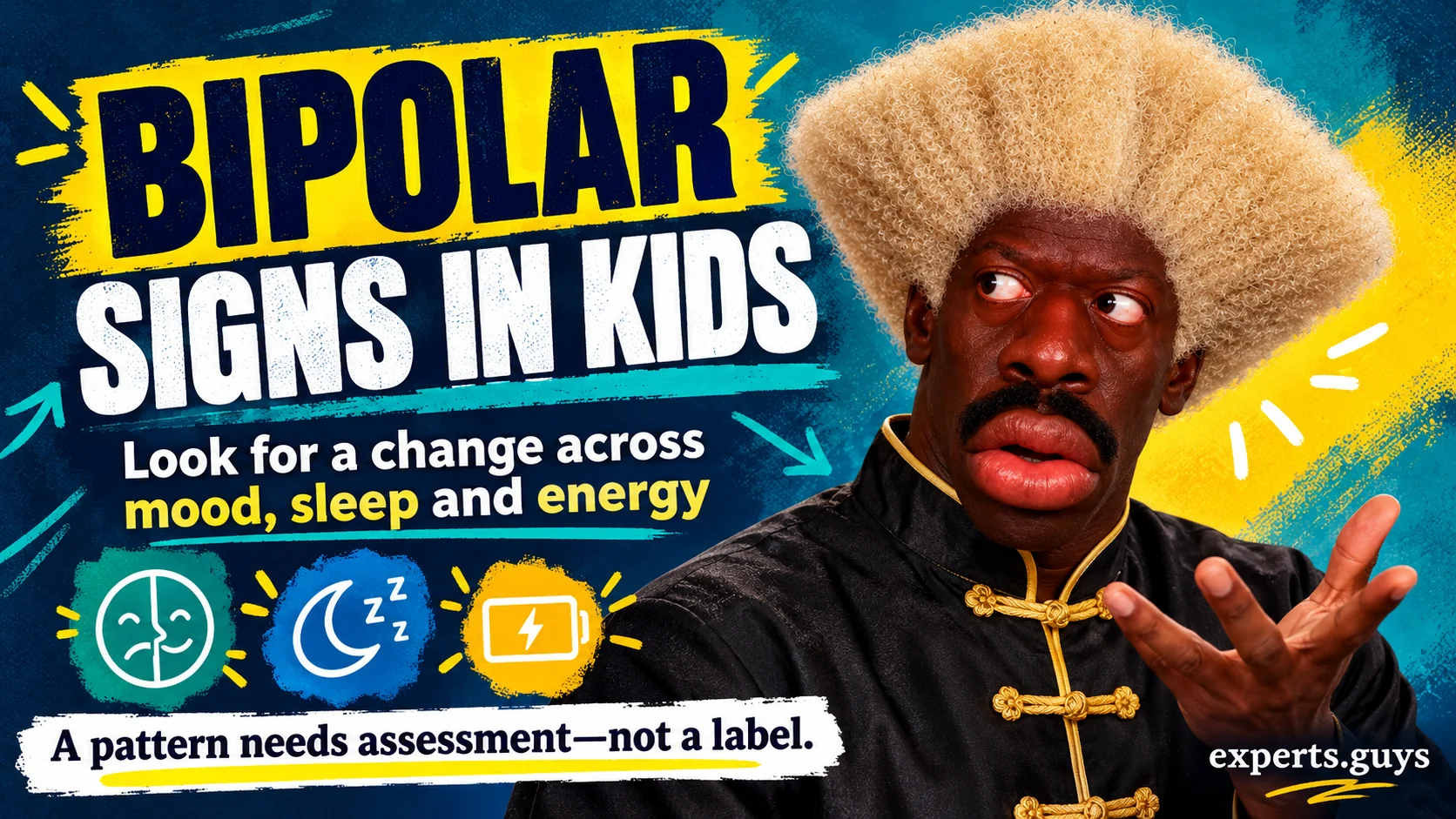
Bipolar disorder in children involves episodes of marked changes in mood, energy and activity that affect everyday life. Possible indicators include unusually high energy with much less need for sleep, major changes in behavior, and periods of depression, but no single sign confirms the condition. The useful question is what has changed from your child’s usual pattern and how much that change is disrupting life.
A child who is naturally lively needs a different comparison from one who is usually quiet. Start with the child you know, rather than a sibling, a classmate or a checklist score. A familiar personality trait becomes more informative when its intensity, timing or consequences change substantially.
If there is immediate danger, a suicide attempt or an inability to keep your child safe, contact emergency services now. Stay with the child if it is safe to do so. Do not wait to decide which diagnosis fits before getting help.
For a child who is currently safe, the distinctions below help organize your concern. They are reasons to seek an assessment, not a way to diagnose bipolar disorder at home. The NIMH guide to bipolar disorder in children and teens describes why changes in several areas matter together.
Which changes deserve closer attention?
| What you notice | The useful distinction | What it means for the next step |
|---|---|---|
| Much less sleep | Is the child exhausted, or unusually energetic despite sleeping less? | Describe both sleep and next-day energy, especially if the change is pronounced. |
| Fast speech or many new plans | Is this familiar enthusiasm, or a sustained change that disrupts ordinary activities? | Give an example of what became difficult to finish, follow or manage. |
| Irritability or outbursts | Is there a particular trigger, longstanding irritability, or a broader change in mood and activity? | Do not treat anger alone as evidence of bipolar disorder. |
| Withdrawal or loss of enjoyment | Has the child stopped participating in things they usually want to do? | Seek help for the impairment even if the diagnosis is uncertain. |
| New dangerous behavior or loss of contact with reality | Can the child remain safe right now? | Seek urgent assessment; immediate danger requires emergency help. |
The table separates an observation from an interpretation. “She is manic” is an interpretation; “she has slept much less, talks continuously and cannot settle into her usual activities” gives a clinician information to examine. There can still be several explanations for that combination.
Examples throughout this article are hypothetical. A child does not have to match an example exactly to deserve help, and an example is never enough to establish a diagnosis.
Does it look like a mood episode or a difficult moment?
A mood episode is a broader period of changed functioning, rather than a label for every emotional reaction. During a suspected episode, mood, sleep, activity and thinking may shift together. A brief upset after a disappointment is a different kind of observation, although brief reactions can still be severe and need support.
Consider a hypothetical child who becomes angry when a game ends but later returns to their usual play, conversation and sleep. Compare that with a child whose behavior has changed across several days, whose sleep is substantially different, and whose ordinary school and home activities are becoming harder. The second account contains a wider pattern for assessment; it does not identify the cause.
Within an episode, emotions can still fluctuate. A pleasant afternoon does not automatically cancel a concerning week, and a difficult hour does not establish a week-long episode. Avoid selecting only the best or worst moment as if it represents the whole period.
Clinical assessment also considers duration, severity, developmental stage and possible alternative explanations. Parents do not need to wait for a formal duration threshold before asking for help. In particular, marked activation, unsafe behavior or psychotic symptoms warrant prompt attention even when they have only recently appeared.
Use these questions to keep the comparison concrete. They can be considered during ordinary conversation; there is no requirement to keep a diary or produce a complete timeline before arranging care.
- Usual pattern: What would this child normally be doing at this time of day?
- Linked changes: Did sleep, energy, speech or participation change during the same general period?
- Consequence: What has become harder, less safe or unusually different?
- Context: Did illness, a stressful event, a medication change or a disrupted routine occur nearby?
These questions organize an account; they are not a validated screening instrument. There is no number of “yes” answers that proves or excludes bipolar disorder. A clinician may need more than one visit and information from several people to understand the pattern.
The American Academy of Pediatrics’ explanation of childhood bipolar symptoms emphasizes changes in everyday functioning and the overlap with other childhood conditions. That is why a confident label based on one dramatic behavior can be misleading.
An obvious trigger does not settle the question either. Stress and sleep disruption can matter alongside mental health symptoms, while an apparently unprovoked change can have a medical or environmental explanation that is not yet obvious. Describe what happened without using the trigger as proof for or against a diagnosis.
For younger children, pretend play deserves developmental context. Saying “I can fly” during a superhero game is different from a new, persistent belief that leads to a dangerous action. The safety concern is the action and the child’s ability to recognize danger, not the imaginative phrase by itself.
For adolescents, increased independence can make changes less visible at home. A parent may first notice missed commitments, disrupted sleep or difficulties with friends. Ask about the experience without assuming secrecy means illness or that a teenager’s disagreement confirms poor judgment.
The clearest takeaway is to compare several connected changes with the child’s own baseline. Keep the conclusion open while taking the difficulty seriously.
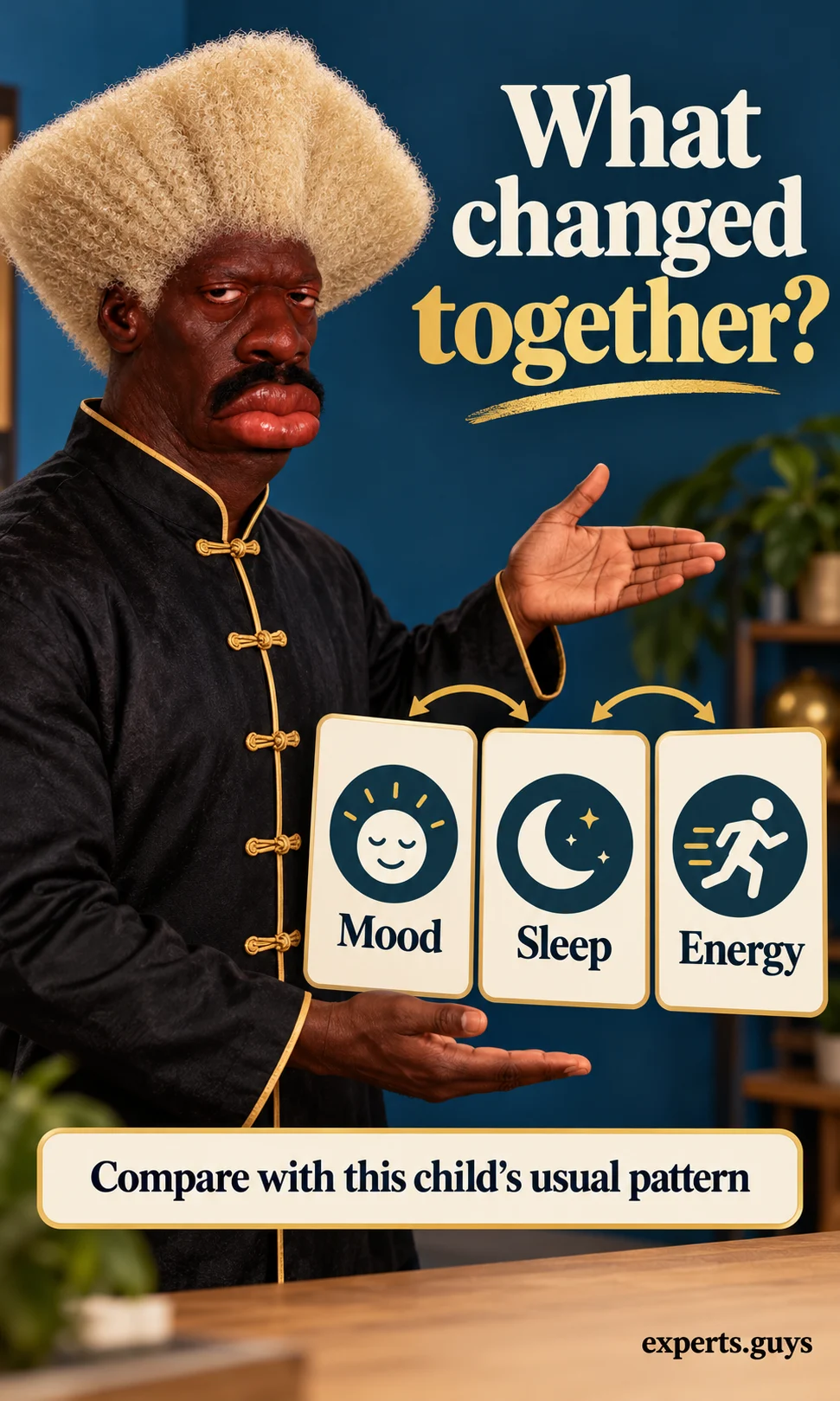
What does sleeping less actually tell you?
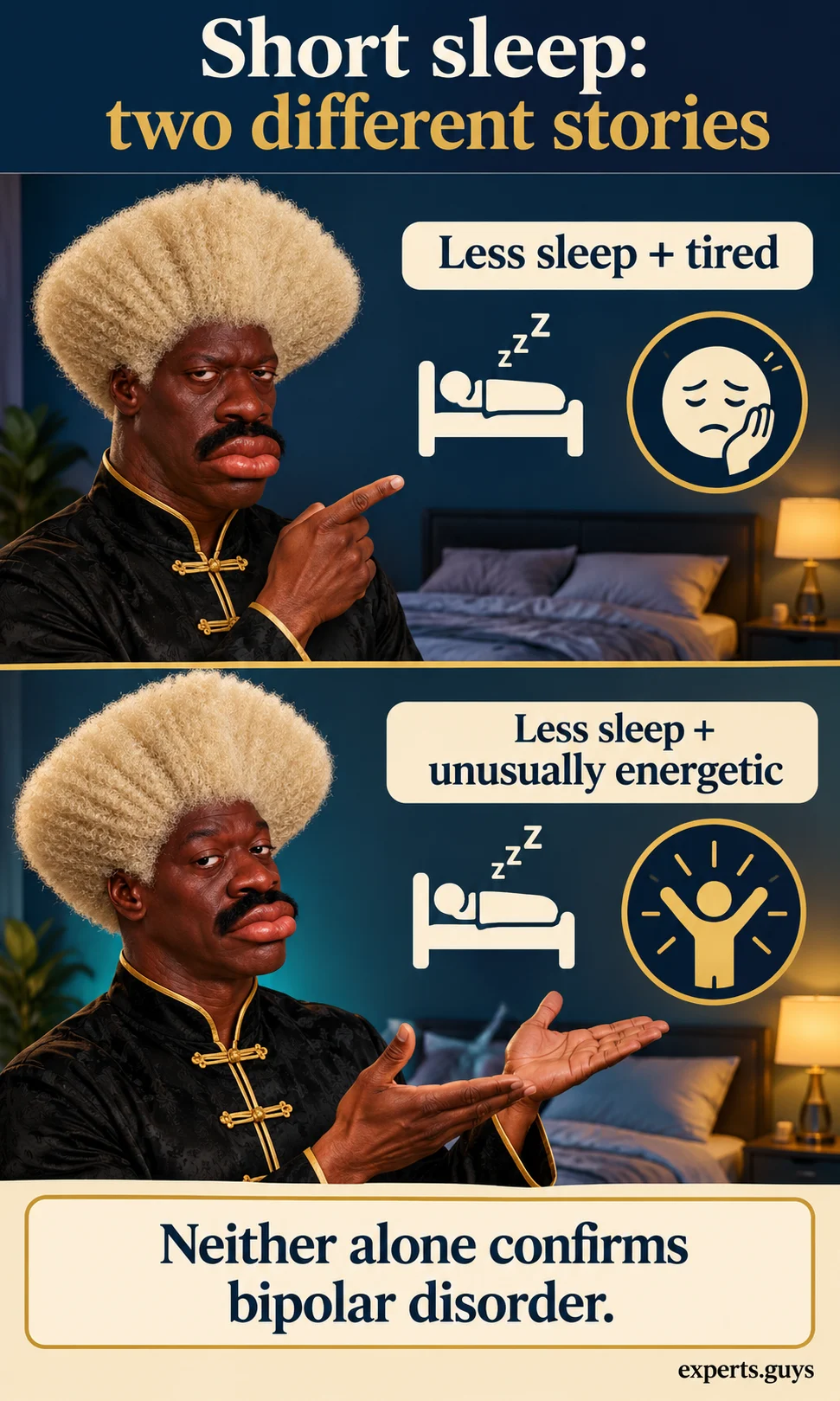
Reduced need for sleep differs from being unable to sleep and feeling worn out. A child who remains unusually energetic after much less sleep presents a different concern from a tired child who lay awake worrying. Neither observation is sufficient on its own, and short sleep should never be deliberately induced to see what happens.
In a hypothetical school-morning example, one child yawns, struggles to get dressed and wants to return to bed after a late night. Another has slept much less than usual but begins several projects, talks unusually fast and does not appear to feel tired. Those are different descriptions to give a clinician, even if the time spent asleep was similar.
Do not turn that distinction into a home experiment. Keep normal opportunities for rest, avoid asking the child to stay awake, and do not use exercise, caffeine or extra activities to “test” energy. A parent can describe what happened naturally without provoking a symptom.
Sleep information is incomplete without context. Pain, breathing difficulties during sleep, anxiety, late-night activities and changes in medicines can all be relevant to a healthcare assessment. Tell the clinician about recent changes rather than deciding that every sleep problem belongs to a mood disorder.
Likewise, depression does not have one visual appearance. A child may be irritable, lose enjoyment or struggle to concentrate rather than simply look sad. Depression can occur without bipolar disorder; its presence does not establish a history of mania or hypomania.
Why might home and school tell different stories?
A classroom, a playground and a family evening place different demands on a child. One setting may offer more structure, more noise, different relationships or fewer opportunities for rest. A discrepancy between adults’ observations is useful context, not evidence that one adult must be wrong.
For example, “nothing unusual in class” and “unable to settle every evening” can both be accurate. Ask what was happening in each setting and whether the behavior is different from that child’s usual behavior there. Do not ask a teacher to confirm a medical diagnosis.
A practical school question is: “Have you noticed a change in participation, energy or interaction compared with how they usually are?” A useful follow-up is: “Can you give one example and say roughly when it began?” The goal is a concrete account, not agreement with a proposed label.

Keep your child involved at an age-appropriate level. Explain that adults are trying to understand what is making everyday life difficult. Share relevant information with people involved in support rather than circulating a suspected diagnosis widely.
| Possible explanation to explore | Information that helps separate the questions |
|---|---|
| ADHD or another longstanding developmental pattern | Which difficulties have been present over time, and which represent a new change? |
| Persistent irritability, including possible DMDD | Is irritability a longstanding pattern between outbursts, rather than only part of a distinct period of changed mood and energy? |
| Anxiety, stress or sensory overload | What situations feel difficult, and how does the child function when those demands change? |
| Depression | What has changed in enjoyment, energy, relationships and functioning, and is there any history of a separate activated period? |
| Medical, medicine-related or substance-related effects | What symptoms, exposures or treatment changes occurred before or alongside the behavior? |
This is a conversation guide, not a differential-diagnosis checklist. Conditions can coexist, and an apparent explanation such as ADHD does not mean a new change should be ignored. A clinician weighs the whole history rather than choosing whichever row seems closest.
Disruptive mood dysregulation disorder involves severe, persistent irritability and recurrent outbursts. It is not simply another name for bipolar disorder. That distinction matters because repeated anger alone cannot tell a family which assessment or treatment is appropriate.
How can you make an overwhelming transition easier?
While an assessment is being arranged, a parent can make one ordinary task less demanding. The example here is moving from getting ready to putting on shoes. It suits a child who is safe but overwhelmed by several instructions; it is not a way to manage an emergency or determine whether bipolar disorder is present.
The purpose is modest: make the next action easier to understand and physically accessible. This is an editorial application of general child-support principles, including calm communication, predictable routines and respecting personal space. It is not a clinically validated bipolar treatment or a promise that distress will stop.
- Pause competing demands. Put the bag aside and stop adding instructions about lunch, homework and leaving. Keep supervision appropriate to the child’s age and safety needs.
- Prepare one visible next step. Put the familiar shoes beside a stable chair with a clear approach. Say, “Your shoes are here; you can sit if you want.” Use the child’s usual communication method.
- Leave room to respond. Step back enough to avoid crowding, keep the route open and allow a pause. Do not repeat the instruction faster or turn the setup into a countdown.
- Use a small completion point. The child may approach the chair, indicate a preference or put on a shoe. Acknowledge that step without immediately adding several new tasks.

If the setup adds pressure, simplify further. Offer a seated option, familiar easy-fastening footwear or help with one part if the child wants it. For a child with mobility or sensory needs, use their established accessible setup and preferred footwear; there is no required posture or speed.
Correct the common mistake: standing over the child and repeatedly pointing at the shoes can turn a helpful arrangement into another demand. Move back, reduce talking and pause. Never block the exit, grab the child into position or force physical contact to complete an everyday task.
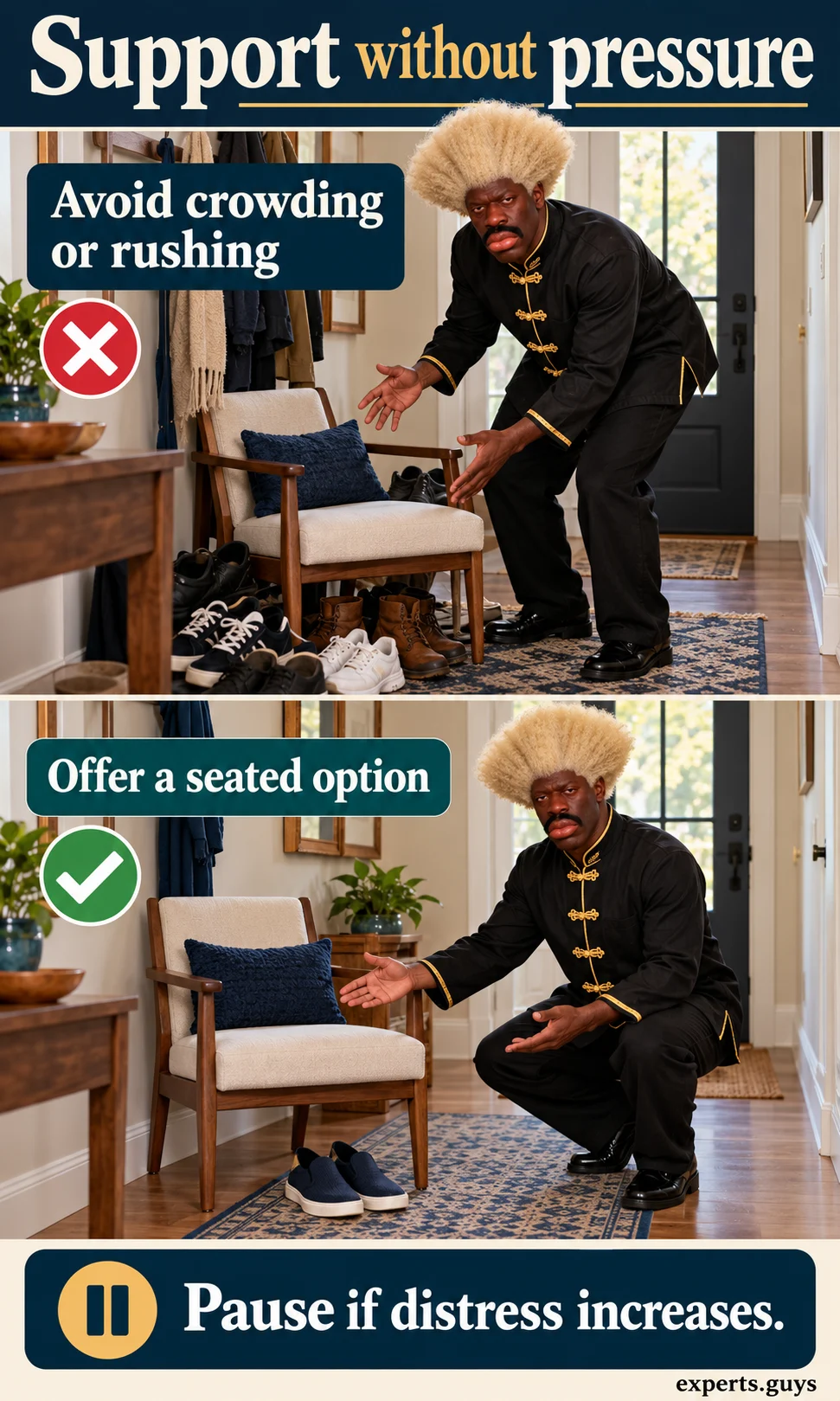
Completion means the transition became more manageable, not that the child complied immediately. If distress increases, stop pressing the task and reassess what is needed. A successful transition does not rule out illness, and an unsuccessful one does not prove it.
The pediatric guidance on talking with a stressed child supports calm connection and attention to the child’s preferred support. The shoe example is a practical adaptation, not a substitute for individualized care.
What information makes an assessment more useful?
An assessment is not an exam that a parent must prepare perfectly for. Bring the concern as it is. The NIMH explanation of children’s mental health assessment describes how family history, school information and the child’s own experience contribute to understanding the problem.
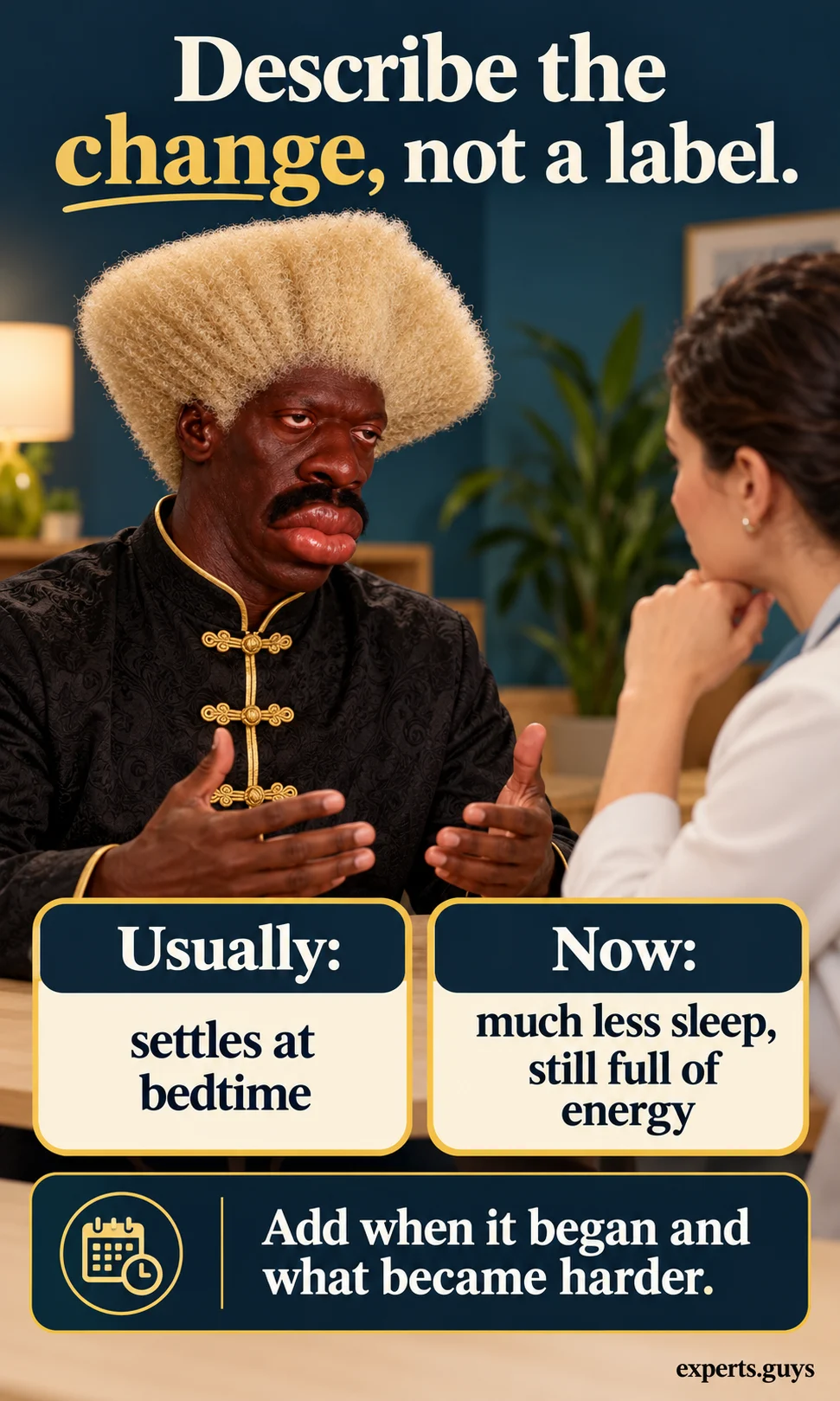
Use a short spoken comparison: “Usually, bedtime goes like this. Now, this has changed. It began around this time, and this part of daily life has become difficult.” If you do not know when something started, say so. An honest uncertainty is more useful than a precise date reconstructed under pressure.
Include relevant medicines and supplements, recent illnesses, major stressors and family mental health history. Family history can influence risk, but it does not determine the child’s diagnosis. Do not stop, start or change prescribed medication on the basis of an article or a suspected label.
Blood tests or imaging do not by themselves diagnose bipolar disorder. A clinician may recommend tests to investigate other explanations, while the psychiatric assessment considers symptoms and their course. An initial assessment can therefore end with a plan for further observation rather than an immediate firm diagnosis.
Where treatment is needed, it is tailored to the child and may include medication, psychological treatment and family or school support. The child psychiatry guidance on bipolar care explains the role of comprehensive treatment. For understanding support options more generally, see what mental health counseling involves; it does not replace a child-specific assessment.
When should help be urgent?
Urgency follows safety and severity, not confidence about a diagnosis. Seek emergency help for an attempt to harm themselves, immediate threats with access to a means of harm, or behavior that you cannot safely manage. In the United States, call 911 for an immediate emergency; elsewhere use your local emergency number.
New hallucinations, severe confusion, dangerous disinhibition, or very little sleep accompanied by escalating activation need urgent clinical assessment. If you cannot keep the child safe while arranging this, use emergency services. Stay nearby when safe, and reduce access to dangerous items only if you can do so without a confrontation.
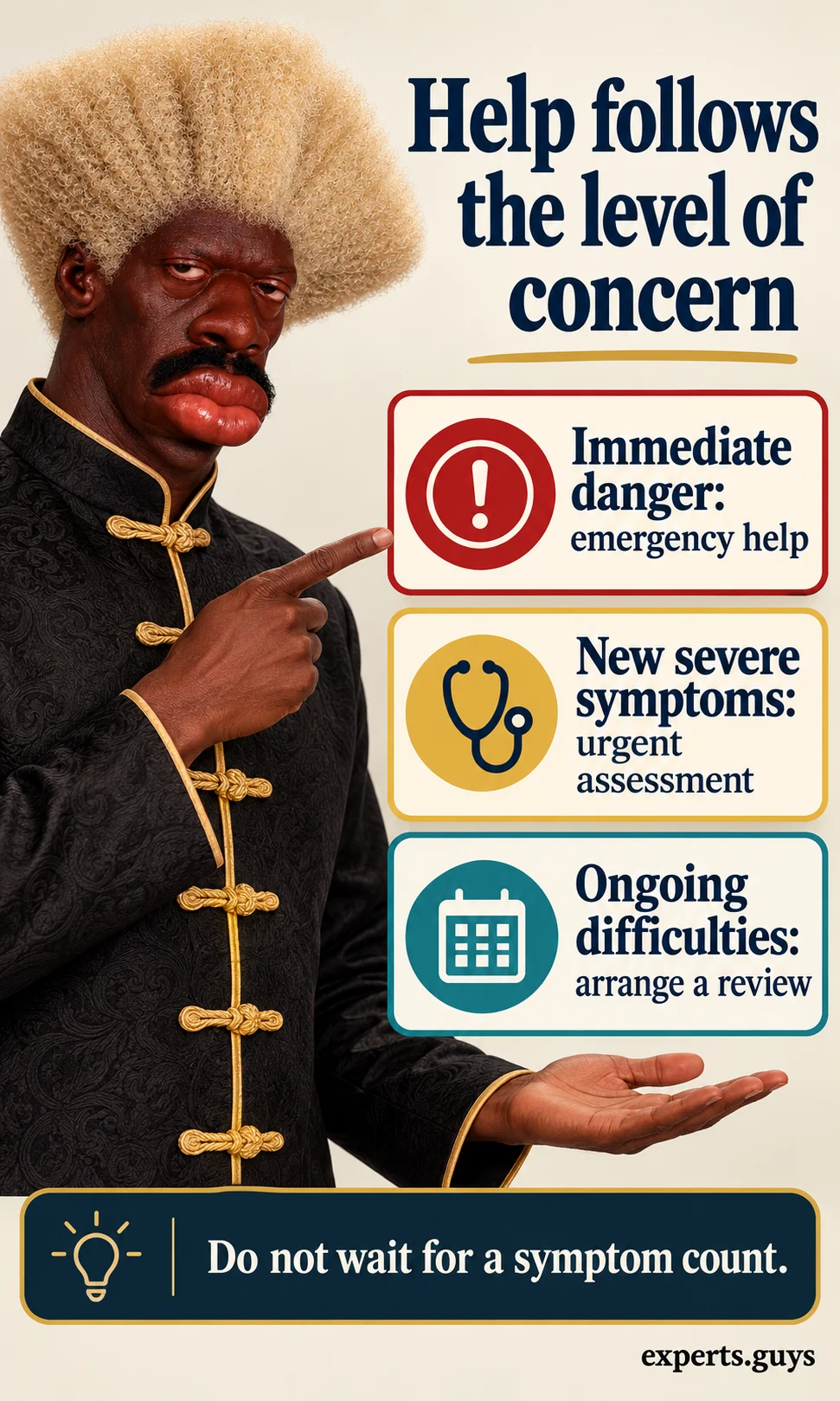
For persistent difficulties without immediate danger, arrange a review with the child’s healthcare provider. Do not wait for school failure, a particular symptom count or agreement from every adult. Children deserve help for impaired functioning even when the eventual diagnosis is something other than bipolar disorder.
Frequently asked questions
Can a child have bipolar disorder without a family history?
Yes. Family history can affect risk, but its absence does not exclude bipolar disorder. Assessment depends on the child’s symptoms and history, not family history alone.
Does a good day mean an assessment is unnecessary?
No. One good day does not explain a wider period of difficulty. Describe the broader pattern while also mentioning the better periods.
Should I make my child complete an online bipolar test?
An online result cannot establish this diagnosis. If you are concerned, bring concrete examples to a qualified child mental health professional rather than treating a score as an answer.
What if my child does not want to talk?
Avoid turning the conversation into an interrogation. Offer a simple explanation that you want to understand what is hard, and give the child a chance to speak privately with the clinician when appropriate.
Can the shoe-transition exercise show whether my child is bipolar?
No. It only makes one everyday task easier to approach. Improvement or continued distress cannot confirm or exclude bipolar disorder.
The useful next step
Look for a meaningful change from your child’s usual functioning, explain what has changed together, and respond to the level of concern. Make one ordinary transition easier where that helps, without treating the response as a diagnostic test. A clear description and timely assessment are more useful than attaching a label at home.









