




Depression in teenagers is a mental health condition that can affect mood, interest, energy, and everyday functioning. It usually develops through a combination of inherited vulnerability, life experiences, health factors, and ongoing stress, rather than one identifiable cause. Understanding these influences helps families reduce harmful pressures without blaming the teenager or delaying care.
Why do some teenagers develop depression and others do not?
A risk factor changes the likelihood of depression; it does not decide what will happen to one person. Two teenagers can face a similar setback and have very different responses because their histories, health, relationships, and available support differ. A teenager who develops depression has not failed a test of resilience.
Family history can increase vulnerability, but it is not a forecast. Families share both inherited characteristics and environments, so a family pattern does not tell you which influence matters most. Equally, the absence of a known family history does not rule depression out; relatives may never have been assessed or may have described their difficulties differently.
Adolescence brings changes in sleep timing, relationships, identity, and expectations alongside physical development. Those changes can make stressful circumstances harder to navigate, but puberty is not a sufficient explanation for persistent impairment. Dismissing a teenager’s difficulties as “just hormones” can obscure the need to understand what has changed.
Depression involves interacting genetic, biological, environmental, and psychological factors. It cannot be reduced to a single brain chemical being low, and ordinary symptoms do not identify a particular chemical imbalance. An explanation that sounds biological is not automatically a diagnosis or a reason to choose one treatment.
Support changes the context in which difficulties are experienced, but supportive families cannot guarantee prevention. A teenager can have caring parents, material security, and achievements while still becoming unwell. The useful question is not “What reason do you have to feel this way?” but “What is happening, what is hard to manage, and what support is missing?”

A practical distinction follows: some influences are background information, while others are conditions adults can change. A family history belongs in an assessment; bullying requires action to stop the harm. Neither should become a reason to tell the teenager that their future is fixed. The broader discussion of how depression can feel adds context about the inner experience; it does not establish its cause.
Which experiences can contribute, and what can they actually tell you?
Loss, abuse, bullying, family conflict, exclusion, and sustained pressure can contribute to depression, especially when difficulties accumulate. Sometimes an episode follows a recognisable event; sometimes there is no clear starting point. A plausible explanation is useful for support, but the timing of an event alone cannot prove that it caused the illness.
A trigger is not the same thing as a symptom. A friendship breakdown may be a possible trigger. Persistent loss of interest is a symptom, while withdrawal may also make support harder to reach. Calling sadness, guilt, or irritability “causes” mixes up what a teenager experiences with why the condition developed.

Consider an illustrative example: a teenager changes schools, sleeps poorly, and then stops enjoying football. The school transition is a possible stressor, disrupted sleep may contribute to or reflect the problem, and loss of enjoyment is a sign to assess. This description is more useful than deciding that football, the new school, or sleeping late must be the single cause.
Ask what the information changes. A pattern of bullying changes the safety response; a recent medication change changes what the clinician needs to review. Neither observation licenses a family to diagnose depression or stop treatment. The distinction below keeps explanations connected to appropriate decisions. For wider symptom context, the depression overview explains how everyday functioning can change.
| Observation | Meaning and limit |
|---|---|
| Family history | Greater vulnerability worth discussing in assessment. Does not establish: That depression is inevitable or someone is to blame. |
| Bullying, abuse, or repeated rejection | Harmful exposure that needs protection and support. Does not establish: That coping better is the teenager’s responsibility. |
| Bereavement or a relationship loss | A possible trigger; grief and depression can overlap. Does not establish: That every painful response is a depressive disorder. |
| Sleep change, illness, or substance use | A possible contributor, consequence, or coexisting problem. Does not establish: A diagnosis from one sign or a reason to alter medication alone. |
| Persistent loss of interest or irritability | A possible symptom requiring context and assessment. Does not establish: The underlying cause of the change. |
Abuse and bullying deserve a different response from ordinary disappointment. Reassurance does not remove an ongoing threat, and a teenager should not have to become better at tolerating mistreatment. Childhood depression risk factors include violence, neglect, bullying, and parental mental health difficulties. These are population-level associations, not a checklist that can explain an individual case.
School pressure may involve more than the amount of homework. Repeated failure caused by an unrecognised learning difficulty, humiliation in class, unsafe corridors, or expectations that leave no recovery time create different problems. Adults need to identify the actual obstacle before choosing a response; extra tutoring will not resolve harassment, and punishment will not make concentration return.
Does social media cause teen depression? Online experiences can expose a teenager to harassment, comparison, or disrupted sleep, but they can also provide friendship and support. The evidence on youth social media and mental health does not make a time total an individual diagnosis. Ask what content and interactions occur and what online use displaces; a blanket explanation may miss both the harm and the support.

Identity itself is not an illness. Discrimination, rejection, or fear of disclosure can add stress for teenagers who are marginalised, while acceptance and safe relationships matter. Similarly, poverty is not a personal failing: unsafe housing, food insecurity, and practical barriers to care require resources and adult action, not a lesson in positive thinking.
- Background vulnerability: information such as family history helps interpret the broader picture.
- Possible trigger: an event may precede the change without explaining everything.
- Ongoing pressure: an unsafe or unmanageable situation may still need to change.
- Symptom: changes in interest, mood, sleep, or functioning describe what needs assessment.
Physical illness, pain, other mental health conditions, and alcohol or drug use can complicate the picture. Sleep problems may be both a contributor and a consequence, making a simple before-and-after story unreliable. A clinician can assess these possibilities and whether examination or targeted tests are warranted; no single routine blood test confirms depression.
What can adults change without blaming the teenager?
Change a specific pressure in the environment instead of setting a new self-improvement assignment. The approaches below are practical examples of supportive care, not independently validated depression treatments. Their immediate result is a responsibility transferred, a usable space, or safer access to school; mood improvement is not required for the action to count.
The lead skill is transferring an excessive demand to an adult who can actually take responsibility. It differs from asking the teenager to break tasks into smaller steps: here, the burden itself changes hands. Broader parental support provides the relationship context, while this section shows concrete environmental changes.
Transfer one adult-sized responsibility
Use this when household duties, caring responsibilities, or repeated demands exceed what the teenager can manage. First check that another responsible adult can take over safely; essential care for a younger child or dependent person must not simply be left undone. Choose the duty together where possible, without requiring the teenager to justify their distress.
- Name one specific duty and when it usually happens, such as evening laundry or collecting a sibling.
- Agree who will take responsibility and for which upcoming occasions. The adult must have the time and ability to do it.
- Carry out the handover: the adult does the duty rather than supervising the teenager through it.
- Check verbally at the next agreed conversation whether the demand was actually removed and whether another arrangement is needed.

Example: instead of telling a teenager to manage homework faster so they can finish laundry, an adult handles the evening laundry for the agreed period. A common mistake is announcing help and then repeatedly asking the teenager to remind or direct the helper. If a complete transfer is impossible, have the adult take one defined portion; success means fewer duties resting on the teenager, not a happier expression afterward.
Remove one environmental interference
Use this when a particular setting makes an ordinary activity harder: television noise beside homework, repeated interruptions, or a seat without enough usable space. This is an adjustment to access, not a claim that a quiet room treats depression. Ask which interference matters to the teenager rather than redesigning the entire room.
- Identify the specific interference while the activity would normally happen.
- Change that condition: switch off the nearby television, move the activity to an available quieter seat, or arrange a short period without interruptions.
- Let the teenager try the adjusted setting without monitoring their productivity.
- Ask whether the space is more usable. Keep, modify, or undo the change based on their answer.

Example: the family switches off a television during a homework attempt instead of telling the teenager to concentrate harder. A common mistake is turning the new space into compulsory isolation or a reward that must be earned. In a crowded home, a quieter shared table may be more realistic than a separate room; assess comfort and access, not grades or the amount completed.
Arrange a supported school arrival
Use this when a specific arrival point feels unsafe or overwhelming, especially where bullying is involved. Arrange this with school staff and the teenager; do not send them into a threatening situation to prove confidence. A supported entrance is one access measure within a wider response to the harm, not a substitute for stopping it.
- Agree a staffed entrance or reception point and a named adult who will meet the teenager.
- Confirm when that adult is available and who provides cover if they are absent.
- If the teenager agrees, rehearse the route with a trusted adult at a suitable time.
- Check that the support is present on the actual day. If it fails, contact the school before repeating the same arrangement.

Example: a teenager who is targeted near a school gate meets a named staff member at reception instead. A common mistake is promising “someone will be there” without an actual handover. If a rehearsal would itself be distressing, staff can explain the arrangement verbally first; the checkpoint is reliable access to safety, not forcing full attendance regardless of circumstances.
These changes should be collaborative wherever safety allows. If the proposed adult is part of the harm, involve another safe adult, appropriate school safeguarding staff, or local child-protection services. Do not make a teenager disclose abuse repeatedly to earn practical support, and do not promise secrecy when someone’s safety is at risk.
When is an assessment needed, even if the cause is unclear?
Arrange an assessment when low or irritable mood, loss of interest, or other changes persist, recur, or interfere with school, relationships, sleep, eating, or ordinary life. Symptoms on most days for about two weeks are an important prompt, not a compulsory waiting period. Severe deterioration or any safety concern needs help sooner; teen depression guidance emphasises reaching a trusted adult when persistent difficulties affect daily life.
An assessment considers the pattern over time, functional changes, health, medication and substance exposure, family history, and safety. It may also explore other explanations or coexisting conditions. A screening questionnaire can support that conversation, but its result is not proof of a cause, and a teenager does not need a convincing explanation before asking for help.
Treatment may involve psychological therapy, family or school involvement, and medication when appropriate to age, severity, preferences, and clinical assessment. Medication is not automatically the first option for every teenager. Do not start, stop, or change prescribed treatment to test a theory about the cause. The on-site depression topic collection offers related reading; a clinician must individualise treatment.
| Situation | Response and reason |
|---|---|
| Ongoing changes or reduced functioning | Arrange a health assessment; offer practical help getting there. Reason: Support should not depend on finding one cause. |
| Rapid deterioration, inability to meet basic needs, or markedly unusual behaviour | Seek urgent clinical advice or urgent assessment. Reason: A routine appointment may not be soon enough. |
| Immediate danger, serious self-harm, or inability to stay safe | Use local emergency services or the nearest emergency department now. Reason: Safety takes priority over explanation or self-help. |
Remove the practical barrier to an appointment
Use this when a teenager accepts help but travel, scheduling, or fear of being spoken over makes attending difficult. A trusted adult can organise the logistics and accompany them if wanted. Confidentiality and safeguarding rules vary, so ask the service how private time and parent involvement work rather than promising complete confidentiality.
- Arrange an appropriate appointment and confirm its time, location, and transport. Use a phone if necessary for booking; no tracking exercise is required.
- Agree who will accompany the teenager and what assistance they want on arrival.
- At the visit, allow the teenager to answer for themselves and ask the clinician about private conversation time.
- Before leaving, make sure the next practical step is understood, including how to obtain earlier help if things worsen.

Example: an adult arranges transport and waits outside for part of the consultation, when the clinician and teenager agree. A common mistake is treating accompaniment as permission to answer every question. If travel is the obstacle, ask the service about available alternatives; success means the teenager reaches suitable care and has a voice in the conversation.
When does safety take priority?
If there is immediate danger, a serious injury or overdose, or the teenager cannot stay safe, contact local emergency services or go to the nearest emergency department. Stay with them if safe, involve a trusted adult, and have an adult reduce access to dangerous items when this can be done safely. Do not put yourself at risk, leave the teenager to organise the response alone, or use reassurance as a substitute for urgent help.
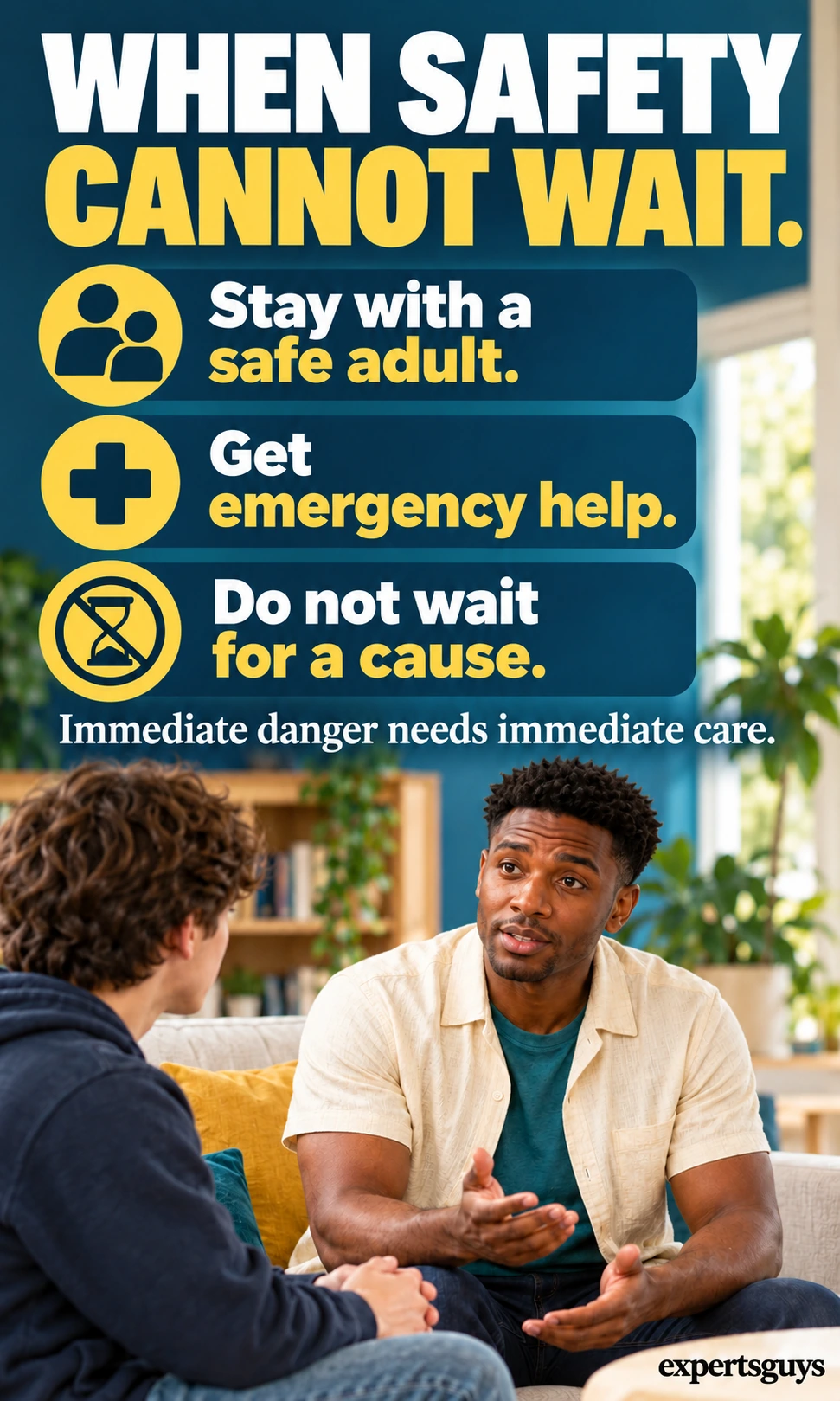
Suicidal thoughts also need prompt professional attention when there is no known immediate plan. Ask directly and calmly about safety rather than assuming silence means there is no risk. If a parent is unsafe or unavailable, another trusted adult or emergency service can help. Finding the “real reason” for depression is not a prerequisite for protection.
Frequently asked questions
Can a teenager be depressed without an obvious reason?
Yes. A clear triggering event is not required, and the relevant influences may be difficult to separate. Take persistent changes and reduced functioning seriously even when home or school looks fine from the outside.
Does a good day mean the concern has passed?
No. One enjoyable afternoon or a good result at school does not settle the overall picture. Consider the continuing pattern and how ordinary life is affected, without asking the teenager to prove distress all the time.
Should siblings be expected to react in the same way?
No. Siblings can differ in temperament, health, relationships, experiences, and support, even within one household. Comparing them can discourage disclosure and does not explain why one is struggling.
What if the teenager says “I don’t know”?
Accept that answer. They may be unsure, unable to find words, or not ready to discuss something. Offer a choice of safe people to talk with and practical support without making a complete explanation the price of help.
Will removing a stressor cure depression?
Not necessarily. Reducing harm or pressure is worthwhile, but symptoms can continue after circumstances change. Maintain appropriate care and reassess ongoing difficulties rather than treating the lack of an immediate improvement as non-cooperation.
Next steps
Start with the teenager’s safety and current functioning, then choose one pressure that an adult can genuinely change. Keep the practical agreement, arrange an assessment when needed, and let the teenager participate in decisions without requiring them to identify a single cause. Understanding should lead to support, not an investigation into who is at fault.










