Types of depression include major depressive disorder and persistent depressive disorder, while terms such as seasonal, postpartum and psychotic depression describe particular timing or symptom patterns. Bipolar depression belongs to bipolar disorder, which changes the treatment approach. The useful distinction is what each label tells a clinician about duration, mood history and the care you need.
You do not need to decide which label fits before asking for help. Start with the change that is disrupting your life: lost interest, poor sleep, low energy, difficulty eating or trouble managing ordinary tasks. A clear example is more useful at an appointment than a diagnosis chosen from an online list.
Depression labels at a glance
| Term | What it describes | Why it matters |
|---|---|---|
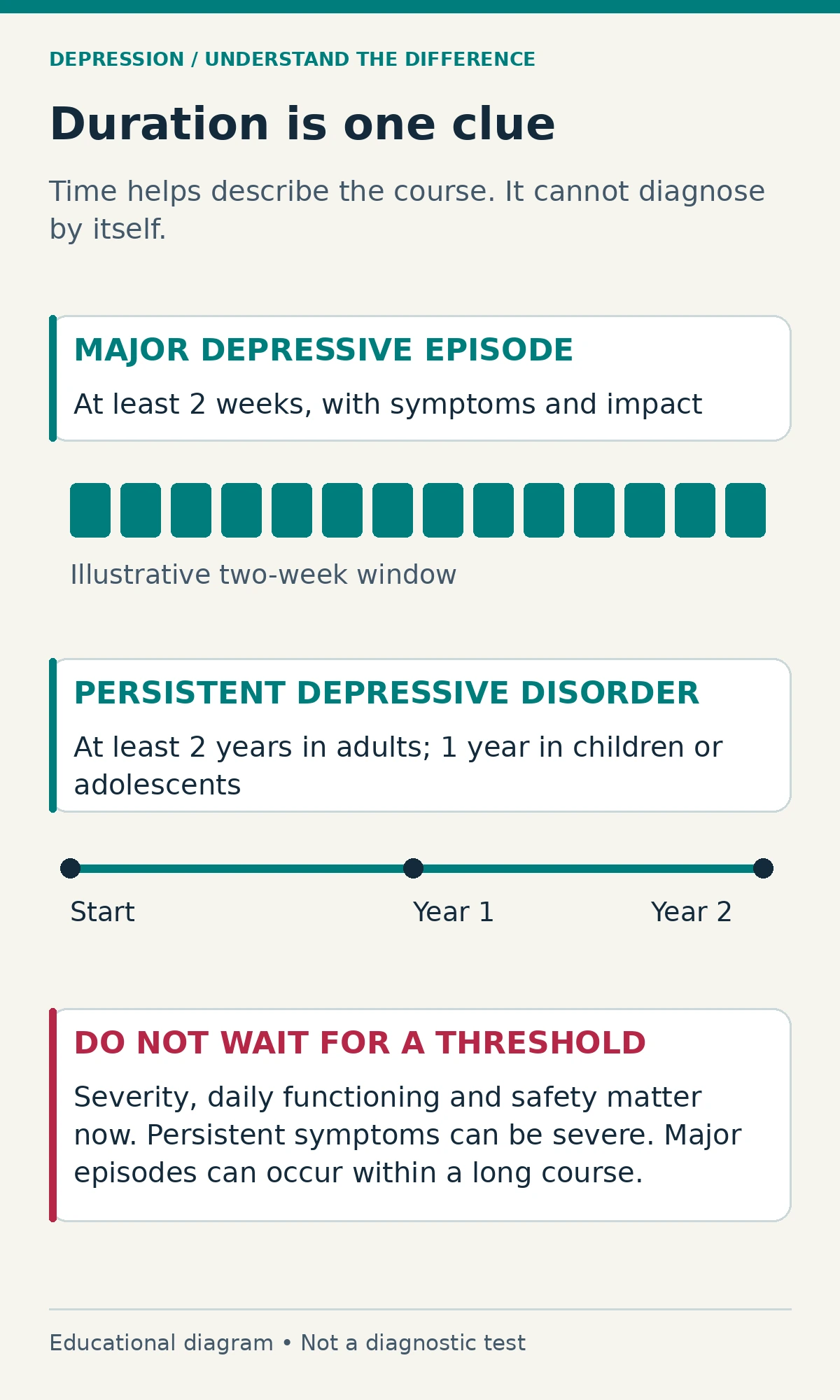
| Major depressive disorder | A depressive-disorder diagnosis, with one or more major episodes | History of mania or hypomania changes the diagnostic picture. |
| Persistent depressive disorder | A long-lasting depressive course | Duration does not tell you how severe it is. |
| Seasonal depression / SAD | A recurring seasonal pattern | Timing and repeated episodes need assessment. |
| Perinatal / postpartum depression | Depression during pregnancy or after birth | Care considers pregnancy, breastfeeding and safety. |
| PMDD | A recurring, disabling premenstrual disorder | Symptoms outside the premenstrual window also matter. |
| Psychotic depression | Depression with psychotic symptoms | Specialist assessment is important. |
| Bipolar depression | A depressive episode within bipolar disorder | The wider mood history changes treatment. |
| High-functioning / situational depression | Informal descriptions | They do not establish a clinical diagnosis. |
A single person can have more than one descriptor. For example, a clinician might identify a recurrent major depressive disorder with a seasonal pattern, rather than two unrelated illnesses. Treat the table as a vocabulary guide; diagnosis still requires an assessment of symptoms, functioning and alternative explanations.
Which depression terms are diagnoses, and which describe an episode?
Major depressive disorder, persistent depressive disorder and premenstrual dysphoric disorder are diagnostic categories; seasonal pattern and psychotic features describe how an illness presents. “Clinical depression” is commonly used for major depression, while “high-functioning depression” is an informal description. These labels answer different questions, so a longer list does not mean there are more mutually exclusive diseases.
Major depressive disorder and persistent depressive disorder
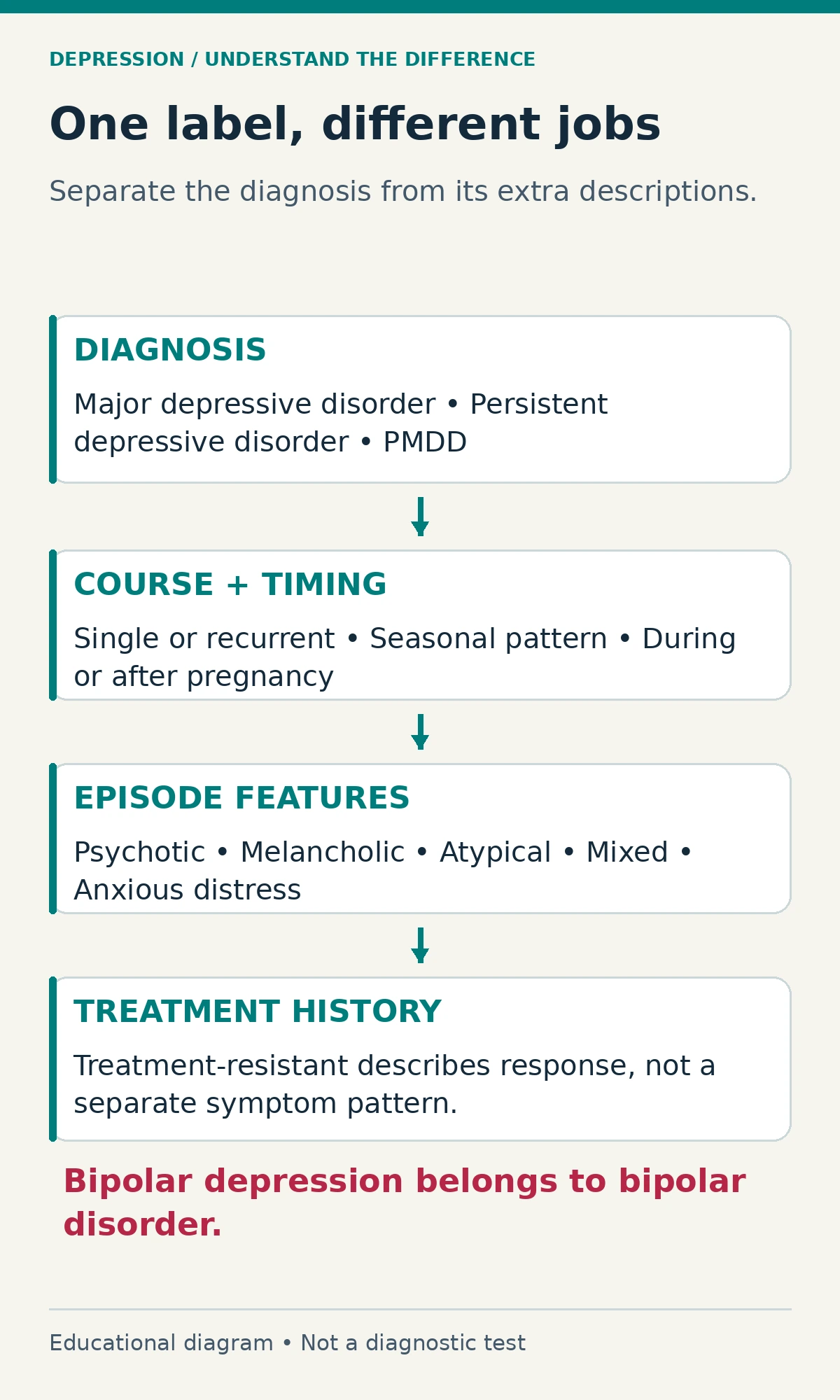
A major depressive episode involves a cluster of symptoms lasting at least two weeks, including depressed mood or loss of interest, with significant distress or difficulty functioning. In the DSM framework, at least five relevant symptoms are assessed; one must be depressed mood or loss of interest. Duration alone does not establish the diagnosis, and a major depressive episode can also occur within bipolar disorder.
Persistent depressive disorder describes a longer course of depressed mood, typically at least two years in adults and one year in children or adolescents. “Persistent” describes the course rather than promising that symptoms will be mild. Major depressive episodes and substantial impairment can occur within a long-lasting depressive illness.
The distinction matters because a snapshot can miss the course of an illness. Someone seeking help for a recent deterioration may also have years of lower-level symptoms, while another person may have separate episodes with recovery between them. Our explanation of persistent depressive disorder and chronic depression explores that longer-term distinction.
Other diagnostic categories worth knowing
- Premenstrual dysphoric disorder (PMDD): a disabling, recurring premenstrual symptom pattern, not simply any sadness around a period.
- Substance/medication-induced depressive disorder: a clinician considers whether a substance or medication is responsible, rather than assuming that any coinciding use explains the symptoms.
- Depressive disorder due to another medical condition: requires evidence of a direct physiological relationship. Having both depression and a physical illness does not establish this category.
- Other specified or unspecified depressive disorder: may be used when symptoms are clinically important but do not fit a particular category or information is incomplete.
- Disruptive mood dysregulation disorder (DMDD): a childhood disorder involving persistent irritability and severe, repeated outbursts. It is not an adult depression label or a synonym for bipolar disorder.
Diagnostic naming also varies between classification systems and countries. The practical point is to understand the meaning of the term used in your care, rather than force every diagnosis into one internet taxonomy. The American Psychiatric Association depression overview explains clinical assessment, and NIMH guidance on DMDD describes the distinct childhood presentation.
Takeaway: Ask, “Is this my diagnosis, an episode feature, or an informal description?” That question helps clarify what a label changes in your care. You can seek assessment even when your symptoms do not match a familiar name.
How do seasonal, pregnancy-related and menstrual patterns differ?
Timing can help distinguish a recurring seasonal pattern, depression during or after pregnancy, and PMDD. A calendar association is a clue, not proof of a cause. A clinician also considers whether symptoms continue outside the apparent window and whether another illness better explains them.
Seasonal affective disorder
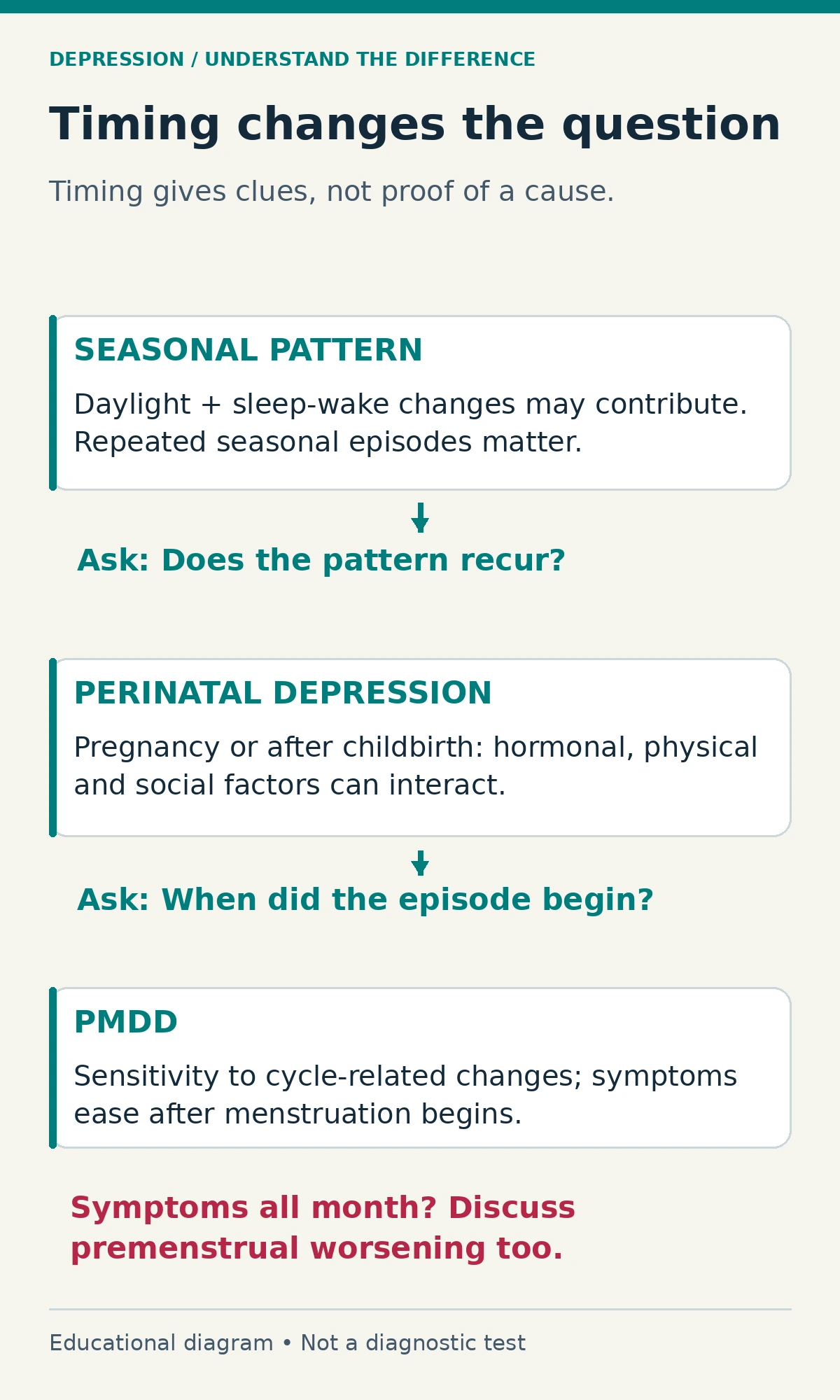
Seasonal affective disorder, or SAD, involves recurring depressive episodes linked to a season; winter patterns are more common, but summer patterns occur too. Changes in daylight and sleep-wake regulation may contribute, although the mechanism is not fully understood. A difficult holiday or a stressful annual work period is not automatically SAD.
Assessment considers repeated seasonal onset and improvement, usually across at least two consecutive years, with seasonal episodes predominating. Treatment options include psychotherapy, medication and, for appropriate winter-pattern cases, supervised light therapy. The NIMH seasonal depression guidance explains the evidence and cautions; discuss suitability before buying a light box, especially if you have bipolar disorder or eye-related concerns.
Perinatal and postpartum depression
Perinatal depression covers depression during pregnancy and after childbirth; postpartum depression refers to the period after birth. Hormonal changes, disrupted sleep, physical demands and previous vulnerability can interact, rather than one factor explaining every case. The broader clinical use of “perinatal” should not be confused with narrower onset windows used in diagnostic coding.
Brief baby blues usually settle within about two weeks, whereas severe symptoms, ongoing low mood or difficulty caring for yourself need assessment. Postpartum psychosis is a separate emergency involving symptoms such as hallucinations, delusions, mania or confusion. The NIMH perinatal depression guidance supports these distinctions; severe symptoms should never be dismissed as routine new-parent exhaustion.
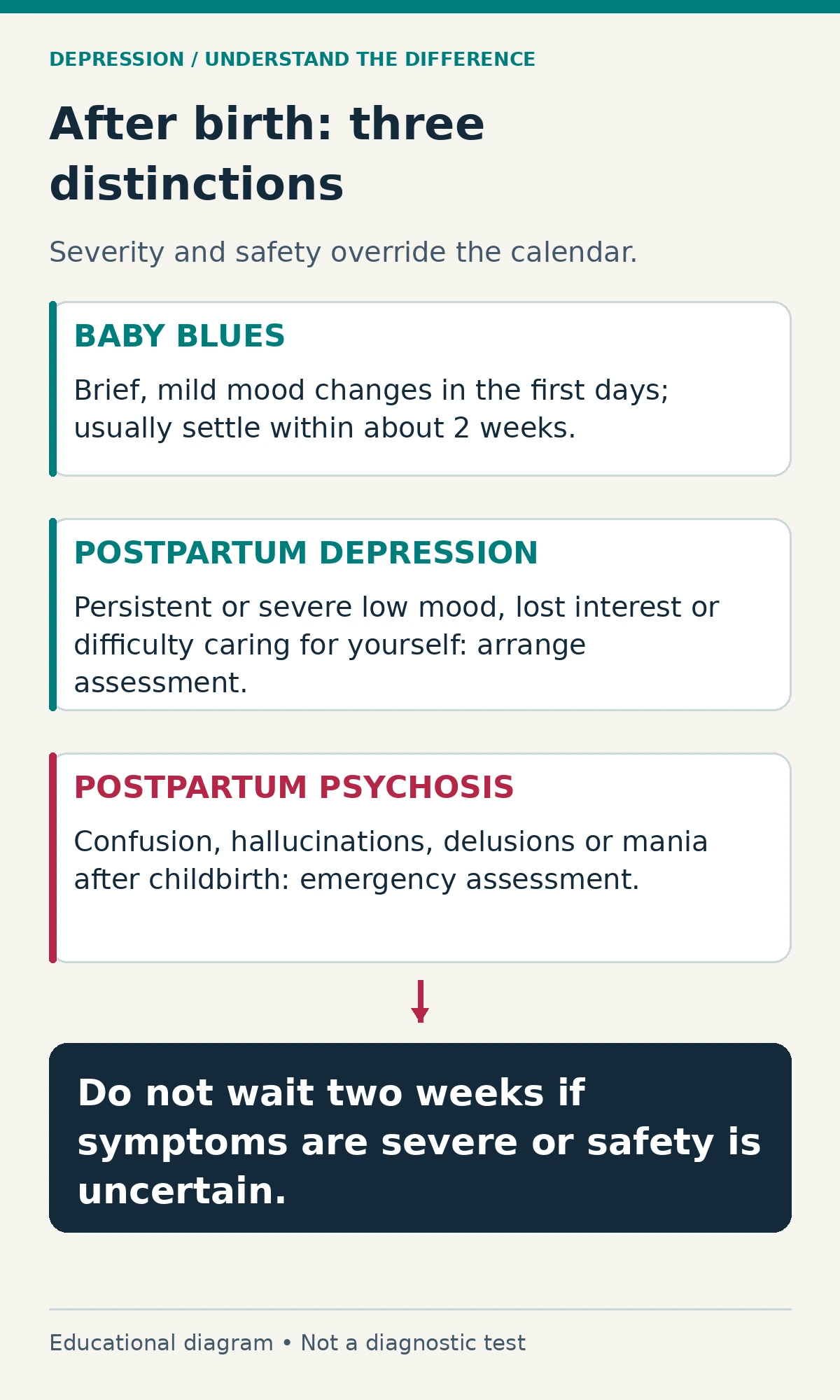
For a deeper explanation of pregnancy-related care and the period after birth, read postpartum depression. Mention pregnancy or breastfeeding when discussing treatment because the benefits and risks need individual consideration. A timing label does not select a medicine or rule out bipolar disorder.
PMDD versus premenstrual worsening
PMDD symptoms typically intensify before menstruation, improve after the period starts and become minimal or absent afterward. Depression that remains present throughout the month but worsens before a period may instead involve premenstrual exacerbation. This difference matters because treating the underlying illness and treating a cyclic disorder are not identical decisions.
Research links PMDD to sensitivity to normal reproductive-hormone changes, rather than a simple assumption of abnormal hormone levels. Research on prospective PMDD assessment also shows why remembered impressions are less reliable than daily observations across cycles. If a clinician requests a record, our two-cycle PMDD symptom diary guide owns that procedure; you do not need to finish a diary before seeking care for severe symptoms.
Takeaway: Describe when symptoms appear and when they ease, including any symptoms outside the expected window. Say if the timing is uncertain instead of guessing. The pattern helps frame the assessment, but it cannot diagnose you by itself.
Which mood histories and symptom features change treatment?
A history of mania or hypomania, psychotic symptoms, mixed features and previous treatment response can change the care plan. The important difference is not how dramatic a label sounds. It is whether the history changes medication safety, the need for specialist assessment or the urgency of help.
Bipolar depression versus unipolar depression
Bipolar depression is a depressive episode within bipolar disorder, rather than a separate depressive-disorder category. Assessment looks beyond the current low period for episodes of unusually increased energy or activity and elevated or irritable mood. Reduced need for sleep is particularly relevant: feeling rested after little sleep differs from lying awake and feeling exhausted.
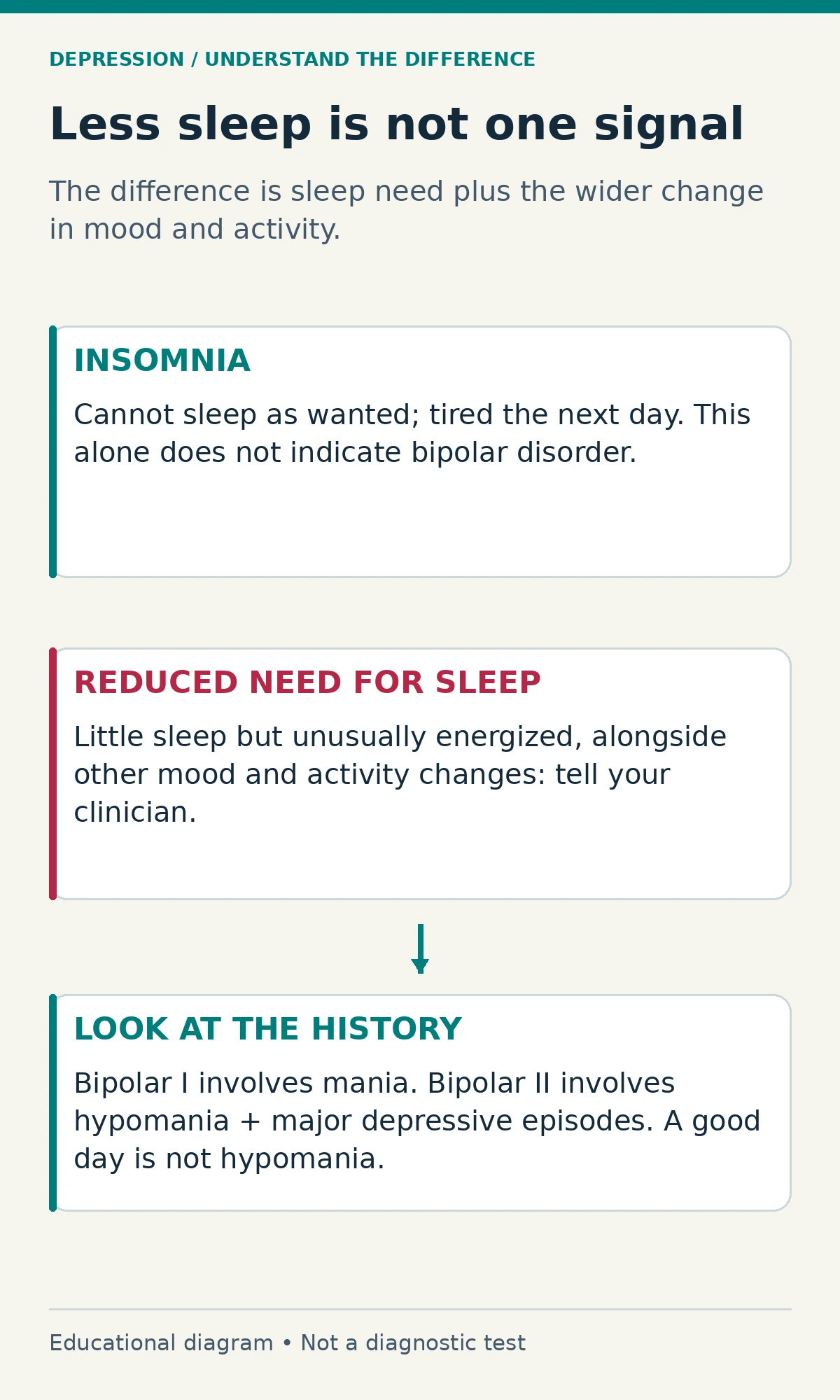
Bipolar I involves mania; bipolar II involves hypomania and major depressive episodes without a history of mania. Feeling happier for a day does not establish either condition. NIMH bipolar disorder guidance explains why antidepressant treatment alone can trigger mania or rapid cycling in some people with bipolar disorder; report relevant history and discuss changes with your prescriber rather than stopping medication yourself.
For the broader comparison, read depression, anxiety or bipolar disorder. A useful appointment example is a period when other people noticed an unusual change in your energy, sleep or behavior. You do not have to decide whether it was hypomania before mentioning it.
Psychotic, melancholic, atypical and mixed features
| Feature | What a clinician considers | Practical implication |
|---|---|---|
| Psychotic | Hallucinations or delusions alongside depression | Arrange urgent assessment; immediate danger needs emergency help. |
| Melancholic | Very limited pleasure or little response to positive events, with other symptoms | Describe the overall pattern, not just an early waking time. |
| Atypical | Mood reactivity, with features such as oversleeping, increased appetite or limb heaviness | Brief improvement does not mean symptoms are unimportant. |
| Mixed | Some manic or hypomanic symptoms during depression | Report unusual activation, sleep need and impulsivity. |
| Anxious distress | Prominent anxiety symptoms during the episode | This is not automatically a separate anxiety-disorder diagnosis. |
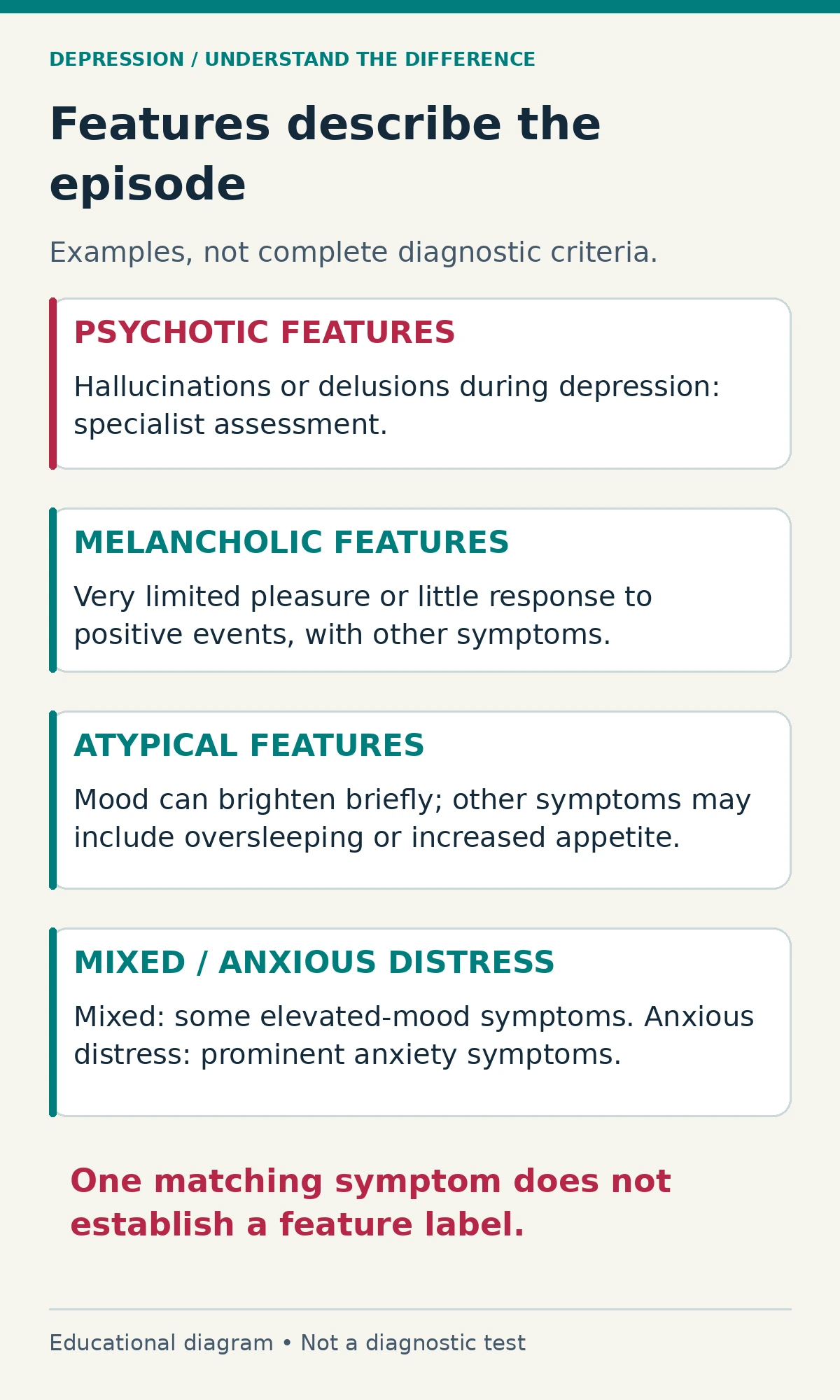
Feature labels describe patterns within an episode and can coexist with other descriptors. They are not a ladder from “real depression” to “less serious depression,” and one matching symptom is insufficient. The CANMAT clinical classification discussion explains these specifiers; it is a classification reference, not a current individualized prescribing guide.
Psychotic depression requires specialist assessment because beliefs or perceptions may become disconnected from reality alongside the depressive illness. Treatment may combine antidepressant and antipsychotic medication; other specialist treatments may be considered in severe cases. NHS psychotic depression guidance explains the care pathway, but the presence and timing of psychosis must be assessed rather than inferred from an online description.
Treatment-resistant depression is a response description
Treatment-resistant depression commonly refers to depression that has not responded adequately to at least two appropriate antidepressant trials. It describes treatment history, not a unique symptom pattern or a judgment about your effort. Definitions vary, and a review needs to consider dose, duration, tolerability, diagnosis and other contributing problems before selecting further treatment.
Takeaway: Bring previous treatment names, what helped, what did not and any unusual activation or side effects to the conversation. The NICE depression guideline supports reassessment and shared decisions when treatment has limited benefit. A failed trial does not mean further care cannot help.
How can you prepare for assessment without diagnosing yourself?
Prepare one short account of a change, its timing and its impact, then ask for an assessment. This helps when low energy or poor concentration makes a conversation difficult. It is appointment preparation, not a symptom test, treatment exercise or requirement for receiving help.
Prepare a brief visit note
- Choose one change. Use paper or a phone note and name what is different: sleep, interest, appetite, energy or an ordinary task.
- Add timing and impact. Write when it began, whether it is continuous or comes and goes, and one concrete example of what became difficult. “Unsure” is acceptable.
- Add relevant history. Include unusual high-energy periods, prior episodes, pregnancy or menstrual timing if relevant, medicines, supplements, alcohol or other substances. Bring an existing medicine list rather than reconstructing everything.
- Ask for an assessment. Contact a primary care clinician or appropriate mental health professional and take the note to the visit. For pregnancy-related concerns, your maternity team can help arrange care.
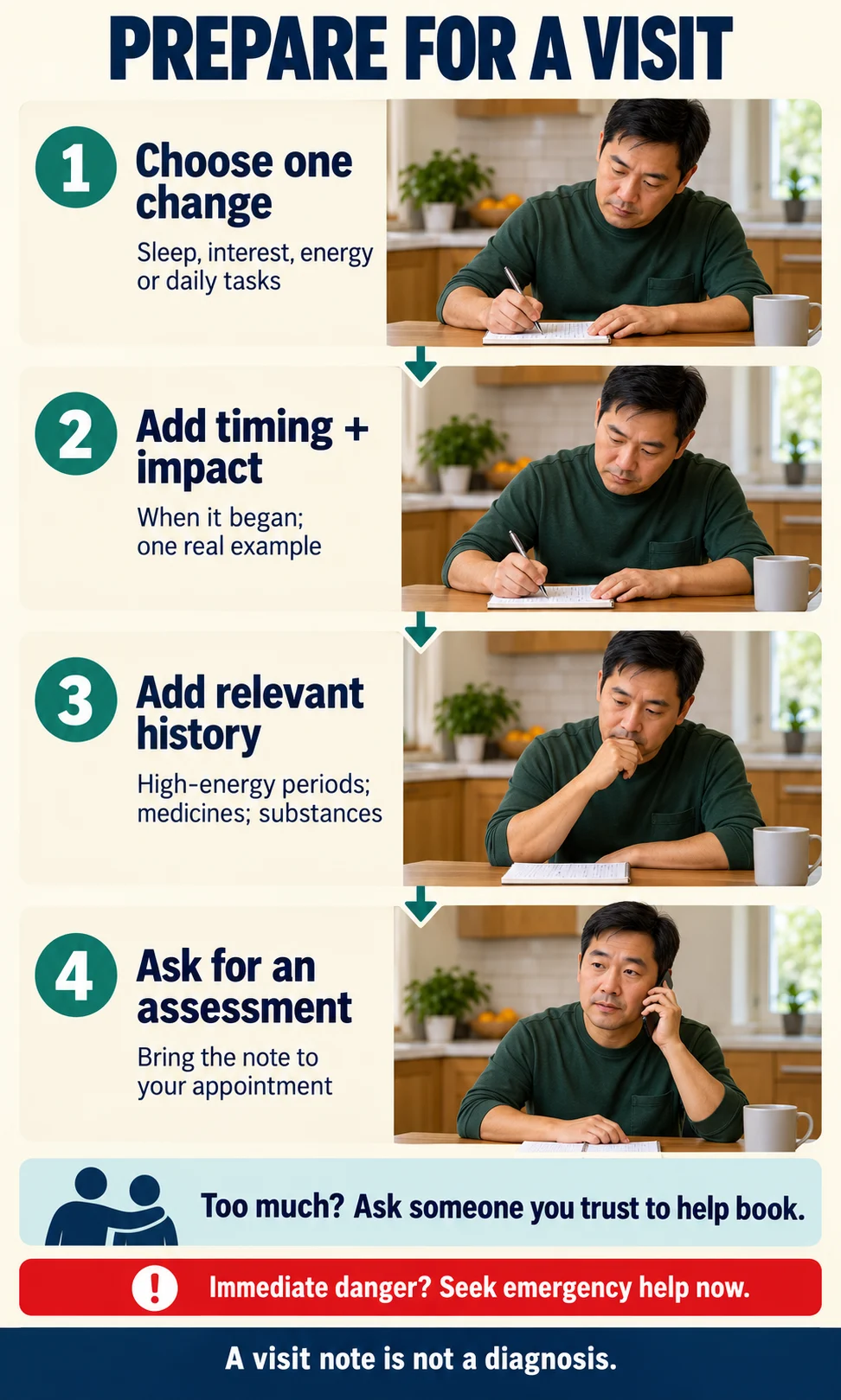
Illustrative example: “For about three weeks I have stopped enjoying cooking and keep leaving meals unfinished. I am missing morning work because I cannot get out of bed. I would like an assessment and help deciding what to do next.” This fictional example describes an impact; it does not establish a diagnosis.
Easier option: If writing is too much, use one sentence: “My mood and daily life have changed, and I need help arranging an appointment.” Ask someone you trust to help book or accompany you, if you want. Completing this step means opening the conversation or arranging support; it does not require your mood to improve.
The NIMH appointment preparation guidance supports bringing concerns, medication information and a trusted person when helpful. The short-note format and example here are editorial adaptations, not validated screening instruments. If a clinician gives you a particular questionnaire, complete it as instructed and let them interpret it.
What the assessment can clarify
A clinician considers symptoms, severity, daily functioning, previous episodes, mood elevation, physical health and medication or substance effects. An examination or selected blood tests may investigate overlapping problems such as thyroid disease; there is no routine blood test that identifies your depression type. The NHS explanation of depression diagnosis describes this process, while our depression symptoms guide helps describe emotional, physical and cognitive changes.
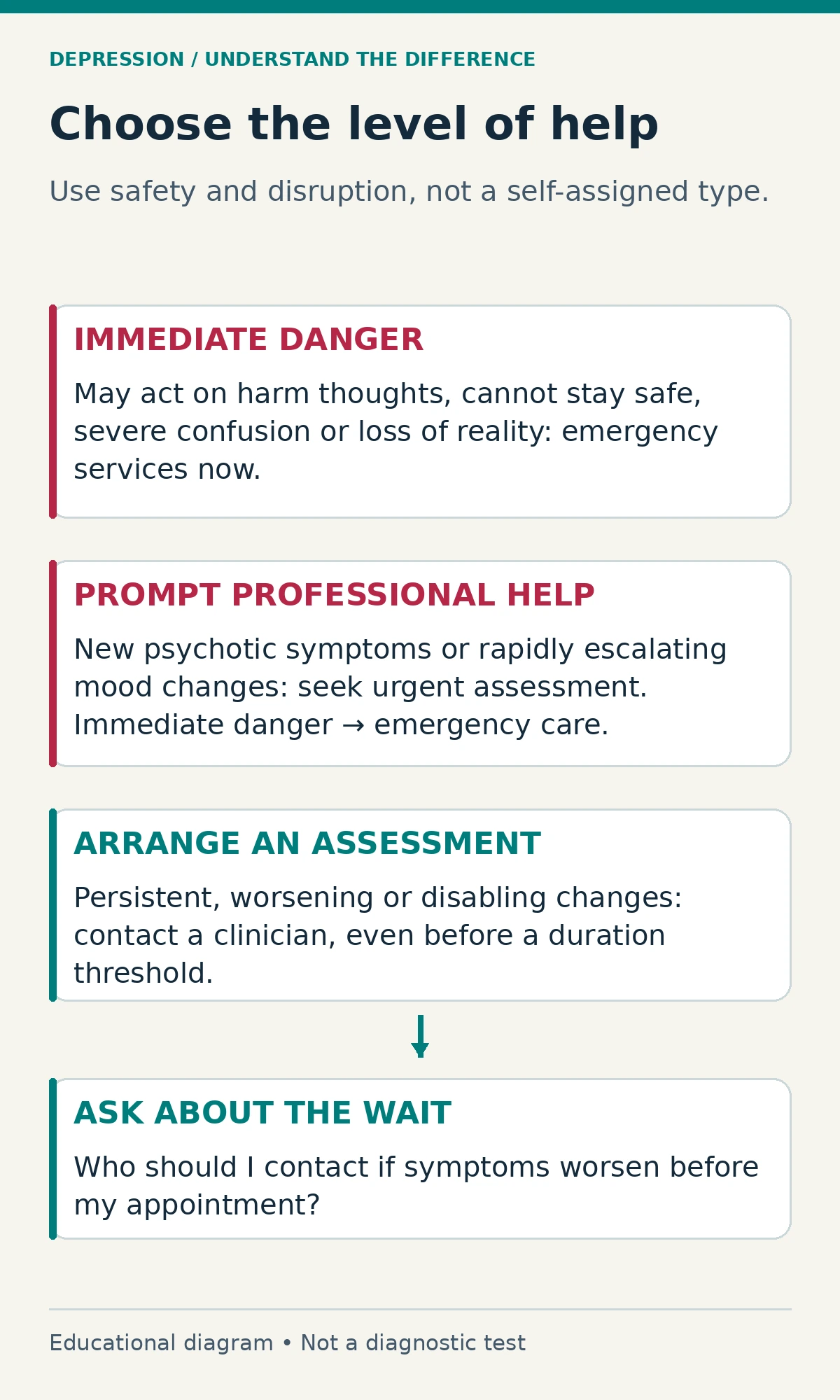
Seek emergency help for immediate danger or severe loss of contact with reality, and prompt professional help for new psychotic symptoms or rapidly escalating mood changes. Persistent, worsening or disabling symptoms also deserve assessment, even if their duration is shorter than a diagnostic threshold. Do not change prescribed medication or attempt to manage alcohol withdrawal alone on the basis of this article.
Takeaway: You can ask for care with an incomplete history and without a chosen label. A good first outcome is a clearer conversation about the problem and an agreed next step. Ask who to contact if symptoms worsen while you wait.
Frequently asked questions
Is high-functioning depression an official diagnosis?
No. High-functioning depression describes someone who appears to manage responsibilities while experiencing depressive symptoms. It does not identify one diagnosis or establish severity; the difficulty and cost of functioning still deserve assessment.
Can grief and depression happen together?
Yes. Bereavement does not rule out a depressive illness, and grief does not automatically mean major depression. A clinician considers the pattern, severity, daily impact and safety concerns rather than diagnosing from the presence of a loss alone.
Can a screening questionnaire tell me my depression type?
No. A screening questionnaire may highlight symptoms that need discussion, but it cannot establish the diagnosis or reliably rule out bipolar disorder. Interpretation needs your history and a clinical assessment.
Is depression after a stressful event always situational depression?
No. Situational depression is an informal phrase, and stress can precede different conditions. A clinician may consider an adjustment disorder, a depressive disorder or another explanation; the trigger alone does not settle the diagnosis.
Does feeling better briefly mean I cannot have depression?
No. Symptoms can fluctuate, and some depressive episodes include a temporary improvement after positive events. A brief better moment does not erase an ongoing pattern of distress or impairment.
Do I need to wait two weeks before seeking help?
No. Two weeks is a common duration criterion for a major depressive episode, not a waiting instruction. Seek care sooner for severe, worsening or disabling changes, and emergency help for immediate danger.
Your next step
Use depression labels to understand the care conversation, rather than to judge whether you are struggling enough to deserve help. Explain the change that matters most and ask what the diagnosis or descriptor means for your treatment. If safety is uncertain, seek urgent support instead of spending more time comparing names.