
Dysthymia is a term commonly used for persistent depressive disorder (PDD), a long-lasting pattern of depression, not simply a sad personality. If low mood has become your normal, its duration and effect on everyday life matter more than whether you can still work, laugh, or get through the day. You do not need to wait years or decide on a diagnosis before asking for help.
Start with one clear sentence: “I feel low most days, and ordinary things take more effort than they used to.” Use that sentence when requesting an appointment if it fits your experience. You do not need a complete history, a symptom spreadsheet, or the right medical vocabulary to start the conversation.
Get urgent help first if safety is at risk. If you may act on thoughts of suicide or cannot keep yourself safe, contact your local emergency service or go to the nearest emergency department now. Tell someone you trust and ask them to stay with you while help is arranged; a routine appointment message is not an emergency service.
- Persistent: describe the recurring pattern, including times when you felt better.
- Disruptive: explain distress, extra effort, or activities you have stopped doing.
- Worth assessing: seek help for ongoing or worsening symptoms, even if you are unsure what to call them.
Is chronic sadness the same as dysthymia?
No: chronic sadness describes an experience, whereas PDD is a clinical diagnosis with a particular pattern of symptoms and duration. In adults, the core duration is at least two years; for children and adolescents it is at least one year, and irritability may be prominent. Duration alone does not establish the diagnosis, and a clinician also considers associated symptoms, impact, other explanations, and periods of improvement.
Low energy, sleep or appetite changes, poor concentration, low self-esteem, and hopelessness can accompany persistent low mood. The phrase “low-grade depression” can therefore understate its effect on someone’s life. The MedlinePlus explanation of persistent depressive disorder describes the core pattern; the formal diagnostic detail belongs in our persistent depressive disorder DSM criteria guide.
| Experience | What it can tell you | What it cannot establish |
|---|---|---|
| Sadness after something difficult | Context may help explain the feeling. | A clear trigger neither proves nor excludes depression. |
| Low mood that feels familiar | Long familiarity makes the history worth discussing. | “I have always been like this” is not a diagnosis. |
| Symptoms with substantial distress or disruption | Assessment is worthwhile even without a precise start date. | You do not have to stop working to deserve help. |
| A happier day within a difficult stretch | Mood varies; describe the length and quality of better periods. | One enjoyable moment does not settle the diagnosis. |
No single event or personality trait explains every case of persistent depression. Biological, psychological, and environmental influences can interact, and the cause for one individual may remain uncertain. A useful first step is therefore describing what you experience rather than proving why it happened.
Name the pattern without inventing a start date
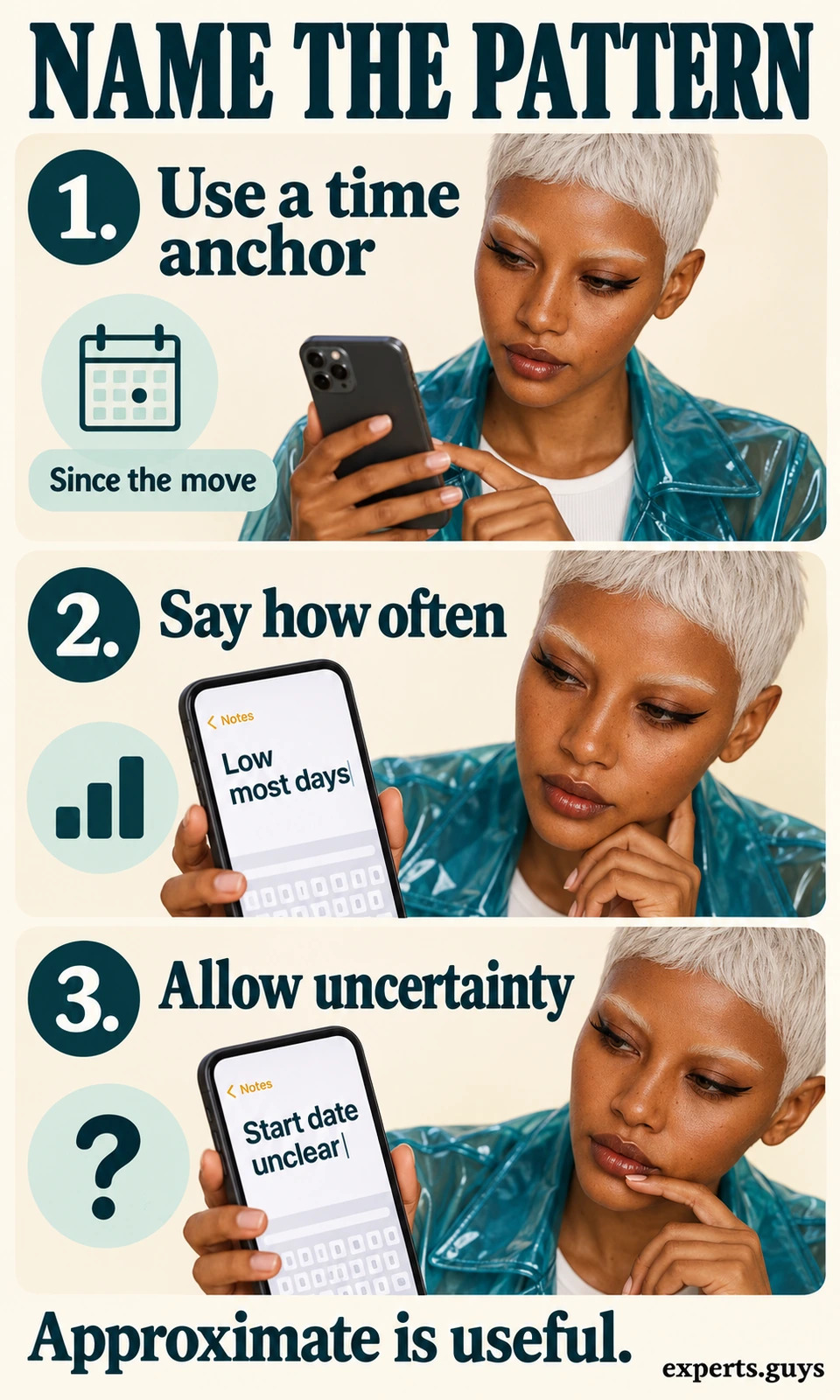
Use this approach when “forever” is the only time description that comes to mind. An approximate anchor gives a conversation some structure without pretending memory is exact. Your phone calendar may jog your memory, but searching it is optional and should not delay requesting help.
- Choose one recognizable period: before a move, during a particular job, or since a family change.
- Say how frequent low mood has been in ordinary language, such as “most days” or “it comes in stretches.”
- If you cannot place the beginning, say “the start date is unclear.” Mention any earlier periods you can remember.
Illustrative example: “I remember feeling this way before I moved, but I cannot say when it began.” Avoid selecting a date simply because a form demands one; ask how to enter an estimate instead. If recalling the past becomes upsetting or exhausting, stop with the current pattern and let the assessment fill in the history.
What if I still function or sometimes feel happy?
Continuing to function does not make your distress unimportant, and an enjoyable moment does not explain the whole course of your mood. Instead of defending whether you “look depressed,” describe what life requires from you and what has become difficult. This keeps the conversation grounded in experience rather than appearance.
The distinction is between an observable result and the experience of producing it. “I sent the email” leaves out difficulty concentrating, repeated indecision, or the effort needed to begin. Our guide to high-functioning depression signs covers the broader pattern; here, the practical job is turning one example into useful appointment information.
Explain the effort behind one ordinary task
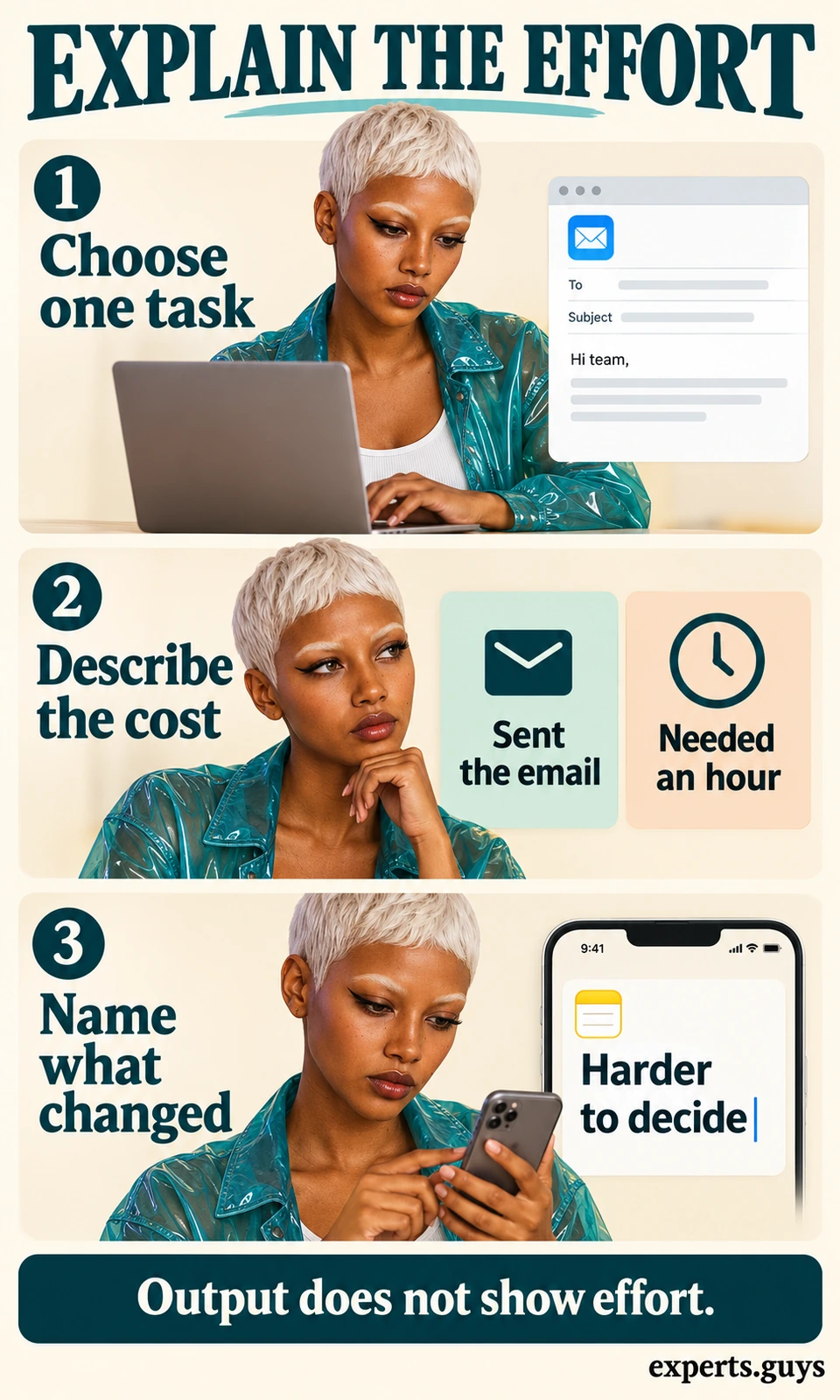
Choose an ordinary task when “I am coping” hides what it costs you. You can speak the example aloud or keep one short note on your phone. The purpose is clearer communication, not measuring productivity or diagnosing yourself from how long something takes.
- Pick one recent task, such as answering a work email or deciding what to eat.
- Describe both the outcome and the difficulty: what you completed, postponed, abandoned, or found unusually demanding.
- Compare it with your own experience when possible; if you have no clear earlier baseline, describe the present difficulty without forcing a comparison.
Illustrative example: “The email was sent, but I spent about an hour trying to decide what to say.” That time is an example, not a clinical cutoff. If details are hard to recall, “decisions are much harder” is enough; completion means finding a useful description, not proving that you are struggling.
Describe better periods without dismissing the pattern
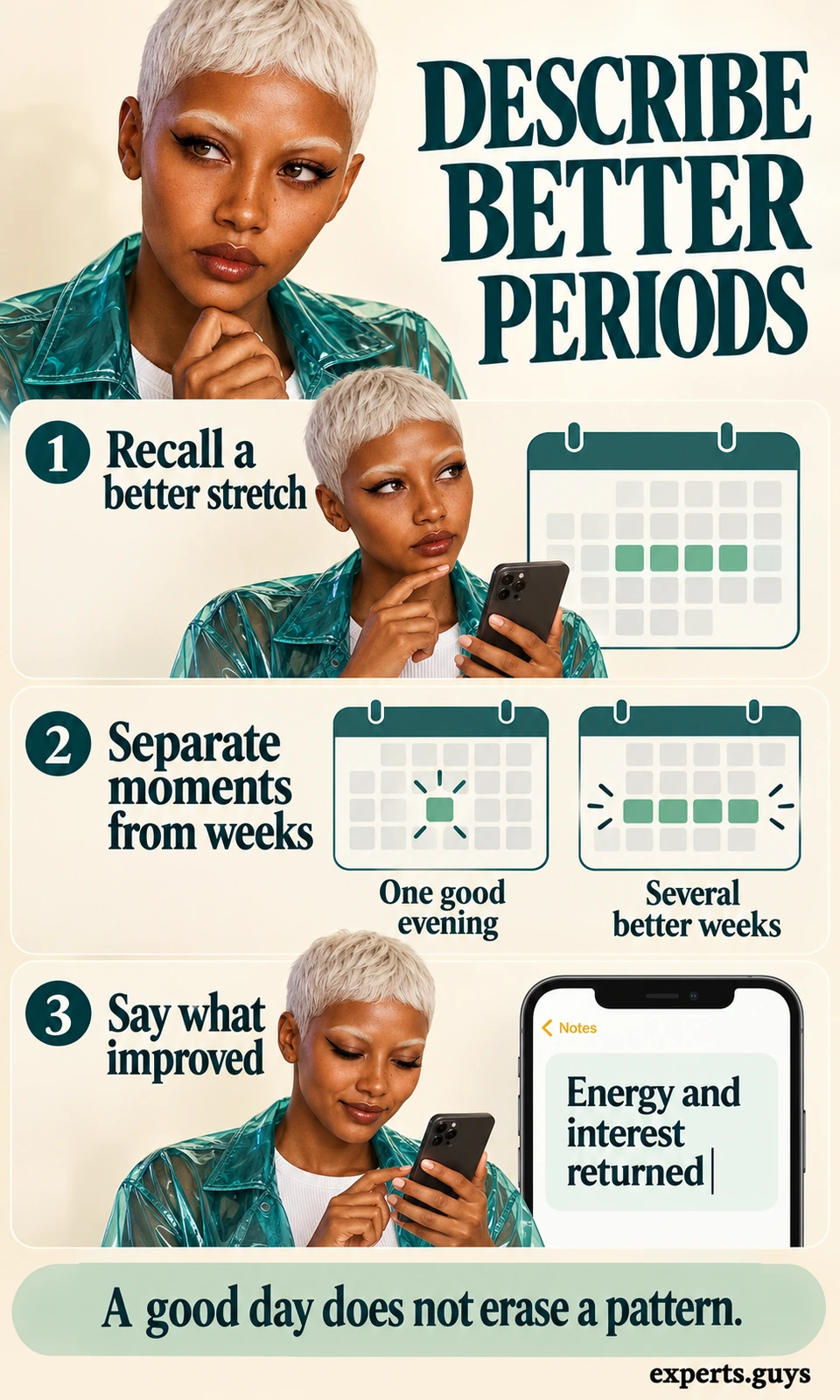
Describe improvement as carefully as difficulty when you worry that a happy day makes your concern invalid. The length of better periods helps explain the course of symptoms. A good evening, several better weeks, and a sustained return to feeling well are different descriptions, without any one of them being a self-diagnosis.
- Recall a better period, if one comes readily to mind.
- Describe its approximate length and whether it was a brief enjoyable moment or a broader improvement.
- Name what improved, such as interest, energy, or feeling connected; say when you are unsure.
Illustrative example: “I enjoyed dinner on Saturday, but the rest of the week still felt flat.” The common mistake is treating either the best day or the worst day as the whole story. An easier option is simply to say “there are better moments”; the next step is discussing the wider pattern, not trying to calculate a diagnosis.
What should I explain when asking for an assessment?
Explain the mood pattern, one real-life effect, and relevant health context; you do not need to arrive with a diagnostic label. Assessment is a conversation about your history and current circumstances, sometimes supported by a questionnaire or tests for other conditions. There is no blood test that confirms depression, although tests may help investigate another explanation for symptoms.
Persistent symptoms deserve attention well before the two-year PDD threshold. The NHS guidance on depression assessment advises seeking help when depressive symptoms persist, affect daily life, or are not improving. If choosing a service is the barrier, our mental health counseling guide explains that separate decision.
Bring the context that could change the assessment
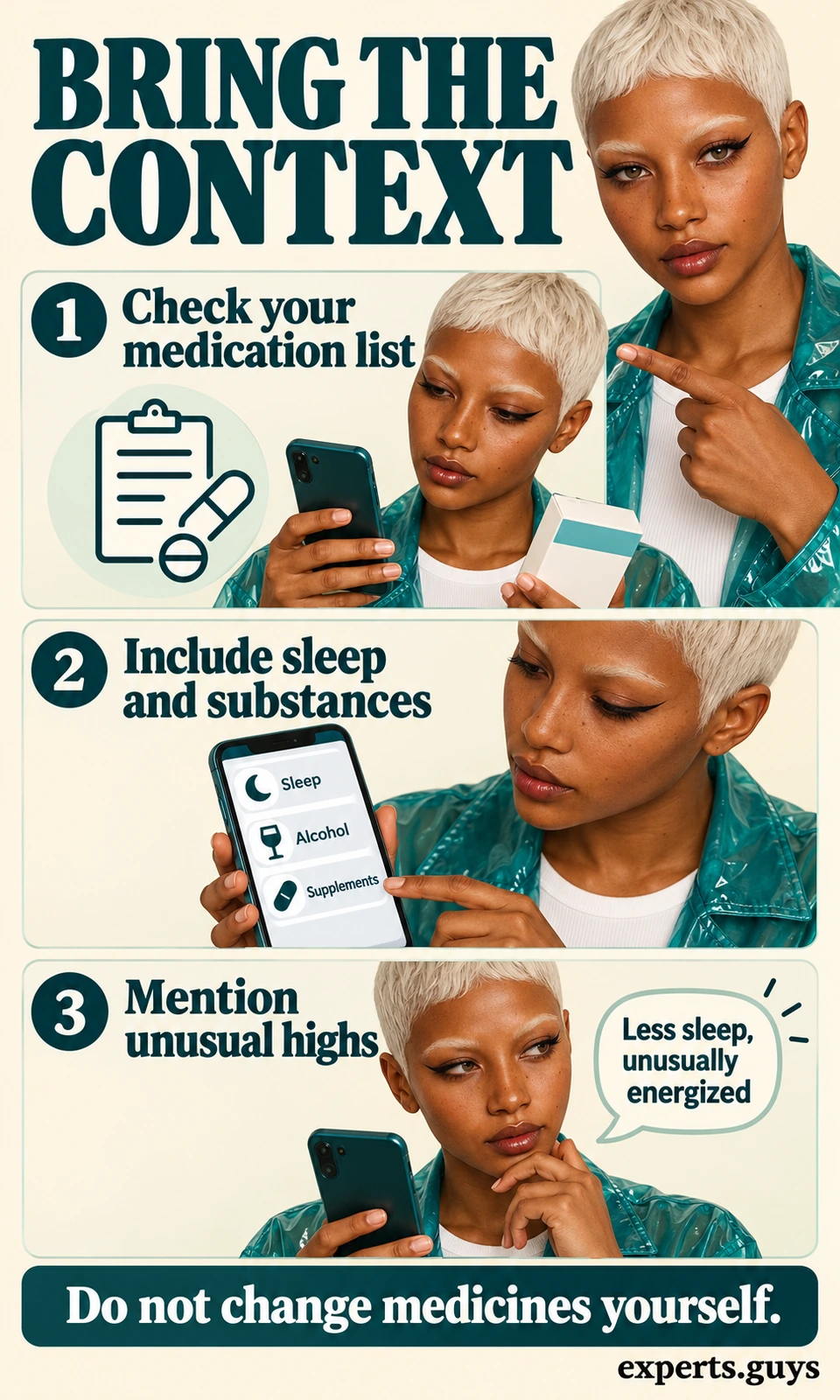
Use this preparation when a mood conversation might otherwise leave out medicines, health changes, or a different kind of mood episode. These details can change what the clinician investigates. Preparation is useful, but an incomplete list is not a reason to postpone the appointment.
- Open your existing medication list or gather medicine and supplement names, including nonprescription products.
- Mention sleep changes, physical symptoms, alcohol or other substance use, and major life changes honestly.
- Include periods of unusually increased energy or irritability with much less need for sleep, even if they felt productive at the time.
Periods of unusual activation are different from simply enjoying yourself again, and they can matter when assessing possible bipolar disorder. For example, “I slept very little and felt unusually energized” is useful context, not proof of a condition. Do not change medicines yourself to test a theory; if the list is overwhelming, bring what you already have and ask for help checking it.
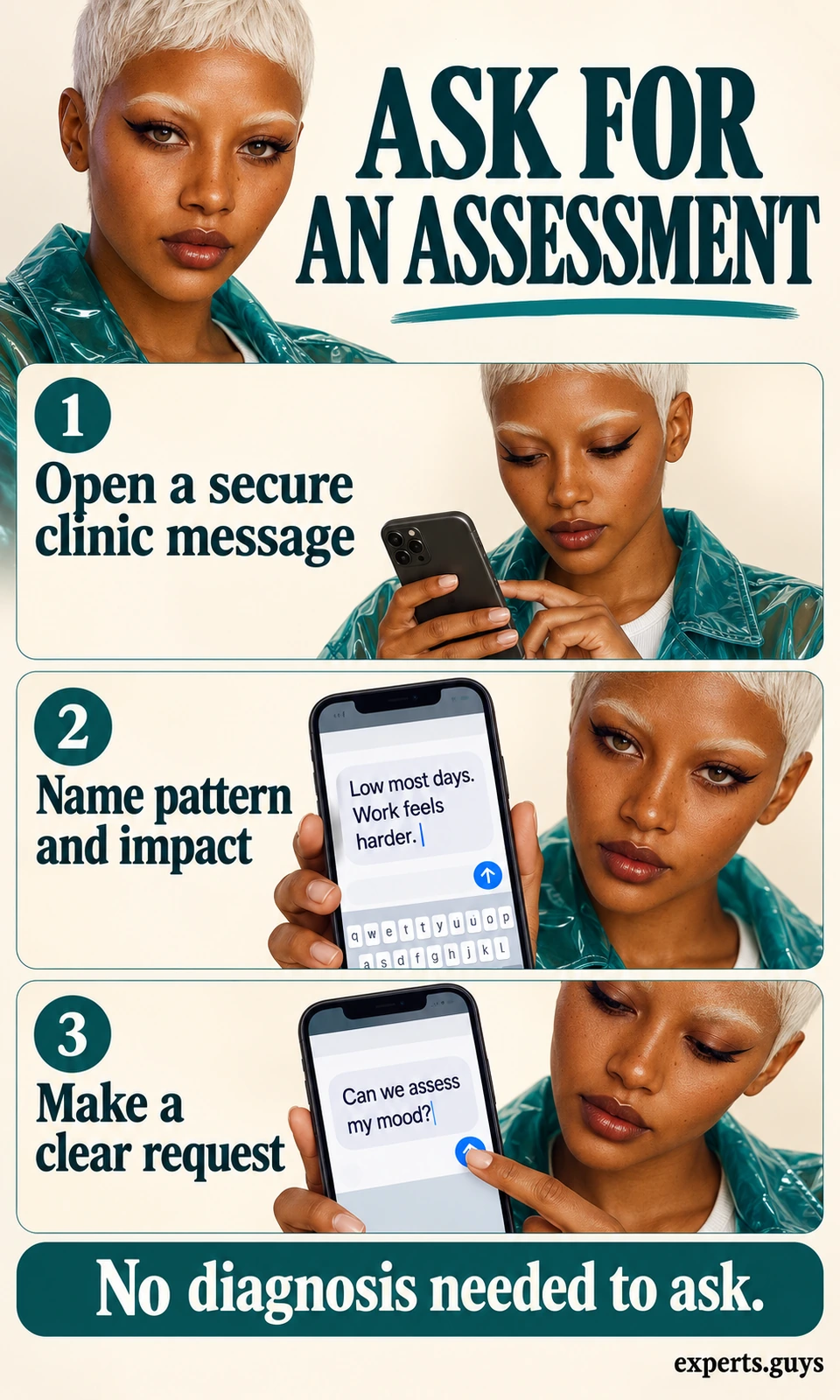
Send a clear request for an assessment
A short request is enough to begin when composing the perfect explanation has become another obstacle. Use the clinic’s secure messaging service if available, or say the same words when calling. A public comment thread or social-media message is not a suitable place for a detailed health history.
- Open the clinic’s appointment or secure-message route, or use its phone number.
- Give the recurring pattern and one effect on daily life.
- Ask for an assessment, then follow the clinic’s booking instructions.
I have felt low on many days for [approximate period or “an unclear length of time”]. It is affecting [one example, such as decisions or meals]. Could I book an appointment to assess my mood and discuss what might help?
Replace the bracketed wording with your own experience, or use only the opening request if that is easier. The mistake to avoid is delaying contact until you have completed every preparation step. Sending a message does not mean an appointment is confirmed: check the response and use another booking route if the service cannot offer one.
What can help while I arrange care or review treatment?
Practical support can make the next action easier, while follow-up gives you a way to discuss whether life is improving. Neither requires a new tracking app. The goal here is to reduce friction around getting help and communicating change, not to turn everyday tasks into a treatment test.
Treatment may include psychotherapy, medication, or both, with the choice shaped by your needs and clinical assessment. Persistent symptoms do not mean there is nothing worth trying, and a poor experience with one approach does not settle every option. The NIMH depression guide explains treatment choices; the steps below are communication support, not substitutes for treatment.
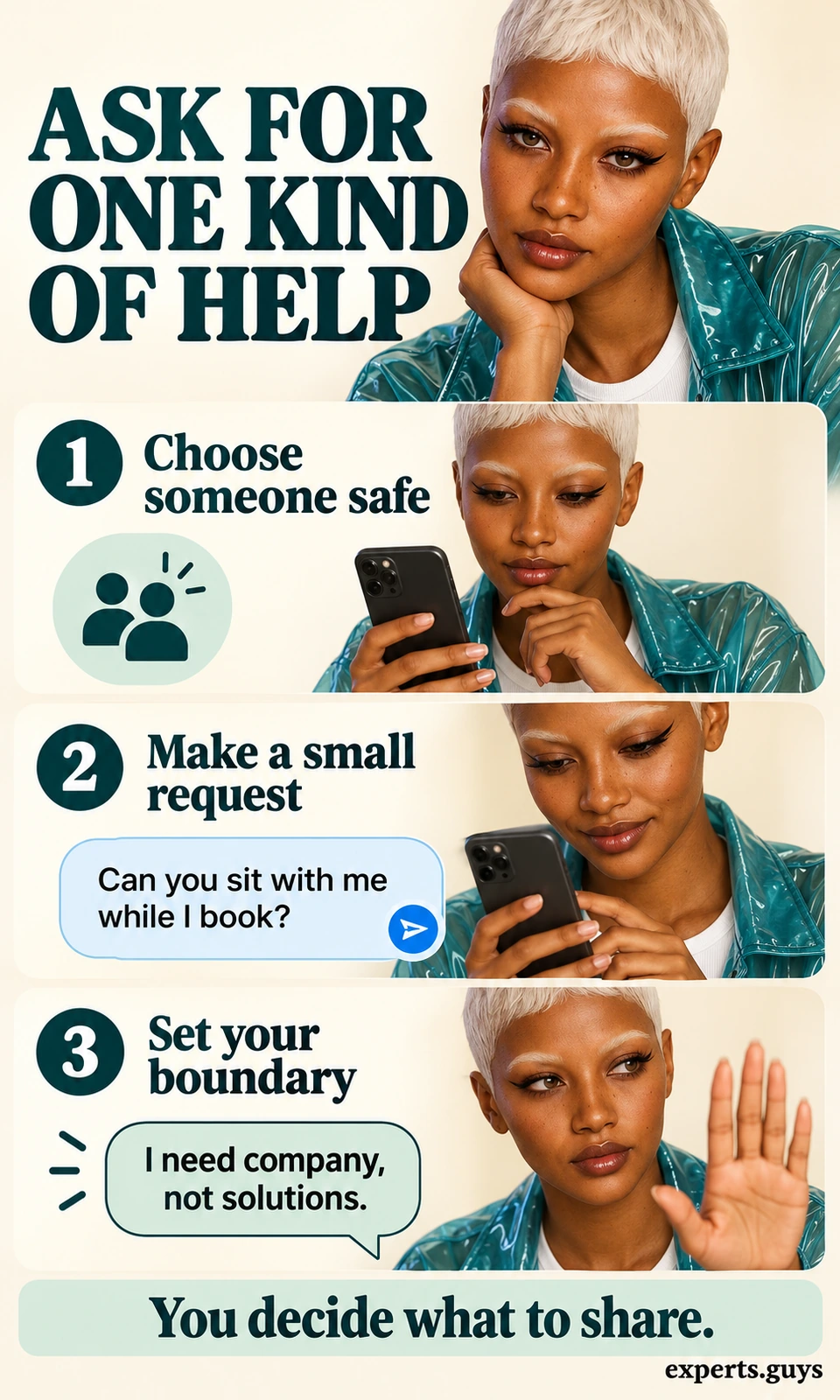
Ask someone safe for one specific kind of help
Ask for one specific kind of company when arranging care feels harder alone. A clear request gives the other person a practical way to respond. Choose someone you feel safe with; you do not owe a detailed disclosure to a person who dismisses, pressures, or threatens you.
- Choose a trusted person and a channel you are comfortable using.
- Ask for one bounded action, such as sitting with you while you book an appointment.
- Say whether you want company, practical assistance, or someone to listen rather than offer solutions.
Illustrative example: “Could you sit with me while I make the booking? I do not need advice today.” If that feels too personal, ask only for help finding the clinic’s booking page. Success is making a clear request; if the person cannot help, another trusted contact or the clinic’s administrative staff may be a better route.
Check everyday change and agree a follow-up
Use a concrete daily-life example at follow-up instead of relying entirely on “better” or “worse.” Symptoms, side effects, and everyday functioning all deserve discussion. A single task cannot measure recovery, but it can make a change easier to explain.
- Choose one activity that matters to you, such as making a meal or joining a conversation.
- Describe whether participation, effort, or enjoyment has changed, and mention symptoms or side effects that remain.
- Agree when the next review should happen and how to contact the service earlier if things worsen.
Illustrative example: “Cooking is easier, but I still feel flat most days.” Avoid treating one easier meal as full recovery or one difficult day as proof that treatment has failed. If comparisons feel burdensome, bring one recent example; the useful outcome is a clearer review conversation and an agreed next step.
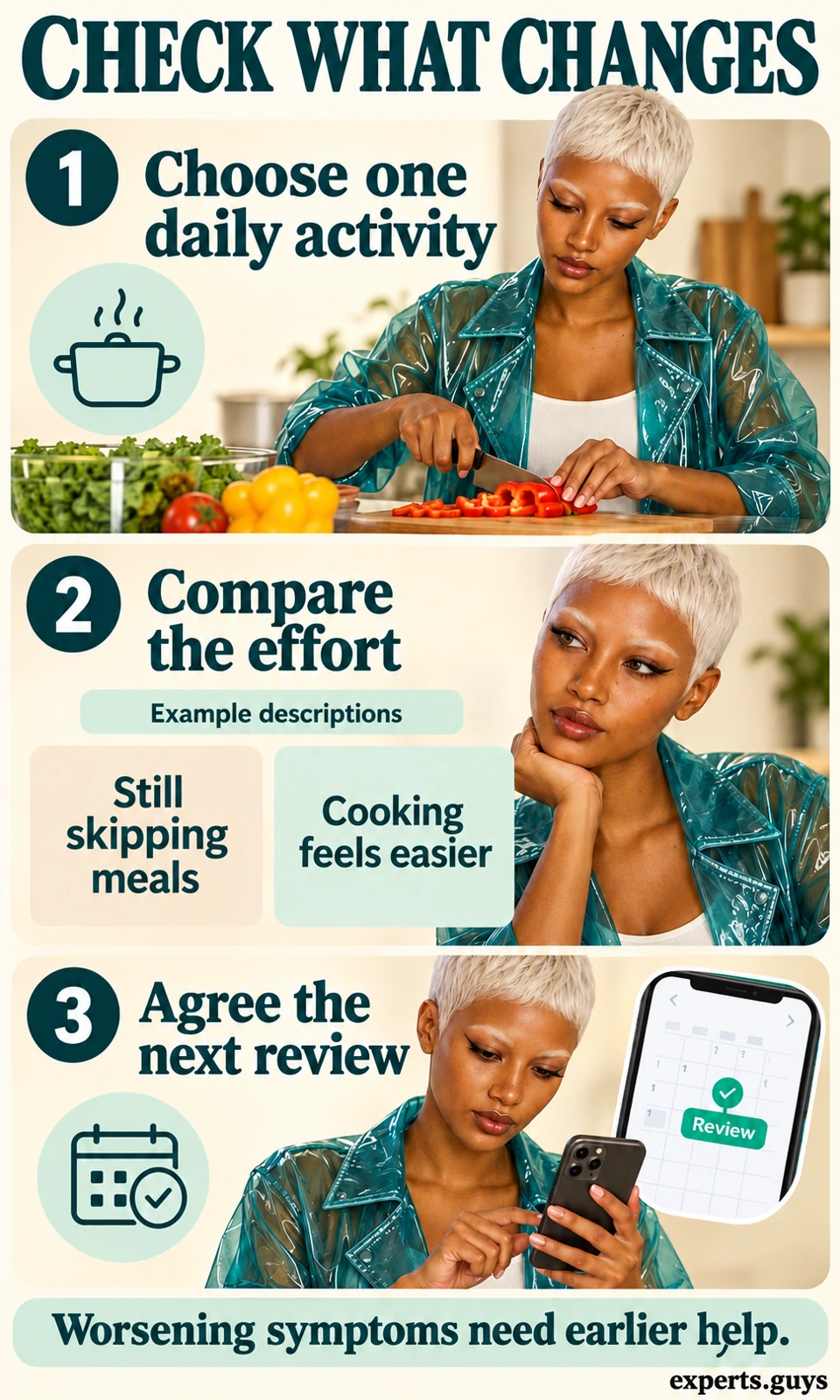
If low mood worsens, daily care becomes much harder, or new troubling symptoms appear, seek an earlier review instead of waiting for the planned date. Immediate danger requires emergency help, as described near the start of this article. For the wider question of a long course and continuing support, read is depression a chronic mental illness.
Frequently asked questions
Can I ask for help without knowing whether it is depression?
Yes. Describe the concern and its effect on your life, and ask for an assessment. Uncertainty is a reason to explore what is happening, not a requirement to solve the diagnosis yourself.
Does having a reason to feel sad rule out PDD?
No. Difficult circumstances and depression are not mutually exclusive. A clinician considers the context alongside symptoms, duration, and impact rather than deciding from the presence of a trigger alone.
What if I cannot remember a time when I felt well?
Say that directly rather than inventing a healthy baseline. Describe your current experience and any periods you remember as different. The history can be developed over more than one conversation.
Do I need a daily mood app before my appointment?
No. One clear description of the pattern and one example of its impact can start the discussion. A record is optional, and it should serve a specific question rather than delay contact or become another burden.
Can a screening questionnaire tell me that I have dysthymia?
A questionnaire may help organize symptoms, but its score alone cannot establish PDD. Assessment also considers duration, course, functioning, and possible alternative explanations. Bring the result if you already have it, without treating it as a diagnosis.
Your next action
- Choose the sentence or example that best explains your current concern.
- Request an assessment if symptoms are ongoing, worsening, or affecting your life; do not wait to meet a diagnostic duration.
- Use the remaining preparation steps only if they make that conversation easier.
These images and worked examples illustrate communication steps; they do not depict actual patients or treatment outcomes. The article provides general education and does not diagnose a condition. The examples adapt health-information guidance to everyday digital communication.
Sources and further reading
- NIMH: talking with a health care provider about mental health – preparing concerns, sharing relevant history, and asking questions.
- NICE: depression in adults, full guideline – assessment considers severity, duration, and course rather than a symptom score alone.