
Depression can be a chronic mental illness when symptoms persist or repeatedly return, but it is not always chronic and a long history does not mean recovery is impossible. Alongside appropriate care, one practical place to begin is a daily action small enough to finish without turning it into a catch-up session.
Try one manageable daily action
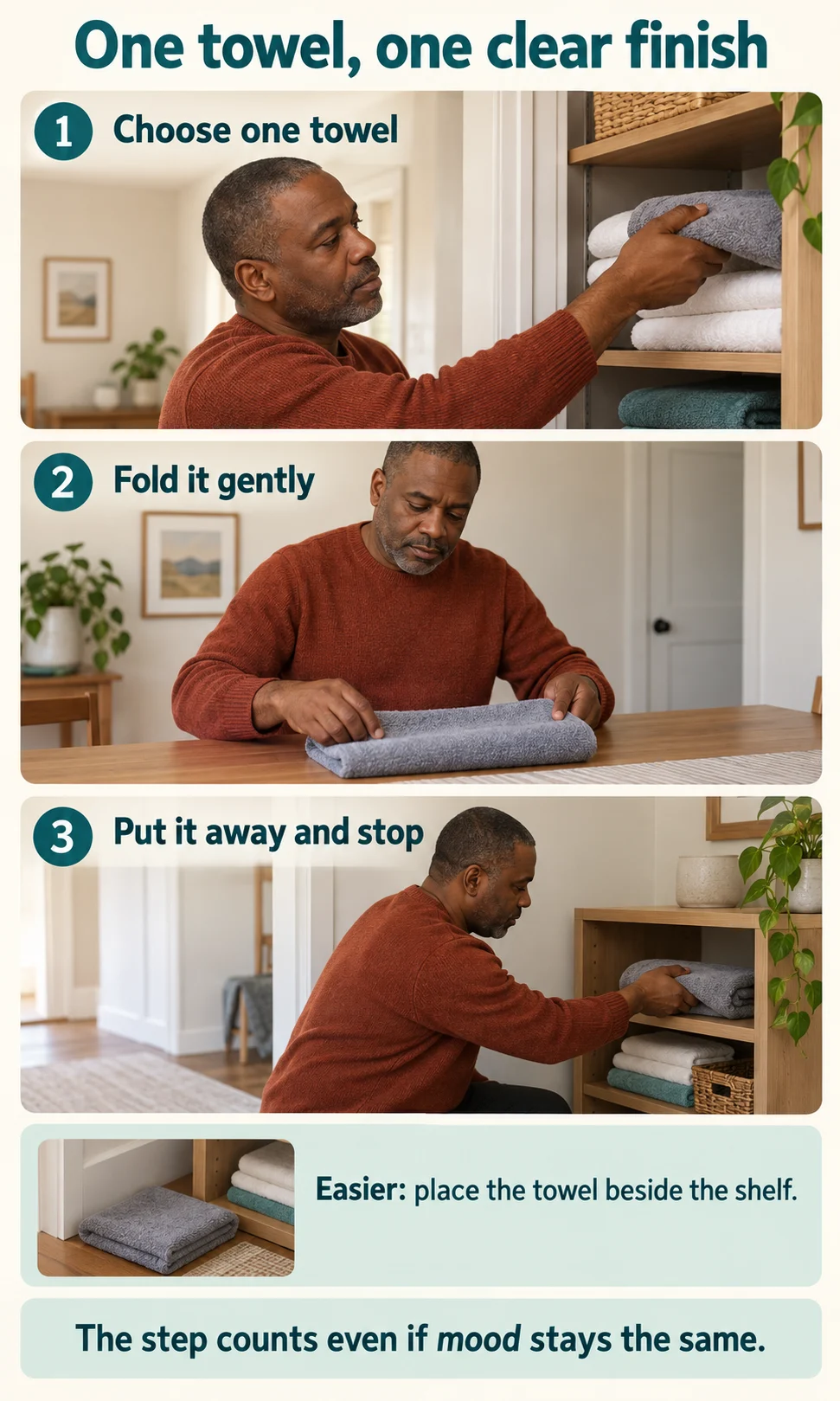
If starting an ordinary task feels overwhelming, choose one clear finish rather than the whole chore. Use one clean towel, a comfortable place to sit or stand, and an accessible shelf. Decide beforehand that putting away this one towel is the end of the exercise.
- Choose one clean towel; leave the rest of the laundry alone.
- Fold it gently on a comfortable surface, seated if that suits you.
- Put it on a reachable shelf, then stop.
Illustrative example: Alex sees a basket of laundry and feels unable to deal with it. Alex selects one towel, folds it at the table, and places it on a low shelf without emptying the basket. Completion means that one towel is put away; it does not require feeling cheerful or continuing with the next item.
If this is too much, place the towel beside the shelf and stop there. If reaching or folding is difficult, ask someone to bring the towel within reach or help with that movement. Pause for pain, significant exhaustion, or worsening distress, and choose a different action or seek support rather than pushing through.
What “chronic” tells you-and what it does not
Chronic describes the course over time; it is not a prediction that nothing can change. An episode can be prolonged, symptoms can recur, or low mood can remain persistent between harder periods. These patterns matter when planning support, but an online label cannot establish which one applies to you.
Persistent depressive disorder is one specific diagnosis associated with a long-lasting pattern. The American Psychiatric Association’s DSM-5-TR explanation describes depressed mood lasting at least two years in adults, most of the day and more days than not. Its explanation also makes clear that persistent depressive disorder should not simply be treated as another name for mild depression; see the separate guide to persistent depressive disorder, dysthymia and chronic depression for terminology.
Recurrent depression involves episodes returning rather than necessarily being present continuously. The World Health Organization distinguishes single and recurrent depressive episodes and notes that effective treatments are available. Use the following comparison to understand the language, rather than to diagnose yourself from a calendar.
Swipe horizontally to compare if the full table does not fit.
| Pattern | What it describes | Useful next step |
|---|---|---|
| Single episode | A period of depressive illness; it may improve with care. | Do not assume the first episode predicts lifelong symptoms. |
| Recurrent episodes | Depressive episodes return, with intervals of improvement. | Discuss prevention and early help for a return of symptoms. |
| Persistent symptoms | Low mood and related difficulties continue over a long period. | Seek assessment; duration alone does not establish a diagnosis. |
A duration threshold is part of clinical classification, not a waiting period before asking for help. You do not need to wait two years if low mood is persistent, worsening, or disrupting everyday life. A qualified professional can consider the whole pattern and other possible explanations.
Duration and day-to-day impact answer different questions. Still working or caring for others does not, by itself, settle whether someone has depression. If this is the part you recognise, the guide to high-functioning depression signs discusses the gap between outward activity and inner difficulty; that expression is not a formal diagnosis.
Improvement, remission, and preventing another episode are useful topics to discuss with your care team. NICE guidance for depression in adults includes continuing care and relapse prevention after improvement, as well as care for chronic symptoms. An action completed today cannot show that treatment is working or that a relapse will not occur.
Make room for something beyond chores
If the day has narrowed to obligations, try one familiar activity you once valued, rather than adding another household task. NHS Every Mind Matters encourages balancing routine, necessary, and enjoyable activities, while the American Psychological Association describes behavioural activation as re-engaging with helpful or pleasurable activities. The towel, song, and message examples here are editorial adaptations of activity-based support, not a validated treatment programme or a substitute for therapy.
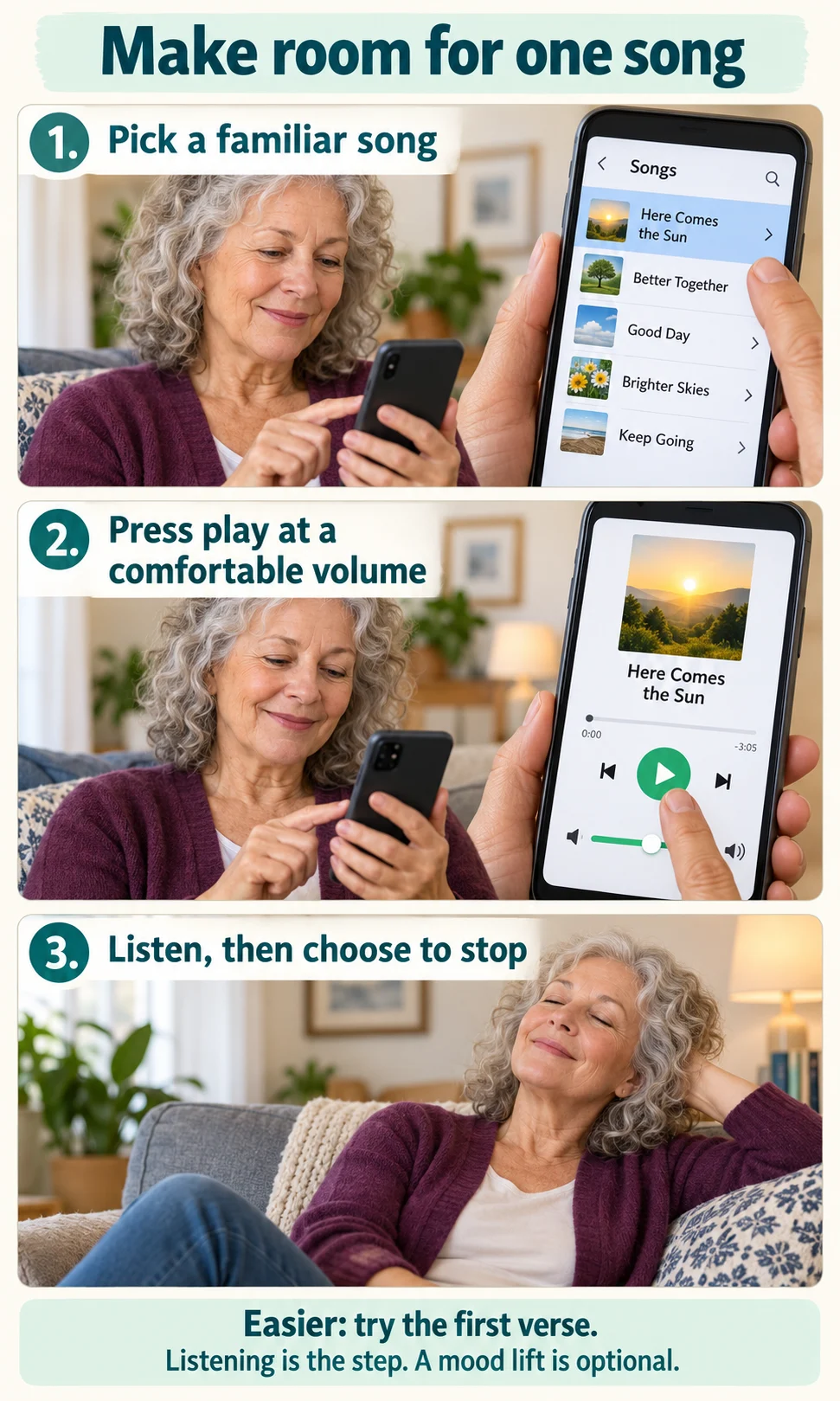
Illustrative example: Priya chooses one familiar song on a phone or radio and sits somewhere comfortable. Priya presses play at a comfortable volume, listens, and then chooses to stop instead of requiring a playlist or a better mood. Choosing and listening are the practice; the song does not need to produce pleasure immediately.
- Pick one familiar song on a phone, radio, or other available player.
- Press play at a comfortable volume.
- Listen, then choose to stop.
If the full song feels demanding, try only the first verse or choose the song without playing it yet. If sound is uncomfortable or inaccessible, choose a different familiar activity, such as looking at one favourite photograph. Repeat the same size another time if it suits you, or switch activities if it feels upsetting; neither choice requires a mood score.
Reconnect without needing a perfect conversation
If withdrawing has left you disconnected, choose one person who feels safe to contact. You do not need to explain your whole situation or apologise for every unanswered message. Avoid this exercise with someone who is threatening, coercive, or unsafe; support can come from another trusted person or a qualified service.
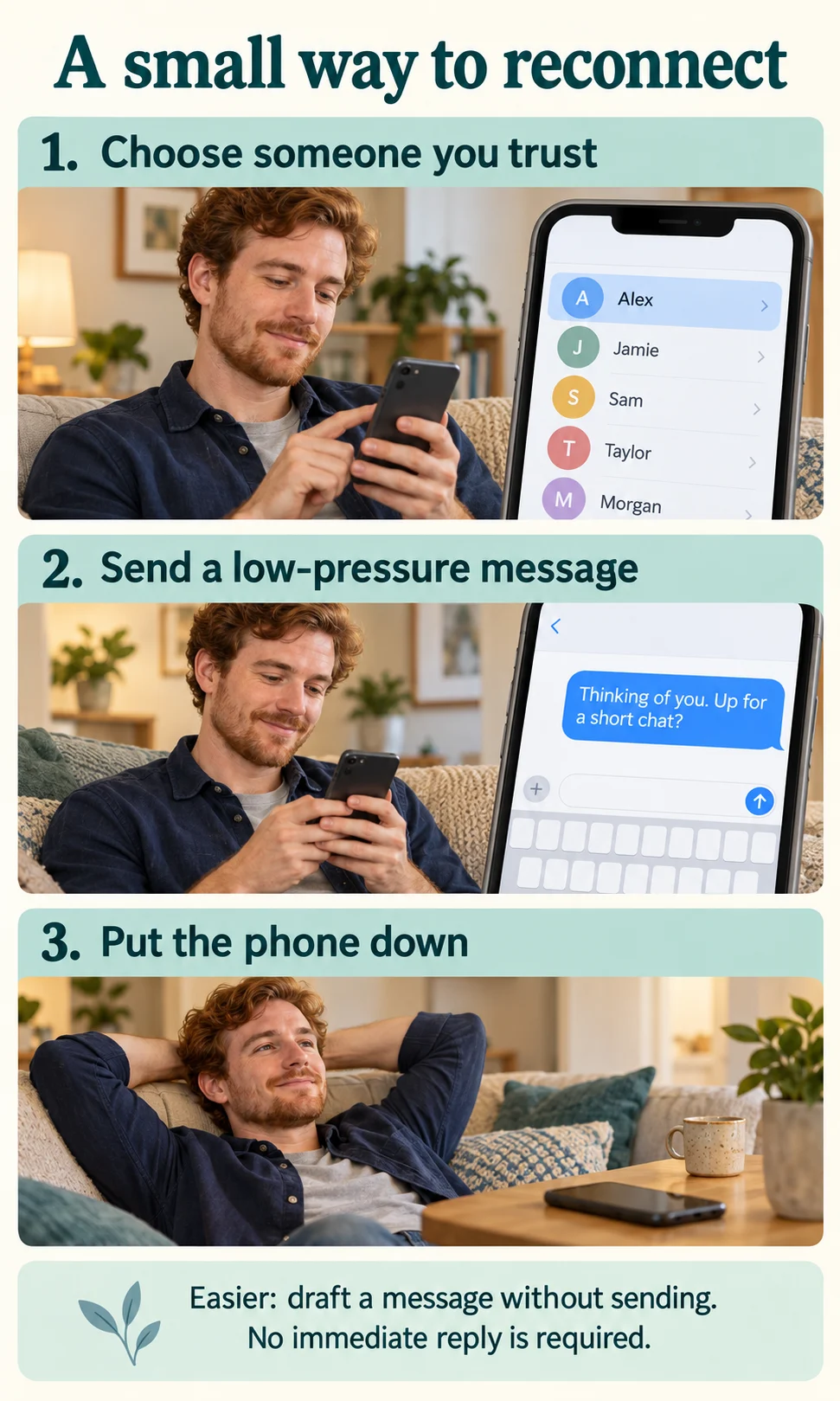
Illustrative example: Sam chooses a trusted friend and types, “Thinking of you. Up for a short chat?” Sam sends that message, puts the phone down, and leaves the friend free to respond when available. The chosen step is sending a low-pressure invitation, not securing an immediate reply.
- Choose someone you trust.
- Send a short message, such as “Thinking of you. Up for a short chat?”
- Put the phone down; you do not need to wait beside it.
If sending feels overwhelming, draft the message without sending it. You can also ask a trusted supporter to sit with you while you decide whether to make contact. Repeat, simplify, or choose another safe contact later; a delayed or missing reply is not evidence that your effort was pointless.
Choose your next step in Steady Day Studio
Choose routine, enjoyment, or connection, then select a small step, setup only, or a supported version. Steady Day Studio returns concrete instructions, an illustrative example, an easier option, and what to do next. It keeps your selections in the current page only and can open a one-page A4 action card, without diagnosing depression or asking you to rate your mood.

Steady Day Studio
Choose one manageable action. Get a clear finish, an easier version, and a next step.
Choose the area you want to make room for and the size that fits today. Your choices change the instructions, not a score. Nothing you select is saved by this experience or sent to a service.
Choose both options to see your action.
Illustrative example
Make it easier
A clear finish
What to try next
A completed step does not prove symptom improvement or recovery. Stop for pain, significant exhaustion, or worsening distress.
A method you can use without the controls
Choose one clean towel. Fold it on a comfortable surface, put it on a reachable shelf, then stop. If that feels too much, place it beside the shelf or ask someone to help. The chosen step counts without a change in mood.
For enjoyment, choose one familiar song, play it at a comfortable volume, listen, and stop. Try the first verse or select the song only if needed. For connection, choose a trusted person, send a short invitation to chat, and put the phone down; drafting without sending is a smaller option.
These everyday examples adapt activity-based support; they are not a validated therapy programme. The surrounding article explains the evidence and care boundaries. Selections last only while this page remains open. Your browser and website may have their own privacy policies.
Repeat, simplify, or ask for more help
After practising, decide whether the same size is manageable again. If it cost too much effort, shrink the action or ask for support instead of adding a streak target or catching up tomorrow. If you missed it entirely, choose one suitable step another time without treating the missed attempt as a verdict on recovery.
Professional assessment matters when symptoms persist, worsen, or substantially affect your life. The National Institute of Mental Health explains that evaluation can also consider medical conditions and medicines that cause similar symptoms. Mention unusually elevated or irritable periods with much less need for sleep, because understanding depression, anxiety or bipolar disorder requires more than looking at low periods alone.
Treatment can include psychological therapy, medication, or a combination, chosen with a professional according to your situation. The NHS treatment guide explains several approaches, including behavioural activation; the overview of types of psychotherapy for depression can help you prepare questions about therapy options. Do not stop or change prescribed medication because a daily exercise felt helpful or unhelpful.
At a care appointment, ask for a plan that connects treatment with the difficulty you most want help with. You might say, “My day has become only obligations, and even small activities take a lot out of me.” Agree what support to try, when to review it, and how to get help sooner if things worsen.
- Which treatment or support fits my symptoms and current limitations?
- Can you help me choose an activity-based approach that is manageable for me?
- When will we review the plan, and whom should I contact if I feel worse?
If you may harm yourself, feel unable to stay safe, or face immediate danger, seek urgent local help now. Contact your local emergency service, a crisis service, or the nearest emergency department, and involve a trusted person if safe to do so. Do not rely on the exercises or Studio during an immediate crisis.
Frequently asked questions
Is every case of depression chronic?
No. Depression can occur once, return in episodes, or persist over time. The course helps inform care but does not establish an individual prognosis.
Does two years of low mood prove I have persistent depressive disorder?
No. Duration is only one part of the assessment. Seek help when symptoms are persistent, worsening, or disruptive rather than waiting for a threshold.
Can long-lasting depression improve?
Yes, effective treatment is available and improvement is possible. The course and support needs differ between people. A long history does not justify assuming that further care cannot help.
What if the small exercise does not lift my mood?
The goal is to practise the chosen action, not force a mood change. Try the same manageable size again, simplify, or choose another suitable action. Persistent or worsening symptoms still deserve professional care.
Can Steady Day Studio diagnose me?
No. It suggests a practical action from your choices and offers an easier version. It does not provide a diagnostic score, a treatment recommendation, or proof of recovery.
Summary
Depression can be chronic, but that word describes a course rather than an inevitable future. Choose one suitable action, follow the demonstration, and allow a clear finish without requiring immediate relief. Repeat or simplify what is manageable while seeking appropriate care for persistent or worsening difficulties.