




Mental wellness concerns can have a name, but recognizing a familiar symptom is different from receiving a diagnosis. Start with an accurate description of what is happening; a useful label should help explain the pattern and guide support without becoming a verdict on your character.
You do not have to identify the condition before your concern deserves attention. The practical task is to keep three things separate: what you notice, what might explain it, and what you need next. Those questions remain useful whether you are waiting for an assessment, have just received a diagnosis, or feel unsure about one.
If safety is at risk: thoughts of suicide or urges to harm yourself need immediate support. If you may act on them, cannot keep yourself safe, or someone is in immediate danger, contact local emergency services or go to the nearest emergency department. A diagnostic label is not a prerequisite for urgent help.
What can a name explain about a mental health concern?
A name can identify a feeling, describe a symptom, or summarize an assessed condition. Its value depends on which job it is doing. “I feel anxious about tomorrow” communicates an experience; it does not, by itself, establish an anxiety disorder, its cause, or the treatment that would fit.
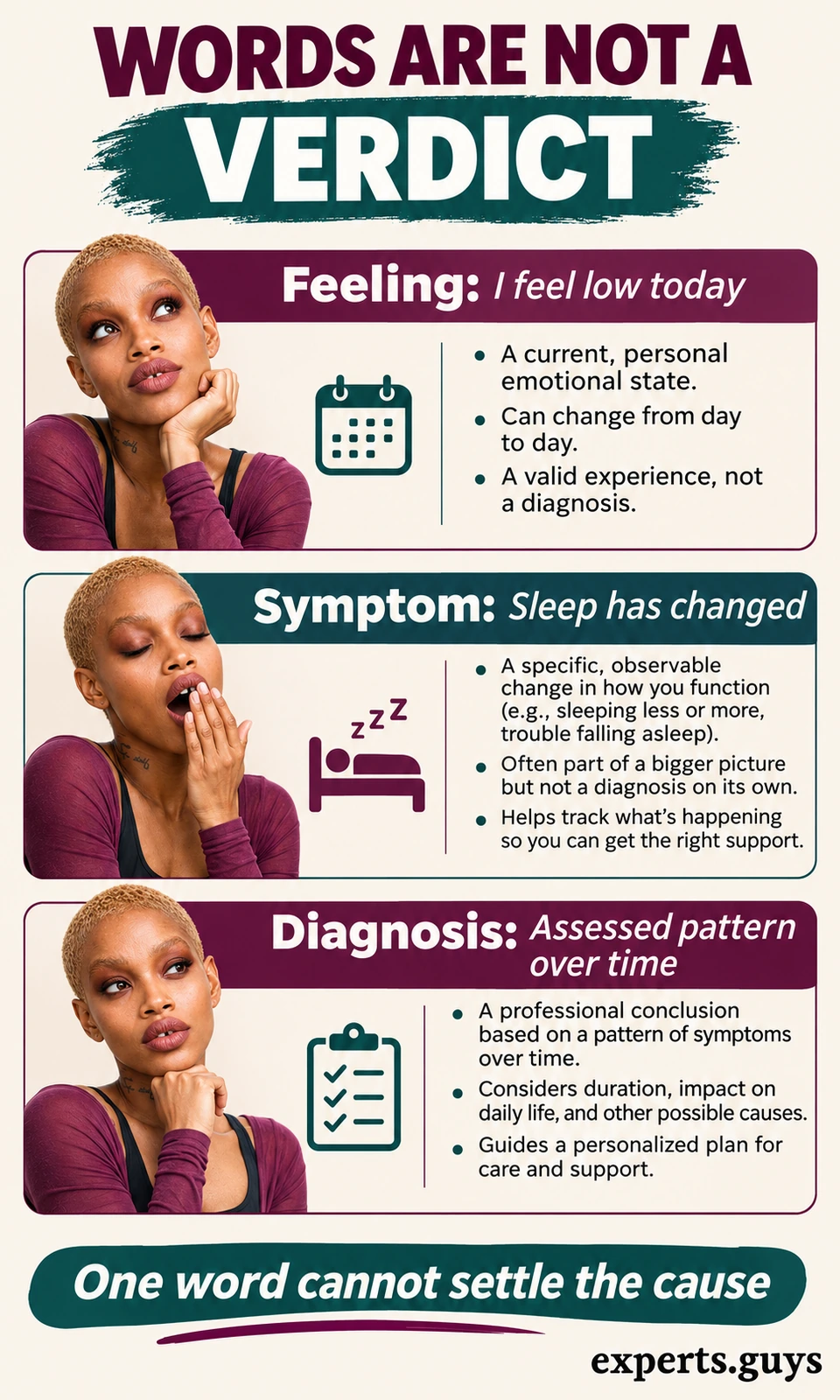
That distinction matters when a word suddenly makes your experience feel recognizable. You may encounter a description of emotional numbness, persistent worry or depression and think, “That sounds like me.” Recognition gives you a question to investigate. It does not require you to accept every detail attached to that term.
- A description tells someone what you are experiencing.
- A possible explanation remains something to consider rather than a settled conclusion.
- A diagnosis brings clinical judgment to a pattern, with its history and alternatives.
- A support request identifies something another person could help you do.
A label is a category, not your complete explanation
Two people can use the same diagnostic term while describing different daily obstacles. One may be struggling with meals; another may find concentration hardest. The category can help organize care, but the details determine what an ordinary morning actually requires. A label that never connects back to those details has left part of the explanation unfinished.
Think of the name as a heading rather than an entire biography. It should leave room for your circumstances, preferences, strengths and relationships. This is a practical way to use clinical language: keep what helps communication and ask for clarification where it stops explaining your experience. You do not need to make the term your preferred description of yourself.
There is also a difference between naming a pattern and explaining its origin. A diagnostic term may organize what has been happening without identifying one cause. An account of your circumstances may explain pressures without determining whether diagnostic criteria are met. These answers can complement each other; neither should be stretched to do every explanatory job.
For instance, a changed rehearsal schedule can be part of someone’s story without being the whole story. A useful explanation would preserve that context rather than erase it once a health term appears. In the same way, the presence of a stressful situation does not make a health assessment irrelevant. Keep both kinds of information available.
The distinction between the name and its usefulness also prevents a false choice. You can value an assessment while disliking some of the associations you have heard about its terminology. Equally, feeling relieved by a name does not mean every future difficulty must be interpreted through it. Mind’s explanation of diagnosis recognizes both relief and the feeling that a label does not capture the whole person.
Why one familiar symptom cannot identify the cause
Fatigue is a useful example because it describes an experience without settling its explanation. In the illustration, a dancer is tired after a late rehearsal and is also shown tired at home. Those scenes supply context, not a clinical conclusion. We cannot tell from a face or a setting whether someone has a mental health condition.
Medical conditions and some medicines can produce symptoms that resemble depression; physical and mental health difficulties can also coexist. The NIMH depression guide explains why an assessment may include an interview, physical examination and appropriate tests. This is a reason to keep alternatives open, rather than deciding that a symptom must be either “only physical” or “only psychological.”
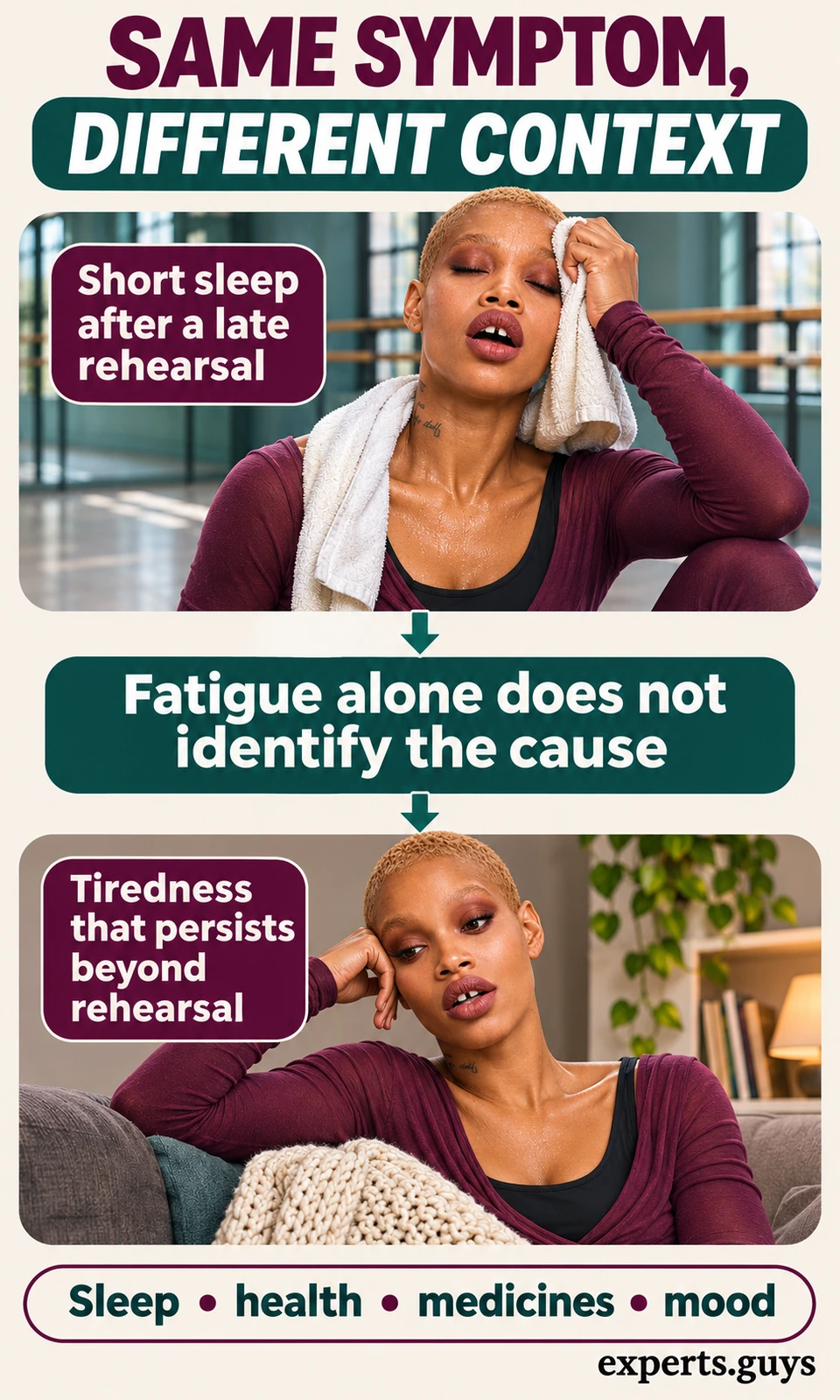
A context can make a symptom more understandable without making it unimportant. “I have been under pressure” and “I need help with the effects” can both be true. Conversely, a plausible explanation can be incomplete: knowing rehearsals have been late does not tell us why a problem continues after the schedule changes.
| What the name helps with | What still needs an answer |
|---|---|
| Finding a shared term for a concern | Which parts describe your experience accurately? |
| Organizing a clinical discussion | What evidence and alternatives support the assessment? |
| Finding relevant information | Does that information apply to your situation? |
| Discussing a care plan | What is the plan meant to change in daily life? |
If the word you are trying to understand is depression specifically, the guide to clinical depression versus depression covers its everyday and clinical meanings in detail. Here, the useful next question is different: does the name help explain your concern, or are you asking the word to answer something it cannot?
The useful test: after hearing the label, can you explain something more clearly than before? You might understand why a particular question matters or which difficulty the next appointment will address. If you have only acquired a frightening word, the explanation needs more work; that does not make your experience less real.
How can you describe the concern without turning it into self-judgment?
Use an observable description before assigning a character judgment or a diagnosis. “I stopped joining meals” gives another person something specific to understand. “I am lazy” supplies an explanation that has not been established and can hide the very difficulty you are trying to discuss.
Replace a verdict with a description
This short spoken comparison fits the moment when you catch yourself using a harsh label. It is an editorial language aid, not a diagnostic test or a treatment exercise. You need no notebook, phone, timer or special setting; you can say the words quietly to yourself or use them in a conversation.
- Notice the verdict. Identify the conclusion you have jumped to, such as “I am lazy.” You do not have to argue with it or prove the opposite.
- Describe the action or change. Replace it with something that could be explained concretely: “I stopped joining meals.” Keep the description accurate rather than choosing the most dramatic version.
- Leave the cause open. Add “I do not know why yet” when that is true. This keeps a useful question available instead of replacing one unsupported conclusion with another.
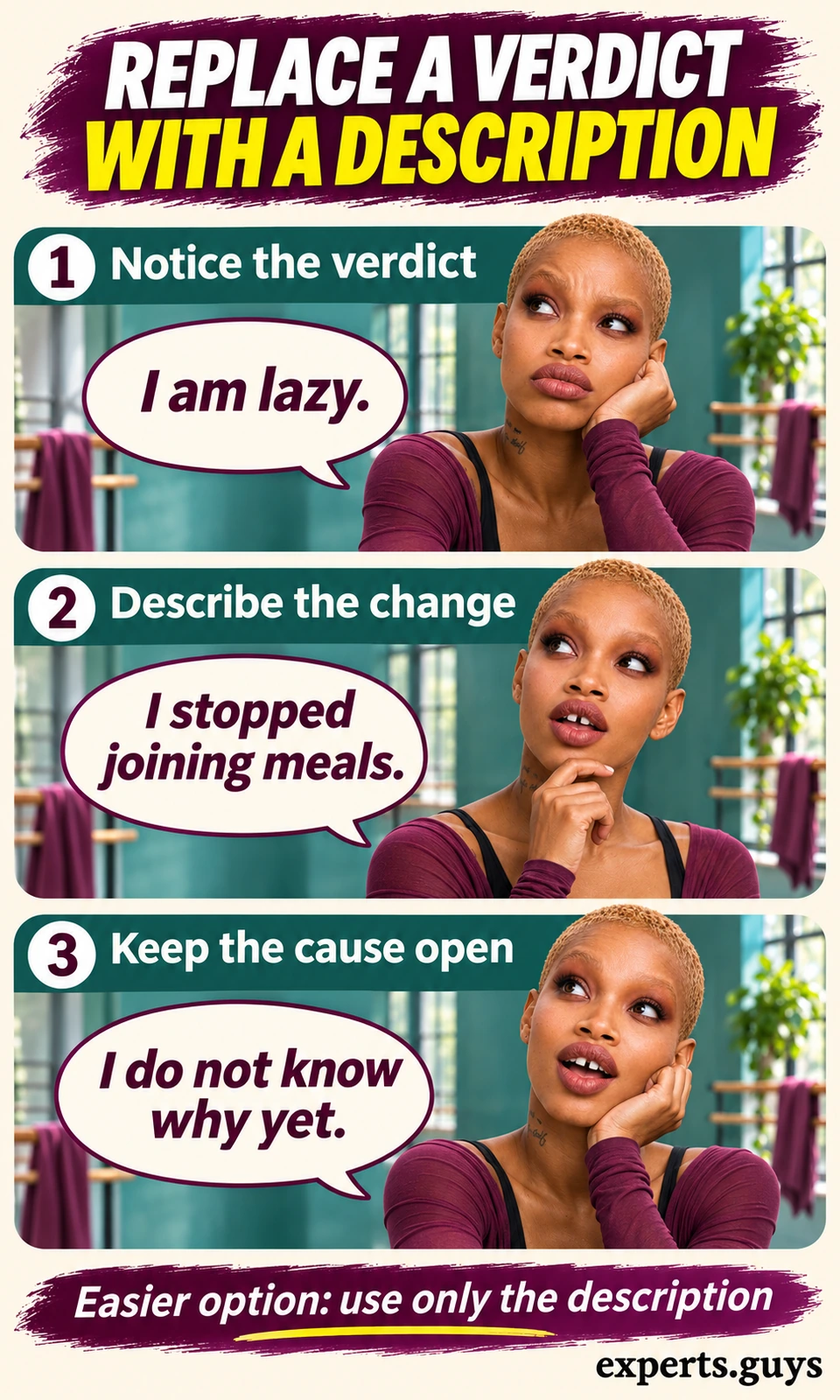
In that example, the completed step is the change in wording. It does not require you to feel kinder toward yourself immediately, and it does not establish whether a health condition is involved. The benefit of the format is practical: another person can ask what has made meals difficult rather than having to debate your character.
The common mistake is replacing the original verdict with an equally certain medical claim: “I am not lazy, so this must be depression.” That closes the question too early. A more accurate version is, “I am missing meals, and I want to understand what is getting in the way.” The concern stays serious while its explanation stays open.
If three steps feel demanding, use just the description. “I have stopped joining meals” is enough to begin. If speech is not accessible, use your usual communication support or ask a trusted person to help convey that one point with your agreement. The task is clearer communication, not performing a perfect sentence.
Compare two ordinary moments, without creating a diary
When “I am not myself” feels too broad, compare one familiar activity before and now. Choose a moment you remember well enough to describe honestly. You are giving context for a conversation, not calculating a score, reconstructing every day or testing yourself against an ideal version of your life.
The illustrated example is deliberately ordinary: “Before, I ate breakfast before rehearsal. Now, breakfast stays untouched.” It shows what has changed without deciding why. That distinction is the entire job of the comparison; neither the uneaten food nor the person’s expression identifies a diagnosis.

The explanation becomes more useful when it stays close to the activity. “I prepare food but cannot settle to eat” describes a different obstacle from “I cannot afford groceries,” although both can result in a missed meal. Do not smooth those differences into a vague statement about motivation. The practical response depends on what is actually happening.
There is no need to choose the worst moment you can recall. An ordinary, representative example is often easier to understand than an absolute claim such as “I never do anything.” If the difficulty comes and goes, say so. “It happens on some mornings” preserves information that “everything is always impossible” would lose.
Likewise, avoid turning an uncertain memory into a precise date. “I think this began around the schedule change” is more informative than a confident date you do not trust. If you cannot identify a clear before-and-now contrast, describe the present obstacle alone. Lack of a neat comparison does not disqualify the concern.
Keep your words separate from someone else’s interpretation
A relative might call the change stress; a friend might call it burnout; an online discussion might suggest a diagnosis. Each person may be trying to help, but agreement is not evidence by itself. You can acknowledge the suggestion while returning to what you know: “That might be worth discussing. What I can describe is that eating has become difficult.”
A helpful conversation does not require the listener to solve the cause immediately. It can end with an accurate shared understanding of one obstacle. That is a different outcome from reassurance alone: “You will be fine” might be warmly intended while leaving the practical difficulty untouched.
Check whether the listener has understood the distinction you meant to make. If “I stopped joining meals” is heard as “I dislike everyone’s cooking,” you can correct that misunderstanding without adding a diagnosis: “I am describing a change in what I can manage, not criticizing the food.” The correction preserves the useful detail rather than expanding the disclosure.
The NIMH guidance on talking about mental health supports describing symptoms clearly and asking questions. The spoken examples here adapt that communication principle; they are not validated scripts. For the separate task of selecting a service and arranging an initial appointment, use the guide to choosing mental health counseling.
What you have accomplished: you have turned a judgment into information someone can respond to. You can keep your preferred everyday language while allowing a professional to ask more specific questions. You do not need to learn a diagnostic vocabulary before you can explain a meaningful difficulty.
What should an assessment or diagnosis add to the picture?
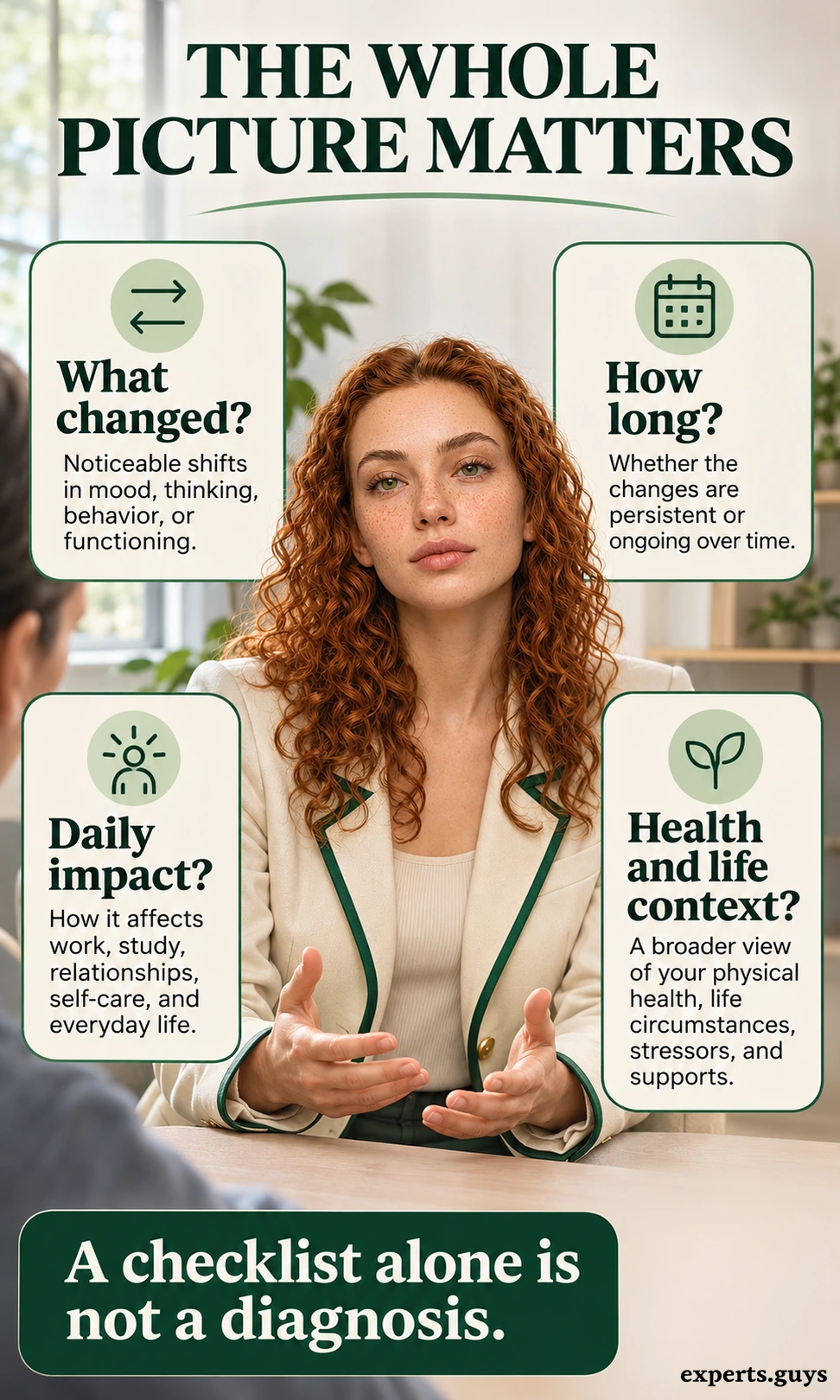
An assessment should connect the concern with its history, context, effects and possible explanations, then make the next step understandable. It should give you more than a name to search. The central question is what the assessment helps explain and what follows from it.
The NHS description of a mental health assessment includes mental and physical health, relationships, living circumstances, safety and personal priorities. Those are examples of the wider picture; the format and professional roles vary between services and countries. An assessment is not an exam you pass by presenting your experience in a particular way.
Why a questionnaire cannot finish the explanation
A screening questionnaire can identify signs that merit further attention. Its result is an input to assessment, not a complete account of the cause, history or support you need. MedlinePlus explains the role of mental health screening and the possible need for further evaluation or checks for physical contributors.
That is why a search result that says “you match these symptoms” has a narrower meaning than it may appear to have. The items may be relevant, but the conclusion still depends on information the page cannot establish. Do not use a low score to dismiss a serious concern or a high score to select a treatment yourself.
Imagine two people giving the same answer to a question about poor sleep. One has a disrupted work schedule; the other describes a major change in mood and activity. The shared answer makes sleep worth discussing. It does not make their situations interchangeable or establish that either person has a particular disorder.
Another distinction worth mentioning during an assessment is whether reduced sleep comes with exhaustion or with unusually increased energy and activity. Those are different descriptions. Bipolar disorder involves changes in mood, energy and activity, as the NIMH overview of bipolar disorder explains; feeling tired or having an occasional good day does not establish that diagnosis.
Ask what the label explains, what remains uncertain and what changes
Use this conversation when a diagnostic term has been offered but its practical meaning remains unclear. The purpose is to understand the reasoning and plan, rather than obtain a second opinion from an internet checklist. You can ask during the conversation or through the service’s usual follow-up route.
- Ask what it explains. “Which parts of what I described led you to this conclusion?” This connects the name with your actual experience.
- Ask what remains uncertain. “Is there anything you still need to understand, and what might change the assessment?” This makes uncertainty discussable rather than leaving you to infer it.
- Ask what changes in the plan. “What are we trying to improve first, and what is the next step?” You should be able to connect the plan with a problem that matters to you.
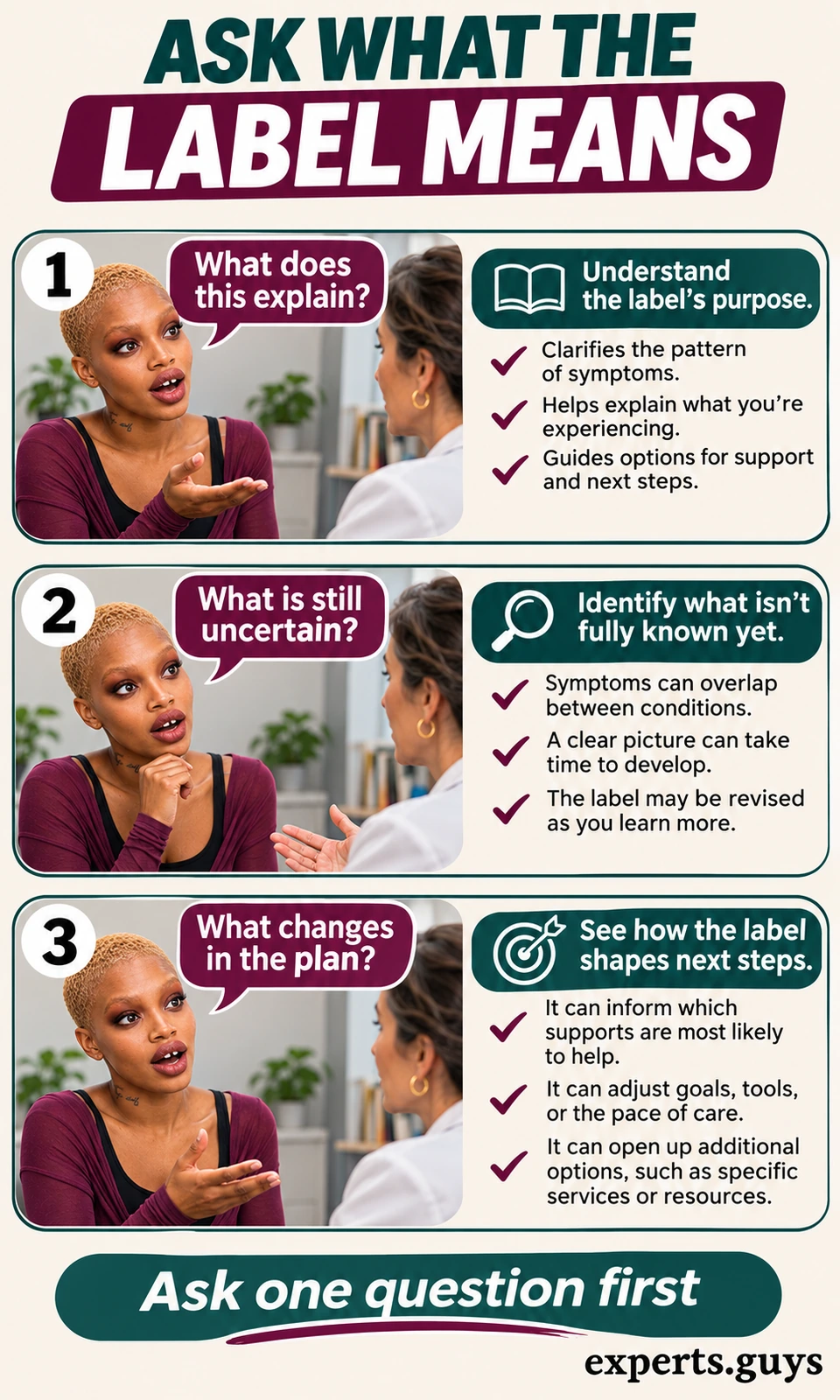
A completed conversation does not require agreement about every word. Its useful outcome is that you can explain the current reasoning, one unresolved question if there is one, and what happens next. If you leave knowing only the diagnosis name, ask for the practical explanation in ordinary language.
For example, someone might be told that further assessment is needed while support for disrupted sleep begins. The uncertainty and the immediate plan can coexist. This is an illustrative possibility, not a recommendation for a particular treatment: the appropriate plan depends on the individual assessment.
The common mistake is treating “working diagnosis” as either a guarantee or an admission that nothing is known. Ask the person using that term what they mean in your situation. It may describe the best current explanation while more information is gathered; the useful detail is what is being clarified and whether it affects the plan.
If asking all three questions feels like too much, begin with “What changes in the plan?” That focuses on the next decision. You can ask the clinician to explain it again or involve a trusted supporter if you wish. The smaller version is complete when the next step makes sense, not when every uncertainty disappears.
When the label does not feel like a good fit
Be specific about the mismatch. “This explanation does not seem to include the periods when my activity changes” gives a clinician something to reconsider. “I do not like the sound of that condition” also deserves a conversation, but it raises a different question about the label’s meaning and associations.
You can ask for the reasoning, correct information that was misunderstood, and discuss whether another opinion would help. NAMI’s guidance on understanding a diagnosis describes diagnosis as a tool for treatment and recognizes that it may be refined as more information becomes available. Revision is not, by itself, proof that your earlier distress was imagined.
Do not stop or change prescribed medication on the basis of a label you have read about online. If a treatment is causing problems or you question its purpose, raise the specific concern with the prescriber and discuss the options. The goal is an understandable, appropriate plan, not winning an argument over terminology.
For depression specifically, the guide to types of depression explains related terms. It is useful background after a term has come up; it is not a menu from which to choose your own diagnosis. Keep the question anchored to the pattern being assessed and the decision you need to understand.
How can you get useful support without making the label your whole story?
Ask for help with a concrete need and decide how much personal information you want to share. A trusted person can understand “Please sit with me while I eat” without receiving a diagnosis, a medical history or an explanation you do not yet have. Support and disclosure are related choices, but they are not the same choice.
Make one request and keep one boundary
This fits an ordinary conversation with someone who is safe, willing and able to help. It does not fit a coercive relationship or replace urgent care. Choose a request that respects both people’s capacity; the other person may need to say what they can realistically offer.
- Choose the person and moment. Speak privately to someone you trust, when they can give the request attention. You do not have to share it with a whole class, workplace or family group.
- Name one useful action. For the meal example: “Please sit with me while I eat.” This identifies companionship as the request; it does not ask the person to diagnose, supervise treatment or make you finish food.
- Set the information boundary. If it fits, add: “I do not want to discuss a diagnosis.” You can accept practical company without agreeing to answer further personal questions.
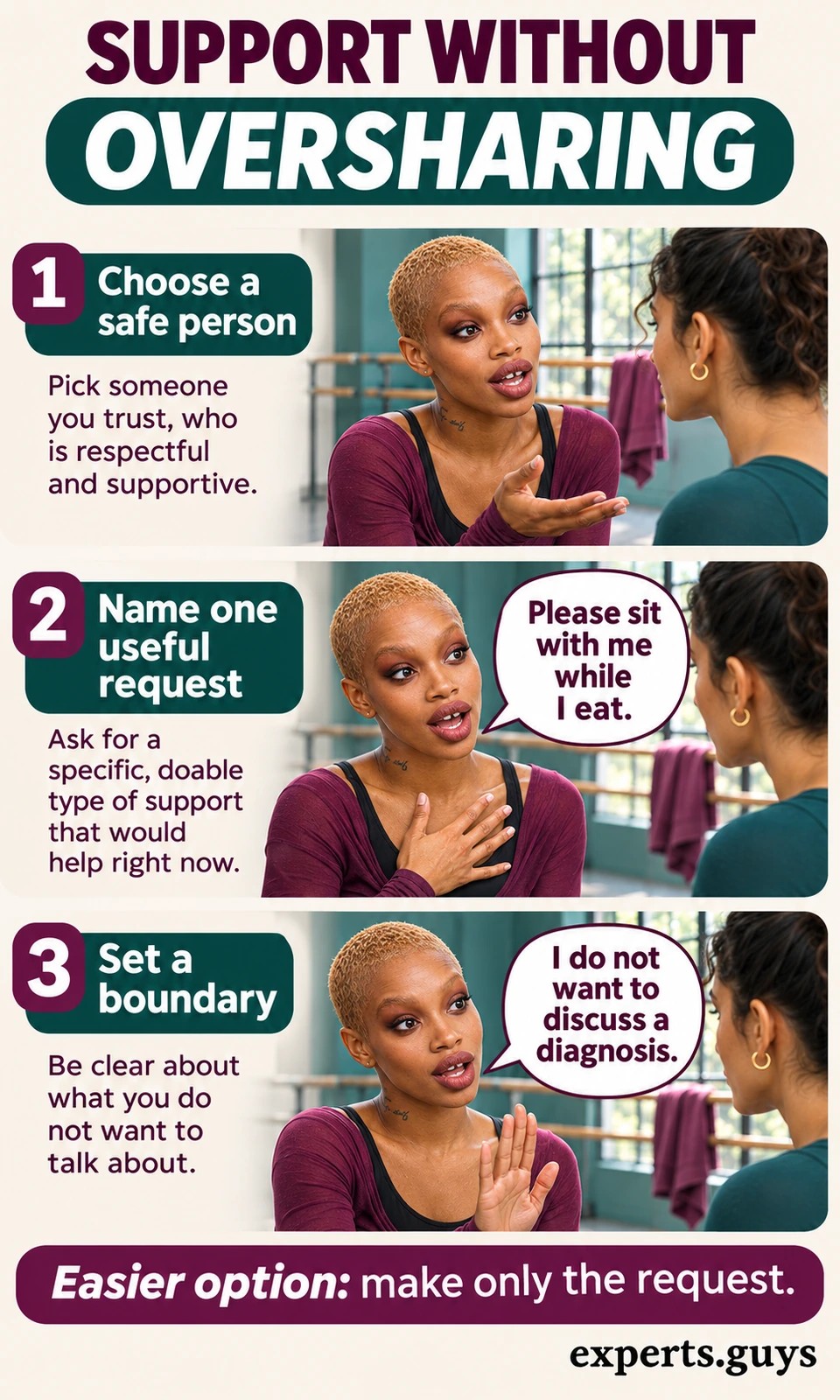
The observable result is modest: the other person understands what you are asking and what you prefer to keep private. They may agree, suggest another time or explain a limit. A respectful response does not require them to understand every mental health term, and your request has not failed simply because you still feel uncomfortable.
The common mistake is making the request so broad that nobody knows how to respond: “I need you to fix this.” Narrow it to the action that would help in that moment. Another mistake is offering more private information than you want because you feel obliged to justify the request. You can explain the need without presenting a case for deserving kindness.
If adding a boundary feels difficult, use the easier version and make only the request. If the person asks for details, you can decide then whether to continue. If you communicate without speech, use your usual accessible method; the choice about what to share still belongs to you.
Someone who dismisses or pressures you may not be the right person for this conversation. You do not have to persuade that person before seeking a safer source of support. For the distinct question of receiving someone else’s disclosure respectfully, why public depression stories matter explores the limits of judging a person’s experience from appearances.
Let urgency follow the difficulty, not the certainty of the name
A concern does not have to be fully explained before action is appropriate. When symptoms persist, worsen or interfere with everyday life, arranging an assessment is a reasonable next step. When there is immediate danger, urgent help takes priority. When symptoms are mild and brief and daily tasks remain manageable, ordinary support may be useful while you decide whether more help is needed.
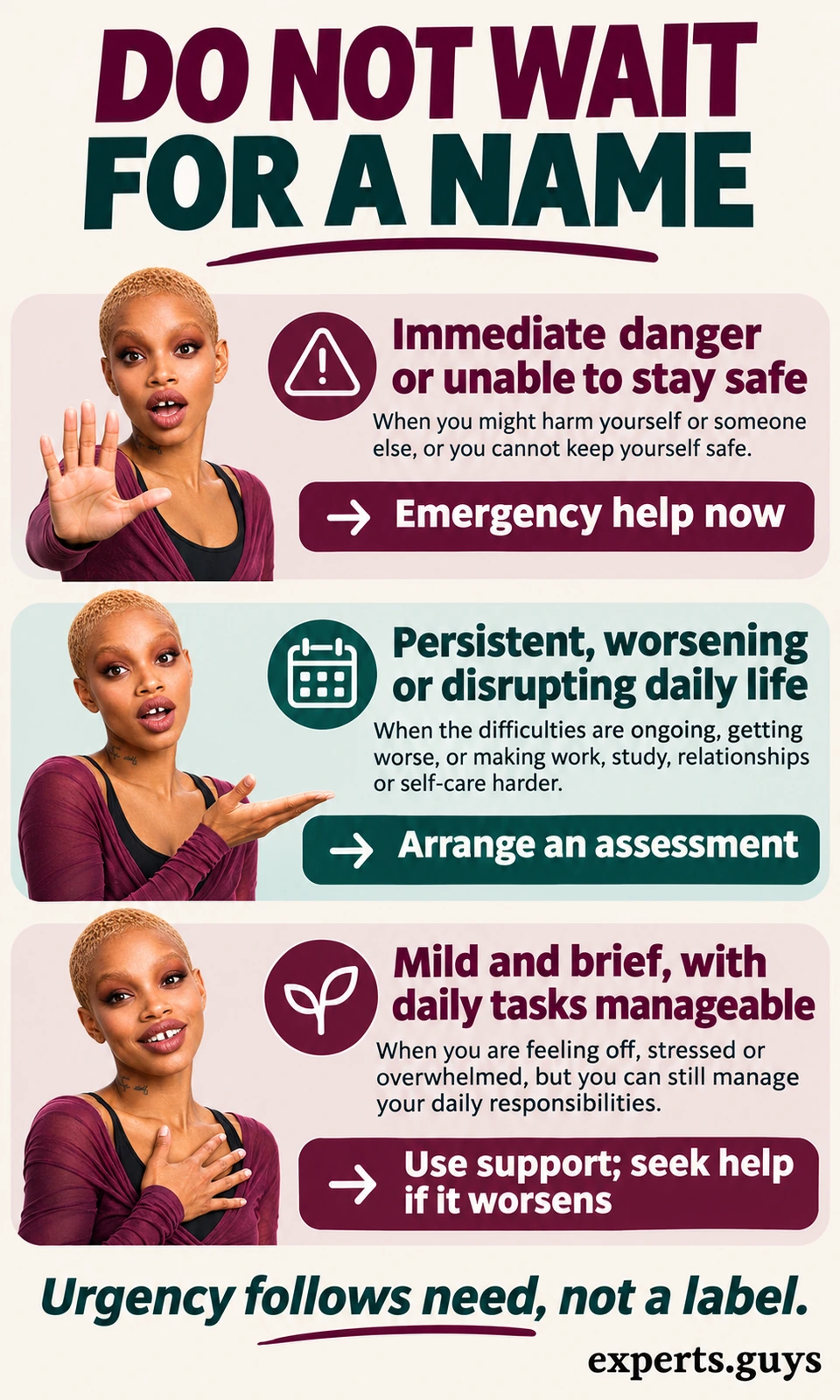
The NIMH guide to deciding when to seek help uses duration, severity and everyday functioning together. It highlights severe symptoms lasting two weeks or more, but that is not an instruction to wait when symptoms are worsening or safety is at risk. The important distinction is between a guide to recognizing need and a rule that delays assistance.
Consider the difference between “I cannot name it yet” and “nothing needs to happen yet.” The first is an honest statement about uncertainty. The second is a decision that needs its own justification. If the concern is already stopping basic activities, uncertainty about the term does not remove the obstacle.
While an assessment is pending, you can still request practical company, use the support already available to you and tell the service if the situation changes. Those actions do not require a new self-diagnosis. They also should not become a promise to manage alone until a scheduled appointment, whatever happens.
Use the name where it helps, and keep your own priorities visible
In a clinical conversation, a diagnostic term can help discuss treatment. With a friend, a plain description and request may be enough. In a workplace or formal service, information requirements and privacy rules vary, so avoid assuming that an informal conversation and an official disclosure have the same consequences.
You do not need to settle every identity question at the moment a term is introduced. It is reasonable to ask what it means, consider what you want to share, and return to the immediate difficulty. The practical priority is a clearer understanding and an appropriate next action, with enough room for your experience to be more detailed than the label.
Questions that can remain after the first conversation
What if I do not relate to every symptom in a diagnosis description?
An information page describes a range of possible experiences, rather than a personal profile that everyone must match exactly. A mismatch is worth discussing when it affects your understanding. Explain which parts fit and which do not, and ask how the assessment accounts for that difference. Do not use a webpage as a checklist for accepting or rejecting a diagnosis yourself.
Can I ask what a term means without agreeing to a treatment?
Yes. Asking for an explanation is part of understanding the options, not an agreement to every proposed intervention. Ask about the purpose, alternatives, benefits and risks of the recommendation before deciding with the clinician. If you are already taking prescribed medication, discuss concerns with the prescriber rather than changing it on your own.
What if a family member insists on a different label?
You can separate their observation from their conclusion. “You have noticed I am missing meals” may be useful information; “therefore you have this condition” is a further claim. You can discuss the observation without accepting the diagnosis they suggest. If you want them involved in an assessment, clarify what you would like them to contribute and what you prefer to discuss privately.
Does a changed diagnosis mean the earlier support was pointless?
Not automatically. New information can refine an assessment, and some support may address a difficulty that remains relevant. The practical question is what the revised explanation changes about the plan. Ask which parts continue, which need reconsidering and why. A change in terminology alone does not show whether a particular intervention helped you.
Do I have to explain the name to friends immediately?
No. You can take time to understand it yourself and choose whether a friend needs that information. For an ordinary support request, describe the action you want rather than giving a complete medical explanation. Formal workplace, insurance or service processes can have different information requirements; check the relevant process before assuming that an informal disclosure will serve the same purpose.
What if the most accurate answer is still I do not know?
Keep that answer where it belongs: with the explanation, not with the existence of the difficulty. You can be uncertain why meals, sleep or conversation have changed while being clear that the change matters. Ask for help with the actual obstacle and clarification of the unknown part. Certainty is not the price of being taken seriously.
Choose the next step that matches your uncertainty
If you are stuck on a harsh judgment, replace it with one accurate description. If a diagnosis has been offered but remains confusing, ask what it explains and what changes in the plan. If you need company or practical help, make one specific request without disclosing more than you choose.
A name becomes useful when it helps you understand a real difficulty and respond to it. You can take the concern seriously while its explanation remains open, and you can use a diagnosis without allowing it to speak for every part of your life.









