



Bruce Springsteen’s public account of depression matters because it challenges the idea that achievement, stamina or admiration tells us how someone feels privately. His story offers a reason to take distress seriously without turning a celebrity’s experience into a diagnosis or treatment plan for everyone else. The useful next step is to make disclosure easier to receive, not to decide who looks depressed enough to deserve support.
What did Bruce Springsteen actually reveal?
Springsteen discussed depression openly around the publication of his memoir, Born to Run, in 2016. In his televised conversation with Anthony Mason, he described prolonged episodes and acknowledged the support of his wife, Patti Scialfa. These were accounts of his experience at that time, not a statement about his health today.
The 2016 Vanity Fair profile also covered therapy and medication. Those details matter because the public story included receiving help, not simply overcoming difficulty through fame or willpower. They do not establish which treatment would suit another person, and this article does not speculate about his current care.
A performer is seen through a narrow window: the concert, interview, recording or public appearance. The work can be real and accomplished while the audience still knows very little about the effort behind it. A person’s capacity to do one demanding thing is not a complete account of their sleep, relationships, enjoyment or private distress.
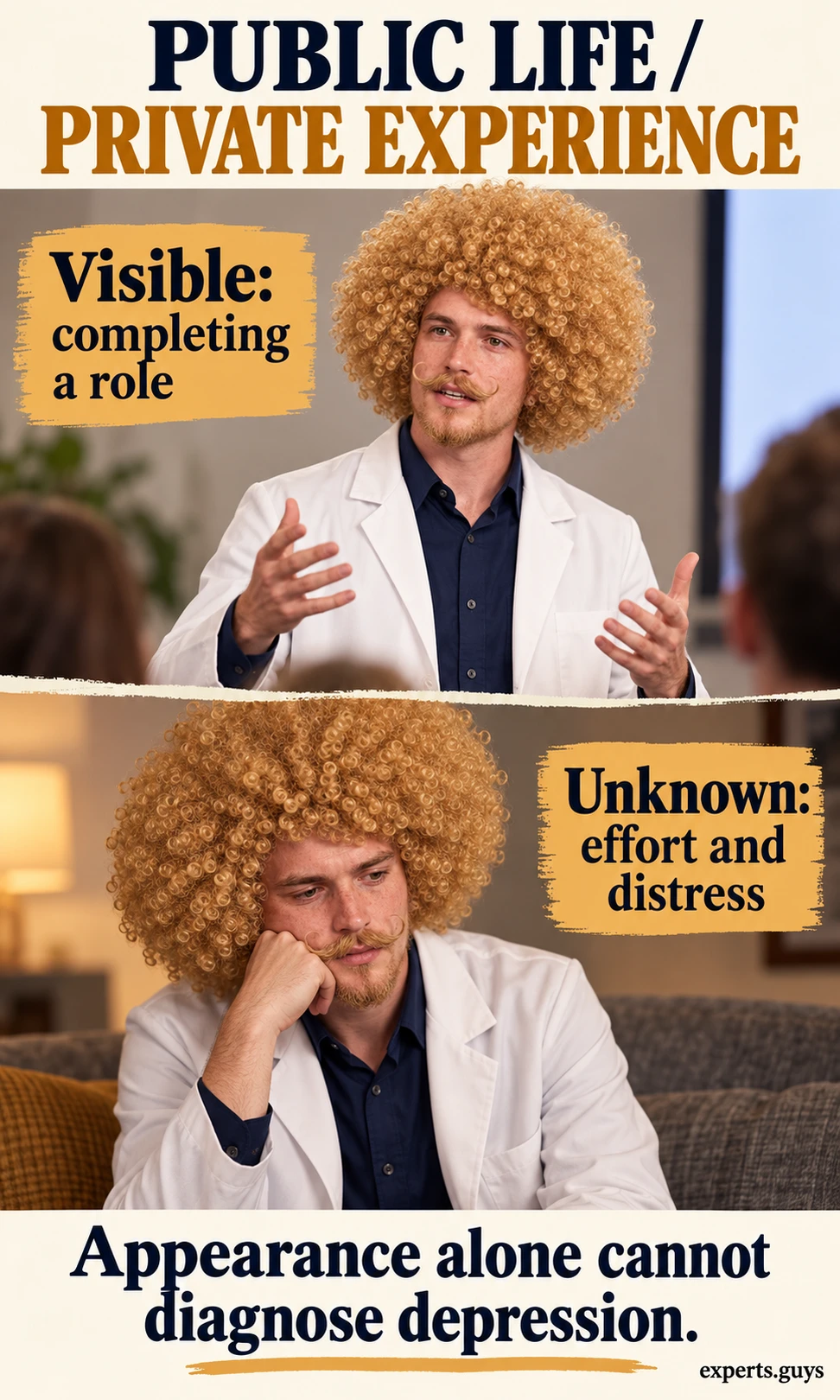
The distinction is especially useful when a familiar public figure seems inconsistent with someone’s mental picture of depression. Rather than replacing one stereotype with another, the disclosure asks us to stop using a public image as a health assessment. There is no requirement to look visibly defeated before a concern deserves to be heard.
- He chose to describe depression publicly.
- He discussed support and treatment in historical interviews.
- His account does not disclose a complete medical record.
- An old interview cannot establish his present mental health.
Keep the history separate from today’s assumptions
The date belongs beside the account because the story is often recirculated without its original context. A headline shared today may describe an interview from years earlier. Treating it as a new announcement can mislead readers and invite unwarranted claims about a person’s current condition.
The cleanest way to discuss the story is to identify the interview, describe the limited facts it contains, and stop where the evidence stops. Avoid assigning an undisclosed diagnosis, interpreting an appearance as a symptom, or treating a lyric as a clinical record. A song can resonate with depression without proving the writer’s condition at the time it was composed.

The same boundary protects ordinary people. Someone who mentions depression has not automatically agreed to answer questions about medication, family history or a difficult period at work. Receiving the information respectfully means allowing the speaker to decide what remains private.
Why does success make depression easier to overlook?
Success gives observers an obvious explanation for how a life is going: the person is productive, valued or financially secure. But those are observations about circumstances and output. They do not tell us whether the person is enjoying life, struggling to function outside work, or using considerable effort to maintain a familiar role.
This is an interpretation problem rather than proof of a hidden diagnosis. A colleague who completes a presentation may be well, unwell or dealing with something unrelated to depression. The mistake is assuming that the presentation settles the question. Equally, quietness or fatigue alone should not be treated as evidence of depression.
Public stories can make it easier to imagine that the visible and private parts of a life differ. That is a reasonable editorial interpretation of their value, not evidence that one celebrity interview has produced a measurable reduction in stigma. Recognition can open a conversation; it does not guarantee access to care, a supportive response or recovery.
Avoid turning recognition into a comparison test
A reader may think, “If someone with so much can struggle, perhaps my feelings are real.” Another may think, “My life is easier than his, so I should cope better.” The first interpretation permits attention to a difficulty; the second turns another person’s history into an unfair eligibility test. Neither wealth nor hardship creates a reliable threshold for who deserves help.
The practical question is what has changed for the individual and how it affects their life. Persistent low mood or loss of interest, significant distress and difficulty with ordinary activities merit attention. The words themselves also need context: the difference between everyday low mood and a clinical condition is explained in our guide to clinical depression versus depression.
| What you notice | What it establishes | What remains unknown |
|---|---|---|
| Someone finishes demanding work | They completed that task | How they feel outside it or what it cost them |
| A person shares a diagnosis | They chose to disclose that information | Their full history and preferred support |
| A familiar story feels relatable | It resonates with your experience | Whether the same diagnosis or treatment applies |

The phrase “high-functioning depression” is sometimes used informally for someone whose difficulties are not obvious. It should not become a diagnosis assigned from a distance. It can describe an observer’s impression, but that impression is not a substitute for understanding symptoms, their course and the person’s circumstances.
Let the story challenge a belief, not supply a label
A useful change in perspective is modest: “I may not know how this person is doing.” That leaves room to ask and listen. It avoids both dismissal and the opposite error of searching every successful person’s behavior for concealed illness.
How can you make a private conversation easier?
Offer a place and a choice, then let the other person set the pace. The practical skill here is arranging a low-pressure invitation to talk: choosing an available comfortable seat, preserving personal space and leaving a clear way to pause. It is an everyday communication adaptation, not a treatment for depression or a method with a guaranteed emotional result.
This fits a situation where someone has raised a concern or where you have noticed a change and want to check in privately. It does not fit an unsafe relationship, a confrontation, or an immediate emergency. If someone is in immediate danger, getting urgent help takes priority over arranging a calm conversation.
Make room without making a scene
Choose a familiar, reasonably quiet place where both people feel safe. Use seating already available rather than asking a tired person to rearrange furniture. Privacy should not mean isolation or a blocked doorway; a person should remain free to leave, decline or choose a different setting.
- Ask whether they would like to sit somewhere quieter; do not lead or touch them without consent.
- Let them choose an available seat and comfortable distance. Keep a clear route for walking or a mobility aid.
- Sit comfortably at a similar level if that suits both of you. Avoid looming over them, crowding them or demanding eye contact.
- Ask whether listening or quiet company would be more useful. Accept either answer, including no conversation.
- Stop when asked. A respectful invitation is complete even if nothing personal is disclosed.

The observable result is a usable invitation, not a better mood. If the person can choose where to sit, how close you are and whether to continue, the practical task has been completed. You do not need a notebook, timer, prepared questionnaire or proof that the conversation helped.
Correct pressure before adding more questions
A common mistake is standing over someone while asking increasingly personal questions. Move back or take an available seat if invited. Let the person settle without filling every pause, and do not interpret limited eye contact as dishonesty, rejection or a symptom.

Another mistake is answering the disclosure with a comparison: “But you have a good job,” or “Other people have it worse.” A simple alternative is to acknowledge what was shared and ask what kind of support is wanted. The goal is not to find a perfect phrase; it is to avoid making the speaker defend the legitimacy of their experience.

Use the easier version when talking feels like too much
Stay where the person is already comfortable if moving would be tiring, painful or inaccessible. Sit nearby at a distance they choose. Quiet company can be enough for this moment, and an invitation can remain open without repeated persuasion. If in-person contact is unavailable, an accessible communication method is a valid alternative; the point is choice, not compulsory face-to-face contact.

Do not force this arrangement on a person who wants space. Nor should a friend feel responsible for remaining indefinitely or becoming someone’s sole support. You can care about another person while being clear about your own availability and the limits of what you can provide.
These examples put the NHS advice to listen without forcing a conversation into an ordinary physical setting. The seating details are practical adaptations, not claims that a particular posture treats depression. For the separate decision of choosing qualified help, use the guide to mental health counseling rather than trying to turn a supportive conversation into a therapy session.
What should readers take from the story about getting help?
Take permission to pay attention to distress, not instructions to copy a celebrity’s care. Depression treatment may involve psychotherapy, medication or both; choosing care depends on an individual’s needs and assessment. A public account cannot tell a reader which approach, medicine or dose is appropriate, and it is not a reason to start, stop or change medication independently.
Concern does not need to wait until someone stops working. If symptoms persist, worsen or interfere with daily life, seek an assessment. Symptoms occurring most days for around two weeks are a useful reason to arrange help, but the duration alone does not diagnose depression and is never a waiting requirement when symptoms are severe or safety is uncertain.
| Situation | Useful response | Limit |
|---|---|---|
| A person wants to talk | Offer time, privacy and choice | Do not pressure them for details |
| Distress persists, worsens or affects life | Arrange an appropriate health assessment | A duration threshold alone is not a diagnosis |
| Immediate danger or inability to stay safe | Seek emergency help now | Do not wait for an ordinary appointment |
Keep companionship and care in their proper roles
A trusted person may help someone feel less alone or accompany them to an appointment if wanted. They cannot establish a diagnosis, promise recovery or take responsibility for every change in symptoms. A partner’s support is valuable without being portrayed as the treatment that should have been sufficient on its own.

If someone describes immediate danger, an intention to harm themselves or an inability to stay safe, seek emergency help now. In a life-threatening situation, contact local emergency services or go to the nearest emergency department; remain nearby if it is safe while help is arranged. Do not keep an immediate safety threat secret or try to manage it with the conversation exercise above.
The wider lesson is about how we judge and respond. Respect a person’s account, preserve their privacy and avoid using achievement as a reason to dismiss distress. That makes room for appropriate help without reducing anyone, famous or otherwise, to a diagnosis.
Frequently asked questions
Was the depression disclosure new in 2016?
The 2016 memoir and interviews brought detailed public attention to his experiences. This article discusses those dated accounts and does not claim they were the first time the subject was ever mentioned.
Does this article establish that Springsteen has bipolar disorder?
No. It discusses his public account of depression and does not assign an additional diagnosis.
Is the man in these images Bruce Springsteen?
No. He is an illustrated presenter demonstrating the article’s comparisons and conversation examples.
Must someone disclose depression publicly to help others?
No. Disclosure is personal. A private conversation, limited disclosure or a decision to remain private should not be treated as a failure of courage.
A useful decision to take away
Let Springsteen’s disclosure change the assumption that outward success proves inward wellbeing. When someone chooses to speak, offer attention and choice; when distress persists or safety changes, recognize the limits of ordinary support. You do not need to reproduce his experience to take your own concerns seriously.









