



Borderline personality disorder (BPD) and depression can happen together: difficulties regulating emotions and relationships may coexist with a sustained depressive illness. The useful question is whether persistent low mood, loss of interest and changes in daily functioning need attention alongside the familiar emotional surges. Care should address both needs rather than assume that one diagnosis explains everything.
If you may act on thoughts of suicide, cannot keep yourself safe, or have already seriously harmed yourself, contact local emergency services or go to the nearest emergency department now. If possible, ask a trusted person to stay with you while help is arranged. Do not wait for a routine appointment or a diagnostic answer.
This guide is for adults trying to understand overlapping difficulties, including people already receiving BPD care. It explains what deserves a closer look, what a joined-up treatment plan should clarify, and how to reduce the demands of a safe everyday interaction. It does not determine your diagnosis from a description, a picture or the length of one difficult day.
How can BPD and depression overlap without being the same condition?
BPD describes a broader pattern involving emotions, sense of self and relationships; depression involves a clinically significant pattern of mood and other symptoms. They share experiences such as emptiness, irritability and hopelessness, so a symptom name alone cannot separate them. If emotional reactions settle but reduced interest and difficulty functioning continue, both questions deserve attention.
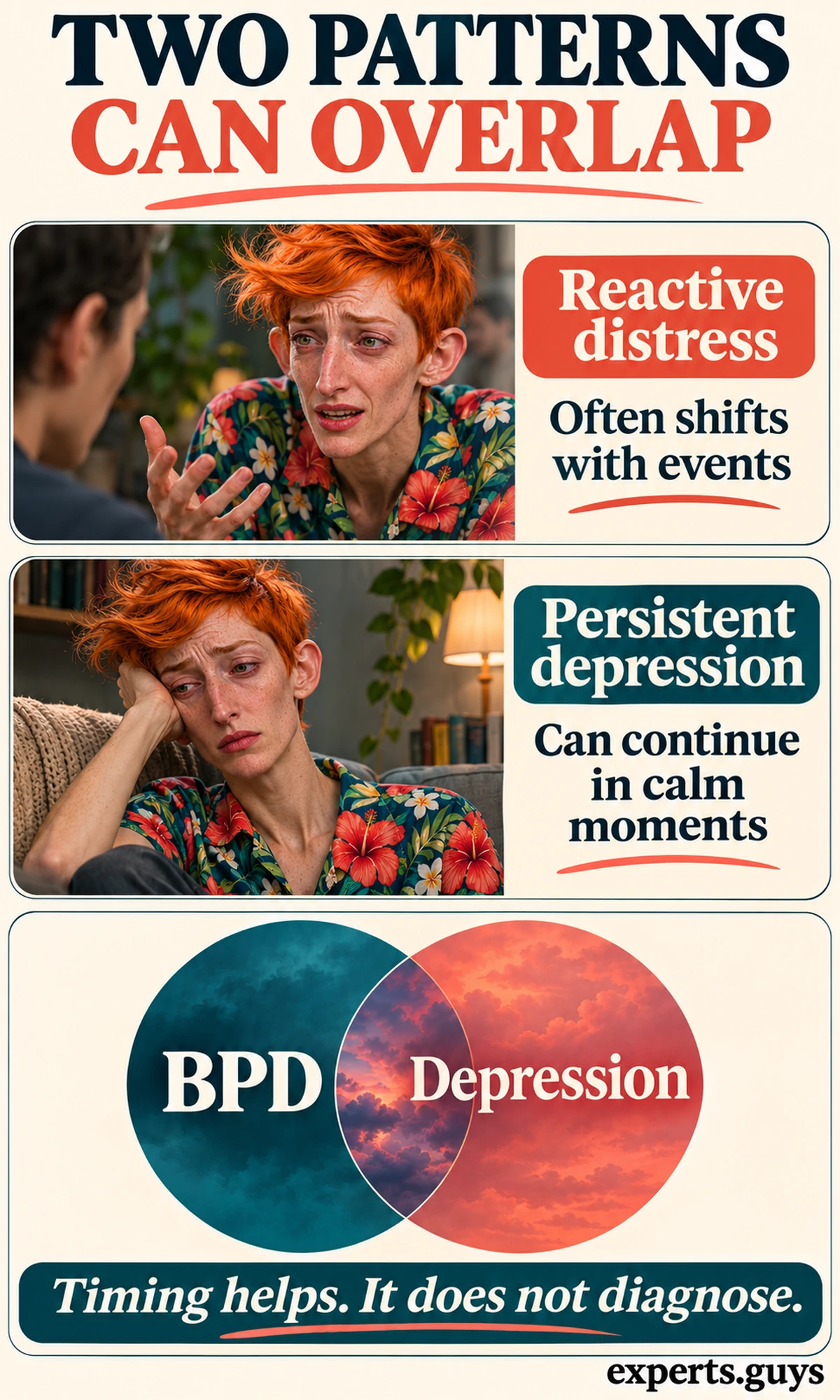
A practical starting point is to keep three decisions separate: what feels difficult, what might explain it, and what help is needed. You do not have to solve the second decision before acting on the third. For example, needing help to attend an assessment remains a practical need even when the diagnostic picture is uncertain.
- For understanding: consider the wider course, including calmer situations, rather than the most intense moment alone.
- For treatment: ask what each part of the plan is intended to change.
- For today: choose support that fits your actual capacity and present safety.
A surge and a background difficulty can occupy the same day
An emotionally painful exchange may draw everyone’s attention because it has an obvious beginning and a visible response. A more sustained difficulty can be less noticeable: meals feel effortful, a familiar hobby has lost its pull, or concentration stays poor after the exchange is over. Looking only at the argument can leave that second problem unexplained.
BPD-related emotional changes can unfold over hours or days, while major depression involves a broader pattern that usually persists most of the day, nearly every day, for at least two weeks. That contrast is an orientation, not a diagnostic shortcut. BPD can include enduring distress, and depression can fluctuate or follow a stressful event; neither condition requires an unchanging facial expression.
The NIMH overview of BPD describes its symptoms, assessment and possible co-occurring conditions. The distinction that matters here is between a familiar response and a wider change needing assessment. A BPD diagnosis should not become a reason to overlook new or worsening difficulties.
Why a laugh, reassurance or a calm evening does not settle it
A welcome moment can be real without describing the whole week. The question is not whether you were capable of smiling, but what remains difficult across situations. Equally, a terrible evening does not establish that you have developed a separate depressive disorder. Both conclusions would demand more information than one observation supplies.
In an illustrative example, Alex laughs during a conversation with a friend after a disagreement has settled. Later, Alex still cannot engage with a familiar model-building hobby and finds an ordinary meal unusually difficult. The laughter is not evidence that the continuing difficulty was invented; the later difficulty does not erase the genuinely pleasant conversation. A useful assessment can include both.

The mistake in that example would be using one event as a verdict: “You enjoyed yourself, so nothing is wrong,” or “You struggled afterward, so the evening meant nothing.” A more accurate interpretation leaves each observation at its proper scale. A moment tells you about that moment; recurring problems call for a broader explanation.
Emptiness also needs context. Someone may mean painful disconnection, a shifting sense of self, reduced pleasure, or several experiences at once. The separate article on mental pain in BPD and depression examines why intensity alone cannot identify the condition. Here, the next question is what the continuing pattern changes about care.
| Observation | What to ask without jumping to a diagnosis |
|---|---|
| Distress follows an interaction | Ask what happened and what else was already difficult. A relationship trigger does not identify the diagnosis. |
| Low interest continues in calmer settings | Ask whether this is a wider change affecting daily life. Persistence deserves assessment; it does not prove its cause. |
| A person briefly feels better | Ask what remains difficult outside that moment. Short-term relief is not a complete assessment of recovery. |
| A previous BPD diagnosis exists | Ask whether the present difficulty needs reassessment. An existing label does not explain every new symptom. |
What if the question is actually bipolar disorder?
BPD is not an abbreviation for bipolar disorder. If there have been periods of unusually increased energy or activity, markedly reduced need for sleep, or other substantial changes in behavior, include them in an assessment rather than assume that all mood changes are depression. The dedicated BPD versus bipolar disorder comparison covers that distinction; it is a different question from whether depression and BPD coexist.
Co-occurrence also does not establish a single chain of cause. It would be too simple to say that BPD always causes depression, or that depression creates every relationship difficulty. In an individual assessment, stressful circumstances, previous experiences, sleep, physical health, substances and treatment effects may all be relevant. The useful explanation is the one that accounts for the person’s history and current needs without turning a possible contributor into a proven cause.
For example, someone might begin withdrawing after repeated difficult interactions, while another notices reduced interest before any obvious disagreement. Those are different illustrative histories, even if both people describe feeling empty. They show why the order of events is worth exploring without assuming that the first remembered event explains everything. You can describe an approximate sequence from memory and leave unanswered parts open; reconstructing a perfect history is not a condition of receiving help.
What should treatment address when both conditions are present?
Treatment should make room for the core BPD difficulties and for depression when it is present. A coordinated plan identifies the main problems, the purpose of each intervention and who will review the overall picture. Having two conditions is a reason to make those responsibilities clearer, not a reason to leave either one untreated.
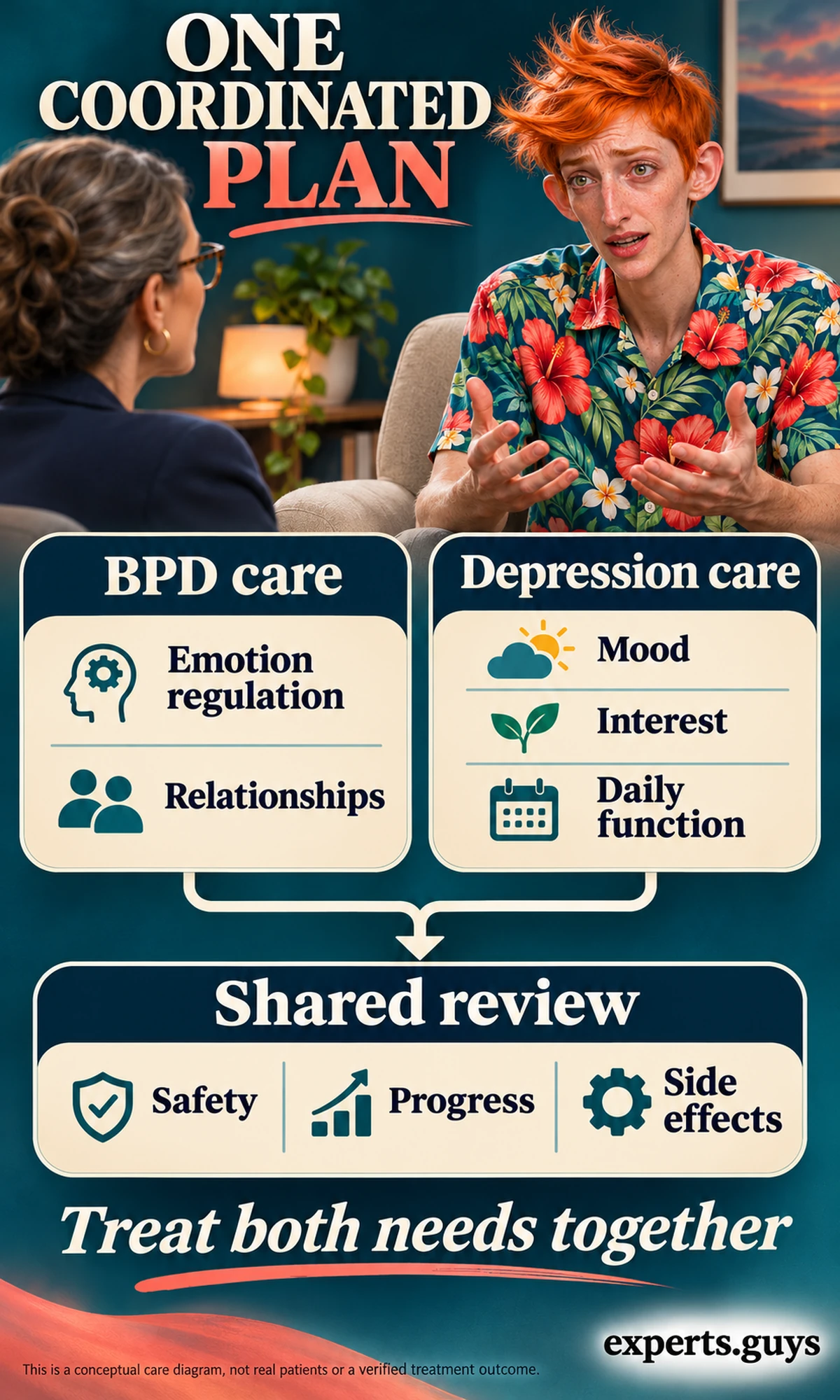
NICE depression guidance explicitly advises against withholding depression treatment because a personality disorder coexists. This has a concrete implication: an assessment should consider the depressive difficulty on its own merits while keeping the wider care plan connected. The best arrangement depends on severity, previous treatment, preferences and available services.
Two targets do not have to mean two disconnected services
A useful plan might address what happens during relationship distress while also addressing persistent loss of interest and reduced functioning. The targets are related, but they are not interchangeable. Being better able to stay in a conversation does not automatically tell you whether appetite, energy or enjoyment have improved; improvement in depression does not answer every question about recurring relationship difficulties.
Imagine a hypothetical review in which fewer conversations end abruptly, but leaving home for ordinary activities remains much harder than usual. Calling the whole plan a success would miss a remaining need. Calling it a complete failure would miss a useful change. The better question is which target has moved, which has not, and whether the current explanation still fits.
Structured psychotherapy is central to BPD treatment. A service should be able to explain the approach, how it addresses your difficulties and how you will take part in reviewing it. Dialectical behavior therapy is one established option; it is more than a handful of coping tips. Other structured approaches may be appropriate, and no single programme is guaranteed to suit every person or every available setting.
If the main barrier is knowing how to participate in a session, the guide to making talk therapy sessions more useful covers that task separately. The narrower issue here is how the sessions fit alongside care for the other continuing difficulties.
For depression, psychological treatment, medication or a combination may be considered according to the assessment. The NHS explanation of depression treatment outlines these options. This article does not select a therapy or medicine for you; its recommendation is to make the purpose and relationship of the chosen treatments understandable.
Ask what each medicine is intended to do
A prescription should have an identifiable purpose. Treatment for co-occurring depression is a different question from using medication as the main response to BPD itself. The American Psychiatric Association’s BPD recommendations emphasize structured psychotherapy and careful review of medications, including specific targets and their role alongside psychotherapy.
If a medication discussion feels overwhelming, ask one question at a time and let the prescriber explain it in ordinary language. You do not need to arrive with a preferred drug or challenge every detail. The immediate aim is to understand why something is being offered and how concerns will be handled.
- Target: “Which symptom or condition is this intended to treat?”
- Benefit: “What change would make us think it is helping?”
- Burden: “Which side effects should I raise, and which need urgent attention?”
- Review: “Who checks the plan, and what should I do if I am worried before that appointment?”

Do not start, stop or change medication independently on the basis of this comparison. If treatment appears to make you markedly worse, or you develop troubling new symptoms, seek prompt advice from the prescriber or an urgent service according to severity. An immediate safety problem takes priority over waiting to see whether a medicine eventually helps.
Make the plan fit the capacity needed to attend it
An appointment can be available yet difficult to use. Travel, following a lengthy discussion or fitting several contacts into one day may exceed current capacity. Tell the service which part is getting in the way so that a practical adjustment can be considered. A smaller explanation, clearer contact arrangements or support with attendance may make the existing plan more usable without changing its clinical purpose.
Be specific about responsibility when several professionals are involved. “My therapist is addressing relationship distress, but who reviews the persistent low mood?” is a different question from asking everyone to do everything. The useful outcome is knowing who handles each concern and how information will be shared with your agreement. A friend can help you ask, but should not have to become the unofficial coordinator of your treatment.
Transitions deserve the same clarity. When a course of therapy ends, a referral is made or a clinician changes, an intended handover is not the same as an understood next step. Ask whether the receiving service has accepted the referral, what happens while you wait and who remains available for questions in the meantime. If the answer is not yet known, ask how you will be told. This is a practical continuity question, not a demand that every service offer immediate access.
Consider a hypothetical arrangement in which one appointment reviews medication and another addresses emotional and relationship patterns. If tiredness is interfering with both, each clinician may need to know, but someone still needs responsibility for deciding what to review next. Simply telling you to mention it elsewhere can leave the issue moving between appointments. A clearer arrangement identifies who will consider the concern, what information is needed and when you should expect a response, without promising that the first explanation will be correct.
What can help when emotional overload and low energy collide?
When a conversation becomes overwhelming while depression limits energy, reduce the immediate demand and make the next contact clear. Do this only in an ordinary, safe interaction where both people can choose whether to participate. The practical aim is a workable pause and a manageable return, not proving that the relationship is repaired or making distress disappear.
The following two examples adapt broad principles of calm communication, time out and manageable activity. They are everyday support suggestions, not a stand-alone BPD treatment or a clinically validated sequence. If you already have a care or crisis plan, use its agreed instructions rather than replacing them with an online example.
Agree a pause that leaves less uncertainty
Use this when you notice that continuing an otherwise safe discussion is becoming unmanageable. Choose an accessible place where you can pause without blocking anyone’s movement. You may remain seated; walking away is not a requirement. A threat, coercion or fear for safety changes the task from conversation management to getting appropriate help.
- Name the pause: say, “I need a break.” Keep the statement about what you can manage rather than making a verdict about the other person.
- Agree the next contact: where feasible, say where you will be and suggest a realistic check-in, such as “Can we check in after dinner?” Ask rather than demand agreement.
- Return or renegotiate: at the agreed point, say whether you can continue briefly, need a smaller conversation or need to arrange another contact. Do not promise to be calm or ready by a deadline.
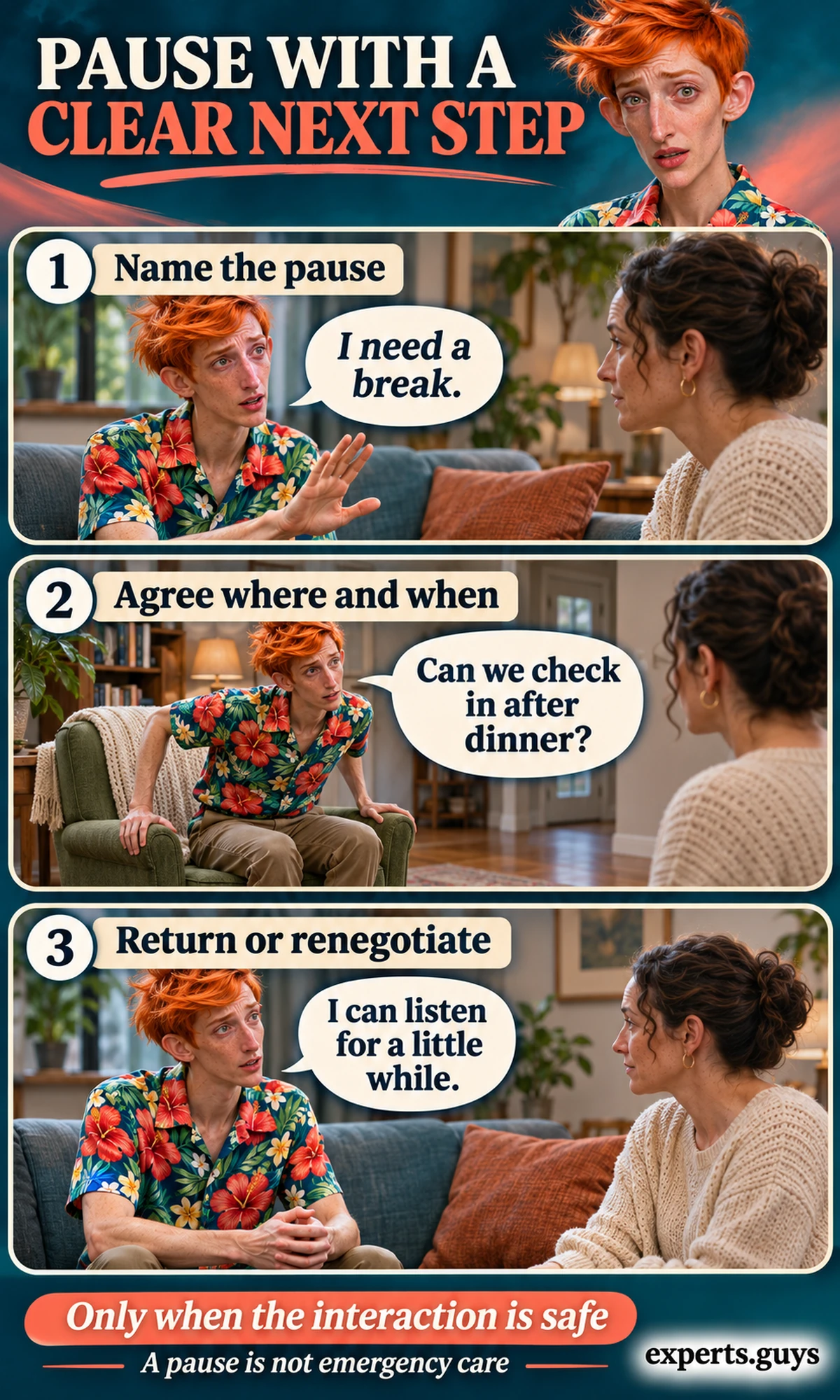
A lower-effort version is “I need a break; can we decide the next step together?” and letting the other person offer an option. The example is complete when the immediate discussion has stopped safely and the next contact is understood, or a further arrangement is being made. You do not need to feel better to have used the pause.
The common mistake is treating the proposed check-in as a guarantee: “You said after dinner, so you must discuss everything now.” A check-in can establish that more time or another kind of support is needed. Repeated postponement may still leave a real problem to address, but forcing a difficult conversation to satisfy a timetable is not the purpose of this step.
The NHS inform guidance on time out supports stepping away before escalation and letting others know where you are going. The agreed check-in wording here is an editorial adaptation for uncertainty around contact. It cannot guarantee that another person will respond supportively, and it does not make an unsafe relationship safe.
Return through one shared activity when a long discussion is too much
If both people want ordinary contact but cannot manage a full discussion, separate being together from resolving the disagreement. A small shared activity can provide a limited point of contact. In the example below, the activity is setting a table with a trusted person; the relevant skill is agreeing how much participation is manageable, rather than completing a household chore.
- Invite a specific kind of contact: “May I sit with you while we set the table?” Either person can decline or suggest another safe arrangement.
- Take one agreed part: from a comfortable seated position, place a folded napkin beside a plate while the other person handles the remaining setup. Use only a light, safely reachable item.
- Stop at the agreed point: rest your hands and say, “That is enough for now.” Decide together whether to remain quietly, pause again or finish the contact.

The easier version is simply sitting nearby with consent while the other person does the activity. No contribution, eye contact or cheerful conversation is owed in exchange for companionship. Stop if the task increases distress, pain or exhaustion. The result is an agreed amount of contact or a clearer limit, not evidence that depression has improved.
This example deliberately does not reopen the disagreement while the napkin is being placed. Switching from a small shared activity to a major emotional discussion changes the demand without agreement. If an important issue still needs attention, acknowledge that it remains and arrange a separate opportunity when both people can participate safely.
The broader skill of manageable contact already belongs to the guide on reconnecting after depression without overwhelm. Here it is a supporting adaptation for the specific tension between wanting reassurance and lacking energy for a long interaction. It should not become a test of affection, an obligation to resume contact, or a substitute for care when symptoms remain disabling.
For the person offering support
Ask what kind of presence is wanted before offering solutions. You can acknowledge that something feels painful without agreeing with every explanation of why it happened. In this context, “Would quiet company or space be more manageable?” offers a limited choice; repeated demands to explain, reassure or show gratitude can add another task when capacity is already low.
Keep your own limits clear, too. A supporter can agree to sit nearby during a short activity without promising constant availability. If either person needs more help than the arrangement provides, say so and use the appropriate care route. Consistent limits and genuine concern can exist together; neither person should be required to manage a crisis alone.
Avoid treating participation as evidence about someone’s motives. Agreeing to place a napkin but declining a lengthy conversation does not establish that the person is being deliberately difficult; the tasks make different demands. Equally, declining contact should not be interpreted automatically as a symptom that another person has permission to override. The arrangement works only while consent and capacity remain part of the decision. Its limited purpose is to make one moment more manageable, with the unresolved clinical and relationship questions left available for proper attention.
How do you ask for coordinated help and choose its urgency?
Ask for a plan that identifies continuing difficulties, the targets for both conditions and the next contact if things worsen. Choose urgency from present safety and functioning, rather than from whether you have the right diagnostic label. A planned assessment and emergency help serve different jobs; you do not need to complete one before becoming eligible for the other.
Use a short request for joined-up care
This communication aid is for a planned assessment or review when you can participate safely. It does not require dates, a diary or an account of your whole life. Start with one continuing problem and let the clinician ask for the history needed to understand it; saying “I do not remember” is more useful than guessing.
- Name what remains: for example, “The argument settled. My low mood has not.” If that is not your experience, describe the actual difficulty instead.
- Ask for the care targets: “How will we address both patterns?” Ask whether the current formulation covers the persistent problem as well as the emotional surges.
- Confirm the next contact: “Who should I contact if things worsen?” Clarify which service handles routine questions and which route applies when safety is uncertain.
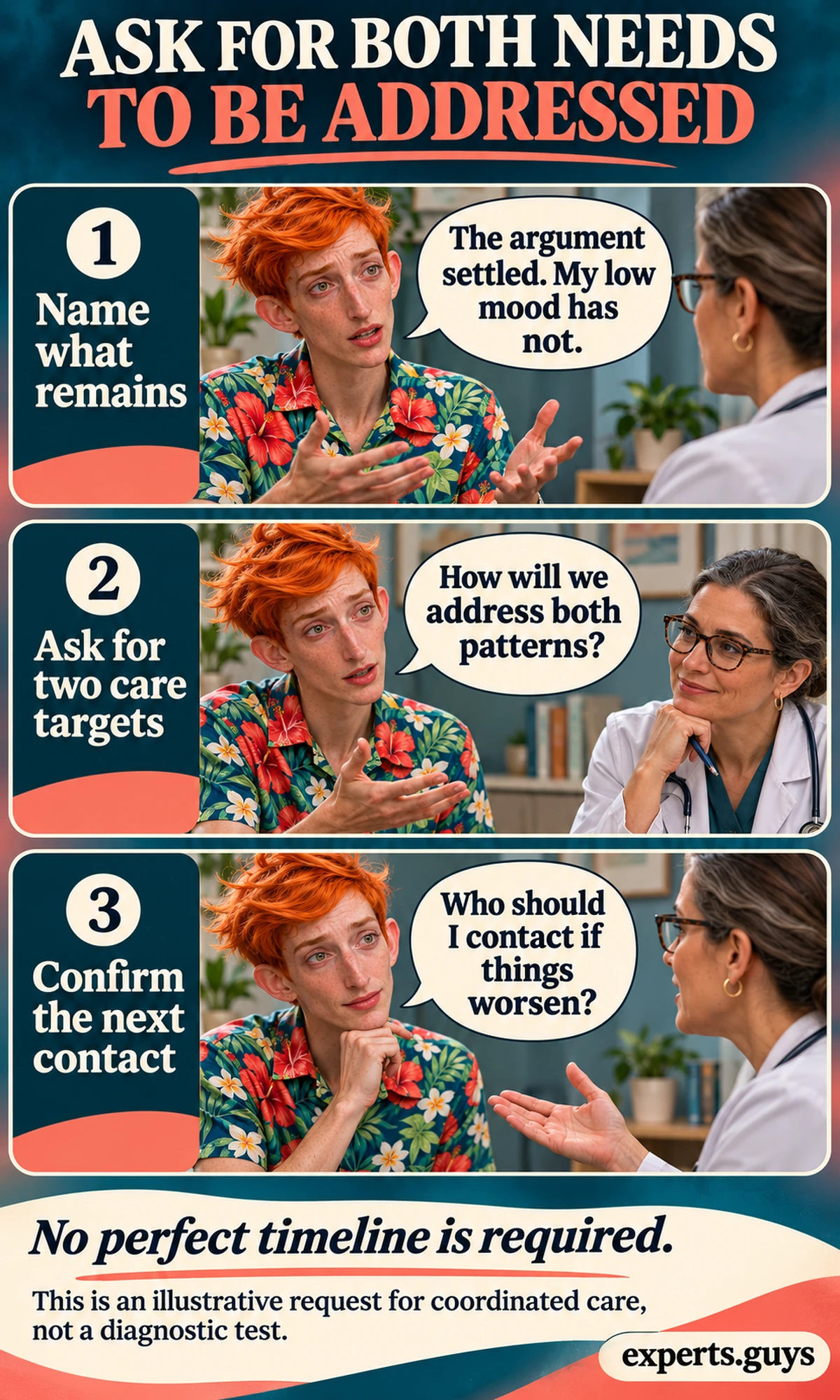
The smaller version is “I need help with what is still happening between the difficult moments.” That is enough to begin a conversation, even if you cannot yet explain every symptom. The completion point is understanding the next assessment or review step and who is responsible, rather than receiving a particular diagnosis on the day.
A common failure is leaving with an encouraging explanation but no practical arrangement. If you are unclear, ask which contact is next and what its purpose is. The answer may involve further assessment rather than an immediate treatment change. Uncertainty can be acceptable when it is explained; an unexplained gap in responsibility is a different problem.
With your agreement, a trusted person may help communicate what they have observed or support attendance. Their account should complement yours rather than replace your description of your own feelings. You can ask to speak privately, request an interpreter or use an appropriate communication aid. Needing such support does not invalidate what you are trying to explain.
Match help to the present problem
| Present concern | Appropriate next step |
|---|---|
| Immediate danger, likely action on suicidal thoughts, or serious harm already done | Contact local emergency services or go to the nearest emergency department now. Ask a trusted person to stay if possible; do not delay emergency help. |
| Safety is uncertain or symptoms are escalating quickly | Seek urgent help through your care team, an available local crisis service or urgent medical care. If you cannot stay safe or urgent help is unavailable in time, use emergency services. |
| Persistent, worsening or disabling difficulties with daily life | Arrange assessment or a treatment review. Explain the continuing problem and ask how both the BPD and depression questions will be considered. |
| A safe everyday interaction is becoming too demanding | Use an agreed pause or smaller contact if wanted. This does not replace assessment for ongoing illness or urgent help when risk changes. |
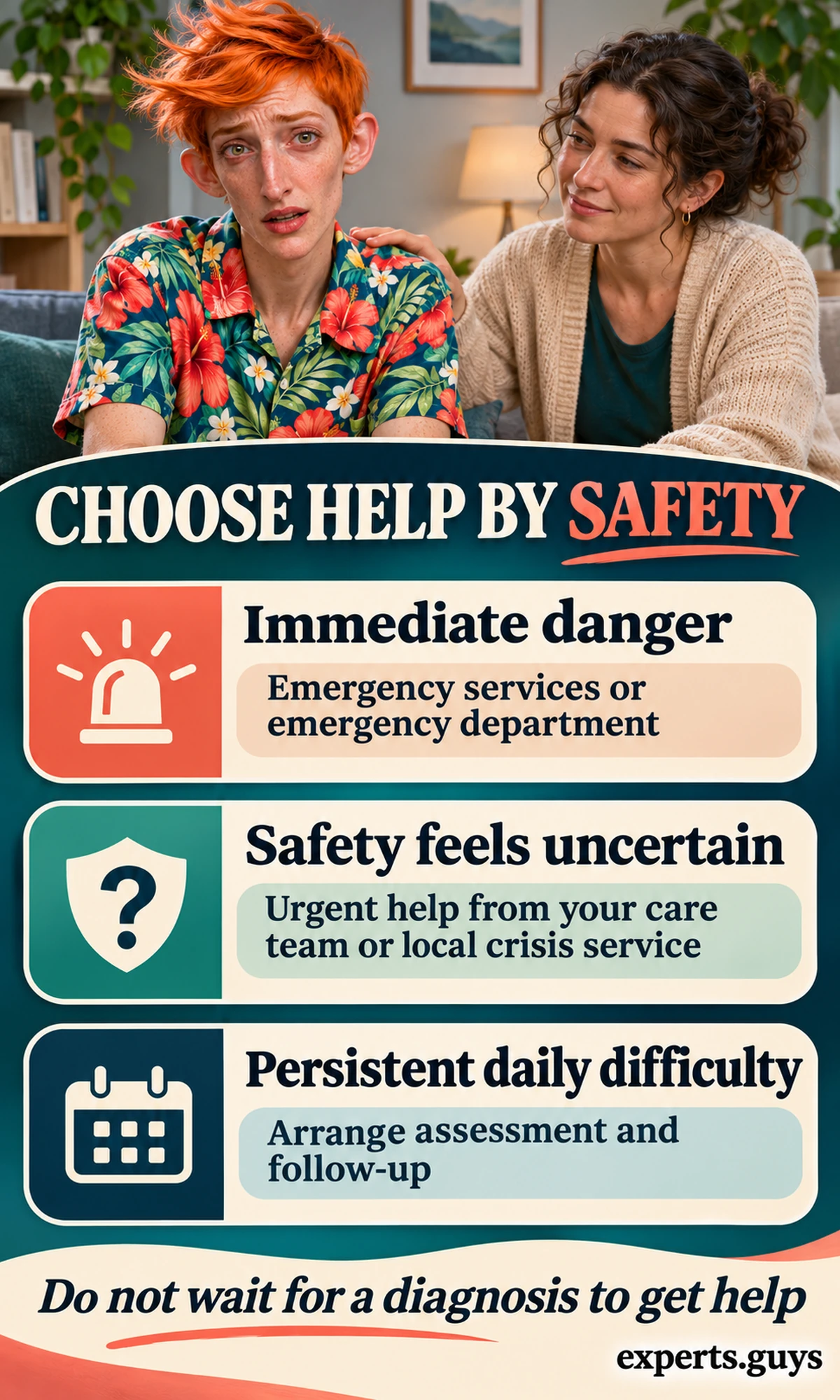
Safety cannot be inferred from how calm someone looks. If you are the supporter and the person says they cannot stay safe, take the statement seriously and help access urgent or emergency care as appropriate. Do not make them demonstrate distress, complete the shared activity or promise to manage alone before you respond.
What to do when the explanation keeps changing
An assessment may revise the understanding of a problem as a fuller history emerges. Ask what information changed the view and what practical difference it makes to care. The words used in the diagnosis are not the only result: the plan should still explain the current needs, what is being offered and when the response will be reviewed.
If you feel that everything is being attributed to BPD without discussion of a sustained change, explain that concern directly. You can ask how depression and alternative explanations have been considered. That request does not presume a second diagnosis; it asks for reasoning you can understand and a plan that does not leave the continuing problem unaddressed.
Frequently asked questions
Does having both conditions mean treatment cannot work?
No. Coexisting difficulties can make care more complex, but they do not make improvement impossible. A useful plan keeps treatment targets and responsibility clear, and reviews what is helping rather than treating either label as a prediction about your future.
Does feeling empty always mean depression?
No. Emptiness can occur in BPD and in other experiences, including depression. Explain what the word means for you and its effects on everyday life; the feeling alone cannot establish a depressive disorder.
Must I be upset all the time to have depression?
No. A person can have better moments within a wider depressive pattern. Assessment considers symptoms, duration, impairment and other explanations together, rather than requiring uninterrupted visible sadness.
Can I ask for another explanation if the appointment focuses only on BPD?
Yes. Ask how continuing low mood, reduced interest or other changes fit the current assessment, and what would prompt a review. You can request clarification without deciding in advance what the diagnosis should be.
Should a partner become the person who manages both conditions?
A partner can offer agreed support, but should not be expected to diagnose, direct medication or replace professional care. Ordinary companionship, clear boundaries and access to appropriate help have different roles.
Choose the next step that addresses what remains
If you are safe but overwhelmed today, choose a smaller, agreed interaction rather than requiring yourself to resolve everything at once. If the low mood or loss of interest continues beyond the immediate exchange, make that remaining difficulty the focus of a coordinated assessment or review. A useful plan can take both experiences seriously without asking you to prove that one is the only real problem.









