
Depression usually develops through an interaction of biological vulnerability, stressful experiences, physical health and social circumstances. There may be a recognizable trigger, but some episodes begin without an obvious event, and identifying one factor does not prove it caused the illness. You can get support before the cause is clear and practise a small action suited to the difficulty you face today.
A cause, a risk factor and a symptom are different things. A risk factor makes depression more likely; a trigger may help explain when symptoms began; a symptom describes what the person is experiencing. Poor sleep, for example, may precede low mood, appear during it or keep an existing episode going.
The main factors that can contribute to depression
Family history, adversity, relationship difficulties, isolation and long-term illness can all be relevant. Their importance varies between people, and several may operate together. The NHS explanation of depression causes describes this combination rather than a universal single cause.
The table separates a possible contribution from the information worth bringing to an appointment. It is a discussion guide, not a way to count risk factors or decide whether you have depression. Having none of the listed experiences does not rule out a depressive illness.
Swipe horizontally to compare on a small screen.
| Factor | What it may contribute | What to discuss |
|---|---|---|
| Family and personal history | An inherited vulnerability or a history of previous episodes. | Previous low periods; relatives with depression or bipolar disorder. |
| Stress, loss or trauma | An episode may follow major adversity or accumulated pressure. | Timing, ongoing demands and available support; disclose trauma at your own pace. |
| Isolation and social strain | Relationship problems, financial insecurity or loneliness may increase strain. | What support is missing and which practical pressures remain. |
| Physical illness or pain | Illness can affect mood through symptoms, disruption and treatment. | Health changes, pain, fatigue and current medical care. |
| Medication, alcohol or drugs | Some substances or treatment changes can affect mood or mimic symptoms. | Names, doses and dates of changes; ask before altering treatment. |
| Reproductive or seasonal patterns | Some episodes occur around pregnancy or with recurring seasonal changes. | Repeated timing patterns, rather than an assumed hormone deficiency. |
Family history changes vulnerability, not destiny
Depression can run in families, but there is no simple inheritance rule that predicts an episode. Many genetic variations may contribute small effects, alongside environmental influences. A relative with depression is useful background information, not a forecast of your future.
Brain signaling and the ability of nerve connections to adapt are among the biological processes researchers study. This is more complex than treating depression as a measured shortage of one chemical. The MedlinePlus genetics overview explains why genes and environment must be considered together.
Stress can be a trigger, while circumstances keep adding pressure
A bereavement, relationship breakdown, job loss or traumatic experience may help explain the start of a difficult period. Yet two people exposed to the same event can respond differently, and emotional pain after an event is not automatically a depressive disorder. Assessment considers the pattern, persistence and effect of symptoms, rather than the event alone.
Ongoing pressures deserve attention alongside past events. Unemployment, unsafe relationships and isolation may leave someone with fewer resources for recovery. Describing these circumstances helps a clinician understand the context and may identify practical support, without reducing the illness to a failure to cope.
Why depression can start without an obvious reason
The absence of a clear trigger does not make low mood less real. A person may have a biological vulnerability, subtle health changes or accumulated pressures that do not point to one memorable event. Sometimes the explanation remains incomplete even after a careful assessment.
Consider a person who notices little enjoyment, disrupted sleep and increasing difficulty at work while describing life as otherwise stable. The uncertainty is itself worth bringing to a consultation. You do not need a convincing causal story before asking for help, and treatment need not wait for one.
Sleep and low mood may reinforce each other, while the wider explanation remains uncertain. Improving one daily difficulty may make life more manageable without settling why depression began. That is a reason to combine practical support with assessment, rather than waiting for perfect causal certainty.
Physical illness and medication deserve a separate check
Long-term illness and depression can coexist, with each making the other harder to manage. Pain, restricted activity, treatment demands and fear about health may contribute; illness-related biological changes can also matter. The NIMH guide to chronic illness and depression supports assessing mental and physical health together.
Fatigue and poor concentration are not specific to depression. Thyroid problems and other medical conditions can produce overlapping symptoms, so a clinician may use the history, an examination and selected tests to investigate alternatives. There is no reason to order every possible blood test for every person; the choice should follow the actual findings.
If tiredness appears alongside breathlessness or other physical changes, mention those separately instead of treating everything as emotional. Our guide to depression or anemia explains that particular overlap. Finding a physical condition does not automatically rule out depression, and treating one condition may not resolve both.
Medicines used for other illnesses can sometimes contribute to mood symptoms. Bring the names, doses and dates of any recent starts, stops or dose changes, including supplements. Ask the prescriber to review the timeline rather than stopping a medicine on your own.
Research on inflammation and stress biology helps explain possible pathways, especially alongside chronic illness. It does not establish that inflammation is the cause for every person with depression. A research finding about cells or stress hormones is not a substitute for an individual clinical assessment or a validated diagnostic test.
Sleep and alcohol can complicate the picture
Sleep is often part of the symptom pattern, and disrupted sleep can also make day-to-day coping harder. Trouble falling asleep, early waking, oversleeping and a reduced need for sleep convey different information. A regular routine may support recovery, but improving sleep alone is not a test of whether depression is present.
Alcohol and other drugs can affect mood, and their use can increase when someone is already struggling. Changes after reducing or stopping alcohol deserve a careful timeline rather than an automatic conclusion that all symptoms are temporary. If you drink heavily or may be dependent, obtain medical advice before suddenly stopping because withdrawal can be dangerous.
Patterns that change the assessment
Depression may occur during pregnancy or after childbirth, when biological changes, life demands and previous vulnerability can interact. Distress in this period deserves assessment and support, rather than being dismissed as an expected part of parenthood. Confusion, hallucinations or immediate safety concerns require urgent help.
Recurring symptoms around the menstrual cycle or a particular season are also useful information. A repeated cycle-linked pattern is a different clinical question from low mood present throughout the month; our two-cycle PMDD symptom diary explores that distinction. A recurring seasonal pattern should likewise be discussed rather than assumed from a single difficult winter.
Past periods of unusually elevated or irritable mood, markedly increased energy and much less need for sleep can change the diagnosis and treatment discussion. Mention them even if they felt productive at the time. Our explanation of depression, anxiety or bipolar disorder shows why a low-mood snapshot may miss relevant history.
| Observation | Avoid assuming | Better next step |
|---|---|---|
| Low mood after a stressful event | The event proves the diagnosis or explains everything. | Describe persistence, daily impact and what else changed. |
| Symptoms after a medicine change | The medicine is definitely responsible. | Ask the prescriber to review timing and alternatives. |
| A good life with no clear trigger | Depression cannot be present. | Describe symptoms without needing to justify them. |
| Fatigue plus mood changes | Every physical symptom is psychological. | Discuss physical symptoms and targeted medical checks. |
| Past high-energy periods with little sleep | They are irrelevant to current depression. | Include lifetime mood history in the assessment. |
What you can do while the cause is being assessed
Choose one difficulty that is making today harder: starting, self-blame or withdrawing from support. The following methods support daily life; they do not establish a diagnosis or replace depression treatment. Trying a step counts even if your mood does not change immediately.
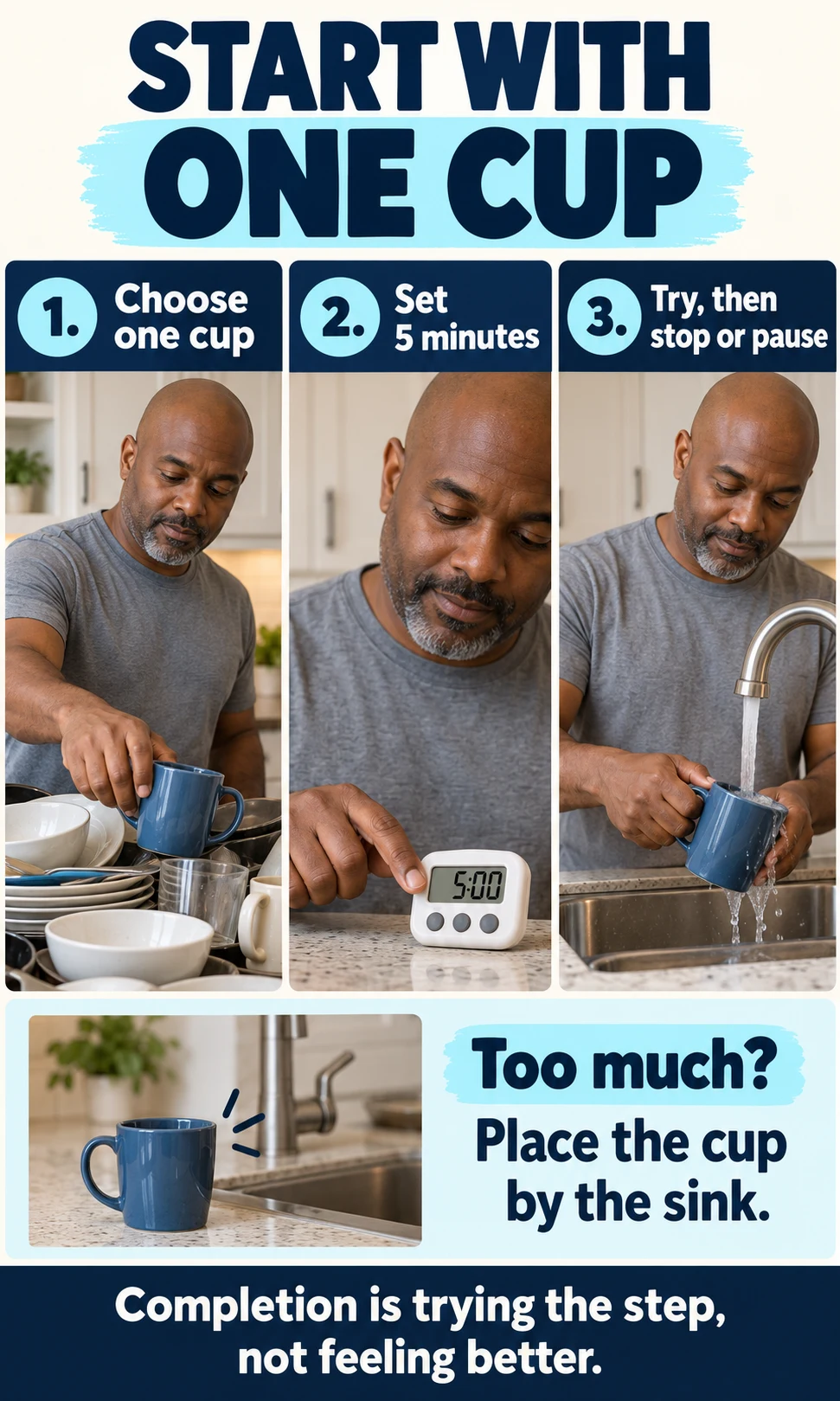
When starting feels impossible: try one tiny task
When a whole chore feels overwhelming, reduce the starting demand. You need one cup, access to a sink and a timer, with any physical limits respected. This is an illustrative adaptation of the short-timer approach, not a claim that washing dishes treats depression.
- Choose one cup rather than the whole pile of dishes.
- Set a five-minute timer and try rinsing or washing that cup within your usual physical limits.
- When time is up, stop or pause; continuing is optional.
Easier option: Place the cup by the sink without washing it. Completion: Trying the chosen step counts; a clean kitchen or better mood is not required. Next step: Repeat later if manageable, or make the task smaller. Stop for pain, significant exhaustion or worsening symptoms.
When you blame yourself: practise a balanced response
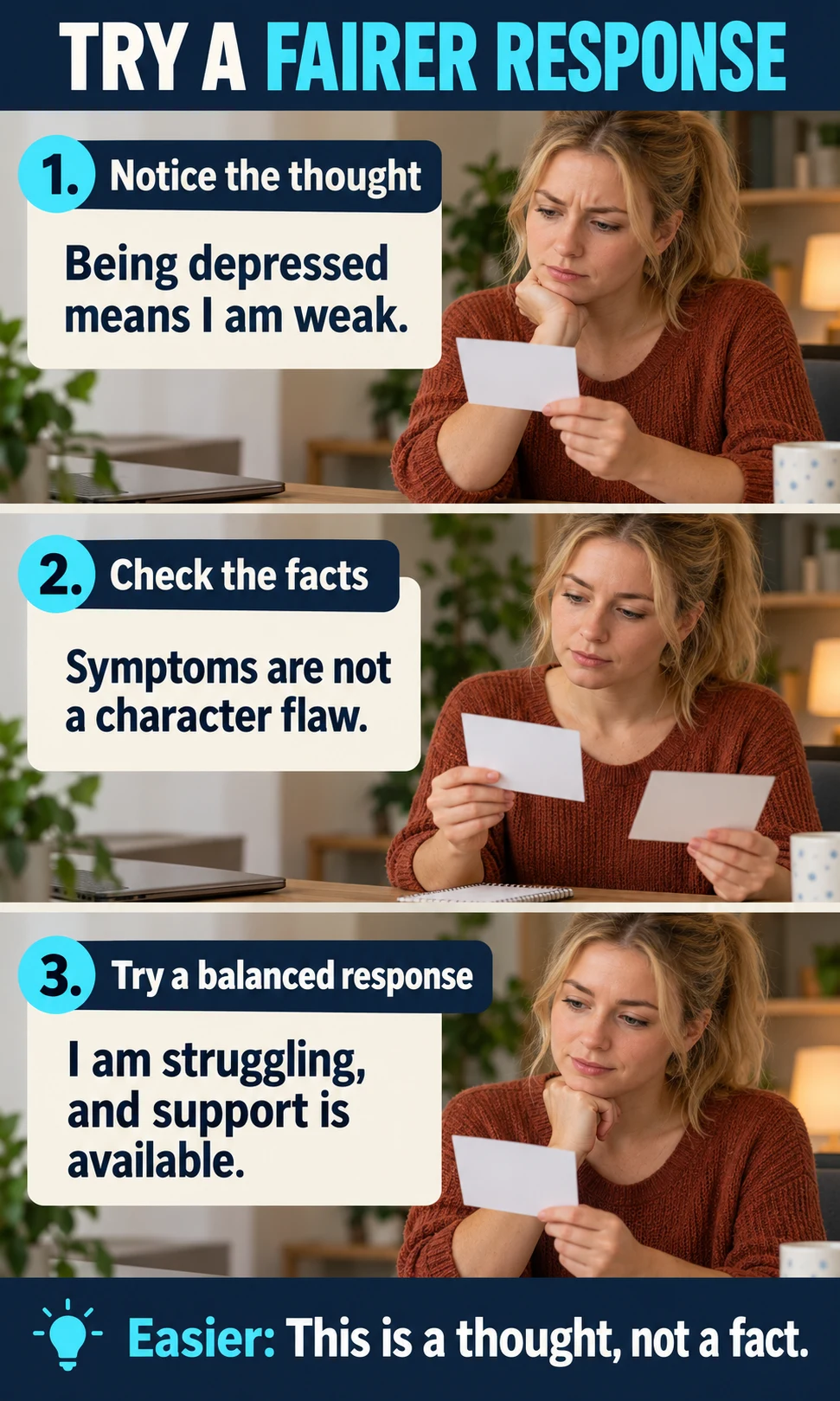
Self-blame can turn uncertainty about causes into a judgment about your worth. Try noticing the judgment before accepting it as a fact. The evidence-checking approach below uses an illustrative example; it does not ask you to deny genuine adversity or force optimism.
- Notice the thought: “Being depressed means I am weak.”
- Check facts: symptoms have several possible contributors; struggling does not establish a character flaw.
- Try a fairer response: “I am struggling, and support is available.”
Easier option: Say, “This is a thought, not a fact,” without arguing with it. Completion: Practising a fairer response counts even if the thought or difficult feeling remains. Next step: Pause if checking thoughts becomes repetitive or more distressing. Ask for help using this skill if needed.
When you withdraw: make one low-pressure contact
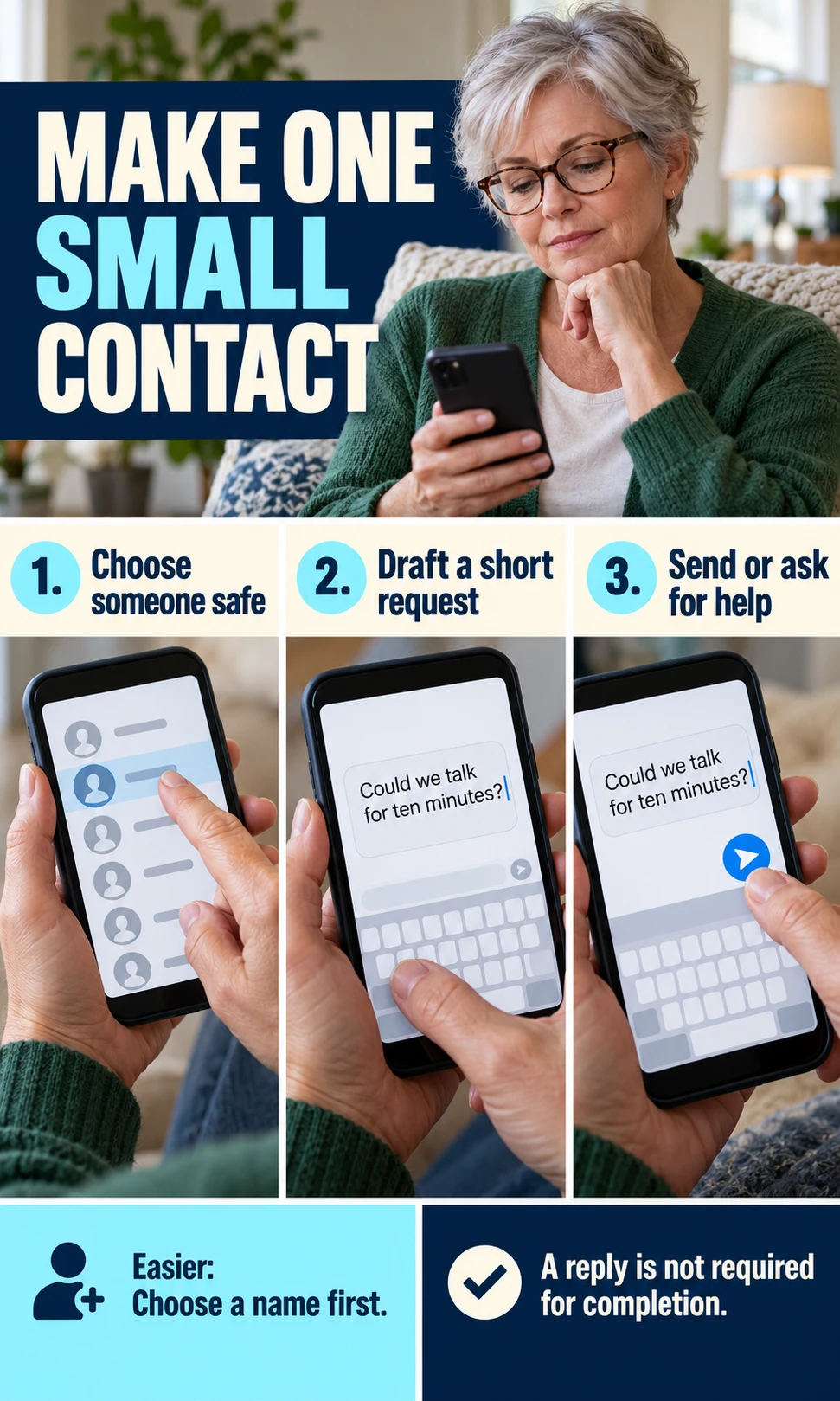
Withdrawal can make support harder to reach, even when someone would like to help. Make the first request small and choose a contact who feels safe. The example below adapts guidance on building manageable connections; a friend is not a substitute for clinical or emergency care.
- Choose a person you trust and feel safe contacting.
- Draft a short request: “I have had a difficult week. Could we talk for ten minutes?”
- Send it when ready, or ask a trusted person to help you make contact.
Easier option: Choose a name without sending anything yet. Completion: Making the chosen contact step counts; a quick reply or immediate relief is not required. Next step: If there is no reply, it does not prove rejection. Try another trusted person or professional support; a message is not emergency help.
Choose a first step in Depression Context Studio
Choose the difficulty and the amount of effort you can manage. The experience returns a worked example, an easier version and a sensible next step, without ranking causes or measuring your depression. An optional practice acknowledgment refers only to trying the step; it is not evidence of symptom improvement.

Understand contributors · Practise a step
Depression Context Studio
Choose a manageable action for the difficulty you face today.
No diagnosis or scoreUrgent help: If you are in immediate danger or cannot stay safe, contact local emergency services. For suicidal thoughts, seek urgent crisis or professional support; in the US, call or text 988. Do not wait to try an exercise.
These methods support daily life while you seek appropriate care. They cannot identify the cause of depression, diagnose illness or replace treatment. No selections are stored or transmitted by this experience.
Manual option: Use the complete steps and instructional images in the article. For starting, choose one cup and try a short timer; for self-blame, notice the thought and check facts; for withdrawal, choose a safe contact and a small request.
Worked example
Find and compare professional support
Primary care can review physical health, medicines and mood; a qualified mental health professional can assess symptoms and discuss care. Search listings are not vetted recommendations or crisis services.
These actions send only the provider category and area you choose to Google. Health selections are never included.
Compare three candidates you find
Check local registration, relevant experience, appointment access, fees and coordination with your current care. No ratings, rankings or availability are assumed. Notes stay in this page and are excluded from the A4 practice card.
When to seek help, even before the cause is clear
Persistent low mood or loss of interest, especially around two weeks or longer, is a reason to contact a health professional. Seek help sooner if symptoms are severe, rapidly worsening or interfering substantially with eating, sleep or daily responsibilities. Two weeks is not a waiting requirement, and a duration alone does not establish a diagnosis.
- Immediate danger or inability to stay safe: contact your local emergency service or go to an emergency department.
- Thoughts of suicide or self-harm: seek urgent support from a crisis service or health professional; in the United States, call or text 988.
- Unable to eat or drink, severe confusion, hallucinations or dangerous behavior: obtain urgent medical assessment.
- Persistent or disruptive symptoms without an emergency: arrange a primary care or mental health appointment.
A clinical assessment can review symptoms, physical health, medicines, previous mood episodes and current pressures. Uncertainty about the cause does not make those difficulties less deserving of care. Treatment can address the symptom pattern while possible contributors and alternative explanations are investigated.
Frequently asked questions
Can depression have more than one cause?
Yes. Biological vulnerability, experiences, health and circumstances can interact, and their importance differs between people. A risk factor is not proof of what caused an individual episode. Assessment can still guide care when no single explanation emerges.
Does a family history mean I will become depressed?
No. Family history can increase vulnerability, but many people with affected relatives never develop depression, and depression can occur without a known family history. Share the history with your clinician as background rather than treating it as a prediction.
Can medication cause depression symptoms?
Some medicines and changes in substance use can contribute to low mood or overlapping symptoms. The timing is useful information, but it does not prove causation. Ask the prescriber to review any concern before stopping or changing treatment.
Is depression just a chemical imbalance?
Brain signaling is part of the biology being studied, but a simple shortage of one chemical does not capture the full explanation. Genetic and environmental influences also matter. A treatment helping someone does not by itself prove a single underlying cause.
Do I need to know the cause before getting treatment?
No. A health professional can assess the symptom pattern, possible alternatives and appropriate care even when the cause is uncertain. Bring a timeline and examples of daily impact. Seek urgent help for immediate safety concerns rather than waiting to prepare notes.
Understand the contributors and take one supported step
Depression usually has a multifactorial explanation, and knowing one risk factor rarely settles the question. Care can address symptoms and contributing circumstances even when the explanation remains incomplete. Choose one manageable action for today, and arrange professional support for persistent, worsening or disabling symptoms.