




Depression can include anger and irritability, so a sharp reply may be the part other people notice while low mood, exhaustion or lost enjoyment stays hidden. Anger alone does not identify depression, and understanding a possible symptom does not remove responsibility for hurtful behaviour. The useful first step is to consider the wider change while keeping the conversation safe.
If someone is threatening harm, blocking an exit, throwing objects or making you afraid to leave, stop trying to solve the disagreement and get to safety. Contact emergency services if anyone is in immediate danger or at risk of acting on self-harm thoughts; the communication exercises below are for situations where participation is safe and voluntary.
This guide focuses on a particular misunderstanding: one person experiences distress, another experiences the way that distress is expressed, and each can believe the other is ignoring the real problem. Both accounts may contain useful information, but neither person needs to accept insults or intimidation to prove that they understand depression.
Separate the feeling, the possible health problem and the behaviour before deciding what needs to happen next. An explanation can guide support, while the behaviour still needs its own boundary and repair.
Swipe horizontally if columns extend beyond the screen.
| Question | Useful interpretation | What it does not establish |
|---|---|---|
| What am I feeling? | Anger, frustration, hurt or overload may be present. | A feeling does not identify a disorder. |
| What else has changed? | Reduced pleasure, low mood, sleep, energy and functioning deserve attention together. | A few familiar symptoms do not confirm depression. |
| What did I do? | Words and actions can be addressed specifically. | A possible illness does not make harm acceptable. |
Why can anger hide the rest of depression?
Anger draws attention to the immediate interaction: the raised voice, the impatient answer or the sudden refusal. Depression may be less visible because the person has not explained the dullness, effort or loss of interest occurring outside that interaction. A conversation about manners can therefore become the only conversation anyone has.
There is no reliable facial expression for depression. Some people cry, some appear flat, and some continue meeting obligations while feeling unlike themselves. Looking irritated does not reveal which of these experiences, if any, is present.
The NIMH guide to depression includes increased anger or irritability among possible changes, alongside a broader pattern of symptoms. That supports taking irritability seriously; it does not support identifying depression from someone’s temper or appearance.
Consider an illustrative household disagreement. A partner asks what to cook, and the reply is, “Why do I have to decide everything?” The partner hears criticism for asking an ordinary question. The speaker may be struggling with making another decision, but the sentence does not communicate that difficulty clearly.
The distinction changes the response. “You should know I am struggling” asks the other person to infer an invisible problem, whereas “Choosing feels difficult tonight” gives them usable information. It also leaves room to acknowledge that the first reply was unfair.
Depression is not the only possible explanation for that exchange. An unequal division of work, pain, poor sleep, anxiety or a genuine disagreement may be relevant. A person can have depression and still have a reasonable complaint about how responsibilities are shared.
Treating every complaint as a symptom creates another misunderstanding: it can make the person feel that their point has been dismissed before it has been heard. The better question is what happened, what has changed more broadly and what can be addressed without guessing at motive.
- Notice the observable event: describe the words or action rather than naming a personality flaw.
- Allow more than one explanation: symptoms, circumstances and a legitimate disagreement can coexist.
- Keep the boundary: listening to distress does not require continuing an unsafe or insulting exchange.
The word “irritability” often describes a lowered threshold for annoyance. It may show up as terse replies or impatience rather than an explosive outburst. Anger is an emotion; aggression concerns harmful or threatening behaviour. Keeping those terms distinct avoids portraying depression as inherently violent.
The private meaning of anger also varies. One person feels hurt, another feels cornered by demands, and another cannot identify anything underneath it. Do not insist that all anger is hidden sadness or that identifying a deeper feeling will automatically settle the dispute.
Gender stereotypes can further narrow what gets noticed. Anger can accompany depression in people of any gender; being a man does not turn irritability into a diagnostic clue with special certainty. The same care is needed when a woman’s anger is dismissed as hormones or a young person’s distress is described only as attitude.
Someone who remains polite at work and becomes sharp at home has not proved either that they are well or that family members caused the problem. Different settings place different demands on people. Still, the impact at home deserves attention even when the explanation involves sustained effort elsewhere.
For the wider symptom association, the existing guide to anger and irritability in depression covers that background. Here the practical priority is translating the visible reaction into information that another person can understand without making them responsible for decoding it.
A useful editorial priority is to clarify impact before debating intention. “I meant no harm” cannot tell the listener that they are safe to continue, whereas acknowledging the specific sharp reply makes room for both the underlying difficulty and the other person’s experience.

Which changes deserve attention beyond the argument?
A sustained departure from your usual mood and functioning matters more than whether the anger seems justified in one moment. Consider whether irritability arrived alongside reduced interest, persistent low mood, sleep disruption, low energy or difficulty carrying out ordinary responsibilities. These changes are reasons to investigate the whole picture, not items to add up into a home diagnosis.
The NHS description of adult depression symptoms includes irritability and difficulties across daily life. If a pattern persists, worsens or disrupts relationships, work or basic care, arrange an assessment and explain the anger as part of that pattern. Severe impairment or a safety concern warrants help sooner; you do not have to wait for a duration threshold.
One important distinction is poor sleep followed by exhaustion versus much less sleep accompanied by unusually increased energy or activity. The latter, especially with racing thoughts or risky behaviour, calls for prompt clinical assessment. Irritability alone cannot distinguish unipolar from bipolar depression; the guide to why episode history matters explains that separate question.
Medicines, alcohol or other substances, pain and physical illness can also complicate the picture. A striking new change after a medicine adjustment belongs in a conversation with the prescriber, rather than an attempt to stop or alter treatment yourself. Sudden confusion, hallucinations or rapidly escalating behaviour needs urgent assessment.
| What is happening | What follows |
|---|---|
| A disagreement without a broader change | Address the specific issue; do not diagnose the other person. |
| Persistent irritability with wider mood or functioning changes | Describe both the daily-life impact and the emotional change during assessment. |
| Very little sleep with unusual energy, activity or risk-taking | Seek prompt clinical advice about the changed state. |
| Threats, violence, severe confusion or immediate danger | Prioritise safety and urgent help rather than practising communication. |
1. Use the first body cue to make your next action safer
A body cue can help you interrupt a reaction; it cannot explain why you are angry. The NHS anger guidance describes signs such as tense muscles and clenched fists. Choose one cue you actually recognise, such as gripping a cushion or tightening your jaw, rather than searching for a perfect warning sign.
In a safe ordinary disagreement, use that cue to stop handling an object while you prepare your next sentence. This is a practical adaptation of early anger recognition, not a prescribed muscle-relaxation treatment. It is particularly useful when your hands have started expressing tension before your words catch up.
- Notice the grip or tension without using it to diagnose yourself.
- If you are holding a harmless object, place it on a nearby stable surface rather than waving it while speaking.
- Let your hands rest in a comfortable position and decide whether the conversation needs a pause.
Illustrative example: you notice that you are squeezing a sofa cushion during an argument about dinner. Put it beside you and say, “I am getting wound up; I need to slow this conversation down.” The completed action is putting the cushion down and interrupting the gesture, even if you still feel angry.
Do not force your hands open through pain or make a conspicuous gesture toward the other person. An easier option is simply loosening your grip while seated. If there is a risk of throwing or striking, create distance and seek help; this small adaptation is not a sufficient response to imminent harm.

What can protect a conversation while anger is rising?
When you are struggling to hear a sentence without interrupting, solving the entire disagreement is usually too ambitious. Start by changing the conditions of the conversation: pause it, reduce a competing demand or clarify a disputed meaning. Choose the action that addresses the obstacle in front of you rather than working through every method as a compulsory routine.
The wider guide to emotional regulation in depression explains the processes behind these choices. These are everyday applications of anger-management and communication principles. They are not a treatment programme, and there is no promise that a particular sequence will lower your mood symptoms. The immediate outcome is a conversation with less interruption, less guesswork or more space to stop.
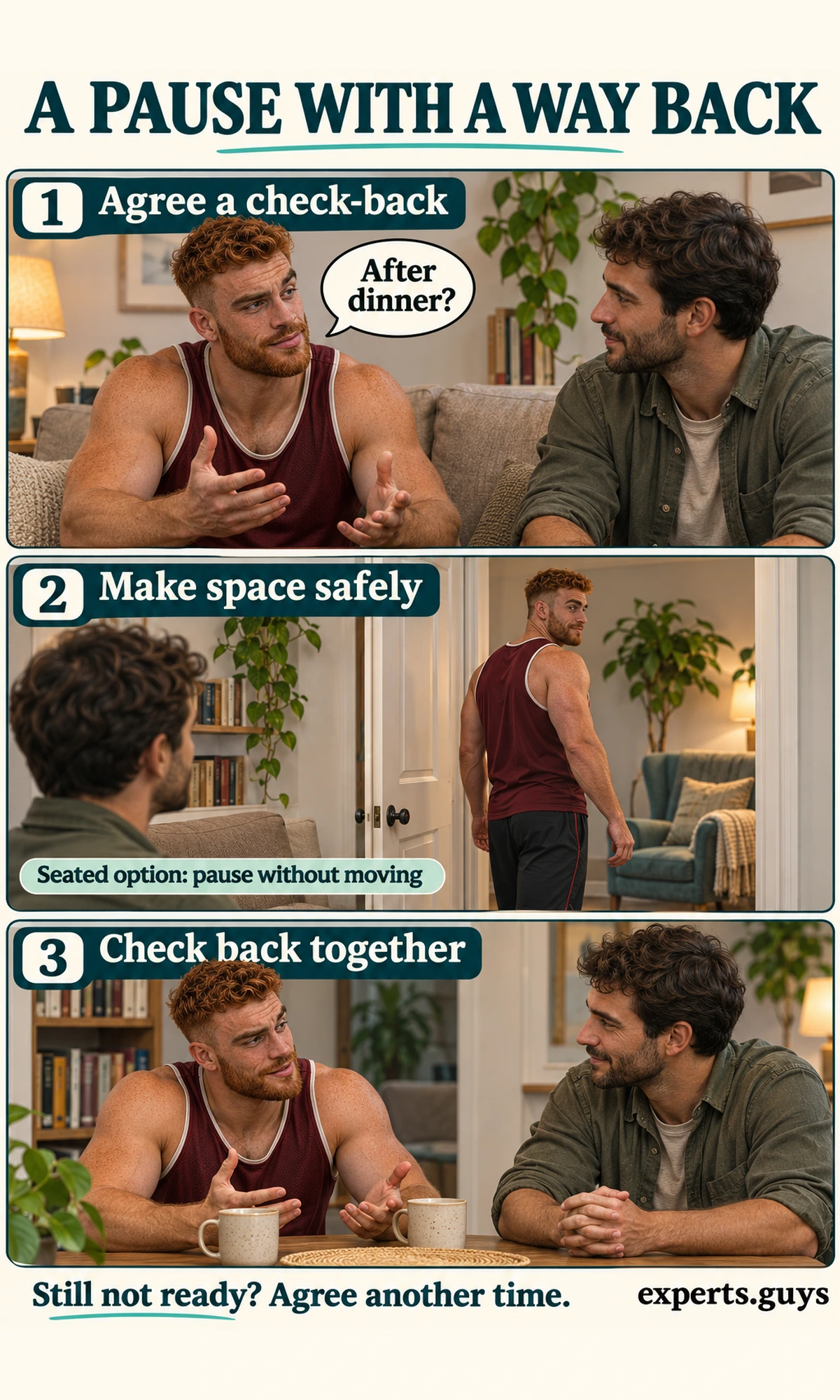
2. Step aside with an agreed return point
A useful pause has a way back. SAMHSA’s anger-management workbook describes timeouts and agreements to return to finish or postpone a discussion. The purpose is to interrupt escalation, not to win by making the other person wait indefinitely.
Discuss the arrangement when both people are able to choose freely. Neither person should have to request permission to leave an unsafe situation. In a safe relationship, agreement about a return point can reduce the uncertainty created by walking away without explanation.
- Say that you are pausing the discussion and identify where you will be if it is safe to do so.
- Agree on a realistic point to check back, such as after dinner; this is a practical arrangement, not a therapeutic dose.
- Move to a separate safe place without slamming, following or blocking anyone.
- At the agreed point, ask whether both of you can continue; if not, explicitly arrange another opportunity.
Illustrative example: “I cannot answer this well right now. I will be in the sitting room; can we check back after dinner?” If walking is difficult, remain seated and ask the other person for space. A spoken pause can be the lower-effort version when neither person needs to move.
The common mistake is turning the break into punishment: disappearing, refusing all future discussion or repeatedly demanding that someone chase you. Another is returning only to restart the same accusation. Completion means honouring the check-back, including an honest decision to postpone, rather than promising that you will be completely calm by then.
3. Remove one competing sound, with permission
If you cannot follow a conversation because a television is talking over it, reduce that specific obstacle instead of demanding that the other person speak louder. This is an environmental communication adaptation: it reduces the number of things you are trying to follow. It does not treat the cause of irritability or establish sensory sensitivity as a depression symptom.
Ask before changing shared equipment. “Could we mute this while you finish?” is different from grabbing a remote or switching off something the other person is using. Keep necessary alarms and accessibility devices operating.
- Identify one optional competing sound, such as the television.
- Ask whether it can be muted for the conversation, or offer to move somewhere quieter together.
- Change that one condition and check whether you can now follow the sentence.
- If understanding is still difficult, use the pause rather than removing more and more things.
Illustrative example: two people are discussing a grocery purchase while a television programme plays. With agreement, one person mutes it; the other repeats the question once. The observable result is being able to hear and answer the actual question, not a required change in emotion.
An easier alternative is asking the speaker to face you in a quieter nearby spot, where accessible. Do not remove hearing aids or insist on silence as a condition for everyone sharing your home. If the difficulty occurs repeatedly even in quiet settings, mention the concentration or hearing problem in its own right rather than assuming depression explains it.

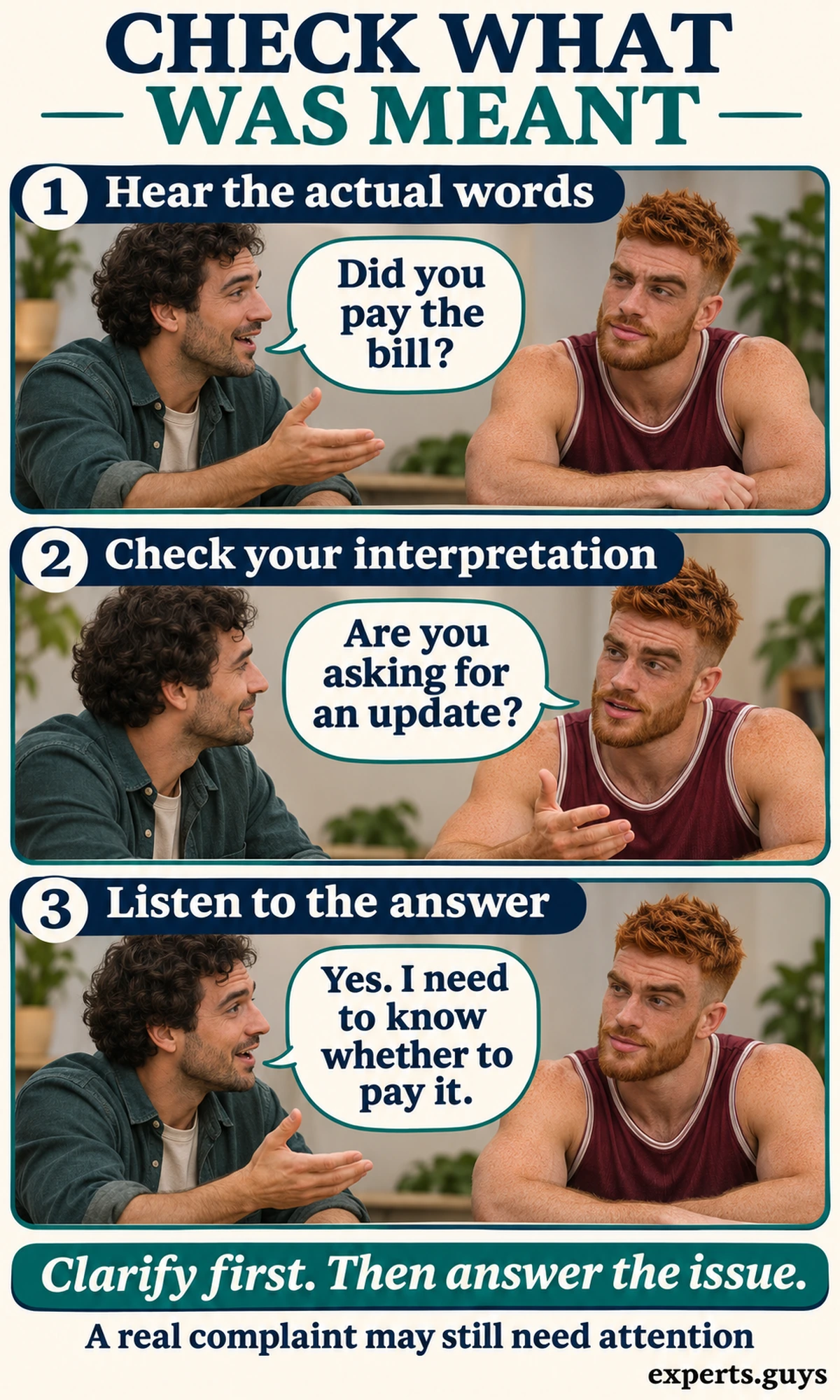
4. Check the meaning before answering the accusation you heard
An interpretation can arrive faster than the words that prompted it. “Have you paid the bill?” can be heard as “You never do anything,” even when that is not what was said. Checking the meaning leaves room for a correction without requiring you to deny a real criticism.
This is a no-writing clarification practice, informed by CCI’s guidance on responding to criticism. Its value is obtaining specific information. It is not an instruction to reinterpret mistreatment as kindness.
- Repeat the observable question or comment in plain terms.
- Name your interpretation as an interpretation: “I heard that as criticism.”
- Ask what the person meant and allow the answer before responding to the practical issue.
Illustrative example: “You asked whether I paid the bill. I heard that as saying I am unreliable; is that what you meant?” The answer may be, “No, I need to know whether to pay it myself,” or it may reveal a genuine concern about missed payments. Each answer gives you a different problem to address.
Avoid sarcastic questioning such as “So you think I am useless?” It invites reassurance or a fight rather than clarification. The easier version is one neutral question: “Are you asking for an update?” Completion means hearing the answer without immediately substituting your original assumption; disagreement can still remain.
How can you explain the distress and repair the impact?
Explain what is difficult in terms another person can respond to, then take responsibility for the part of the interaction you can change. A possible depression symptom is context, not an apology or a request that the listener ignore the impact. Repair becomes more credible when it includes a specific action instead of another promise never to be angry.
These methods fit conversations where both people are willing to participate. They are not techniques for persuading an abusive person to respect a boundary. You can end a conversation, decline touch or ask for distance without first explaining your mental health.
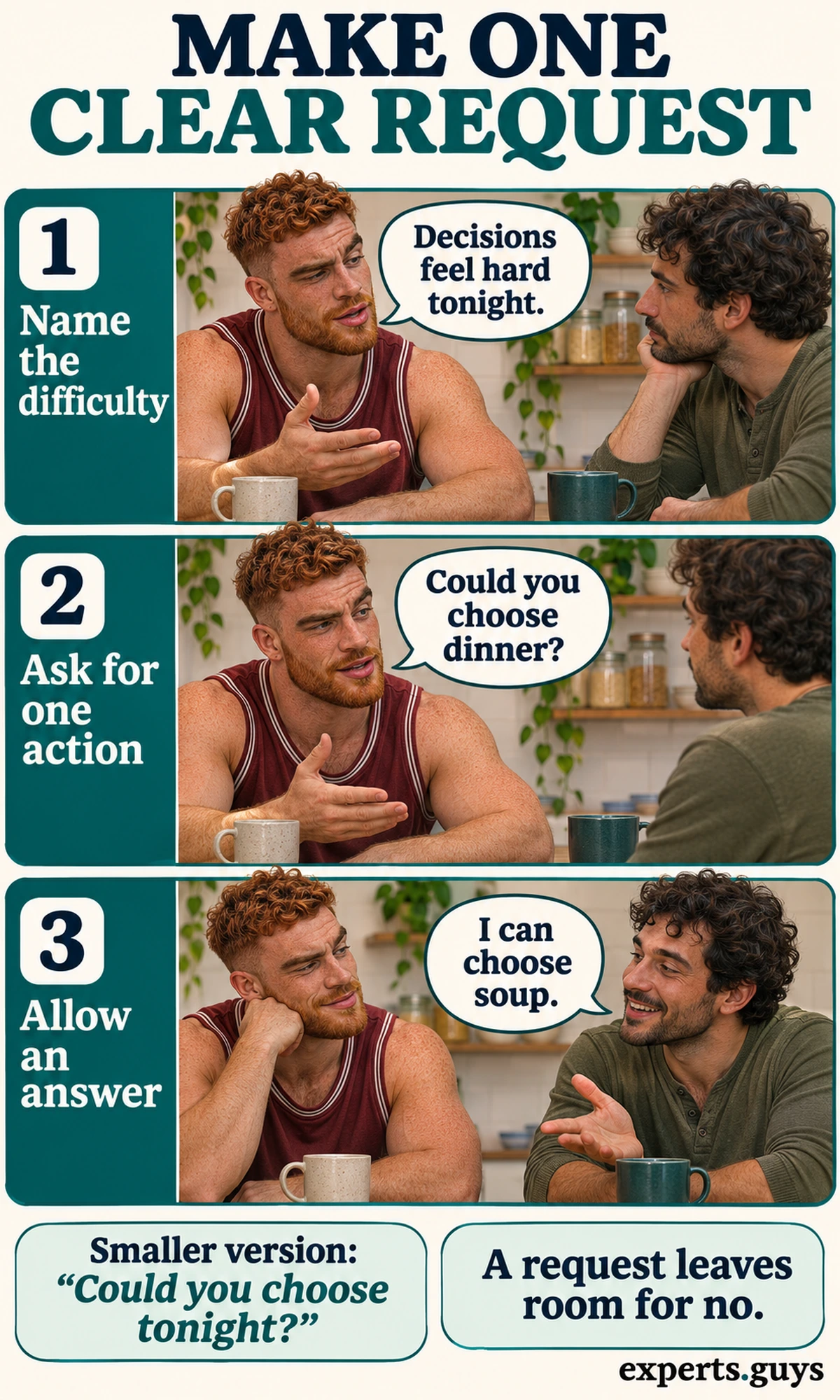
5. Replace the global complaint with one concrete request
Choose the smallest request that would make the present situation more workable. “You never support me” gives the listener a character accusation to defend against; “Could you choose dinner tonight?” identifies an action. This does not settle whether the overall division of responsibility is fair, but it makes the immediate need clearer.
The VA’s assertive communication guidance emphasises specific, clear and respectful requests. An “I” sentence helps only if its content also respects the other person. “I feel that you are selfish” still communicates a judgment.
- Name your present difficulty without diagnosing yourself or blaming the listener.
- Ask for one observable action that is realistic in this setting.
- Allow a refusal or alternative and agree on what each person can actually do.
Illustrative example: “I am finding decisions difficult tonight. Could you choose between pasta and soup?” The other person may agree, suggest a simpler option or explain that they cannot take over. A request is useful because it can receive an answer; it is not an entitlement to a particular answer.
If explaining the whole difficulty takes too much effort, use “Could you choose tonight?” as the smaller version. Avoid stacking several unrelated requests into the same sentence. Completion means a clear request and a clear response, after which a broader discussion about responsibilities can happen separately.
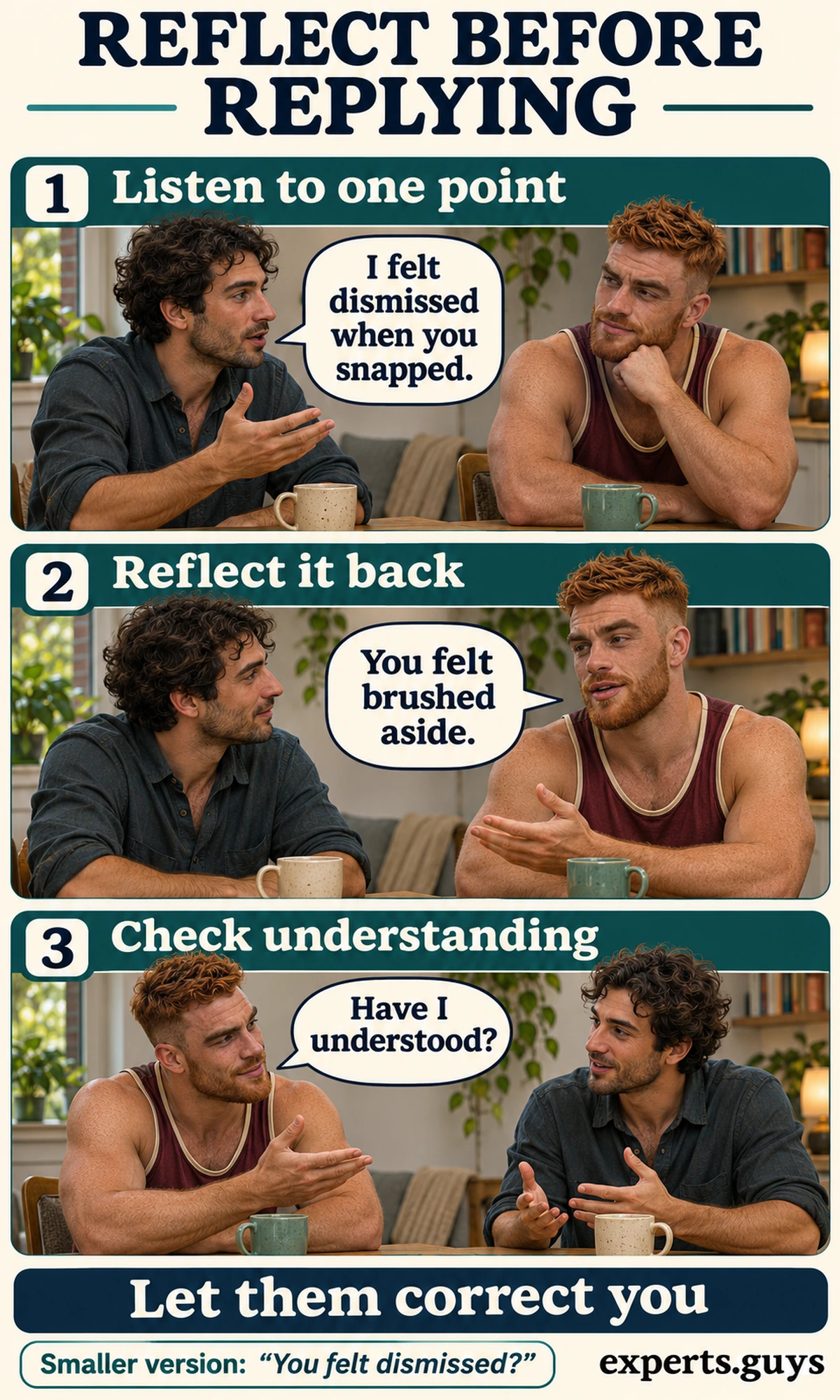
6. Reflect one point before giving your side
When both people keep correcting each other, neither may know whether their point has been understood. Reflecting one point creates a check before the next explanation. Agreement is not required: you can understand that someone felt dismissed while disagreeing about what should happen next.
SAMHSA’s guidance on supportive conversations recommends listening and repeating back what you heard so misunderstandings can be corrected. The short exchange below adapts that principle for a safe everyday disagreement; it is not a substitute for formal relationship or depression care.
- Ask the other person to give one main point while you listen without preparing an interruption.
- Reflect that point in your own short sentence.
- Ask whether you understood and accept a correction before offering your own view.
Illustrative example: your partner says that the sharp reply made them stop asking for help. You respond, “You felt brushed aside when I snapped, and now asking feels difficult. Have I understood?” If they say the concern is actually being left with all the cooking, revise your understanding instead of defending the first reflection.
The common mistake is using the reflection as a prelude to dismissal: “I hear you, but you are too sensitive.” A smaller version is “You felt dismissed?” with room for an answer. Do not require eye contact or touch. Completion is a corrected understanding of one point, not mutual forgiveness or a solved relationship.
7. Repair one concrete consequence without demanding reassurance
An apology is more useful when it names the action and what you will do about its impact. This is an everyday responsibility practice, not a clinical protocol or a promise that the relationship will immediately feel better. It draws on assertive communication’s distinction between acknowledging behaviour and attacking a person’s whole character.
First ask whether the other person is ready to hear you. If they are not, respect that boundary rather than following them or making the apology another demand. When a practical consequence can safely be corrected, agree on that correction instead of assuming what would count as repair.
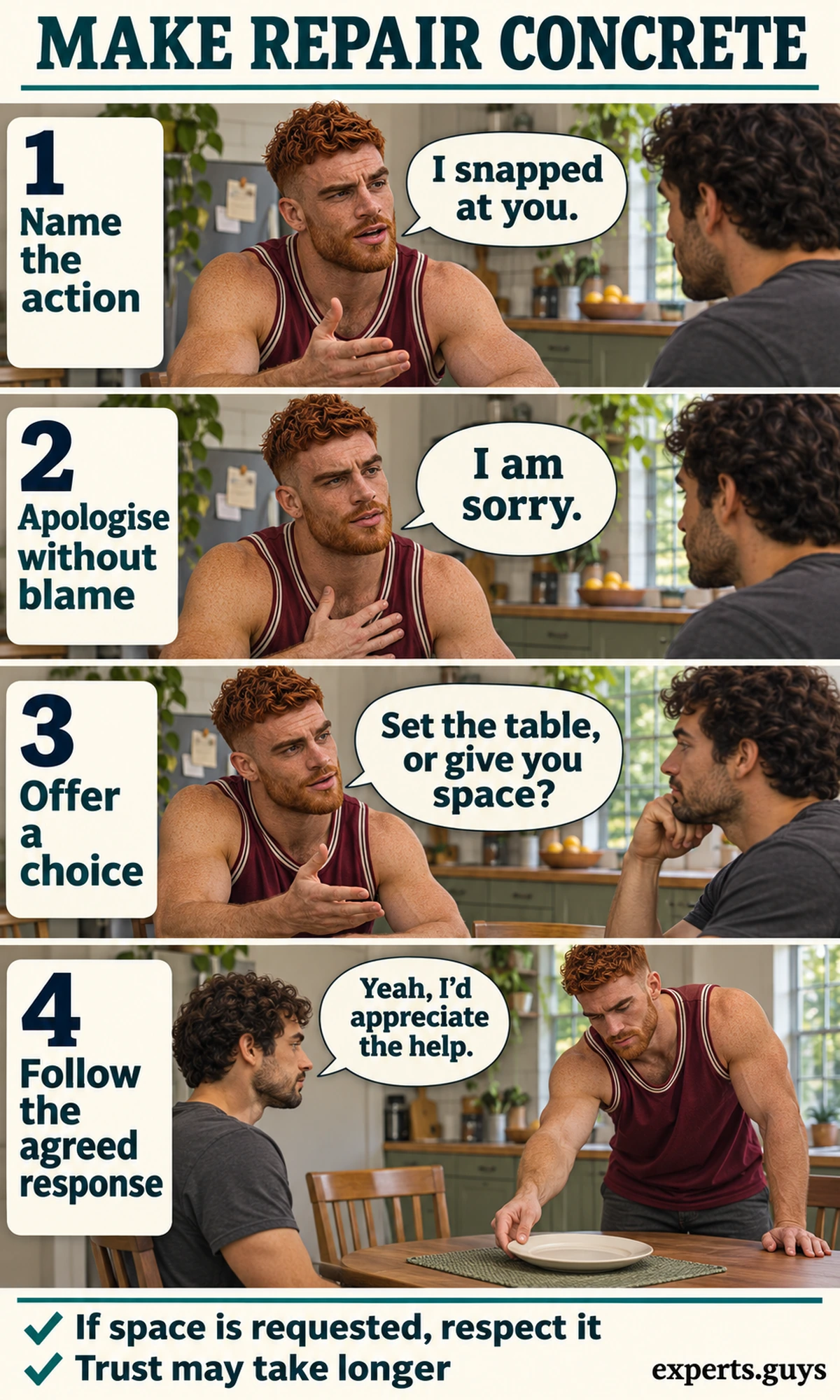
- Name the specific action: “I snapped at you when you asked about dinner.”
- Acknowledge the effect and apologise without adding a blame clause.
- Offer one relevant correction and let the other person choose whether to accept it.
- Carry out the agreed action; leave room for trust to take longer.
Illustrative example: “I left you with the meal after speaking sharply. I am sorry. Would it help if I set the table while you finish, or would you prefer space?” If the first option is welcome, set the table; if not, respect the request for space. Handling a light plate or cutlery is the practical follow-through here, not a symbolic cure for depression.
Avoid “I am sorry you were upset” or a lengthy explanation designed to make the listener comfort you. The easier version is a short acknowledgment now and an offer to talk later. Completion means acknowledging the behaviour and following the agreed response, even if the person remains hurt.
Repeated apologies without changed behaviour are a signal to reconsider the plan. If arguments keep escalating, the useful next step is more support for the pattern, including the underlying symptoms and the harmful behaviour. The other person should not become your sole monitor, therapist or safety system.
What changes when the wider depression is treated?
Communication skills address what happens between people; they cannot by themselves resolve a depressive illness. Treatment may include talking therapy, medication or both, depending on the assessment and your circumstances. The NHS overview of depression treatment describes options, including therapies that address thoughts, behaviour and relationships.
Bring the part that is easily missed into that conversation: “I am snapping more, and I have also stopped enjoying things and am struggling with ordinary tasks.” You do not need a diary, polished explanation or certainty about the diagnosis. Describe what is happening and what it is preventing you from doing.
Outward quietness is an incomplete measure of progress. A person may stop shouting yet spend the rest of the day withdrawn or distressed. The related guide to emotional dysregulation patterns explains why the course of the reaction matters as well as its visible intensity.
For these practices, look for functional changes: you can stop an exchange without intimidation, understand the request, return when agreed or correct a practical consequence. Those outcomes matter even on a day when you still feel low. If functioning continues to deteriorate, the coping plan needs reassessment rather than more pressure to perform calmness.
Frequently asked questions
Can I still be angry about something genuinely unfair?
Yes. Depression does not make every complaint mistaken. A fair concern and a harmful way of expressing it can coexist; discuss the concern while addressing the words or actions separately.
Should I tell my employer that I have depression?
Disclosure is a personal decision affected by your needs, workplace and local rules. You can often begin by describing the practical adjustment you need, such as a quieter discussion space, without making a diagnosis claim. Formal accommodations may require a separate process.
Does regretting an outburst mean it was harmless?
No. Regret describes your reaction afterward, not the other person’s experience. Acknowledge the specific impact and accept that they may need distance or support. Repeated frightening behaviour needs more than repeated apologies.
Do both people need to agree on a diagnosis?
No. You can respect a request for space or acknowledge a hurtful reply without agreeing that depression explains it. A diagnosis belongs to an appropriate assessment; the practical boundary and the effect of the behaviour can be discussed on their own.
What if the other person refuses to continue later?
You can offer a respectful opportunity, but you cannot require participation or forgiveness. Essential practical matters may need another safe arrangement. Where fear, coercion or repeated harm is involved, prioritise independent support over trying to force a discussion.
Summary
Choose the smallest change that addresses the current difficulty. If you are escalating, use the safe pause; if you are guessing at criticism, clarify the meaning; if the harm has already happened, acknowledge it and offer a relevant repair. Persistent changes in mood, enjoyment or daily functioning deserve attention alongside that practical work.










