



Bipolar disorder medicines receive FDA approval for specific uses, such as treating a manic episode, treating bipolar depression or maintaining stability after an episode. An approval for one of those jobs does not automatically cover the others: check the exact product, diagnosis, age group and whether it is prescribed alone or with another medicine.
This guide explains U.S. FDA labeling. Readers elsewhere can use the same questions, but local approval, prescribing rules and availability may differ. The purpose is to understand a treatment plan and verify a claim, not to choose a medicine or change a dose from an online list.
If there is immediate danger: seek emergency medical help for an inability to stay safe, a seizure, collapse, severe confusion or breathing difficulty. A suspected serious medication reaction needs medical assessment, not a database search. For an ordinary question about approved uses, the steps below can help you identify exactly what needs clarification.
What does FDA approval actually tell you about a bipolar medicine?
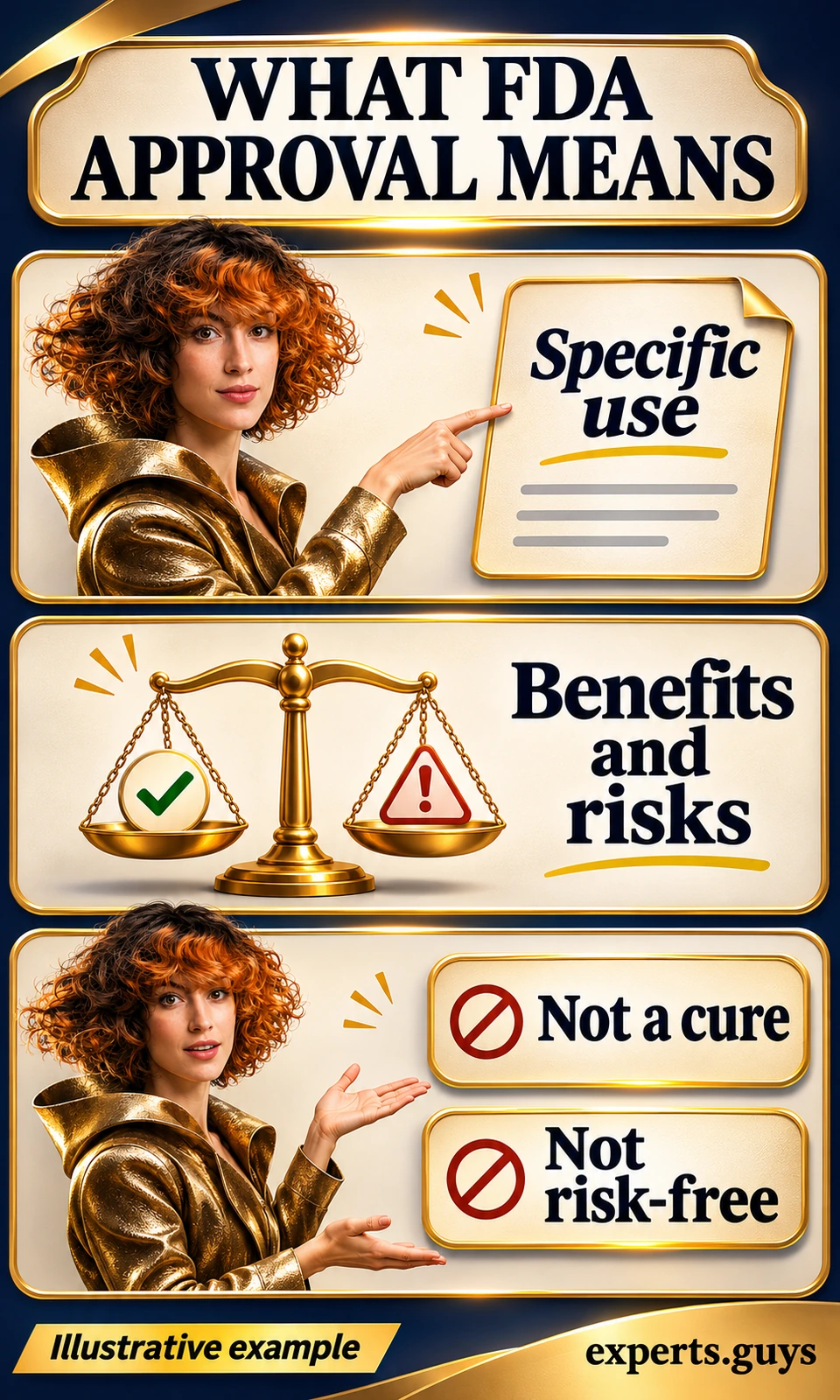
FDA approval means the agency has evaluated evidence for a particular intended use and determined that the benefits outweigh the known risks under the conditions described in its labeling. It does not mean that everyone with bipolar disorder should receive that medicine, that side effects are absent or that the medicine cures the disorder. The word that does the most work is use.
Consider the difference between an ingredient, a product and an indication. An ingredient is the active substance. A product includes its formulation and route of administration. An indication describes the condition and treatment purpose covered by the approval. Saying only that an ingredient is “FDA approved” leaves the most important part of the question unanswered: approved for what?
The agency’s explanation of approved and off-label drug use describes this benefit-risk boundary. Approval supplies a defined starting point for prescribing. It does not replace an individual discussion of previous response, other medicines, pregnancy considerations, daily functioning or the monitoring needed to use a product safely.
| Question | What answers it |
|---|---|
| Is this product approved for this use? | The specific FDA product record and Indications and Usage section. |
| Is it suitable for this person? | An individualized assessment of the diagnosis, treatment goal, previous response, risks and alternatives. |
| Does approval guarantee no harm? | No. Approved medicines still have warnings, adverse effects and monitoring requirements. |
| Can the same medicine have other uses? | Yes. Separate each labeled indication from any proposed off-label use. |
Why a drug class is not a list of approved uses
Terms such as mood stabilizer, anticonvulsant and atypical antipsychotic describe different aspects of a medicine. They do not tell you all its approved indications. A medicine originally developed for another condition may have an established bipolar indication, while another member of the same class may not share that indication. Check the named product instead of borrowing approval from its neighbors.
The word antipsychotic can be particularly confusing. Its presence in a bipolar treatment plan does not, by itself, mean the person has schizophrenia or is currently experiencing psychosis. Some products in that class have indications involving bipolar mood episodes. The diagnosis comes from clinical assessment; it cannot be reconstructed reliably from a medicine’s class name.
Likewise, a medicine appearing in a treatment guideline and a medicine carrying an FDA indication are related but different findings. A guideline evaluates how evidence can inform care. An FDA label specifies the authorized claims for a product and use. An informed discussion can involve both, but a recommendation in one document should not be described as an approval in the other.
Does approval explain the diagnosis?
No. A prescription is not a diagnostic test. The same product can be used for more than one condition, and an approved drug can also be prescribed off-label. If the diagnosis is uncertain, reading the box cannot settle the uncertainty. Ask which condition and treatment purpose the prescription is intended to address.
For the broader diagnostic context, the bipolar disorder guide explains episode patterns and assessment. This page keeps a narrower job: understanding the boundary between a treatment claim and the exact approved use behind it. A short, specific label question is more useful here than another general symptom checklist.
Why do mania, depression and maintenance have different approvals?
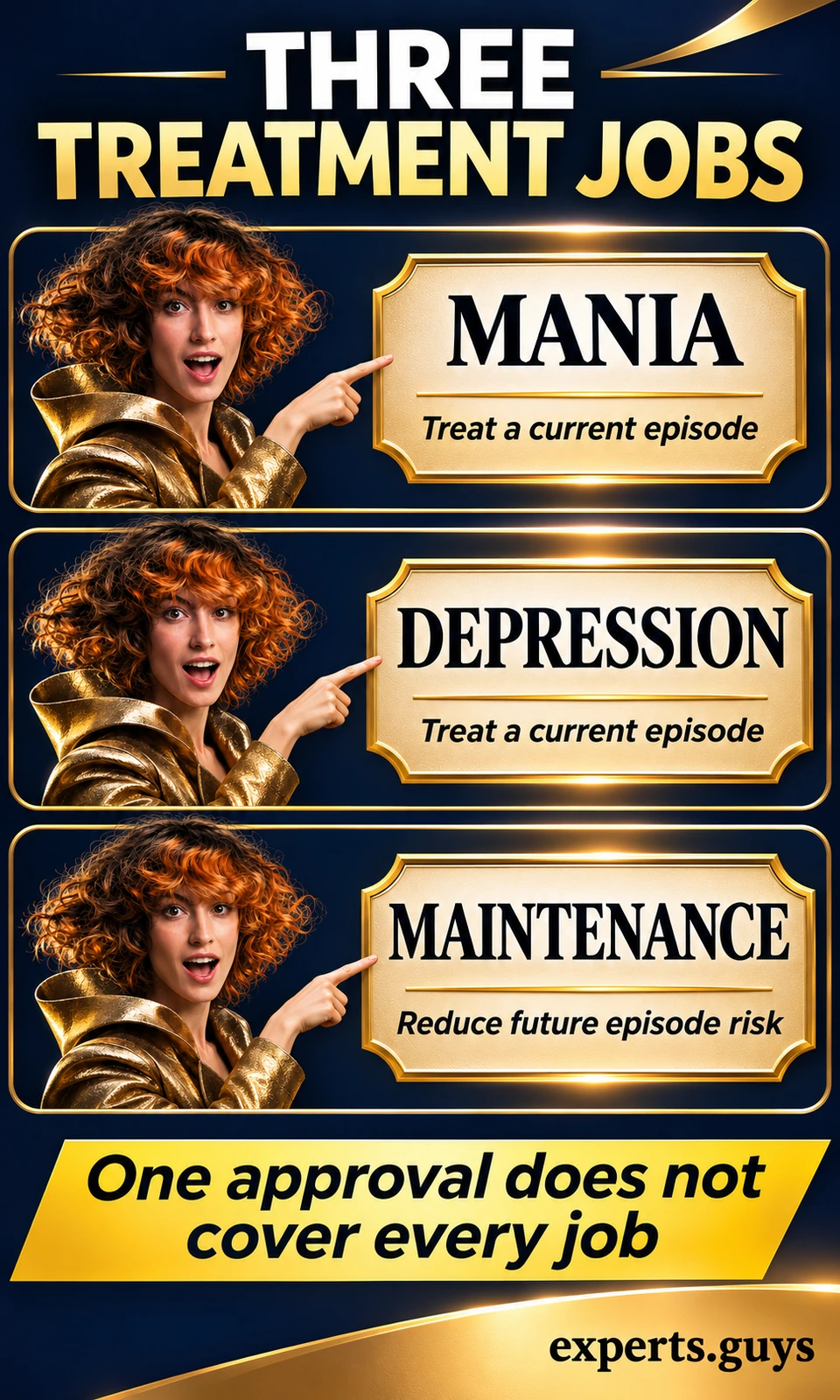
They are different treatment tasks, supported by different study questions. Acute treatment asks whether a medicine helps during a current episode. Maintenance treatment asks about delaying or preventing later episodes after an initial treatment phase. Evidence for one task does not automatically establish another, even when the same person may need both kinds of care over time.
For a reader, the practical starting point is the purpose of today’s prescription. Is it addressing a current manic or depressive episode, supporting longer-term stability, or treating a separate problem? The prescription’s intended job should be understandable without inferring it from the tablet’s appearance, the dose or how sleepy the medicine makes someone feel.
Read the phase before comparing the names
An acute mania indication should not be translated into a bipolar depression indication. Nor should improvement in sleep alone be treated as proof that the underlying mood episode has been adequately treated. Treatment outcomes involve the intended clinical problem, not a single noticeable effect. A sedating effect and evidence for an indication answer different questions.
Maintenance can also be misunderstood as a weaker or optional version of treatment. It addresses a different time horizon. Someone may feel well while a maintenance medicine is doing the job it was prescribed to do. The absence of current symptoms does not, by itself, show that the original reason for treatment has disappeared.
Some maintenance studies also have important entry conditions. Participants may first have responded to a treatment combination before entering a longer follow-up phase. When interpreting the label, look for words describing stabilization and other treatments. A finding in people already stabilized on a combination is not the same as a study establishing every possible starting regimen.
Three examples that show why the wording matters
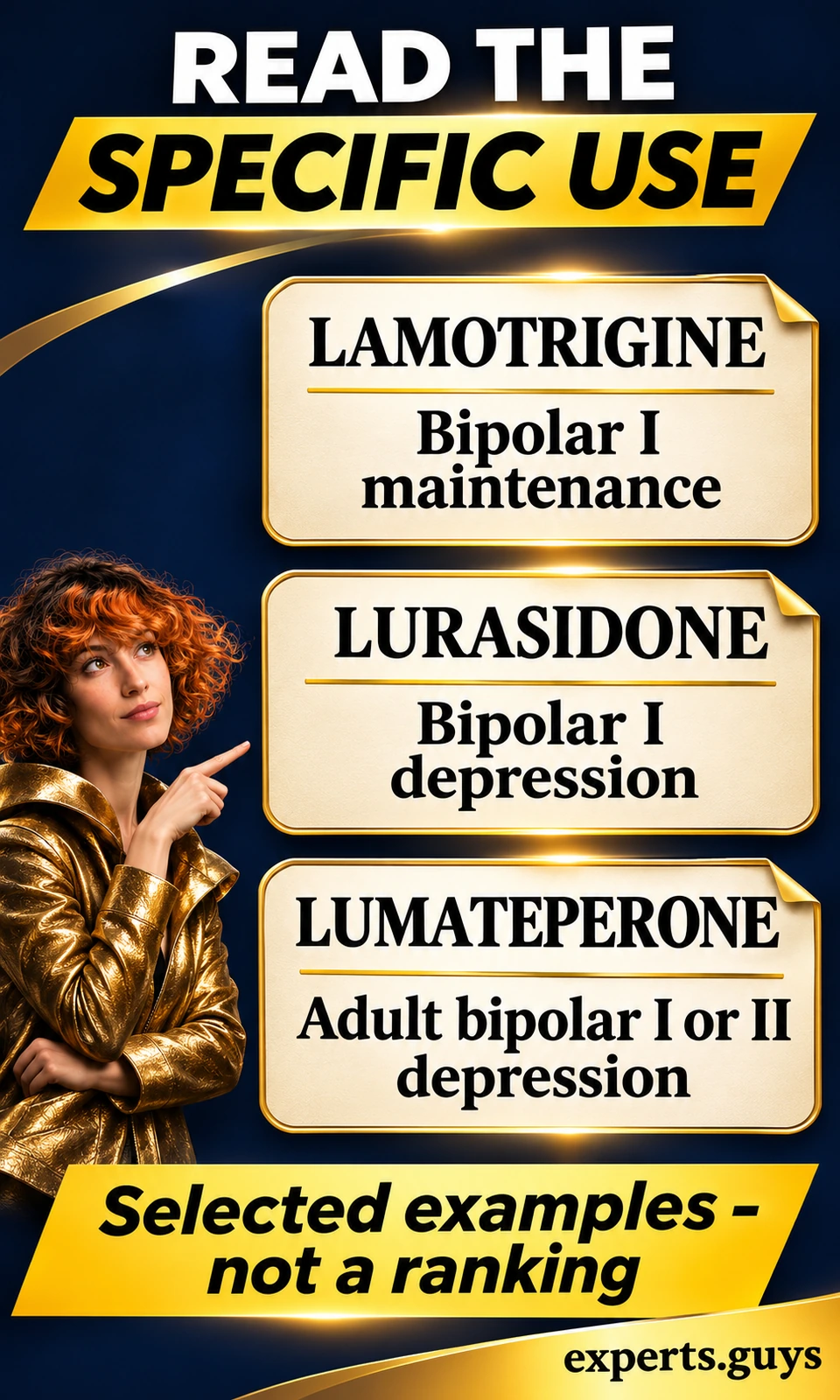
The examples below illustrate label interpretation rather than rank medicines. They are deliberately limited to selected products, not a complete inventory of FDA-approved bipolar treatments. The linked prescribing information supports the specific distinctions. Check the current product record before using any example to interpret a particular prescription.
| Product example | Approved-use example and limit |
|---|---|
| Lamictal (lamotrigine) | Use: Adult bipolar I maintenance after acute treatment. Limit: Acute mood-episode effectiveness is not established; maintenance is not an acute mania indication. |
| Latuda (lurasidone) | Use: Bipolar I depression: adults and ages 10-17 alone; adults with lithium or valproate. Limit: Do not extend adult adjunctive wording to children or assume a bipolar II indication. |
| Caplyta (lumateperone) | Use: Adult bipolar I or II depression, alone or with lithium or valproate. Limit: This does not establish every other bipolar use or pediatric use. |
The Lamictal prescribing information describes maintenance treatment of bipolar I disorder after treatment of acute episodes with standard therapy. It also states that effectiveness for acute mood episodes has not been established and that treatment of acute manic or mixed episodes is not recommended. That is a consequential limit, not a minor footnote.
The Latuda prescribing information distinguishes bipolar I depression in adults and patients aged 10-17 as monotherapy from adult adjunctive treatment with lithium or valproate. A reader who notices only “bipolar depression” can miss both the subtype and the different combination conditions. Pediatric wording cannot simply be copied from the adult line.
The Caplyta prescribing information includes depressive episodes associated with bipolar I or II disorder in adults, alone or with lithium or valproate. The explicit mention of bipolar II matters. It should not be assumed that every other depression indication carries identical wording merely because the medicines sometimes appear in the same discussion.
What these examples do not establish
They do not show that one medicine is best, that a person should switch, or that a prescription outside one of these examples is inappropriate. A short comparison cannot account for prior responses, contraindications, interactions or tolerability. It can reveal a specific question: does the proposed use match the product’s labeling, and if not, what evidence supports it?
An illustrative situation makes the distinction concrete. Suppose an adult sees lamotrigine described online as a “bipolar medicine” and concludes that it should quickly treat a new manic episode. Reading the maintenance indication corrects the misunderstanding. The useful outcome is a prompt clarification of the acute treatment plan, not a self-directed dose increase or a declaration that the medicine has failed.
Another reader may have bipolar II depression and see a webpage about a drug indicated for bipolar I depression. The webpage has not established an FDA indication for the reader’s situation. That does not settle whether a clinician has evidence for a particular off-label use. It means the approval claim must be kept separate from that clinical reasoning.
The distinction between the diagnoses is explained further in why episode history changes the interpretation of depression. Here, the takeaway is narrower: carry the precise diagnosis and episode purpose into the label comparison. Do not treat the word depression as a universal approval category.
How can you check the exact FDA-approved use without guessing?
Start with the exact medicine on the pharmacy label, then open its official FDA product record and read the full Indications and Usage section. Match the active ingredient, product name, formulation and route before comparing the indication. A search result excerpt, advertisement or old screenshot is not a substitute for the actual document.
The workflow below is an editorial reading method, not a clinical assessment or treatment-selection system. It requires no diary, symptom scoring or written exercise. Keep the product and the official document beside each other, on screen if convenient. If concentration is difficult, ask a pharmacist to help locate the one indication relevant to the prescription.
Find the product and the relevant document
- Identify the product. Read the medicine name and dosage form on the pharmacy label. Notice whether it is a tablet, extended-release product, capsule or injection. If you are uncertain which product was dispensed, clarify that before comparing documents.
- Find its official record. Use Drugs@FDA, which supports searches by drug name, active ingredient or application number. Match the result to the product rather than opening the first similarly named medicine.
- Open the labeling and read the indication. Check the document identity and revision information, then read the full relevant section. Continue to the warnings and patient information before drawing a practical conclusion. Finding a familiar word in a search result is not the endpoint.
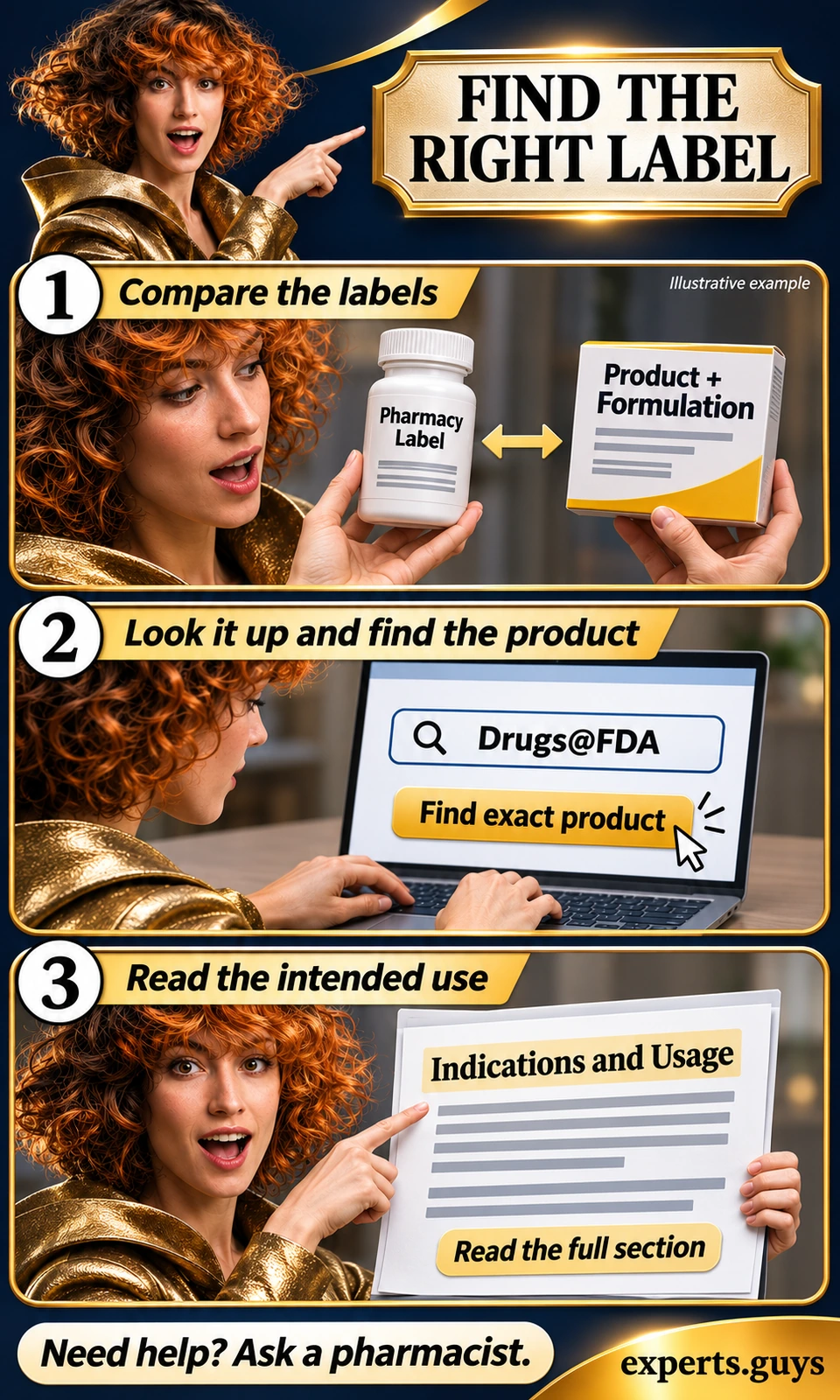
FDA distinguishes its approved labeling from manufacturer-submitted “current” labeling in other systems. Its labeling resources guide explains why DailyMed or FDALabel content may differ from the last approved version. These systems can be useful, but the difference matters when the exact question is what FDA has approved.
If the document is hard to navigate, use its contents list or search within it for “Indications and Usage.” Read the surrounding paragraph rather than a single highlighted phrase. The highlights at the front are a summary; the full prescribing information may contain limitations and age-specific details that a quick scan misses.
For accessibility, enlarge the document rather than relying on a tiny phone screenshot. A supported version of the same task is to show the dispensed product to a pharmacist and ask them to identify the relevant indication line. You have completed the lookup when you can identify the product and its stated purpose, or name the exact detail that remains uncertain.
Apply five matching checks
Once the correct document is open, compare five dimensions. They work together: matching four does not establish the fifth. Do not convert a partial match into a yes/no judgment about whether you personally should take the medicine. The purpose is to locate an approval boundary and make the next conversation specific.
| Check | Compare with the label |
|---|---|
| Diagnosis | Bipolar I, bipolar II or another stated condition. |
| Episode or purpose | Current mania, bipolar depression or maintenance. |
| Age | The age group covered for that specific use. |
| Treatment combination | Alone, or added to the particular companion treatment named in the indication. |
| Product and route | The dispensed formulation and route, not only the ingredient name. |
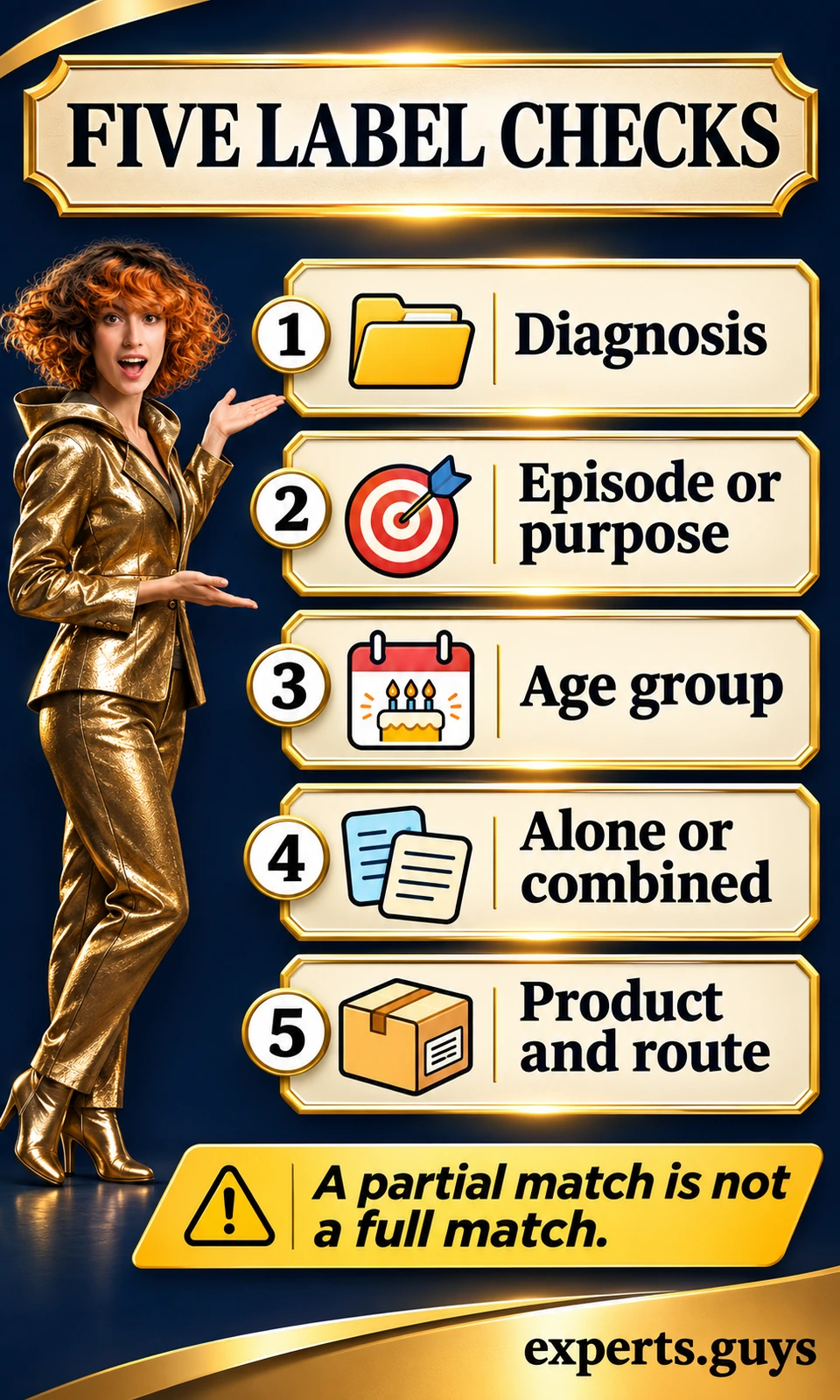
The first common mistake is dropping the subtype. “Bipolar I depression” and “bipolar I or II depression” are different label statements. The second is dropping age. A medicine may have one pediatric indication and a different adult indication, or no established pediatric indication for the use being discussed. A child’s treatment plan deserves its own evidence discussion.
The third mistake is ignoring the other medicine named in a combination indication. Monotherapy means treatment with the medicine alone for that indication. Adjunctive therapy means it is added to another treatment. If the label specifies lithium or valproate, “with another medicine” is an incomplete paraphrase. The companion treatment is part of the approved-use description.
The fourth is treating a route or release formulation as interchangeable merely because the active ingredient is familiar. A long-acting injection and an oral tablet can have different approved uses and instructions. This is a reason to verify the dispensed product, not a reason to substitute one formulation for another independently.
Work through an incomplete claim
Imagine an advertisement saying only “approved for bipolar disorder.” This is an illustrative claim, not a quotation from a named company. Ask what information is missing: the episode, subtype, age group, formulation and whether treatment is alone or combined. If the advertisement does not answer those points, follow the product information instead of filling in the blanks yourself.
Now imagine a person reading the adult adjunctive line in a lurasidone label and assuming it also describes a 15-year-old’s combination treatment. The age-specific monotherapy wording is a reason to stop that inference. A clinician may have a rationale for a different regimen, but the adult approval line cannot be used as proof of the pediatric combination claim.
This is also why an approval year is insufficient. The first approval can concern another condition; later supplements can change indications or warnings. A headline saying that a product “was approved” may describe a real regulatory event while still leaving the reader unclear about the present use. Read the relevant label section, not just the date.
Read administration instructions as instructions, not evidence of fit
A labeled administration requirement explains how an indicated product is used; it does not tell you whether that product is right for you. For example, Latuda labeling specifies taking it with food containing at least 350 calories because food changes absorption. That requirement belongs to that product. It must not be generalized into an instruction for every bipolar medicine.
If your own directions seem different from the document, identify the discrepancy before improvising. Kidney or liver function, interactions and an individualized plan can affect prescribing. Ask the pharmacist or prescriber which directions apply to the dispensed medicine. Do not use a general webpage to override a prescription or compensate for a missed dose.
What should you do when the prescription or safety information raises a question?
First separate a non-urgent labeling question from a possible adverse reaction. An off-label use needs an explanation of evidence, alternatives and monitoring. New severe symptoms need timely care. Those are different decisions, and neither is resolved simply by checking whether a medicine’s name appears in an FDA database.
Understand off-label use without assuming either safety or error
Off-label use means an approved drug is being used outside a particular approved condition, age, dose, route or other labeled use. FDA explains that clinicians generally may prescribe approved drugs for unapproved uses when they judge that medically appropriate. The agency has not established approval for that specific unapproved use. These two statements can both be true.
Off-label is therefore a question to explore, not a synonym for experimental, useless or risk-free. The strength of evidence can vary substantially between uses. A familiar medicine can have limited evidence for one proposed purpose, while a different off-label use may be supported by clinical literature and guidelines. The label alone does not grade that whole evidence base.
The most useful conversation has a defined endpoint. You should understand what the prescription is intended to do, why this option was selected and what will happen if the expected benefit does not appear or an important adverse effect emerges. A vague reassurance that it is “commonly used” leaves those decisions unresolved.
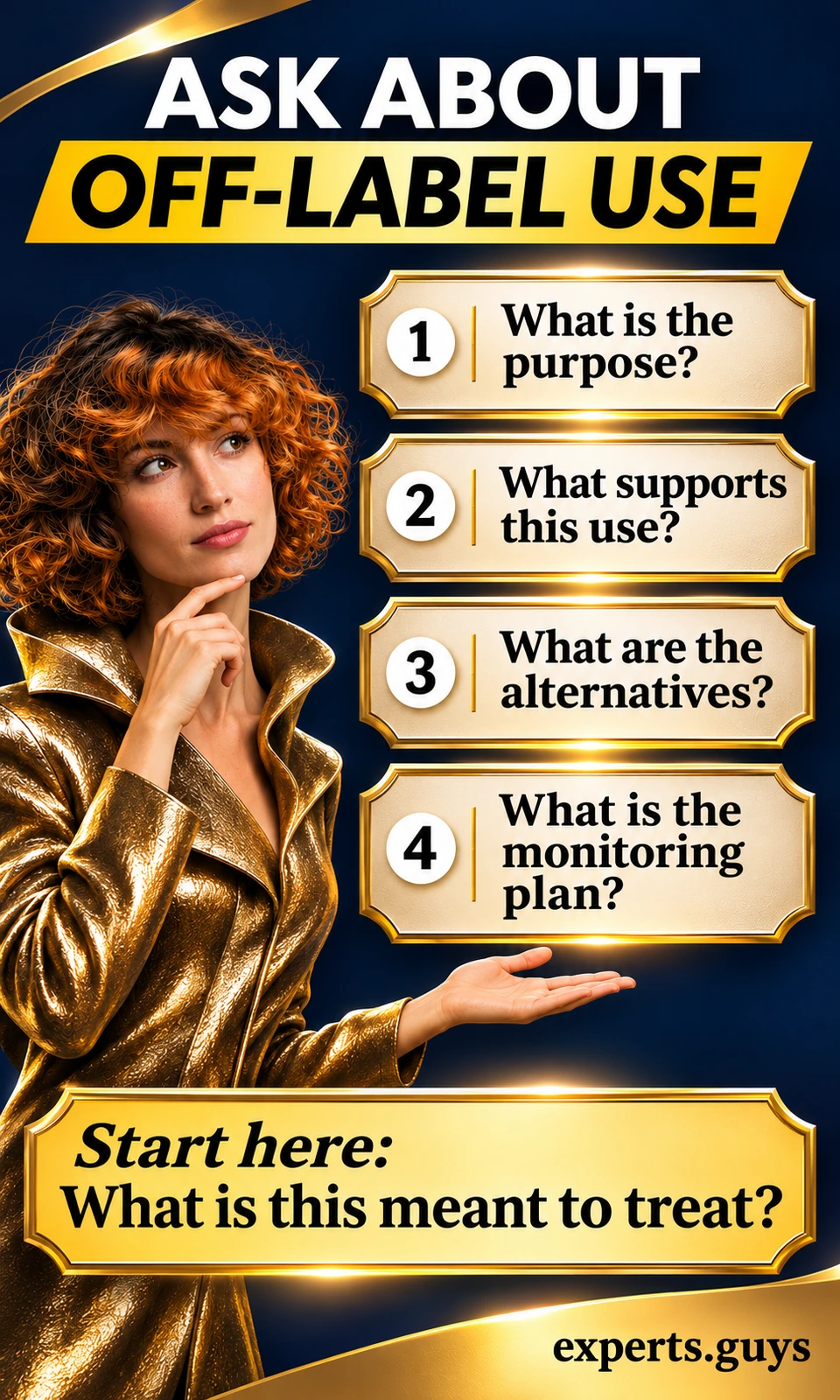
Ask in this order: “Which part of this use is outside the label?” Then ask what evidence supports the use for someone in your situation, what reasonable alternatives exist and which risks change the choice. Finish with the monitoring and follow-up plan. The sequence avoids comparing alternatives before everyone has agreed on the actual treatment purpose.
If you have limited time or energy, the shorter version is one question: “What is this medicine meant to treat for me, and is that use in the label?” You can build the discussion from the answer. Completion means that the reason for the prescription is clear, or that someone has taken responsibility for clarifying it before a change is made.
For example, an adult may discover that a prescribed use is outside the specific product’s indication. The useful next step is to clarify the rationale while keeping the existing prescription plan in place unless urgent reaction instructions say otherwise. The discovery is not evidence that treatment should be stopped abruptly, and it is not proof that the prescriber has made an error.
Make warnings actionable
Read warnings with three questions in mind: what could happen, what would make it more likely and what action is required? A boxed warning is prominent because the risk is serious. It does not predict that everyone will experience the event, and an approved indication does not cancel it. Keep the treatment benefit and the safety plan in the same conversation.
Some monitoring is designed to identify problems before they become obvious. The relevant tests differ by medicine. Laboratory checks, metabolic monitoring and interaction reviews are not interchangeable tasks. Adding another medicine can change drug exposure through an interaction even when the original dose stays the same. Ask which checks apply to your product, when they are due and who acts on an abnormal result. An internet symptom list cannot replace a scheduled laboratory assessment.
The patient Medication Guide and full prescribing information serve different reading needs. The guide gives patient-facing safety information; the professional label contains more technical detail. Use the patient document for instructions you need to recognize and act on, while asking for help interpreting technical passages rather than assuming they all apply equally to you.
| Situation | Appropriate response |
|---|---|
| Ordinary uncertainty about an indication | Clarify the intended use and any off-label rationale before making a treatment change. |
| Troublesome new side effect without emergency signs | Contact the prescriber or pharmacist promptly for product-specific advice. |
| New rash while taking lamotrigine | Obtain urgent medical advice immediately; follow the label’s urgent rash instructions. |
| Possible lithium toxicity | Seek urgent medical assessment; severe confusion, seizure or collapse requires emergency care. |
| Immediate danger or inability to stay safe | Seek emergency medical help now. Do not delay for label research. |
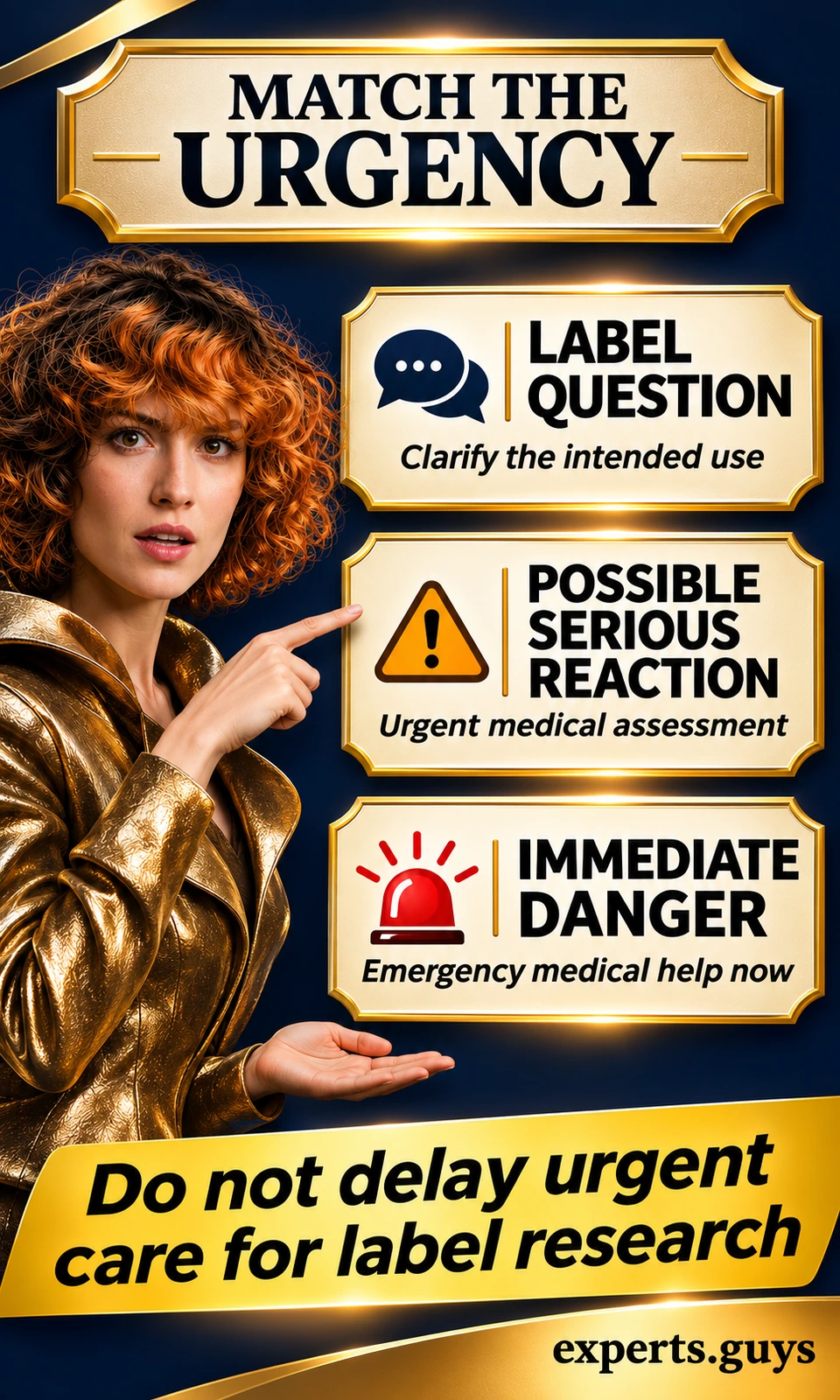
Lamotrigine deserves a specific safety distinction. Its label warns that a new rash can be serious and cannot reliably be classified at home as harmless; it instructs discontinuation at the first sign unless clearly not drug-related. If a rash develops, obtain urgent medical advice immediately and follow the product’s urgent instructions. Do not continue while waiting for a routine appointment or attempt a restart yourself.
For lithium, possible toxicity changes the urgency. Vomiting or diarrhea together with worsening tremor, unsteadiness, slurred speech or confusion should prompt urgent medical assessment; severe symptoms need emergency care. Its narrow safety margin makes guessing from a dose especially unreliable. Tell the treating team about illness, dehydration and any recently added medicines, including nonprescription products.
The FDA-hosted lithium prescribing information explains toxicity, monitoring and interaction risks. It is an illustrative label reference, not a substitute for the current instructions for your own product. Do not try to correct suspected toxicity by adjusting salt, fluids or doses without urgent clinical advice.
Changes in mood or behavior also deserve attention. A marked reduction in need for sleep with escalating energy, impulsivity or unusual behavior after a medication change calls for prompt contact with the treatment team. Severe agitation, psychosis, dangerous behavior or inability to stay safe calls for urgent assessment. Do not wait to finish a label comparison before seeking help.
The NIMH bipolar disorder guidance explains why antidepressants are not used alone in bipolar disorder: they can trigger mania or rapid cycling. An approval for major depressive disorder should not be transferred automatically to bipolar depression. This is a reason to clarify the whole regimen, not to stop an antidepressant independently.
Reporting is separate from treatment
After immediate care needs are addressed, a suspected serious side effect or product problem can be reported through FDA MedWatch in the United States. Reporting helps the safety system receive information. It does not provide emergency treatment, establish that a medicine caused an event or replace a clinical review of what happened.
Outside the United States, use the relevant local medicine-safety reporting system. The distinction is practical: approval status, access and reporting routes are jurisdiction-specific. An FDA reference can explain a U.S. label accurately without establishing whether the same product or indication is authorized where you live.
Frequently asked questions
Does FDA registration mean a supplement treats bipolar disorder?
No. Registration or a manufacturing claim is not approval of a treatment indication. The FDA explanation of what it does and does not approve distinguishes supplements from approved disease treatments. A product claiming to cure bipolar disorder needs more than an official-sounding badge. Verify the specific claim rather than treating registration, a testimonial or a manufacturing standard as proof of effectiveness.
Does an FDA-approved generic mean a weaker version of the brand?
FDA-approved generics are required to meet standards for the same clinical benefit and risks as their brand-name counterparts. Match the ingredient, strength, dosage form and route, and clarify any formulation change with the pharmacist. A familiar brand name is not itself evidence that the treatment will suit an individual better.
Can a blood-test result tell me which approved medicine to take?
A diagnostic test and a medicine-selection study answer different questions. A result that contributes to assessment does not automatically predict treatment response. The explanation of RNA editing tests and their limits separates diagnostic classification from choosing medication. Ask what treatment decision the specific test has actually been shown to inform.
Does an approval automatically establish insurance coverage?
No. FDA labeling describes a regulatory use; payment depends on the applicable insurer or health system and its rules. Ask the payer about the exact product, indication and any authorization requirements. Do not assume either approval or off-label status determines the coverage decision without checking the actual policy.
The next useful step
Begin with the treatment purpose, then verify the exact product’s indication. If the pieces match, continue to the administration and safety instructions; if one piece differs, ask for the rationale and monitoring plan. The useful result is an understandable prescription plan and a clear response to important risks, not a self-selected medicine from an approval list.










