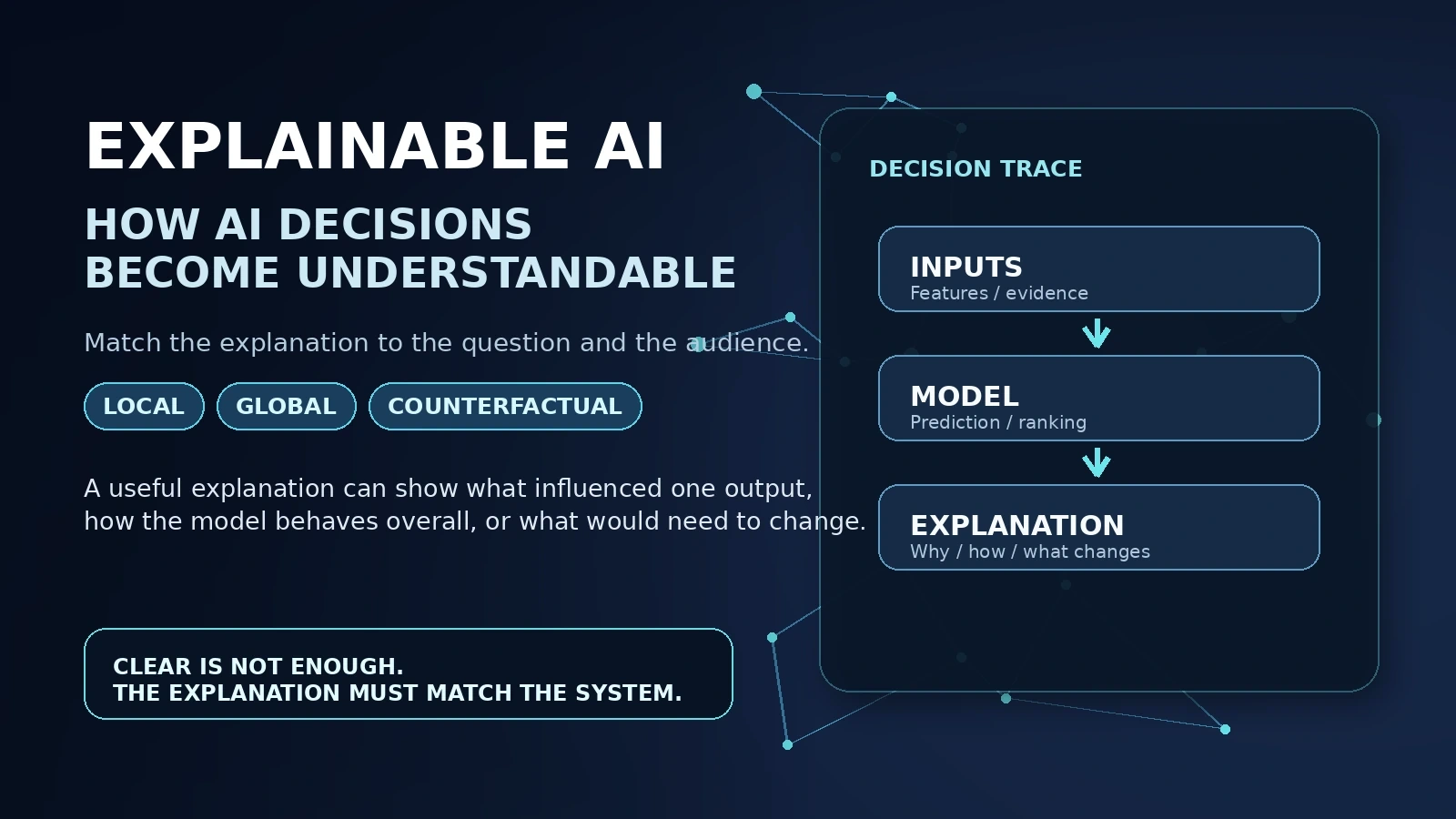

Explainable AI turns a model output into an account a person can actually use: what influenced a specific result, how the model behaves more broadly, what evidence supports the output, or what could change the outcome. The useful explanation depends on the question and the audience, and an explanation should never be treated as proof that the model is correct, fair, or causal.
That distinction matters because “explainable” is not one technique. A credit decision may need a local feature explanation and an actionable counterfactual, an engineering team may need global model behavior and failure analysis, while a generative AI response may need source provenance and verification rather than a confident-sounding story about its own reasoning.
Explainable AI examples at a glance
| AI use case | Useful explanation | Question it answers | Important limit |
|---|---|---|---|
| Credit or eligibility decision | Local feature attribution plus a counterfactual | Why this result, and what permitted change might alter it? | Feature influence is not the same as legal justification or causation. |
| Fraud or anomaly flag | Local factors, similar cases, and rule or threshold context | What made this case unusual? | A plausible pattern can still be a false positive. |
| Medical decision support | Feature or region importance, uncertainty, and human-review context | What evidence influenced the model? | An explanation does not replace clinical validation or professional judgment. |
| Image classifier | Saliency, occlusion, or region-based explanation | Which parts of the image affected the prediction? | Highlighted pixels may not faithfully represent the full decision process. |
| Recommendation or ranking | Reason codes, feature contributions, and “what changed” comparison | Why was this item ranked above another? | The explanation should distinguish user preference signals from business rules. |
| Predictive maintenance | Sensor importance, trend view, and threshold context | Which signals drove the failure-risk estimate? | Correlated sensors can make importance rankings unstable. |
| Generative AI response | Source provenance, retrieval trace, tool outputs, and uncertainty | What evidence supports this answer? | A model’s self-reported rationale is not automatically a faithful record of how the answer was produced. |
What explainability means – and what it does not mean
The terms transparency, explainability, and interpretability are often used loosely, but they describe different reader jobs. The NIST AI Risk Management Framework resources distinguish them by the questions they help answer: transparency can help show what happened, explainability can describe how a decision was made, and interpretability can help a person understand what the output means in context.
In practice, the boundary is not perfectly clean. A simple decision tree may be interpretable by inspection, while a large ensemble or neural network may require post-hoc explanation methods. The important question is not whether a dashboard is labeled “XAI”; it is whether the explanation is faithful enough for its purpose, understandable to its audience, and connected to the real decision.
If you need the wider decision pipeline first, read how AI makes decisions. Explainability sits on top of that pipeline; it does not replace model validation, data quality checks, uncertainty handling, or human oversight.
Local vs. global explanations: two different jobs
A local explanation asks why one prediction, ranking, flag, or recommendation happened. A global explanation asks how the model behaves across many cases, which features it generally relies on, where decision boundaries sit, or how outputs change across the feature space. Confusing the two can produce an explanation that looks polished but answers the wrong question.
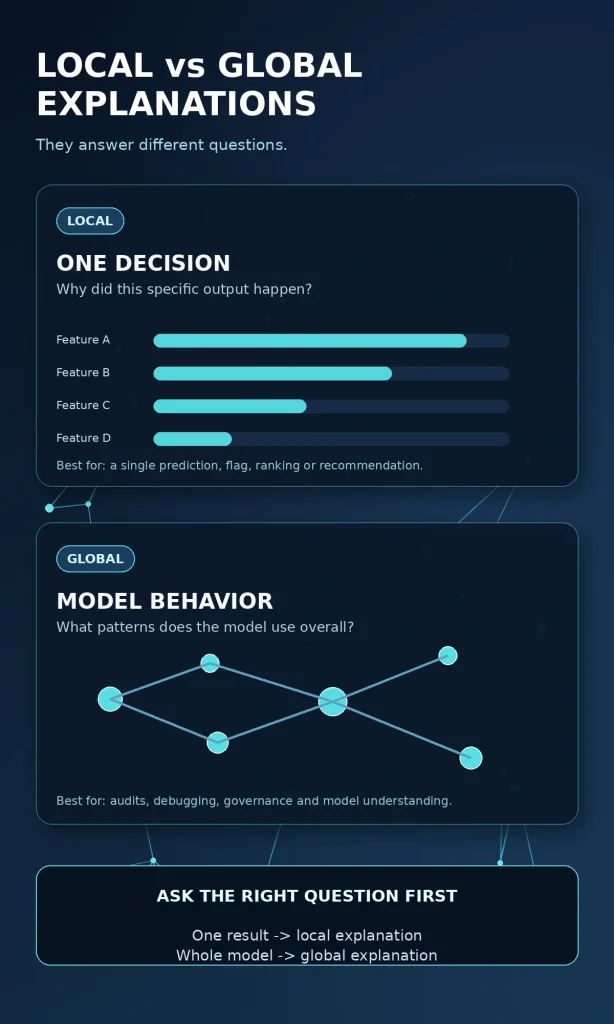
For an applicant asking why a single decision went against them, a global feature-importance chart is usually too abstract. For a model owner investigating drift, bias, or unexpected behavior across thousands of cases, a single local explanation is too narrow. Strong XAI systems often need both levels because individual accountability and system-level governance are different tasks.
Choose the explanation by the question, not the method
Start with the decision that a human needs to make. “Why this result?” points toward a local explanation; “what would change it?” points toward a counterfactual; “what does the model rely on overall?” points toward global inspection; “what evidence supports this generated answer?” points toward provenance and verification rather than feature attribution.
- Why this result? Use local feature attribution, model-native reason codes, a local surrogate, or example-based explanation.
- What would change the result? Use a realistic counterfactual constrained to variables that can actually change and are appropriate to use.
- How does the model behave overall? Use global feature importance, partial dependence, individual conditional expectation, interpretable model structure, or grouped scenario testing.
- What evidence supports the output? Use source provenance, retrieval records, data lineage, tool-call outputs, or traceable evidence.
- Can we act safely? Pair the explanation with uncertainty, validation status, operating limits, escalation rules, and human review.

Explanation Fit Studio
Choose the decision, audience and access level. Get an explanation stack that answers the right question without pretending one XAI method fits every model.
This experience recommends an explanation approach, not a trust score. It does not certify model quality, fairness, causality, safety or legal compliance.
Your explanation stack
Use this as a starting architecture, then validate it against the real model and decision context.
Primary explanation
Companion explanation
Quality checks
Avoid relying on
Human review cue
Keep the boundary clear
An explanation can make a model easier to inspect without proving that its prediction is accurate, fair, causal, safe or legally sufficient.
The A4 view opens in a separate browser window with only Close and Print This A4 outside the 210 × 297 mm report page.
Common explainable AI methods and what each one tells you
| Method | Best question | What it produces | Main caveat |
|---|---|---|---|
| Interpretable model structure | How does the model reach decisions? | Coefficients, rules, splits, monotonic relationships, or other inspectable logic | Even a simple model can become hard to interpret with many features or complex preprocessing. |
| SHAP | Which features pushed a prediction up or down? | Shapley-value-based contributions for model outputs | Results depend on assumptions about feature dependence, background data, and the explainer used. |
| LIME | What simple pattern approximates the model near this case? | A locally fitted interpretable surrogate around one input | The surrogate is local and can be sensitive to how the neighborhood is sampled. |
| Permutation importance | Which features does the fitted model rely on for predictive performance? | Performance drop after a feature is shuffled | Correlated features can hide one another’s importance; the model must be worth interpreting first. |
| Partial dependence / ICE | How does the prediction change as a feature changes? | Average or per-case response curves | Changing one feature independently may create unrealistic combinations when features are correlated. |
| Counterfactual explanation | What feasible change could alter the result? | A contrast between the current case and a changed case that reaches a different outcome | A mathematically small change can be unrealistic, prohibited, unaffordable, or impossible for the person. |
| Saliency / occlusion | Which image, text, or input regions influenced the output? | Highlighted areas or sensitivity maps | A visually convincing heat map is not automatically faithful or stable. |
| Example / prototype explanation | What similar cases influenced understanding of this result? | Representative, similar, or contrasting examples | Similarity must be meaningful for the domain, not merely close in an arbitrary embedding. |
The SHAP documentation describes its explainer interface as using Shapley values to explain a model or function. LIME focuses on local interpretable, model-agnostic explanations, while scikit-learn’s permutation importance measures how model performance changes when a feature is shuffled. Those are different mechanisms, so their outputs should not be presented as interchangeable “importance scores.”
Worked example: explaining a credit-risk decision
Consider an illustrative credit-risk model that flags one application as higher risk. A useful explanation could identify which permitted input groups most influenced that specific output, show the data used, state the model’s uncertainty or review status, and provide a counterfactual only for factors that are legitimate and realistically changeable. The explanation should not tell a person to change a protected characteristic, invent a guaranteed route to approval, or imply that a feature contribution proves causation.
A local attribution might show that recent payment history and debt burden affected the model output more than other inputs. A counterfactual could then test a permitted scenario such as corrected data or a lower verified debt obligation. If the model’s decision changes, that answers a practical “what would need to be different?” question; it still does not prove that changing one factor in the real world guarantees the same outcome.
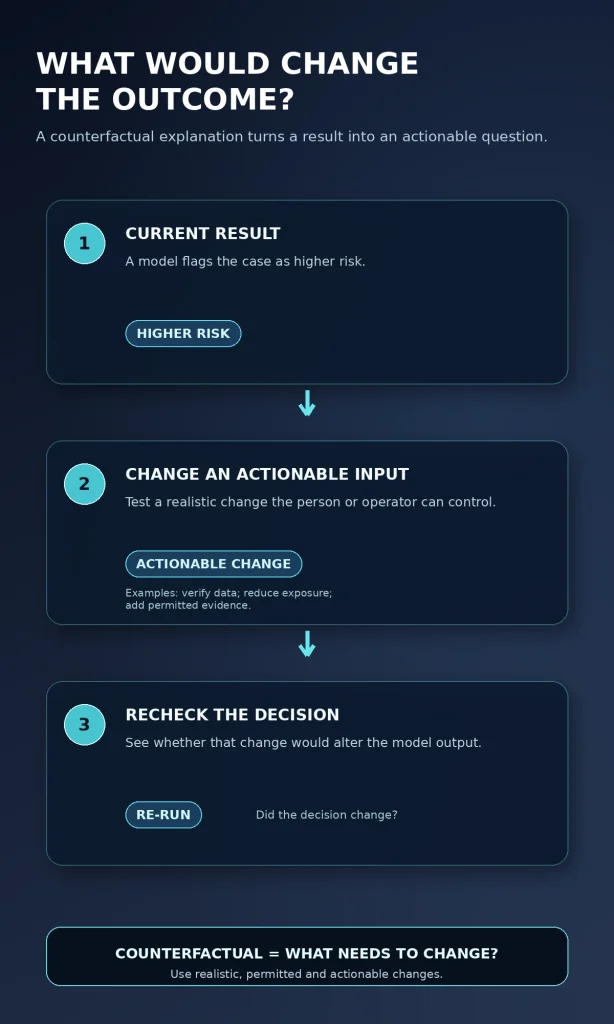
This is also where explainability meets governance. If the underlying data is wrong, the model is poorly calibrated, or the decision process uses impermissible factors, a beautiful explanation does not repair the decision. For adjacent risk issues, see algorithmic bias examples and the broader AI safety and ethics guide.
How to tell whether an AI explanation is good
A good explanation is not merely easy to read. NIST’s Four Principles of Explainable Artificial Intelligence provides a useful quality frame: the system should provide an explanation, make it meaningful to the intended user, ensure the explanation accurately reflects the system or output being explained, and operate within stated knowledge limits.
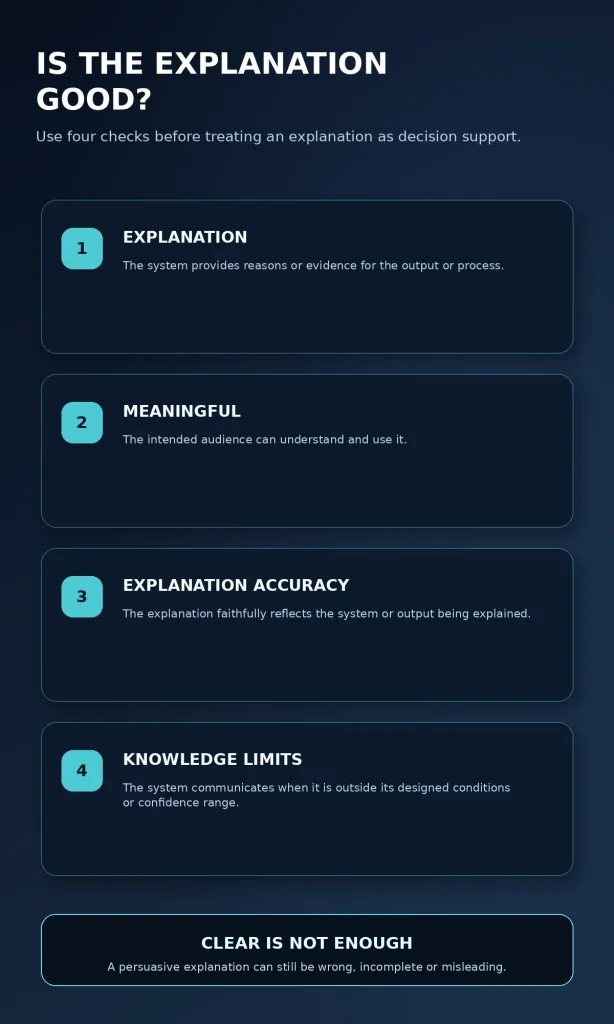
- Explanation: Does the system provide reasons, evidence, or process information instead of only an unexplained output?
- Meaningful: Can the intended audience understand the explanation well enough to use it?
- Explanation accuracy: Does the explanation faithfully reflect the model or process rather than merely tell a plausible story?
- Knowledge limits: Does the system communicate when the case is outside its designed conditions or when confidence is insufficient?
These principles also explain why different users need different presentations. A developer may need feature interactions and stability diagnostics; a person affected by a decision may need plain-language reasons and actionable recourse; an auditor may need reproducible logs, model versions, data lineage, and evidence that the explanation method itself was validated.
Why an AI explanation can still mislead you
Explainability creates a second object that also needs to be evaluated: the explanation itself. Post-hoc methods approximate, summarize, perturb, or attribute behavior around a model; they do not automatically expose a single hidden “true reason.” That becomes especially important with correlated features, complex pipelines, unstable local neighborhoods, and systems whose outputs can be generated in several functionally similar ways.
- Post-hoc is not the model itself. A surrogate can be useful while still being an approximation.
- Correlation can distort importance. Two related features may split, mask, or transfer apparent importance.
- Local does not mean global. A feature that matters for one case may be minor across the whole population.
- Predictive influence is not causation. A model can rely on a feature without that feature causing the real-world outcome.
- Natural-language rationales can sound more certain than the evidence. Fluency should not be used as a proxy for faithfulness.
- Explanations can be unstable. Small, irrelevant input changes should not produce radically different reasons without investigation.
- The audience can be wrong for the format. A dense SHAP plot may help a data scientist but fail an affected customer.
This is why explainability belongs with AI trust and uncertainty, not in place of it. Trustworthy use requires evidence about performance, limits, data, safety, fairness, and oversight in addition to an understandable explanation.
Match the explanation to the audience
| Audience | What they usually need | Useful format |
|---|---|---|
| Affected person | Main reasons, role of AI, what can be corrected or challenged, and realistic next steps | Plain-language reason codes plus constrained counterfactuals and recourse |
| Operator or reviewer | Case-specific evidence, confidence, exceptions, and escalation triggers | Local explanation plus uncertainty and human-review checklist |
| Developer or data scientist | Feature behavior, interactions, stability, drift, and failure modes | Global inspection plus representative local cases and diagnostic plots |
| Auditor or compliance team | Reproducibility, controls, model version, data provenance, limitations, and decision records | Versioned reports, logs, validated explanation method, and traceable evidence |
| Executive or system owner | Where the model is useful, where it fails, and what controls are required | Global behavior summary, risk conditions, monitored limits, and escalation ownership |
Explainability for generative AI needs a different approach
For a generative AI answer, asking the model to describe “why it thought that” can produce a coherent explanation, but coherence is not evidence that the narrative faithfully reconstructs the internal generation process. A safer operational explanation focuses on what can be verified: the user input, system constraints, retrieved sources, tool calls, data provenance, model and configuration version, and the evidence that supports the final claim.
That does not make feature-level research on language models irrelevant. It means the explanation shown to a reader should match the assurance question. If the question is “Can I trust this factual answer?”, source traceability and independent verification are usually more useful than a long self-reported rationale.
Regulatory context: explanations can also be a rights issue
Explainability is not only a design preference. The EU AI Act includes a right to explanation for certain individual decisions involving high-risk AI systems, requiring clear and meaningful explanations of the role of the AI system and the main elements of the decision when the legal conditions are met. The European Commission’s current AI Act implementation guidance also describes explanation duties for affected people and notes that implementation timing for high-risk rules has evolved, so organizations should check the current legal text and guidance rather than rely on an old compliance date.
That legal requirement is narrower than the broad technical idea of XAI. A SHAP chart, for example, may be technically informative but still fail to meet a particular legal, accessibility, or recourse requirement. High-consequence deployments should involve qualified legal, compliance, domain, and technical review rather than assuming a single XAI library solves the obligation.
A practical workflow for building explanations that are useful
- Define the human question first. Write down whether the person needs a local reason, a global model view, a counterfactual, evidence provenance, or a safety decision.
- Validate the underlying model before explaining it. Check performance, calibration where relevant, data quality, drift, subgroup behavior, and the intended operating domain.
- Choose an explanation method that fits model access. A transparent model, full feature access, prediction-only API, and generative system do not support the same explanation stack.
- Constrain the explanation to realistic variables. Especially for counterfactuals, exclude immutable, protected, prohibited, or operationally impossible changes.
- Test faithfulness and stability. Check whether the explanation tracks real model behavior and whether small irrelevant changes cause large explanation swings.
- Test it with the intended audience. A technically correct explanation is still weak if the person cannot understand the consequence or next action.
- Version and log the explanation context. Record the model version, explanation method, relevant data or background set, and decision timestamp where governance requires reproducibility.
- Monitor after deployment. Model drift, data drift, interface changes, or new use cases can make an explanation misleading even if it was once adequate.
If the explanation reveals that the system cannot support the decision safely or that the required evidence is unavailable, the next step may be to narrow the use case or stop using the model for that job. The guide on when not to use AI covers that decision boundary more directly.
What explainability should never substitute for
Explainability is one control in a larger assurance system. Do not use it as a substitute for model validation, fairness testing, security review, privacy controls, human oversight, uncertainty communication, documentation, or domain-specific safety requirements. A system can be explainable and still be inaccurate, discriminatory, insecure, poorly calibrated, or inappropriate for the task.
The practical standard is stronger: the explanation should help the right person understand or act on the right question, while the underlying AI system is independently tested for the properties that matter. That is also why types of reasoning in artificial intelligence and explainability are related but not identical – reasoning architecture describes how a system may process information, while explainability concerns what useful, faithful account can be provided about its behavior or output.
Frequently asked questions about explainable AI
What is explainable AI in simple terms?
Explainable AI is the practice of giving people useful information about an AI system’s output or behavior. Depending on the need, that can mean showing what influenced one prediction, how the model behaves overall, what evidence supports an answer, or what realistic change could alter a result.
What is a simple example of explainable AI?
A simple example is a risk model that gives a result and then shows the main permitted inputs that pushed that specific prediction higher or lower. A stronger version can add a counterfactual showing which realistic, actionable change would be enough to alter the model output.
What is the difference between SHAP and LIME?
SHAP expresses feature contributions using a Shapley-value framework, while LIME fits an interpretable surrogate around a local neighborhood of the case being explained. Both can support local explanations, but they rely on different mechanisms and assumptions, so their outputs should not be treated as equivalent.
What is the difference between a local and global AI explanation?
A local explanation focuses on one specific prediction or decision. A global explanation describes behavior across the model more broadly, such as overall feature reliance, response patterns, or decision structure. You often need both when individual decisions and system governance both matter.
Does explainability make an AI system trustworthy?
No. Explainability can make behavior easier to inspect, challenge, or use, but it does not prove accuracy, fairness, robustness, privacy, safety, or causality. Those properties require their own evidence and controls.
Can a large language model explain its own reasoning?
A language model can generate a rationale, but a fluent rationale is not automatically a faithful record of the internal process that produced the answer. For factual assurance, source provenance, retrieved evidence, tool outputs, reproducible input-output tests, and independent verification are usually stronger evidence than self-reported reasoning alone.
The practical rule
Explainable AI works best when the explanation is designed backward from the human question. Use local methods for individual outputs, global methods for model behavior, counterfactuals for actionable change, and provenance for evidence-backed generated answers – then test whether the explanation is faithful, stable, understandable, and appropriate for the decision.
Do not stop at “the model explained itself.” Ask whether the explanation matches the system, the audience, and the consequence of being wrong. That is the difference between an attractive XAI artifact and an explanation that can support a real decision.