
Bipolar disorder in women involves episodes that change mood, energy, sleep and judgment, rather than ordinary reactions to a demanding day. Hormonal transitions can matter, but so can treatment, disrupted rest and the work of keeping a household running. The useful question is what has changed from your usual pattern and which support would make the situation safer or more manageable.
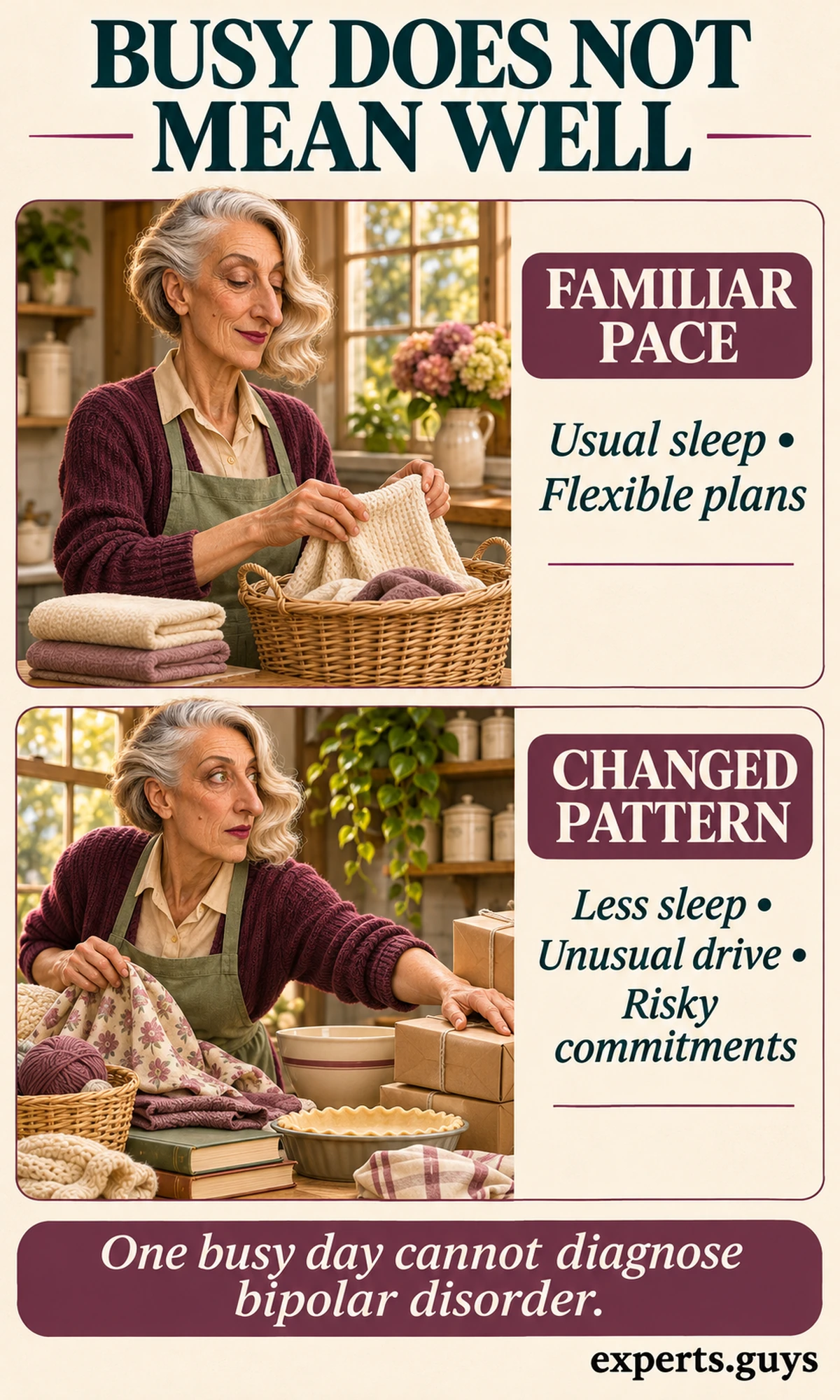
A woman can still prepare meals, answer messages or care for relatives while struggling. Equally, an untidy kitchen, a sharp reply or a burst of enthusiasm does not establish a mental health diagnosis. Household performance is an unreliable shortcut in both directions: it can hide difficulty, and it can be unfairly used to label perfectly understandable behavior.
Act on urgent changes first. New hallucinations, delusions, severe confusion or rapidly escalating behavior need urgent assessment. If anyone is in immediate danger or cannot stay safe, use local emergency medical services or an emergency department now. Sudden confusion or psychotic symptoms after childbirth are a medical emergency; do not wait to try the household adjustments below.
For a non-emergency, start by separating three issues: the possible episode, the circumstances around it and the practical responsibility that needs covering. Those issues can coexist without sharing one cause. This distinction lets a family arrange dinner or overnight care without pretending that a cleaner house will resolve bipolar disorder.
Why can bipolar changes be missed in everyday home life?
They can be missed when the visible result gets more attention than the effort, pace and consequences behind it. A spotless room may be praised without anyone noticing that it involved several nights of very little sleep and unusual spending. A meal left unmade may be criticized without anyone asking whether concentration, pleasure and energy have changed across the rest of life.
The comparison should be with the woman’s own usual functioning. Someone who has always enjoyed ambitious projects is different from someone who suddenly cannot stop taking on unfamiliar commitments. Personality, culture, income and how tasks are shared all affect what a household looks like. They do not replace assessment of a sustained change and its wider effects.
In an illustrative example, a woman normally enjoys rearranging one shelf after breakfast. During a changed period, she starts reorganizing several rooms overnight, buys furniture she cannot afford and insists that normal sleep is unnecessary. The shelf itself is irrelevant; the cluster of altered sleep, drive and judgment changes the concern. This is an example for understanding, not evidence about a real person.
Swipe horizontally to compare on a narrow screen.
| What is visible | What needs a closer look | What it cannot prove |
|---|---|---|
| More housework than usual | Whether pace, sleep, spending and flexibility changed together | That productivity means recovery |
| Less housework than usual | Whether energy, interest or thinking changed beyond the chore | That the person is lazy or necessarily depressed |
| Irritability during a dispute | The actual dispute and the wider mood context | That a fair complaint is a symptom |
| An unusually confident new plan | Whether the person can reconsider costs and consequences | That confidence alone is hypomania |
Depression may be the difficulty that prompts someone to seek help, while earlier activated periods were remembered as unusually successful weeks. That creates an assessment problem: the history can sound like repeated depression if the supposedly good periods are never explored. The NIMH explanation of bipolar disorder describes why clinicians consider the course of mood, energy and activity rather than today’s mood alone.
A useful question is, “Was that period comfortable and flexible, or did ordinary limits stop feeling relevant?” The answer does not diagnose an episode. It helps explain why the same outward activity may have different meanings at different times. Being able to choose to leave a project until tomorrow is different from feeling compelled to continue despite mounting consequences.
Consider the opposite illustrative situation. A woman leaves laundry unfinished because she has been caring for a relative with an acute illness. She feels exhausted, wants sleep and is upset about the lack of help. Those facts may identify an unreasonable workload without establishing an episode. The fair first response is to cover the care and household needs, while remaining open to assessment if a wider persistent change is also present.
These two examples lead to different questions because the context differs, even though both involve household disruption. The first raises concern about a change in activation and judgment. The second identifies a concrete burden that should not be dismissed as illness. Looking at both avoids the false choice between treating every difficulty as bipolar disorder and pretending that genuine illness is simply a stressful life.
Do women have a different kind of bipolar disorder?
There is no separate diagnostic category called female bipolar disorder. Bipolar I involves a history of mania; bipolar II involves hypomania and major depression without a manic episode. The broader guide to bipolar types, episodes and treatment owns those distinctions. This article focuses on how women’s circumstances affect interpretation and support rather than reproducing the full diagnostic guide.
Population differences cannot tell an individual woman what her illness must look like. The WHO fact sheet describes broadly similar prevalence in men and women, despite differences in diagnosis. Treating bipolar disorder as a women’s condition would miss affected men and turn women’s ordinary emotions into suspicious behavior.
Rapid cycling also has a specific meaning: four or more distinct mood episodes within a year, not four depressive spells alone and not changing your mind several times in an afternoon. The term describes an illness pattern that requires clinical interpretation. It should not be used as a casual label for a busy or emotionally difficult day.
Another misleading shortcut is assuming that an active woman must be experiencing a positive high. Depressive distress and activation can coexist. Nor does every restless depression have mixed features. When activity is rising while distress is worsening, the important consequence is to take the combination seriously rather than praising the activity as motivation returning.
The practical takeaway is to remove household output from the role of diagnostic judge. Ask what has changed across the same period and whether the change is affecting choices, wellbeing or safety. A family can describe observations without reaching a verdict, and it can provide practical help without demanding that the woman first prove why she needs it.
How do periods, pregnancy and menopause change the picture?
They add context and can change care needs; they do not explain every symptom or establish bipolar disorder. Menstrual changes, pregnancy, the postpartum period and perimenopause each raise different questions. Collapsing them into “hormones” obscures the timing, the competing explanations and the support that would actually be useful.
Some women notice mood symptoms worsening around parts of the menstrual cycle. That is different from assuming that every episode follows a cycle or that a difficult premenstrual week proves bipolar disorder. A hormone-related pattern and a bipolar history can overlap; the overlap requires careful interpretation rather than a choice between believing one and dismissing the other.
Premenstrual dysphoric disorder and premenstrual worsening of an existing disorder are not interchangeable descriptions. The first involves a particular cyclical pattern; the second describes symptoms becoming worse against an existing background. Research on premenstrual exacerbation shows that the evidence and patterns differ across disorders. A systematic review of prospective studies is a useful reminder that hormonal sensitivity is not a single universal explanation.
If symptoms are substantial, explain the concern in ordinary words: whether difficulties disappear between episodes, continue outside the premenstrual phase or involve periods of unusual activation. A clinician may recommend structured assessment for a specific question, but self-help should not become an endless assignment to document distress.

Pregnancy planning includes the period after delivery
Pregnancy is not a reliable shield against bipolar episodes, and a stable pregnancy does not remove the need for a postpartum plan. The transition after birth combines biological changes with recovery, infant care and interrupted sleep. For someone with bipolar disorder, advance planning can make the difference between an agreed response and a household trying to improvise while everyone is exhausted.
- Practical cover: who will handle essential home and care responsibilities after delivery.
- Treatment and feeding: how the agreed plan will support both the mother's health and infant care.
- Rapid access: which service to contact if a worrying change begins, using the existing care plan where available.
Advance agreement reduces the number of decisions a tired household must improvise. The Royal College of Psychiatrists’ pregnancy-planning guidance explains why these decisions belong before conception where possible, with individualized advice rather than a universal medication rule.
Postpartum psychosis is distinct from ordinary tiredness or brief baby blues. Confusion, delusions, hallucinations or strikingly altered behavior after childbirth require emergency attention. The NHS postpartum psychosis guidance emphasizes how quickly the condition can worsen. A previous bipolar diagnosis matters, but someone without a known diagnosis can also develop it.
Do not use the mother’s ability to feed the baby or hold a conversation as reassurance that everything is safe. A person may not recognize how unwell they are. A trusted adult can help the mother and baby reach care safely; the exact response should follow the existing crisis plan or emergency-service advice. Household help is valuable, but it is not the treatment for a psychiatric emergency.
Perimenopause requires more than a hormone assumption
Sleep disruption, physical discomfort and mood symptoms can overlap during the menopause transition. A new change deserves attention even when it seems to fit that stage of life. The competing mistake is to interpret every hot-flash-related awakening or difficult week as a bipolar relapse; the context needs to be considered alongside the established illness pattern.
Research suggests that some women with bipolar disorder experience greater mood difficulty around the transition, but the evidence does not establish one inevitable course. A small observational study of bipolar symptoms during the menopausal transition found differences between reproductive stages. It cannot predict an individual’s outcome or prove that hormone treatment will stabilize bipolar disorder.
Ask which part of the problem is being addressed. Treating night sweats, reviewing a bipolar treatment plan and reducing avoidable overnight responsibilities are different decisions. One intervention may help one part without resolving the others. This separation keeps the discussion practical and avoids offering hormone therapy, supplements or a medication change as a complete answer without appropriate evidence.
The site’s menopause and bipolar comparison addresses the narrower question of overlapping symptoms. Here the takeaway is broader: reproductive stage changes the context for care, but the woman’s own history and present functioning still matter. Do not assume that pregnancy, menstruation or menopause explains a serious change simply because the timing is convenient.
Which treatment decisions need special attention for women?
Medication decisions need to account for the current episode, previous response, side effects and reproductive circumstances. There is no single medicine that is best for every woman, and “natural” does not automatically mean safer. A household adjustment can support treatment; it cannot safely choose a medicine, set a dose or substitute for an individualized plan.
A useful treatment conversation separates three questions: what the medicine is intended to do, what problems it is causing and what has changed in the woman’s circumstances. Combining those questions into “I want something milder” can hide the actual trade-off. Less sedation might be a meaningful goal, for example, while preserving protection against episodes remains a separate requirement.
The same distinction applies when energy changes. Difficulty waking may relate to poor sleep, depression, a medicine effect or several factors together. Deciding which explanation fits affects the response. It is more useful to describe the everyday consequence, such as being unable to safely manage an early responsibility, than to assume either that the medicine is wrong or that all tiredness is the illness.

The everyday decision is whether to arrange a focused review, not how to redesign treatment at home. Mention a change after starting or altering a medicine, any substantial adverse effect and any pregnancy possibility. If the problem affects safety, explain that directly. A good review makes the trade-off visible instead of requiring the woman to choose between silently tolerating difficulties and abruptly stopping treatment.
Pregnancy risk requires a specific medicine discussion
Valproate is a particularly important example because of serious fetal risks. It should not be treated as an interchangeable option for someone who could become pregnant. The NHS advice on valproic acid and pregnancy explains the risks and the need for urgent contact if pregnancy occurs. Regulatory requirements vary by country; obtain advice for your location and prescription.
Do not stop an existing prescription abruptly on discovering a pregnancy or deciding to try for one. The risk of an untreated episode also matters, and a safe change may need planning. An urgent medication review is different from an instruction to continue indefinitely or stop immediately. Neither a general article nor a family member can make that individualized decision from the medicine’s name alone.
Breastfeeding questions also depend on the specific medicine, dose, infant health and monitoring arrangements. A feeding plan should support both infant nutrition and maternal wellbeing. Decisions made around rest or treatment are not a measure of maternal commitment. Practical support can help implement the agreed plan without making the woman responsible for defending it repeatedly to relatives.
A practical treatment review can be direct without requiring a form or a diary. For example: “The current treatment has helped the episodes, but I am too drowsy to manage breakfast safely. What options preserve the benefit while addressing that problem?” This invented example identifies both benefit and cost. It does not presume that the answer is a dose change; changing timing, another explanation for fatigue or a different treatment may need consideration by the prescriber.
Access barriers deserve the same specificity. If an appointment time repeatedly clashes with an essential care responsibility, arranging cover or asking about another appointment format may be more useful than another reminder to attend. That is a service-access decision rather than a clinical intervention. It also shows why helpful support sometimes means changing the surrounding arrangement instead of asking the woman to become better organized.
Feeling better does not settle the maintenance question
Some treatment prevents future episodes as well as addressing current symptoms. That explains why a medicine may still have a purpose when the person feels well. Conversely, an ongoing prescription should not mean that burdensome side effects are never revisited. The right question is what continued benefit is expected and how unwanted effects will be managed.
Antidepressants are not a simple stand-alone solution to bipolar depression; treatment selection must account for the possibility of activation or switching. Nor should a history of depression be used to assume that all future low mood has the same explanation. A substantial change after treatment deserves interpretation within the whole history, especially when sleep, activity and judgment shift together.
The practical recommendation is to ask for a plan that explains both intended benefit and review triggers in language the woman understands. That creates a shared reference for decisions without handing control to a spouse or relative. Supporters can help with agreed practical arrangements, while the person and the treating team retain the treatment discussion.
How can a household offer useful support without taking over?
Start with a real responsibility that is making the day harder, then agree on who will handle it from start to finish. The lead skill here is a complete household handoff: transferring the thinking and follow-through of one task, rather than asking the woman to supervise someone else’s help. These are practical adaptations of support and routine principles, not separately validated treatments for bipolar disorder.
The reason to begin here is editorial and practical. “Have less stress” is difficult to act on while meals, dependants and household decisions still need attention. A clearly bounded transfer removes one demand now. It does not require a diagnosis to justify cooperation, and it produces an observable result without requiring an immediate improvement in mood.
Hand over a responsibility, not just one movement
Use a low-risk example such as putting away a small basket of clean towels. Agree that a willing helper will carry out the whole job, including finding the usual storage place and returning the empty basket. Put the basket within comfortable reach or let the helper collect it; avoid lifting, bending or carrying that causes pain. Do not substitute a safety-critical duty without confirming that the helper can do it competently.
- Name the complete outcome: “Please put these clean towels away and return the basket.”
- Let the helper take the basket and complete the ordinary decisions within the agreed scope. The woman can remain seated and does not need to direct each towel.
- Confirm that the whole responsibility is covered. Leave unrelated laundry, cleaning and reorganizing outside the handoff.
The common mistake is offering hands while leaving all management with the person who needs relief. “Tell me each thing to do” can preserve the original burden. The correction is a narrower but complete job. If a whole basket is too much for the helper, agree on one small, clearly finished responsibility instead; if nobody is available, postpone a non-essential chore rather than inventing another obligation.
Completion means that responsibility was actually transferred or a non-essential demand was removed. It does not mean that the woman is recovered or now owes additional work. The next useful action is to keep the arrangement proportionate: repeat what genuinely reduced burden, revise an unclear scope, or choose another necessary responsibility only with agreement.

Prevent a small task from turning into an expanding project
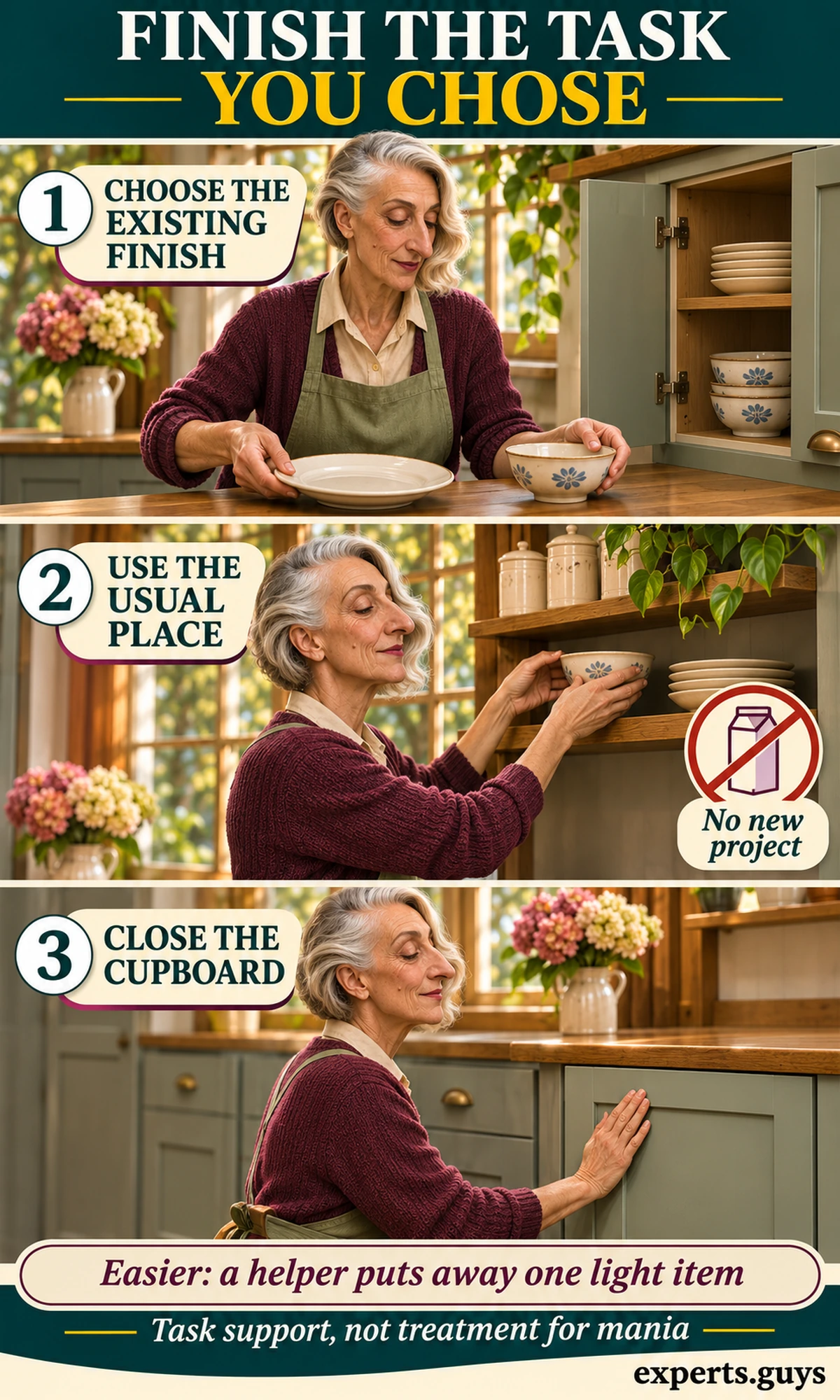
This adaptation fits a familiar household task that keeps spreading into extra commitments. It is not a technique for controlling mania at home. If unusual drive, falling sleep and worsening judgment are developing together, use the treatment plan or prompt clinical contact rather than trying to solve the pattern by managing chores.
For an ordinary, safe task, agree on the boundary before starting: placing already-clean everyday dishes in their usual cupboard. This example involves no washing, heat, blades or heavy objects. Use a reachable shelf; do not climb, stretch or carry unstable stacks. A helper can handle any awkward movement while the woman remains seated if needed.
- Choose the existing finish: return the clean dishes to their normal places.
- Leave the cupboard arrangement unchanged. Do not empty other shelves, start shopping or add a new storage project.
- When the dishes are away, close the cupboard and stop. Another suitable person can take over if stopping is becoming difficult.
The mistake is letting “while I am here” create a second job. The correction is visible: the original dishes are stored, the cupboard is closed and no new materials have been brought out. An easier version is one light item placed on an accessible shelf by the helper. Completion is a bounded task, not a test of willpower or evidence that an emerging episode is controlled.
The trade-off is accepting a merely functional result. A shelf may remain imperfect, but sleep and other responsibilities do not have to compete with an optional redesign. That is a reasonable household preference, not a medical threshold. If the person cannot disengage and this is part of a larger change, the next step is assessment rather than a stricter household rule.
Transfer interruptions so rest is a real opportunity
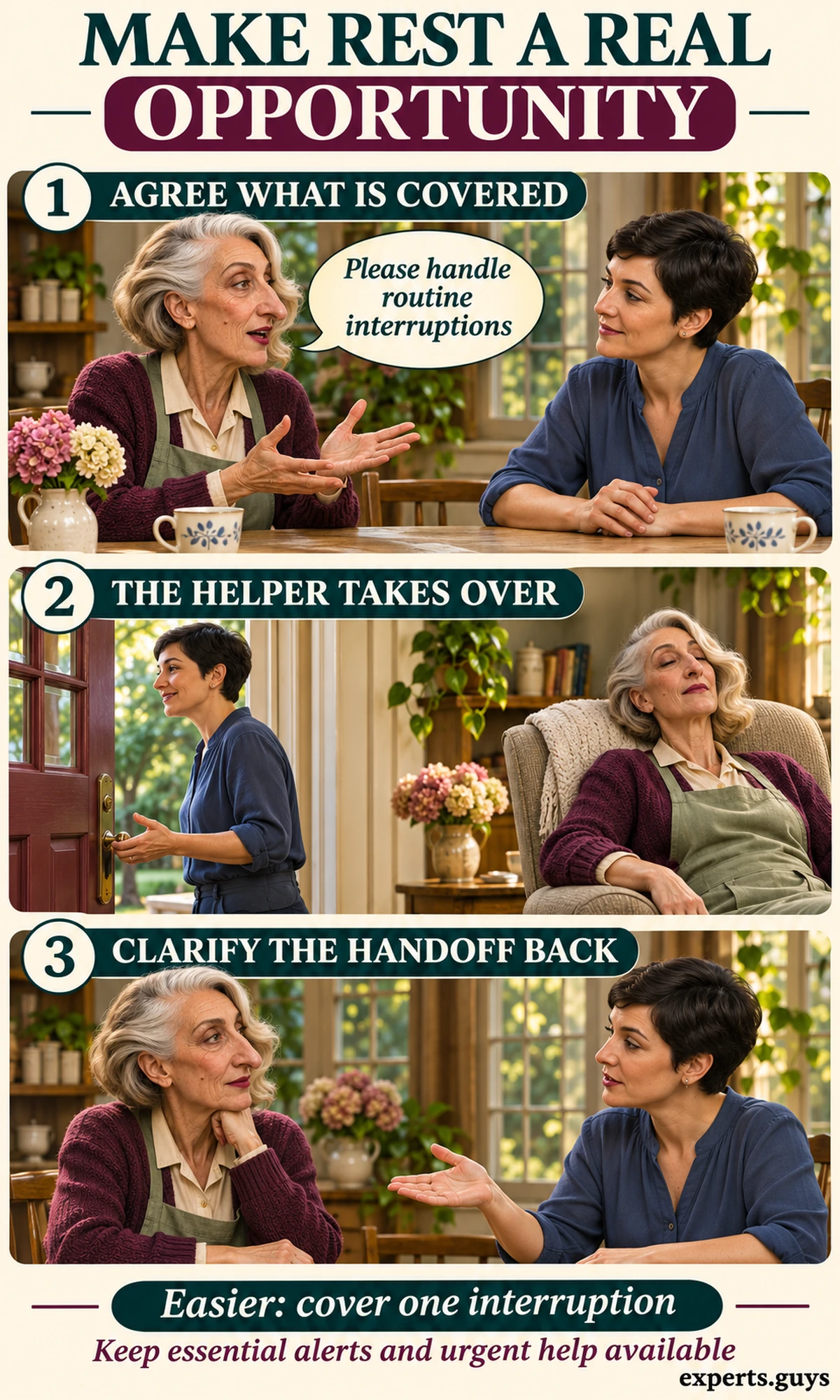
A protected rest opportunity requires someone to cover the interruptions, not simply permission to lie down. For a woman who is otherwise safe to rest at home, a willing helper can take over a specified ordinary responsibility, such as answering the door and handling routine household requests. This example is about access to rest; it makes no promise about sleep or mood.
- Agree which requests the helper will handle and which essential alerts must still reach the woman. Keep access to urgent help available.
- The helper moves to the shared living area and handles those agreed interruptions. The woman can use her usual safe, comfortable resting place without monitoring the task from there.
- When the agreed responsibility changes hands again, make that clear. Avoid leaving the woman to guess whether she is still on call.
An easier version covers one interruption rather than a long period. Do not impose an arbitrary rest duration, lock someone away, silence safety alarms or remove essential communication. If no helper is available, remove one optional demand while keeping necessary care covered. A sleeping woman must not be assumed able to supervise a child or vulnerable adult at the same time.
After childbirth, practical night support needs to fit the feeding and care plan agreed with the maternity and mental health teams. The helper must be capable of the responsibility and clear about when to seek help. A rest handoff is not enough for new confusion, delusions or hallucinations, and no household arrangement should delay emergency care.
Keep concern, autonomy and safety in proportion
Support should be negotiated while the person is able to participate, with preferences and limits respected. An apron, marriage, parenthood or a diagnosis does not make someone responsible for all domestic labor. Nor does a diagnosis automatically authorize another adult to inspect spending, control movement or take possession of medicines. Existing care and legal arrangements may be relevant, but they should not be invented by a household during an argument.
The guide to supportive bipolar conversations covers wording and repair in more detail. The narrower focus here is follow-through: whether the offered help actually covers a responsibility. A respectful sentence cannot compensate for leaving all the work and decisions with the person who asked for relief.
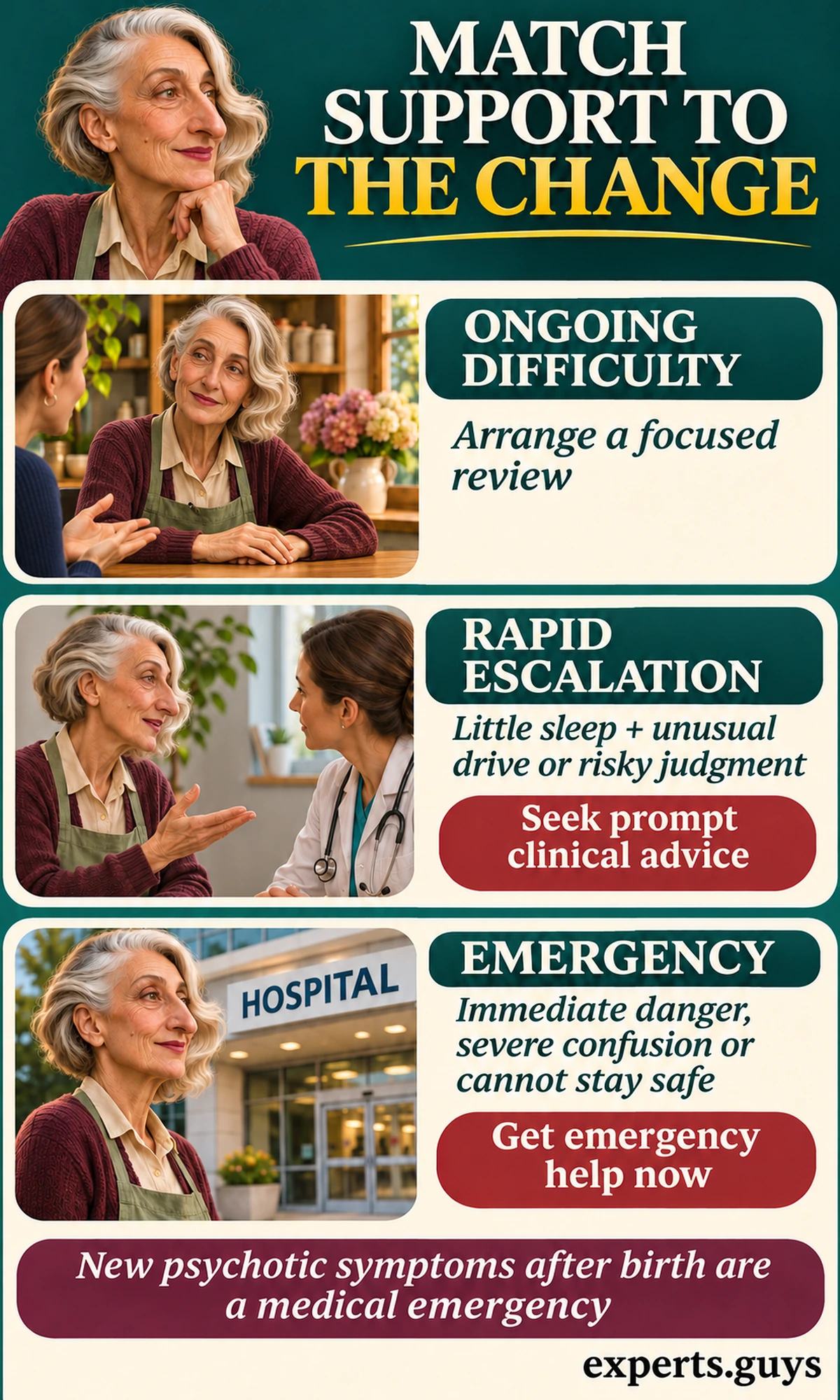
For ongoing symptoms that are persistent, worsening or disabling, arrange a focused assessment or treatment review and explain the change that matters. For rapidly increasing activity, little sleep with unusual drive or major deterioration in judgment, seek prompt advice from the treating team. For immediate danger, inability to stay safe or severe confusion, use emergency help. These are response priorities, not a self-diagnosis score.
Questions that often come up
Can bipolar disorder first be recognized later in life?
Yes. Recognition and onset are different questions: earlier episodes may not have been identified at the time. A first major mood change later in life also needs assessment for other explanations, including medicines and physical illness. Age alone neither confirms nor excludes bipolar disorder.
Does being a housewife increase the chance of bipolar disorder?
A domestic role is not a diagnostic criterion or a demonstrated personal cause. Unpaid work, financial strain and disrupted rest can affect wellbeing and support needs, but they cannot establish why an individual has bipolar disorder. Women in paid work, unpaid care, retirement or none of these roles can be affected.
Should a partner attend every appointment?
Only when the woman wants that involvement, except where applicable emergency or legal arrangements determine otherwise. A supporter may contribute useful observations with permission, but private time with the clinician can also matter. Agree what help is wanted rather than treating attendance as an entitlement.
Can an online hormone or mood test settle the diagnosis?
No. A result may answer a limited medical question when appropriately ordered, but it cannot independently establish a bipolar history or explain every mood change. A useful assessment connects the current difficulty with previous episodes, other health issues and treatment. Avoid paying for a test on the promise that it will identify one universal cause.
Choose the first step from the actual obstacle
If there is no urgent concern, choose the responsibility that most clearly needs covering today and agree on one complete handoff. Keep the outcome modest and observable: the helper owns the task, a non-essential project remains closed, or a rest opportunity is genuinely protected. Use those changes alongside appropriate care, without making household performance the measure of whether a woman deserves help.