



Bipolar depression is a depressive episode occurring as part of bipolar disorder, affecting mood, thinking, energy and everyday functioning. Treatment needs to address the low mood while also accounting for past or emerging mania or hypomania. For today, the useful distinction is whether you need urgent help, an earlier treatment review, or practical support with an ordinary activity.
A difficult morning does not explain an entire illness. Equally, a known bipolar diagnosis does not mean every new difficulty should be dismissed as “just bipolar.” This guide focuses on getting through a depressive episode with clearer decisions about care and daily demands, rather than trying to diagnose yourself from a symptom list.
If you may act on suicidal thoughts, cannot keep yourself or someone else safe, or have severe confusion, seek emergency medical help now. New hallucinations, delusions or rapidly escalating agitation need urgent assessment. The practical suggestions below are for everyday support alongside care; they are not a way to manage an emergency at home.
What changes during bipolar depression?
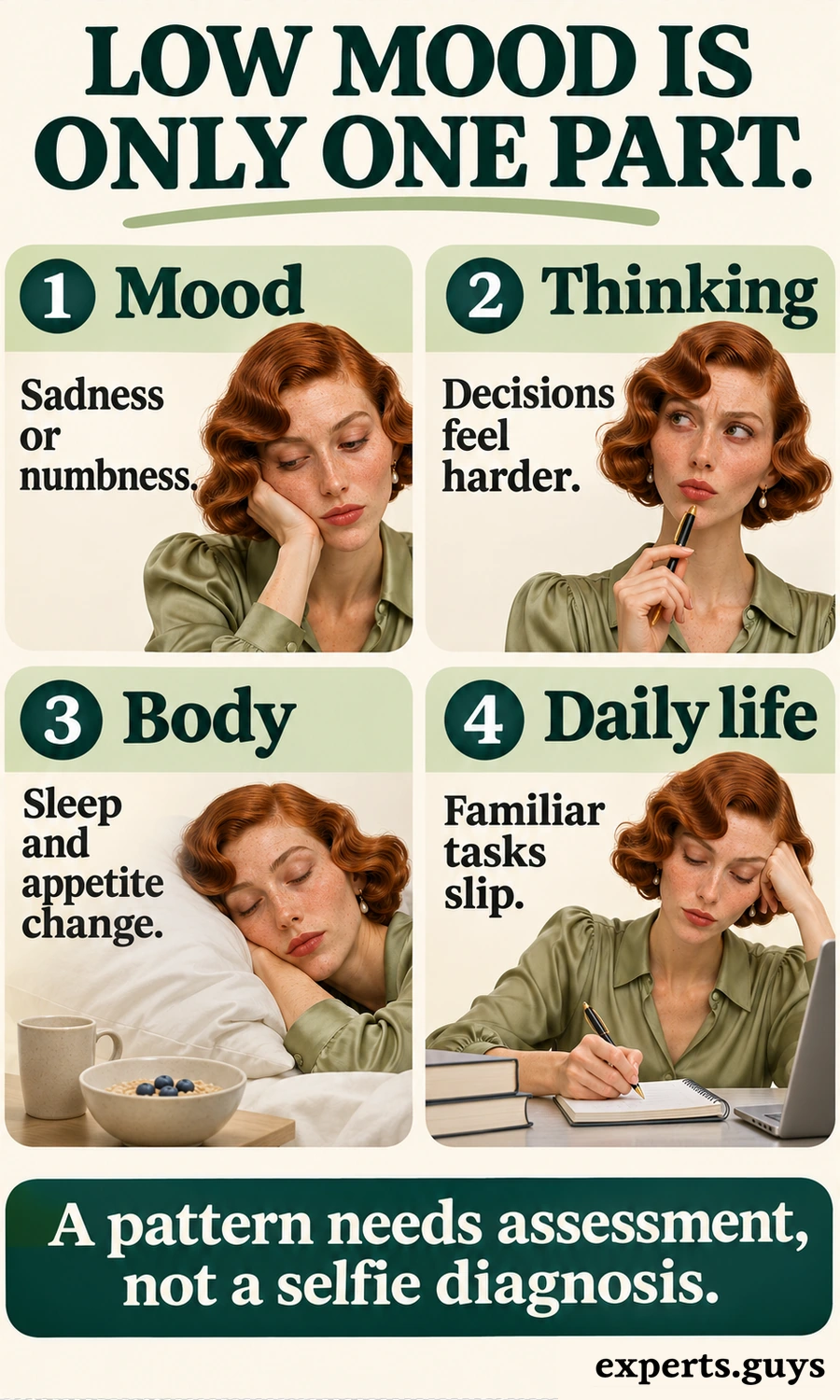
The change is broader than sadness: interest, concentration, sleep, appetite and the ability to carry out familiar activities can all be affected. Some people feel emotionally flat rather than tearful. A depressive episode involves a sustained pattern; its seriousness depends on its impact and safety as well as its duration.
The World Health Organization’s bipolar disorder overview describes depressive episodes as symptoms present most of the day, nearly every day, for at least two weeks. That describes an episode pattern, not a waiting period for help. A person whose eating, safety or ability to care for themselves is deteriorating needs attention before any calendar threshold is reached.
- Mood: sadness, emptiness, irritability or a sense that nothing feels worth doing.
- Interest: activities may lose their appeal even when you still value them.
- Thinking: concentration and decisions may become harder.
- Body and daily life: sleep or appetite can change, and familiar responsibilities may become difficult to manage.
Consider an illustrative morning. Maya knows how to make breakfast, has food in the kitchen and wants to eat, but choosing what to prepare feels surprisingly difficult. Calling this laziness misses the problem. The obstacle is not a missing recipe; it is the demand of choosing and beginning when ordinary tasks have become harder.
That distinction matters because the response should match the obstacle. More instructions will not necessarily help someone who already knows what to do. A ready-to-eat option or another person’s practical assistance may reduce the immediate demand. Neither proves that the episode is improving, but both can make an essential activity more accessible.
Why can someone look capable and still be struggling?
Visible performance is an incomplete measure of what an activity costs. Someone may attend a meeting while struggling with meals at home, or answer a familiar question while being unable to choose the next task. There is no contradiction: different activities require different amounts of concentration, initiation and support.
In another illustrative example, Maya can greet a neighbour automatically but cannot decide whether to wash clothes or prepare lunch. The greeting has a familiar cue and a short endpoint. The household choice requires weighing needs and starting a sequence. This example explains a practical difference; it cannot identify which condition is causing it.
Use the specific difficulty to guide support rather than arguing about whether someone “looks depressed enough.” If the immediate problem is lunch, solve access to lunch. If the problem is a new inability to manage essential responsibilities, bring that change into care. Asking for help does not require proving that every part of the day has stopped working.
Can you feel depressed and activated at the same time?
Yes. Depressive symptoms can occur alongside symptoms of mood elevation. Feeling low while thoughts race, activity accelerates or the need for sleep drops should not automatically be read as ordinary recovery. At the same time, restlessness by itself does not establish a mixed-features diagnosis; anxiety, medicines and other causes also need consideration.
The NIMH bipolar disorder guide explains that depressive and manic symptoms can occur together and that assessment considers the course of symptoms over time. The practical implication is to mention the combination, especially a new change in sleep, energy or behaviour, rather than reporting only that you feel sad.
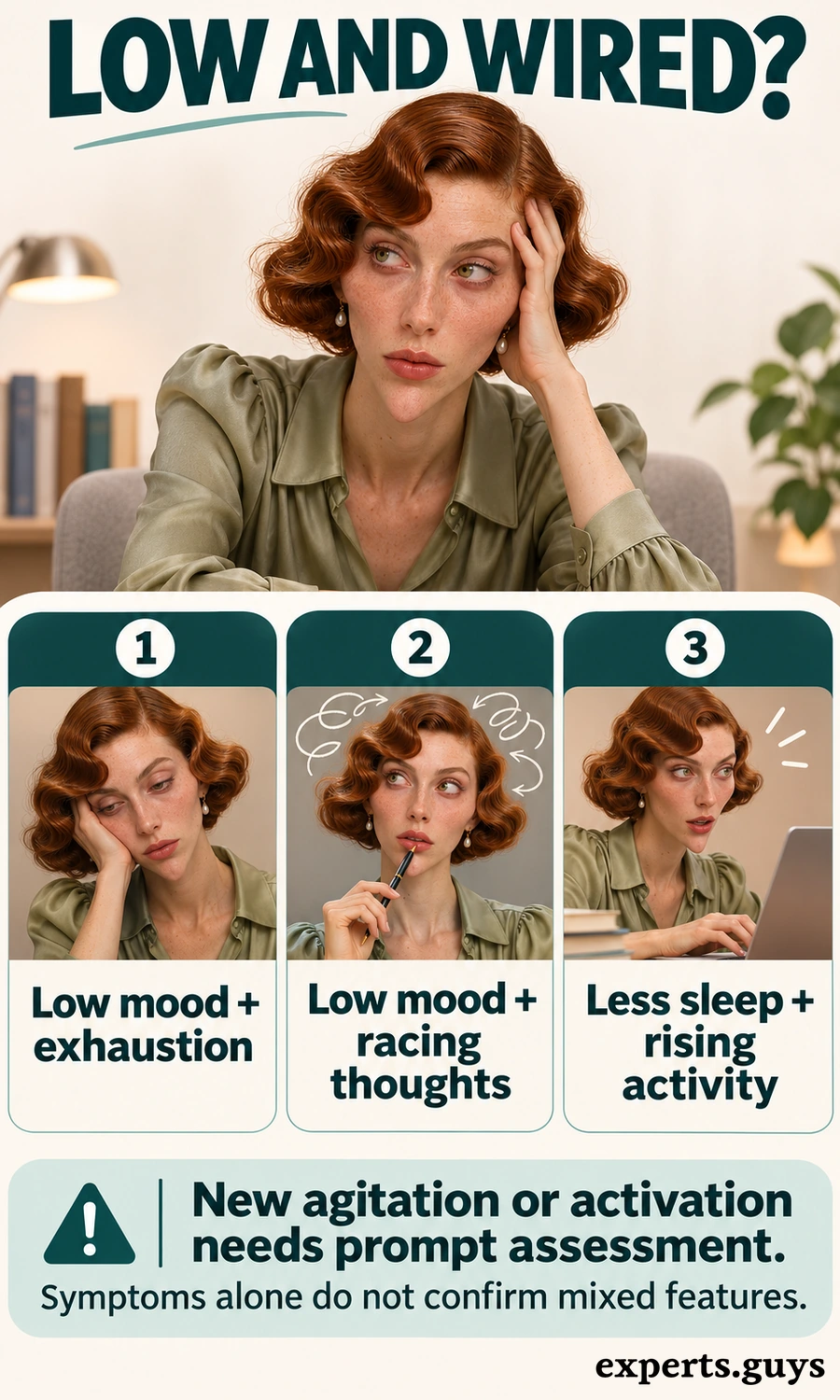
Compare two illustrative evenings. On one, Maya feels exhausted, wishes she could sleep and struggles to settle. On another, she feels miserable but unusually driven, starts several projects and feels little need to stop for sleep. Both deserve a clear account, but they raise different questions. Neither scene is a self-test or a reason to deliberately stay awake to see what happens.
A better afternoon is not automatically hypomania, either. Enjoying lunch again or managing a shower may simply be welcome improvement. The concern is an unfamiliar pattern of altered mood, energy, activity and sleep, particularly when judgement or safety changes. Treat that pattern as information for assessment, not a label to assign from one good or bad moment.
If your main uncertainty is whether a depressive illness is unipolar or bipolar, the dedicated comparison of unipolar and bipolar depression explains the role of episode history. This page’s job is different: choosing useful support during the depression you are experiencing now.
Why does treatment need to cover more than low mood?
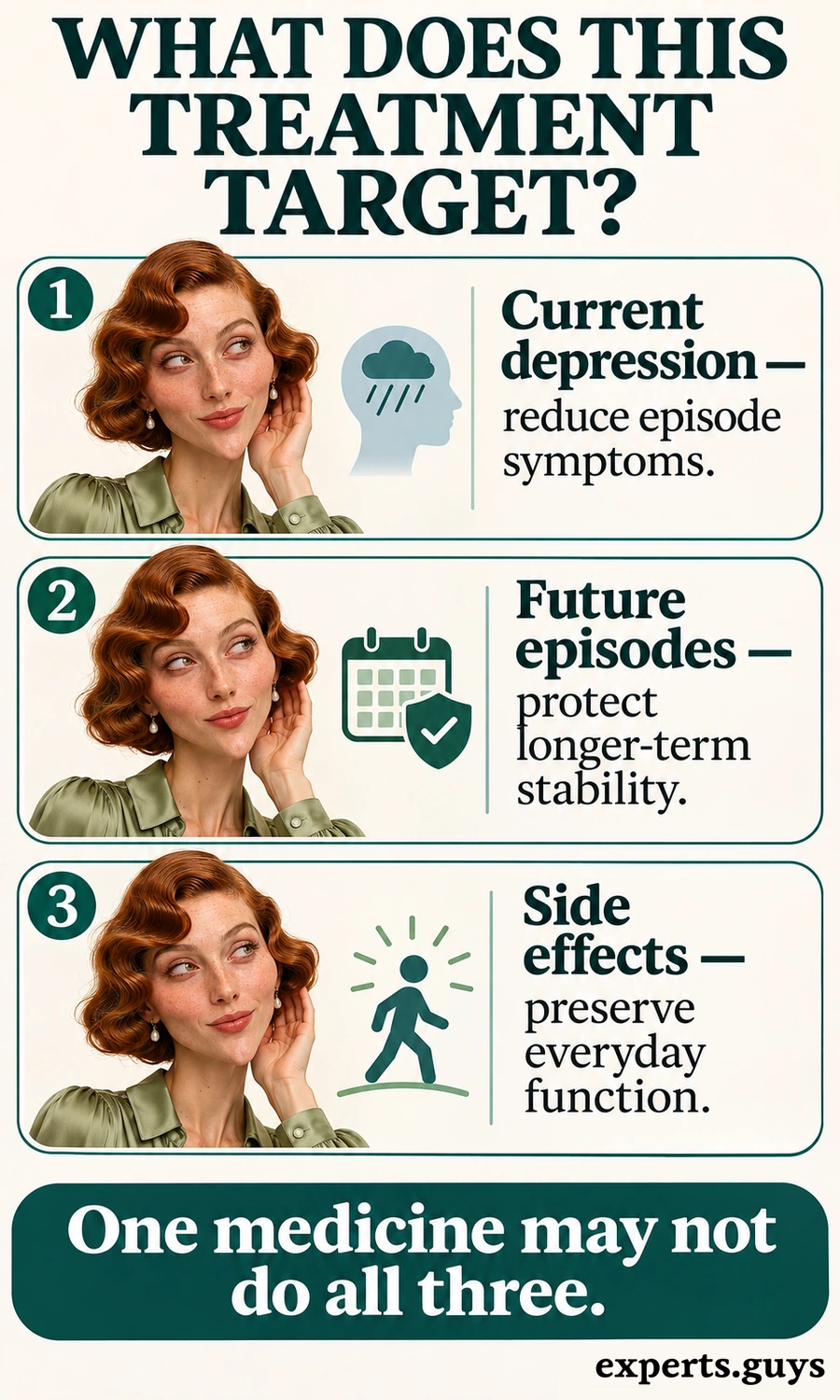
Bipolar depression treatment has to consider the current episode, future episodes and the burden of treatment itself. A plan that helps one goal may need additional measures for another. This is why a medicine’s role in treating mania, acute depression or long-term stability should be clarified rather than treating all bipolar medicines as interchangeable.
Think of the treatment discussion as three separate questions. What is intended to help the depression now? What is intended to reduce future episodes? What side effects or practical barriers could make the plan difficult to follow? These questions organise a conversation; they are not a ranking system for choosing medicines.
| Goal | What to clarify |
|---|---|
| Current episode | Which part of the plan targets this depression? A medicine name alone does not explain its purpose. |
| Future episodes | What continues after you feel better? Improvement and deciding the next phase of care are separate questions. |
| Daily function | Which benefits and burdens matter at home? A plan needs to be usable outside the consultation. |
The NICE bipolar guideline distinguishes treatment of bipolar depression from longer-term management and recommends psychological interventions appropriate to bipolar disorder. Medicine selection depends on factors such as what someone already takes, previous response and preferences. Its UK recommendations guide clinicians; they are not a universal prescription menu.
Why not simply copy an antidepressant plan?
Antidepressants require particular care in bipolar disorder because mood elevation can occur. They should not be started, stopped or adjusted as a personal experiment. A clinician may use an antidepressant in selected circumstances, but the surrounding treatment and episode history matter; a friend’s depression prescription is not a suitable template.
The VA/DoD clinical guideline assesses treatments specifically for bipolar depression and distinguishes the evidence for different medicines and combinations. The useful lesson for a reader is to ask about the proposed treatment’s actual evidence and purpose. A drug class alone does not tell you whether a particular option fits your episode.
For a concrete example, the VA/DoD guideline recommends quetiapine on its own for acute bipolar depression, while making a different recommendation for lamotrigine in preventing depressive recurrence. This illustrates why “used for bipolar disorder” is too broad a description. It does not mean that either medicine is right for you, or that someone should switch a successful plan to match a single guideline. Different guidance can weigh the evidence differently; individual history and tolerability remain important.
Do not assume that a new symptom has only one explanation. Feeling slowed down could reflect depression, a medicine effect, poor sleep, another health problem or several factors together. Deciding between those possibilities may require examination, discussion and tests. Describing the effect precisely is more useful than silently tolerating it or changing a dose yourself.
For example, “I feel tired” leaves several possibilities open. “I am falling asleep while preparing food” identifies a safety consequence that needs attention. “My concentration is worse” is different from “I cannot safely manage the oven.” You do not need a written record to explain a concrete event, and you should not repeat an unsafe activity to demonstrate it.
What can talking therapy add?
Psychological treatment can help address the effects of episodes on thoughts, relationships and daily functioning. It does not mean that bipolar disorder is caused by a poor attitude or that changing thoughts replaces medication. A useful therapy plan should fit the condition and the person’s current capacity to participate.
During a severe low period, a large amount of homework may be unrealistic. It is reasonable to explain that concentration is limited and ask what can be done within the session, what can be simplified and whether a trusted person could help with a practical barrier. Adapting the work is different from assuming that the person does not want to get better.
Suppose Maya’s immediate problem is attending an appointment without having eaten. A sophisticated explanation of thinking patterns will not remove that barrier by itself. Arranging accessible food or help with transport may make treatment participation possible. Practical assistance and psychological work can serve different parts of the same difficulty.
What would make a review more useful?
A useful review ends with decisions that can be understood afterwards: the intended goal, what happens next and who to contact if a problem appears. You can ask for an explanation in ordinary language. If several medicines or services are involved, uncertainty about which person manages a question is itself something to resolve.
Practical barriers deserve an answer of their own. If an appointment is hard to reach, ask the service what alternatives it actually offers rather than assuming remote care or transport support is available. If cost is the obstacle, say so before accepting a plan you cannot obtain. Availability differs between places and services, and an inaccessible recommendation needs adjustment rather than blame.
A plan can also be too complicated for the support available at home. For example, telling someone to eat regularly does little if they cannot obtain suitable food. Clarifying who can help, what can realistically be provided and what remains unresolved makes the plan more concrete. These are access questions, not evidence that the person is unwilling to participate.
This is not a demand to arrive with a complete life history or perfectly organised notes. One clear example can be enough to begin. If speaking is difficult, someone you trust may attend with your agreement and help describe the practical change. Their role should support your account, not replace your preferences or speak over you.
For the broader cure question, see whether bipolar disorder can be cured. Here, the immediate decision is whether the present plan addresses the episode and whether its demands are manageable today.
What can you do when ordinary tasks feel too much?
Choose a support that addresses an actual obstacle, and give it a clear stopping point. The aim is to make eating, dressing, resting or accepting help possible alongside treatment. These everyday adaptations are illustrative ways to reduce demands; they are not separately validated treatments for a bipolar depressive episode.
The NHS bipolar disorder guidance supports regular routines, adequate sleep, healthy eating and avoiding excessive stress. The examples below translate those broad principles into small household actions. Your existing care plan, dietary needs, disability and available support take priority over the example setup.
Make breakfast possible without a big cook
Use this when: preparation and choice are preventing a meal, but you can safely eat and drink. Set out a ready-to-eat combination you already tolerate, such as bread, yogurt and a banana, with water. The example is about access, not a claim that these foods treat depression.
- Choose food that needs little or no preparation. Check it is suitable for your allergies, swallowing needs and any dietary care plan.
- Put the food within comfortable reach at a stable place to sit. Sit and eat what you can without making the meal depend on washing the whole kitchen first.
- If preparation still blocks you, ask someone to place a suitable ready-to-eat meal nearby. Accepting the help is an available version of the task.
Illustrative example: Maya intended to cook eggs, make toast and clear the counter before breakfast. She cannot begin the sequence. She instead takes a familiar ready-to-eat option to the table and eats it. The completed outcome is access to a meal; it does not require feeling cheerful or managing the original plan.
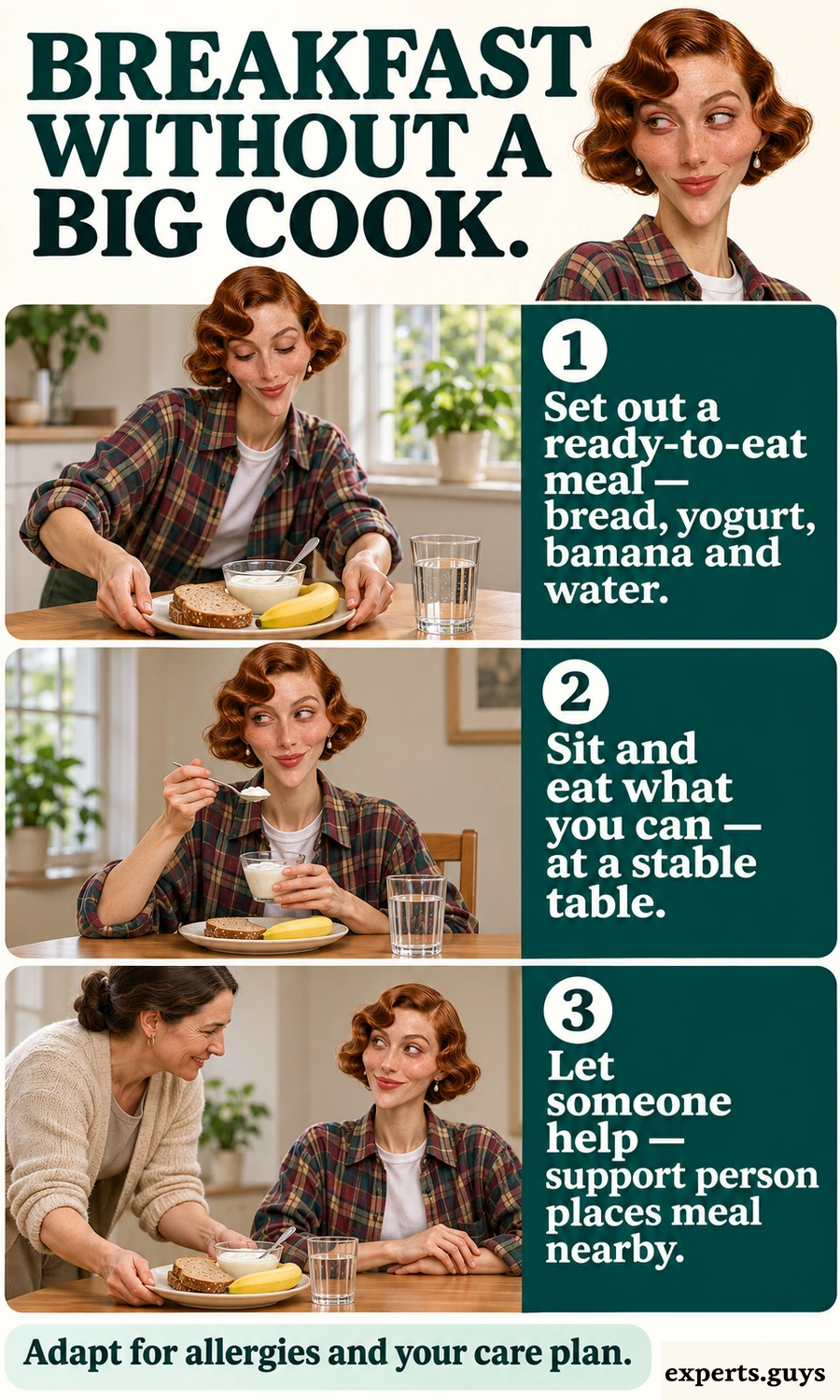
Common mistake: turning the smaller meal into a nutrition overhaul. A new shopping list, unfamiliar recipe and ambitious cooking session add decisions. Keep the example familiar and usable. Balanced eating matters over time, but the immediate obstacle is obtaining something suitable to eat, not producing an ideal breakfast.
Easier option: someone else prepares or brings the food. If standing, reaching or carrying is difficult, have it brought to a safe seated position. If you cannot maintain fluids, are becoming physically unwell or cannot eat adequately, seek prompt medical help rather than repeatedly trying a smaller meal.
The NHS advice on coping with depression discusses eating and maintaining routine. Its general advice does not establish a special bipolar diet. The task here is completed when suitable food is accessible and eating has been attempted; repeated difficulty is a reason to increase support.
Stop before a little energy becomes catch-up mode
Use this when: you have enough capacity for one necessary activity and feel pressure to repay every unfinished task immediately. Select the essential activity and its endpoint before starting. This is a practical boundary around workload, not a clinical rule about how much activity anyone with bipolar disorder should do.
- Choose one concrete endpoint, such as getting dressed in a clean shirt. Put the shirt within reach.
- Complete that activity at a manageable pace. Dressing is the task; reorganising the wardrobe is a different task.
- Leave the extras for another occasion. Rest or return to your existing routine rather than automatically adding the next backlog item.
Illustrative example: Maya has enough energy to change clothes. The laundry basket catches her eye, and she starts considering washing, drying and sorting everything. She returns to the chosen endpoint: put on the clean shirt. Leaving the basket does not cancel the useful activity she has completed.
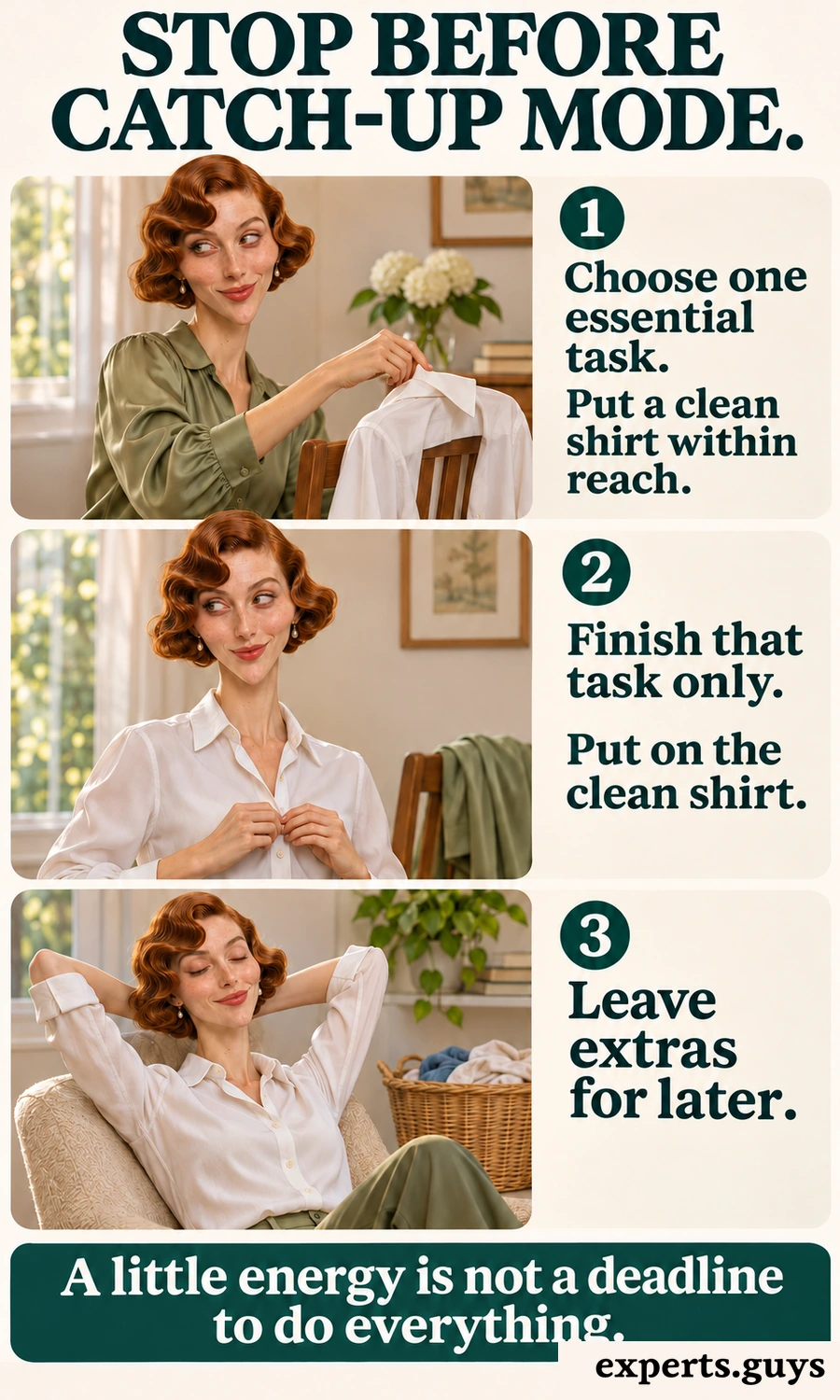
Common mistake: treating a stopping point as a challenge to exceed. “I managed one thing, therefore I should manage ten” turns a manageable action into a test of worth. The correction is to separate today’s necessary activity from the backlog. You can acknowledge that other tasks matter without making them all due now.
Easier option: have someone bring the clothing or help with the part you cannot manage safely. Dressing can be adapted to seated access and personal assistance where appropriate. Completion means the selected need was addressed, not that every step was done independently.
This boundary also has a limit. Unusually little need for sleep, rapidly rising activity or a marked change in judgement should not be managed simply by making a shorter to-do list. Those changes call for assessment. Conversely, ordinary returning energy does not have to be treated with fear; use it proportionately without assuming it proves either recovery or hypomania.
Make the evening quieter without trying to force sleep
Use this when: unnecessary noise and activity are making a familiar evening harder to settle into. You need access to the ordinary controls in your space, not equipment, supplements or a strict darkness programme. Keep essential lighting for safe movement and any accessibility needs.
- Reduce one optional source of stimulation, such as switching off a loud television.
- Prepare a familiar place to rest. Lower an ordinary lamp if comfortable, while keeping the route to the bathroom safely lit.
- Protect the usual rhythm you have agreed in your care plan. Do not deliberately shorten sleep to make up unfinished work.
Illustrative example: Maya has the television playing while trying to finish household tasks. She switches it off, makes the room comfortable for rest and leaves the remaining chores. The result is a quieter evening setup. It is not a promise that she will fall asleep quickly or that the depressive episode will end.

Common mistake: replacing one pressure with another by demanding sleep at an exact minute. If sleep does not arrive, the evening has not become a failed exercise. The part under your control was reducing an avoidable disturbance. Persistent sleep change deserves a care discussion rather than increasingly elaborate household rules.
Easier option: ask someone to lower the volume or help prepare the rest space. In a shared home, reducing one local disturbance may be more realistic than controlling the whole property. Do not remove lighting someone needs to move safely, and do not make another person’s entire evening a condition for your success.
This is ordinary environmental support. It is not bright-light therapy, sleep deprivation, a prescribed sleep schedule or a treatment protocol. Do not introduce those interventions yourself to treat bipolar depression. A substantial new change in sleep, especially with agitation or rising activity, belongs in clinical assessment.
Ask for one specific practical help
Use this when: an ordinary need is unmet and a safe, trusted person is available. Start with the practical need rather than requiring yourself to explain your entire illness. The request can be short, and the other person can say what they can realistically offer.
- Name the immediate need: “I need dinner.”
- Ask one person for a concrete action: “Can you bring something ready to eat?”
- Agree what will actually happen, such as the person bringing a suitable meal to the table. If they cannot help, choose another available support rather than assuming the need was unreasonable.
Illustrative example: Maya’s sister asks whether there is anything she can do. Maya cannot think of a broad answer, but she can identify dinner. Her sister brings a meal they already know is suitable. They have solved a defined need without asking Maya to host, entertain or describe every symptom.

Common mistake: accepting help that brings an additional obligation. A complicated shared cooking session may be harder than eating. Clarify the task and its end: food brought to the table, rather than an evening of preparation and cleanup. Support should reduce the relevant demand.
Easier option: ask the person to sit with you while you eat or while another suitable support is arranged. If speaking is difficult, a trusted person may offer a simple choice you can accept or decline. Consent still matters; being depressed does not remove your preferences about food, company or privacy.
The NHS guidance for supporting someone with depression emphasises patience, listening and maintaining contact. The specific dinner request is an illustrative adaptation of practical support. It is not a clinical communication technique or evidence that one conversation changes symptoms.
If family help is complicated by privacy, conflict or unrealistic expectations, the article on family support and household boundaries addresses that separate problem. Choose someone safe; you do not owe personal disclosure to an unsupportive person in order to receive care.
How should support change when the episode worsens?
Support should increase when safety, physical needs or the ability to manage ordinary responsibilities deteriorates. A household adaptation is useful only while it fits the situation. Repeatedly shrinking a task is not an adequate response to an escalating episode or a person who cannot meet basic needs.
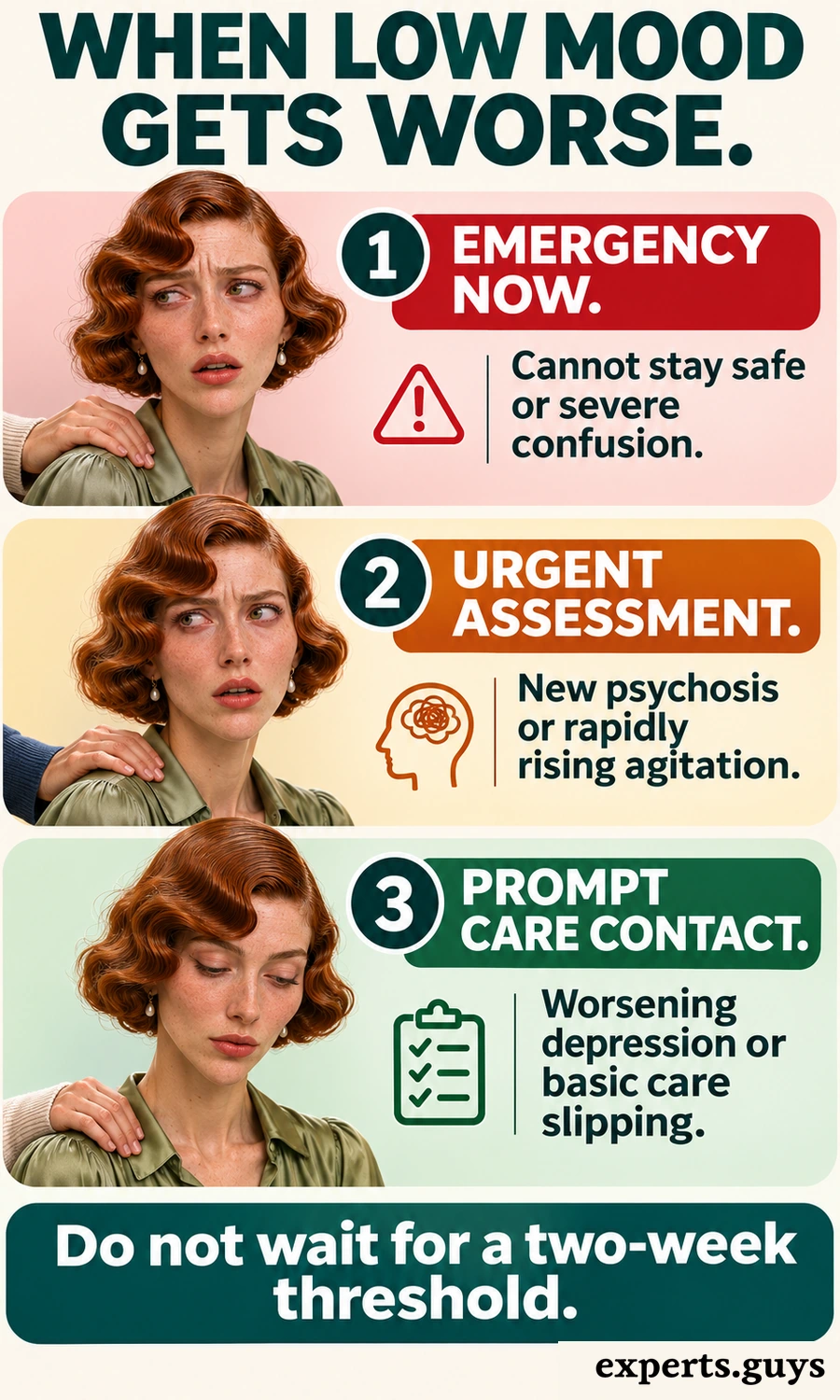
Separate emergency help from an earlier appointment
If someone may act on suicidal thoughts, cannot stay safe or is severely confused, seek emergency medical help. Where possible and safe, have a trusted person remain with them while help is arranged. Do not delay to finish an exercise, establish the diagnosis or collect a complete account of symptoms.
New hallucinations or delusions, rapidly rising agitation or a striking change in behaviour require urgent assessment. Emergency care is appropriate when there is immediate danger or severe impairment. If depression is worsening without immediate danger, contact the existing care team promptly rather than waiting for the next routine appointment.
The dividing line is not whether the person has managed one household task. Someone can eat a meal and still be unsafe. Someone can speak calmly and still need urgent help. The visible completion of a practical step should never be used to dismiss what the person says about their safety or distress.
What should a supporter actually notice?
Pay attention to the change in a real need or activity. “You are being difficult” is a judgement; “You have not been able to eat the meals available today” describes a practical concern. Offer assistance and communicate the change to the appropriate service. Do not turn ordinary household observations into an attempt to diagnose or police the person.
Keep agency wherever possible. Ask what help is wanted, offer a manageable choice and explain any urgent action you are taking. In an emergency, safety may require action despite disagreement, but the person should still be treated with dignity. Avoid arguing about whether their distress is justified or demanding that they prove it.
Supporters also need limits. One relative cannot provide constant crisis care indefinitely. An appropriate professional or emergency service needs to take over when the level of risk exceeds what can safely be managed. A supporter who is frightened or exhausted should not be expected to resolve a dangerous situation alone.
What does a practical step tell you about progress?
It tells you what became possible under those conditions. Eating after someone brought food demonstrates that the support helped with access to food. It does not show that every symptom improved. Getting dressed demonstrates completion of that activity, not readiness for a full working day.
This makes the result useful without overstating it. Keep the support that meets a real need, simplify what remains too demanding and discuss persistent limitations in care. There is no requirement to produce a streak, log or score. The question is whether essential life activities are becoming more manageable and whether safety and health are adequately supported.
For work-specific concerns, how bipolar symptoms can affect sleep, speech and judgement at work explores a different setting. A household success should not be used as a demand to resume every employment responsibility immediately. Decisions about returning to demanding roles need the person’s circumstances and appropriate support.
Frequently asked questions
Does a single bad day mean another episode has started?
A difficult day alone cannot establish an episode. Its context, persistence and effect on your life matter. You can still respond to the immediate need, such as accessible food or company, without deciding on a diagnosis. If the change is concerning or worsening, use your care plan rather than waiting to be certain what label applies.
Can physical tests diagnose bipolar depression?
There is no single blood test or scan that establishes bipolar depression. Tests may investigate physical conditions that can contribute to similar symptoms or support medicine monitoring. Diagnosis relies on clinical assessment and episode history. A normal test result therefore does not mean that difficulties with mood and functioning are unreal or that no further assessment is needed.
What if I miss a medicine dose?
Follow the instructions for that particular medicine and ask a pharmacist or prescriber if you are unsure. The appropriate response depends on the medicine, timing and circumstances. This article cannot supply a universal missed-dose rule. Do not use a missed dose to experiment with stopping treatment, or compensate by changing your regimen on your own.
Does needing help at home mean I have lost my independence?
Needing support with one activity does not define your capacity for every decision. You can still choose what help you accept, who is involved and what privacy you need. A useful arrangement addresses the particular obstacle and can change as your needs change. Independence does not have to mean completing every household task without assistance.
Can I use a supplement instead of prescribed care?
Do not assume that a product is safe or effective for bipolar depression because it is described as natural. Supplements can have risks and interactions, and a claim of mood support is not evidence that they treat an episode. Discuss the specific product with a pharmacist or clinician before taking it, and do not replace prescribed treatment on the strength of a testimonial.
Choose the next action that fits today
- If safety is in doubt: use urgent or emergency care rather than a household exercise.
- If care is not addressing the current difficulty: request an earlier review and describe the practical consequence.
- If an ordinary need is the immediate obstacle: choose one relevant adaptation above, including help from another person if available.
- If a step becomes possible: recognise that specific result without turning it into a demand to catch up on everything.









