

Bipolar depression is a depressive episode within bipolar disorder, and its symptoms can include loss of pleasure, low mood, fatigue, sleep or appetite changes, slowed thinking, and feelings of worthlessness. These changes can make ordinary life harder even when someone does not look sad. The symptoms alone cannot establish bipolar disorder; the wider history of mania or hypomania matters.
This guide focuses on adults and on understanding the current depressive experience. It separates what a symptom can look like from what it can prove, so a difficult morning does not become a diagnosis and a serious decline is not dismissed as laziness.
Which symptoms change everyday life during bipolar depression?
Look beyond sadness to changes in enjoyment, energy, thinking, physical pace, and basic routines. A person may feel empty or emotionally flat, have trouble following a familiar conversation, or find getting dressed unusually demanding. What matters is the experience and its impact, not whether the person matches a familiar picture of depression.
The table separates common symptom descriptions from everyday examples. These are illustrative situations, not diagnostic tests: the same difficulty can occur for other reasons, and a clinician considers the pattern, duration, distress, and context together.
| Symptom area | What it can look like |
|---|---|
| Mood and pleasure | Persistent low, empty, or hopeless feelings; familiar activities feel unrewarding. |
| Energy and pace | Unusual fatigue, slowed speech or movement, or restlessness. |
| Sleep and appetite | Difficulty sleeping or excessive sleep; eating noticeably more or less. |
| Thinking | Difficulty concentrating, deciding, or following a familiar task. |
| Self-worth and safety | Excessive guilt, worthlessness, thoughts of death, or suicidal thoughts. |
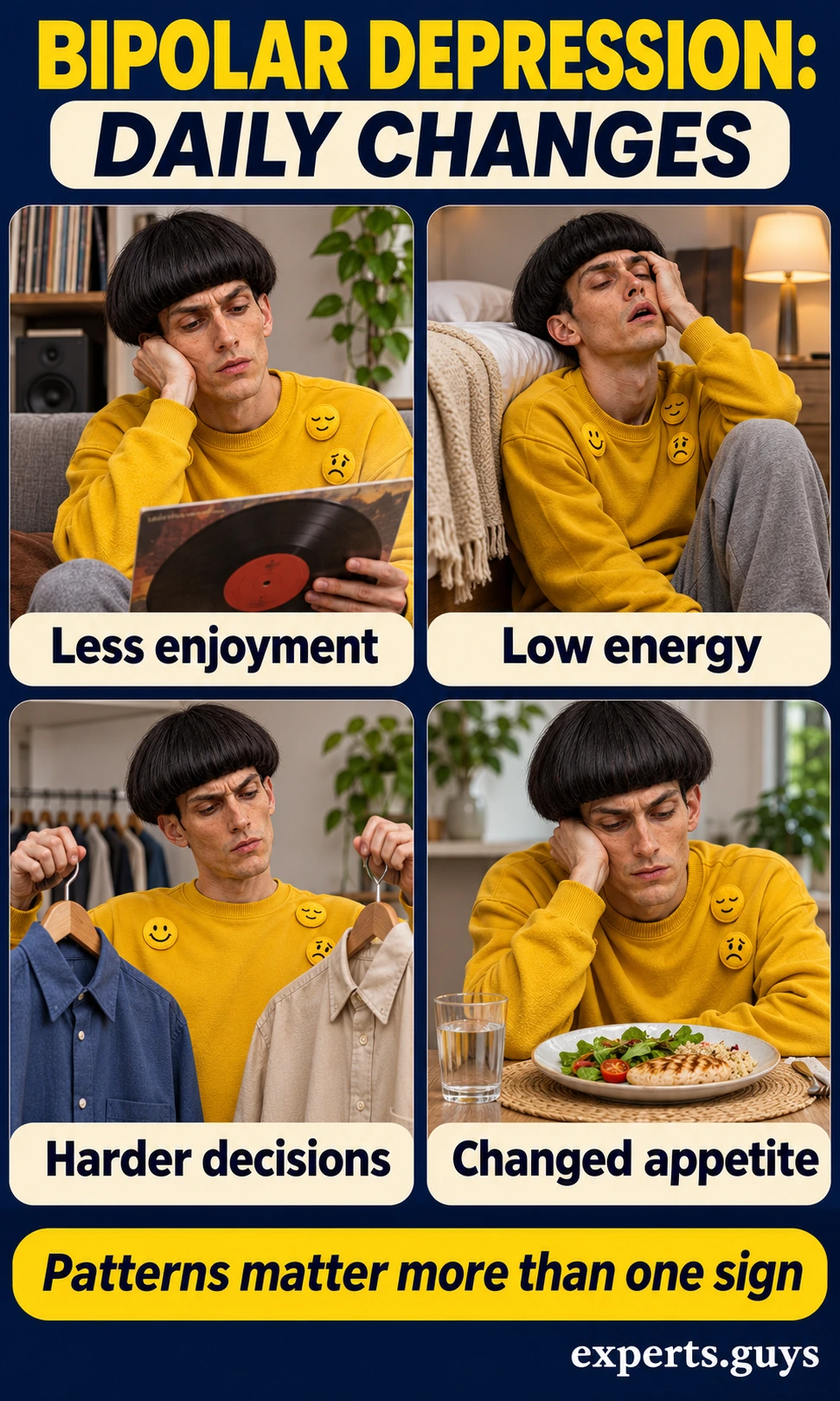
Loss of pleasure is different from having no opportunity for pleasure. Someone may have free time and access to a favorite record, yet feel disconnected while it plays. Another person may still enjoy music but be too exhausted to arrange an evening out. Both experiences are worth describing accurately because “I never do anything” can hide very different obstacles.
Changes in appetite also need ordinary context. Eating less because food feels unappealing is different from missing meals because shopping and preparation have become difficult. Appetite and access can overlap, but one should not be assumed from the other. A substantial or persistent change in food or fluid intake deserves attention regardless of its cause.
Concentration difficulties can feel like repeatedly losing the thread rather than forgetting everything. A familiar email may take several attempts to understand; choosing between two simple options may feel disproportionately demanding. The useful distinction is a change in ordinary functioning, not whether someone can still complete a challenging task on an unusually good day.
Descriptions of bipolar mood episodes from NIMH include changes in thinking, sleep, appetite, and activity as well as mood. An outward expression is therefore a poor shortcut for severity: tears, a smile, silence, or irritation cannot settle what the person is experiencing.
Some symptoms are mainly internal. Excessive guilt may turn a small mistake into a broad judgment about personal worth, while hopelessness can make future options feel unavailable. These experiences are not reliable verdicts about the person’s value or future. They belong in a conversation about care even when work or household tasks still appear to be getting done.
A major depressive episode generally involves symptoms persisting for at least two weeks, with low mood or loss of interest among the central features. Duration is only part of an assessment; significant symptoms lasting less time can still need help. There is no useful reason to postpone care until a calendar threshold is crossed.
When explaining the difficulty, ordinary descriptions are more useful than self-judgment. The following distinctions keep the experience specific without asking you to score or log it:
- Interest: “I can join in, but the activity feels unrewarding.”
- Effort: “The usual task takes much more concentration than before.”
- Body: “I am moving slowly,” or “I cannot settle comfortably.”
- Self-view: “Small mistakes make me feel worthless.”
- Daily needs: “Getting dressed or eating regularly is becoming difficult.”
These examples are descriptions, not a script you need to complete. You can use your own words, disagree with an example, or say that you are unsure. Difficulty explaining symptoms does not make the symptoms less important.
The effort required to maintain appearances can be easy to miss. An illustrative example is someone who completes a workday but has little capacity left for dinner or washing. Another person may miss work entirely. The first situation should not be dismissed, and the second should not be treated as a failure of character.
Function includes both what gets done and what becomes difficult elsewhere. A single productive afternoon cannot show that the overall problem has resolved. Equally, a difficult afternoon without a wider change cannot establish an episode.
If bipolar disorder has already been diagnosed and the concern is a familiar pattern returning, the separate guide to bipolar depression early warning signs addresses that relapse-focused question. The present page explains the symptom picture rather than teaching a second monitoring routine.
The most useful takeaway is to separate the symptom from the interpretation. “Deciding what to wear feels unusually hard” describes a difficulty; “I must have bipolar depression” is a conclusion that needs more information. That separation allows care to begin without requiring certainty about the label.
Across these examples, the symptom domains are related but not interchangeable. Enjoyment, energy, decision-making, and appetite can change in different combinations, which is why a single visible sign cannot represent the whole episode.
Being able to work does not measure the whole day
Work is only one setting. A person might manage a predictable job while struggling with open-ended tasks at home, or have difficulty at work while still managing personal care. Ask what the task demands and what support is already present before interpreting performance. Accommodations can make an activity possible without removing the underlying symptoms.

Why can sleep, energy, and movement give confusing signals?
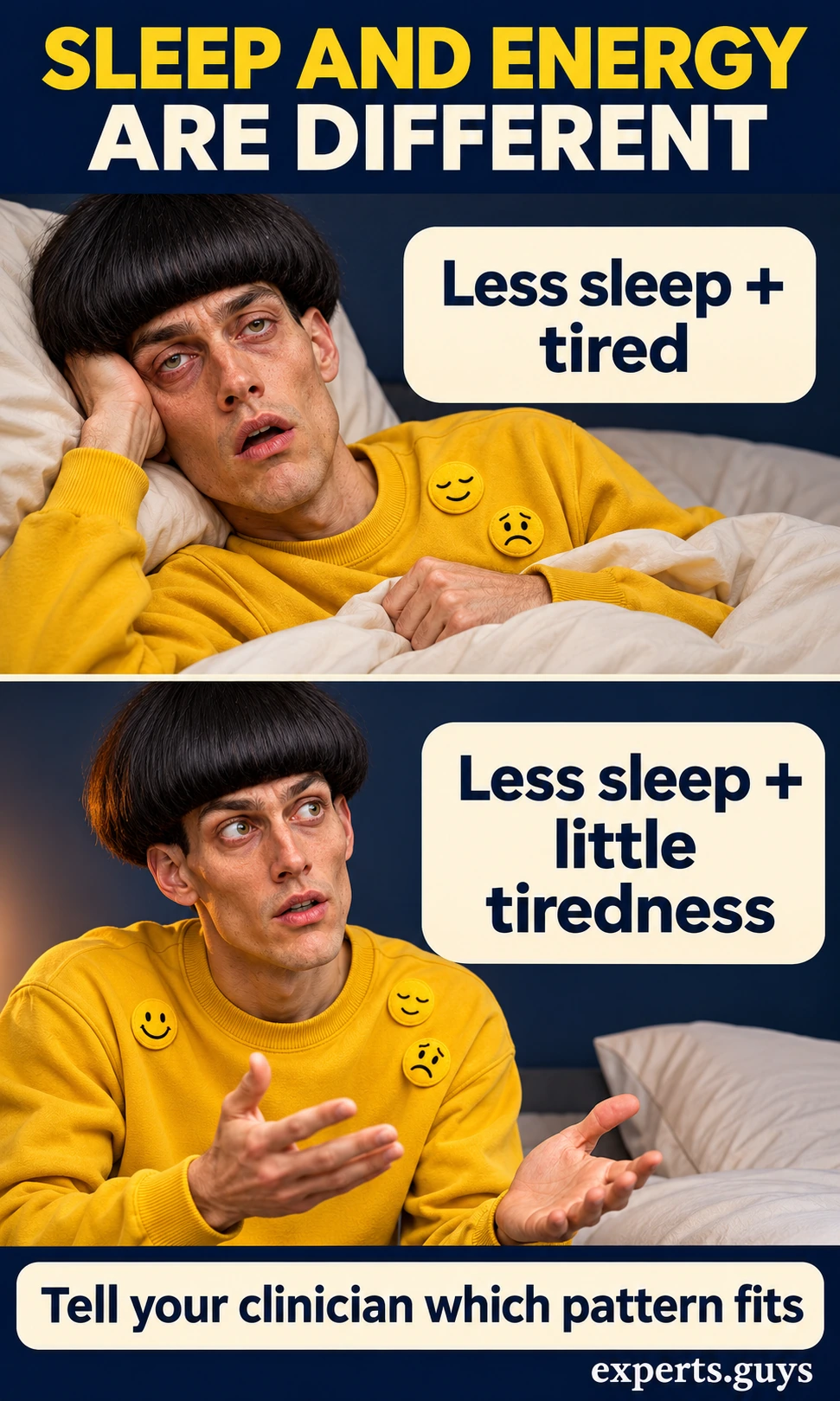
Sleep duration, tiredness, and physical activity describe different things. Sleeping poorly and feeling exhausted is not the same as needing much less sleep while feeling unusually energized. Depression can also involve either slowed movement or restlessness, so “active” and “well” are not interchangeable.
| What you notice | What remains uncertain |
|---|---|
| Little sleep with exhaustion | Why sleep is disrupted; this alone does not identify bipolar disorder. |
| Little sleep with unusual drive | Whether activation is part of a mood episode or another cause. |
| Pacing or inability to settle | Whether distress, anxiety, medication, or another condition is contributing. |
| Slower speech or movement | The cause and severity; a quiet appearance does not establish safety. |
Reduced need for sleep is about the relationship between sleep and energy, not a particular number of hours. An unusually energized person after little sleep may need assessment for activation, especially when speech, activity, or judgment also changes. One sleepless night cannot identify mania, hypomania, or mixed features.
- Insomnia: wanting or needing sleep but having difficulty sleeping.
- Excessive sleep: sleeping much more than usual, sometimes without feeling restored.
- Reduced need for sleep: sleeping less without the expected tiredness, particularly alongside unusual drive or activity.
Slowing can affect speech and movement as well as the feeling that thoughts take longer. Restlessness can mean pacing, shifting position, or feeling unable to settle. Neither observation identifies its cause: anxiety, distress, medicines, physical illness, and mood episodes can produce overlapping experiences. A new change is more informative than comparing yourself with someone who naturally moves or speaks at a different pace.

Mixed features mean that symptoms from the depressive and manic sides occur together within an episode. This is more specific than feeling unhappy and irritable. Low mood accompanied by markedly increased energy, racing thoughts, much less need for sleep, or risky behavior needs timely clinical attention rather than being celebrated automatically as improvement.
For a closer look at anger and activation, see irritability in bipolar depression. Here the practical point is to preserve both pieces of information: how low or distressed you feel, and whether your pace or energy has changed. Do not try to settle the distinction by skipping sleep, taking extra stimulants, or changing a medicine.
Can these symptoms distinguish bipolar from unipolar depression?
No single depressive symptom reliably makes that distinction. A depressive episode can occur in either condition; the history of manic or hypomanic episodes changes the diagnostic picture. Bipolar I includes a history of mania, while bipolar II includes hypomania and major depression without a manic episode.
A history question is not a request to reinterpret every happy period as illness. Ordinary relief, enthusiasm, or a productive weekend is not automatically hypomania. Clinicians look for a distinct pattern of change in mood and activity, its accompanying features, and its consequences. A person may remember such a period as successful, which helps explain why a visit about depression still includes questions about earlier energized periods.
| Finding | Meaning and limit |
|---|---|
| Current depressive symptoms | Describe the current difficulty; do not establish bipolar disorder alone. |
| Past mania | Central to bipolar I assessment; requires a clinical history. |
| Past hypomania and major depression | Relevant to bipolar II; the absence of mania also matters. |
| Family history | Useful context, not a required positive finding. |
| Questionnaire result | Can support discussion; cannot confirm the disorder. |
NICE’s specialist-assessment standard highlights earlier overactivity or disinhibited behavior when adults present with depression. Its referral threshold is not a stand-alone home diagnosis or a reason to delay urgent care. An assessment also considers medicines, substances, physical health, and other explanations.
- What changed during the current low period?
- Were there earlier distinct periods of unusually increased activity or altered judgment?
- Did sleep and energy change together?
- What other health or treatment changes might be relevant?

Family history can contribute useful context, but its absence does not rule out bipolar disorder. Similarly, a screening questionnaire can help organize information without establishing the diagnosis. A symptom score cannot reconstruct an entire mood history, determine every alternative explanation, or replace a clinical interview.
There is no routine blood test that confirms bipolar depression. Tests may be used to investigate other contributors, such as thyroid problems, or to support safe treatment. “No confirming test” does not mean “nothing can be assessed”; it means the clinical history has a central role.
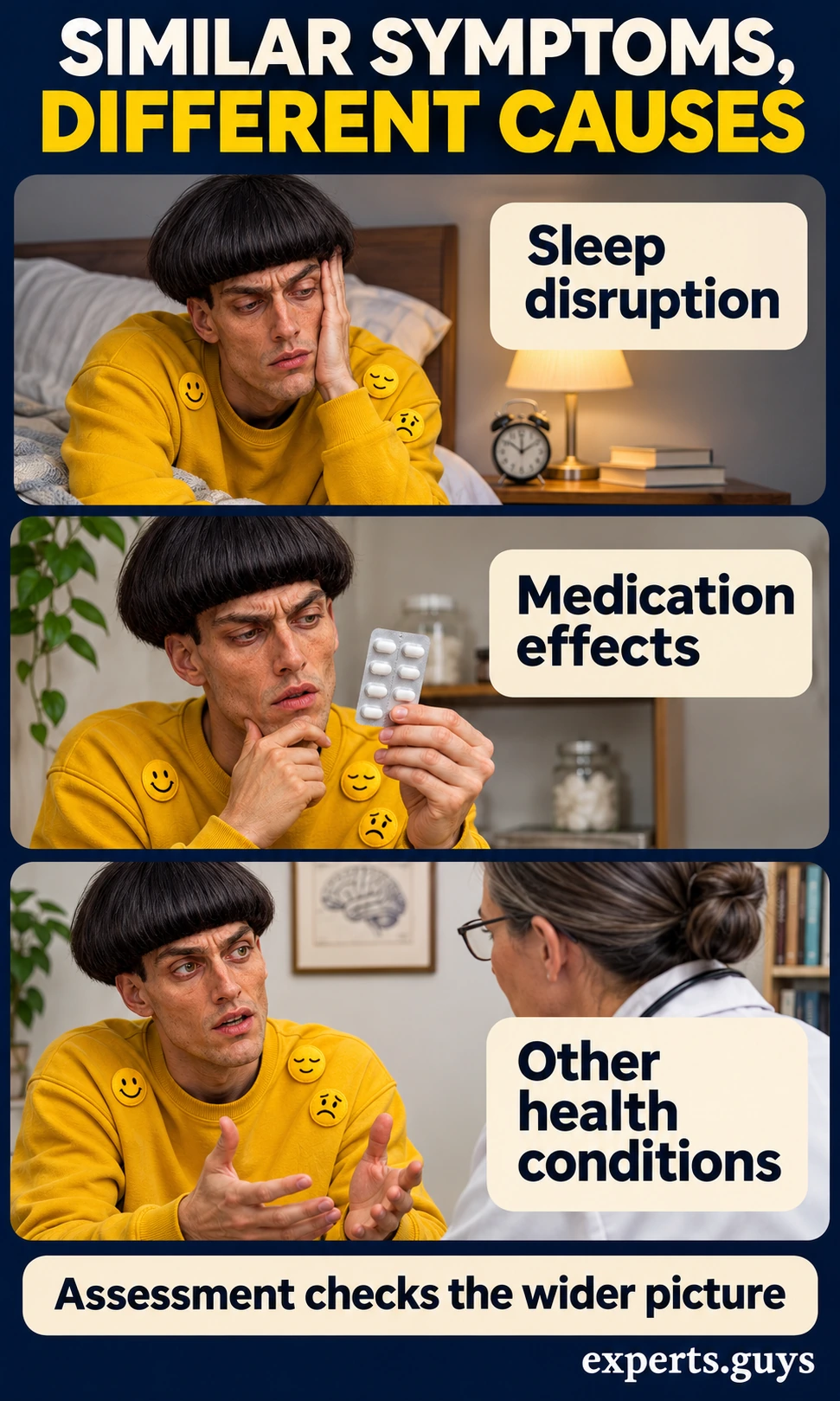
New tiredness after a treatment change, disrupted sleep, and another health condition can all belong in the same assessment. Having bipolar disorder does not make every new symptom part of it. Conversely, an apparent explanation such as a stressful week does not automatically exclude an episode. Mention timing and uncertainty without stopping medication to test a theory.
The related explanation of what unipolar depression means covers that diagnostic label in more depth. For this article, the distinction to retain is simple: the current depressive symptoms describe the episode; the wider course helps establish the disorder.
What can help when symptoms make an ordinary task difficult?
Reduce the specific demand that is blocking the task while arranging appropriate care. If getting dressed is hard because choosing and sequencing feel overwhelming, lay out one comfortable outfit in wearing order. This is a practical accommodation for decision load, not a treatment for bipolar depression or a test of motivation.
Make dressing easier with one prepared outfit
Use this adaptation when you want to dress but repeated choices are getting in the way. Start with familiar clothes that suit the temperature and your mobility needs, an accessible surface, and a stable seat if sitting is comfortable. Avoid balancing on one leg, stretching into a high wardrobe, or pushing through dizziness or pain.
- Choose one comfortable outfit. Select familiar, easy-to-manage clothing. If choosing is the main barrier, a trusted person can offer two suitable options rather than opening the whole wardrobe.
- Place the clothes in your usual wearing order. Keep the next item visible and within comfortable reach. You are reducing repeated decisions, not reorganizing the wardrobe.
- Dress one item at a time. Use your usual safe method, seated where appropriate. Pause when needed; the first item is an acceptable smaller endpoint.
Illustrative example: A person keeps changing their mind between several tops and never begins dressing. They choose a familiar sweatshirt, place it beside their trousers, and put on the sweatshirt first. The improvement is that one part of dressing became accessible; they do not need to feel happier afterward for the adaptation to have served its purpose.
Easier version: Ask someone to set out one item you have agreed on. If dressing itself is physically difficult, use your existing mobility support or ask for suitable assistance rather than forcing the movement. Keep the choice yours; practical help should not become pressure or a struggle over what you wear.
Common mistake: turning the setup into a wardrobe-clearing project or demanding a complete outfit as proof of progress. Keep the scope to today’s clothes. If the arrangement does not help, stop and reconsider the barrier: pain, exhaustion, distress, or difficulty moving may need a different response.
This example adapts the general principle of making ordinary tasks manageable, discussed in NHS guidance on tackling avoided tasks. The specific dressing sequence is an everyday adaptation, not a separately validated bipolar treatment. Its observable result is a prepared outfit or one completed dressing step.

Match the next step to the level of difficulty
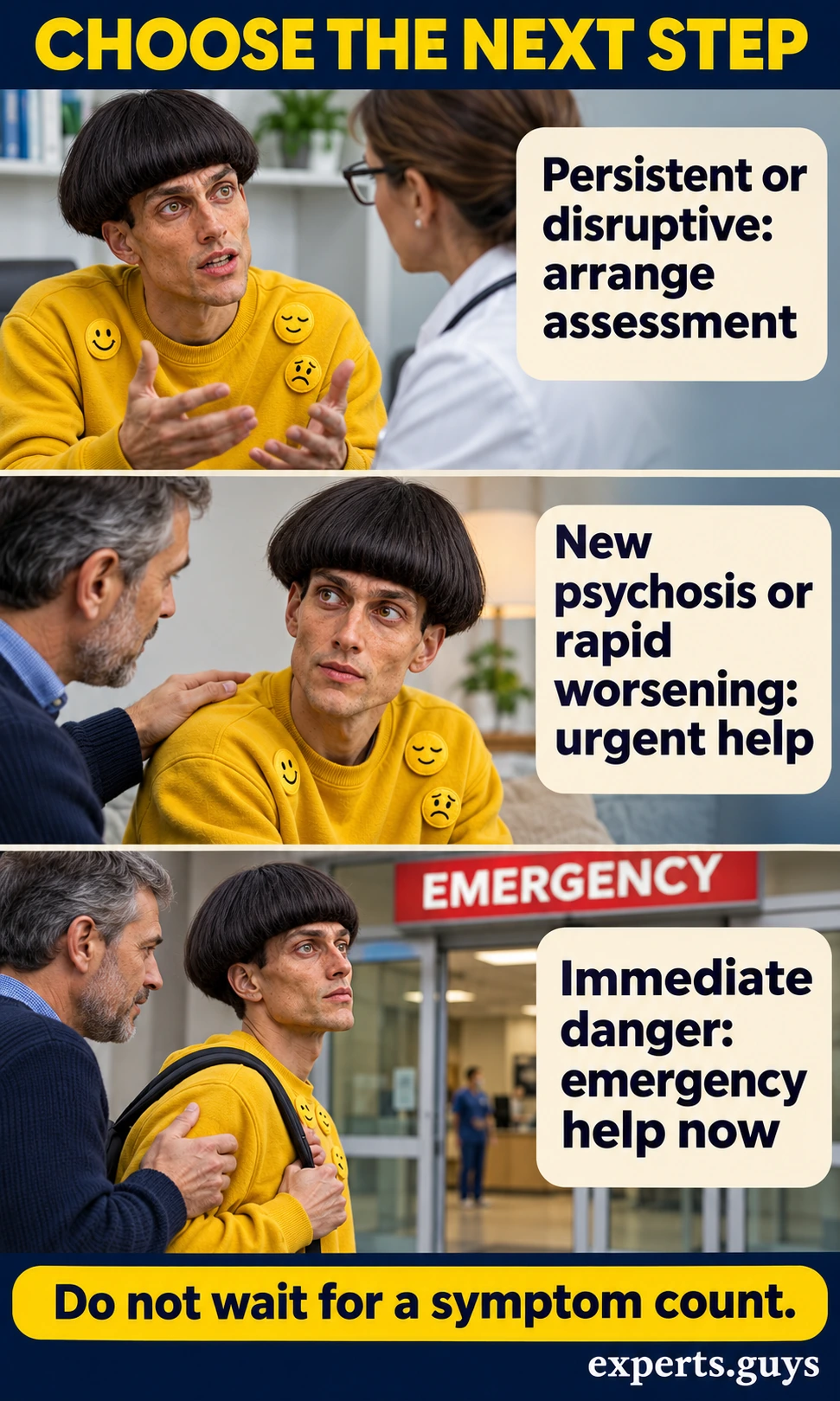
Routine adaptations are useful only within their limits. Persistent or worsening symptoms, or difficulty maintaining ordinary needs, call for a clinical review. Someone unable to eat, drink, or manage basic safety needs more than another household strategy. Severe confusion or new psychotic symptoms also change the urgency.
| Situation | Next step |
|---|---|
| Persistent or disruptive symptoms | Arrange assessment with primary care or the service already managing your care. |
| New psychotic symptoms or rapid worsening | Seek urgent clinical help; use emergency care if safety is uncertain. |
| Immediate danger or inability to stay safe | Use local emergency medical services or an emergency department now. |
- Describe the current difficulty: use whichever symptom or functional change is most pressing.
- Include important context: earlier activated periods, medicine changes, and major sleep changes can affect assessment.
- Keep treatment decisions with the prescriber: do not stop, start, borrow, or alter medication based on this article.
Treatment addresses the mood disorder as well as the immediate difficulty. Medication and appropriate psychological support may be used together, with choices based on episode type, past response, other conditions, and individual risks. Antidepressant decisions in bipolar disorder require particular care because of the possibility of switching into an elevated episode; a symptom checklist cannot choose a safe prescription.
The bipolar disorder overview explains the broader roles of assessment and treatment. A successful dressing adaptation does not show that treatment is unnecessary, just as needing assistance does not show that recovery is impossible. Practical support and clinical care answer different parts of the problem.
Frequently asked questions
Does bipolar II mean the depression is mild?
No. The distinction concerns hypomania rather than mania, not a promise of mild depression. Depressive episodes can be severely disabling in bipolar II, and the level of support should reflect the actual symptoms and safety needs.
Can a person have a better afternoon during a depressive episode?
Yes. Some variation does not automatically cancel the wider episode. Assessment considers the sustained pattern and impact rather than requiring an identical mood every hour.
Are hallucinations required for bipolar depression?
No. Many depressive episodes do not include psychotic symptoms. New hallucinations or delusions need urgent assessment and should not be assumed to be a routine part of depression.
Can symptoms occur while taking medication?
Yes. Ongoing symptoms, recurrence, and side effects can all require review. Describe the change to the prescriber; do not decide that a medicine has failed or change its dose on your own.
Does rapid cycling mean changing mood several times a day?
No. Rapid cycling refers to four or more distinct mood episodes within a year. Changes within a day can still be distressing, but that description alone does not establish rapid cycling.
The useful next step
Take the change in daily life seriously without trying to diagnose yourself from one sign. If choosing clothes is the immediate obstacle, try one prepared outfit or the one-item version; if the broader symptoms persist or disrupt ordinary needs, arrange assessment. Immediate safety concerns take priority over any self-help step.