
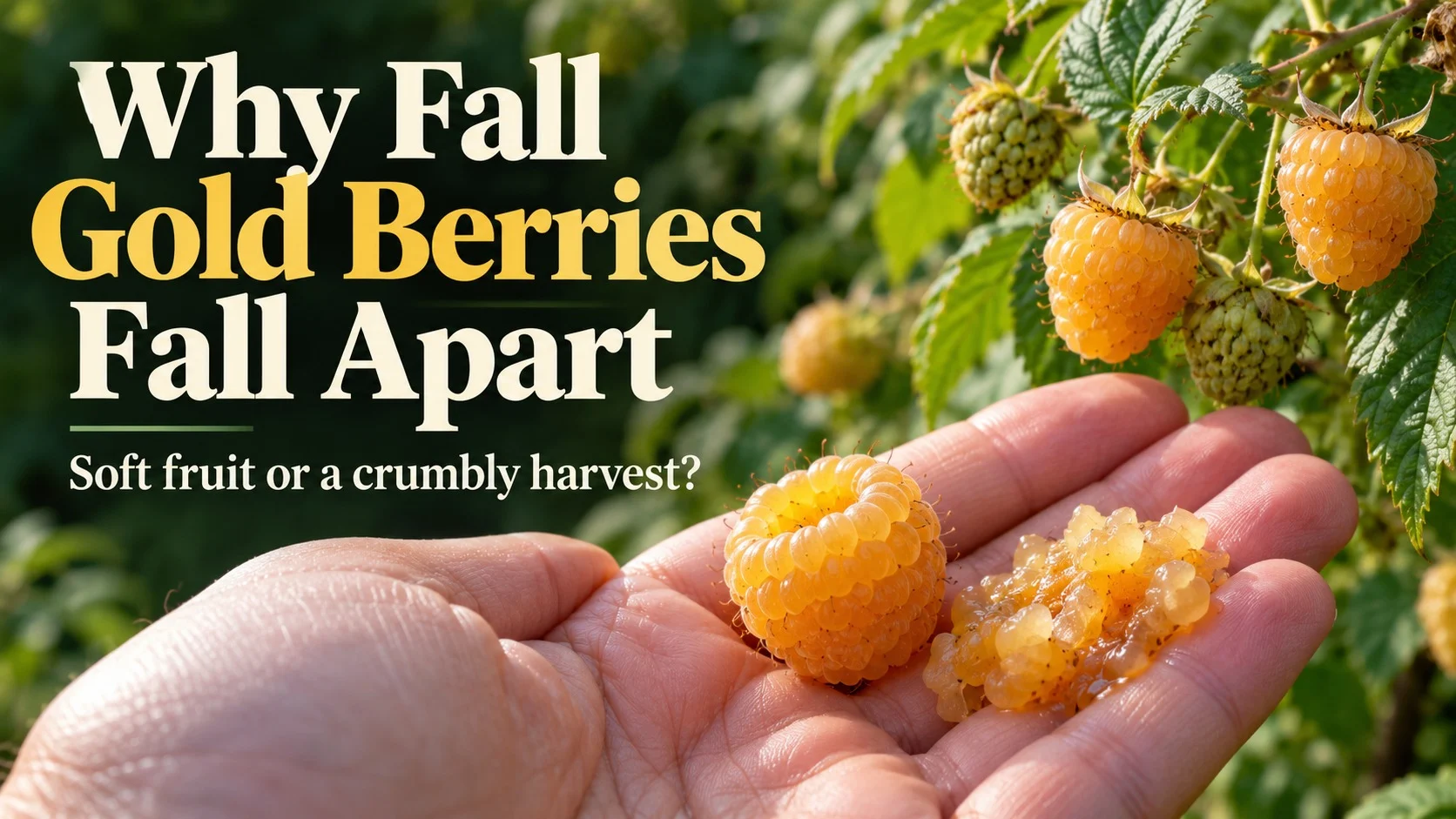
Fall Gold raspberries can crush when picked because the cultivar is naturally very soft, especially once fully ripe. A complete berry that squashes under pressure is different from a small, misshapen berry that separates into loose pieces before you handle it. Start by looking at the fruit on the cane, then check how easily it releases.
Why Fall Gold raspberries fall apart when picked
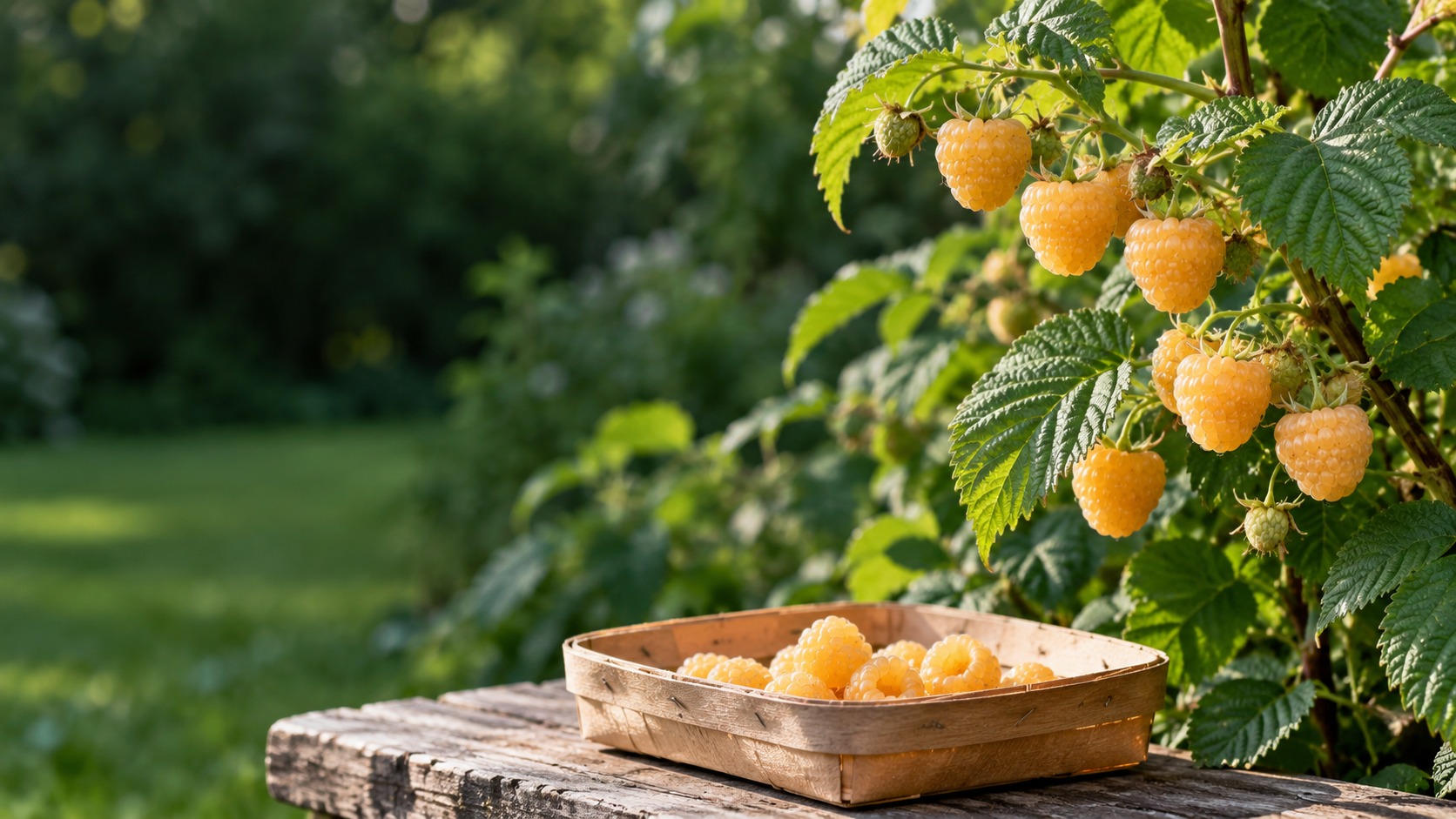
Fall Gold, also written Fallgold, is a golden-fruited, fall-bearing raspberry. Its tenderness is a cultivar characteristic: the Oregon State cultivar guide describes Fallgold as very soft. That makes handling a practical part of growing it, rather than an afterthought once the bowl is full.
The timing of the failure gives you the first useful clue. If a rounded berry stays together on the cane, releases gently, and only collapses when squeezed or buried under other berries, handling is a plausible explanation. If it already has gaps, uneven lobes, or dry loose sections while attached, inspect fruit development before blaming the picking technique.
Each little rounded segment is a drupelet, with its own seed. Those segments must develop and hold together to form the whole raspberry. You do not need to count them: compare the outline and fullness of affected fruit with a normal berry on the same plant, and note whether the damage begins before or after picking.
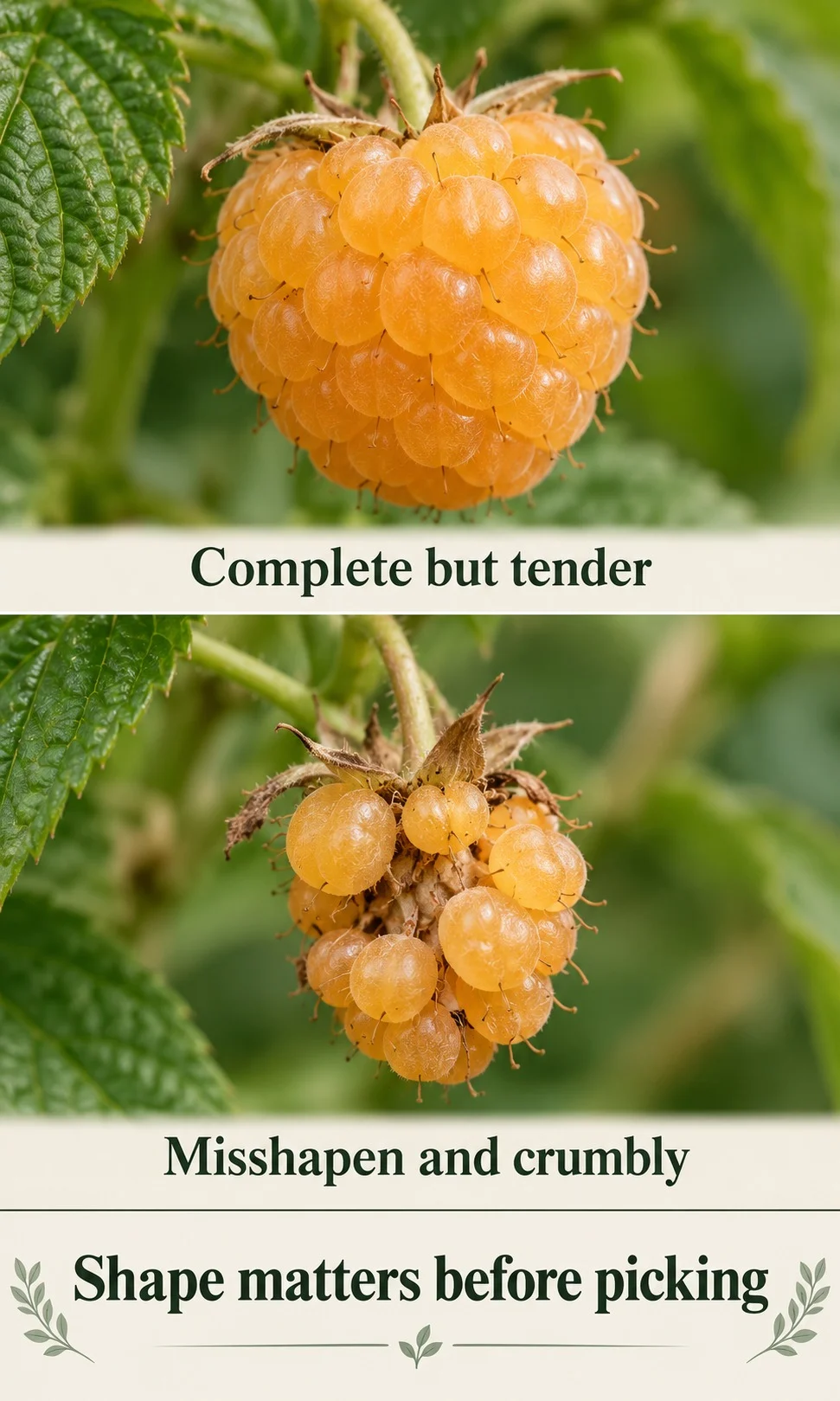
What a normal Fall Gold berry feels like
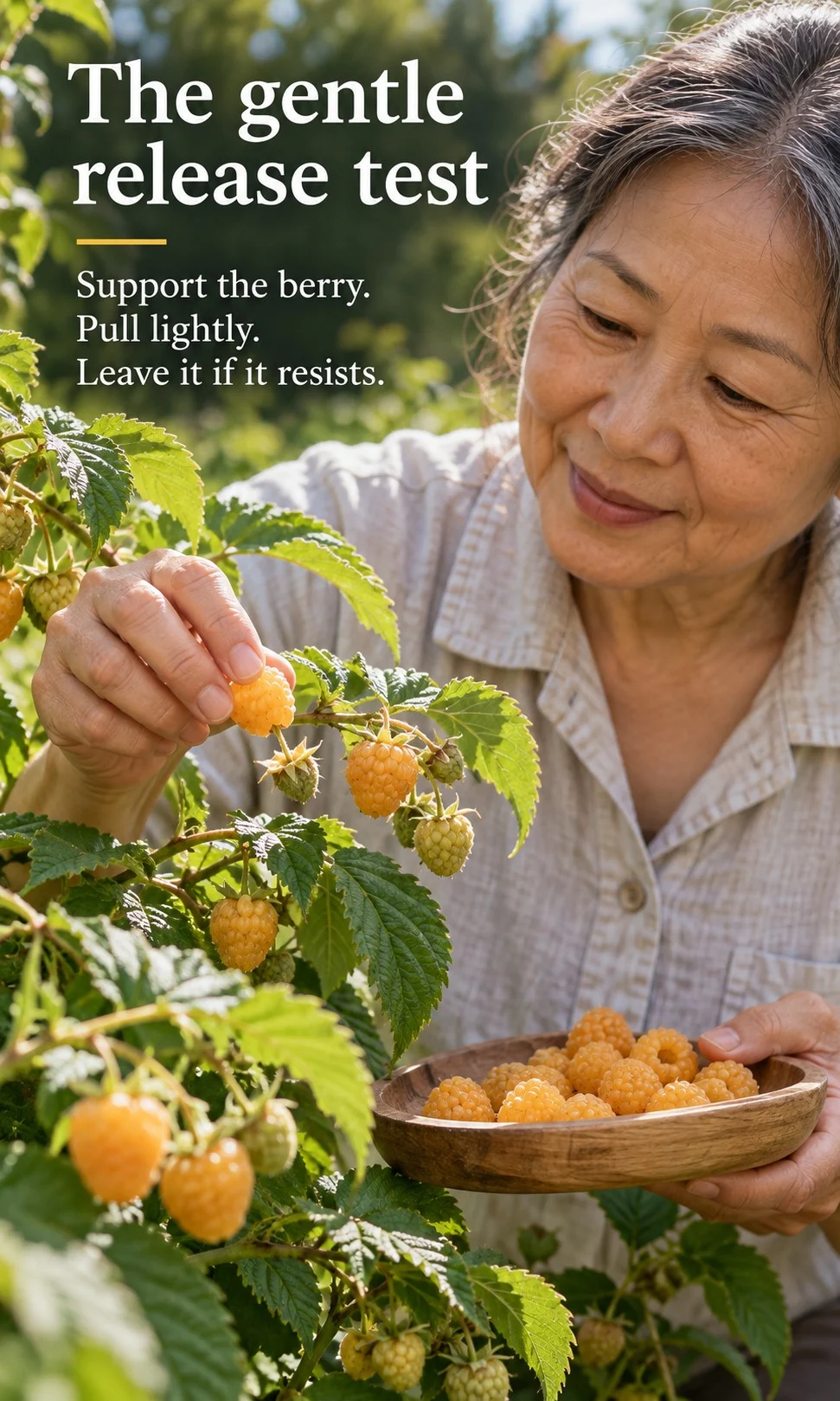
Use color as an orientation, then test release. Golden raspberries do not need to turn red, and hue alone cannot establish ripeness across plants and growing conditions. Support a likely ripe berry loosely and give it a very light pull; it should slip away from the receptacle without a yank.
A berry that resists is a reason to stop, not grip harder. Recheck it later instead of tearing it free and calling the resulting breakup a plant problem. Once a ripe berry releases, lower it straight into a shallow container rather than holding several in the same closed hand.
Sweet flavor does not tell you that fruit will tolerate transport. A fully developed Fall Gold berry may taste good yet bruise under very little pressure. For the eating side of that distinction, our guide to why food texture matters more than flavor explains why good flavor and a disappointing mouthfeel can occur together.
- Look at the berry before touching it: rounded and complete, or uneven with gaps?
- Support it gently and test release; do not pull hard to prove it is ripe.
- Keep a few gently picked berries separate from the main harvest and compare their condition.
- Record recent heat, dry soil, leaf changes, and whether the same plants are affected repeatedly.
Four causes to separate before changing the patch
Naturally soft fruit
Uniformly formed berries that collapse only after handling fit cultivar tenderness more closely than a fruit-set disorder. Start with a shallower tray, less hand pressure, and quicker cooling. Keep the plant while you evaluate those changes; softness alone is not a sound reason to remove it.
Late picking and pressure in the container
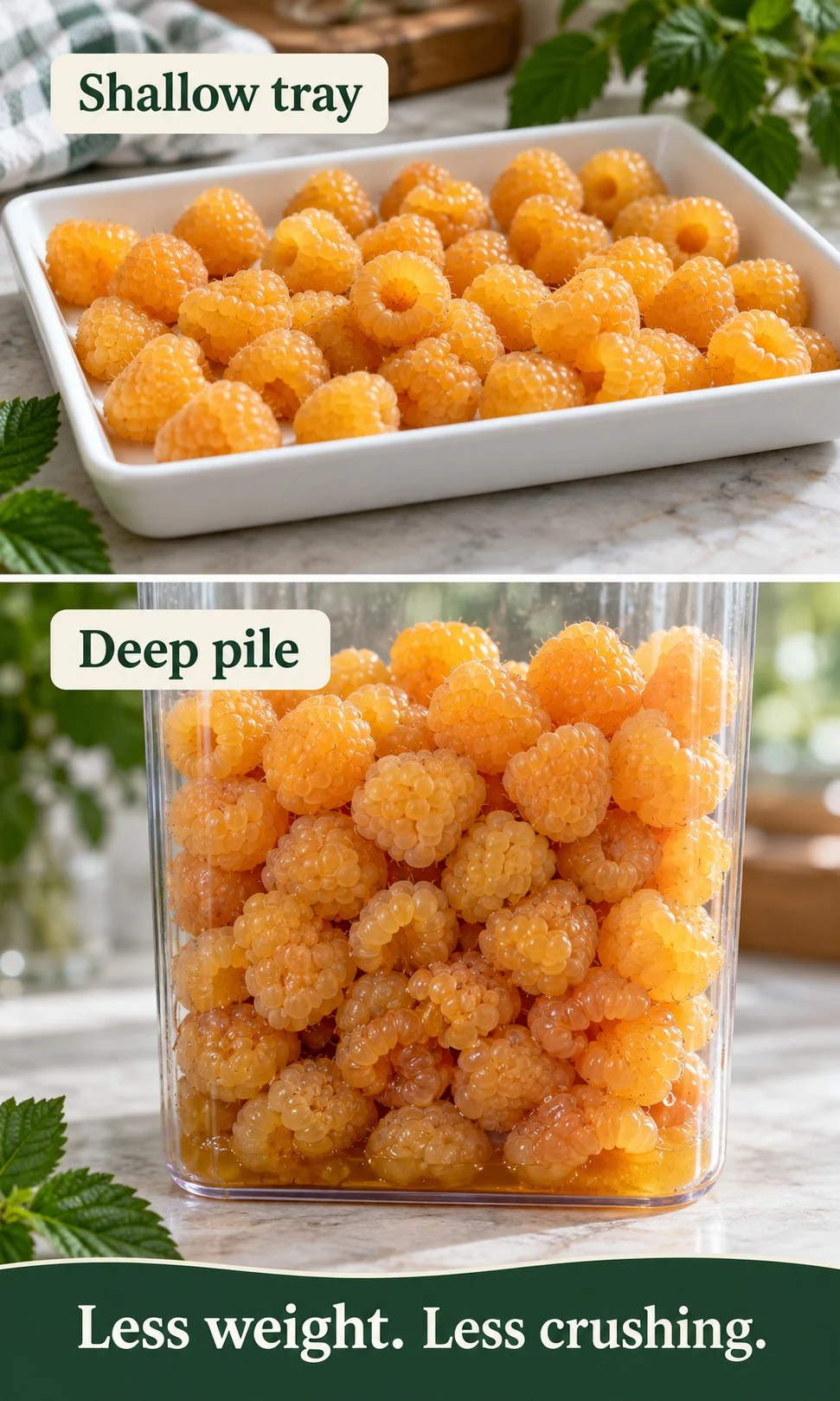
Fruit left beyond its best picking stage can become fragile, while deep containers load the lower berries with the weight of the upper ones. The useful comparison is a gently picked, shallow-held sample against your usual harvest. If the small sample stays intact but the bucket fruit leaks, the container and handling deserve attention before fertilizers or sprays.
Heat and dry soil during fruit development
Heat and inadequate moisture can interfere with fruit quality before you ever touch the berries. Iowa State explains that heat, drought, and poor pollination can produce dry, crumbly fruit. Check moisture in the root zone and the weather during flowering and fruit fill, rather than increasing watering simply because the surface looks dry.
A problem limited to fruit developing through a hot spell is a different pattern from malformed berries repeatedly appearing along the same canes. Correct an observed moisture problem without keeping the roots waterlogged, and avoid an untested fertilizer increase. Later fruit is a useful comparison, although improvement alone cannot rule out every pest or disease.
| What you see | First check | Useful next step |
|---|---|---|
| Complete on the cane; crushed in your hand | Release test and finger pressure | Pick gently into a shallow tray and compare. |
| Intact when picked; lower layers leak | Container depth and time before cooling | Reduce stacking and refrigerate promptly. |
| Small, dry, uneven fruit after harsh weather | Flowering weather and root-zone moisture | Record the affected flush; correct confirmed moisture stress. |
| Repeated malformed fruit; leaf rings or stunting | The same plants and canes over time | Ask a plant diagnostic service about sampling; do not assume a virus. |
Poor pollination, pests, or a persistent plant problem
Poor pollination leaves some drupelets undeveloped, so the fruit may look sparse or lopsided before harvest. Insects feeding on flowers or young fruit can produce a similar result, and some viruses also cause crumbly berries. The UC IPM crumbly-fruit guide treats the distribution of affected fruit as a useful clue, not a diagnosis by itself.
Inspect several canes and mark which plants repeatedly produce malformed fruit. Leaf rings, unusual distortion, or stunting strengthen the reason to seek help, but healthy-looking leaves do not exclude virus infection. Repeated failure across seasons warrants investigation; do not wait for a second season if the plant is declining or the symptoms are already pronounced.
Run a harvest check before cutting or spraying
The harvest check below sorts your observations into a next inspection step. It gives handling advice when the fruit is complete, flags unresolved development problems, and makes plant-health help easier to find when the pattern is persistent or other symptoms appear. It does not identify a pathogen, approve fruit for eating, or recommend a pesticide.
Fall Gold Harvest Check
Separate gentle-picking problems from fruit that develops unevenly.
Complete berries that crush under pressure need a different check from malformed fruit. Choose what you observed to get a practical next step. This is an observation guide, not a plant-disease diagnosis or a food-safety assessment.
No pesticide rates or removal instructions are generated. Lab testing may be needed for suspected virus problems. Keep observations locally; this experience sends no analytics or form answers.
How to pick and hold Fall Gold for the next day
Treat tomorrow as a practical use target, not a guaranteed shelf life. Raspberries are highly perishable, and very soft fruit may deteriorate sooner than a firmer cultivar. Montana State’s harvesting and storage guidance recommends gentle release, shallow containers, prompt refrigeration, and washing only when you are ready to use them.
- Pick when the fruit is dry and handle it as little as possible.
- Place berries loosely in a shallow clean container; avoid heavy layers.
- Refrigerate promptly and inspect again before serving.
- Rinse gently under running water just before use; do not use soap.
- Keep visibly spoiled fruit out of the usable harvest.
Do not try to firm soft fruit by leaving it warm on a counter. Cooling helps preserve quality but cannot rebuild crushed drupelets. Our explanation of texture changes before visible rot gives broader storage context; normal Fall Gold tenderness on its own should not be mistaken for spoilage.
What to do with crushed fruit-and what to discard
If sound fruit is freshly crushed by handling, a sauce or smoothie is a more realistic use than a bowl of intact berries. Freezing does not preserve the fresh berry’s firmness, so plan for a softer texture after thawing. Sort and rinse suitable fruit, freeze it promptly, and choose a recipe that accepts softened fruit rather than promising a fresh-looking result. Our guide to how cooking methods change texture explains why a cooked sauce is a different texture goal from intact fresh fruit.
Softness is not a food-safety test. Do not taste suspect fruit to investigate it, and discard berries with mold, slime, off odors, or clear deterioration. Cooking or blending is not a way to salvage spoiled berries, and shelf-stable jam requires a tested preservation recipe rather than an improvised response to a damaged harvest.
When to get help with the plant
Contact a local horticultural extension service, qualified plant-health adviser, or plant diagnostic laboratory if malformed fruit persists, the same plants repeatedly decline, leaves develop rings or distortion, or you find larvae in the berries. Photograph the whole patch, affected canes, leaves, and fruit before pruning. Ask the receiving service how to collect and send a sample, because a poorly collected sample can make the problem harder to resolve.
Virus identification requires laboratory testing, and confirmed infection can change removal and replanting advice. Cutting canes to the ground does not cure a systemic virus in the surviving plant. Avoid moving suckers from suspect plants, and ask about disposal and site suitability before replanting in the same ground.
Frequently asked questions
Do Fall Gold and Fallgold fall apart for the same reason?
Fall Gold and Fallgold are alternate spellings used for the cultivar. Both names refer to a very soft golden raspberry, but the cause of a particular damaged harvest still needs checking. Look at fruit shape on the cane and when the collapse begins.
Are yellow raspberries always softer than red raspberries?
No; firmness varies by cultivar, not simply by color. Fallgold is notably soft, while other yellow-fruited cultivars have different firmness characteristics. Compare cultivar descriptions instead of assuming every yellow raspberry behaves identically.
Why do my golden raspberries taste sweet but turn to mush?
Flavor and resistance to pressure are separate qualities. A ripe, sweet Fall Gold berry can still bruise during gripping, stacking, or transport. Try the gentle release test and a shallow tray before treating the plant for disease.
Can I freeze Fall Gold raspberries?
You can freeze suitable, sound berries, but expect a softer thawed texture. Sauce and smoothies are more forgiving uses than fresh-looking bowls. Do not freeze spoiled fruit as a way to rescue it.
Does white spotting mean a golden raspberry is rotting?
White or colorless drupelets on the sun-exposed side can result from sunscald. That differs from fuzzy mold, slime, or spreading deterioration. If you cannot distinguish the surface change, do not taste the berry to identify it.
Should I cut Fall Gold to the ground if its fruit is soft?
Soft fruit alone is not a reason to cut the patch down. Fall-bearing raspberry pruning can be managed for one crop or two, but that choice will not make a naturally tender cultivar firm or cure a systemic virus. Resolve the handling or plant-health question before changing the pruning system.
Keep the distinction clear at the next harvest
Keep complete, gently released berries separate from the normal picking container and record what happens to both. If pressure explains the damage, improve the harvest routine and keep expectations realistic for this cultivar. If malformed fruit starts on the cane or repeats with other plant symptoms, investigate the patch rather than trying to squeeze a firmer berry out of Fall Gold.