



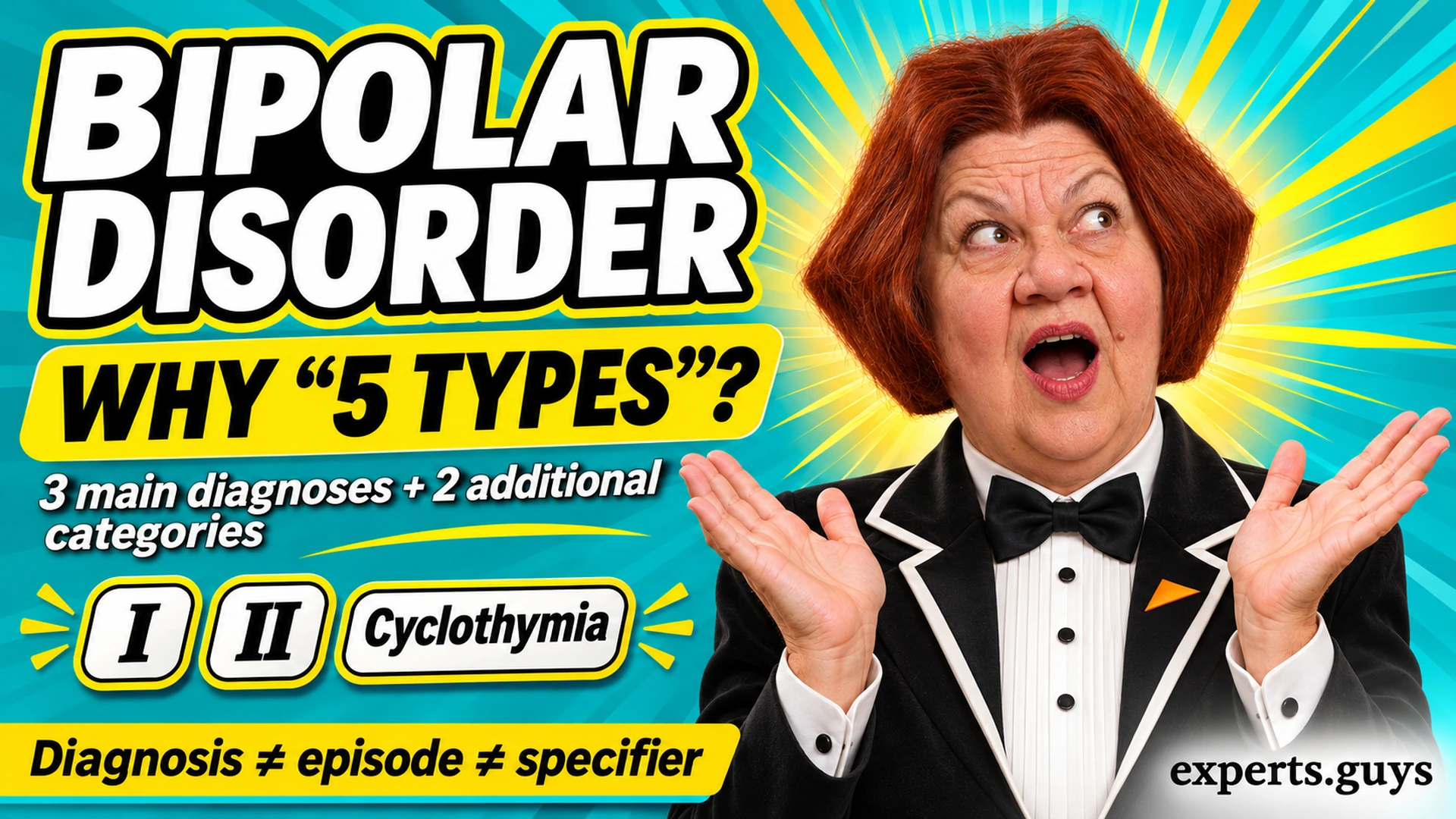
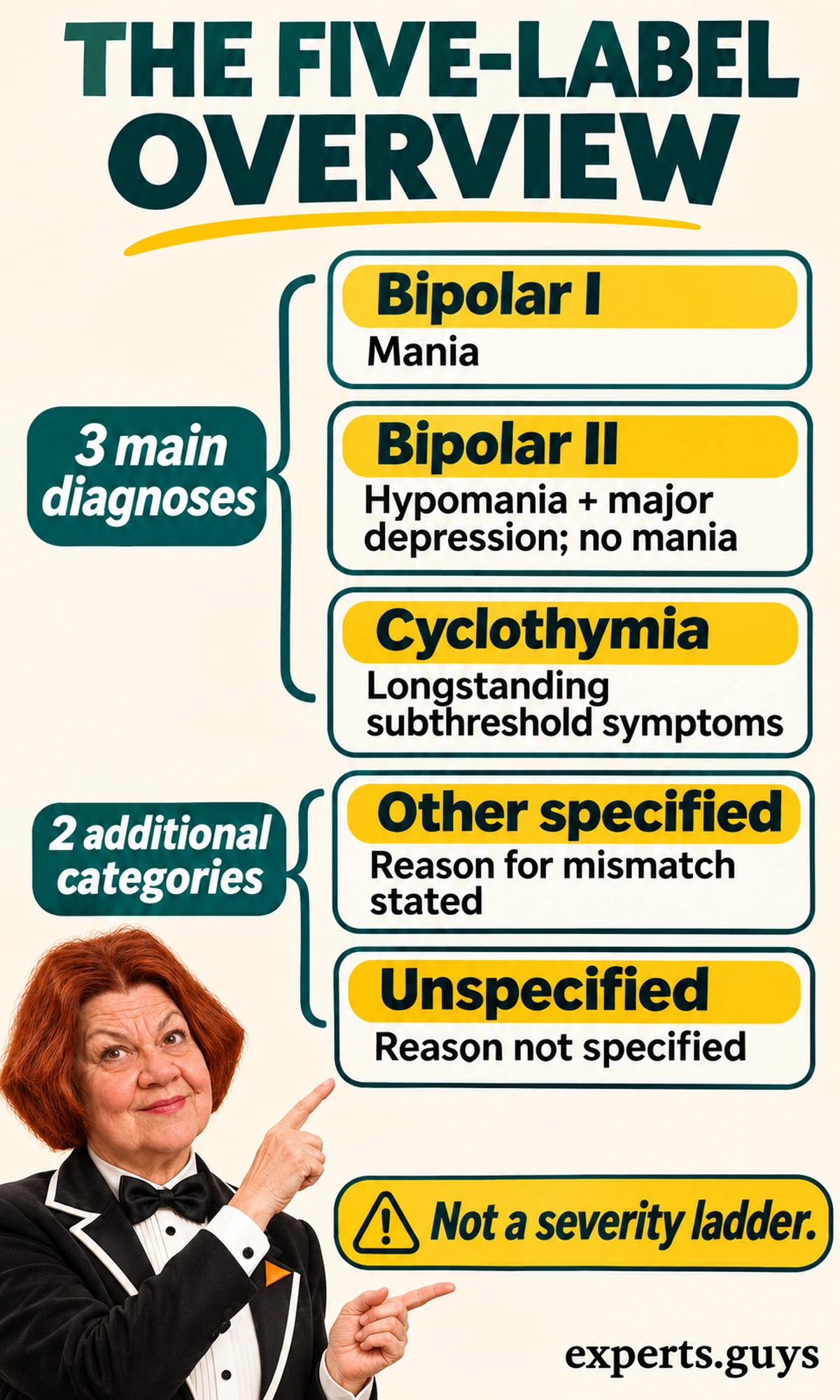
The five labels commonly listed for bipolar disorder are bipolar I, bipolar II, cyclothymic disorder, other specified bipolar and related disorder, and unspecified bipolar and related disorder. The first three are the main diagnoses, while the last two describe clinically important presentations that do not fit their full criteria; these labels are not five steps on a severity scale.
A useful way to read a diagnosis is to separate three questions: what overall pattern has occurred, what episode is happening now, and what additional description applies. That separation explains why someone can have bipolar I while currently depressed, or why rapid cycling can describe bipolar I or II without becoming a separate type.
Why do some guides list three types and others five?
They are counting at different levels of detail. A short overview names the three main diagnoses; a five-label explanation separates other specified and unspecified presentations into their own entries. Neither count is a complete inventory of every condition in the broader bipolar and related disorders chapter, which also includes substance- or medication-induced conditions and conditions due to another medical illness.
The distinction matters when a search result seems to contradict the wording on a clinical letter. A heading that says “three types” may simply leave out the additional categories for brevity. A heading that says “five types” becomes misleading if it implies that every person must fit one of five neatly ordered boxes, or that a label outside the first three means the symptoms are unimportant.
- Read the full name: “other specified bipolar and related disorder” is more informative than an informal phrase such as “type four.”
- Separate the label from severity: the diagnosis describes a pattern; current risk and support needs require their own assessment.
- Check what the list excludes: mixed features and rapid cycling add information to a diagnosis, while a medicine-related cause may change the diagnostic category.
The NIMH overview of bipolar disorder uses the three main diagnoses and then discusses other specified and unspecified presentations. This article uses the five-label framework to make that wording understandable, rather than presenting five as a universal official total. Diagnostic language can also differ between classification systems and health services.
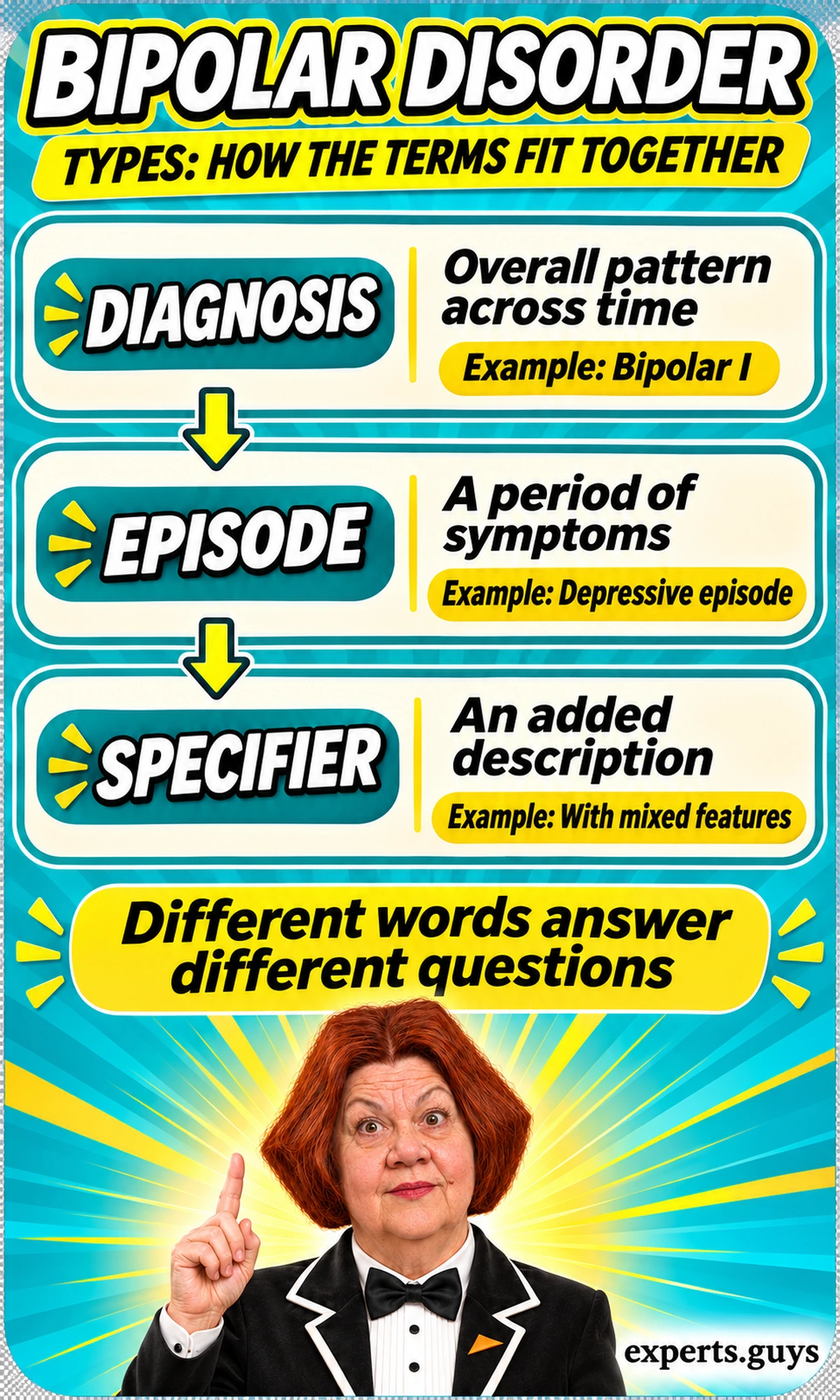
Diagnosis, episode and specifier answer different questions
A diagnosis summarizes the pattern across a person’s history. An episode describes a period with a particular cluster of symptoms. A specifier adds detail about features or course. These layers can appear together in one description without contradicting one another: the first identifies the illness pattern, the second identifies a phase, and the third makes the description more precise.
Consider an illustrative sentence: “A person with bipolar I is experiencing a depressive episode.” There is no need to change the I to II because the current symptoms are depressive. The history establishing bipolar I still matters. Equally, a period of feeling well does not erase the diagnosis, just as the absence of a current episode does not reveal which episodes occurred previously.
This is the most useful starting point for comparing labels because it prevents a common reading error: treating every extra word as a new disorder. If a report contains a term you do not recognize, ask what job that word is doing. Is it naming the overall condition, describing the present episode, or adding a feature? You can understand the wording without trying to classify yourself.
The same approach keeps adjacent topics in their proper place. A guide to unipolar versus bipolar depression addresses why depressive symptoms alone do not identify the illness pattern. Here, the narrower job is understanding how the bipolar labels fit together once episode history is being considered.
What separates bipolar I, bipolar II and cyclothymia?
The decisive difference is the kind of episode or longstanding symptom pattern that has occurred, rather than how cheerful or distressed someone looks today. Mania establishes the key distinction for bipolar I; bipolar II requires hypomania and major depression without a manic episode. Cyclothymia concerns a sustained pattern of symptoms that remain below full episode thresholds, alongside additional diagnostic requirements.
Use the comparison below as an explanation of clinical reasoning. It deliberately leaves out a home scoring system: symptom counts, duration, impact, exclusion of other causes and the relationship between episodes have to be considered together. Matching one row does not complete that assessment, and failing to recognize a past episode from memory does not prove it never happened.
| Diagnosis | Defining distinction | What the name does not mean |
|---|---|---|
| Bipolar I | At least one manic episode, after clinical exclusions. Depression is common but not required. | Not a requirement to alternate regularly between high and low moods. |
| Bipolar II | At least one hypomanic episode and one major depressive episode, with no manic episode. | Not a guarantee of mild depression or lower support needs. |
| Cyclothymic disorder | Longstanding elevated and depressive symptoms below full episode thresholds, with specific course requirements. | Not ordinary moodiness, a brief difficult week, or a synonym for rapid cycling. |
Bipolar I: mania is the defining distinction
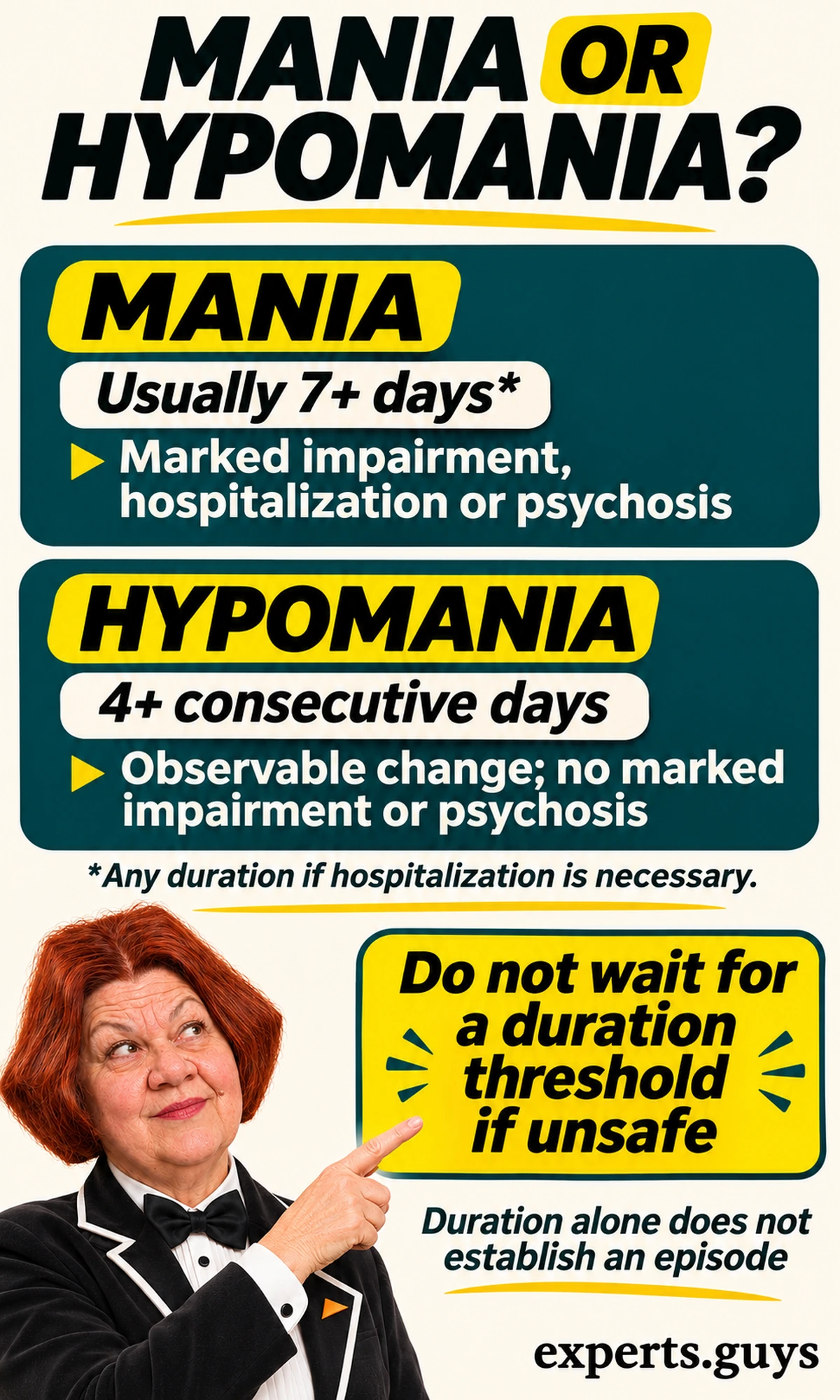
Mania involves an abnormal change in mood together with increased energy or activity and associated symptoms. The mood can be elevated, expansive or markedly irritable. A person need not appear happy. The manic episode is severe enough to cause marked impairment, require hospital care, or involve psychotic features; assessment also checks whether another explanation accounts for the presentation.
The usual duration threshold is at least one week, with symptoms present most of the day nearly every day, or any duration when hospitalization is necessary. These are classification rules, not a waiting period for help. An unsafe change on an earlier day still needs attention, and a calendar alone cannot turn ordinary excitement into mania. The SAMHSA comparison of manic-episode criteria shows why mood, energy, symptoms and severity belong together.
An illustrative example makes the distinction clearer. Imagine an adult whose clinician has established a previous manic episode and excluded relevant alternative causes. Months later, that person experiences depression. The current phase changes what needs attention now, but it does not remove the past mania from the diagnostic history. The illness is not renamed according to whichever symptom feels strongest that morning.
This also explains why the familiar picture of perfectly alternating highs and lows is unreliable. A diagnosis describes qualifying history, not a required rhythm. Someone may have long stretches of stability, repeated episodes in one direction, or a course that does not resemble a symmetrical wave. A teaching diagram should therefore show the defining event without pretending to predict a person’s next episode.
Bipolar II: hypomania and depression both matter
Hypomania is an observable departure from usual functioning, not simply a good mood. The standard duration is at least four consecutive days, with an abnormal mood change and increased energy or activity present most of the day nearly every day. The episode does not cause the marked impairment or need for hospitalization that defines mania, and it has no psychotic features.
The SAMHSA hypomania criteria comparison also cautions against treating a small number of activation symptoms after antidepressant treatment as sufficient proof of hypomania. That is a useful restraint: a person can feel edgy, sleep poorly or become irritable for several reasons. A medication response needs interpretation, rather than being used as an informal diagnostic experiment.
A major depressive episode generally lasts at least two weeks and involves depressed mood or loss of interest alongside other qualifying symptoms and clinical impact. For bipolar II, a qualifying major depressive episode is required, and there must have been no manic episode. The word “hypomania” describes the elevated episode’s threshold; it does not describe the intensity of the person’s depression. This is why calling bipolar II “the mild version” can hide the very problem that brought someone into care.
Picture a second illustrative history in which a clinician establishes hypomania and major depression, with no mania. The person’s depression may have disrupted everyday life more visibly than the hypomania did. That imbalance does not make the elevated episode irrelevant. Conversely, a productive period is not automatically hypomania simply because depression occurred before or afterward; the full characteristics of that period still matter.
If mania later occurs and is clinically established, the diagnostic picture changes toward bipolar I. That is a change in the available episode history, not a promotion to a more legitimate illness. Avoid using the Roman numerals as personal rankings. They tell you which pattern is being described, while the current episode, risks and individual circumstances determine what help is needed.
Cyclothymia: the course is part of the definition
Cyclothymic disorder concerns recurring elevated and depressive symptoms that do not meet the full criteria for hypomanic or major depressive episodes. In adults, the duration requirement is at least two years; in children and adolescents, at least one year. During the qualifying period, symptoms are present for at least half the time, with no symptom-free interval longer than two months. Clinical impact, exclusion of other causes and the absence of qualifying full episodes also matter.
The NHS explanation of cyclothymia describes why symptoms below full episode thresholds can still interfere with life. “Below threshold” is a statement about classification, not a statement that the person should tolerate the disruption without support. At the same time, distress by itself cannot identify cyclothymia: the characteristic course has to be established.
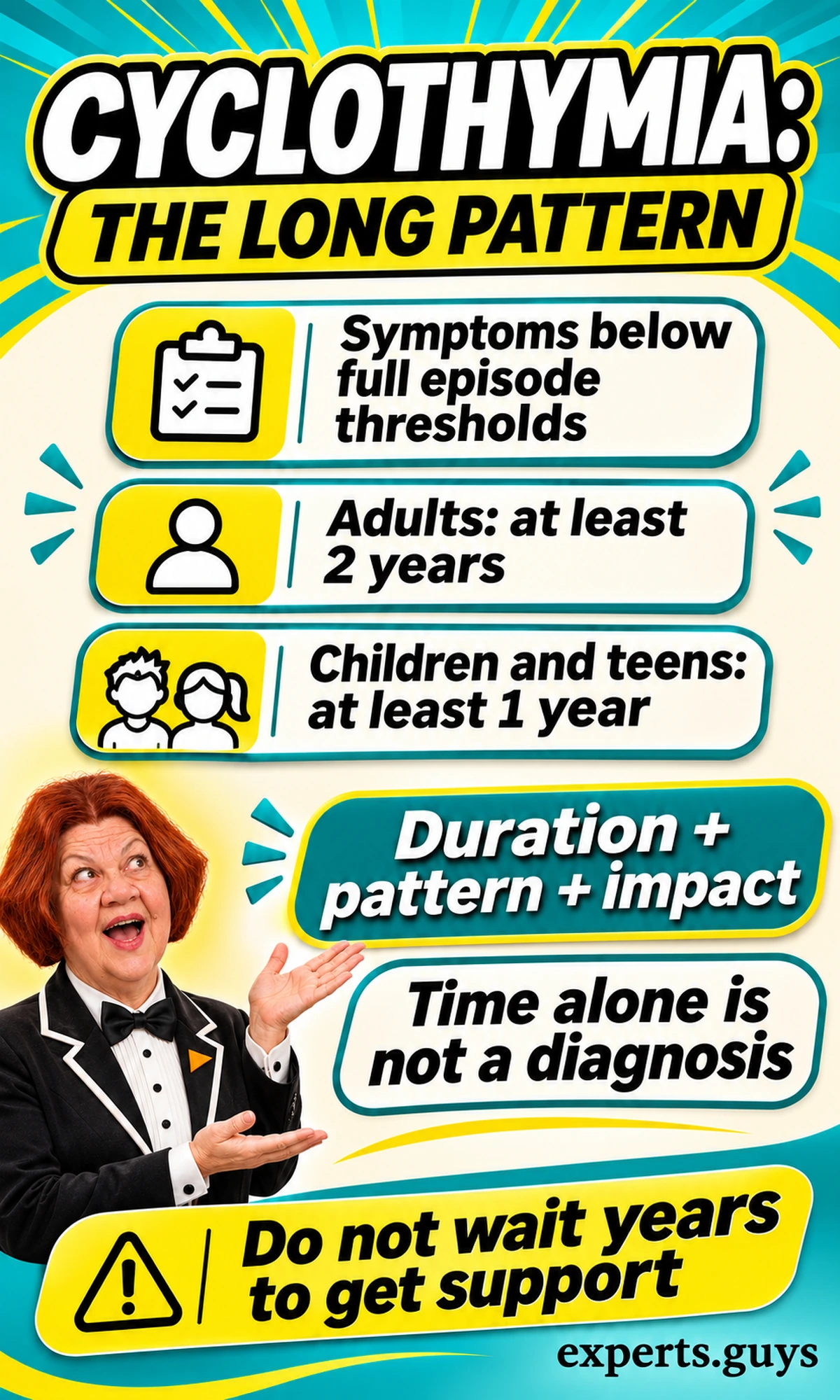
A useful comparison is between intensity and persistence. A short, intense disturbance and a long pattern of less intense symptoms raise different diagnostic questions. Neither dimension can replace the other. You cannot establish cyclothymia by choosing the least dramatic label, and you cannot infer that every difficult day in a long period belongs to the same disorder.
The dedicated guide to cyclothymia and its longer-term pattern develops that topic in more detail. The takeaway here is narrower: the presence of a qualifying full episode can change the assessment, so cyclothymia should not be used as a catch-all for any alternating emotions. Its long duration criterion is also no reason to postpone support for symptoms that are already disruptive.
What do “other specified” and “unspecified” actually tell you?
Both labels allow clinically important bipolar-related presentations to be described when the full requirements for a more specific disorder are not met. “Other specified” states the reason for that mismatch. “Unspecified” does not state it, including situations where the available information is insufficient. Neither term tells you, on its own, how urgent the current symptoms are.
The difference is easier to understand as a question about explanation rather than certainty. In an other specified diagnosis, the clinician can name the relevant way the presentation falls short of a full category. With an unspecified diagnosis, the label does not supply that explanation. It is a mistake to translate the first into “almost bipolar II” or the second into “nothing was found.”
Other specified: the reason belongs with the label
A recognized example involves short-duration hypomanic-like episodes alongside major depressive episodes. Another concerns a cyclothymic-like presentation that has not reached the duration requirement. The APA clarification of other specified bipolar presentations uses “cyclothymic-like” to distinguish that example from full cyclothymic disorder.
For an illustrative comparison, suppose a clinician has established major depressive episodes and repeated periods of hypomanic-like symptoms lasting two or three days, with the remaining relevant assessment completed. Those shorter periods do not meet the standard four-day duration for hypomania. They may be relevant to an other specified presentation, but the duration alone does not settle the diagnosis or tell the person which medicine to take.
The practical value of the wording is that the reason remains visible. If the short periods are later understood differently, or additional history establishes a full episode, the assessment can be revisited using that new information. Without the reason, a reader might incorrectly assume that all other specified presentations are the same. They are a group of presentations, not one hidden fourth pattern with identical treatment needs.
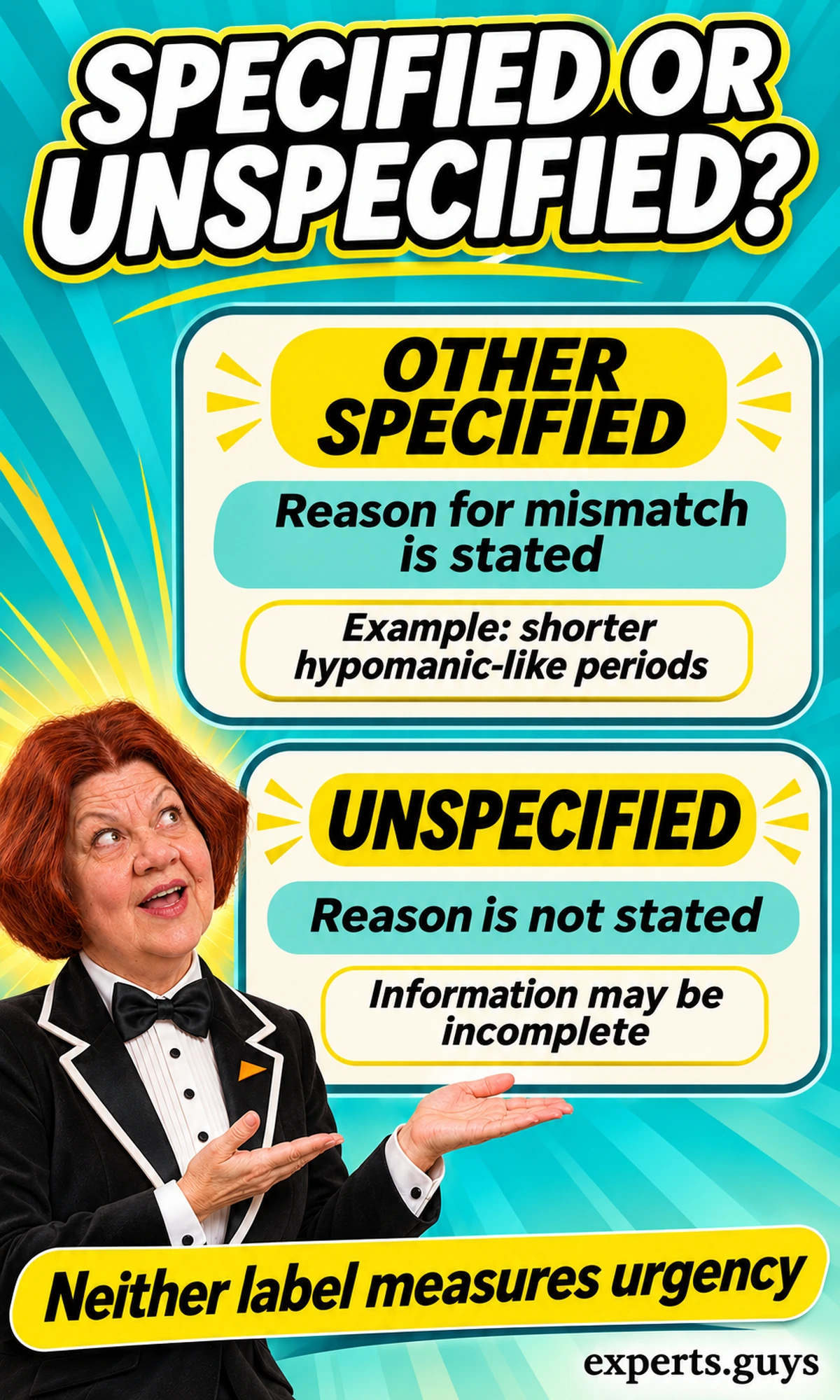
- Ask what was specified: which duration, symptom or course requirement was not met?
- Ask what remains relevant: which current symptoms and functional problems need attention even with that distinction?
- Ask what would change the explanation: is there a particular historical uncertainty or future clinical finding that would prompt reassessment?
Unspecified: an incomplete description is still a description
An unspecified label can be used when a bipolar-related presentation causes clinically significant distress or impairment but a more specific diagnosis is not assigned and the reason is not stated. Insufficient information is one context. The wording itself does not establish why the clinician chose it, so avoid assuming that it always means an emergency visit, a temporary diagnosis or a definite future bipolar I diagnosis.
Imagine receiving a brief discharge summary that contains the term but little supporting history. The useful response is to ask what the team currently understands and what follow-up will clarify. Arguing about which numbered type it “really” is can distract from the actual unresolved issue. A care plan can address current problems while the diagnosis remains less specific.
There is a trade-off in diagnostic precision. A more detailed label can make an explanation clearer when the information supports it. Adding detail that the information does not support creates false confidence. Leaving uncertainty visible is preferable to filling gaps with a guessed episode history, but the uncertainty should not become a reason to leave the person without an understandable plan.
The broader family includes causes that a five-label list leaves out
Substances, medications and medical illnesses can produce mood changes that resemble bipolar presentations. The classification includes substance- or medication-induced bipolar and related disorder and bipolar and related disorder due to another medical condition. The Merck Manual overview of bipolar disorders distinguishes these categories from the primary patterns.
Timing helps raise a question about cause, but it does not answer it alone. Symptoms that begin near a medication change deserve prompt discussion with the prescriber; they do not justify stopping and restarting treatment to see what happens. A clinician considers the substance or medicine involved, the course, other symptoms and alternative explanations. The safe task for the reader is understanding why a cause review belongs in the assessment.
This is another reason not to present the five labels as the complete official list. A useful educational list simplifies a classification while explaining its boundary. An oversimplified list hides relevant alternatives. Keep the shorthand when it helps you read the main distinctions, then use the full diagnostic wording whenever the cause or an additional category matters.
How should you read extra labels and use the information?
Treat extra descriptors as information about features, course or current state, then connect that wording to the actual care plan. Rapid cycling and mixed features are common sources of confusion because they sound like additional types. Understanding the terms can make a clinical explanation easier to follow; it does not provide a reliable way to assign a diagnosis from an online list.
Rapid cycling counts episodes, not every emotional shift
Rapid cycling describes at least four qualifying mood episodes within twelve months. It can occur in bipolar I or II. It does not mean that any four emotional changes count, and it is not a synonym for cyclothymia. Episode boundaries matter, which is why a sequence of upsetting events in one afternoon cannot be translated directly into that specifier.
For a classification illustration, imagine four distinct, clinician-established episodes over a year. The rapid-cycling description adds information about frequency, while the kinds of episodes and lifetime history determine the underlying diagnosis. A calendar with four colored blocks could illustrate that relationship, but it would still be an example, not evidence of an individual’s illness or a prediction of the next year.
Mixed features describe symptoms that overlap within an episode
Mixed features indicate that an episode includes qualifying symptoms associated with the opposite mood pole. They do not simply mean feeling happy and sad on the same day. The APA bipolar-disorder questions and answers explains the distinction between mixed features and the older mixed-episode terminology. Irritability or agitation alone should not be treated as a complete mixed-features checklist.
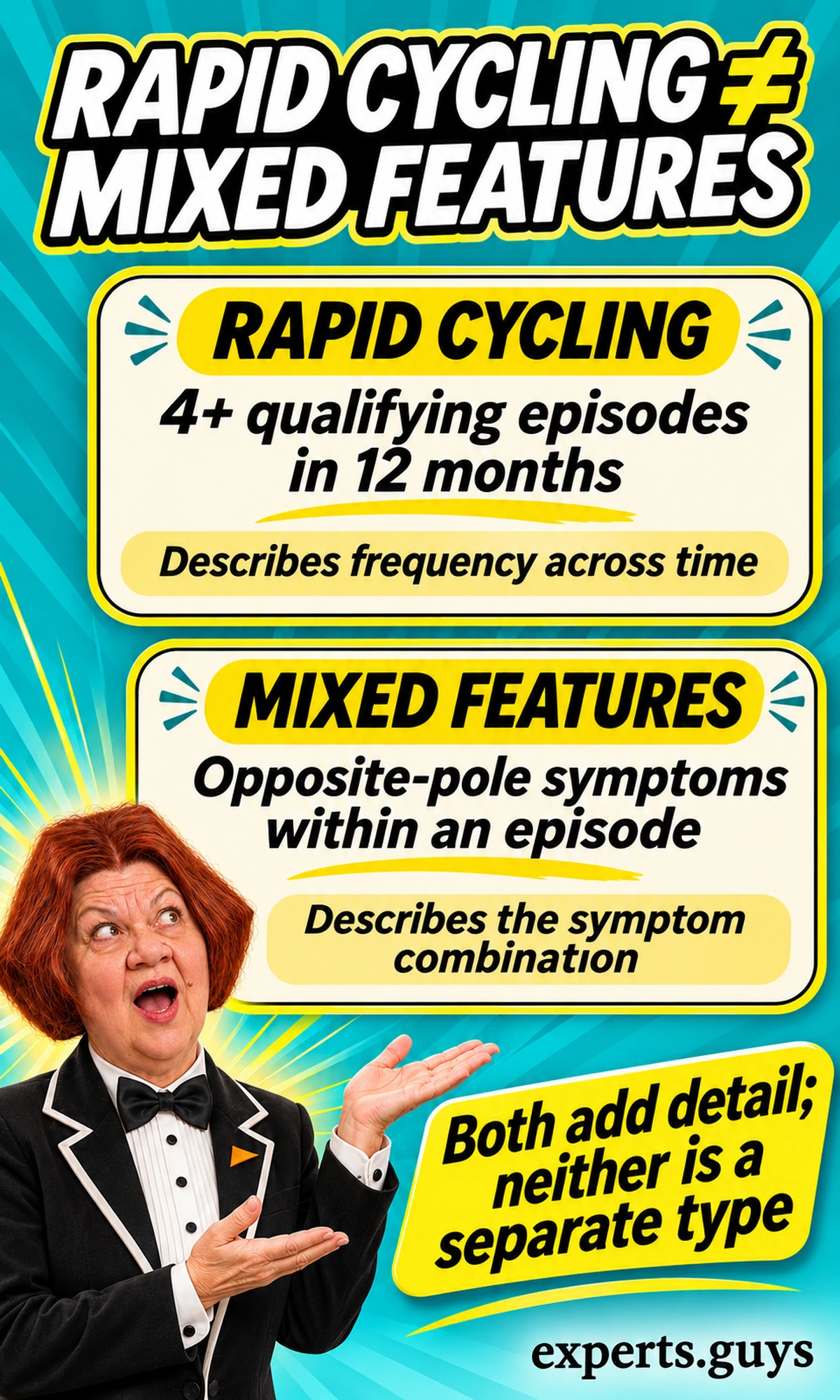
These descriptors answer different questions: rapid cycling concerns recurrence across time, while mixed features concern the symptoms present during an episode. A person can need discussion of both. Do not use one to cancel the other, and do not infer that a person with mixed features necessarily has rapid cycling. Keeping the time scale visible prevents two different ideas from collapsing into “mood swings.”
Current severity is a further dimension. A diagnosis can remain the same while the immediate level of risk changes, and a person’s support needs can change without a new type being assigned. That is why a reassuring-sounding label is never a reason to ignore a severe new change. Names help organize care; they do not replace attention to what is happening now.
Read a diagnostic sentence in three passes
Use this no-writing approach when a letter or discussion contains unfamiliar wording. Start with the diagnosis name, identify any phrase describing the current or most recent episode, and then identify any added features or course description. Leave a phrase unclassified if it is unclear. The result is a clearer question for the treating team, not a diagnosis you have made yourself.
- First pass – the overall pattern: find the full condition name, such as bipolar I disorder.
- Second pass – the episode: find whether the wording describes depression, mania, hypomania, remission or a recent episode.
- Third pass – the added detail: identify phrases such as mixed features or rapid cycling, then ask what each changes in the explanation.
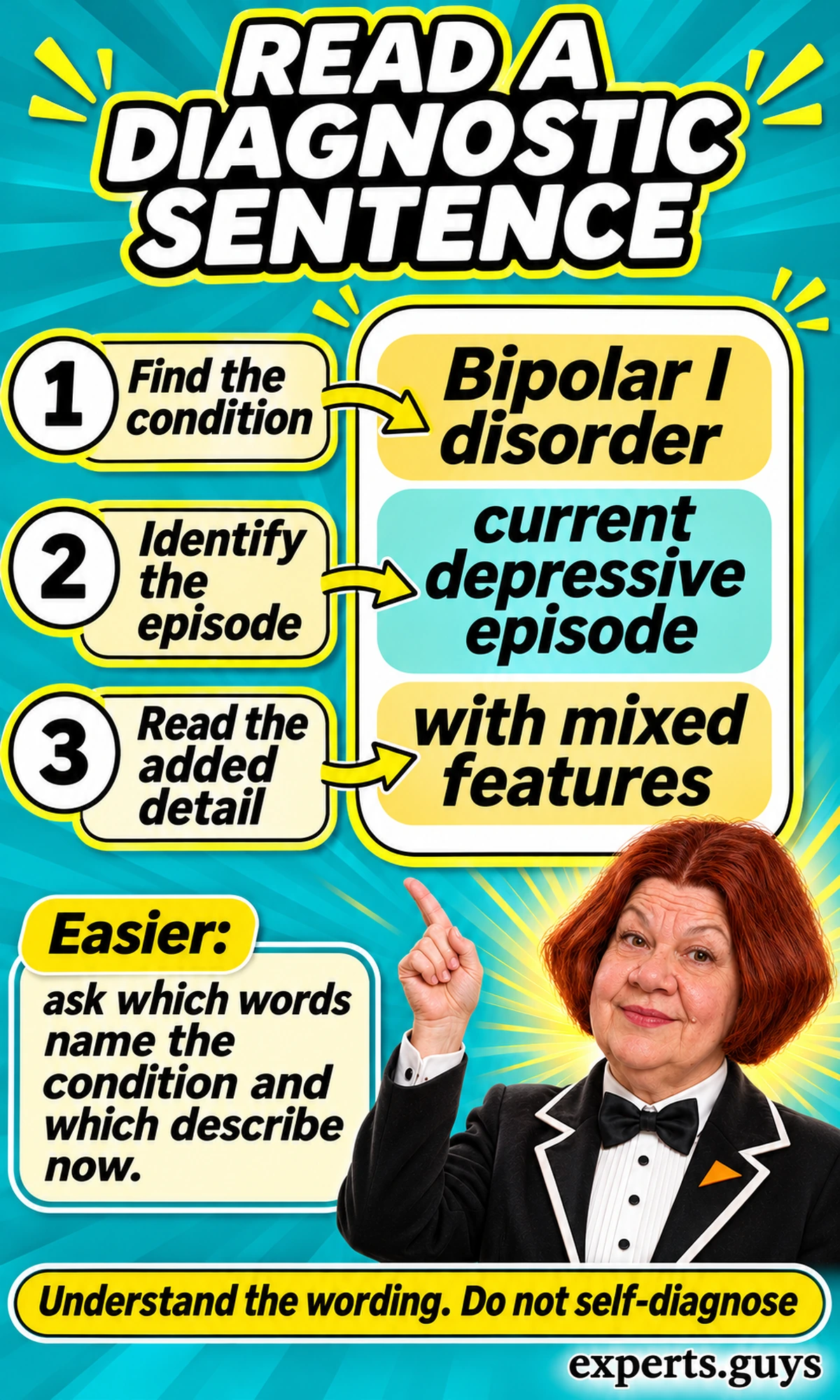
For example, take the illustrative wording “bipolar I disorder, current depressive episode, with mixed features.” The diagnosis is bipolar I, the current episode is depressive, and mixed features add detail about symptoms within that episode. The common mistake is to interpret “depressive” as evidence that the diagnosis should be bipolar II. Returning to the lifetime pattern resolves that reading error without needing a symptom score.
If reading the full phrase is difficult, use one question: “Which words name the condition, and which describe what is happening now?” Someone you trust can read it aloud with your permission. Completion means you can point to the unfamiliar phrase or explain the distinction more clearly. You do not need to write a timeline, complete a worksheet or defend a preferred label.
This reading method has a limit: it interprets vocabulary, not whether the diagnosis was correctly made. If the documented history differs from what you remember, ask for the reasoning and explain the discrepancy. Do not silently change the wording on a prescription, assume a medication is wrong, or use an educational example to overturn an individual assessment.
Match the question to the decision that matters next
The most useful question depends on what remains unresolved. If the label is unclear, ask what pattern supports it. If symptoms have changed, ask what action the care plan calls for now. If treatment is confusing, ask which current problem and future risk it is intended to address. These are different questions; one can be answered even while another still needs investigation.
| What is unclear? | Question to ask | Useful result |
|---|---|---|
| The condition name | Which part of my history supports this diagnosis? | An explanation of the pattern and any uncertainty. |
| An additional descriptor | Does this describe this episode or the longer-term course? | Clarity about what the extra wording adds. |
| The treatment purpose | What is this intended to treat now or prevent later? | A reason for the plan, including relevant cautions. |
| A significant change | Which contact route should I use for this change? | A concrete next step with appropriate urgency. |
Treatment is individualized and may address an acute episode, prevention of recurrence, psychological support and practical functioning. A five-label chart cannot choose between medicines or supply a dose. The VA/DoD bipolar-disorder guideline separates diagnosis and triage from management of mania, hypomania and bipolar depression, illustrating why the treatment task is more specific than selecting a type.
For recognizable changes in everyday settings, the guide to bipolar symptoms at work explores sleep, speech and judgement. This article does not repeat its work-handover or commitment-management methods. The additional skill here is reading the classification accurately enough to ask the right question about your own explanation and plan.
When urgency outranks the label
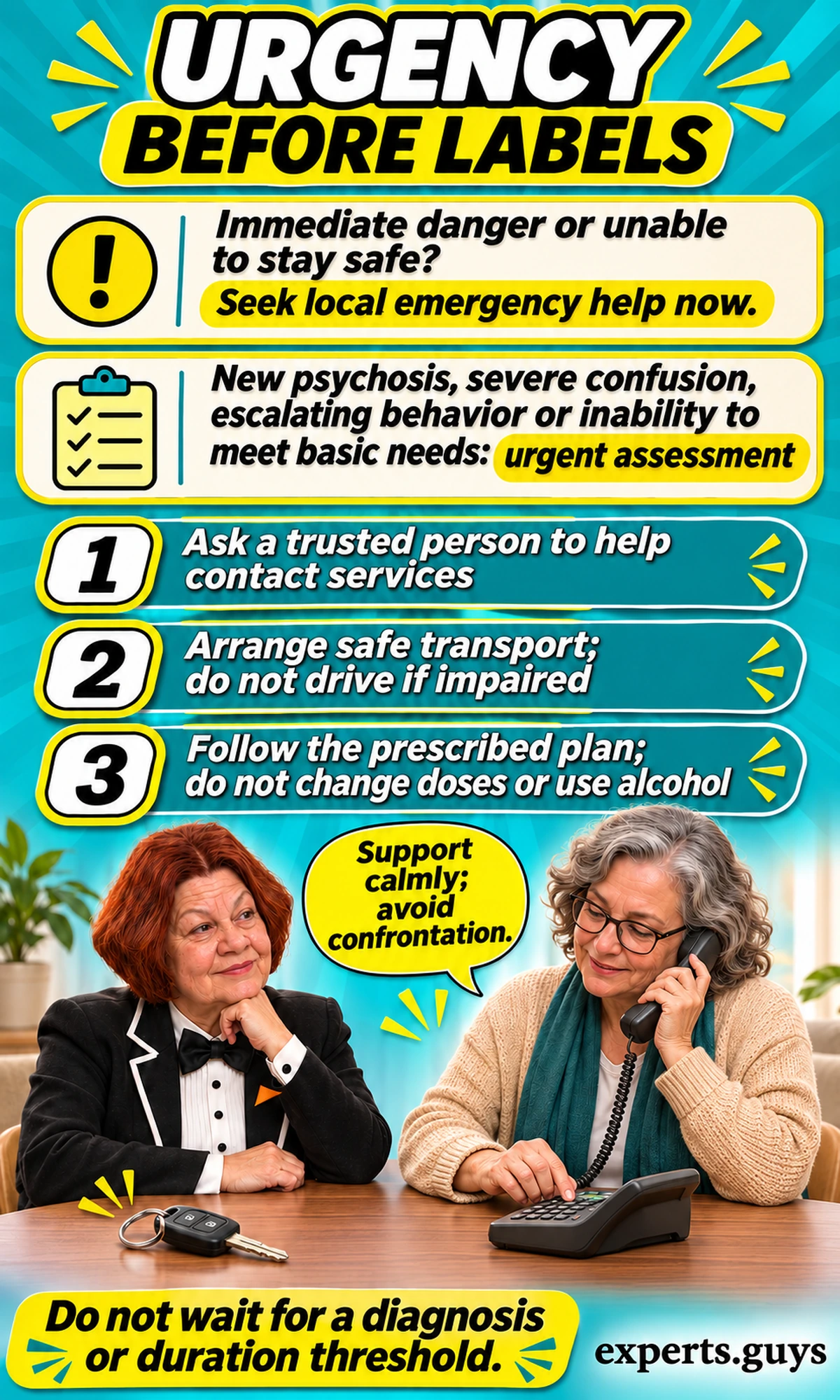
New psychotic symptoms, severe confusion, rapidly escalating behavior or an inability to meet basic needs require urgent clinical assessment. If there is immediate danger or someone cannot stay safe, seek local emergency help now. Do not wait for a week-long episode threshold, a more specific diagnosis or certainty about whether the label is bipolar I or II.
While arranging urgent help, avoid driving if judgement or attention is impaired and ask a trusted person to help with safe transport or contacting services. Do not attempt to settle the situation by taking extra medication, changing a dose or using alcohol. A helper should prioritize safety and clear communication without confronting or trying to prove a belief wrong.
A prior plan is useful only if it provides a usable contact route for the present situation. When no emergency is present, ask the treating service what changes call for earlier contact and who receives that contact. The NICE assessment and management recommendations place detailed history, alternative explanations, functioning and risk within the same assessment rather than letting the label do all the work.
Frequently asked questions
Are bipolar III, IV or V official equivalents of these labels?
Do not assume that they are. Numbered terms beyond I and II appear in some proposed frameworks and informal discussions, but they are not interchangeable replacements for cyclothymic, other specified or unspecified diagnoses. Ask which classification and definition the speaker is using before comparing them with wording in a clinical report.
Does a normal mood between episodes mean the diagnosis was wrong?
No. A diagnosis can reflect episodes that occurred in the past even when no episode is active now. Whether an individual diagnosis is correct depends on the supporting history and assessment, rather than the presence of symptoms on every day. A period of stability is compatible with an episodic illness.
Can a relative have a different bipolar diagnosis?
Yes. A family connection does not require identical episode histories or identical diagnoses. It also does not tell you which medicine, dose or support plan is appropriate for another person. Family information can contribute to an assessment while each person’s own course remains central.
Does “unspecified” mean I must wait before receiving help?
No. Current symptoms, functional problems and safety needs can be addressed while the diagnostic explanation is being clarified. Ask what the present plan covers and what information the next assessment is intended to establish. A less specific label should not be interpreted as proof that the symptoms do not matter.
Can a blood test distinguish bipolar I from bipolar II?
There is no routine blood test that sorts people into these types. Tests may investigate possible alternative causes or support safe medication use, but the distinction between I and II depends on episode history and clinical assessment. A laboratory result cannot replace the question of whether mania has occurred.
Decision summary
Read the full label as an explanation of pattern, episode and additional detail. If a word remains unclear, ask what evidence supports it and what it changes in the current plan. Keep that interpretation separate from urgent action: a severe change needs a response even when the diagnostic wording is still being clarified.










