
Cyclothymia, also called cyclothymic disorder, is a longstanding pattern of recurring elevated and depressive symptoms that do not meet the full thresholds for hypomanic or major depressive episodes. It is more specific than ordinary moodiness, and the effect on daily life can still be significant. The useful next step is to understand the pattern and history, not to diagnose yourself from a few familiar traits.
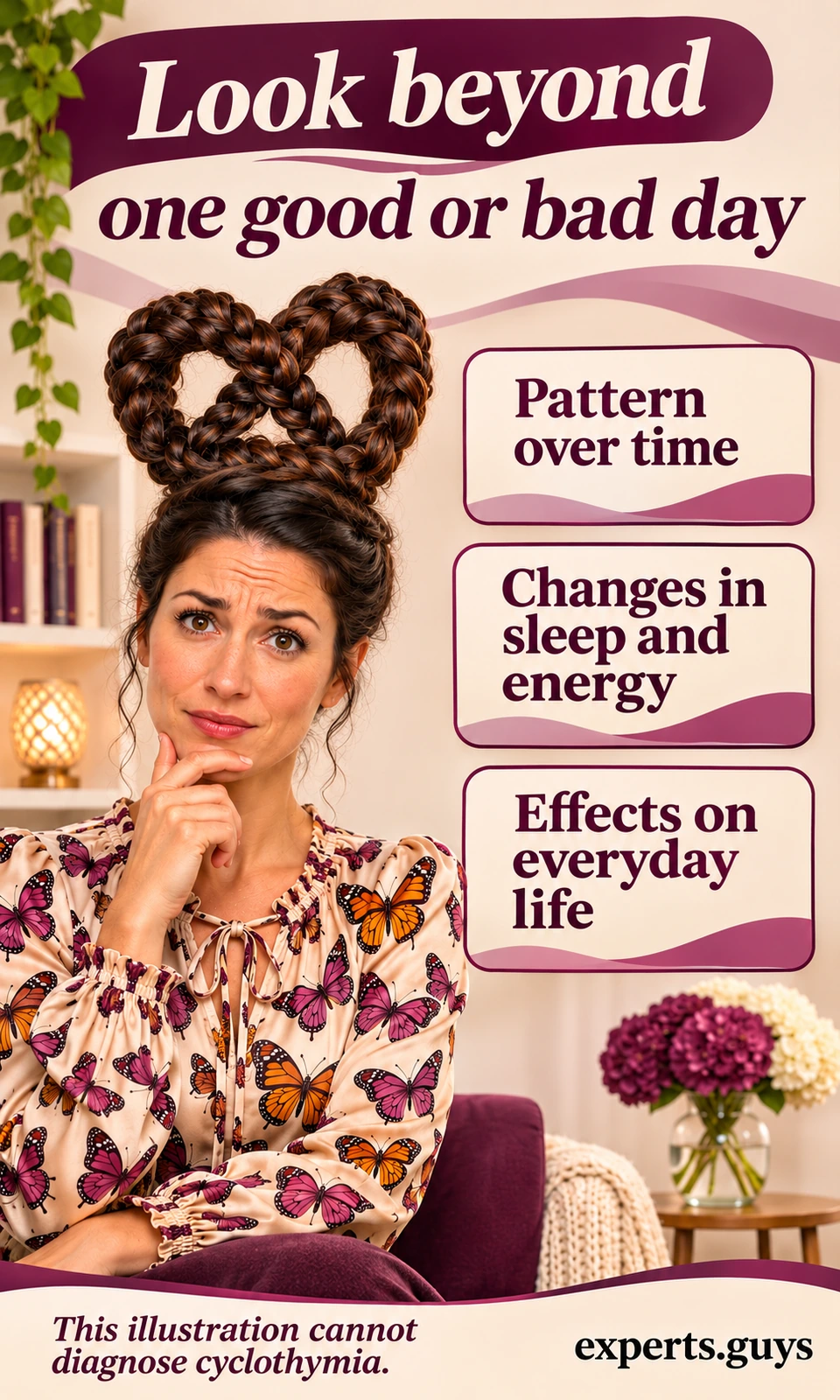
A good day followed by a difficult day is not enough to establish cyclothymia. Assessment considers how symptoms behave over time, whether there have been distinct mood episodes, how functioning is affected and whether another explanation fits. This guide explains those distinctions and offers practical support ideas without a home diagnostic score.
Why the long-term pattern matters
The NHS overview of cyclothymia describes frequent highs and lows over a sustained period. Diagnostic descriptions generally use at least two years in adults and one year in children and adolescents, alongside other requirements. Those durations describe classification; they are not a reason to delay asking for help.
It is possible to recognize a familiar pattern only after looking back across different situations. Someone may remember several stretches of unusual energy and several low stretches without having called either an illness. That recognition can begin a useful conversation, but it does not settle the diagnosis.
The word “mild” can be misleading here. Symptoms may be less extreme than full episodes while still disrupting work, relationships, decisions or confidence about what tomorrow will feel like. A label describing symptom thresholds should not be used to dismiss the disruption.
Equally, distress does not prove a particular diagnosis. Many problems can affect mood, energy and sleep. A useful explanation stays open to the whole history instead of choosing the first label that resembles an online list.
The table below keeps the main distinctions visible. It is a guide to questions worth discussing, not a set of boxes that can confirm or exclude cyclothymia at home.
| Question | Why it matters | What it cannot establish alone |
|---|---|---|
| One mood change or a longstanding pattern? | Cyclothymia concerns a sustained course with recurring high and low symptoms. | A single good day or argument cannot identify it. |
| Symptoms or a full mood episode? | A history of mania, hypomania or major depression changes diagnostic considerations. | An internet symptom list cannot classify the whole history. |
| Sleep loss or reduced need for sleep? | Feeling exhausted after too little sleep differs from unusual energy despite little sleep. | One short night does not settle the cause. |
| Distress and daily disruption? | Work, relationships and decisions can be affected even when symptoms are described as less extreme. | Being able to attend work does not prove there is no problem. |
| Medicine, substance or physical-health contribution? | Other explanations need consideration. | A mood label should not close assessment early. |
| A familiar pattern or a severe new change? | Escalating symptoms may need prompt or emergency help. | An existing diagnosis is not a reason to wait through danger. |
Symptoms and full episodes are different concepts
The NIMH bipolar-disorder guide distinguishes cyclothymia’s recurring symptoms from mood episodes that meet other thresholds. That difference matters because a history of a full manic, hypomanic or major depressive episode changes how the overall pattern is assessed.
Do not interpret this as an instruction to decide whether a difficult period was “serious enough” by yourself. Duration, associated symptoms, change from baseline and impact all matter. A very productive-looking period can still contain changes that deserve attention.
The same caution applies to low periods. Feeling able to get to work does not prove the absence of significant distress, and feeling very distressed does not automatically identify the type of mood disorder. Function and experience should both be described rather than used to cancel each other.
A clinician also considers whether substances, medicines or physical conditions contribute to the picture. For example, a change after starting or adjusting a medicine is relevant information, but timing alone is not proof of the cause. Bring it into the assessment rather than running a self-directed stop-and-start experiment.
It is not a synonym for rapid cycling
“Rapid cycling” has a specific meaning in bipolar-disorder descriptions: repeated full mood episodes within a year. It should not be used as a casual synonym for changing emotions within an afternoon. Cyclothymia is likewise not diagnosed by counting how many times someone felt different during one day.
A more useful description asks about a sustained departure from the person’s usual self. What changed in sleep, energy, speech, commitments or functioning? How did that change unfold? Those questions preserve the history without forcing it into an internet label.
Describe what changed without creating a diary project
Choose an example you remember clearly. You might describe a period when you needed much less sleep than usual, made commitments that were unusual for you, or became noticeably harder to interrupt. Then describe the impact, including what another person might have noticed.
Keep uncertainty in the account. “I remember this happening around a work change” is better than inventing exact dates to make the story look complete. An existing message, appointment or ordinary calendar entry can help orient a conversation, but you do not need a new recording routine before seeking help.

Ask whether the account suggests recurring symptoms, distinct episodes or something else that needs attention. You are supplying the history; the assessment is responsible for classifying it. That division is more useful than trying to arrive with a fully defended diagnosis.
If another person contributes, ask for specific observations with your permission. “You were awake much later and took on several extra projects” is easier to discuss than “you were impossible.” Concrete descriptions reduce blame while keeping the change visible.
Make ordinary support realistic
A practical support plan should be usable during both lower-energy and unusually driven periods. It should not depend on becoming perfectly motivated, buying an app or maintaining an elaborate dashboard. The aim is to reduce avoidable disruption while treatment and assessment do their separate jobs.
NHS bipolar support guidance emphasizes routine and sleep among helpful measures. Applied cautiously here, that means protecting a reasonable opportunity for sleep and avoiding unnecessary overload, rather than treating routine as a cure.
Choose a realistic stopping point for evening work or stimulating commitments. If you are unusually driven to keep adding tasks, pausing a new commitment can preserve room for the following day. This is a modest planning measure, not a prescribed sleep intervention or a way to diagnose a high.

The same principle helps during a low period: make the next essential task manageable rather than treating a reduced day as a failure. A specific handover can be useful, but support should not become an automatic takeover of the person’s decisions or privacy.
- Describe changes from the person’s usual functioning.
- Keep ordinary sleep and meal opportunities reasonably consistent.
- Pause optional commitments when the day is already overloaded.
- Agree on one concrete support that the person wants.
- Use the care plan’s contact route when symptoms change.
Agree on support before a difficult moment
Ask what help is welcome. One person may want a reminder about an appointment; another may want help with dinner or transport. A useful agreement says who will do what and when, instead of relying on a broad promise to “keep an eye on things.”
Include a contact route for a change in symptoms. That might be the existing mental health service, prescriber or another appropriate local service. The route should be clear enough that the person and supporter do not have to negotiate it from scratch while a problem is escalating.

A support agreement is not permission for unrestricted monitoring. Do not demand passwords, inspect private messages or treat every disagreement as a symptom. Respecting autonomy makes it easier to discuss the moments when a specific change genuinely needs attention.
If relationships are strained, distinguish the person from a behaviour that needs addressing. A diagnosis can provide context without making harmful conduct acceptable or making a partner responsible for managing every mood change. Clear boundaries and practical assistance can coexist.
Treatment is individualized, not a menu to copy
Mayo Clinic’s treatment overview describes psychotherapy and, where appropriate, medication in an ongoing care plan. The purpose is to address symptoms and functioning, with follow-up rather than a one-time fix.
An article cannot choose a medicine or decide that one is unnecessary. It is especially unhelpful to copy someone else’s account of what made them feel energetic or calm, because the underlying history and treatment needs can differ.
Do not stop treatment simply because a higher-energy period feels productive. If sleep, energy or behaviour changes markedly, discuss the change promptly with the prescriber. A treatment review needs the actual history, current medicines and the person’s safety, not only whether the mood feels pleasant.
Self-directed sleep deprivation, intense light interventions, supplements or stimulant use should not be presented as simple ways to correct the pattern. They are different from ordinary routine support and can introduce risks or complicate assessment. Ask about any proposed intervention within the care plan.
Know when the response needs to change
A severe new change is not something to wait through merely because a person has previously been described as having cyclothymia. Escalating energy with very little sleep, increasingly unsafe behaviour, or a marked departure from the usual pattern deserves prompt assessment.
Psychosis, immediate danger or an inability to stay safe requires urgent help. Seek local emergency assistance if the danger is immediate. Do not wait for a routine appointment or for a self-monitoring score to reach an arbitrary threshold.
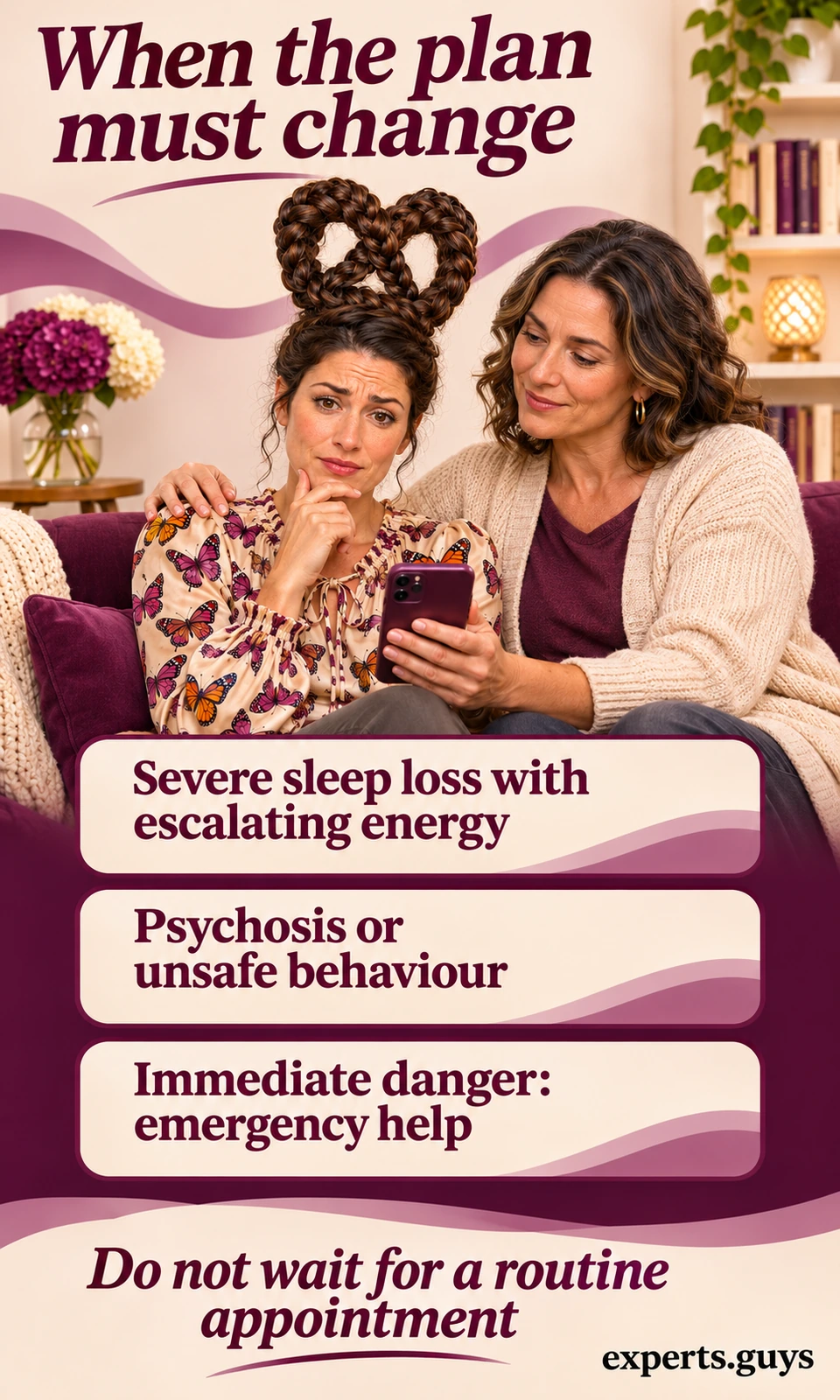
The same principle applies to a severe low period or immediate thoughts of acting on self-harm. The practical question is safety now, not whether the symptoms still fit the old label. A change in the clinical picture may require a different plan.
That boundary does not mean everyone with cyclothymia will develop bipolar I or II. Mayo Clinic’s overview describes the possibility of more severe difficulties, but an individual future is not settled by a diagnosis. Reassessment responds to what actually changes.
Keep this article’s question separate from broader bipolar guides
The site’s bipolar indicators and symptoms article addresses broader signs, while the manic-depression terminology article concerns a different naming question. Neither should be used as a shortcut to classify a longstanding pattern at home.
This guide’s distinct job is to keep the threshold and history questions clear, then make support concrete. You do not need to settle every diagnostic detail before asking for help with sleep opportunity, an overloaded schedule or a difficult task. You do need an appropriate assessment rather than treating those support ideas as a diagnosis or cure.
Frequently asked questions
Is cyclothymia just ordinary moodiness?
No. It concerns a persistent pattern of recurring elevated and depressive symptoms with distress or functional impact. Ordinary changes in emotion, by themselves, do not establish that diagnosis.
How long must the pattern have been present?
Diagnostic descriptions generally use at least two years for adults and one year for children and adolescents, alongside other requirements. These are classification criteria, not instructions to wait that long before seeking help.
Is cyclothymia the same as bipolar II?
No. Bipolar II involves hypomanic episodes and major depressive episodes. Cyclothymia concerns recurring symptoms that do not meet the full episode thresholds. The person’s complete history matters.
Does every person with cyclothymia develop bipolar I or II?
No. Some people develop more severe episodes, while others do not. A forecast for one individual cannot be read from the diagnosis alone; changes in symptoms should be reassessed.
Should I stop medication if I feel unusually energetic?
Do not change prescribed treatment on your own. A new or escalating change in sleep, energy or behaviour should be discussed promptly with the prescriber, especially after a medicine change.
Can a sleep routine cure cyclothymia?
A regular routine can support a broader care plan, but it is not a guaranteed cure or a substitute for assessment and treatment. Protecting sleep time should not become self-directed sleep deprivation or another intensive intervention.
Summary
Cyclothymia concerns a sustained pattern, not an isolated swing in emotion. Describe changes in sleep, energy and functioning, keep full-episode history and other explanations open, and agree on realistic support. If the pattern becomes severe or unsafe, the response must change with it.