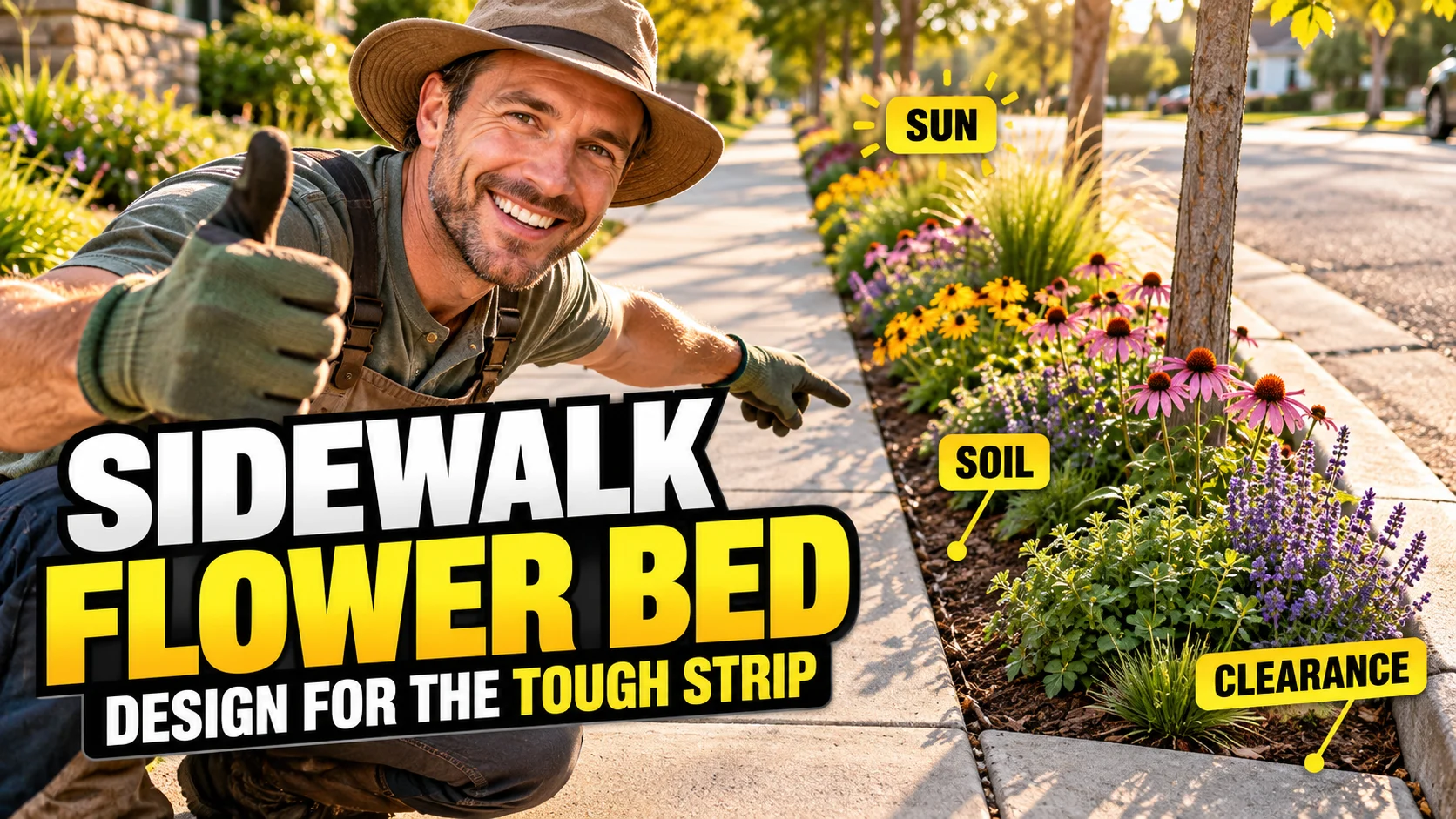

A sidewalk flower bed works best when you design it as a hard-site planting strip, not a miniature version of a backyard border. The narrow soil is usually hotter, more compacted, more exposed to feet and pets, and sometimes affected by deicing salt, so plant choice and clear walking space matter more than squeezing in extra varieties. Start by measuring the strip, checking sun and drainage, and confirming local right-of-way rules before you buy plants.
The first question is not which flowers look good. Confirm who controls the strip, whether underground utilities cross it, and whether your local rules limit planting near corners, driveways, hydrants, signs, curb ramps, or other sight-sensitive areas; if you will dig deeply, use the utility-locating process required where you live.
Then measure the usable width and length and watch the site for a full day. Note direct sun, reflected pavement heat, where rainwater moves, where people step off the path, where dogs regularly pass, and whether winter deicer or salty runoff reaches the soil.
- Width: measure the soil you can actually plant without reducing the walking surface.
- Sun and heat: record both direct sun and heat reflected from concrete or asphalt.
- Drainage: note whether water disappears normally, runs off immediately, or sits after rain.
- Traffic pressure: identify shortcut paths, doors, curb access, bins, pets, and maintenance routes.
- Salt exposure: check whether deicer or road spray reaches the bed in winter climates.
- Visibility: keep planting conservative near corners, driveways, crossings, and sight lines.
Choose a layout that fits the actual width
For a very narrow strip, one repeated layer of compact plants is usually stronger than a tiny version of a three-tier border. As a practical design heuristic, a strip under about 45 cm (18 in) is easiest to manage as a single low layer, while wider strips can support two or three layers if plants will not lean into the sidewalk.
Keep the sidewalk edge disciplined. Use clumping or mounding plants that hold their shape, and place loose, arching, thorny, sticky, or brittle plants farther from pedestrian contact so the bed does not become a daily obstacle.
Near a street corner or driveway, visual clearance becomes a design requirement rather than an aesthetic preference. Penn State Extension’s hellstrip design guidance emphasizes shorter planting along the sidewalk and controlling plant height to protect visibility; the exact legal limit still depends on the local jurisdiction.
Fix the soil problems before adding more flowers
Sidewalk soil often behaves differently from the rest of the yard because construction and repeated foot traffic compress the pore spaces that roots need for air and water. Illinois Extension’s soil-drainage guidance specifically notes repeated foot traffic along sidewalks as a source of compaction.
If water sits after rain, do not solve the problem by simply piling a few centimeters of good soil on top and planting into it. First determine whether the whole strip is compacted, whether the grade traps water, and whether runoff from hard surfaces is concentrating in one place.
Where soil drains extremely fast, heat and drought become the dominant stress instead. A thin strip surrounded by pavement can dry much faster than a larger garden bed, so drought-adapted plants, mulch, and realistic access to water matter more than decorative variety.
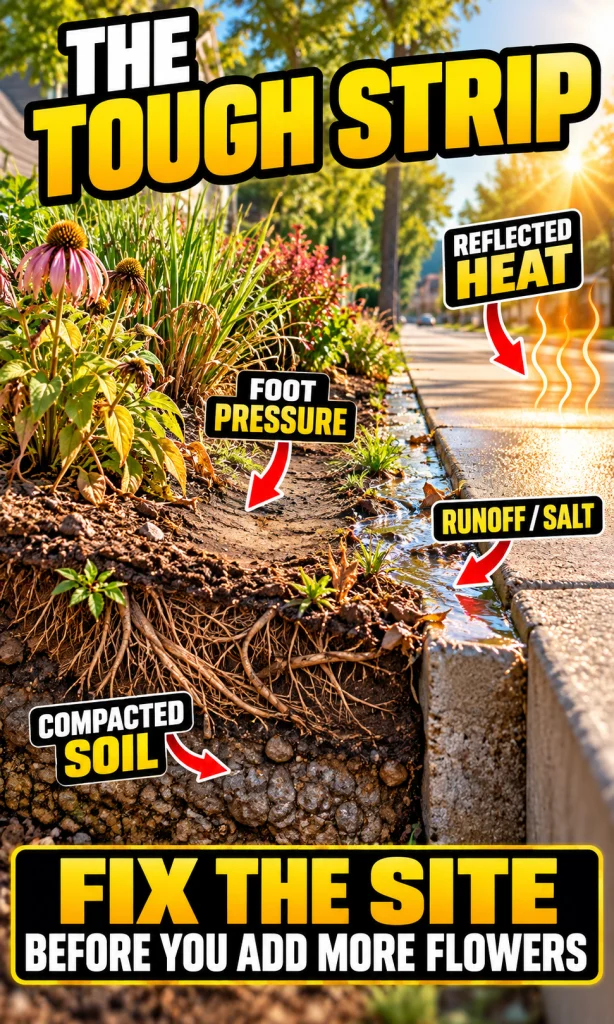
In cold-winter regions, deicing salt can change both plant water uptake and soil structure. The University of Minnesota Extension recommends selecting salt-tolerant plants for areas beside walks and roads where deicers are used, while recognizing that salt exposure varies greatly by site.
| Site condition | Design response | Plant traits to favor |
|---|---|---|
| Narrow + high foot pressure | One low layer, strong edge, repeated groups | Compact, clumping, non-flopping |
| Hot + fast-draining | Mulch, efficient watering, fewer tougher species | Heat- and drought-adapted |
| Wet after rain | Correct grade/compaction first; do not bury the problem | Moisture-tolerant only after cause is understood |
| Regular deicer exposure | Keep sensitive plants away from runoff paths | Regionally appropriate salt tolerance |
| Corner/driveway visibility | Keep mass low and verify local sight-line rules | Low, stable, easy-to-trim forms |
Use repetition instead of collecting one of everything
A sidewalk bed is viewed while people move past it, so repetition reads better than a scattered collection of individual specimens. Repeat a small number of plant forms down the strip, then use limited seasonal accents to create change without losing the visual rhythm.
In a single-layer bed, choose one main mounding or clumping plant and repeat it at a spacing appropriate to its mature size. Add a second lower accent only where the width allows it to remain off the walking surface.
In a medium-width bed, a two-layer arrangement usually works well: low compact plants along the sidewalk and a slightly taller repeated layer behind them. Keep taller material away from any place where it would reduce visibility or brush against passersby.
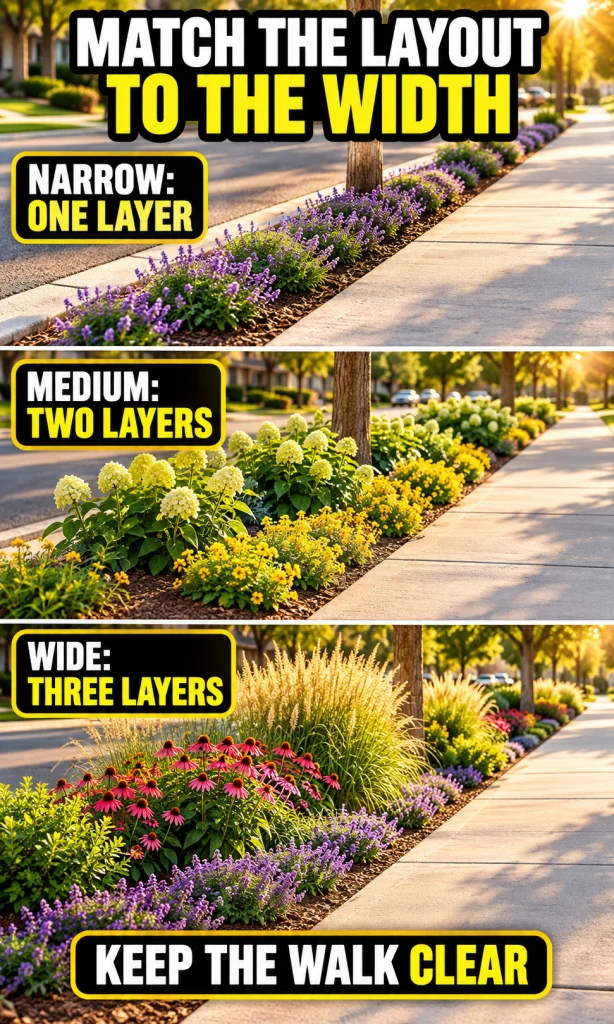
In a wide strip, three layers can work, but the bed still needs restraint. Use low edging plants, a middle mass for most of the flowering display, and taller accents only where the site has enough depth and no sight-line conflict.
Color is easier to control when the structure is already clear. Two or three flower colors repeated along the bed usually look more intentional than a different color at every plant, especially when foliage texture and bloom time already create variation.
Plan for the bed after peak bloom as well. Seed heads, grasses, evergreen foliage, structural perennials, or clean mulch gaps can keep the strip readable when one flowering group has finished.
Build a clean edge that protects both plants and pedestrians
Edging is most useful when it solves a maintenance problem. A flush or low edge can keep mulch and soil off the sidewalk, give you a clean line for trimming, and discourage casual stepping into the bed without creating a trip hazard.
If you want more material ideas, compare garden borders and edging ideas with creative landscape edging ideas for modern garden beds. For a sidewalk strip, prioritize stability, drainage, and pedestrian clearance before decorative height.
Mulch helps moderate soil moisture and temperature, but do not bury plant crowns or pile material against trunks and stems. In a narrow strip, the mulch should also stay contained so rain and foot traffic do not push it onto the walking surface.
Use the Sidewalk Bed Reality Check before you plant
The interactive check below turns the strip dimensions and site stresses into a layout profile, plant-trait priorities, build sequence, and a one-page A4 report. It does not pretend to choose a universal plant list because climate, local rules, mature plant size, and availability change what is appropriate.
Sidewalk Bed Reality Check
Match the strip to a layout, plant profile, and build sequence before you buy.
1 · Site inputs
Describe the strip you actually have
2 · Your result
Bed profile
Useful for mulch and soil planning.
Approximate loose volume at your selected depth.
Design priorities
Plant profile
Build sequence
Check before digging
Local follow-up
Find plants that fit your climate
Search for a local native-plant nursery or extension-style horticulture resource. The location is used only to build the search link.
Build the bed in the right order
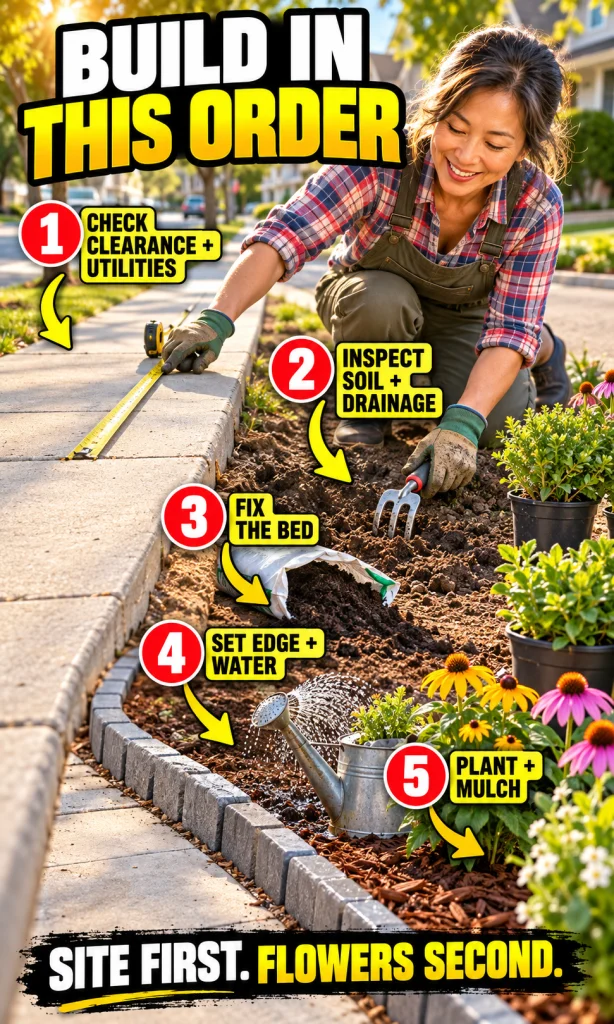
- Confirm the boundary and constraints. Verify ownership/right-of-way rules, utilities, visibility, and the walking surface you must keep clear.
- Remove unwanted vegetation without damaging nearby roots or infrastructure. Avoid deep excavation around established street trees unless the method is appropriate for the tree and site.
- Correct compaction and drainage across the planting area. Improve the bed as a whole rather than creating isolated pockets of amended soil.
- Set the edge and watering strategy. Make sure water can reach new plants without regularly flooding the sidewalk.
- Place plants at mature spacing. Arrange the pots first, check the walkway from both directions, then plant.
- Mulch and water for establishment. Keep mulch off crowns and adjust irrigation as roots establish.
For a broader planting framework, use garden planting design to match plant requirements to the site rather than buying for flower color alone. If your goal is reduced upkeep across the whole frontage, the same site-first logic also applies to front yard landscaping ideas for low maintenance.
Flower-bed ideas that work especially well beside a sidewalk
Repeated drought-tolerant drifts are effective in hot, sunny strips because the design is visually strong even with a limited plant palette. Choose locally suitable species that stay within the space at maturity rather than relying on constant clipping.
A low pollinator ribbon can work where the sidewalk edge remains clear and the selected flowers do not flop into pedestrian space. Favor a sequence of bloom times and regionally appropriate plants instead of a generic wildflower mix that may contain unsuitable species.
A foliage-first shade strip is better than forcing sun-loving flowers into a bed shaded by buildings or street trees. Use leaf texture and restrained flower color to create interest while respecting the moisture competition that often exists under mature trees.
A gravel-and-perennial strip can suit dry climates when the material, drainage, reflected heat, and plant palette all belong together. Gravel is not a universal low-maintenance answer; in the wrong site it can increase heat or migrate onto the walkway.
A seasonal annual ribbon is useful when you want intense color and are willing to replant. Annuals can also fill temporary gaps while slower perennials establish, but they usually require more frequent watering and seasonal work than a well-chosen perennial structure.
Common sidewalk flower-bed mistakes
The most expensive mistake is choosing plants before understanding the strip. A beautiful plant can still fail if its mature width, root environment, salt tolerance, sun requirement, or water need does not match the site.
- Planting too close to the walking surface and relying on constant trimming.
- Using tall plants where drivers or pedestrians need clear sight lines.
- Ignoring compacted soil and treating symptoms with fertilizer.
- Letting mulch, gravel, or loose edging spill onto the sidewalk.
- Choosing a high-water planting where there is no practical watering access.
- Assuming a plant is suitable simply because it is native somewhere in the same country.
- Planting deeply around established street-tree roots without understanding the consequences.
If the bed is part of a larger front-yard redesign, connect the strip to the route toward the house rather than treating it as an isolated decoration. The article on how to plan curb appeal landscaping ideas can help you coordinate the sidewalk planting with the entrance, lawn, and other visible beds.
Frequently Asked Questions
There is no single correct width. Design around the usable soil that remains after keeping the walking surface and required clearances open; very narrow strips usually perform better as one low repeated layer, while wider strips can support more depth.
There is no single correct width. Design around the usable soil that remains after keeping the walking surface and required clearances open; very narrow strips usually perform better as one low repeated layer, while wider strips can support more depth.
What flowers are best next to a sidewalk?
The best choices match the local climate and the strip’s actual stress: sun, heat, drainage, salt exposure, foot traffic, and watering access. Favor compact, stable plants at the walking edge and confirm mature size before planting.
Can I plant between the sidewalk and the street?
Often yes, but ownership, right-of-way rules, planting-height limits, utility access, snow storage, and maintenance requirements vary by municipality. Check the local rules before converting the strip.
Should I use raised edging beside a sidewalk?
Use the lowest stable edge that solves the maintenance problem. High or loose edging can become a trip hazard, obstruct drainage, or narrow the usable walkway, so pedestrian function should come before decorative height.
How do I make a sidewalk bed low maintenance?
Use fewer plant species, repeat them in groups, match them to the site, install a clean edge, mulch appropriately, and avoid plants that need frequent staking or clipping to stay off the path. Low maintenance starts with fit, not with a specific plant list.
Can road salt damage a sidewalk flower bed?
Yes. Salt spray and salty runoff can injure foliage, reduce water availability to roots, and worsen soil structure, so winter exposure should influence both plant selection and where sensitive plants are placed.
Final decision: make the strip easy to live with
A strong sidewalk flower bed stays attractive because its shape, soil, plant size, and maintenance load fit the site from the beginning. If you preserve walking space, solve the dominant stress first, and repeat a small palette of appropriately sized plants, the bed can look intentional without becoming a constant trimming or replacement project.