



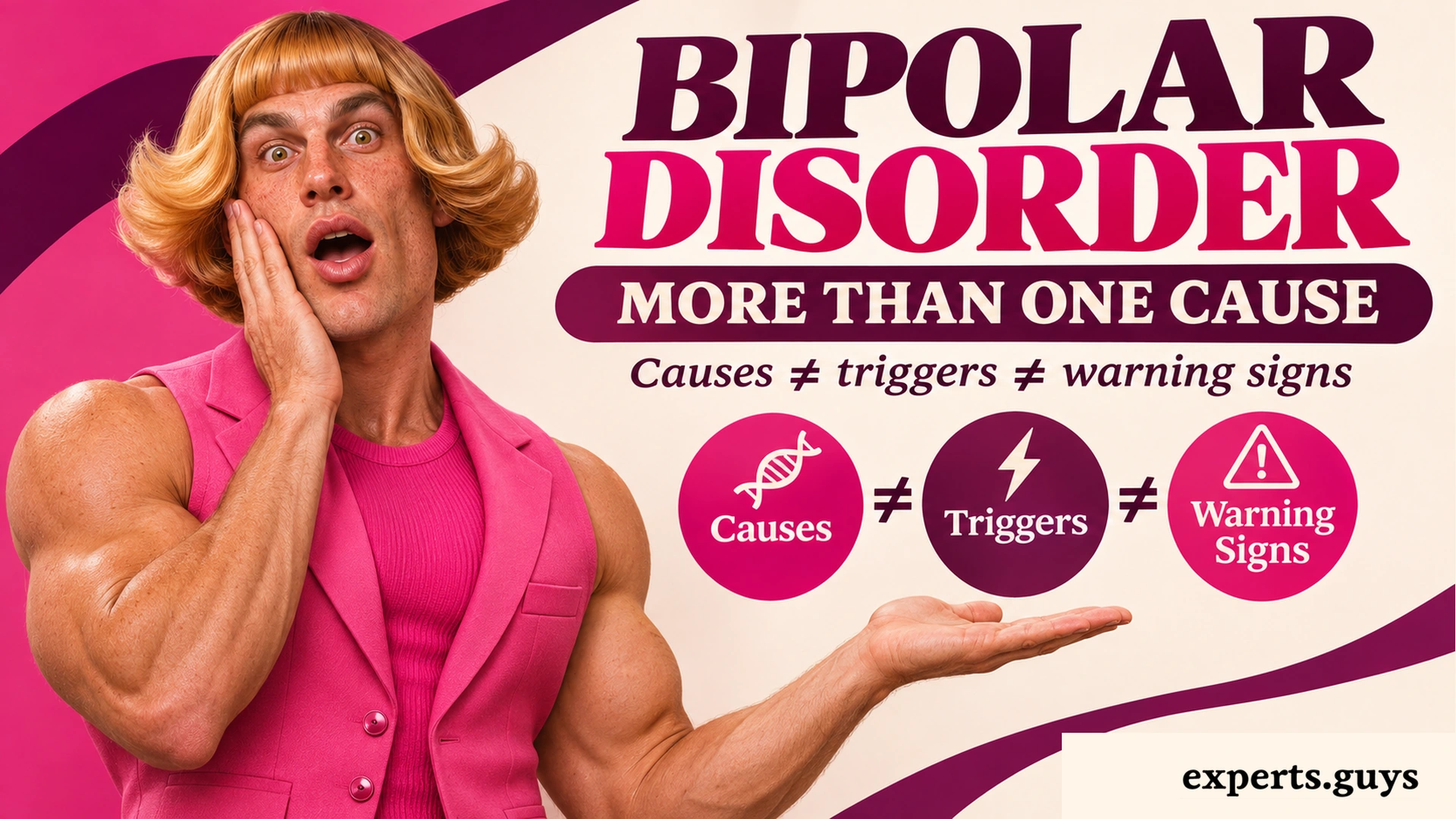
Bipolar disorder has no single established cause that explains every person’s illness. Genetic susceptibility, biological processes and life experiences can contribute, while a possible trigger for an episode is a different question from why the disorder developed. The useful starting point is to separate background risk, events that may precede an episode and signs that a mood change may already be underway.
An explanation does not have to identify one decisive event to be useful. It should help you understand what a study actually measured, what its findings cannot establish and which present-day changes deserve a practical response. Finding a plausible connection is the beginning of that reasoning, rather than the end of it.
What is the difference between a cause, a trigger and a warning sign?
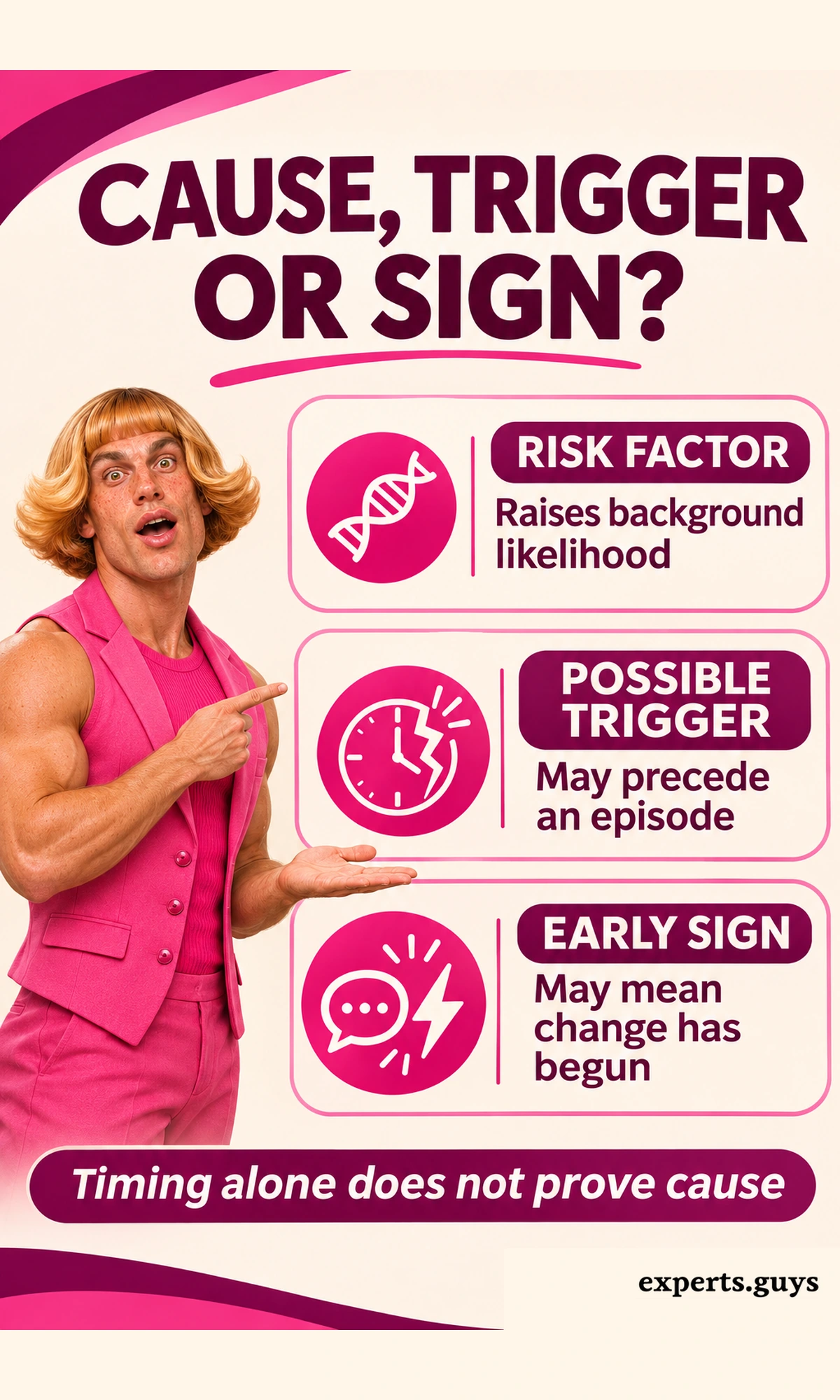
A cause concerns the processes involved in developing a condition. A risk factor changes its likelihood; a trigger may help precipitate a particular episode; a warning sign may indicate that an episode is beginning. These descriptions concern different parts of the story, so using them interchangeably can lead to the wrong conclusion and the wrong next step.
A family history, for instance, is relevant to background susceptibility. A period of disrupted sleep might be considered when assessing what preceded a mood episode. An unfamiliar reduction in the need for sleep, especially with other changes, can be information about a mood state already changing. None of those observations, by itself, explains an individual’s entire illness.
The distinction also changes responsibility. “This happened before I became unwell” is a statement about timing. “I caused my illness by allowing it to happen” adds a causal and moral conclusion that the timing does not establish. Looking for a useful explanation should not require turning a difficult event, a demanding job or a family relationship into a verdict about blame.
Our recommendation is to ask what decision the explanation would change. A family association may matter when discussing history; a disrupted evening may suggest a preventable source of lost sleep; new activation may require a care response. These are useful decisions even when the original cause of the illness cannot be reconstructed.
Why a trigger does not explain the whole condition
Consider an illustrative situation in which someone with diagnosed bipolar disorder becomes unwell after an overnight journey. The journey may be relevant because it disrupted an established routine. It does not follow that travel created the disorder, that every future journey will cause an episode or that everyone on the same flight has a similar risk.
That difference is easy to lose in everyday conversation. “Travel caused it” compresses susceptibility, sleep disruption, timing and a clinical outcome into one statement. A more accurate account keeps the event specific: the journey changed the person’s sleep opportunity, and an episode followed. Whether the journey contributed, and how much, remains a question for the wider history.
The same reasoning applies when no obvious event can be found. The absence of a memorable trigger does not invalidate a diagnosis or mean that someone has failed to search hard enough. A plausible trigger is not required before a serious mood change deserves attention. The overview of bipolar episodes and assessment explains the broader clinical framework without making a single event the deciding factor.
| Question | Useful evidence and boundary |
|---|---|
| Why did the disorder develop? | Consider susceptibility and interacting influences. One remembered event does not explain the whole illness. |
| What may have preceded this episode? | Consider the sequence and established care history. An event happening first does not prove cause. |
| Is a mood change beginning now? | Consider sleep, energy, activity, judgment and safety together. Help need not wait for a known trigger. |
| Does this finding change treatment? | Consider evidence for the intervention and your treatment plan. Changing an associated measurement is not automatically helpful. |
Why inherited risk is not a personal prediction
Genetic findings describe differences in likelihood across groups. They do not supply a date when a particular person will develop symptoms, nor do they identify a single unavoidable outcome for a family. Knowing that an illness has a genetic component is therefore different from knowing what will happen to one individual.
The scale of the research makes the distinction clearer. A large multi-ancestry genomic analysis reported 298 associated genomic regions using data from 158,036 bipolar cases and approximately 2.8 million controls. An associated region is not the same thing as a standalone “bipolar gene,” and the number of regions does not translate into a home diagnostic checklist.
An individual result also needs a defined clinical purpose. A test developed to investigate inherited susceptibility answers a different question from a test intended to help distinguish two current diagnostic possibilities. Before attaching meaning to a result, ask what the test was designed to do and which people were included in its evaluation. A compelling biological explanation does not automatically establish that a test is useful for your decision.
What did the 12-year bipolar study actually establish?
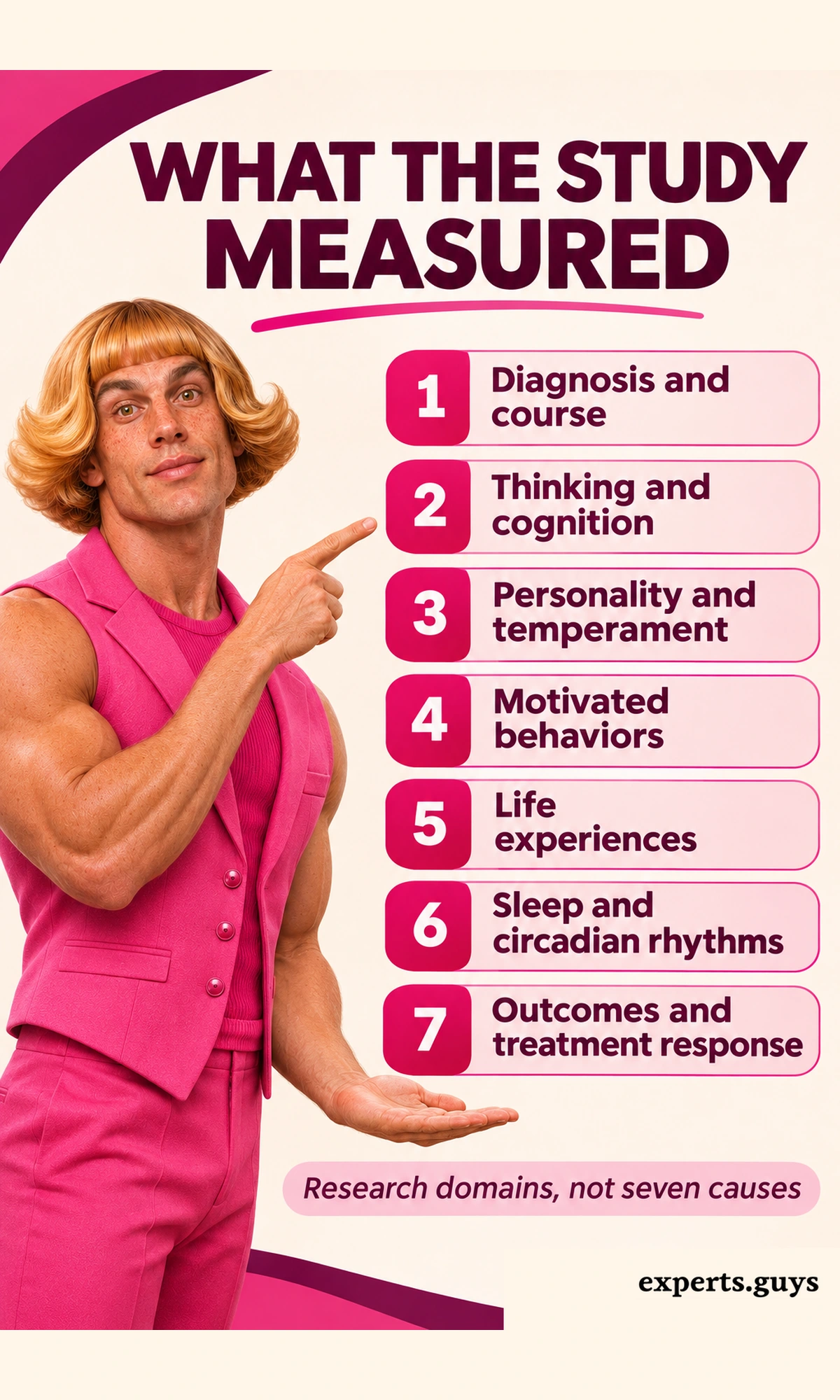
The research behind the old headline proposed a framework for studying bipolar disorder across several domains. It did not demonstrate seven independent causes or divide everyone into seven new diagnostic types. The number seven refers to categories of information, not seven switches that can be checked to explain why a person became ill.
The historical context matters here. The University of Michigan story was published in December 2017 and described work from the Heinz C. Prechter Bipolar Research Program. The linked Prechter longitudinal cohort profile described 1,111 participants, including 731 with bipolar diagnoses and 277 healthy controls; the remaining participants had other diagnoses. These were cohort totals, not a claim that every participant completed twelve years of observation.
A longitudinal cohort follows people over time. It can relate earlier information to later outcomes and examine how characteristics change. It does not assign people to inherit particular variants, experience trauma or develop an illness. That design supports valuable questions about patterns, but a finding that two things occur together does not, on its own, establish a causal relationship.
Seven domains, not seven boxes for people
The framework included diagnosis and illness course, cognition, psychological dimensions, motivated behaviors, life experiences, circadian patterns and outcomes. These are overlapping lenses through which researchers can investigate the same person. An individual does not need to choose one category or “have all seven” in order to qualify for a diagnosis.
There is a practical reason to measure more than current mood. A brief snapshot may miss how an illness unfolds, which difficulties persist between episodes or how another health issue complicates the picture. Measuring several domains makes it possible to ask more specific research questions. It does not mean that every measure is a cause, or that every statistically interesting measure should become a treatment target.
The personality category is particularly vulnerable to misunderstanding. Measuring temperament is not a declaration that a person’s character caused an illness. Likewise, measuring cognition does not mean that every person has the same difficulties or that the difficulties are fixed. A category describes the researchers’ field of observation; it does not tell a reader what judgment to make about a person.
| Research domain | Question it helps researchers investigate |
|---|---|
| Diagnosis and course | Which clinical patterns and histories are being compared? |
| Thinking and cognition | How do thinking abilities vary with illness and time? |
| Personality and temperament | Which psychological dimensions accompany different experiences? |
| Motivated behaviors | How do patterns such as substance use relate to the illness course? |
| Life experiences | What relationships and life events form part of the context? |
| Sleep and circadian rhythms | How do timing and sleep patterns relate to other measurements? |
| Outcomes and severity | How do symptoms, functioning and treatment responses develop? |
What a broad framework adds, and what it leaves open
The useful contribution is methodological: researchers can compare several aspects of illness within a shared structure instead of expecting one measurement to explain everything. That can help generate better questions about why experiences differ. It is a research organizing framework, rather than a ready-made explanation of any individual’s life.
The framework also encourages readers to distinguish the object being measured from the interpretation placed on it. A questionnaire response, an observed behavior and a biological measurement are different kinds of evidence. Bringing them into the same project does not make their limitations disappear. Their value depends on how well each measure answers the question being asked.
What the framework cannot do is assign a percentage of someone’s illness to genes, relationships, sleep or another domain. A pie chart with those slices would look reassuringly concrete while inventing precision. The original research did not give readers that calculation, and this article does not offer a substitute score.
Why twelve years is context rather than a guarantee
A long-running project can gather observations that a short study would miss. Length alone, however, does not settle what caused an association. You still need to know who was included, what was measured, which comparisons were made and whether other explanations were considered. “Long-term” is a useful feature of a design, not a replacement for reading it.
Follow-up time also has several possible meanings. A project can have existed for twelve years while individual participants entered at different points or contributed different amounts of follow-up. Treating the age of the project as a uniform exposure for every person would create a stronger claim than the cohort description supports.
The historical headline should therefore be read as an account of a research programme reaching a broad interpretation. It should not be republished as a fresh announcement that a definitive cause has just been discovered. Preserving the date here protects meaning; it does not imply that the older framework represents the whole of present-day bipolar research.
How can you tell a useful finding from an overstated cause claim?
Start with the distance between what was observed and what is being promised. A study may identify an association, describe a mechanism in cells or examine an intervention. Each can be useful, but they answer different questions. Problems arise when a headline moves from one kind of evidence to another without showing the missing steps.
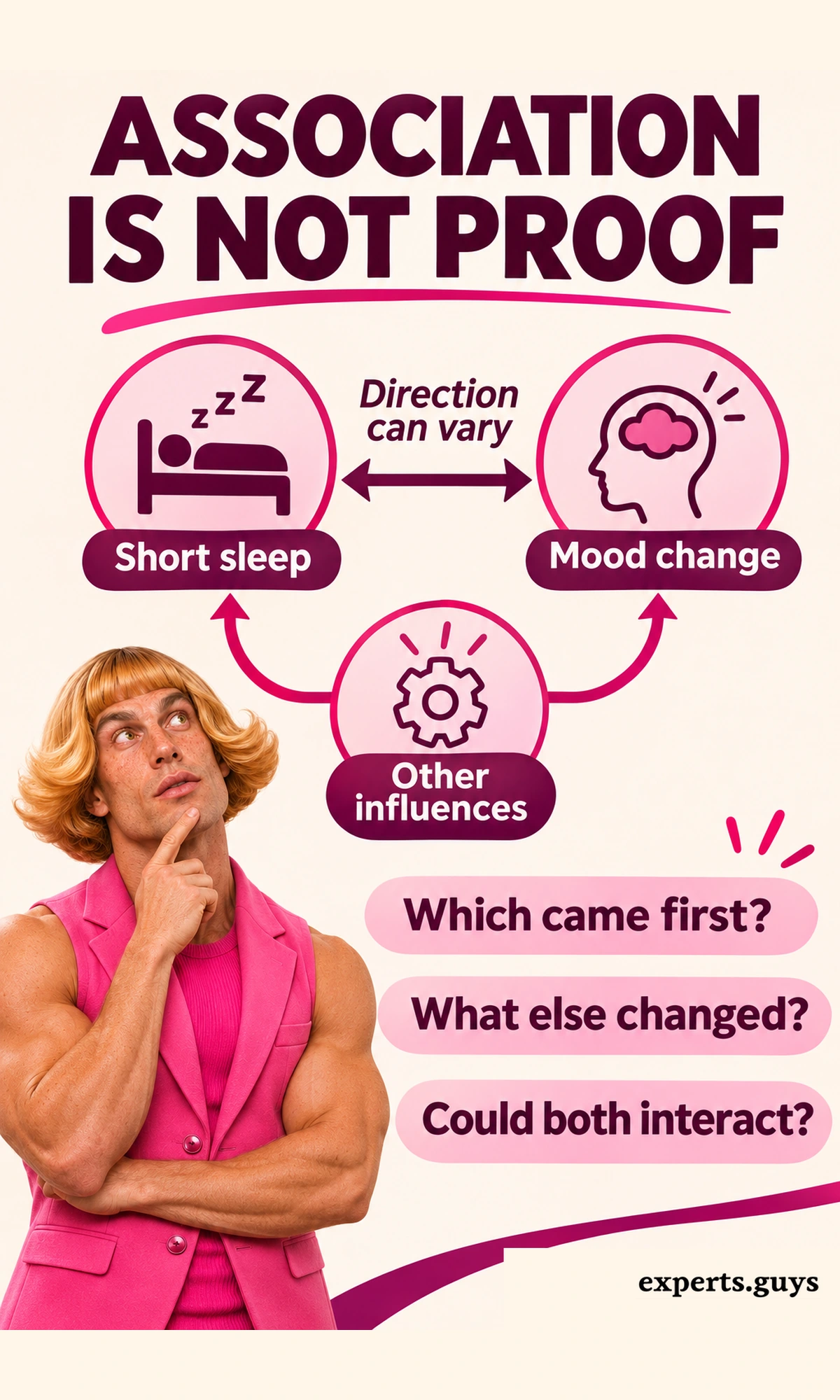
For example, observing that two characteristics are linked does not establish which came first. A characteristic could contribute to illness, result from it, reflect treatment exposure or share another influence with it. Those alternatives do not make the observation worthless. They define what further evidence would be needed before a causal claim becomes convincing.
Sleep illustrates why direction matters
Sleep is a useful example because the everyday phrase “not sleeping” covers several experiences. Someone may have too little opportunity to sleep because of noise or work. Someone else may want sleep but struggle to obtain it. Another person may sleep much less than usual and feel unusually energized. The outward total of hours can conceal a clinically meaningful difference.
The NIMH bipolar disorder guide distinguishes decreased need for sleep among manic symptoms from sleep difficulties that can accompany depression. That distinction is a reason to describe the experience accurately, not a rule that tired people cannot have activation or that an energetic morning confirms hypomania. A clinical assessment considers the wider pattern.
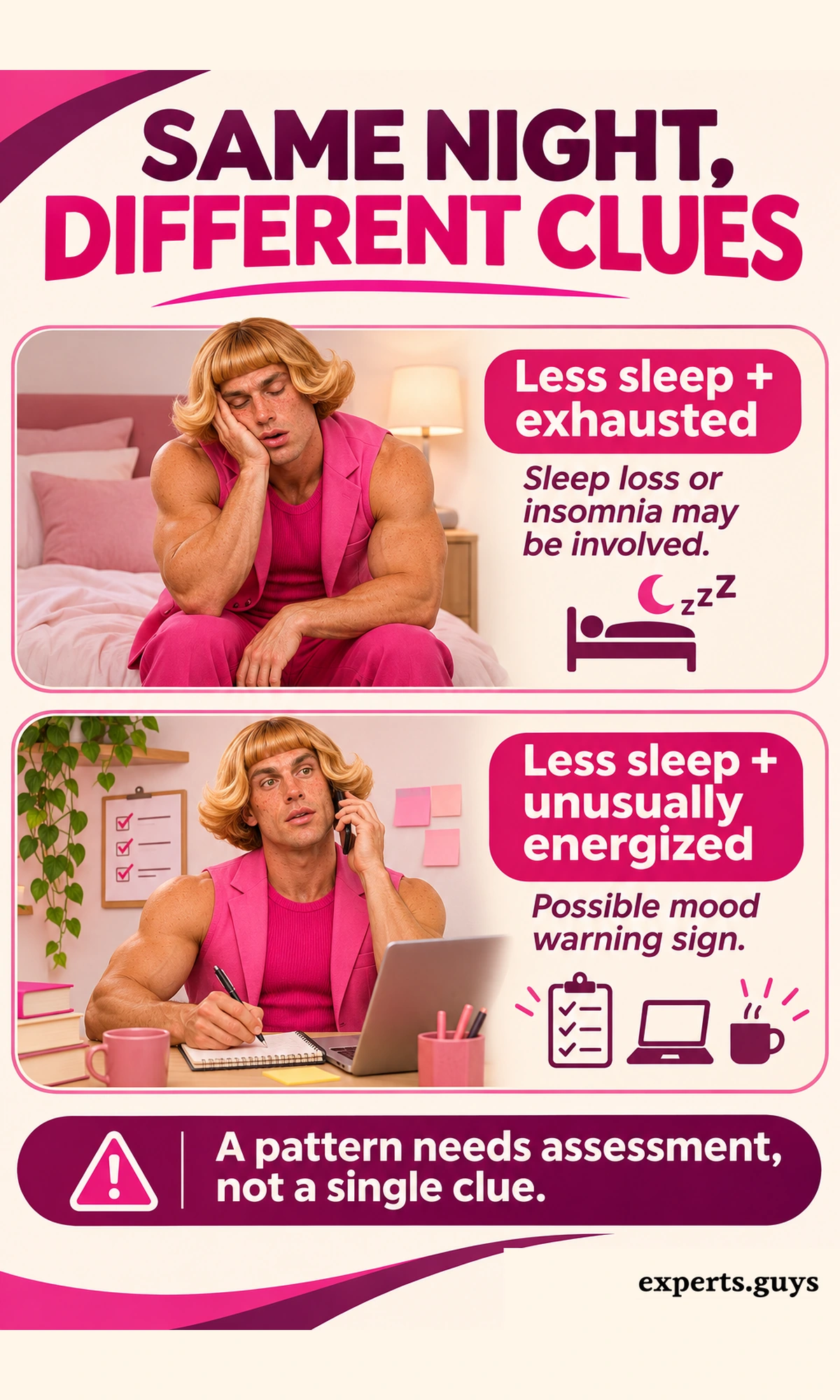
Think through an illustrative weekend without trying to diagnose it. A noisy gathering keeps someone awake, and the next morning they feel depleted. In another situation, an unfamiliar surge of activity begins before the late night and continues afterward. The late bedtime is visible in both accounts, but its place in the sequence differs. Calling it “the cause” in both stories would hide the very information needed to interpret it.
You do not need to repeat the situation to investigate it. Deliberately staying awake to see what happens is not a useful home experiment. The practical question is what already changed, whether the change is continuing and what response the person’s existing care plan specifies. Detailed recognition of a depressive return belongs in the separate guide to early warning signs of bipolar depression.
Read a cause claim in three passes
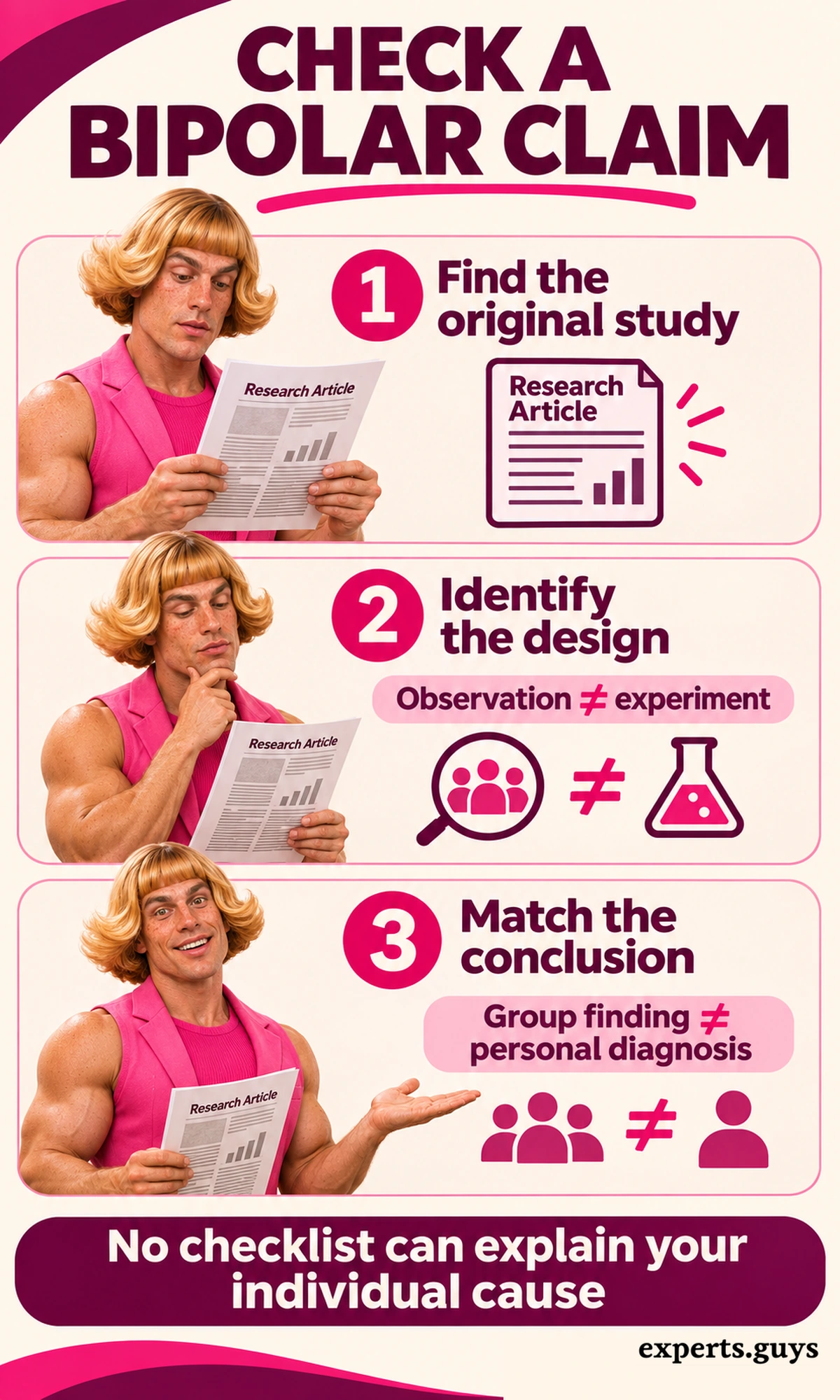
Use this process when an article promises that researchers have found “the reason” for bipolar disorder. You can read the relevant lines on a screen or in a printed article; there is no worksheet to complete. The aim is to decide whether the conclusion fits the study, not to evaluate your own diagnosis.
- Find the original study. Follow the research link rather than relying on the headline. Identify the participants and what was measured; an article about a laboratory experiment answers a different question from a clinical treatment trial.
- Identify the design. Ask whether the researchers observed existing differences or tested an intervention. Look for the comparison group and the outcome. A long duration does not turn observation into an experiment.
- Match the conclusion. State only what that design supports. If it describes an association in a group, keep that boundary. Do not translate it into your individual cause, diagnosis or a reason to change treatment.
Here is a worked example. Suppose a headline says a particular biological measurement explains bipolar disorder, but the study compared measurements in people who already had different diagnoses. That design might identify a difference worth investigating. Unless it also addresses timing and alternative explanations, it cannot show that the measured difference produced the illness. The appropriate conclusion is narrower than the headline.
A second example concerns a proposed treatment. If a study measured a characteristic but did not test an intervention that changes it, the study has not established that changing it will improve symptoms. Moving from “associated with illness” to “remove this and recover” crosses an evidential gap. The more consequential the proposed action, the more that gap matters.
The common mistake is to treat a detailed mechanism as a completed chain of proof. An explanation can sound biologically plausible while leaving open whether the proposed pathway operates in the same way in people, whether it meaningfully changes outcomes and whether an intervention is safe. Technical vocabulary should make the question more precise, not exempt the claim from scrutiny.
If the paper is inaccessible or difficult to interpret, retain the uncertainty. Do not fill the gap with a social-media summary or a confident sales page. A useful fallback is to ask whether the public abstract describes observation, prediction or treatment. If you cannot identify that basic purpose, the result is not a sound basis for changing your care.
Why improvement does not prove the original cause
A further distinction matters when someone feels better after a change. A helpful intervention and an explanation of the original illness are different claims. Improving a difficulty does not, by itself, show that the absence of that intervention caused the condition in the first place. Otherwise, every useful support would become a competing theory of origin.
Consider a deliberately simple illustration. A quieter room might make resting easier for someone whose evening was being interrupted. That practical benefit would tell you something about the immediate obstacle. It would not establish that noise caused bipolar disorder, explain earlier episodes or show that the same room adjustment replaces treatment. The size of the conclusion must stay matched to the question the change actually addressed.
The reverse error is also possible: dismissing an ordinary adjustment because it cannot explain or cure the illness. Removing an avoidable obstacle can still be worthwhile. The criterion is whether the action has a useful, bounded purpose and fits the person’s situation, rather than whether it solves the whole causal puzzle. This leaves room for practical help without inflating it into a treatment claim.
When a claim uses personal improvement as proof of a universal cause, ask what else could explain the observation and whether a proper comparison was made. One person’s account may raise a useful question. It cannot establish what will happen for everyone else, and an illustrative example should never be passed off as evidence from a real patient.
A group result is not a personal verdict
Even a sound comparison can be misapplied. A result describes a defined group under particular measurement conditions. Your history may include circumstances the study did not address. That does not mean a finding has no relevance; it means relevance must be worked out rather than assumed from a shared diagnosis.
The same caution applies to a negative result. Failing to detect a particular marker does not automatically erase a clinically established illness. A marker only answers the question for which its performance has been evaluated. The separate explanation of RNA editing tests in bipolar assessment explores the narrower distinction between a research measurement and a diagnostic aid.
For everyday reading, the useful result of these checks is a sentence that keeps the claim within its evidence: “This finding describes an association in this group,” or “This study tested this intervention under these conditions.” You have completed the task when you can state that boundary. You do not have to decide whether the entire field is right or wrong.
What can you do without knowing the original cause?
You can respond to a current, changeable difficulty without settling the origin of the disorder. The relevant choice is between a proportionate everyday adjustment and a change that needs clinical attention. A search for perfect causal certainty should not delay action when sleep, behavior or safety is deteriorating.
Urgent changes take priority. If there is immediate danger, an inability to stay safe, severe confusion or rapidly escalating unsafe behavior, use local emergency medical help now. New hallucinations or delusions need urgent assessment. Do not finish an environmental routine or wait for a diagnostic duration threshold before obtaining necessary help.
For someone already diagnosed, follow the response agreed with their treating team. NICE bipolar management guidance supports individualized plans that distinguish triggers, early warning signs and who to contact. An online article cannot determine medication changes or replace that plan; any advance medication instructions must come from the responsible clinician.
Reduce avoidable evening interference
This small environmental adjustment suits a specific situation: optional late activity, noise or bright room lighting is crowding out your ordinary opportunity to rest. It is an everyday adaptation, not a treatment for mania, depression or insomnia. If sleep need is shrinking alongside unfamiliar energy, impulsivity or worsening judgment, arranging clinical support is the priority.
The rationale is modest. The NHS guidance on living with bipolar disorder identifies lack of sleep, stress and being too busy as relevant difficulties and recommends a regular routine. The sequence below applies that principle to one evening. Its purpose is to remove interference you can control, not to claim that a room arrangement prevents an episode.
Begin where you already spend the evening. Use the existing work folder, television controls and ordinary lighting; no new equipment, app or timer is needed. Keep the route through the room safely lit and choose controls you can reach comfortably. There is no need to stand, stretch overhead or move furniture to complete the task.
- Stop adding optional late tasks. Close the work folder or put the current nonessential task aside. Leave urgent responsibilities and prescribed care intact. The checkpoint is that you are no longer extending the evening with another discretionary job.
- Reduce avoidable noise. Switch off the television or other nonessential sound you control. Keep necessary alarms or accessible communication available. The checkpoint is less competing stimulation, not complete silence.
- Use ordinary softer lighting. If comfortable and safe, switch off an unnecessarily bright overhead light while retaining a normal shaded lamp and a safely visible route. Return to your usual evening sequence; do not use darkness, special lamps or sleep deprivation as treatment.
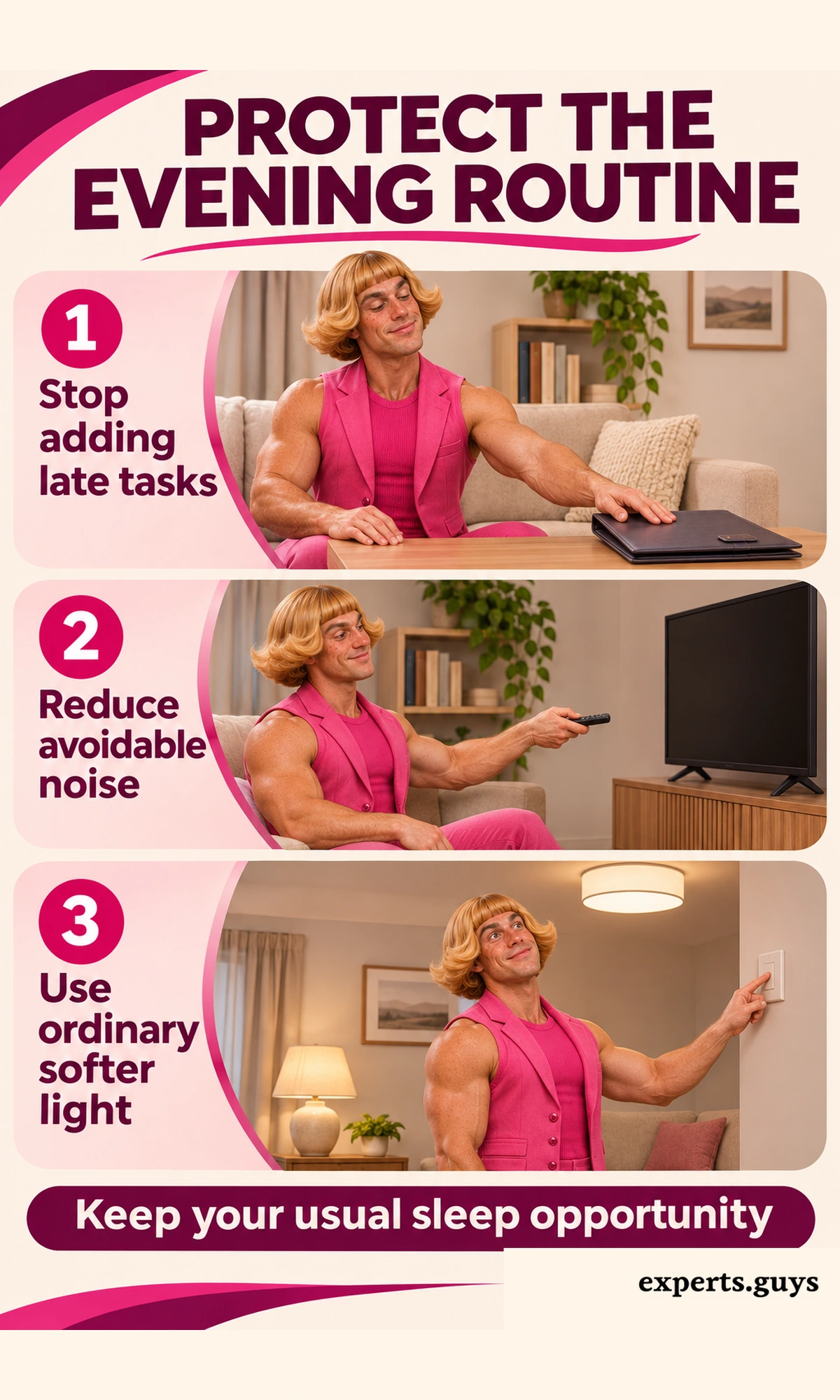
A useful completion point is visible: the optional work is closed, the avoidable noise has stopped and the room is comfortably lit for the next part of your usual evening. Feeling sleepy is not the pass condition. If sleep does not come, repeating the sequence or making the room progressively darker does not prove that you have done it incorrectly.
The common mistake is turning the adjustment into a new project: reorganizing the room, buying sleep products or finishing several additional chores before being “allowed” to stop. Keep the action bounded. If you catch yourself adding jobs, close the current optional task and return to the ordinary routine instead of optimizing it further.
For limited mobility or fatigue, do the reachable parts from your seat and ask a willing person to operate an inaccessible switch. In shared housing, reduce only the noise and lighting you control; this is not a reason to demand darkness or silence from everyone. If the environment cannot be changed, the constraint belongs in the care discussion rather than becoming a personal failure.
Avoid forcing a specific bedtime, deliberately restricting sleep or trying intense light exposure as an experiment. Those are different interventions with different implications. This task simply protects an existing opportunity to rest. It should not become a reason to postpone support when the pattern is becoming unusual or unsafe.
Choose the response from the change you see now
A tired morning after disruption and a continuing reduction in sleep need call for different questions. The first may involve a lost opportunity for rest. The second, especially with unfamiliar activity or risky decisions, may indicate a mood change that needs prompt assessment. Exhaustion does not rule out a serious problem, so uncertainty should not be used to dismiss worsening symptoms.
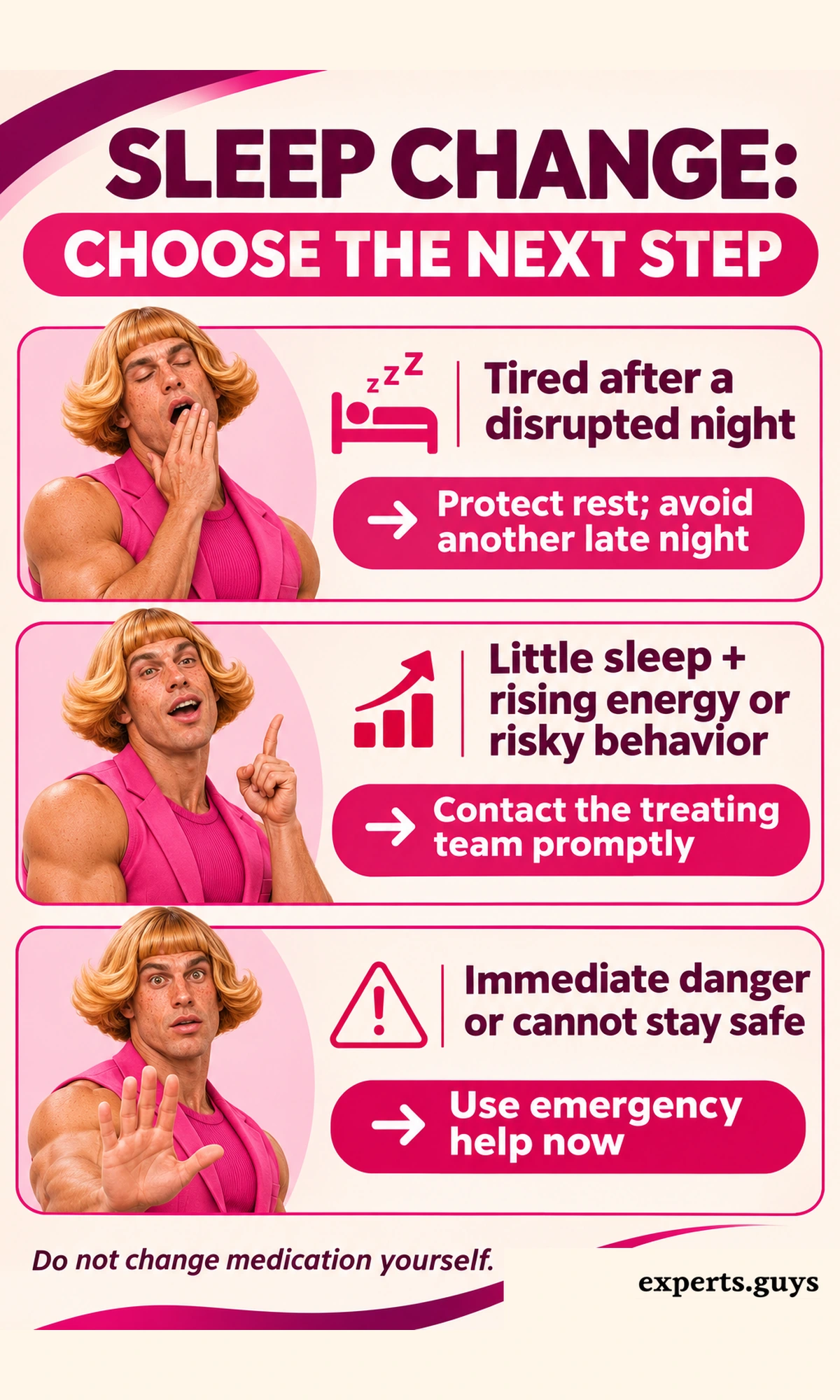
When contacting the treating team, explain the actual change in ordinary language: “I am sleeping far less than usual and becoming much more active,” or “I am exhausted and unable to settle after the disruption.” Mention new unsafe decisions or any recent treatment change. This is a purposeful care conversation, not a requirement to keep a diary or prove a theory about the cause.
Do not independently stop, increase or replace prescribed medication because a research headline suggests a different explanation. A broad model of illness does not tell you which treatment is appropriate today. Questions about benefits, adverse effects and alternatives deserve a decision based on the individual treatment history, rather than a deduction from one associated factor.
For a supporter, help with the concrete difficulty the person identifies and respect their consent. Do not use a research category to explain their character or win an argument. The most useful statement may be simple and observable: the evening has become unusually busy, sleep has changed and the agreed contact is available. Interpretation can remain uncertain while support remains specific.
Frequently asked questions
Does the seven-domain framework mean there are seven bipolar types?
No. Research domains describe categories of measurements. Diagnostic types concern the clinical episode history. The number of research categories cannot be used to assign a subtype or judge how severe someone’s illness is.
Can a cause study show which medication I should take?
Only if it supplies relevant evidence about that treatment decision, and even then the result must be considered alongside your own history. A study of associated characteristics does not by itself establish which medicine is appropriate or justify changing a prescription.
Does not remembering trauma weaken a bipolar diagnosis?
No. A particular traumatic event is not a required explanation for everyone with bipolar disorder. Do not search for or assume a hidden experience to make a diagnosis seem legitimate. Assessment concerns the clinical pattern and other relevant explanations.
Should every possible trigger be avoided forever?
A blanket rule can restrict life without identifying what actually matters. Address specific difficulties and follow an individualized care plan. Deliberately testing a suspected trigger, especially by losing sleep or changing medication, is not a safe way to resolve uncertainty.
Can a reliable explanation still leave my own cause uncertain?
Yes. Research can establish useful patterns without reconstructing the complete history of an individual illness. That uncertainty does not make symptoms less real or prevent a practical response to current difficulties. It sets a boundary on what the explanation can honestly tell you.
Next steps
When you encounter a new explanation for bipolar disorder, identify what kind of evidence it offers before deciding what it changes. Keep the original cause question separate from the present-day care decision. A useful explanation should narrow uncertainty honestly, and a useful next step should address the actual difficulty without requiring you to solve the whole illness first.









