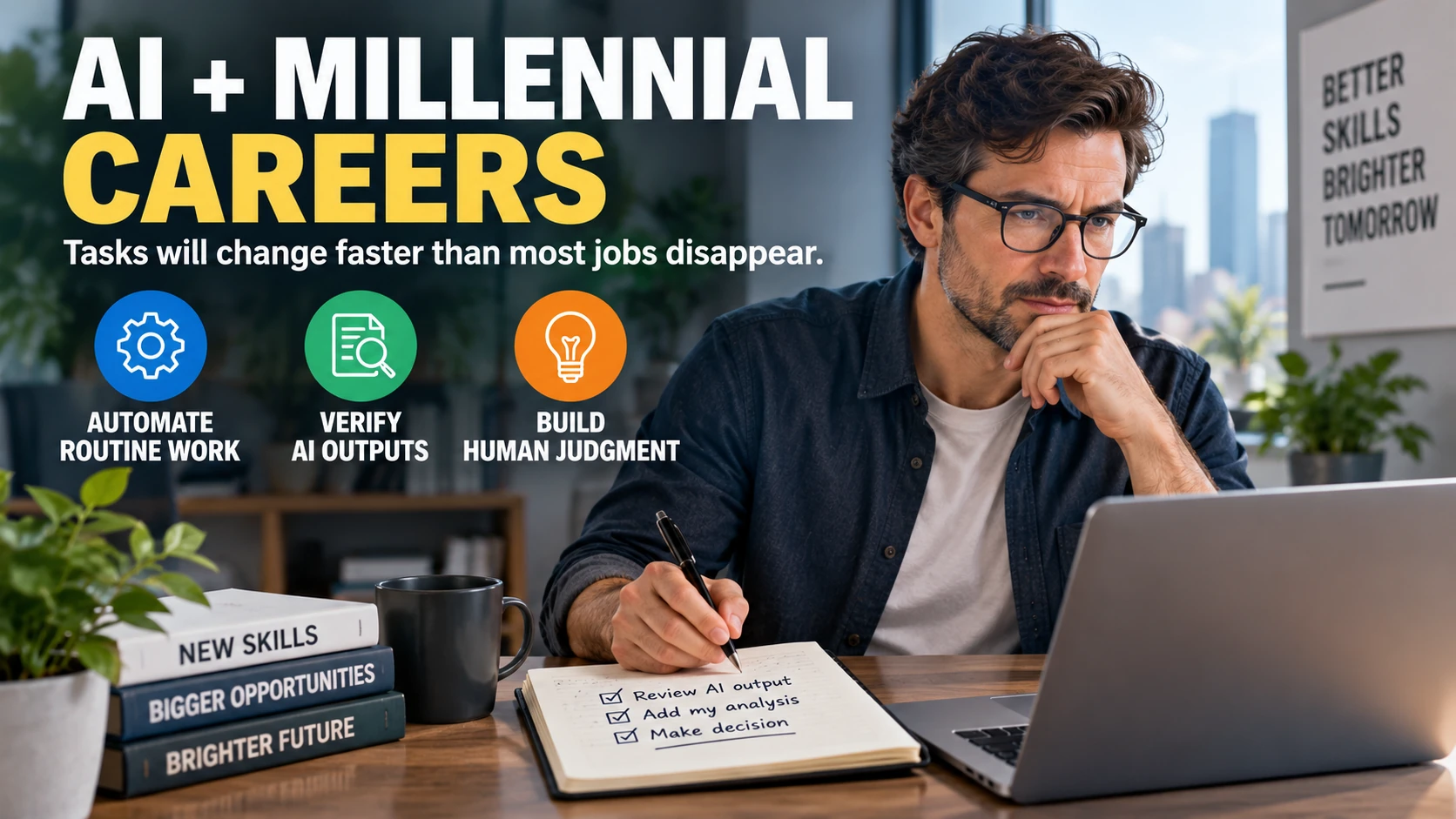
Artificial intelligence is more likely to reshape millennial work than erase it in one sweep. The biggest change is happening at the task level: routine drafting, information lookup and basic analysis can increasingly be automated or accelerated, while judgment, accountability, communication and domain expertise become more important. For millennials now in the middle of their careers, the practical question is not “Will AI take my job?” but “Which parts of my job are becoming cheaper, faster or more valuable because of AI?”
Using Pew Research Center’s widely used 1981-1996 definition, millennials are no longer the generation just entering the workforce. As of 2026, they are roughly in their early 30s through mid-40s, which means many are already managers, experienced specialists, parents, business owners or senior individual contributors. That life stage matters because AI is arriving after they have accumulated experience, relationships and professional judgment that can be amplified rather than simply replaced.
The evidence also argues against a simple “AI destroys jobs” story. A recent International Labour Organization review of empirical research found that large-scale displacement remained limited while work organization and task mixes were changing, and the ILO’s broader occupational-exposure work says transformation is more common than full redundancy. The pressure is real, but it falls unevenly across tasks, occupations, industries and countries.
| What AI changes first | What it means for millennials | Best response |
|---|---|---|
| Routine digital tasks | Some work that once signaled competence becomes faster and cheaper. | Automate carefully, then spend the saved time on judgment and outcomes. |
| Research and first-pass analysis | Speed rises, but weak verification can create confident errors. | Use AI to widen the search, then validate evidence and assumptions. |
| Entry-level stepping-stone tasks | Younger colleagues may reach complex work sooner, changing team structures. | Mentor for judgment, not only for process compliance. |
| Human-facing and accountable work | Trust, context, leadership and responsibility become more visible sources of value. | Make your decisions, trade-offs and ownership legible to others. |

Millennial career adaptation
AI Career Activation Studio
See which parts of your work to automate, augment, protect and prove - without pretending anyone can predict your career with a percentage.
Build your action path
Choose the options that best describe your current role. The result is a task pattern and action sequence, not a personality label or employment forecast.
Your work pattern
-
Your 30-60-90 day sequence
Do not place confidential, regulated or high-stakes information into unapproved systems. AI can accelerate work; you remain responsible for checking the output and following your organization’s rules.
AI Changes Tasks Before It Changes Whole Careers
A job title is a bundle of tasks, and AI rarely affects every task in that bundle equally. A marketing manager may use AI for first drafts, audience research and campaign variations while still owning positioning, budget choices, stakeholder alignment and final approval. A financial analyst may automate document extraction and scenario setup while remaining responsible for assumptions, interpretation and the consequences of the recommendation.
This task-level view is more useful than asking whether an occupation is simply “safe” or “unsafe.” The ILO’s global index of generative-AI exposure found that many occupations contain tasks that are technically exposed to AI, yet human input remains necessary across most jobs. Exposure therefore describes where work can change; it does not automatically prove that the worker or the occupation will disappear.
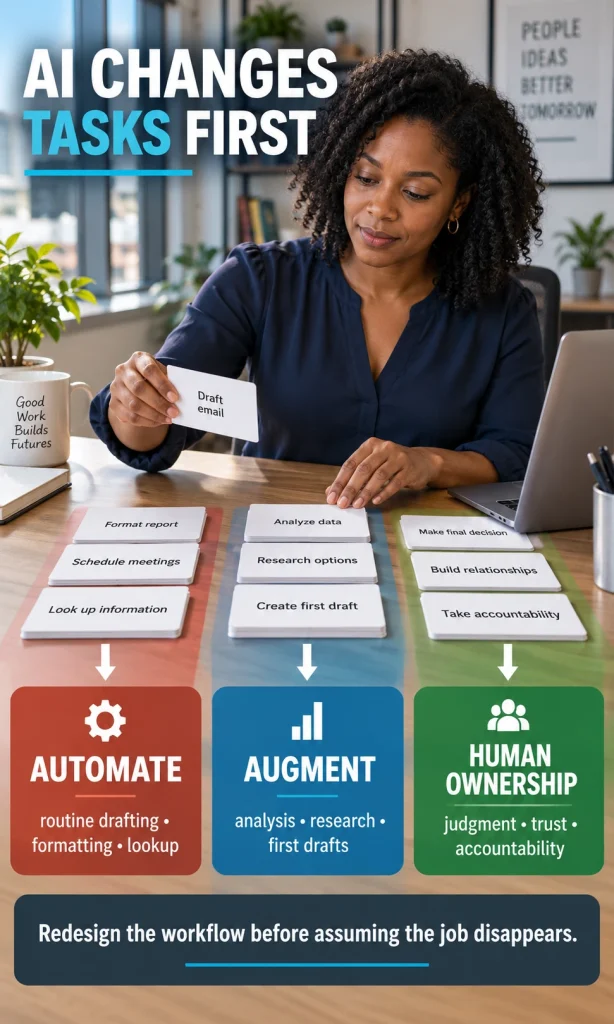
For experienced millennials, that distinction creates both risk and leverage. If much of your value is tied to repeatable digital production, AI can compress the time and price of that work quickly. If your value comes from interpreting messy situations, earning trust, coordinating people, taking responsibility and connecting technical output to real-world consequences, AI can make you more productive without removing the need for your role.
Which Millennial Jobs Face the Most Pressure?
The strongest pressure tends to appear where work is digital, repeatable, text-heavy, rules-based and easy to evaluate after the fact. That can include portions of administration, content production, customer support, coding, research, reporting, scheduling and document processing. The important word is portions, because even highly exposed occupations can contain relationship, exception-handling and decision work that remains difficult to automate reliably.
Pressure also depends on how an employer chooses to use AI. One company may use it to increase output with the same headcount, another may redesign roles around higher-value work, and another may cut positions where tasks have become easy to automate. The PwC Global AI Jobs Barometer describes a widening split between roles where AI amplifies expertise and roles where AI makes existing work easier for non-experts to perform.
That distinction matters for millennials because many are far enough into their careers to possess hard-earned context that AI does not automatically have. A generic model can draft a memo, but it may not know which customer will reject a proposal, which operational shortcut will create downstream risk, or why a technically correct recommendation will fail inside a particular organization. The more your role depends on tacit knowledge and accountable judgment, the more important it is to make that value visible instead of assuming your job title communicates it.
The Skills That Become More Valuable With AI
AI literacy matters, but most workers do not need to become machine-learning engineers. An OECD review of AI and skills argues that advanced AI-development skills will be needed by only a small share of workers, while broader demand rises for digital fluency, data interpretation, problem-solving and other complementary capabilities. That is a useful direction for millennials who already have domain expertise and need to add AI fluency rather than restart their careers from zero.
- Data interpretation: understand what an AI-generated summary, forecast or classification actually means in the real operating context.
- Domain judgment: recognize when an apparently plausible answer conflicts with industry reality, customer behavior, regulation, safety or experience.
- Verification: check sources, calculations, assumptions and missing context before an AI output becomes a decision.
- Communication: translate complex information into language that colleagues, clients and decision-makers can use.
- Leadership: decide which work should be automated, which should be augmented and where a person must remain accountable.
- Workflow design: combine people, software and AI so the result is repeatable, auditable and better than a one-off prompt.
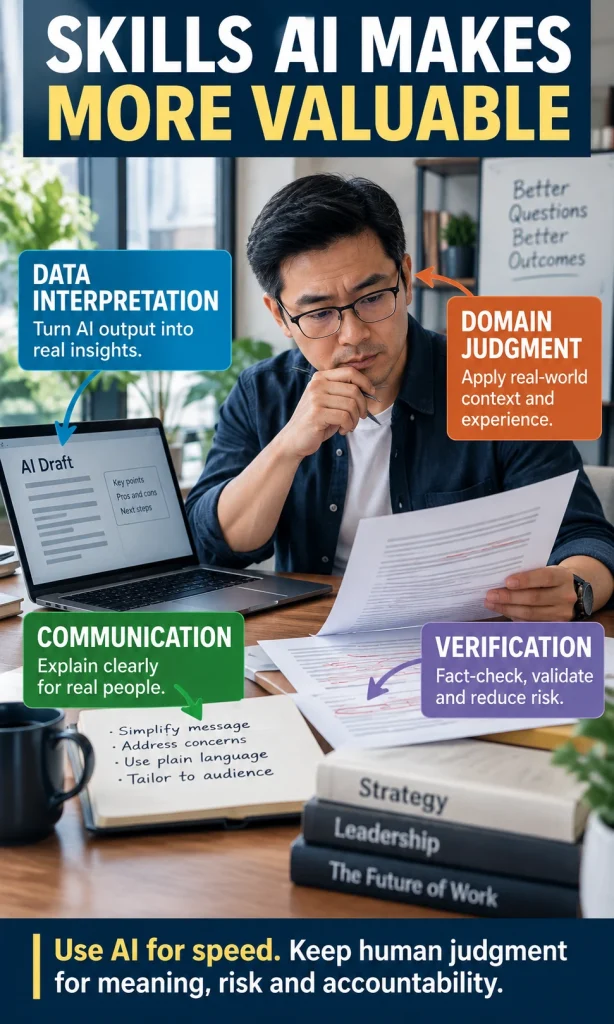
The skill shift is already visible in employer expectations. The World Economic Forum’s Future of Jobs report says employers expect a large share of existing skills to change by 2030, with AI and big data among the fastest-growing technical skill areas while analytical thinking, resilience, leadership and social influence remain important. Those figures are employer expectations rather than guarantees, but they reinforce the same practical pattern: technical fluency and human judgment are becoming complements.
Why Mid-Career Millennials Have an Advantage – and a Blind Spot
The advantage is accumulated context. Millennials have spent enough time in organizations to know where process diagrams differ from reality, which handoffs fail, what customers actually ask for and how incentives shape behavior. That experience can make AI much more useful because the person knows what to ask, what to distrust and what outcome actually matters.
The blind spot is assuming experience will protect a role without changing how the work gets done. If a professional keeps producing the same reports, decks, summaries or routine analyses in the same way while colleagues redesign those tasks with AI, tenure alone may not preserve their relative value. The safer approach is to use experience to redesign the workflow and move closer to decisions, relationships, accountability and measurable outcomes.
This is also why the old article’s idea that every millennial needs a master’s degree or PhD no longer holds up. Formal education can still be valuable in professions that require it, but AI is also changing hiring toward demonstrable capability, applied judgment and rapidly updated skills. A better question is whether a credential changes what you are legally allowed to do, materially improves your expertise, or provides access to a role you cannot reach through experience and targeted training.
AI May Compress the Traditional Career Ladder
One of the less obvious effects of AI is that junior employees may no longer spend as long doing the routine work that once trained them. If drafting, research, formatting and basic analysis are partially automated, people can be pushed toward judgment-heavy work earlier. That creates a management challenge for millennials who supervise teams: organizations still need ways to teach judgment even when the old practice tasks disappear.
Recent labor-market analysis has raised this issue directly. PwC’s global work on AI-exposed roles reports that some junior positions increasingly ask for skills that used to be associated with more senior work, while the ILO’s empirical review points to risks for younger workers even as broad displacement remains limited. Millennials may therefore experience AI not only as a personal career change, but also as a change in how they hire, mentor and evaluate the generation behind them.
The practical response is to make training more explicit. Instead of letting a junior employee produce ten routine reports before they understand the business, a manager can use AI to reduce production time and then spend more time reviewing assumptions, explaining exceptions and exposing the employee to real decision consequences. The career ladder becomes less about waiting for complex work and more about learning how to handle it safely.
AI Will Affect More Than Work
Millennials are also encountering AI while raising children, managing households, planning finances and making health or education decisions. AI can reduce friction in these areas by helping organize information, compare options, draft questions or explain unfamiliar concepts. The risk is treating a fluent answer as if it were automatically correct, current or appropriate for a high-stakes personal decision.
That makes verification a life skill, not only a workplace skill. The same habit that protects a professional from a fabricated citation also helps a parent question an AI-generated school recommendation or a consumer check a financial assumption before acting. The article on when not to use AI is a useful companion for decisions where privacy, safety, accountability or professional expertise matter more than convenience.
AI may also change expectations around speed. Once routine writing, searching and organizing become faster, employers and customers may expect quicker responses from people as well, which can convert a productivity gain into a workload increase if boundaries do not change. Millennials in management positions will have to decide whether AI savings are used to create more output, reduce low-value work, improve quality or simply raise the pace.
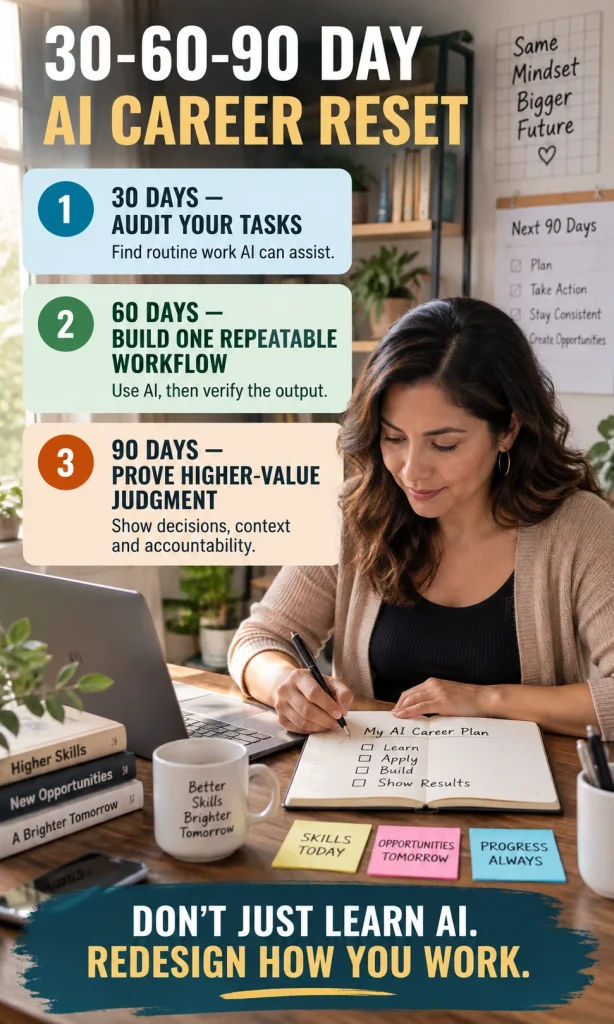
A 30-60-90 Day AI Career Reset
You do not need a dramatic career pivot to respond to AI. A better starting point is to inspect your current work, identify where AI can remove low-value repetition and then prove that the saved time is being converted into better decisions or outcomes. That creates a visible before-and-after story rather than an abstract claim that you are “learning AI.”
- First 30 days – audit your tasks. List the recurring work you do each week and mark what is routine production, research, analysis, relationship work and accountable judgment. Test AI only on low-risk tasks where you can verify the result.
- By 60 days – build one repeatable workflow. Choose a task that happens often enough to matter, document the inputs and checks, and create a reliable AI-assisted process rather than relying on improvised prompts.
- By 90 days – prove higher-value judgment. Show what improved because the routine work became faster: better client communication, more analysis, fewer errors, quicker decisions, stronger mentoring or more time on strategy.
If your employer is already automating parts of your role, move faster. Document which tasks are shrinking, identify adjacent responsibilities that require stronger judgment or relationships, and build evidence that you can own them. If your role is stable, you still benefit from redesigning one workflow now because it gives you practical experience before AI use becomes a formal requirement.
What Millennials Should Avoid
The first mistake is chasing every new AI product without learning a durable workflow. Product names will change, but the ability to define a problem, provide context, evaluate output and create a repeatable process transfers across systems. The second mistake is assuming that using AI automatically makes work better; faster production can simply accelerate errors when the verification step is weak.
The third mistake is hiding AI use when the organization expects disclosure or review. Sensitive data, customer information, proprietary material and regulated decisions may require approved systems and human oversight, so convenience is not a reason to bypass policy. If you are unsure where the boundary sits, start with AI safety and ethics basics and your employer’s own rules before putting confidential information into an external system.
The fourth mistake is waiting for a prediction to become certain. No report can tell an individual millennial exactly which job will exist ten years from now, because adoption depends on economics, regulation, company strategy and the speed at which technology actually performs in real environments. The useful move is to watch your own task mix and act when repeatable work is becoming easier to automate or when employers begin asking for new skills.
How to Think About the Long Run
The strongest long-run position is not “AI-proof.” It is a role where AI increases your reach while your value still depends on context, trust, judgment, coordination or responsibility that cannot be delegated blindly. That can describe a nurse, designer, engineer, marketer, project manager, salesperson, analyst, educator, entrepreneur or many other occupations, depending on the exact tasks and environment.
For a broader look at displacement fears, see why viral AI job-loss panic can be misleading, then compare it with which job tasks are more exposed to automation. If you are trying to decide where AI should and should not make the call, the distinction in AI vs human decision-making is the more useful next step.
Millennials do not need to predict every breakthrough to prepare well. They need to understand which parts of their work are being commoditized, where their experience creates judgment that remains scarce and how to use AI without surrendering accountability. That is a more durable career strategy than either dismissing AI or assuming it will replace everyone.
Frequently Asked Questions
Will AI replace millennial jobs?
AI is more likely to replace or accelerate specific tasks before it replaces most complete jobs. Roles with a high share of routine digital work face more pressure, while work requiring judgment, trust, physical execution, negotiation or accountability is harder to automate end to end. The right unit of analysis is your task mix, not only your job title.
Are millennials too old to benefit from learning AI?
No. Millennials are largely mid-career, which can be an advantage because AI becomes more useful when the user already understands the domain, the customer and the consequences of a bad answer. The goal is usually to add AI fluency to existing expertise, not to restart as an AI engineer.
Which AI skill should a millennial learn first?
Start with one repeatable task in your current role and learn how to use AI safely to improve it. That teaches prompting, context setting, verification and workflow design at the same time, which is more useful than memorizing features in many unrelated products. Choose a low-risk task where you can recognize a wrong answer.
Do millennials need another degree because of AI?
Not automatically. A degree makes sense when it is required for a profession, changes your legal scope of practice, provides deep expertise or unlocks a specific career path. For many roles, targeted training plus demonstrated AI-assisted work may be a more direct response to changing skill requirements.
What is the biggest AI risk for mid-career workers?
The biggest practical risk is role stagnation: continuing to produce routine work in the old way while employers redesign the role around faster AI-assisted workflows. The response is to automate low-value repetition carefully and move closer to decisions, relationships, quality control, mentoring and measurable outcomes. That makes experience easier to see and harder to treat as interchangeable production.