

AI is changing online shopping most visibly by moving product discovery from keyword search toward conversational, personalized, and agent-assisted shopping. The change is useful only when the system has accurate product data and shoppers can still verify price, availability, seller, shipping, returns, and privacy-sensitive personalization. The practical question is no longer whether AI appears in ecommerce, but where it changes the decision and what still needs a human check.
Older ecommerce automation mainly ranked products, triggered recommendations, and targeted ads from relatively narrow behavioral signals. Newer AI systems can interpret natural-language requests, compare many product attributes at once, combine text with images, summarize trade-offs, and in some environments move from recommendation into cart or checkout actions.
That does not make the shopping journey fully autonomous or automatically better. AI can reduce search effort, but it can also amplify stale catalog data, unclear seller information, weak return policies, sponsored influence, or personalization that a shopper did not expect.
| Shopping stage | What AI can change | Main benefit | What still needs checking |
|---|---|---|---|
| Discovery | Understands intent, constraints and natural-language questions | Fewer irrelevant results | Whether the full market is represented |
| Evaluation | Summarizes specifications, reviews and trade-offs | Less tab-hopping | Current specs, source quality and missing caveats |
| Personalization | Adapts recommendations to stated and inferred preferences | Better fit to the shopper | Data use, filter bubbles and price differences |
| Transaction | Can assist with carts, checkout and order actions on supported systems | Lower friction | Final price, seller, delivery, return terms and payment authorization |
How AI changes the shopping journey
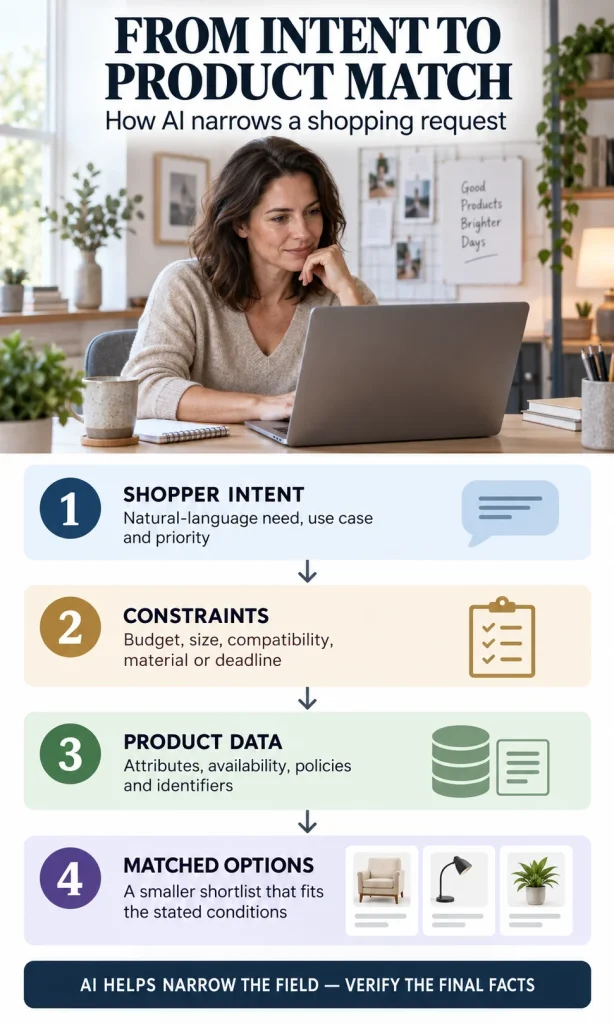
The biggest shift is that shopping systems can now work with intent rather than only exact keywords. A request such as “I need a carry-on that fits a short international trip, works on rough pavement, and stays under my budget” contains constraints, priorities and context that a traditional search box may handle poorly unless those terms match the retailer’s taxonomy.
Conversational systems can translate that request into attributes, ask a follow-up question, compare candidate products, and explain why one option fits better than another. OpenAI’s current product-discovery experience, for example, is built around conversational refinement and side-by-side comparison, while Google is also expanding AI shopping surfaces around conversational intent and structured product information.
That workflow changes the role of the product page. A page still needs persuasive human-facing copy, but the underlying information also has to be specific enough for machines to identify materials, dimensions, compatibility, variants, price, availability, shipping conditions and other decision-critical attributes.
- Natural-language discovery: shoppers can describe the outcome they want instead of guessing the retailer’s exact keywords.
- Constraint handling: AI can combine budget, size, delivery timing, material, use case and other requirements in one request.
- Conversational refinement: a shopper can change one condition without starting the search again.
- Cross-product comparison: AI can summarize differences that would otherwise require opening several tabs.
- Action support: on supported commerce systems, agents can move beyond discovery toward carts, checkout and order actions.
Search is becoming conversational, visual and multimodal
Text search is only one input now. Visual search lets a shopper start with an image, while multimodal systems can combine an image with natural-language instructions such as “show me something similar, but waterproof and less bulky.” This is particularly useful for products where style, shape, finish or visual compatibility matters more than a model number.
The same capability can reduce one of online retail’s oldest problems: shoppers often know what they want visually but do not know the product name. Image understanding can classify objects, identify visible attributes and narrow the catalog, although exact compatibility, sizing and technical specifications still require structured data rather than visual resemblance alone.
Personalization is moving from segments to individual context
Traditional recommendation systems often relied on broad patterns such as purchase history, browsing behavior or “customers also bought” relationships. AI can add more context by using the shopper’s current request, explicit preferences, prior conversation and product constraints to rank options in a way that feels closer to a human sales conversation.
The useful version of personalization is transparent enough for the shopper to understand why an item is being shown and easy enough to override when preferences change. A recommendation that is highly personalized but based on the wrong assumption can be more distracting than a simple category filter.
AI comparison can reduce tab-hopping, but it raises the value of accurate data
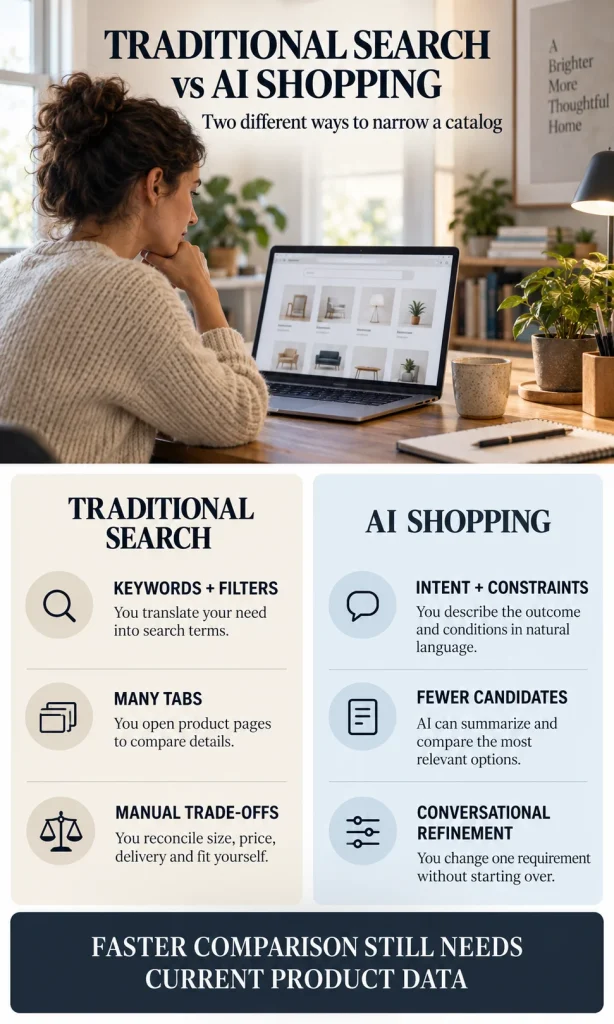
AI can compress long product pages into a smaller set of decision points: price, dimensions, materials, warranty, compatibility, delivery, return conditions and user-relevant trade-offs. That saves time only if the underlying data is current and comparable; one stale price or missing variant can distort the whole recommendation.
This is why structured product data is becoming part of the retail experience rather than a background SEO task. Google’s Merchant Center guidance explicitly connects detailed product attributes and structured data with discovery across AI-driven shopping surfaces, while Shopify now distributes merchant catalog data to agentic storefronts in a form AI channels can parse.
Agentic commerce moves AI from recommending to acting
The newest step is agentic commerce: software that can carry a shopping task further on the buyer’s behalf. Depending on the platform and merchant integration, an agent may search, compare, maintain a cart, prepare checkout, or complete supported transaction steps after the shopper sets the required permissions and constraints.
This is a bigger change than adding a chatbot to a store. Google’s Universal Commerce Protocol and OpenAI’s Agentic Commerce Protocol are examples of infrastructure intended to let AI systems exchange product and transaction information with merchants, although exact capabilities vary by platform and rollout stage.
For shoppers, the practical safeguard is simple: treat autonomous action as a permission boundary. The more an AI system can do without another click, the more carefully the shopper should define spending limits, seller preferences, delivery deadlines, approval rules and the point at which final confirmation is required.
For retailers, product data is becoming a customer-experience layer
An AI shopping system cannot reliably recommend what it cannot understand. Retailers therefore benefit from complete product titles, clean categories, accurate variants, current price and availability, specific technical attributes, clear shipping and return information, and machine-readable structured data that matches what the shopper sees on the page.
| Data area | Weak implementation | AI-ready implementation | Why it matters |
|---|---|---|---|
| Product attributes | Important details buried in prose | Explicit size, material, compatibility and variant fields | Improves matching to shopper constraints |
| Price and availability | Catalog feed and landing page disagree | Current feed and page values remain aligned | Reduces misleading recommendations |
| Policies | Returns and shipping are vague | Clear terms with predictable exceptions | Supports trust and transaction decisions |
| Identity | Weak SKU/GTIN consistency | Stable identifiers and consistent variant grouping | Helps systems distinguish the correct product and offer |
Where AI shopping can still go wrong
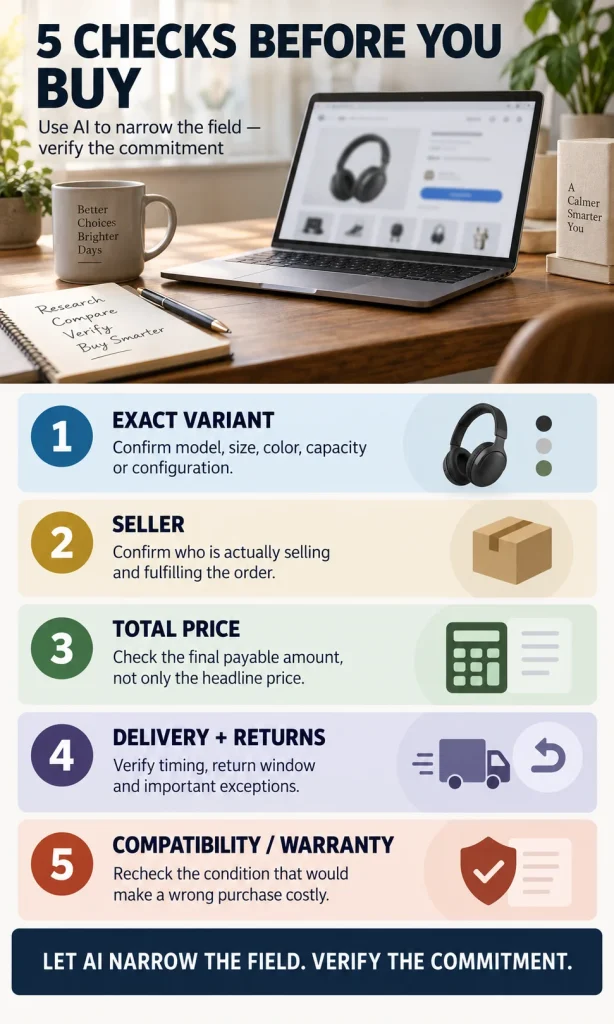
AI can make the shopping process faster without making every answer equally trustworthy. A recommendation may be incomplete because a merchant is not represented, a product feed is stale, a review summary misses an important minority pattern, or the system weighs a convenient attribute more heavily than the shopper would.
Personalization also deserves a separate check from recommendation quality. The U.S. Federal Trade Commission has examined the use of personal data in individualized pricing, including location, browsing behavior and shopping history, so shoppers should not assume that every personalized experience affects only product ranking and never price.
A good verification habit is to separate discovery from commitment. Let AI help narrow the field, then verify the final product page, seller identity, total price, availability, delivery promise, return policy, warranty or compatibility details before money changes hands.
Try the AI Shopping Shift Studio
The interactive experience below is designed to show what AI is likely doing at a specific stage of the shopping journey and which human check still carries the most value. It does not produce a synthetic score; it converts the selected situation into a practical next action for a shopper or retailer.
AI COMMERCE DECISION SUPPORT
AI Shopping Shift Studio
Choose a shopping situation and see what AI is likely doing, what can go wrong, and the human check that still matters most.
YOUR CHECK
AI is helping with discovery
AI Shopping Check
A one-page decision record for the selected shopping situation.
What AI is likely doing
Main weak point
Human check
Next action
What shoppers should do differently
Use AI aggressively for discovery, comparison and question refinement, but keep final transaction facts anchored to the merchant’s current offer. If a recommendation matters because of one decisive condition – exact dimensions, medical suitability, compatibility, delivery before a deadline, warranty coverage or return eligibility – verify that condition on the authoritative product or policy page rather than relying only on a generated summary.
Privacy controls matter more as shopping assistants learn from longer histories and richer context. Review account-level personalization settings when available, avoid sharing unnecessary sensitive information, and use a clean comparison when you suspect past behavior may be narrowing the options too much.
What retailers should do differently
Retailers should treat AI discovery as another distribution surface, not as a replacement for a usable store. Strengthen product information first: complete attributes, consistent identifiers, current availability, clear policies, accessible pages and structured data that matches the visible offer.
Then test the questions real shoppers actually ask. A catalog can be technically valid and still perform poorly if product descriptions omit the language customers use for fit, use case, compatibility, material, dimensions or delivery constraints.
For deeper background, see how artificial intelligence is reshaping ecommerce, current applications of AI in retail, and what agentic AI means in practice. Readers who want the underlying decision logic can also review how AI systems make decisions and how to think about AI trust and uncertainty.
FAQ
How is AI used in online shopping?
AI is used to interpret shopping intent, rank and recommend products, power conversational search, analyze images, summarize product differences, personalize experiences, support customer service, and in some systems assist with carts and checkout actions.
Is AI shopping the same as using a chatbot?
No. A chatbot is one interface. AI shopping can also involve recommendation systems, visual search, product-data matching, review summarization, fraud checks, demand forecasting and agentic transaction workflows behind the interface.
Can AI find better products than normal search?
It can be better when the request contains several constraints or when the shopper does not know the exact product name. The result still depends on catalog coverage, product-data quality, ranking logic and whether the important attributes are actually available to the system.
Can AI complete a purchase for me?
Some supported agentic commerce systems can move beyond recommendations into cart or checkout actions, but capabilities vary by platform, merchant and region. Shoppers should still review permissions, spending limits and the final transaction details before allowing autonomous purchase actions.
What should I verify before buying something recommended by AI?
Verify the exact product or variant, seller, current price, availability, shipping time, return policy, warranty or compatibility details, and any condition that made the recommendation attractive. Treat the AI recommendation as decision support rather than the final source of transaction truth.
What should online stores do to prepare for AI shopping?
Stores should keep product feeds and landing pages consistent, expose detailed attributes, use stable product identifiers, maintain accurate price and availability, publish clear shipping and return terms, and implement machine-readable structured data that matches the visible offer.
Next step
For shoppers, the best use of AI is to compress the messy middle of the purchase journey while keeping the final commitment verifiable. For retailers, the priority is to make product information specific, current and machine-readable enough that an AI system can represent the offer without guessing.