Agentic AI and generative AI can use many of the same underlying technologies, yet they are designed to do different jobs. Generative AI is primarily used to create, transform or analyze an output in response to a request. Agentic AI adds another layer: it can be given a goal, decide what needs to happen next, use permitted tools, observe the result and continue working toward the desired outcome.
The difference becomes important once AI moves beyond the chat window. Asking AI to draft a customer email is a generative task. Giving an AI system permission to inspect the customer’s account, determine whether a follow-up is necessary, prepare the appropriate message, update a record after approval and decide when another action is needed is closer to agentic behavior. The underlying language capability may be similar, but the second system has a much larger operational role.
A useful starting distinction is therefore:
Generative AI primarily creates outputs. Agentic AI can pursue outcomes.
That distinction should not be interpreted as a ranking where agentic AI is automatically more advanced or more useful. Generative AI is often the better option when a person simply needs writing, analysis, summarization, coding assistance, ideation or another bounded result. Agentic AI earns its extra complexity when the task requires changing decisions across several steps and the system must interact with information or tools while the work is underway.
Google Cloud describes generative AI as artificial intelligence capable of creating new content, including text, images, audio and other forms of output. Its explanation of agentic AI focuses on systems that can autonomously make decisions and take actions toward goals. Those definitions help establish the technical distinction, but for everyday users the more important question is what changes when AI receives authority to decide what happens after the first answer.
Readers who need the broader foundation first can review what agentic AI means and how an AI agent works. This comparison focuses on the decision that comes afterward: when is ordinary generative AI sufficient, and when does a workflow actually benefit from agentic behavior?
Agentic AI vs Generative AI: The Short Answer
Generative AI responds to a request by generating or transforming information. Agentic AI can use generative capabilities as part of a larger goal-oriented process in which the system may plan, select tools, perform actions, inspect results and change its next step.
Imagine asking AI:
“Summarize these customer complaints and tell me the recurring problems.”
That is a strong generative-AI task. The system receives information, analyzes it and produces an output for a person to use.
Now imagine giving a system this goal:
“Identify recurring customer problems, determine which open cases appear related, prepare appropriate follow-ups and bring any case requiring compensation to me for approval.”
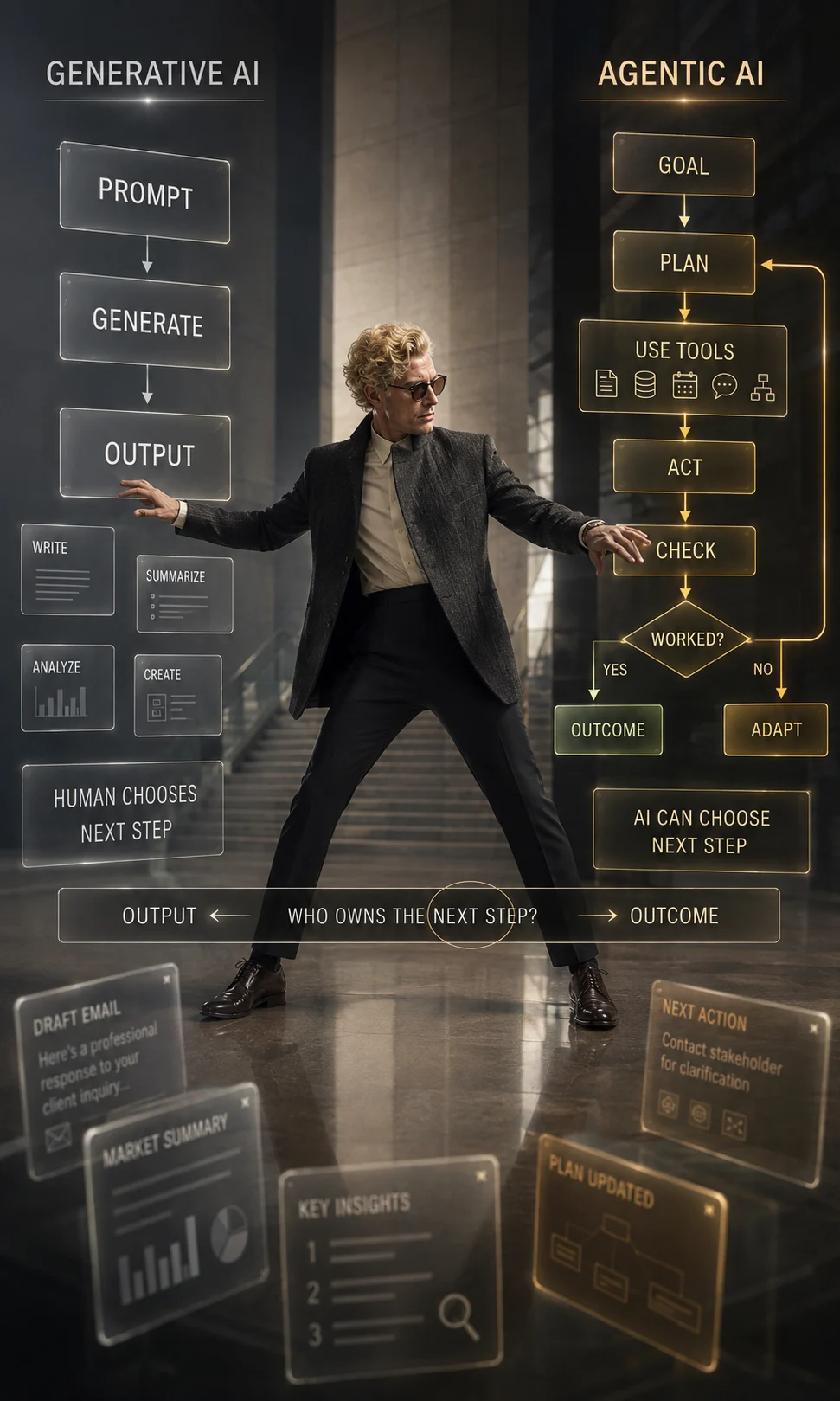
The second instruction contains several decisions that cannot necessarily be completed in one response. The system may need to inspect records, determine which information matters, choose an action, use a tool, observe what changed and continue.
That is the autonomy gap between the two approaches.
The gap is not simply that one model is smarter. It is that the agentic system has been given a different job, environment and level of authority.
What Generative AI Actually Does
Generative AI produces new material or transforms existing material based on patterns learned during training and the context supplied at the time of the request. Depending on the model and interface, that output can include text, software code, images, structured information, summaries, plans, explanations or analysis.
In normal use, the interaction remains highly user-directed.
A person asks for something. The model responds. The person reviews what happened and decides what should happen next.
That structure is extremely useful because many knowledge-work tasks naturally end with an output that a human wants to inspect.
A marketer may ask for alternative headlines. A manager may ask for a meeting summary. A developer may ask for an explanation of a function. A business owner may ask AI to compare two possible approaches. In each situation, the AI contributes cognitive or creative work without necessarily controlling the surrounding workflow.
This is one reason generative AI remains central to an AI productivity system. A significant amount of work does not need autonomy. It needs faster interpretation, clearer communication, useful drafts or assistance thinking through a problem.
Generative AI usually works inside a bounded request
Most generative interactions have a relatively clear beginning and end.
The user supplies a prompt, files, instructions or conversation context. The model processes that information and creates a response. If another action is needed, the user usually initiates it through another prompt or by moving the result into another system.
Consider a project manager asking:
“Read these project updates and identify the biggest delivery risks.”
The AI can analyze the information and produce a useful assessment. The manager then decides whether to change a deadline, contact a supplier or ask a team member for more information.
The AI assisted the decision. It did not own the process.
This boundary is often desirable because the person remains the bridge between interpretation and action.
Generative AI can reason without becoming an agent
Reasoning capability alone does not make a system agentic.
A modern generative model may compare options, solve a multi-stage problem, explain why one approach is preferable or revise its output after receiving additional information. Those are important capabilities, but the interaction can still remain fundamentally prompt-driven.
The distinction becomes clearer when we ask:
Who is responsible for deciding that another action is needed?
If the model responds and waits for the user, the system may still be functioning primarily as generative AI.
If the system can observe what happened after its previous step and independently determine that another permitted action should occur, the behavior becomes more agentic.
What Agentic AI Adds
Agentic AI adds goal-directed continuation.
An agent can potentially receive an objective rather than one isolated task, inspect relevant context, plan how to advance, select from available tools and continue working after an intermediate action produces a result.
That continuing loop changes the role of AI.
Instead of helping only at individual moments, an agent can participate in the connective work between those moments.
For example, suppose a manager wants to schedule a meeting among five people.
A generative assistant could examine pasted availability and suggest a suitable time.
An agentic system with calendar access might inspect availability itself, identify viable options, discover that the preferred room is unavailable, look for another suitable location, prepare the event and request approval before sending the invitation.
The second system is not simply producing a more sophisticated calendar answer. It is interacting with an environment that can change while the task is underway.
Agentic AI can choose what happens next
This is one of the most important practical differences.
With conventional automation, the next step is generally chosen in advance by the workflow designer.
With generative AI, the person commonly decides the next step after reviewing the model’s response.
With agentic AI, some next-step decisions can be delegated to the system.
Suppose an agent is investigating a delayed customer order. It discovers that the shipment is still moving and is expected tomorrow. The appropriate action may be to wait and monitor. If it instead discovers that the shipment has been declared lost, the next action may be to prepare a replacement. If the order is unusually valuable, the agent may need to escalate the case rather than continue automatically.
The route changes according to the situation.
That adaptability is one of the main reasons to introduce an agent rather than extending a rigid AI workflow automation system with an increasingly complicated collection of rules.
Agentic AI can interact with tools
A model that can describe what should happen is different from an agent that can perform an authorized action.
Tools can allow an agent to search a database, read a calendar, inspect project information, create a document, communicate with software, update a record or interact with another permitted service.
That ability is powerful because it connects reasoning with execution.
It also changes the risk profile.
If generative AI produces an incorrect recommendation, a person may catch the mistake before anything happens. If an agent has permission to act, an incorrect judgment can become an operational change before a person reviews it.
Agentic AI therefore requires more attention to permissions, approval boundaries, monitoring and recovery.
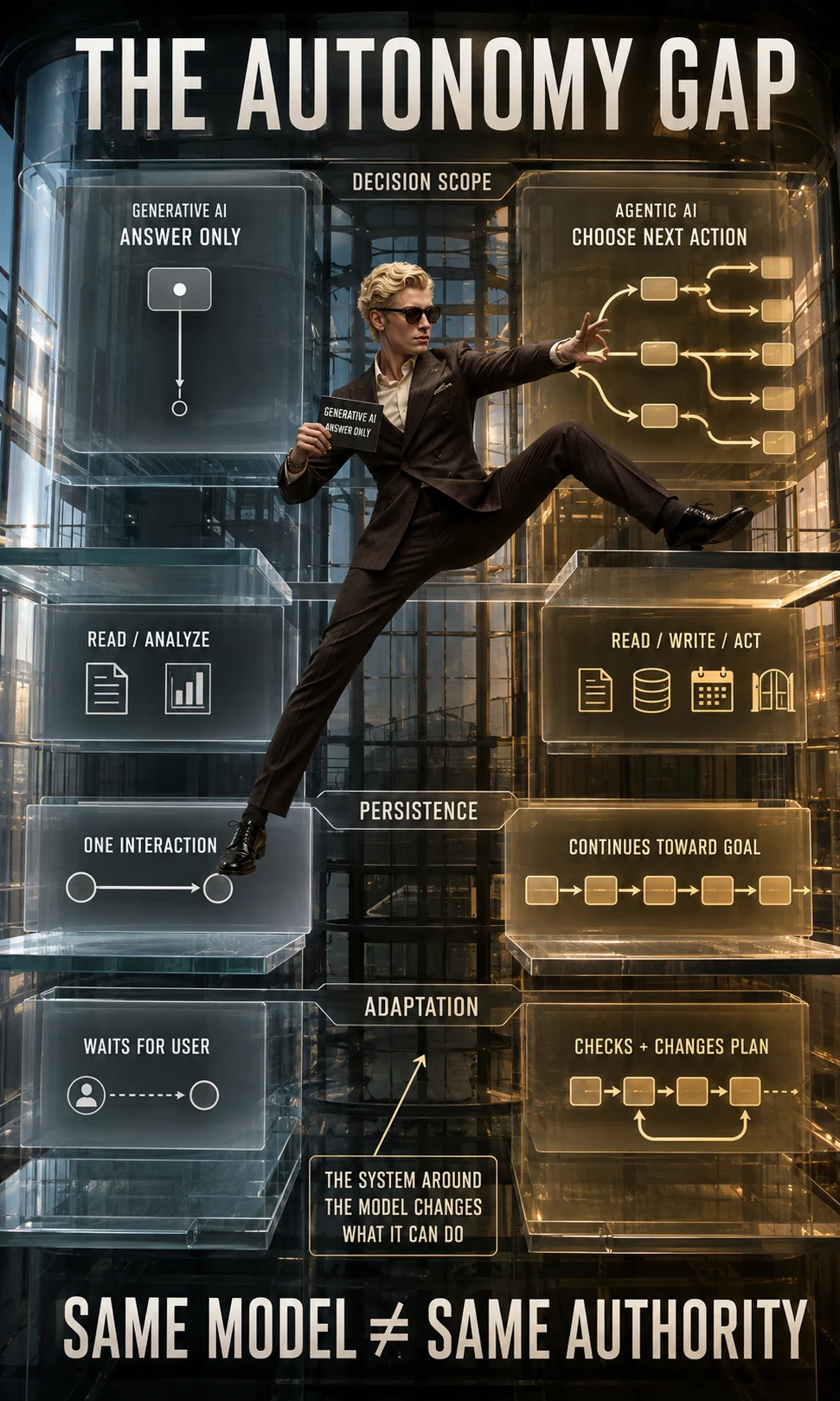
The Autonomy Gap Is the Real Difference
The easiest mistake in an agentic AI vs generative AI comparison is to focus entirely on model intelligence.
The more useful distinction is operational autonomy.
Two systems could potentially use a similar underlying model while behaving very differently because one has access only to a conversation and the other has access to tools, memory, data and permissions.
Imagine the same model used in two environments.
In Environment A, the model receives a document and answers questions about it.
In Environment B, the model can inspect a project database, decide that a deadline has become risky, retrieve supporting information, prepare a revised plan and request approval to update the schedule.
The intelligence inside the model may not have changed. The system around it has.
That system determines whether the model merely advises or can participate in the workflow.
Four things widen the autonomy gap
The gap between generative and agentic behavior becomes larger as the system gains more control over four areas.
Decision scope determines how many choices the AI can make without another instruction. A model that only chooses the wording of an answer has a narrow scope. An agent that chooses which customer case to investigate next has a broader one.
Tool access determines whether the system can affect anything outside its own response. Reading a database and editing a database are different levels of authority.
Persistence determines whether the AI’s responsibility continues beyond one interaction. An agent may remain involved until a broader objective reaches a stopping condition.
Adaptation determines whether the system can revise its route when new information appears.
These dimensions matter more than the marketing label attached to a product. A platform may describe itself as an agent while offering limited operational autonomy, while another system may provide substantial agentic behavior without emphasizing the term.
Agentic AI vs Generative AI Comparison
| Question | Generative AI | Agentic AI |
|---|---|---|
| Primary job | Create, transform or analyze an output | Pursue an outcome across multiple steps |
| Typical starting point | Prompt or request | Goal plus constraints |
| Who usually chooses the next step? | Human user | Agent within defined boundaries |
| Tool use | Helpful but not always necessary | Often central to completing work |
| Interaction pattern | Prompt -> response | Goal -> plan -> act -> check -> adapt |
| Multi-step execution | Usually user-directed | Can continue across several actions |
| Ability to react to changing circumstances | Mainly after new user input | Can react during the workflow |
| Human role | Ask, evaluate and use the output | Define goals, permissions and checkpoints |
| Main risk | Incorrect or misleading output | Incorrect output plus incorrect action |
| Operational complexity | Usually lower | Usually higher |
| Best fit | Writing, summarizing, analysis, ideation, content creation | Dynamic workflows with changing decisions |
| When it is excessive | Rarely excessive for bounded cognitive tasks | When simple AI or automation already solves the problem |
The comparison shows why “agentic AI is better than generative AI” is the wrong conclusion. Each architecture fits a different type of work.
If the job ends when the AI produces a high-quality answer, generative AI may be enough.
If the job begins with a goal and requires the system to continue deciding what should happen afterward, agentic AI becomes more relevant.
Prompt vs Goal: Why the Starting Instruction Changes
Generative AI is strongly associated with prompting because the user normally specifies what should be produced. Prompt quality can influence the usefulness of the response, but the interaction remains centered on the immediate request.
Agentic systems still need instructions, yet the instructions increasingly define objectives and boundaries rather than every individual action.
Compare two requests.
A generative request:
“Write a follow-up message to a prospect who has not replied for seven days.”
An agent-oriented objective:
“Follow up with qualified prospects who have gone quiet, but do not contact anyone who opted out, received a message within the last five days or has an unresolved support issue. Prepare high-value accounts for my approval.”
The second instruction describes a goal and several boundaries. The system has to determine which accounts qualify, which information matters and what action is appropriate.
That is why designing an agent can require more work upfront than writing a prompt. The organization must describe what success means, what exceptions matter and where autonomy should stop.
A vague goal can be more dangerous than a weak prompt
A weak generative prompt may produce an unhelpful response.
A weak agentic goal can produce a sequence of unhelpful actions.
Suppose a sales agent is instructed only to:
“Increase meetings booked.”
The system may discover that sending more follow-ups increases the target metric. Without constraints around customer relevance, communication frequency and account status, it could optimize the visible metric while harming the relationship the business actually values.
Agentic systems therefore expose an old management problem in a new technical form: what you measure can influence what the system learns to pursue.
The objective needs to reflect the real outcome rather than only an easy metric.
Output vs Outcome: The Difference That Matters Most
An output is something the AI produces.
An outcome is something that changes in the surrounding world.
A summary is an output. A completed scheduling process is an outcome.
A drafted support response is an output. A resolved customer case is an outcome.
A list of project risks is an output. A workflow that notices one of those risks, gathers missing information and routes the issue to the correct person is moving toward an outcome.
Generative AI can contribute significantly to outcomes, but the person usually carries the result from the model into the real process.
Agentic AI reduces some of that connective work by allowing the system to participate beyond the initial output.
This distinction is particularly important when evaluating productivity. A person can save ten minutes generating a document while still spending substantial time deciding where the document goes, what needs to happen afterward and whether anything changed as a result.
Agentic systems are designed to address more of that surrounding coordination.
Does Agentic AI Replace Generative AI?
No. Agentic AI generally depends on many of the capabilities developed through generative AI rather than making them obsolete.
An agent may use a generative model to interpret an instruction, summarize information, prepare a message, write code or reason about alternatives. The difference is that those generated outputs become components inside a larger process.
A useful way to visualize the relationship is:
Generative AI capability + goal + context + tools + permissions + feedback = agentic workflow
This is an explanatory model rather than a formal technical equation, but it captures the important relationship. Agentic AI frequently contains generative AI rather than competing with it as a completely separate technology.
The practical decision is therefore rarely “Which one should exist?”
It is:
Where should generative capability stop, and where should delegated action begin?
That boundary determines whether the system remains an assistant or becomes part of the operational workflow.
When Generative AI Is the Better Choice
The rapid interest in AI agents can make ordinary generative AI appear less advanced than it really is. In many situations, giving the AI more autonomy creates little additional benefit.
If the desired result is a document, explanation, analysis, comparison, idea, image or code suggestion that a person intends to review anyway, generative AI is usually the simpler choice.
A writer asking AI to restructure an article does not need an autonomous agent deciding where to publish it. A manager seeking a summary of employee feedback may not want the system contacting employees afterward. A designer asking for alternative concepts may want human judgment to remain the point where exploration becomes a decision.
Generative AI is particularly attractive when the task is bounded, consequences are significant or the surrounding workflow does not need to continue automatically.
The simplicity itself has value.
There are fewer permissions to manage, fewer actions to monitor and fewer opportunities for one mistaken assumption to propagate through several systems.
That makes generative AI a deliberate architecture choice rather than an incomplete version of agentic AI.
Real Examples: The Same Job With Generative AI and Agentic AI
The difference becomes much clearer when both approaches are given the same business problem. Generative AI often handles one cognitive stage exceptionally well, while agentic AI can connect several stages and continue after the first output has been produced.
The important question in each example is not which system sounds more impressive. It is whether the additional autonomy removes enough coordination work to justify the extra permissions, monitoring and complexity.
Example 1: Managing an Overdue Invoice
With generative AI, an employee might paste relevant account information into the model and ask:
“Write a professional payment reminder for this overdue invoice.”
The model produces the message. The employee checks the amount, confirms the customer’s situation, sends the email, records the contact and decides later whether another follow-up is necessary.
That can already save useful time.
An agentic system could receive a broader objective such as:
“Review overdue accounts each morning and advance appropriate collections activity under our approved policy. Ask for human approval before escalation or unusual customer action.”
The system could inspect accounts, identify newly overdue invoices, check previous communication, distinguish between normal late payments and unusual cases, select an approved action, prepare a communication and record what occurred. If the invoice remains unpaid after the defined period, it could inspect the new situation and decide which permitted step comes next.
The agentic version is valuable because the work continues between outputs. However, if every late invoice always receives exactly the same reminder at exactly the same interval, AI workflow automation may accomplish the job more reliably with much less complexity.
Example 2: Preparing for a Meeting
Generative AI can take a collection of documents and create a useful meeting brief. It may summarize recent activity, identify unresolved questions and organize the information into a concise format.
The person still collects the documents, decides which information matters, requests the summary and determines what to do afterward.
An agentic preparation workflow could begin from the calendar event. It might identify the meeting participants, retrieve permitted project information, inspect recent updates, locate unresolved items, prepare the briefing and flag missing information before the meeting begins.
If a major project update arrives later, an agent could potentially revise the brief because the underlying situation changed.
The value is therefore different. Generative AI improves the preparation artifact. Agentic AI may reduce the coordination required to produce and maintain that artifact.
Example 3: Researching a Competitor
A generative-AI workflow might involve collecting several sources and asking the model to compare pricing, positioning or product capabilities. This can produce a strong analysis when the information is already available.
An agentic research workflow could start with the objective:
“Assess whether this competitor’s new offer materially changes our position in the small-business market.”
The agent might determine which questions need investigation, search approved sources, identify a pricing change, realize that the change only applies to one customer segment, investigate that segment separately and then update its conclusion.
The route is allowed to change as the evidence develops.
The human role remains important because the agent may still misunderstand strategic context, accept weak evidence or place excessive importance on information that happens to be easy to retrieve.
Example 4: Customer Support
Generative AI can summarize a customer’s history or draft a response.
Agentic AI can potentially investigate the case.
That may involve checking an order, reviewing previous contact, identifying whether the problem falls inside policy, choosing from approved remedies, preparing an action and checking whether the problem has actually been resolved.
A useful support architecture might allow the agent to handle routine information gathering while requiring human approval before refunds above a certain amount or exceptions outside normal policy.
This kind of implementation illustrates why agentic AI is often about selective delegation. The whole case does not need to become autonomous simply because several stages can be delegated.
Example 5: Software Development
Generative AI can write or explain code from a prompt. A developer decides what should be changed, supplies the relevant context and evaluates the output.
An agentic coding system can potentially receive a broader issue, inspect relevant files, determine where the problem may originate, modify code, run available tests, inspect a failure and revise its approach.
That feedback loop can substantially change the experience.
However, an agent allowed to modify a development branch carries a different risk from one allowed to deploy production code. The useful question remains the same across domains: what authority is necessary to create the benefit, and what authority should remain unavailable?
Agentic AI Introduces Action Risk
Generative AI is capable of producing inaccurate, incomplete or misleading outputs. Those risks remain important, but in many common workflows there is still a human-controlled gap between the AI’s answer and an external action.
Agentic AI can narrow that gap.
If the agent has access to tools, an incorrect assumption can affect another system before a person reviews the decision. The risk therefore expands from output quality into operational behavior.
This does not mean agentic AI is inherently unsafe. It means the architecture needs safeguards appropriate to the actions the system can perform.
The NIST AI Risk Management Framework provides a broader structure for identifying, measuring and managing AI-related risks across an organization’s use of AI. For an agentic workflow, those governance questions become particularly concrete because permissions, actions, monitoring and recovery can all influence the real-world consequences of a model error.
A wrong generative answer may stop with the reader
Suppose generative AI incorrectly summarizes a contract condition.
If a knowledgeable employee reviews the summary before acting, the error may be caught. The mistake exists in the output, but the surrounding process provides another opportunity for correction.
The same failure inside an agent could become more consequential if the system interprets the incorrect condition and automatically changes an account, contacts a customer or triggers another workflow.
The underlying reasoning mistake may be identical. The consequence is different because the system has more authority.
An agent can create a chain of errors
Agentic workflows can contain several dependent decisions.
If the first interpretation is wrong, later steps may inherit the mistake.
For example, an agent could incorrectly classify an account as inactive, use that classification when selecting an action, update another system and then interpret the resulting system state as confirmation that its original conclusion was correct.
The error becomes embedded in the environment the agent is using as context.
This is why independent validation can matter more in agentic workflows than simply asking the same model to reconsider its own previous decision.
Tool access changes the threat surface
Connecting an agent to email, files, databases, browsers or business applications introduces security questions that a standalone generative interface may not face to the same degree.
The system can encounter untrusted information while it is operating.
OpenAI’s current guidance for ChatGPT agent specifically warns that an agent connected to websites, email, files or account settings can encounter prompt injection and other risks while performing actions on a user’s behalf. The practical lesson extends beyond one product: content encountered by an agent can become part of the environment influencing its behavior.
A trustworthy workflow therefore needs to distinguish between information the agent can read and instructions it is authorized to follow.
Human Control Looks Different in Generative and Agentic AI
Generative AI often has a naturally visible human checkpoint because the person requests the output and receives it before deciding what happens next.
Agentic AI can continue beyond that point, so human involvement needs to be designed intentionally.
This produces several forms of oversight.
A person may approve every consequential action. Another workflow may permit routine actions automatically but escalate unusual cases. A mature system may allow broader autonomy within tightly defined limits while monitoring decisions and auditing exceptions afterward.
The right design depends on what the agent can change.
OpenAI’s practical guidance for building agents recommends planning for human intervention when agents exceed defined failure thresholds or attempt sensitive, irreversible or high-stakes actions. That principle is useful because it treats human oversight as part of the workflow architecture rather than a vague promise that someone will eventually review the system.
Human-in-the-loop does not always mean human approval at every step
Requiring approval for every small action can erase much of the value of an agent.
Imagine an agent that needs permission to read each project record, compare every date and create every temporary note. The human may spend so much time supervising the process that the agent creates little productivity improvement.
A stronger architecture can separate actions by consequence.
Information gathering may be autonomous. Draft creation may be autonomous. Internal analysis may be autonomous. A customer-facing commitment, significant refund or destructive data change may require explicit approval.
The human checkpoint is placed where human authority has the greatest value.
The amount of oversight can change over time
Organizations do not need to grant an agent its final level of autonomy on the first day.
An agent can initially operate in observation mode. It generates recommendations while people continue performing the actions. The organization can compare its choices against actual outcomes and examine where the agent struggles.
The next stage might allow the agent to prepare actions for approval.
Later, carefully selected low-risk actions can become autonomous if evidence supports the change.
This gradual progression provides a more defensible path than giving a newly deployed agent broad permissions simply because its early demonstrations look convincing.
Agentic AI Usually Costs More to Operate
Agentic AI can reduce human effort, but the AI system itself may require more computation and infrastructure than a straightforward generative request.
A typical generative task might involve one interaction with a model.
An agent may invoke the model repeatedly while planning, checking information, deciding which tool to use, interpreting tool results, reconsidering its approach and validating completion. It may also interact with external systems, retain working context and generate logs for monitoring.
The total cost therefore depends on the entire workflow rather than the price of one model response.
A cheap model used twenty times during an agent run can become more expensive than a stronger model used once for a bounded task. Tool calls, search, data access, retry behavior and evaluation can add additional cost.
That does not make the agent uneconomical. The relevant comparison is the value of the completed work versus the full cost of producing it.
Measure cost per useful outcome
Comparing AI systems only by token price can hide the real economics.
Suppose a generative assistant costs very little to produce a report, but an employee spends forty minutes collecting information, reviewing the answer and entering changes into other systems.
An agent might have a higher computing cost while reducing most of that coordination work.
The stronger measurement is:
Total AI cost + human review cost + correction cost + infrastructure cost relative to useful work completed.
This is a decision model rather than an accounting standard, but it prevents a common mistake where the cheapest model interaction is assumed to create the cheapest workflow.
Uncontrolled loops can create hidden cost
An agent that repeatedly fails and retries can consume resources without producing additional value.
Imagine an agent searching for information that does not exist. Without a stopping condition, it may continue exploring alternative routes, invoking tools and re-evaluating the same problem.
A well-designed system needs limits.
These might include a maximum number of retries, time limits, cost thresholds, confidence boundaries or conditions requiring human escalation.
Stopping an unsuccessful agent can be an important cost-control function as well as a safety function.
Agentic AI Is More Complex to Build and Maintain
Generative AI can often be introduced with relatively little system integration. A user provides information, requests an output and reviews the answer.
Agentic AI tends to require a larger architecture.
The system may need access to tools, authentication, permissions, memory, context management, workflow state, logging, monitoring, evaluation and escalation mechanisms.
Each additional capability creates another relationship that must work correctly.
A database connection can fail. A permission can change. A field name can be updated. An API can behave differently. A source of information can become stale. A task can enter an unexpected state.
The agent must operate inside this imperfect environment.
This is another reason organizations should avoid building agents for problems that simpler systems already solve well. Additional architectural flexibility comes with additional operational responsibility.
When an AI Agent Is Overkill
Agentic AI is unnecessary when the task does not require meaningful autonomy.
Several situations strongly favor generative AI or conventional automation.
The task ends with a deliverable
If the desired result is a summary, draft, analysis, image, code suggestion or comparison that a person wants to review, generative AI often fits naturally.
Adding autonomous tool use may not improve the task.
The process is predictable
If every occurrence follows the same rules, automation can provide stronger consistency and easier auditing.
A form submission that always creates the same CRM record does not need an agent deciding whether the record should be created each time.
The action carries serious consequences
An agent may still help with research, preparation and recommendations, but full autonomous execution may provide too little benefit relative to the risk.
Human decision support can be a better design.
The organization cannot define the goal clearly
An agent needs a useful target.
If people disagree about what the process is supposed to achieve, the technology will inherit that disagreement.
The better first step may be clarifying the workflow rather than automating it.
The information environment is unreliable
An agent cannot consistently make strong decisions when the records it depends on are stale, contradictory or inaccessible.
Improving the AI knowledge management system may create more value than introducing autonomy too early.
A Practical Decision Framework: Generative AI or Agentic AI?
The following framework helps classify a task without assuming that greater autonomy is automatically desirable.
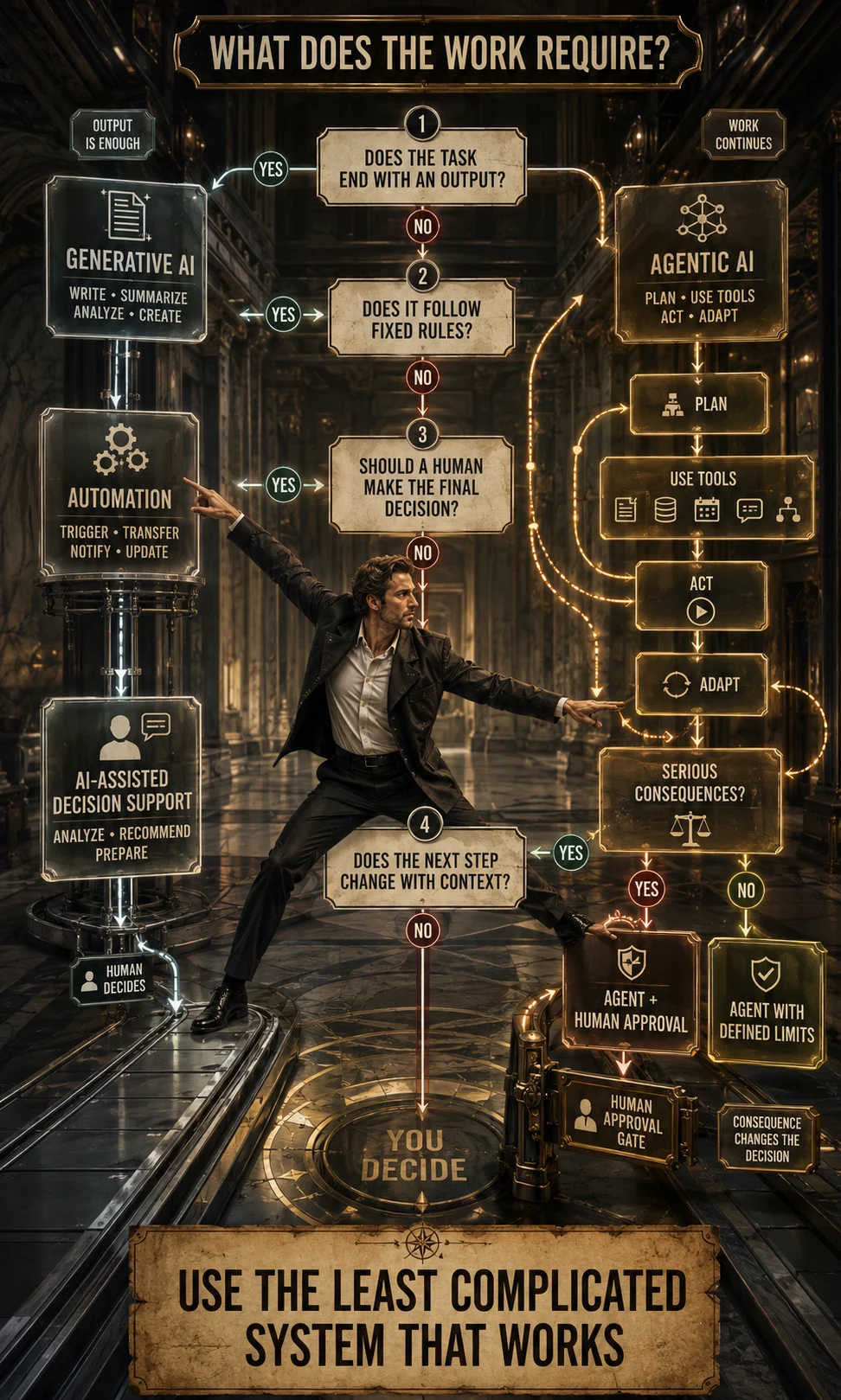
| Ask this question | If YES | If NO |
|---|---|---|
| Does the work primarily end with an output? | Start with generative AI | Continue |
| Can the complete process be expressed with stable rules? | Consider conventional automation | Continue |
| Does the next step change according to context? | Agentic behavior may add value | Generative AI or automation may be enough |
| Must the system use several tools or information sources? | Agentic architecture becomes more useful | Keep architecture simple where possible |
| Can important circumstances change while the work is running? | Feedback and adaptation become valuable | Fixed execution may be sufficient |
| Are autonomous actions reasonably reversible? | Greater autonomy may be practical | Add approval checkpoints |
| Is the objective clear and measurable? | Agent design becomes more feasible | Clarify the process first |
| Can human escalation conditions be defined? | Controlled autonomy is possible | Keep human control stronger |
This framework deliberately does not end with “use an agent” as the default recommendation. It starts by trying to solve the problem with the simplest architecture capable of doing the work well.
That principle matters because the productivity benefit from AI often comes from removing unnecessary complexity rather than adding another intelligent layer to the process.
Four Common Decisions and the Better Starting Point
“I need AI to create something for me.”
Start with generative AI.
Typical examples include writing, summarizing, explaining, creating images, generating code, brainstorming and transforming existing information.
The output is the primary value.
“I need the same action to happen whenever a known condition occurs.”
Start with automation.
A predictable trigger followed by a predictable action rarely needs an agent to reason through the situation each time.
“I need AI to help me decide, but I want to remain responsible for the action.”
Start with AI-assisted decision support.
The model can gather information, compare alternatives and prepare a recommendation while the human retains the operational decision.
This can be especially appropriate for sensitive or consequential work where AI vs human decision making involves accountability that extends beyond computational capability.
“I need AI to keep working because the next step depends on what happens.”
This is the strongest candidate for agentic AI.
The agent can potentially observe the changing situation, choose among permitted actions and continue until the outcome is reached or a boundary requires escalation.
That is where the additional architecture begins to earn its cost.
The Best AI System May Combine Generative AI, Automation and Agents
Real business workflows do not need to choose one technology for every stage.
Consider an employee-onboarding process.
Traditional automation can create a standard checklist when a new employee record appears.
Generative AI can draft a welcome message or summarize role information.
An agent can investigate whether required information is missing, coordinate several systems and handle variations that cannot be represented cleanly by fixed rules.
Human approval can remain around access permissions, employment decisions or unusual exceptions.
The architecture becomes a combination:
Stable process -> automation
Content or interpretation -> generative AI
Changing coordination -> agent
Consequential decision -> human
This layered approach can be more reliable than asking one autonomous agent to own the entire process.
It also makes troubleshooting easier because each component has a clearer job.
What Happens When Generative AI Gains Tools?
Tool access can blur the boundary between generative and agentic systems.
A generative model may be able to search the web, analyze files, run code or access an application without necessarily operating as a persistent autonomous agent.
The presence of tools alone therefore does not settle the classification.
Ask what the system does after the tool returns information.
If the user must decide every significant next step, the interaction may still be predominantly assistant-driven.
If the system can decide that another tool is needed, perform the next permitted action, inspect the result and continue toward a broader objective, the behavior has become more agentic.
This is why product labels are less useful than observing the actual control loop.
Can Generative AI Become Agentic AI?
Generative models are often important components inside agentic systems, so the transition does not require abandoning generative AI.
Instead, additional system capabilities are added around the model.
A simplified progression might look like this:
Generative model
↓
Generative model + tools
↓
Model + tools + goal
↓
Model + tools + planning + feedback
↓
Agent with permissions and stopping rules
↓
Agentic workflow with monitoring and human checkpoints
Each stage gives the system a larger operational role.
The crucial boundary appears when AI begins choosing and executing meaningful next steps without requiring the user to initiate each one individually.
Which Is Better for Small Businesses?
For many small businesses, generative AI will continue to provide the fastest and easiest productivity gains.
Writing customer communications, summarizing information, preparing marketing material, analyzing documents and helping with planning can deliver value without requiring a complex agent infrastructure.
Agentic AI becomes more compelling after the business identifies a recurring workflow where people repeatedly perform coordination work that cannot be reduced to simple rules.
Examples might include investigating support cases, coordinating projects across several information sources or preparing recurring decisions that depend on changing conditions.
The safest adoption path is often gradual:
First understand the process. Then automate the stable parts. Use generative AI where interpretation helps. Introduce an agent only where adaptive continuation solves a real problem.
That approach also reduces one of the major causes behind why AI productivity fails: deploying AI before defining the work problem clearly enough to know what improvement should actually look like.
The Decision Comes Down to Who Owns the Next Step
The simplest way to distinguish the two technologies in practice is to watch what happens after AI completes its first piece of work.
With generative AI, the system typically returns the result to you.
You decide whether to accept it, what it means and what happens next.
With agentic AI, some of that next-step responsibility can move into the system. The agent may decide which information to gather, which tool to use, whether the previous attempt worked and which permitted action should follow.
That transfer of responsibility is where agentic AI creates its greatest opportunity and its most important governance questions.
The comparison therefore reaches beyond output versus outcome.
It becomes a question of who owns the next decision.
How Agentic AI Could Change the Future of Work
Generative AI has already changed how many people approach individual pieces of knowledge work. A person can ask AI to draft a document, summarize information, analyze a spreadsheet, explain unfamiliar material or generate code without starting from a blank page. Agentic AI extends that shift into the coordination that happens before and after those outputs.
A large amount of office work consists of small decisions that connect one task with another. Someone notices that a deadline moved, checks another system, determines who needs to know, updates a document, follows up later and eventually decides whether the issue has been resolved. None of those actions may be especially difficult on its own, yet together they consume considerable attention.
An agentic system can potentially take responsibility for parts of that connective work. It might notice that a dependency changed, gather the information necessary to understand the effect, prepare an updated plan and escalate the issue when the consequences exceed its authority. This changes the productivity question from “Can AI help me complete this task faster?” toward “Which parts of this process still require me to decide what happens next?”
That does not mean people disappear from the workflow. In many settings, the human role becomes more concentrated around objectives, exceptions, judgment, relationships, approval and accountability. The system may perform more of the movement between those decisions while people remain responsible for determining whether the workflow itself is appropriate.
The distinction also connects with what AI can do and cannot do in the workplace. Technical capability can expand rapidly, while organizational responsibility, professional judgment and acceptable risk often change more slowly.
Jobs are more likely to change task by task
Discussions about AI and employment often treat a job as though every activity inside it has the same automation potential. Real roles are usually mixtures of predictable administration, analysis, communication, coordination, physical activity, judgment and responsibility.
Generative AI may reduce the time required for one component of a job, such as preparing a first draft. Agentic AI can potentially connect several components and automate a larger portion of a workflow. That may change how a role is structured even when the whole occupation remains.
A project manager, for example, may spend less time gathering updates while spending more time resolving exceptions and making trade-offs. A support professional may spend less time looking up routine information and more time handling emotionally difficult or unusual cases. A developer may delegate repetitive investigation while retaining responsibility for architecture, review and production decisions.
The useful unit of analysis is therefore the task and decision, rather than the job title alone.
Human judgment may become more concentrated, not less important
As software handles more routine coordination, the decisions left to people can become more consequential.
If an agent successfully handles ninety ordinary cases and escalates the ten unusual ones, the human may interact with fewer cases overall but face a higher concentration of ambiguity and risk.
That changes what good human oversight requires.
People supervising agents need enough context to understand why something was escalated, what the system already attempted, which evidence influenced its recommendation and what consequences follow from the remaining options. Human intervention becomes much less useful when the system merely hands over a mysterious failure without explaining what happened.
Effective agentic systems therefore need to support the person who receives the exception, not merely automate everything before it.
Generative AI and Agentic AI Will Increasingly Work Together
The long-term distinction between the two technologies is unlikely to resemble a competition where one replaces the other. Generative capability is frequently one of the building blocks that makes an agent useful.
An agent may use generative AI to interpret a request, summarize a document, create a plan, write a message, explain a result or generate code. The agentic layer determines how those capabilities participate in a continuing process.
A useful architecture might look like this:
Generative AI creates or interprets information
↓
Deterministic software performs predictable operations
↓
Agentic logic decides when adaptive action is necessary
↓
Human authority controls consequential boundaries
Each layer performs the part of the work it handles best.
This can be more robust than asking one AI system to reason about every decision, even when some decisions could have been expressed perfectly well as fixed software rules.
The future may be less about one AI and more about coordinated systems
As AI systems gain access to tools and external services, workflows can involve multiple specialized components rather than one universal agent.
One model may interpret a customer’s request. A deterministic policy system may determine whether a proposed refund falls within standard limits. An agent may gather missing account information. A human may approve an exception.
The experience can feel unified to the user even though several different systems are operating underneath it.
This is why understanding architecture becomes more useful than memorizing product categories. A system can combine generative AI, agents, automation and human review in different proportions depending on what the task requires.
Which Should You Choose: Agentic AI or Generative AI?
For most readers, the decision can be reduced to a small number of practical questions.
Choose generative AI when the main value is the output itself and you expect a person to decide what happens after receiving it. Writing, summarization, ideation, explanation, analysis, image creation and coding assistance often fit this pattern.
Choose agentic AI when the job continues after the first output and the system needs to make context-dependent decisions about what happens next. The strongest candidates involve changing conditions, several information sources, multiple tools and enough repeated coordination work that delegating some next-step decisions creates meaningful value.
Choose traditional automation when the process is already predictable. Fixed rules are usually easier to understand, cheaper to operate and simpler to audit than allowing AI to decide something that did not need judgment in the first place.
Choose AI-assisted decision support when interpretation benefits from AI but the final action should remain human. This is often the strongest design for consequential decisions where accountability matters more than maximizing autonomy.
The result is not one winner. It is a spectrum of architectures.
A 60-Second Decision Check
Before choosing agentic AI, ask the following questions together rather than judging the task from one characteristic.
Does the work end when AI produces an answer?
If yes, start with generative AI. There is little reason to introduce autonomous continuation when the desired product is the answer itself.
Can the next action be predetermined reliably?
If yes, investigate automation before building an agent. A predictable process rarely improves simply because AI is allowed to reinterpret it every time.
Does the next step change according to what the system discovers?
If yes, agentic behavior becomes more valuable because the workflow requires adaptation rather than simple execution.
Does the AI need to use several tools or information sources?
If yes, an agent can reduce the human coordination required to move between those systems, provided access and permissions can be controlled appropriately.
Would a wrong autonomous action be difficult to reverse?
If yes, retain a human approval checkpoint even if the preceding investigation and preparation are automated.
Is the goal clear enough that you could explain success and failure?
If no, improve the process before increasing AI autonomy. An agent cannot reliably optimize an objective that the organization itself has not defined.
The strongest candidate for agentic AI is therefore not simply a complicated task. It is a task with changing decisions, usable information, controlled tools, clear objectives and manageable escalation boundaries.
One Important Mistake: Using Agentic AI Because It Sounds More Advanced
Technology adoption often creates pressure to move toward the newest architecture even when an older approach already solves the problem.
Agentic AI is especially vulnerable to this because autonomy sounds inherently more capable.
Yet every additional decision delegated to the agent creates something else that has to be designed, evaluated or monitored. Every new tool adds permissions. Every adaptive branch introduces another possible behavior. Every external action creates a recovery question if the decision is wrong.
A simple generative workflow can therefore be better engineering than a sophisticated agent.
The correct goal is not:
Use the most autonomous AI available.
The better goal is:
Use the least complicated system that can reliably achieve the required outcome.
This is also one of the most useful principles for avoiding AI productivity failures. AI creates value when it removes meaningful friction from work, rather than when more AI components are added simply because they are available.
Agentic AI vs Generative AI: Final Comparison
| If your priority is… | Better starting point | Why |
|---|---|---|
| Writing, summarizing or creating | Generative AI | The output itself completes most of the task |
| Exploring ideas or analyzing information | Generative AI | Human can review and choose the next step |
| Repeating a predictable process | Automation | Rules are clearer and easier to audit |
| Getting AI recommendations while keeping authority | AI-assisted decision support | AI helps with interpretation while human retains action |
| Coordinating several changing steps | Agentic AI | System can adapt as circumstances change |
| Working across multiple tools | Agentic AI | Agent can reduce manual handoffs |
| Acting autonomously on low-risk reversible tasks | Agentic AI with limits | Delegation can reduce routine coordination |
| Making consequential or irreversible decisions | Agent + human approval | Automation can help without removing accountability |
The most important line in this table is the boundary between agentic AI with limits and agent plus human approval. The decision should change when the consequences of being wrong change.
A workflow can therefore use agentic AI without granting the agent authority over every stage.
The Bottom Line
Generative AI and agentic AI solve related but different problems. Generative AI is primarily designed to create, transform or analyze information in response to a request. Agentic AI uses AI capabilities inside a broader goal-oriented system that can decide what should happen next, use permitted tools, perform actions, inspect results and adapt as conditions change.
The difference is therefore larger than prompt versus goal or output versus outcome.
It is ultimately about who owns the next step.
When the human receives the AI’s result and decides how the workflow continues, generative AI is often sufficient. When the system itself needs to continue making bounded decisions toward an objective, agentic AI becomes relevant.
Greater autonomy should still have to earn its place. If generative AI, conventional automation or AI-assisted decision support solves the problem more clearly, adding an agent can create unnecessary cost and risk.
The most useful AI architecture is the one that delegates exactly enough responsibility to remove unnecessary work while keeping important human judgment where it still matters.
Frequently Asked Questions About Agentic AI vs Generative AI
What is the main difference between agentic AI and generative AI?
Generative AI primarily creates or transforms an output in response to a request. Agentic AI can operate across a broader process by pursuing a goal, choosing permitted actions, using tools, checking results and adapting what it does next. The practical distinction is that generative AI commonly returns control to the user after an answer, while an agent can continue working within defined boundaries.
Is agentic AI more advanced than generative AI?
Agentic AI can support a broader range of autonomous behavior, but that does not make it the better choice for every task. If the job is simply to write, summarize, analyze, explain, generate code or create another bounded output, generative AI can be more efficient and easier to control. Agentic AI becomes valuable when continuing decisions and actions are necessary.
Does agentic AI use generative AI?
Agentic systems frequently use generative models for reasoning, interpretation, summarization, writing and other cognitive tasks. Generative AI can therefore operate as one component inside an agentic workflow. The additional agentic layer provides goals, tools, permissions, feedback and the ability to continue across multiple steps.
Can generative AI use tools without being agentic?
Yes. Tool access alone does not automatically make a system agentic. A generative assistant may use search, code execution or file analysis while still returning control to the user after each request. Behavior becomes more agentic when the system can decide that another action is required and continue toward a broader objective without the user initiating every step.
Is agentic AI the same as automation?
No. Traditional automation normally follows predefined rules, while agentic AI can make context-dependent decisions about what happens next. They can work together. Stable stages of a workflow can remain automated while an agent handles situations where conditions vary and predefined rules become insufficient.
When should I use generative AI instead of an AI agent?
Use generative AI when the work primarily ends with an output that a person will review or use. Drafting, summarization, ideation, analysis, explanation and many coding tasks fit this pattern. Generative AI is also preferable when additional autonomy would create more complexity than useful time savings.
When is agentic AI worth using?
Agentic AI becomes more attractive when the workflow contains multiple changing steps, several information sources or tools, repeated coordination work and situations where the system needs to decide what happens next. The objective should be clear, permissions controllable and escalation conditions defined before significant autonomy is granted.