




Bipolar depression is the low-mood phase of bipolar disorder, and it can make sleep, meals and ordinary responsibilities difficult to manage. Seven practical supports can make the day more manageable alongside treatment; the starting point is protecting a basic routine rather than trying to force your energy upward.
If you are safe and simply need a place to begin, choose the action that removes today’s most immediate obstacle: closing late-evening work, making breakfast accessible or accepting help reaching an existing appointment. You do not need to complete all seven, and completing an action does not require feeling happier afterward.
If you might act on thoughts of suicide or cannot keep yourself or someone else safe, use your local emergency service or emergency department now and involve a trusted person if available. New hallucinations, severe confusion or rapidly escalating behavior also need urgent assessment. These situations take priority over the everyday suggestions below.
What can everyday remedies do for bipolar depression?
They can support ordinary functioning and reduce avoidable disruption, but they do not replace treatment for a bipolar depressive episode. The useful distinction is between treating the illness and making essential activities easier while that treatment is taking effect. A manageable breakfast is worthwhile even when it does not change the episode.
The word “remedy” can blur that distinction. The comparison of unipolar and bipolar depression explains why a similar-looking low mood can require a different treatment approach. Medication and bipolar-specific psychological care address a clinical condition; rearranging an evening task or sharing meal preparation addresses a practical obstacle. The examples here are adaptations of everyday support principles, not seven independently validated treatments or a home cure.
Before choosing an activity, consider the direction of the change. Feeling exhausted after poor sleep differs from sleeping much less while becoming unusually driven, impulsive or fast-thinking. A person can feel depressed and activated at the same time, so apparent energy is not automatically evidence of recovery. The comparison below is an illustration, not a diagnostic test.
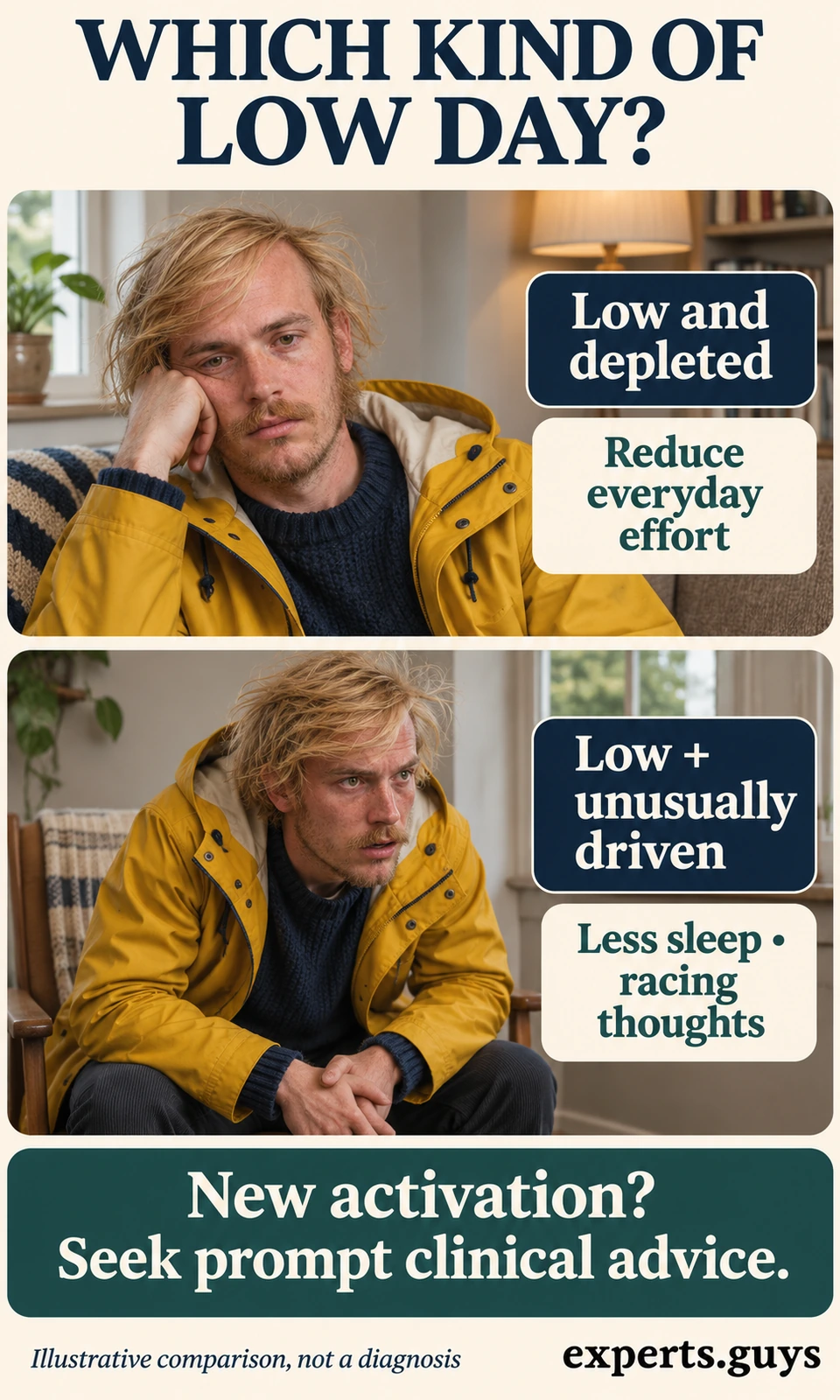
A new combination of low mood, markedly reduced need for sleep, racing thoughts or unusual risk-taking warrants prompt contact with the treating team, especially if it is escalating. Do not respond by adding intense exercise, extra caffeine or more commitments. A previous agreed care plan can guide the response; immediate danger needs emergency help.
For the broader recognition question, the guide to early warning signs of bipolar depression explains changes from your usual baseline. This page has a different task: translating a low-energy day into practical arrangements that preserve food, rest and manageable responsibilities.
Keep treatment and daily support in separate roles
Bipolar depression needs a treatment plan suited to the person’s episode and history. NIMH’s bipolar disorder guidance describes medication and psychotherapy, and warns that antidepressants taken alone can trigger mania or rapid cycling. Do not start, stop or change prescribed medication using this article as a guide.
If treatment leaves you excessively sleepy, restless or unable to manage basic activities, the useful response is a medication review rather than deciding you must work harder. Describe the practical effect directly: “I cannot stay awake through breakfast,” for example. That is information for the prescriber, not proof of a particular drug effect or permission to change a dose.
An everyday support succeeds when it makes a necessary activity possible at a tolerable effort. Clinical improvement is a different question involving the overall course of symptoms and functioning. Keeping these outcomes separate helps avoid both false reassurance from one productive afternoon and self-blame when a useful step does not lift your mood.
| Question | Support and its limit |
|---|---|
| How is the episode treated? | Use an individualized clinical treatment plan. A household exercise cannot select a medicine. |
| How can today become manageable? | Reduce an obstacle to food, rest or an existing appointment. Task completion does not prove symptom remission. |
| What if energy rises while sleep falls? | Describe the change promptly to the treating team. A productive day does not settle the type of episode. |
| What if basic needs remain inaccessible? | Arrange reassessment and practical support. More effort is not a substitute for necessary care. |
For most people facing an ordinary low-energy day, the priority should be the most consequential missing basic, not the most ambitious activity. Food that is accessible and an evening that ends are more useful starting points than an elaborate wellness program. This is a practical editorial priority, not evidence that one household sequence works best for everyone.
Bipolar disorder is generally a long-term condition. Feeling well for a sustained period can be a treatment success, but it does not show that the condition has been outgrown or that ongoing care is unnecessary. The aim is a sustainable life with appropriate support, rather than proving you can manage without it.
The next sections develop seven different ways to reduce practical demands. Choose one by the obstacle it solves, adapt it to your abilities and leave the others available for another occasion. A routine that depends on perfect attendance quickly becomes another burden.
- Sleep disruption: close evening work and keep a familiar morning transition.
- Meal or movement barriers: simplify food assembly and make movement easy to return from.
- Too many demands: contain catch-up work, accept help reaching a treatment visit and remove alcohol as the automatic evening response.
How can you protect sleep without forcing yourself to sleep?
Protect the circumstances around sleep: end stimulating work, keep an ordinary morning cue and avoid turning a poor night into an experiment with extreme schedules. A household routine cannot make sleep happen on command. It can, however, remove tasks and environmental demands that keep postponing an opportunity to rest.
The NHS advice on living with bipolar disorder emphasizes routine, sleep and managing stress. It also identifies very long hours and shift work as potential difficulties. The two demonstrations below translate that general guidance into modest home actions; they are not a substitute for therapy for insomnia or a personalized sleep plan.
1. Close the evening task before it takes over
Use this when unfinished work turns into “just one more thing” and pushes the evening later. Choose an existing transition, such as finishing your evening meal, as the point to put the activity away. You are closing the work session, not forcing yourself to become sleepy or demanding that every evening follow an identical timetable.
- Place loose work materials in their usual safe container and close it. Leave necessary medical equipment and accessibility aids available.
- Switch off an unnecessarily bright room light while keeping enough warm, comfortable light to move safely.
- Choose a familiar quiet activity, such as listening to music or a radio at a comfortable volume. Leave the unfinished task for another session.
Illustrative example: someone repairing a jacket after dinner realizes that sorting every spare button will become another project. They close the sewing box, leave the repair unfinished and listen to a familiar program. The outcome is an evening no longer organized around finishing the repair. It is not a promise that they will fall asleep quickly.
A common mistake is replacing work with another demanding task: an intense workout, a major clean or a long argument. Choose a genuinely lower-demand activity instead. If packing everything away is too much, put away one work item and let someone help with the rest; the smaller version still creates a visible boundary.
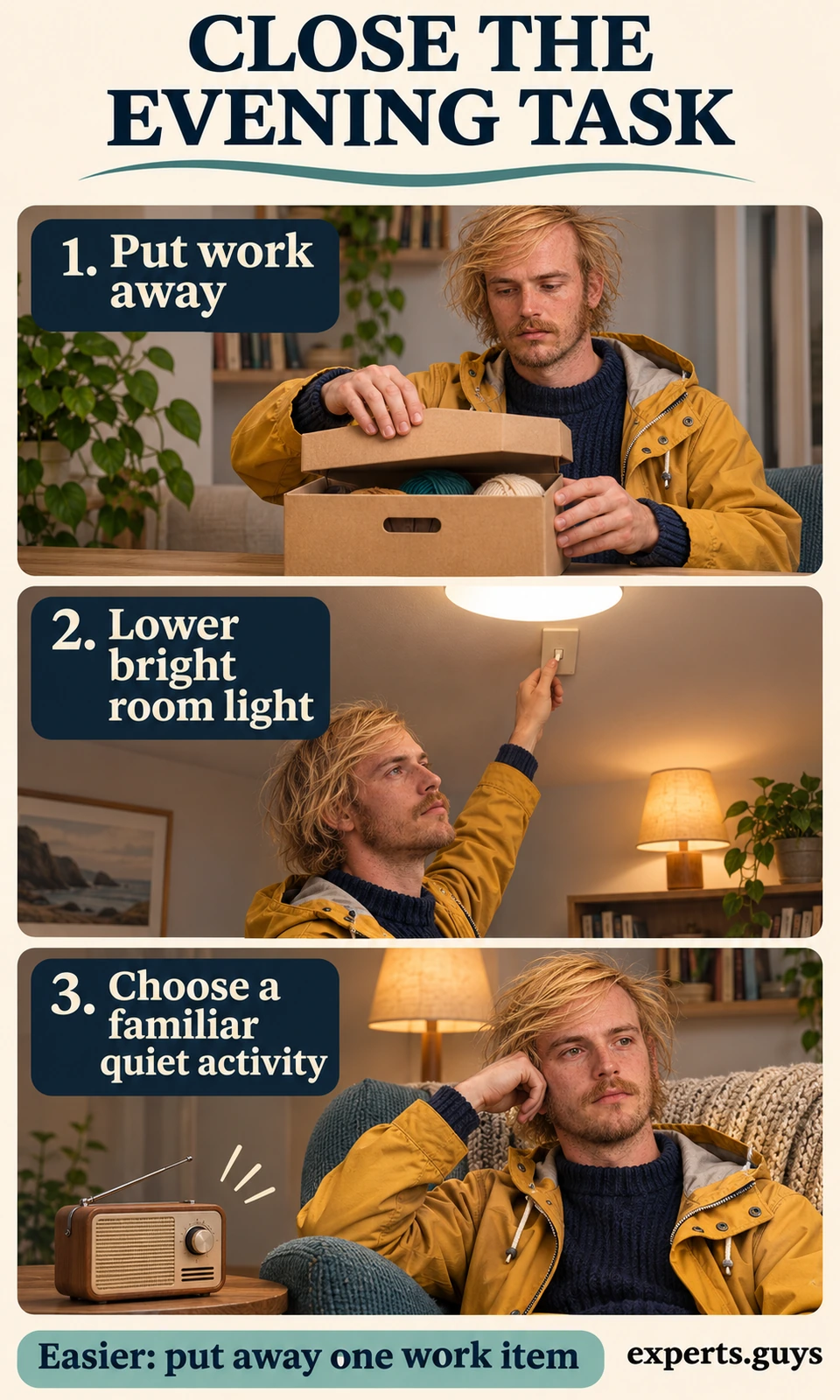
Keep the light comfortable rather than making the room unsafe or completely dark. People who need clear lighting for balance, vision or care should preserve it. If the activity repeatedly expands despite your intentions, change its placement or ask for practical help ending it; do not judge the whole evening by whether you became sleepy.
Persistently worsening insomnia, especially with new activation, changes the problem. It calls for the treating team’s advice rather than progressively stricter bedtime rules. Do not improvise sleep deprivation, all-night resets or changes to sedating medication to recover a missed night.
2. Make the morning transition familiar and accessible
Use this when waking is followed by a long period of uncertainty about how the day begins. The action is a repeatable transition into ordinary daytime activity, not an alarm challenge. Work with your existing sleep plan and usual waking pattern; do not deliberately shorten sleep to complete a morning routine.
- After getting up at the time agreed in your routine, move to a safe daytime seat or other accessible breakfast place.
- Open a curtain or use ordinary comfortable room light. Avoid staring at the sun or adding a therapeutic bright-light device.
- Begin the usual first activity, such as breakfast. If moving rooms is difficult, use an accessible seated version and let someone help open the curtain.
Illustrative example: instead of deciding between exercise, messages and housework while still in the bedroom, a person goes to the kitchen chair, opens the curtain and begins breakfast. The repeated transition reduces decisions at a difficult time of day. The example does not prescribe a wake time, an amount of light or a treatment dose.
The main mistake is turning this into “get up earlier no matter what.” A very poor night may require advice and an adaptation, especially when alertness is impaired. Ordinary daylight in a familiar room is also different from bright-light therapy, which involves clinical decisions about timing, exposure and monitoring in bipolar disorder.
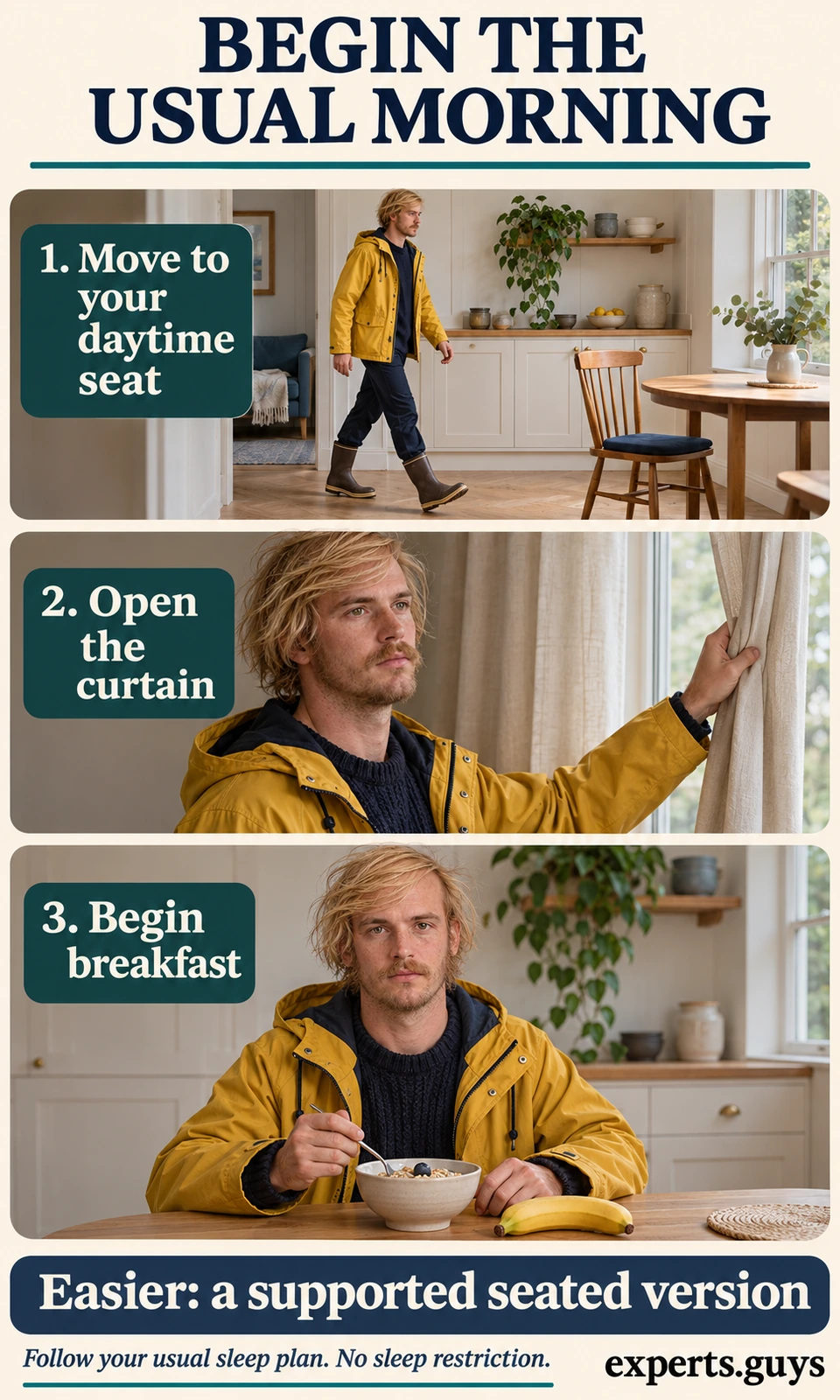
If the kitchen is inaccessible, the practical target can be a comfortable chair nearer the bed, appropriate lighting and food brought within reach. Keep the route clear and avoid carrying hot drinks while dizzy. Completion means making the morning transition possible, not achieving a perfect sequence independently.
For the wider distinction between insomnia, oversleeping and non-restorative sleep, see the explanation of depression and sleep patterns. These actions support regularity without pretending that sleep is entirely under voluntary control. The reason to preserve a routine is to keep daily life predictable enough to participate in; the reason to adapt it is that safety and actual capacity matter more than rigid compliance.
How can meals and movement stay manageable on a low-energy day?
Reduce preparation and keep the effort small enough that the activity remains usable. For meals, that may mean assembly rather than cooking. For movement, it means an accessible route with an easy return rather than a target that leaves you stranded, exhausted or unable to manage the rest of the day.
The WHO overview of bipolar care includes physical activity, a healthy diet and practical psychosocial support alongside clinical treatment. That supports these broad categories, not a claim that a particular breakfast or walking route treats bipolar depression. The arrangements below are illustrative ways to lower the effort of participating.
3. Assemble a meal from food that is already usable
Use this when choosing a recipe, handling pans or cleaning up prevents you from eating. Start with foods you already tolerate and can safely eat. A no-cook meal is a practical access option, not a special bipolar diet, and individual allergies, swallowing needs, diabetes care or other dietary requirements still apply.
- Bring a bowl, spoon and suitable ready-to-eat foods to a stable surface. Keep perishable items refrigerated until needed.
- Assemble a familiar combination. One example is yogurt, oats suitable for eating without cooking and a banana
- choose appropriate alternatives for your dietary needs.
- Sit comfortably to eat, and return perishable foods to the refrigerator. If assembly is too difficult, accept a suitable prepared meal or ask someone to bring one.
Illustrative example: lunch has become difficult because every option seems to involve a pan. The person uses the breakfast foods they have available rather than postponing food until they can make a “proper” lunch. The immediate outcome is accessible food. The meal is not being presented as a balanced solution for every diet or as an antidepressant intervention.
The common mistake is increasing complexity in the name of making the meal healthier: extra ingredients, unfamiliar supplements or a recipe that creates more cleanup. Keep the familiar version usable first. If the food does not fit your needs, change the ingredients rather than forcing yourself to eat the demonstration meal.
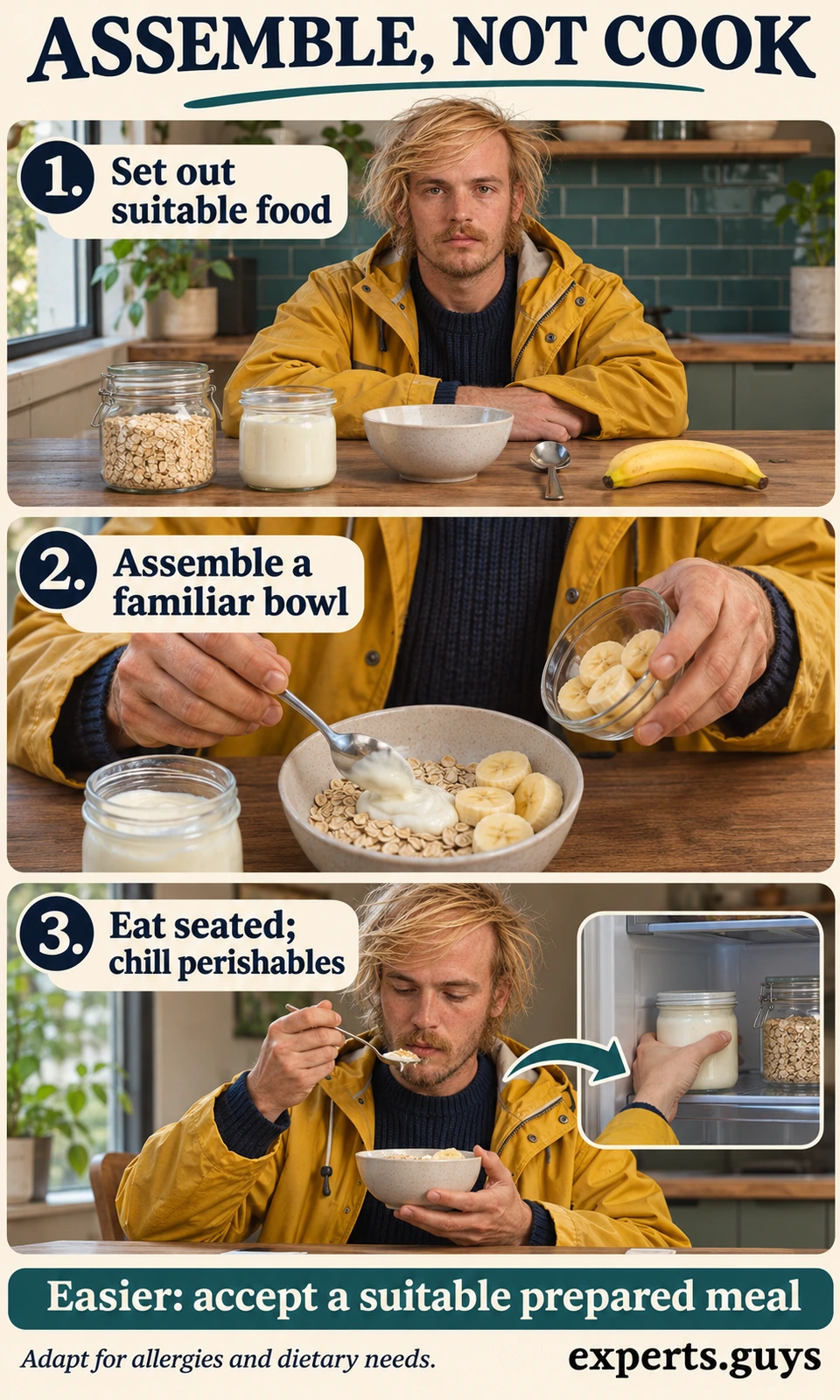
Poor appetite needs a different adaptation from difficulty preparing food. Smaller tolerable portions or assistance may make eating easier, but repeated inability to eat, drink or take essential medicine needs clinical attention. A no-cook option solves a preparation barrier; it cannot explain significant weight change, dehydration or a swallowing problem. The guide to depression and appetite changes owns the fuller food-access explanation; this is a brief application within a bipolar care routine.
If you take lithium, avoid sudden dietary or fluid changes as a self-treatment experiment. NHS lithium guidance explains why dehydration and changes involving salt intake matter. Follow your own instructions, particularly during vomiting, diarrhea, fever or hot weather, rather than using a generic fluid target from the internet.
4. Choose movement with an easy return
Use this when you want some movement but a normal outing feels too demanding. Choose a familiar, level route close to a safe place to stop. The practical design feature is reversibility: you can return without having committed to a long distance, busy crossing or activity that requires someone to collect you.
- Check that your footwear, balance, alertness and chosen route are suitable today. Stay away from water edges, traffic and slippery or uneven ground.
- Move comfortably to a nearby familiar point, then return before the effort becomes difficult. There is no required pace, distance or step total.
- Finish at an accessible rest place. If walking is unsuitable, choose a comfortable seated movement you already know is safe, or have someone support an appropriate alternative.
Illustrative example: someone who usually walks to the shops chooses a level courtyard route close to home instead. They turn back while returning is still easy. This is a way to make an activity less demanding, not a prescribed exercise dose. The same principle can mean remaining indoors when heat, weather or access makes an outdoor route unsuitable.
A common mistake is using a slightly better hour to test fitness or catch up on missed exercise. That changes a manageable activity into a performance demand. End the chosen outing without adding another loop simply because you feel guilty about stopping; a route that remains available tomorrow is more useful than a challenge that discourages another attempt.
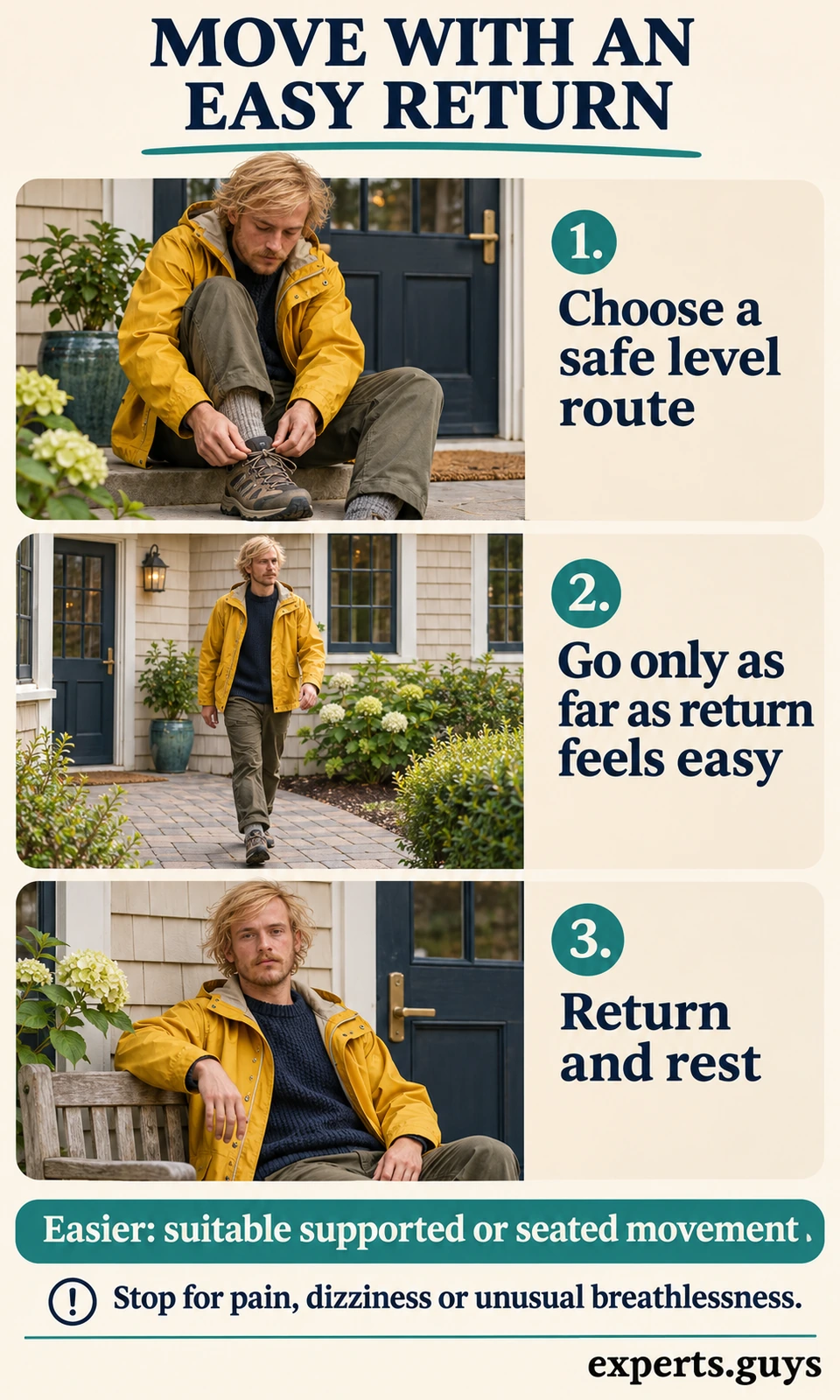
Stop for pain, dizziness, unusual breathlessness or other concerning symptoms rather than pushing through them. New agitation or unusually driven activity also deserves reassessment instead of a harder workout. Physical limitations, medication effects and other illnesses can change what is appropriate, so the ordinary route may need to be smaller or supported.
Outdoor activity does not need to be fishing just because you enjoy it. If concentration, judgment or alertness is reduced, boats, hooks, knives and isolated water introduce unnecessary hazards. Choose the accessible movement itself rather than attaching a risky hobby task to it; safety is part of reducing the day’s demands.
| Barrier | Change the arrangement | Useful stopping point |
|---|---|---|
| Cooking creates too many steps | Use familiar ready-to-eat food or a suitable prepared meal. | Food is available and perishables are stored safely. |
| An outing feels difficult to return from | Choose a level route closer to a safe rest place. | You return before the effort becomes difficult. |
| Standing or balance is a barrier | Use appropriate seated or supported activity. | The activity is accessible without pushing through symptoms. |
| A better hour becomes catch-up work | Keep one naturally bounded unit instead of expanding the task. | The next meal or rest retains its place. |
These examples separate participation from optimization. Food does not need to become a dietary project, and movement does not need to become a fitness test. The practical question is whether the activity removes a barrier without taking away what you need for the next essential part of the day.
How can you reduce demands without abandoning the day?
Contain one activity, accept agreed support to make an existing treatment visit reachable, and change the evening environment when alcohol has become the default response. These actions have different outcomes: a task ends, care becomes accessible or a drink choice becomes easier. None requires a diary or a productivity score.
The lead skill here is ending a manageable unit of work before it consumes the next basic activity. This is especially relevant when guilt about missed work drives a catch-up attempt. The point is to protect the place of a meal or rest in the day, rather than to obtain the largest possible amount of work from a temporary improvement in energy.
5. Finish one bounded unit, then put it down
Choose a task with a visible stopping point before you begin. Avoid an open-ended instruction such as “catch up on the house,” which provides no clear moment to finish. The unit should be useful on its own and small enough to leave the rest of the day available; it does not need to be timed or recorded.
- Select a naturally bounded unit, such as folding the towels already in one small basket. Do not add another load.
- Work seated or in another comfortable position if needed, keeping the task within easy reach.
- Put the finished unit away, leave the remaining work for another occasion and return to the next ordinary activity. Easier version: fold one towel and ask someone to finish the basket.
Illustrative example: dinner is approaching and laundry has been neglected. Instead of emptying every cupboard to reorganize, the person folds the small towel basket and stops. Dinner keeps its place. The action is complete because a useful unit ended, even if the wider room is unchanged and mood remains low.
The trap is changing the agreement midway: one basket becomes the whole wash, then the wardrobe. Correct it by closing the current unit rather than adding another. If even the small unit causes marked exhaustion or pain, reduce it or hand it over. A stopping point is a boundary, not an obligation to finish despite your body.
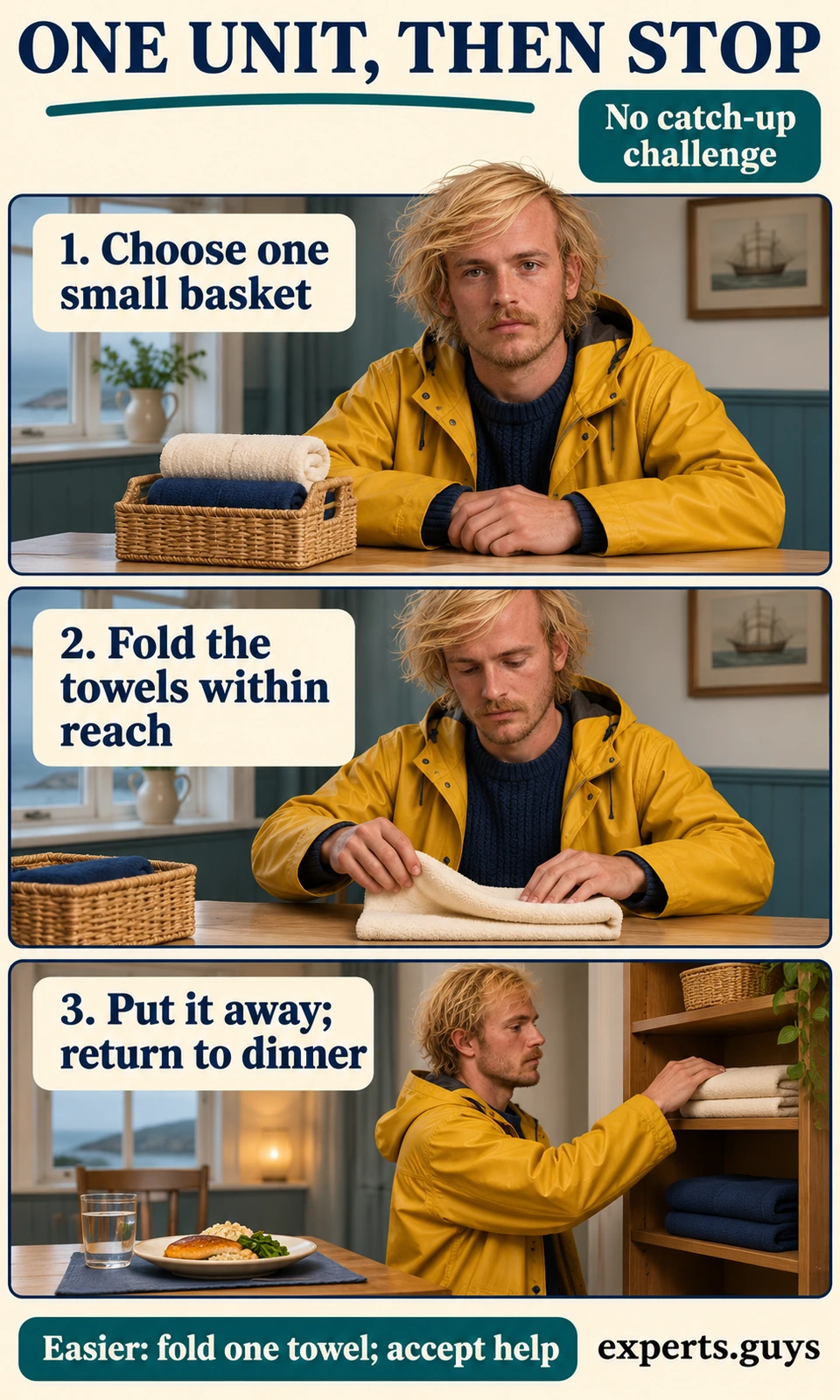
This differs from using activity as a way to prove you are recovering. A person can finish towels while remaining very depressed, and someone who cannot fold them is not failing treatment. Watch what the task costs in the surrounding day: if meals or rest repeatedly disappear afterward, the practical demand is still too large.
On a better day, increase demands cautiously in line with your care plan and ordinary responsibilities. A sudden leap in drive, less need for sleep or unusual urgency to complete everything belongs in the episode discussion, not in a celebration of productivity. The guide to irritability and activation during bipolar depression explores that context in more detail.
6. Make an existing treatment visit easier to reach
Use this when the appointment is arranged but the trip feels unmanageable. The support is transport and accompaniment, not asking a friend to make clinical decisions. Choose a trusted person who agrees to help, and decide whether you want them only for the journey or also in the appointment.
- Agree the pickup place, destination and return arrangement for the visit already booked. Let the helper handle travel logistics when needed.
- Put on suitable clothes and footwear and take the ordinary essentials for that visit. Keep the route to the pickup point safe and accessible.
- Travel with the agreed support and use the planned return arrangement. Do not drive if sleepy, dizzy or unable to concentrate. Easier version: ask the treating service about an accessible or remote option if travel cannot be managed safely.
Illustrative example: a person knows the clinic and wants to attend, but navigating transport feels overwhelming. A trusted companion meets them at the door, handles the journey and waits outside the consultation unless invited in. The completed step is reaching the agreed care contact; the companion does not need to explain the illness on the person’s behalf.
A common mistake is assuming that accepting a lift means giving up privacy or control. Agree the boundary beforehand: transport only, company in the waiting area or help during the consultation if wanted. Consent can change. If the helper is unavailable, contact the service about alternatives rather than silently missing the visit or attempting an unsafe journey.
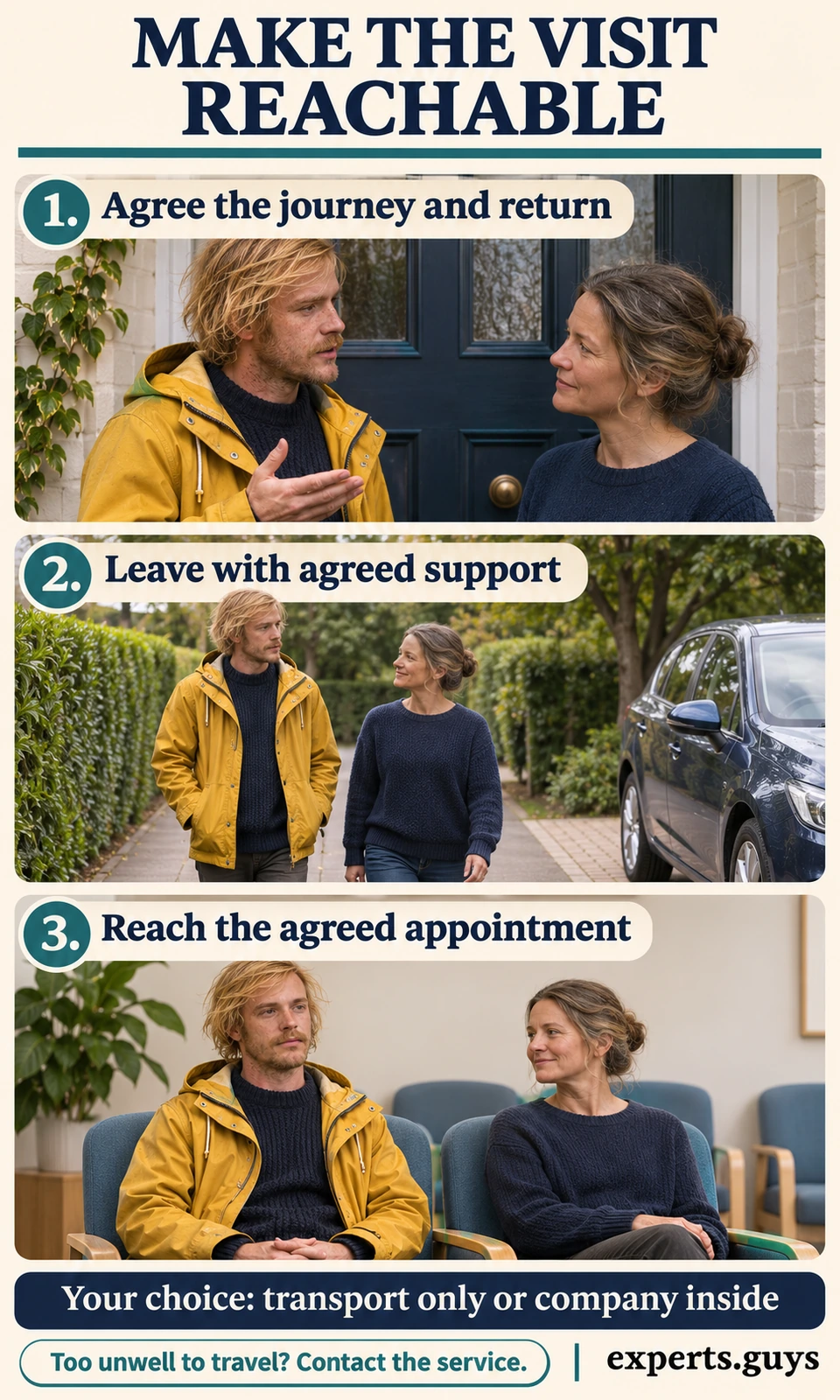
A transport arrangement can be useful even if you can manage household tasks. The obstacle may be navigating the journey, coping with a busy waiting area or getting home safely afterward. No diary, packed worksheet or rehearsed life history is a prerequisite for accepting a lift.
If symptoms make an ordinary visit unsafe or the situation is becoming urgent, tell the service what has changed rather than relying on a routine transport plan. A prebooked appointment is not an emergency response, and a trusted companion is not a substitute for emergency care when someone cannot stay safe.
7. Replace the automatic evening drink, without ignoring withdrawal risk
Use the simple substitution below only when you are not physically dependent on alcohol. If reducing alcohol causes shaking, sweating, nausea or other withdrawal symptoms, or you have a history of withdrawal, get medical advice before stopping abruptly. The NHS alcohol-use guidance explains withdrawal risk and supported care. Severe withdrawal, seizures or confusion require emergency help; a different beverage is not a withdrawal treatment.
- Choose a familiar nonalcoholic, preferably caffeine-free drink that fits your health needs. Water is one simple option.
- Prepare it at the usual evening drink occasion and place it within comfortable reach.
- Pair it with the evening activity you already chose, rather than adding a new project. Easier version: ask someone to bring the drink. If you cannot reduce safely, seek supported alcohol care instead of repeating this substitution.
Illustrative example: someone without dependence usually pours alcohol while continuing household work late into the evening. They choose water with their familiar radio program after putting work away. The substitution addresses the automatic drink occasion; closing work remains a separate action. Neither step establishes that an alcohol problem has resolved.
The common mistake is replacing alcohol with an energy drink to push through tiredness, or replacing it with an unverified “mood” supplement. That can preserve the original problem of overriding the body’s need to stop. The aim is a usable evening choice, not a chemical shortcut to energy, sleep or a better mood.
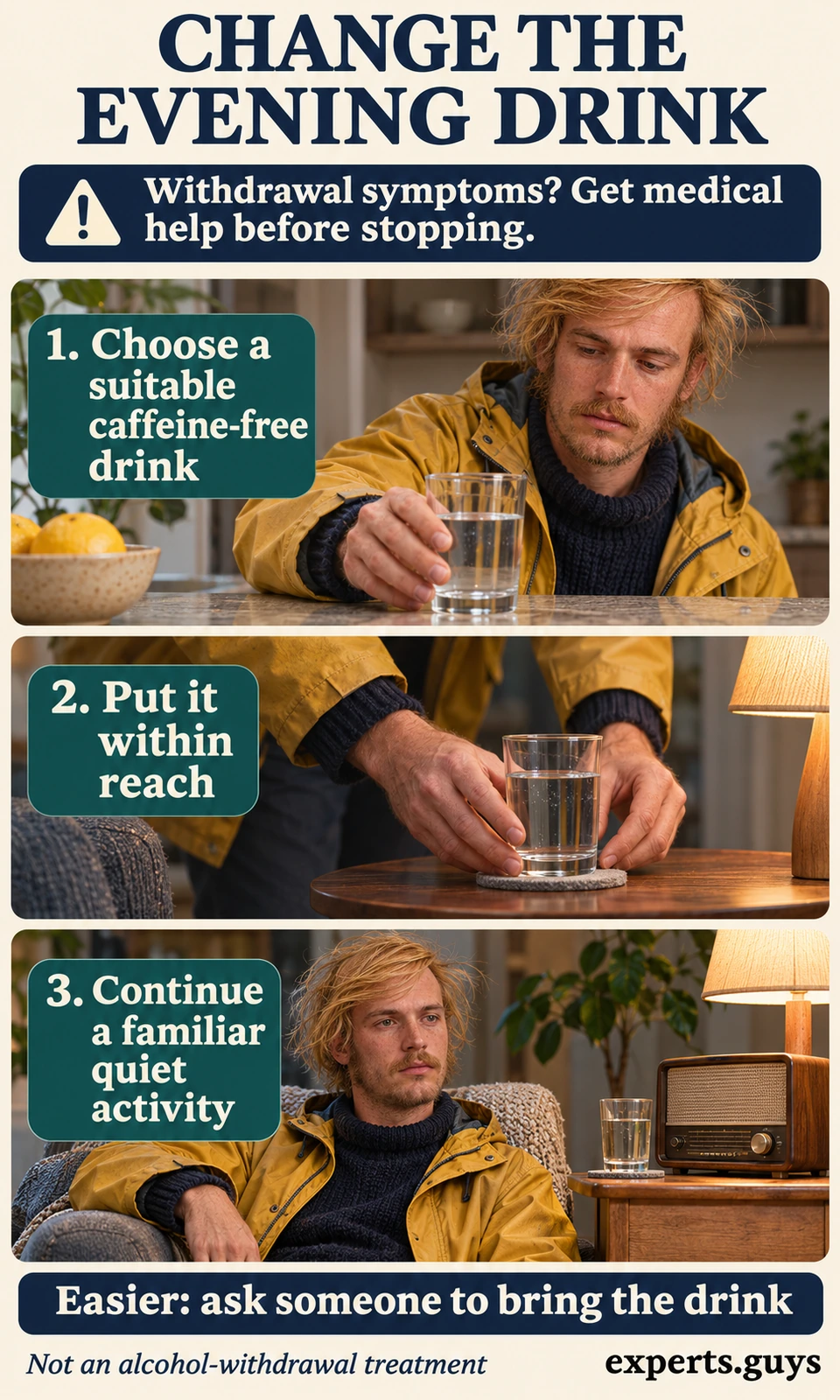
Do not assume herbal products are safer because they are sold as natural. NCCIH’s St. John’s wort guidance describes important medicine interactions and the potential to worsen symptoms in bipolar disorder. A supplement marketed for ordinary depression should not be treated as an interchangeable treatment for bipolar depression.
The seven supports address different obstacles, so you can judge each by its own practical result. If the meal is accessible, the task ends or an agreed care contact becomes reachable, that arrangement may be worth keeping. If symptoms persist, worsen or make basic care unmanageable, the treating team needs to reassess the episode alongside these arrangements.
Questions that often come up
Do I have to start again if I miss a routine?
No. Resume at the next useful ordinary activity rather than treating the day as ruined. Missing breakfast does not require an extreme catch-up meal, and a disrupted morning does not justify staying up to complete everything. If disruption becomes a recurring problem, change the arrangement or support available rather than making the rules stricter.
What if I cannot avoid shift work or irregular responsibilities?
Avoid treating an ideal routine as a personal obligation when your circumstances make it impossible. Discuss the actual work pattern with your treating team and, where available, occupational health or an employer who can consider adjustments. Changes to shifts, transport or workload need to fit your circumstances; do not sacrifice sleep to copy a morning example from this article.
Can these supports be used before a bipolar diagnosis is confirmed?
Accessible food, suitable help and manageable responsibilities can still be useful, but they cannot confirm a diagnosis. If low mood is accompanied by unusual changes in sleep, activity or judgment, assessment should consider the whole history. Do not use a good response to a routine or a poor response to an activity as a test of whether you have bipolar disorder.
Can a relative carry out the steps for someone who does not want them?
Offer a specific choice and ask what would actually help. A person may want a lift but no company in the consultation, or a meal without a long visit. Everyday support should respect those boundaries. If immediate safety is in doubt, use appropriate urgent services rather than arguing over completion of an optional activity.
Choose the support that protects the next basic activity
Start where today’s difficulty has the clearest consequence. If evening work keeps expanding, close it before adding a sleep routine; if food preparation is the barrier, assemble a tolerable meal or accept a prepared food option. Choose one workable arrangement and leave the rest of the list available rather than turning it into seven new demands.
The useful result is a day with one less obstacle: an evening task ends, food becomes reachable or an outing remains easy to return from. Keep the arrangements that help preserve ordinary life, change the ones that cost too much and use the care plan when the mood episode itself needs a different response.









