



Bipolar anger describes anger or irritability that can occur alongside bipolar disorder; it is not a separate diagnosis or proof that every disagreement is a mood episode. When an interaction is escalating, stop trying to settle the dispute, create space safely and decide whether the next step is a calmer conversation or urgent support.
If someone is threatening harm, preventing another person from leaving, becoming severely confused or losing touch with reality, put safety before the coping steps below. Use local emergency services when danger is immediate; do not attempt to restrain someone, take a weapon from them or negotiate your way through an unsafe confrontation.
What does anger tell you about bipolar disorder?
Anger tells you that something needs attention, but it cannot identify the cause on its own. A disagreement may concern an actual broken promise, an exhausting day, pain or a mood change; several explanations can be true together. The useful distinction is between the issue being argued about, the way people are behaving and any wider change in sleep, energy or judgment.
Irritability means becoming frustrated or annoyed more easily. Anger is the emotion itself; aggression describes behavior that threatens or harms. Keeping those terms separate helps you respond proportionately: feeling furious does not mean someone will become aggressive, and a diagnosis does not excuse intimidation. Respond to what is happening rather than treating a person as a prediction.
- An angry moment is not a diagnostic test. Look beyond the exchange if there has been a clear change from the person’s usual functioning.
- A legitimate complaint still deserves an answer. Discussing symptoms should not erase the missed payment, hurtful remark or other practical issue.
- Unsafe behavior changes the task. A threat or blocked exit calls for safety support, even if nobody knows whether an episode is involved.
| What is happening | What to do and why |
|---|---|
| A disagreement, with room to stop | The issue may be ordinary conflict, with or without symptoms. Pause if voices or interruptions are increasing; return to the actual issue when both agree. |
| A wider change from usual | Less need for sleep, unusual drive or impaired judgment may need assessment. Contact the treating team promptly rather than waiting for another argument. |
| Threats, blocked exits or immediate danger | A communication exercise cannot establish safety. Get to safety if possible and use urgent local help; emergency services for immediate danger. |
Mood episodes involve a broader pattern than an argument. A person may be unusually activated and irritable, or low and easily overwhelmed. The NIMH overview of bipolar disorder explains these changes in mood, activity and sleep. The important comparison is with that person’s usual state, not with how calm someone else looks.

Why can a small disagreement feel much bigger?
Sometimes the immediate request arrives when the person is already struggling to tolerate another demand. At other times, fast thinking, urgency or an unusually confident interpretation can make a discussion harder to slow. These are possible contexts, not a way to read someone’s brain from an expression. You cannot settle the explanation by deciding that an “anger center” has taken over.
Consider an illustrative example: a housemate asks why dinner was not started, and the reply becomes sharp. One person may be exhausted and unable to decide what to cook. Another may have slept very little while feeling driven to reorganize the whole apartment. The same sharp reply leaves different questions about the wider picture. Neither example establishes a diagnosis, and neither removes the need to discuss dinner fairly.
When low mood is the main context, the guide to irritability during bipolar depression explains that narrower pattern. Here the priority is what to do when the exchange itself starts to escalate. You do not need to settle the episode question before choosing to stop interrupting or step away safely.
Is "bipolar rage" a useful label?
People use the phrase to describe intense anger, but it is not a separate clinical diagnosis with its own reliable home test. Labels such as “meltdown” can also mean different things to different people. Describing the behavior is more useful: “I was talking over you and could not stop arguing” identifies something that can change; “I had bipolar rage” leaves the action and its impact unclear.
Duration alone will not resolve the uncertainty. A short outburst does not prove intermittent explosive disorder, and a long argument does not prove mania. Assessment considers the history and wider symptoms. The immediate response should still follow present behavior: respect space when a pause is possible, and escalate support when safety or judgment is seriously compromised.
How can you interrupt an escalating argument safely?
Use a pause that changes what you are doing, not a command that the other person must become calm. The lead skill is to stop participating in the escalation, leave a clear route for both people and name how the conversation will be revisited. Use this only when a voluntary pause is safe; it is not a strategy for managing threats or coercive control.
This approach draws on the timeout principle in SAMHSA’s anger-management workbook. The household sequence below is an adaptation, not a separately tested bipolar treatment. Its immediate goal is an interrupted argument with access to support, not a particular feeling or a promise to prevent an episode.
Make the first interruption early
Choose a recognizable action cue: you are repeating the same accusation, raising your volume or cutting in before the other person finishes. You do not need a numerical anger score. An early cue is useful because it gives you something concrete to stop; waiting until you feel completely out of control makes a voluntary pause harder to carry out.
- Stop the current exchange. Finish neither the accusation nor the “one last point.” If you are doing a hazardous task, make it safe before moving; do not walk away from a hot pan, a moving vehicle or someone who needs supervision.
- Put down any ordinary object you are holding, if it is safe to do so. Keep your hands relaxed and avoid pointing, crowding or touching the other person.
- Say one short sentence: “I am too wound up to discuss this fairly. I am stopping now, and we can check later whether we can talk.” Use words that sound natural to you.
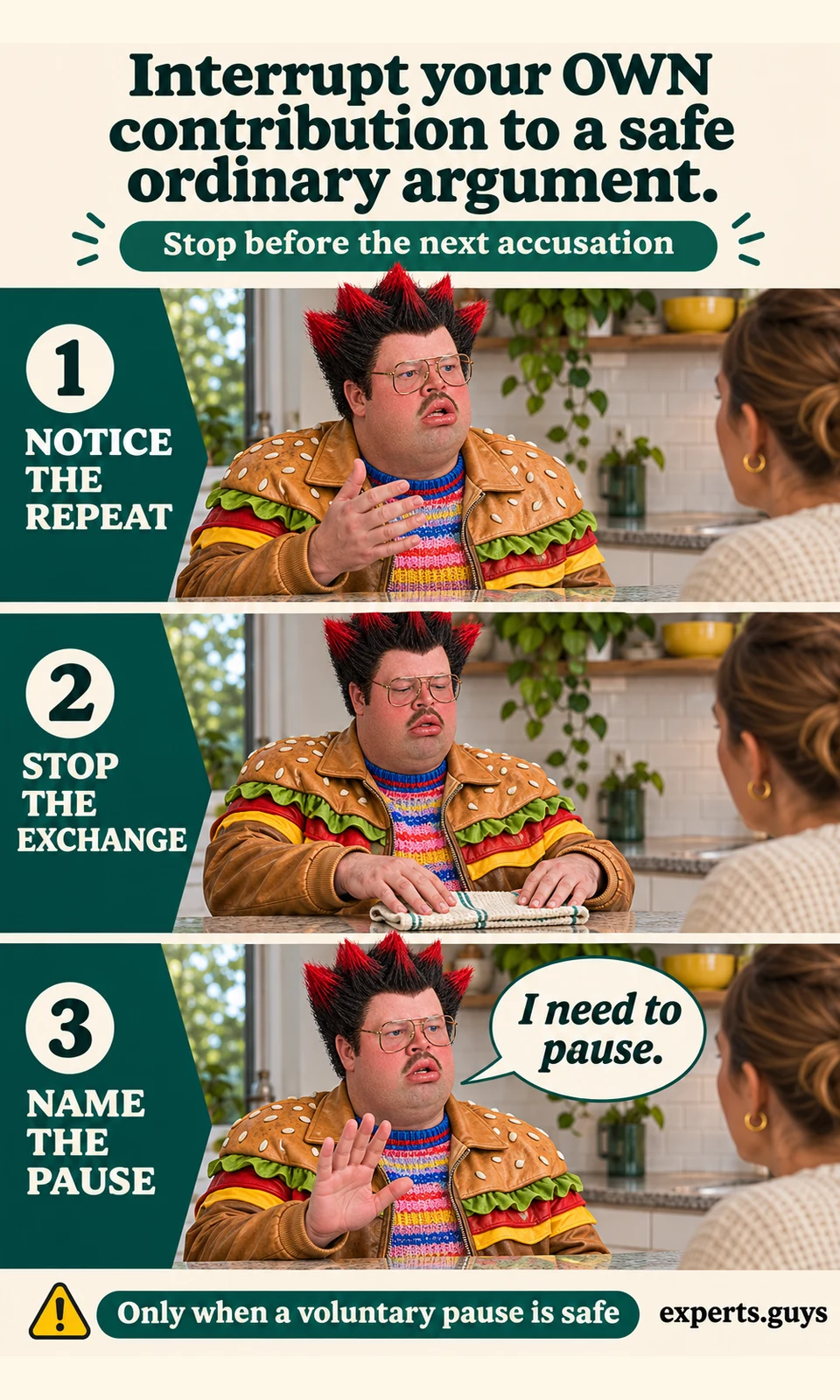
In the dinner example, the person notices they have repeated “You always expect me to do everything.” They set a dish towel on the counter and stop explaining. The towel is incidental; the skill is stopping the accusation and the task at the same time, without adding a final criticism. No object is required, and deliberately handling something breakable is unnecessary.
A common mistake is giving a long speech about why a pause is needed. That can become another round of the argument. Make the boundary brief and about your own participation: “I will not keep talking while I am shouting.” Avoid “You are making me do this,” which transfers responsibility to the other person and invites a debate about blame.
Create space without chasing or trapping
Once the exchange stops, the physical arrangement matters. Move to a quieter accessible place only if doing so is safe. The other person must remain free to move too. Personal space and respectful communication are principles in NICE guidance on de-escalation; that clinical guidance does not make a partner responsible for controlling someone else’s behavior at home.
- Use an unobstructed route to a separate safe space. Do not stand in a doorway to insist on a reply, follow someone between rooms or close a door in a way that traps them.
- Let the break remain a break. Stop calling through the door, sending repeated argumentative messages or recruiting another person to pressure them into answering.
- Keep access to help and necessary communication. If a check-in is appropriate, agree on a practical opportunity to reconnect; a check-in can end with postponing the discussion again.

The observable result is separation from the exchange, with freedom of movement preserved. A person may still feel angry. That does not invalidate the pause, and it does not make immediate reconciliation necessary. The useful change is that neither person is being pulled into another sentence, followed through the home or required to prove that they have calmed down.
Do not use a break to punish or create uncertainty deliberately. “I am ending this exchange and will check whether we can talk after we have eaten separately” is clearer than disappearing after a threat. Equally, no one owes a return meeting to someone who is threatening them. Safety planning for abuse has a different purpose from an agreed pause between willing participants.
What about children, shared responsibilities or a public place?
A pause needs to account for anyone who depends on you. If you are caring for a child, do not simply leave to continue the disagreement elsewhere while supervision disappears. Make a safe handover to an available responsible adult before taking space, or stop the discussion while continuing the necessary care. Do not recruit a child to carry messages, decide who is right or help an adult calm down.
In public, the practical boundary may be to stop discussing the issue until you reach a suitable setting. Avoid following someone into a confined place to finish a point. If you are travelling together, do not continue an argument while driving or use the vehicle to prevent someone leaving. Arrange safe transport when possible; immediate safety takes priority over keeping the original plan.
These are constraints on the same pause, not additional exercises. The sequence remains: stop the exchange, preserve safety and space, and revisit the decision later. If a responsibility cannot be handed over, say so directly: “I am staying here to supervise, but I am not continuing this discussion.” You do not have to abandon care in order to practise a boundary.
What if you cannot leave the room?
The pause does not depend on walking. If pain, fatigue or mobility makes moving unsuitable, stay in a stable comfortable position and stop the exchange where you are. A willing companion can move farther away instead. Do not stand up abruptly, force an uncomfortable posture or turn a physical limitation into a test of whether you are trying hard enough.
- Say that you are pausing the conversation and staying seated. Leave your hands in a comfortable position; no special breathing pattern or eye contact is required.
- Ask for more space or less competing conversation if that would help: “Please give me some room. We can leave this question for now.” The other person can sit elsewhere or leave safely.
- Use the same return decision later. If you remain too unsettled, postpone the discussion rather than treating the seated version as a failed attempt.
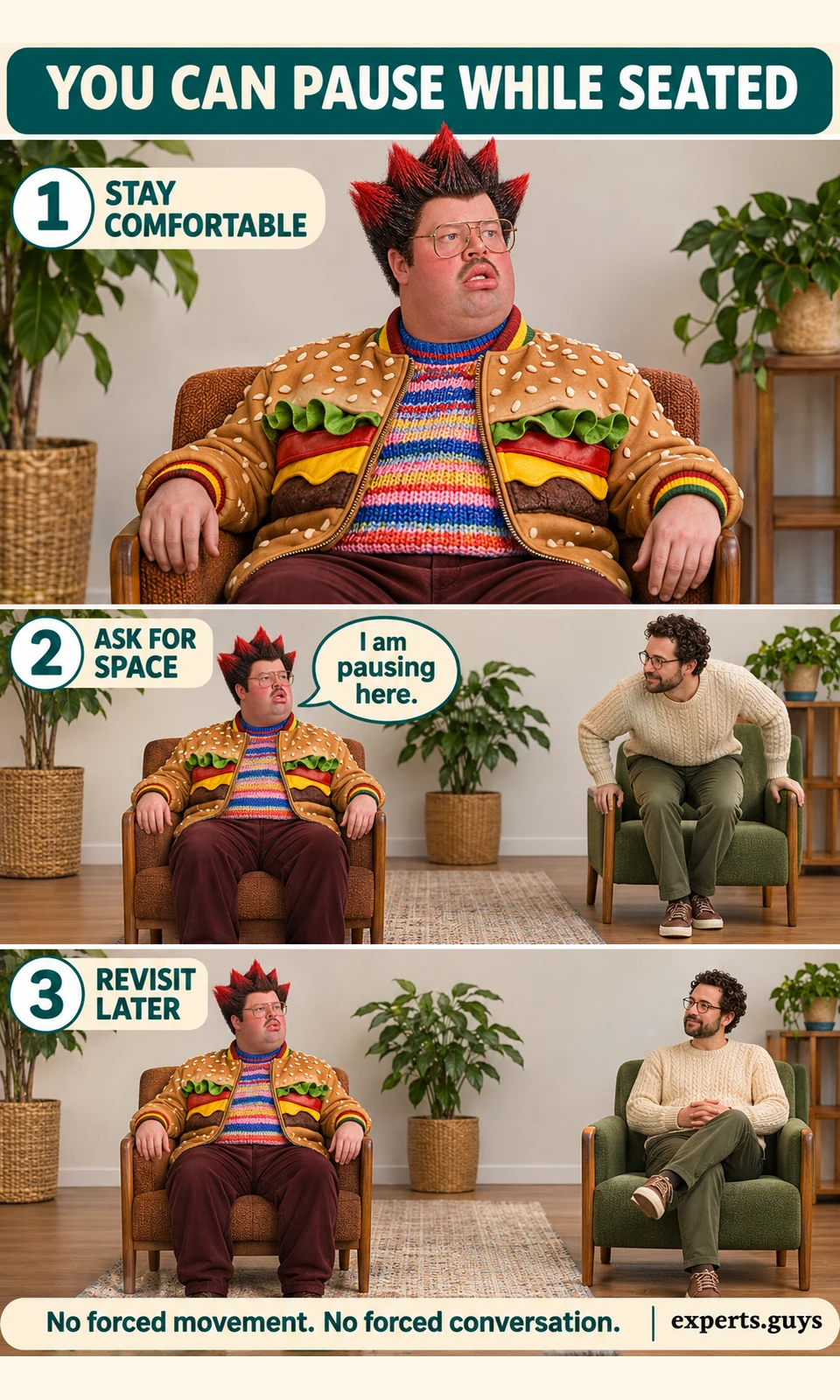
If privacy is limited, stopping the discussion may be the only practical change available. You do not need to find a perfect quiet room. In a shared living space, two people might sit apart and leave the issue alone until another opportunity. Avoid headphones or other barriers if they would prevent you from hearing an alarm or a dependent person who needs you.
The accessible version changes movement, not consent. Both people still need freedom from pressure and a way to obtain help. If the request for space leads to pursuit, intimidation or a blocked route, stop treating this as a cooperative exercise. Seek outside support rather than trying increasingly elaborate wording to make the other person accept the pause.
When should you resume, and how do you repair the harm?
Resume only when both people are willing and able to discuss one issue without intimidation. Feeling less angry is useful, but it is not the only checkpoint: you also need room to listen, the ability to stop again and agreement about the purpose of the conversation. An apology, a deadline or the end of a chosen break does not automatically establish readiness.
Check readiness through the conversation itself
There is no universal number of minutes after which an argument becomes safe or productive. A planned check-in is an opportunity to decide, not an appointment at which one person must perform calmness. Before returning to a difficult subject, ask whether each person wants to try and whether a short discussion can stay on the actual problem.
- Check willingness: “Would you like to discuss dinner now, or leave it until later?” Accept postponement without following it with another accusation.
- Choose one concrete issue. For example, decide who is handling tonight’s food rather than trying to settle the entire history of housework.
- Take turns stating the issue and reflecting what you heard. If interruptions, insults or pressure restart, end the attempt and arrange another appropriate opportunity or support.
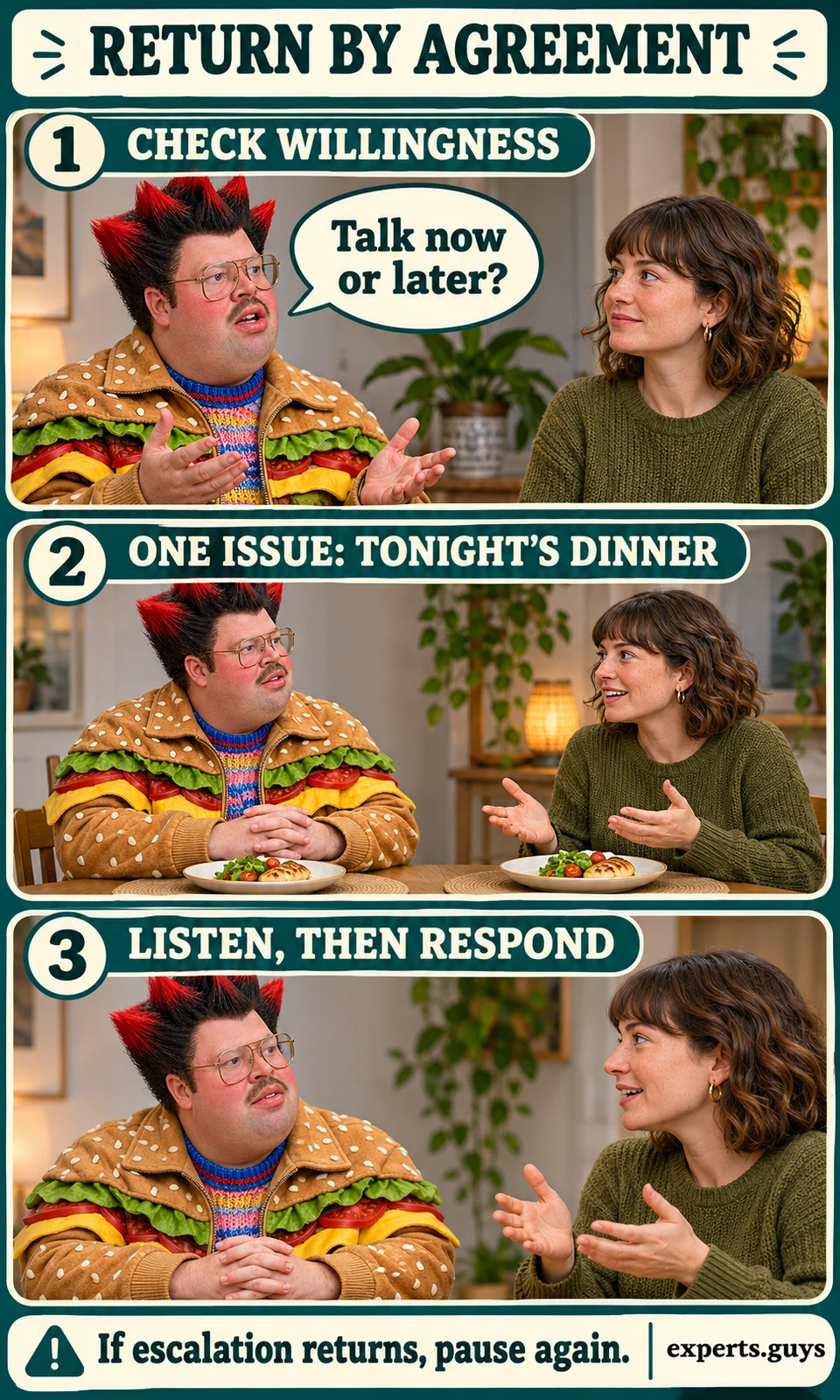
A useful opening in the example is “I cannot cook tonight; we need another dinner arrangement.” The other person can answer that proposal without accepting a judgment about their character. A useful reflection is “You needed to know earlier so you could plan.” Reflection checks understanding; it does not mean agreeing with every claim or admitting responsibility for something you did not do.
For a smaller version, settle only the immediate practical choice and postpone the wider disagreement. “We will each arrange our own meal tonight” can be enough for that conversation. If even that decision becomes another contest, stop. Completing a small agreement is a useful outcome; discussing everything in one sitting is not a requirement.
Watch for a false restart. Two people may have lowered their voices while still repeating accusations, testing each other or demanding a particular response. Quietness does not by itself make the exchange constructive. Readiness includes respecting “not now,” staying with the agreed subject and allowing the other person to finish a thought.
Repair behavior with a practical change
A repair has more substance when it names your action and changes something within your control. “I shouted over you” is clearer than “Things got heated.” It leaves room for illness context without using it to dismiss the other person’s experience. You can explain a symptom concern separately while still taking responsibility for what you said or did.
- Identify the specific behavior and its impact: “I shouted and made it difficult for you to answer. I am sorry.” Avoid adding a demand for reassurance or forgiveness.
- Offer one relevant change you can carry out. In the dinner example: “I will handle my food tonight, and next time I cannot cook I will tell you before you start relying on me.”
- Let the other person choose whether to discuss the repair. Follow through on the agreed practical action; do not make acceptance of an apology the condition for doing it.
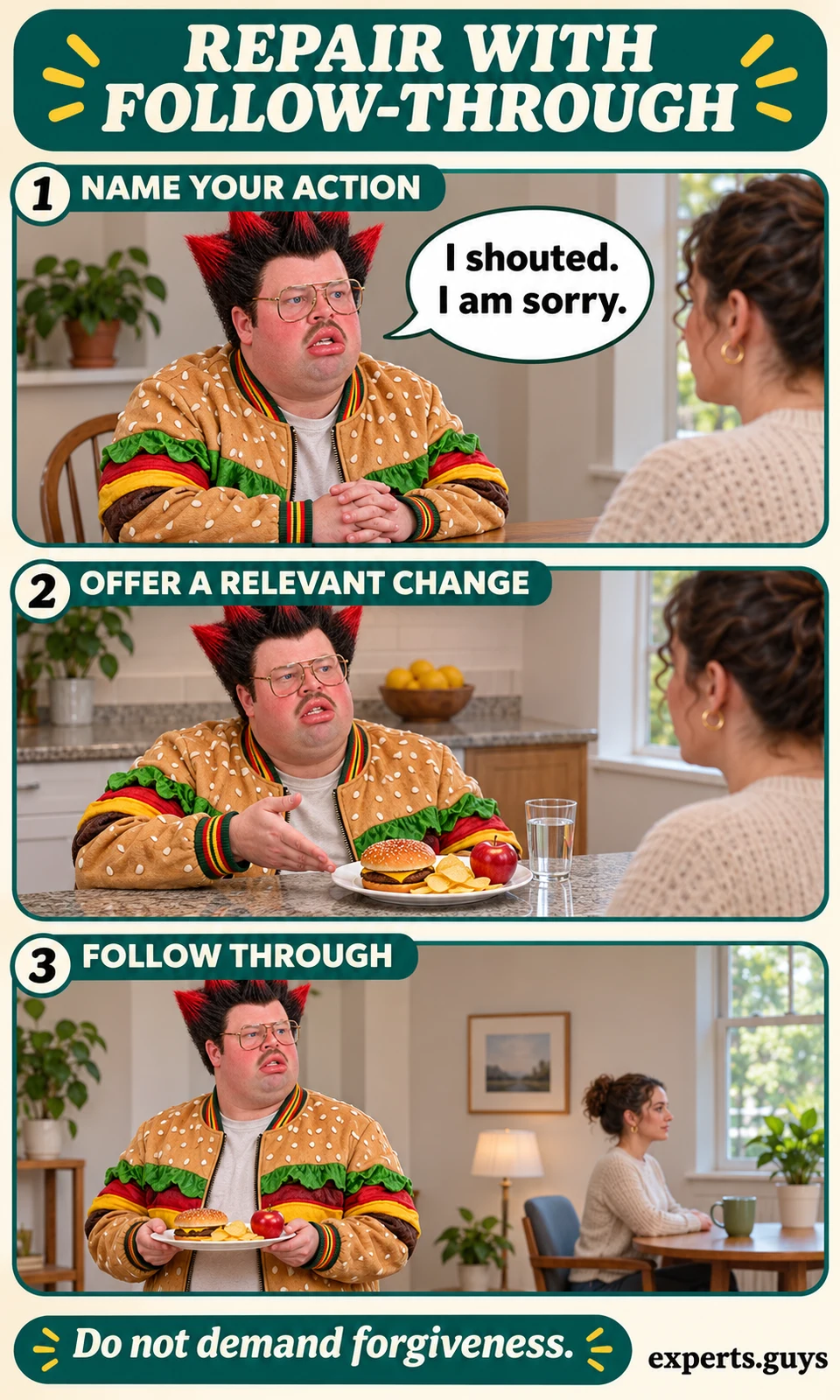
The practical action should fit the actual problem. Handling your own meal addresses a failed dinner arrangement; buying an unrelated gift does not resolve it. If the harm involved frightening behavior, the necessary change may involve outside support and stronger boundaries rather than a shared activity. Never ask someone to remain close to you to demonstrate that they accept your explanation.
For a lower-effort repair, make one clear acknowledgment and complete the smallest relevant action you can safely manage. A long emotional conversation can wait. Avoid promising that you will never feel angry again; a more credible commitment concerns behavior, such as using a pause before continuing to shout and accepting when another person ends an interaction.
The guide to responding without reducing someone to a diagnosis covers harmful language in everyday conversation. The additional task here is follow-through after your own escalating behavior: the change must make the next interaction more workable, not merely make the apology sound better.
If the same conflict keeps returning
Repeated arguments can reveal an unresolved practical disagreement, a difficult communication pattern, worsening symptoms or several of these together. Do not assume a calmer apology has solved the underlying issue. A household arrangement that repeatedly depends on an unavailable person may need to change even when everyone is trying sincerely.
For example, if cooking after a demanding workday repeatedly becomes unmanageable, agree on a different division of that responsibility when you are both able to discuss it. That is a relationship decision about workload. If the difficulty appears alongside a broader change in functioning, it also belongs in a care conversation. One explanation should not be used to cancel the other.
Professional help with communication can be useful when cooperative discussions keep failing and both people can participate freely. It does not replace individual safety support when there is fear, coercion or violence. The right measure of progress is more reliable boundaries and follow-through, not the number of times someone has persuaded the other person to try again.
When does anger need a change in bipolar care?
Arrange a treatment review when anger is a marked change from usual, repeatedly disrupts life or appears with broader changes in sleep, activity or judgment. Do not wait for a relationship dispute to be resolved before raising a health concern. Conversely, asking for care should not become a condition the other person must satisfy before you acknowledge a fair complaint.
The NHS explanation of bipolar care describes medicines and psychological treatment as parts of a broader plan. A pause can interrupt an interaction, but it cannot determine the episode type or select treatment. Avoid choosing a medicine, taking an extra dose or stopping a prescription because an argument felt different.
Keep the health question and the relationship question separate
Use two distinct conversations when possible. The relationship question concerns the event: who said what, what impact it had and what arrangement needs changing. The care question concerns a change from baseline and what support is needed. Combining them into “You need treatment because you disagree with me” makes both questions harder to answer fairly.
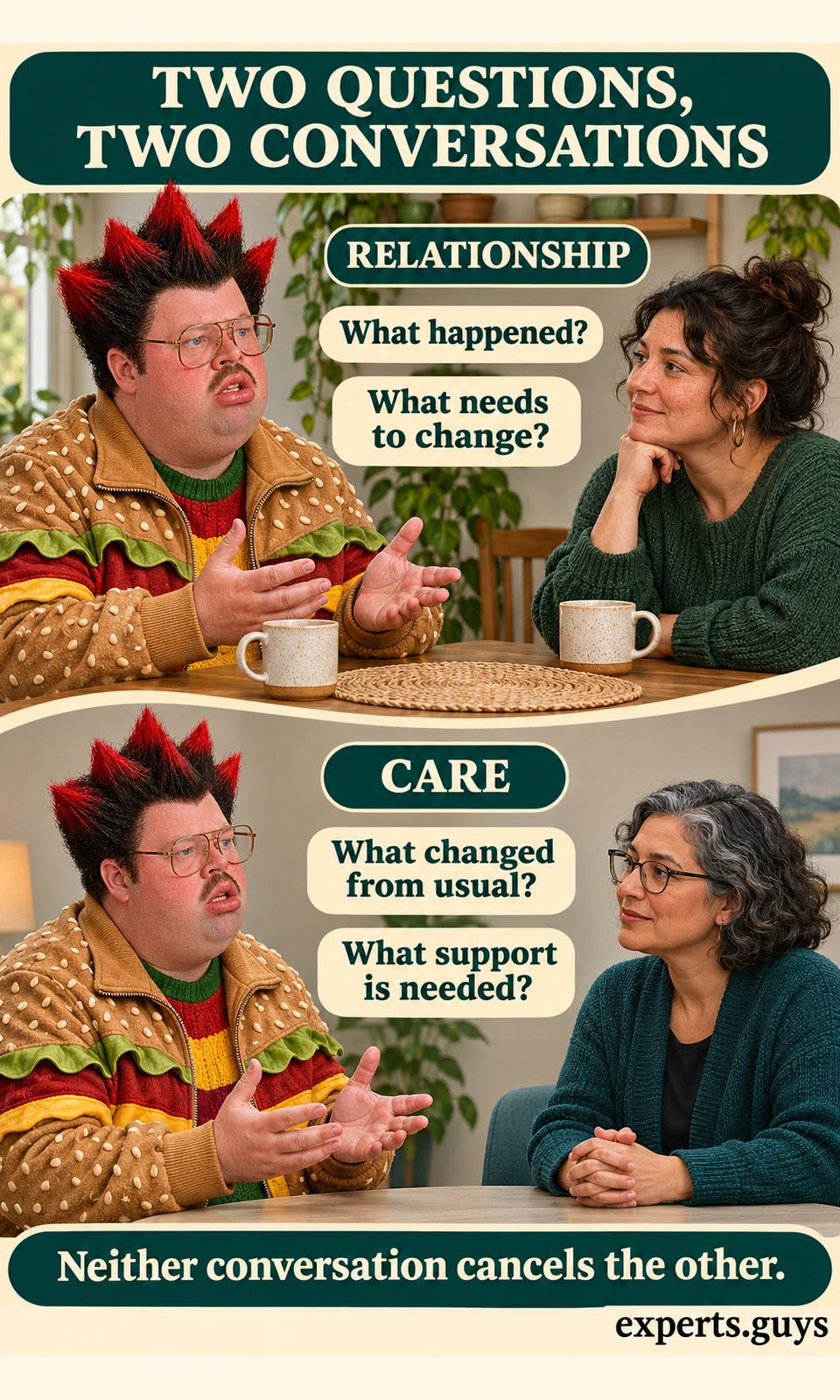
A concise spoken description can be enough to start a care conversation: “I am much more irritable than usual, I have slept far less, and my decisions feel unusually urgent.” Mention when it began, anything different about treatment or substances and whether you can keep yourself and others safe. No diary, worksheet or daily scoring exercise is required to ask for help.
The same distinction protects a person whose complaint is legitimate. “I want the shouting to stop” and “I want you to take my contribution seriously” are both reasonable statements. A care review should not turn a partner or housemate into the judge of every mood. Agreeing what information someone may share, and with whom, helps preserve privacy when support is involved.
Changes that should not wait for another argument
- Much less sleep with unusual energy, rapidly increasing activity or markedly risky decisions: contact the treating team promptly, especially when the change is escalating.
- New hallucinations, delusions, severe confusion or inability to manage safely: obtain urgent assessment; use emergency help if safety is uncertain or danger is immediate.
- Thoughts of harming yourself or someone else, threats or violence: prioritize immediate safety and urgent support rather than practising another conversation technique.
- New restlessness or a major change after a medication adjustment: tell the prescriber about the timing; do not independently stop, restart or change doses.
Low mood combined with marked activation also deserves prompt attention. It can be tempting to interpret sudden activity as improvement after depression, but the pattern needs assessment. A person may look energetic while feeling distressed. The guide to returning bipolar-depression warning signs gives more context for a familiar change in daily functioning.
If the treating service is unavailable and the change is becoming harder to manage, use an urgent local medical or mental-health service rather than waiting for a routine appointment. Another trusted adult may help with practical access if you want that support. Do not drive when agitation, confusion, medication effects or impaired judgment make driving unsafe.
What information changes a treatment conversation?
Describe the change in a way that helps someone assess it: whether sleep is reduced because you cannot sleep or because you feel you need less, whether activity is unusually increased, and whether decisions have become harder to question. Also explain any new treatment, missed doses or substance use honestly. These details are context for assessment, not a checklist that assigns an episode at home.
If a trusted person has noticed a change, their observations may help when you consent to sharing them. Keep observations concrete: “You have been starting projects through the night” is more useful than “You are impossible lately.” Disagreement with a supporter’s interpretation is still possible. The purpose is to improve the information available, not to turn a family argument into a vote on a diagnosis.
What can treatment address that a pause cannot?
A pause addresses the interaction taking place now. Treatment addresses the illness pattern, possible contributing conditions, medication effects and support over time. Those are different outcomes. Repeatedly interrupting arguments while sleep and judgment deteriorate is a reason to increase care, not evidence that the pause needs a more elaborate script.
NICE’s bipolar-management recommendations support reducing stimulation during mania or hypomania and using phase-appropriate treatment. This does not prove that a quiet room treats bipolar anger. A calm setting can make a situation more manageable while the episode itself still needs assessment and an appropriate care plan.
For details on medicines and psychological approaches, see how bipolar treatment changes with the phase of illness. The useful question for a review is not simply “Which medicine treats anger?” It is “What changed, what might be contributing, and which part of the current plan needs attention?”
Frequently asked questions
Can someone have bipolar disorder and feel angry between episodes?
Yes. A diagnosis does not make ordinary frustration disappear, and ongoing symptoms or other difficulties can also affect someone between clear episodes. Persistent or changing anger needs context; it should not automatically be labeled a new episode or dismissed as personality.
What if I remember the argument differently?
You do not have to agree on every detail before acknowledging your own behavior. Name what you can honestly take responsibility for without pressuring the other person to adopt your version. If the disagreement concerns threats or safety, seek appropriate support rather than trying to establish a shared account alone.
Should I explain the diagnosis to colleagues after an outburst?
Disclosure is a personal choice, subject to the circumstances and any relevant workplace process. You can acknowledge a specific behavior and agree on a practical work arrangement without sharing private medical details. Discussing treatment belongs with the appropriate care team, not in a pressured public explanation.
Can a supporter require me to use the pause?
A supporter can end their own participation and set boundaries. They should not restrain you, block movement or enforce an exercise. A cooperative pause depends on consent; urgent safety concerns need an appropriate urgent response rather than someone taking control as an informal therapist.
Does successfully pausing mean the treatment is working?
It shows that you interrupted that exchange. It does not establish recovery, rule out an episode or prove a treatment effect. Treatment progress needs a broader assessment, while the practical success of the pause is that escalation stopped without trapping or pressuring anyone.
Choose the next action from what is happening now
If an ordinary disagreement is escalating and a voluntary pause is safe, practise stopping your own contribution before adding another point. Create space, then decide together whether a short return conversation is workable. If there is a wider change in functioning, arrange the care conversation as well; if there is danger, use urgent help instead of the exercise.
- Use the early cue to stop the exchange.
- Preserve space, movement and access to help.
- Resume only by agreement, with one issue to discuss.
- Make a repair through a specific action you can follow through on.
- Treat worsening symptoms and safety concerns as separate reasons to obtain appropriate support.










