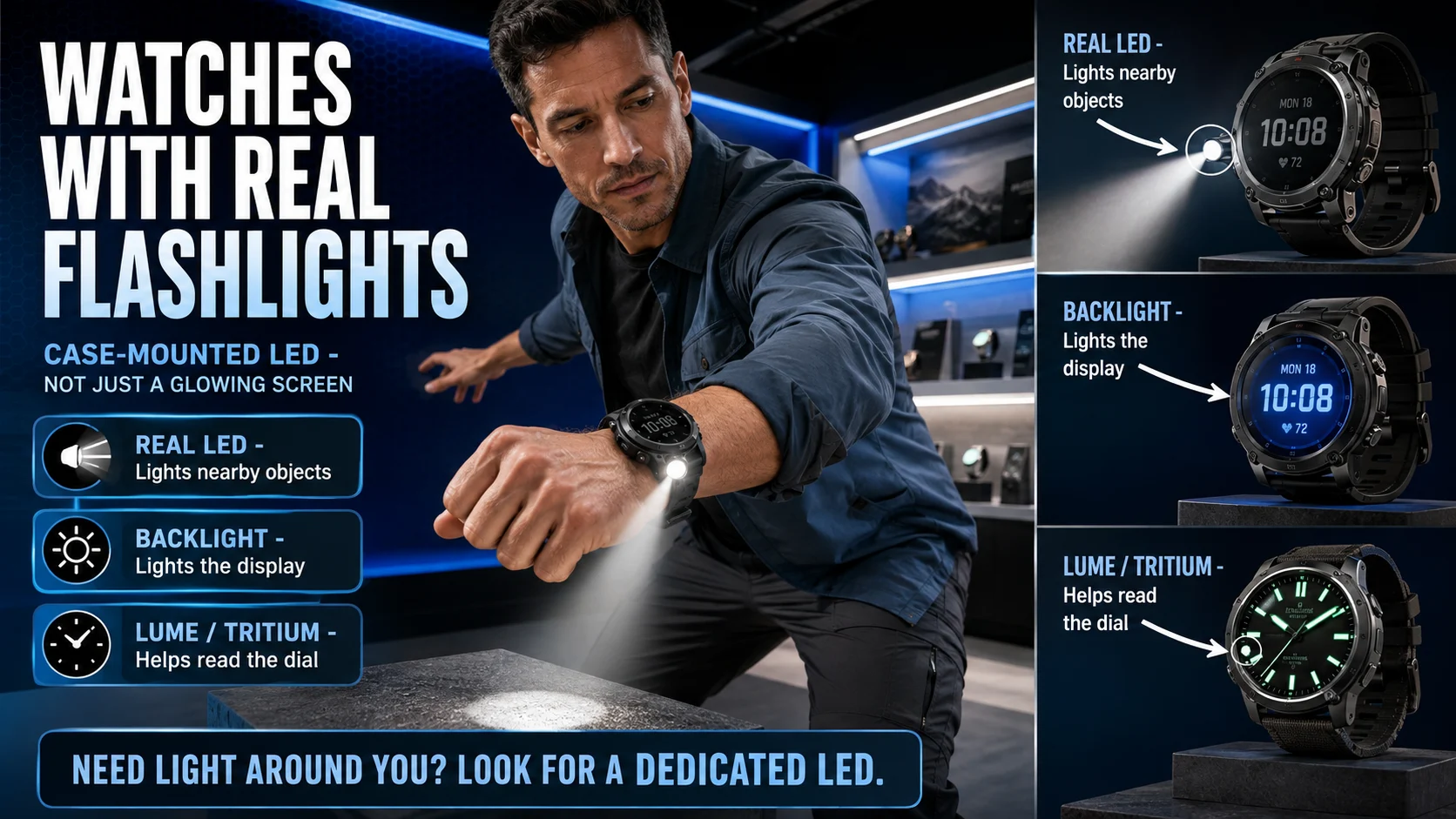

A watch with a real built-in flashlight has a dedicated LED that projects usable light away from the case, allowing you to illuminate nearby objects, a path, a keyhole, equipment, or the inside of a bag. A glowing dial, electroluminescent backlight, illuminated smartwatch screen, or tritium markers can make the watch itself easier to read in darkness, but those systems do not perform the same job. If you specifically want a torch on your wrist, look for a dedicated outward-facing LED rather than a product described only as “illuminated,” “backlit,” or highly luminous.
The best option then depends on what you need the light to do. Everyday users may care most about instant activation and a comfortable case, runners may value strobe or visibility modes, campers may prioritize battery endurance and red light, while people working in dark spaces may care about beam direction and hands-free convenience. A watch flashlight is especially useful for short-range tasks and unexpected darkness, although it should not automatically be treated as a substitute for a proper headlamp when sustained illumination or a longer beam is important.
Flashlight vs Backlight vs Lume vs Tritium
These four lighting systems are frequently grouped together, but they solve different problems. The distinction matters before you buy because a watch can be excellent in darkness while still being unable to illuminate anything beyond its own dial. Use the table below as the fastest way to determine what type of lighting you actually need.
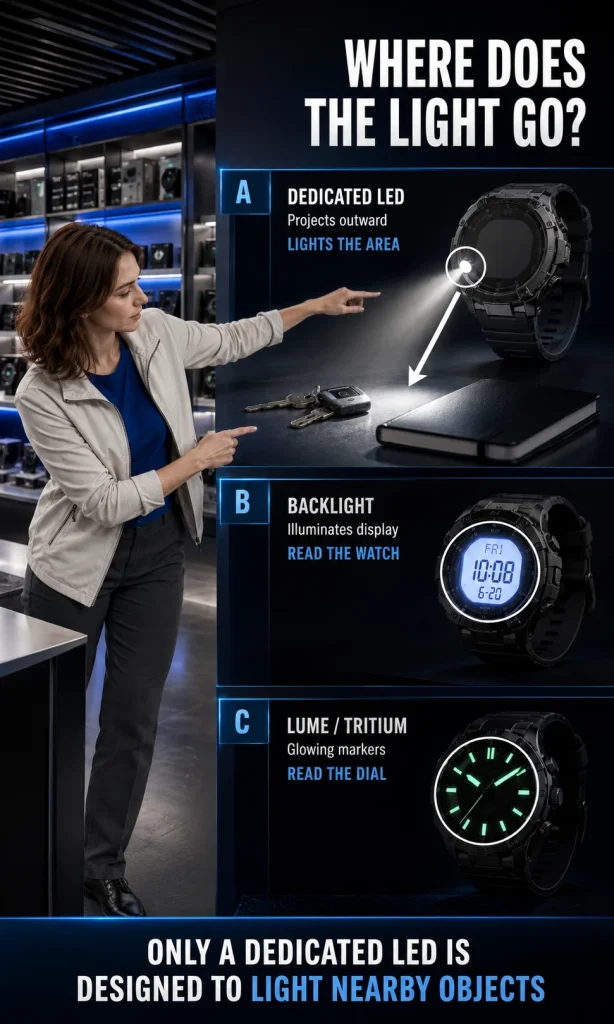
| Lighting System | Lights Surroundings? | What It Actually Does | Best For |
|---|---|---|---|
| Dedicated LED flashlight | Yes | Projects light outward from the watch case | Walking, searching, running, camping, quick tasks and backup illumination |
| Display or dial backlight | Generally no | Illuminates the watch display so information can be read | Reading the time, menus or digital data in darkness |
| Photoluminescent lume | No | Stores light and later glows on hands or markers | Reading an analog dial after exposure to light |
| Tritium illumination | No | Produces continuous low-level illumination in dedicated markers or tubes | Persistent dial readability without first charging the lume with light |
A dedicated LED is the only category in this comparison specifically designed to cast useful light onto the environment around you. That makes the phrase “watch with flashlight” more precise than simply calling a watch bright or illuminated. If you are buying because you want to see objects rather than merely read the time, this distinction should eliminate many unsuitable models immediately.
What Counts as a Real Flashlight Watch?
A true flashlight watch integrates one or more LEDs into the case and directs their output away from the display. The light usually sits near an outer edge of the watch so your wrist can point it toward the floor, a nearby object, or the work area in front of you. Depending on the watch, the controls may offer several white-light levels, another light color, flashing patterns, or quick-access shortcuts so the flashlight can be activated without navigating deeply through menus.
The direction of the LED matters almost as much as brightness. A powerful emitter positioned awkwardly can force you to twist your wrist into an uncomfortable angle, while a more modest light that points naturally forward may be easier to use for everyday tasks. This is one reason raw brightness figures should not be the only specification used to rank flashlight watches.
Case integration matters too because the flashlight shares space with the display, buttons, sensors, battery and water-resistant construction. Adding a useful LED can influence case thickness, weight, bezel design and how the watch sits on smaller wrists. Buyers who already experience sliding, crown pressure or lug overhang should consider the complete fit rather than accepting a larger watch solely because it has the brightest-looking flashlight feature.
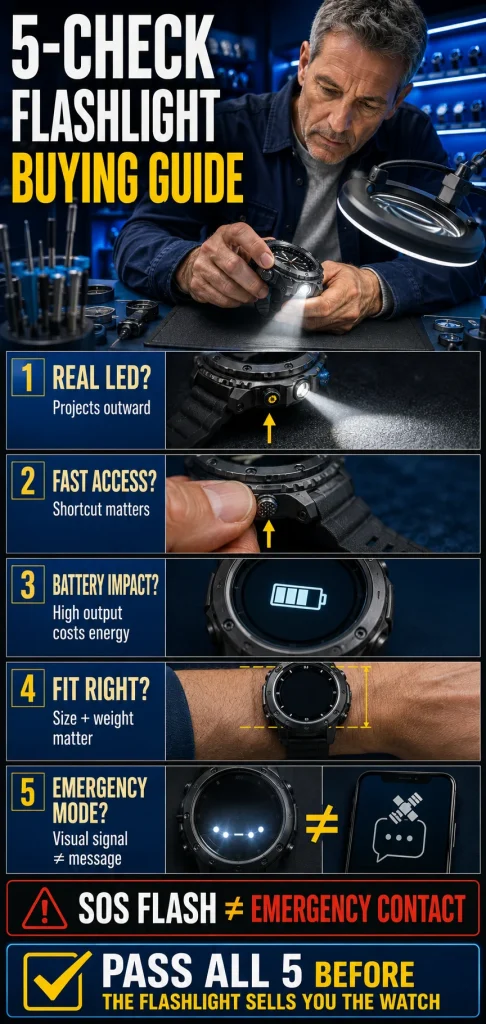
Before You Buy, Confirm These Six Things
- It has a dedicated LED. A glowing screen alone is not the same as an outward-facing flashlight.
- The LED points somewhere useful. Check its location and imagine the natural angle of your wrist during the tasks you expect to perform.
- Activation is quick. A flashlight that takes several menu steps to reach loses much of its value in an unexpected dark situation.
- Brightness can be reduced. Maximum output is rarely necessary for every task, and lower output can be more comfortable at close range.
- The watch fits your wrist. Flashlight hardware does not compensate for a case that is too large, heavy or uncomfortable for daily wear.
- You understand the battery trade-off. LEDs consume energy, so frequent or high-output use can shorten the time between charging or other power-management intervals.
Those checks are more useful than asking which model has the biggest specification number. A flashlight watch succeeds when the light is immediately available, points where you need it, produces enough usable illumination for the task, and does not make the rest of the watch inconvenient to wear. The next step is therefore to match the flashlight system to the situation in which you expect to use it most often.
When Is a Wrist Flashlight Actually Useful?
The most convincing use cases are often small tasks that are too brief to justify finding a phone or carrying a separate torch. Unlocking a door at night, looking beneath a seat, finding something in a backpack, moving through a dark hotel room, checking equipment, walking to a vehicle, or navigating a short unlit section can all be easier when the light is already attached to your wrist. Because the watch is normally accessible without reaching into a pocket, it can also keep one or both hands available for luggage, tools, a dog leash, camping equipment or another task.
Running creates a different benefit because the light can contribute to both seeing and being seen. A forward-facing LED can help reveal immediate ground conditions, while flashing or cadence-related modes on some watches can increase the visibility of the moving wrist to people nearby. It is still important to distinguish that visibility function from a proper running light designed to illuminate a long stretch of road or trail.
Camping and travel create another strong case for wrist lighting because small nighttime tasks happen repeatedly. You may need enough light to find a zipper, check a tent line, locate an item without flooding the area with bright light, or move briefly without waking everyone around you. A lower-output or colored mode can be more useful in those situations than maximum brightness, particularly when your eyes have already adapted to darkness.
Best Current Watches With Real Built-In LED Flashlights
The category is much broader than it used to be. Garmin still has the largest range of flashlight-equipped watches, but Polar, Suunto, Amazfit, and specialist conventional-watch makers now offer genuine outward-facing LEDs rather than relying on illuminated displays. The better buying decision is therefore no longer simply “Which Garmin has a flashlight?” but which implementation gives you the right combination of light controls, watch size, battery endurance, sports features, durability, and price.
| Watch Family | Flashlight Approach | Strongest Fit | Check Before Buying |
|---|---|---|---|
| Garmin Instinct 3 | Integrated case-mounted LED with multiple brightness and light modes | Rugged outdoor use, running, hiking and everyday utility | Case size, display version, battery expectations and exact light controls |
| Garmin fēnix and related premium lines | Integrated LED with adjustable output and activity-related modes on supported models | Multisport users wanting a flashlight inside a more comprehensive outdoor watch | Exact model and case size because flashlight availability varies across generations and versions |
| Polar Street X | Integrated adjustable white LED plus red-light capability | Urban fitness, running and everyday users wanting a simpler flashlight-equipped sports watch | Battery endurance, sports ecosystem and whether its broader feature set fits your training needs |
| Suunto Vertical 2 | Dedicated white and red flashlight with signaling functions | Navigation-heavy outdoor use, hiking and endurance activities | Case dimensions, control layout and how often flashlight use fits your activity pattern |
| Amazfit T-Rex 3 Pro | Dedicated LED with several modes including high-output temporary use | Rugged smartwatch buyers wanting substantial lighting functionality at a competitive price | Battery impact at high output, ecosystem compatibility and exact model features |
| MTM flashlight watches | LEDs integrated into a conventional watch case | Readers who want a dedicated flashlight without a full smartwatch platform | Case bulk, battery system, illumination controls and service requirements |
The table is a starting point rather than a permanent ranking because product generations and feature availability change. Always verify the exact model you intend to buy, especially within watch families that contain several case sizes or versions. A manufacturer may use a similar family name across watches with different display types, battery figures, materials, sensors, or flashlight hardware.
Garmin Watches With Built-In Flashlights
Garmin has pushed the dedicated flashlight from a specialist outdoor feature into several different parts of its watch range. Its current built-in flashlight watch guide identifies supported models across families including fēnix, Instinct, Forerunner, Venu, tactix, Enduro, Descent and quatix. That breadth matters because you can now choose the broader watch platform first and treat the flashlight as one capability within it rather than buying an oversized expedition watch solely to obtain an LED.
Garmin Instinct 3
The Instinct line is one of the clearest starting points for people who want a rugged watch and expect to use the flashlight frequently. Garmin’s Instinct 3 information confirms an integrated LED flashlight across the Instinct 3 family, making the feature less dependent on picking one particularly large premium variant. That makes the series attractive for hiking, running, travel, camping and everyday tasks where durability and quick access matter more than luxury materials.
The important comparison is between the flashlight and the rest of the watch, not between flashlight modes alone. Display technology, case size, solar capability on relevant versions, navigation features and overall battery behavior can change which Instinct configuration makes sense. Someone with a smaller wrist should also consider whether a rugged case remains comfortable enough for daily use, especially if the watch will be worn overnight.
Garmin fēnix and Premium Outdoor Models
Garmin’s higher-end outdoor watches combine flashlight capability with more advanced navigation, training, mapping and multisport features. That creates a strong option for someone who already needs the larger outdoor platform, because the flashlight becomes an additional everyday convenience rather than the sole reason for buying an expensive watch. If you would never use the mapping, advanced training or outdoor functions, however, paying substantially more simply to obtain the LED may offer poor value.
Flashlight availability should be verified at the individual-model level rather than assumed from the family name. Garmin has introduced the feature progressively across different generations and case configurations, so an older watch that resembles a newer flashlight-equipped model may not contain the same hardware. This is particularly important when shopping second-hand, where product titles can omit generation details.
Polar Street X
Polar’s Street X expands the category beyond the traditional rugged adventure-watch buyer. Polar describes the Street X as having an integrated flashlight with adjustable white illumination and a red mode, giving runners and everyday users another genuine LED option. Its significance is less about having the largest possible light and more about showing that wrist-mounted flashlight functionality can fit into a broader fitness-oriented watch rather than only large expedition designs.
For a buyer already using Polar’s training ecosystem, that integration may be more important than a small difference in flashlight capability between brands. Training metrics, app familiarity, sensors and data continuity can affect daily ownership far more than a flashlight that is used for several minutes each week. The flashlight should therefore break a close decision between suitable watches rather than make an otherwise unsuitable ecosystem feel appropriate.
Suunto Vertical 2
Suunto takes a similarly outdoor-focused approach with the Vertical 2. The company’s Vertical 2 flashlight guidance documents dedicated flashlight functionality with white and red illumination along with signaling-related modes. This makes the feature useful for immediate visibility and short tasks while retaining the broader navigation and outdoor orientation of the Vertical platform.
Red illumination is particularly useful when the goal is to avoid blasting a dark environment with bright white light, such as checking equipment inside a tent or moving around others who are sleeping. It does not magically preserve perfect night vision, and the practical effect still depends on brightness, distance and the user’s eyes. Treat colored lighting as another selectable mode rather than evidence that one watch is automatically more capable outdoors.
Amazfit T-Rex 3 Pro
The T-Rex 3 Pro is notable because Amazfit provides unusually explicit information about how its dedicated LED is intended to operate. Its LED flashlight guidance describes several flashlight functions and a temporary higher-output Boost Mode, giving buyers a clearer idea of how normal illumination and short periods of maximum output differ. That distinction matters because the highest available setting is often the least efficient way to use a wrist light for routine tasks.
A high-output option is useful when you briefly need more light, but it should not automatically become the default setting. More output means greater energy demand and potentially more heat around a very small electronic device attached to the wrist. For repeated close-range tasks such as finding keys, checking a bag or walking through a dark room, a lower setting can be more comfortable and may preserve battery life more effectively.
What If You Do Not Want a Smartwatch?
A built-in flashlight does not inherently require a smartwatch operating system, touchscreen, GPS, notifications or health tracking. Specialist companies such as MTM Watch sell conventional-looking watches with integrated LED illumination, providing another route for someone who wants wrist-mounted light without adopting an entire connected platform. These watches represent a different ownership decision because the lighting hardware is central to the watch rather than one application inside a multipurpose sports computer.
The trade-off is that specialist flashlight watches can have substantial cases because the lighting hardware, switches and power source all require physical space. That can be acceptable for professional, tactical-style or utility use, while someone wanting an unobtrusive everyday watch may prefer a more compact smartwatch implementation. Dimensions, weight and how the LED housing interacts with wrist movement should therefore be checked carefully before buying.
White, Red and Green Light: What Changes?
White light is usually the most useful general-purpose mode because it reveals color and detail clearly. It works well when finding equipment, illuminating a doorway, checking the ground immediately ahead or performing a close-range task where seeing the object matters more than preserving a dark environment. Higher white-light levels can feel excessively bright at very close distances, which is why several brightness stages are more useful than maximum output alone.
Red light is often chosen when a lower-disruption light is desirable, particularly after the eyes have adapted to darkness. It can be useful inside tents, bedrooms, vehicles or other dark environments where a bright white beam would feel harsh, while some watch makers also use red LEDs for signaling or visibility modes. The benefit depends on how the mode is implemented, so the presence of a red LED should not be treated as proof that a watch is automatically better for every nighttime activity.
Some watches or specialized models may use additional colors such as green for particular visibility or task preferences. Color selection should remain secondary to beam usefulness, brightness control, activation speed and battery behavior because those factors affect almost every use. Buying primarily because a specification sheet lists more LED colors can lead to a watch whose core flashlight experience is still inconvenient.
How Bright Does a Watch Flashlight Need to Be?
There is no single brightness number that identifies the best flashlight watch. Manufacturers do not always publish output in directly comparable ways, and output can differ according to mode, battery condition, thermal limits and how long the highest setting is allowed to operate. A useful comparison therefore needs to consider what the beam actually accomplishes rather than treating one lumen figure as a universal ranking.
For close tasks, moderate illumination may be preferable because the object is only tens of centimeters from your wrist. Maximum output reflected from a white wall, map, bag lining or piece of equipment can produce glare and reduce comfort rather than improve visibility. Adjustable brightness provides more value because it lets the same LED handle both subtle nighttime tasks and situations where more immediate illumination is useful.
Beam direction is another overlooked specification. The LED needs to point toward the object while your wrist remains in a reasonably natural position, otherwise additional brightness is partly wasted by poor ergonomics. If possible, examine photographs or demonstrations showing the LED location rather than evaluating only a frontal image of the watch face.
Battery Life Is Part of the Flashlight Specification
Every electrically powered flashlight consumes stored energy, which means the watch’s headline battery figure cannot be separated from how often the LED is used. Garmin’s flashlight documentation specifically warns that using the flashlight can reduce battery life and recommends reducing brightness when appropriate. The same underlying energy trade-off applies to any rechargeable watch with a dedicated light.
Occasional use for a doorway, hotel room or short walk may have little practical effect on your normal charging routine. Leaving the LED active for extended periods, repeatedly using maximum output or relying on it throughout a long night is a different workload. If the trip or activity genuinely requires hours of illumination, a separate lighting device with a battery designed for that job becomes the more sensible primary source.
Use Lower Output When It Does the Job
- Finding something in a bag: start low because the target is close.
- Moving through a hotel room: use enough light to see obstacles without unnecessarily flooding the room.
- Checking camping equipment: red or low white light may be more comfortable after dark.
- Short outdoor movement: increase brightness only as far as the immediate environment requires.
- Running visibility: use the watch’s intended visibility or strobe function when available rather than improvising a mode.
- Long night hike: carry a dedicated headlamp and treat the watch light as secondary or backup illumination.
A flashlight watch becomes more useful when its lower settings are genuinely usable. If the only mode you enjoy is maximum brightness, battery consumption becomes more significant and the watch begins competing with products specifically designed to be flashlights. Multiple practical output levels are therefore a stronger feature than a spectacular peak setting that can only be used briefly.
Can a Watch Flashlight Replace a Headlamp?
For most serious nighttime outdoor use, no. A built-in watch light is exceptionally convenient for close tasks, short movements and backup illumination, but a dedicated headlamp normally gives you a more useful beam position, longer sustained output and true hands-free lighting while you walk, climb, set camp or work. Your head also naturally points toward what you are looking at, while a wrist light requires you to orient your arm.
Garmin itself positions the LED as useful backup illumination within its outdoor ecosystem rather than a reason to abandon purpose-built lighting. That is the safer mental model: the watch light is the light you are unusually likely to have with you, while the headlamp is the light you deliberately bring when darkness is part of the plan. The two devices solve overlapping problems, but their strengths are different.
A phone flashlight occupies another position in the same hierarchy. It may produce plenty of light for short tasks, but using it occupies a hand, consumes phone battery and requires you to retrieve a device that may be buried in clothing or luggage. The watch wins on immediacy, which explains why many owners find themselves using the feature for small tasks even when objectively brighter lights are nearby.
A Flashing SOS Pattern Does Not Automatically Call for Help
A flashing distress pattern is a visual signal, and that should not be confused with an emergency communication system. Garmin’s flashlight safety documentation explicitly notes that activating the distress flashlight pattern does not itself contact emergency services or emergency contacts. The distinction matters because a user in an actual emergency should not assume that a flashing watch has transmitted their location or requested assistance.
Emergency communication depends on the separate communication capabilities available to the watch, paired phone, satellite device, network or service being used. Those systems have their own requirements and limitations, and they should be configured before an activity where emergency communication matters. Treat the flashlight’s distress mode as an additional way to attract visual attention rather than a replacement for a tested emergency-contact plan.
Case Size and Fit Matter More Than the Flashlight Looks on Paper
A flashlight watch has to make room for an LED emitter, electronics, battery capacity, sensors, buttons, and protective case construction, so some models are substantially larger than ordinary watches. That size can be useful outdoors, where big controls and robust cases are easier to operate, but it can become uncomfortable if the lugs overhang the wrist, the watch rotates, or the case presses against the hand during normal movement. A flashlight feature that you use for two minutes a day does not compensate for a watch that feels awkward for the other 23 hours.
Check the complete fit before focusing on flashlight output:
- Case diameter: useful as a starting point, but insufficient by itself.
- Lug-to-lug length: determines how far the watch spans across the wrist.
- Thickness: affects bulk, sleeve clearance, and how much leverage the case has when the wrist moves.
- Weight: heavier watches can shift more noticeably during running or all-day wear.
- Button position: controls should remain accessible without digging into the hand.
- LED location: the emitter should point somewhere useful while your wrist stays in a natural position.
- Strap flexibility: a compliant strap can make a substantial outdoor watch feel more stable.
- Adjustment range: enough adjustment helps when wrist size changes with heat, exercise, or long wear.
If a flashlight-equipped watch repeatedly slides, rotates, pinches, or presses against the wrist bone, the problem may be fit rather than the watch’s overall quality. The guide to why watches slide, spin, pinch, or never sit comfortably explains how case length, bracelet balance, clasp position, and wrist shape interact. That is especially relevant to rugged flashlight watches because their larger cases amplify small fitting problems.
Which Flashlight Watch Fits Your Use Case?
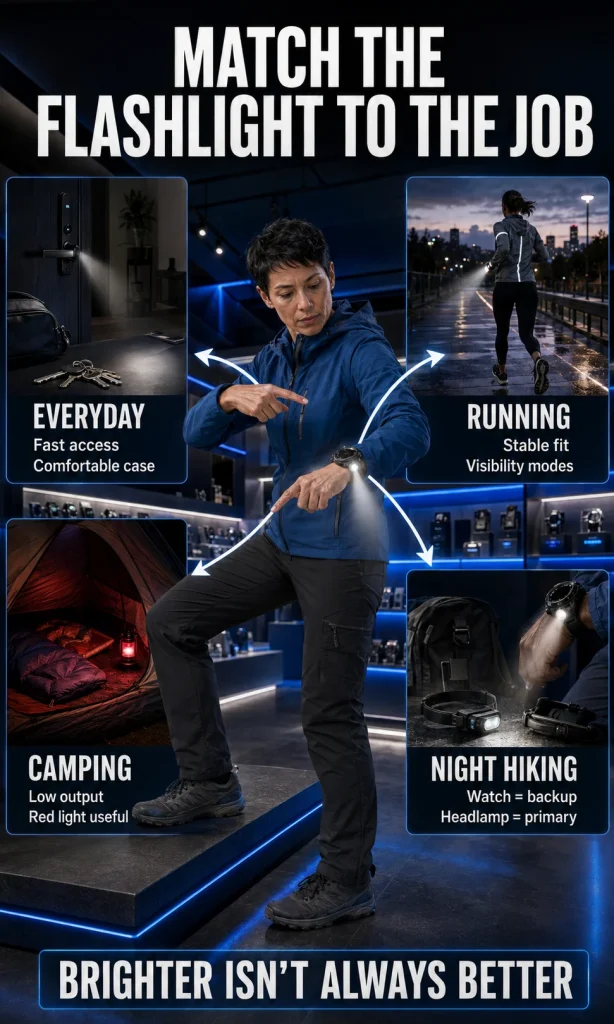
The strongest choice changes according to what happens when the lights go out. Someone who wants a quick light for a hallway has different requirements from a trail runner, while a camper may value low-output red illumination more than a very bright short-duration mode. Use case should therefore determine how much weight you give brightness, battery endurance, case size, color modes, and outdoor features.
| Reader Situation | Prioritize | Avoid Overvaluing | Why |
|---|---|---|---|
| Everyday home and travel use | Fast activation, comfortable size, useful low output | Maximum brightness | Most tasks are close and brief |
| Running | Stable fit, visibility modes, simple controls, battery endurance | Large case purely for stronger light | Movement makes weight and fit more noticeable |
| Camping | Low white output, red mode, battery preservation | Peak output used continuously | Close tasks benefit from controlled light more than glare |
| Night hiking | Reliable backup light plus strong navigation and battery features | Using the watch as the only planned light source | A headlamp remains better for sustained trail illumination |
| Work and inspection | Beam direction, fast access, rugged controls, comfortable working angle | Decorative smart features you will not use | Ergonomics matter when both hands are occupied |
| Emergency backup | Simple activation, known battery state, signaling mode | Assuming visual SOS equals emergency communication | A flashing LED cannot replace a tested contact system |
For everyday use, smaller and easier can be better than brighter and more rugged. If the flashlight is mainly for finding a keyhole, moving through a dark room, looking under furniture, or checking a bag, instant access and comfort are likely to matter more than peak output. This is where fitness-oriented models such as the Polar Street X can appeal to a different buyer from a larger expedition-oriented watch.
Outdoor users should consider the flashlight as part of an entire nighttime system. A watch such as the Suunto Vertical 2 combines illumination with a broader outdoor platform, while Garmin’s flashlight-equipped ranges similarly combine light with navigation, activity tracking, and training functions. The better purchase is the platform whose non-flashlight capabilities already match your needs.
Common Flashlight-Watch Buying Mistakes
Mistake 1: Buying a Backlit Watch and Expecting a Torch
This is the most fundamental error. A digital backlight, illuminated AMOLED screen, INDIGLO-style panel, luminous paint, or tritium marker can make the watch readable in darkness while doing little to illuminate the floor or an object in front of you. If outward illumination is your goal, verify the presence of a dedicated case-mounted LED.
Mistake 2: Choosing the Brightest Model Without Checking Beam Direction
Brightness has limited value when the emitter points awkwardly relative to your hand. A wrist-mounted light works best when you can aim it naturally while carrying luggage, holding equipment, opening a door, or using the other hand. Look at the physical LED placement and activation method rather than relying solely on promotional brightness claims.
Mistake 3: Assuming the Highest Mode Is the Normal Mode
Some watches provide a short-duration high-output setting for situations where extra light is temporarily useful. Amazfit’s T-Rex 3 Pro flashlight documentation is a good example of a system that distinguishes ordinary levels from a temporary Boost setting. A feature designed for brief peak output should not be treated as evidence that the watch can sustain that level throughout a long night.
Mistake 4: Ignoring Battery Cost
The flashlight uses the same finite energy reserve that powers the rest of a rechargeable watch. Regular high-output use can therefore change charging frequency and reduce the endurance available for GPS, sensors, navigation, notifications, or other activities. Manufacturers such as Garmin explicitly advise that flashlight use affects battery life, so the correct question is how often you realistically expect to use it.
Mistake 5: Buying a Large Watch Only Because It Has the LED
A substantial case can be appropriate for outdoor use, but buying too large can create wrist rotation, poor sensor contact, sleeve interference, and discomfort. Several brands now offer flashlight functionality across different kinds of watches, so buyers have more freedom to prioritize fit. Treat case dimensions as a primary specification rather than an unavoidable consequence of wanting a flashlight.
Mistake 6: Assuming a Red Light Makes the Watch Automatically Better Outdoors
Red illumination can be useful in dark environments, but its value depends on the task and implementation. A convenient low-output white mode may be more useful for identifying colors, reading equipment, or inspecting an object. Choose color modes according to how you will actually use them rather than viewing a longer feature list as automatically superior.
Mistake 7: Confusing a Distress Flash Pattern With Calling Emergency Services
A flashing SOS-style pattern can help make you visually noticeable, but it may do nothing beyond flashing the LED. Garmin’s distress flashlight guidance specifically warns that its flashlight distress pattern does not itself contact emergency services or emergency contacts. Emergency communication should be tested and understood as a separate function.
What to Check Before Buying a Watch With a Flashlight
A flashlight-equipped watch should pass two tests: the light must be useful, and the watch must still be good at being a watch. Separating those tests prevents an exciting secondary feature from distracting you from poor fit, weak battery suitability, an incompatible training ecosystem, or controls you dislike. The checklist below can be used when comparing product pages or trying watches in person.
Flashlight Hardware
- Confirm there is a real dedicated LED built into the case.
- Check where the emitter sits and which direction it projects.
- Look for multiple brightness levels if close and outdoor tasks both matter.
- Confirm whether alternative colors are genuinely useful to you.
- Check whether strobe or signaling modes are available if you need them.
- Verify whether high-output modes have time or thermal limitations.
Controls
- Determine whether the flashlight has a direct shortcut.
- Check whether it can be activated while wearing gloves.
- Make sure accidental activation is unlikely.
- Verify whether brightness can be adjusted quickly.
- Learn whether flashlight controls behave differently during activities or locked modes.
Battery
- Check normal smartwatch or watch endurance independently from flashlight use.
- Look for manufacturer guidance on how flashlight use affects battery.
- Consider how much GPS or navigation you use simultaneously.
- Avoid planning around peak battery figures when your own usage will be demanding.
- Make sure the watch has enough reserve to remain useful after several short flashlight sessions.
Fit
- Check diameter, lug-to-lug, thickness, and weight.
- Confirm that the LED housing does not make the case uncomfortable.
- Test whether the watch remains stable while you run or move your arm.
- Make sure buttons are usable without pressing the case painfully into the wrist.
- Try the light with your arm in the position you would actually use.
Durability and Environment
- Verify the manufacturer’s water-resistance guidance for the activities you perform.
- Check whether controls remain practical when the watch or your hands are wet.
- Consider how the emitter area is protected against knocks.
- Look at temperature and environmental limitations if the watch will be used in demanding outdoor conditions.
- Do not infer professional, diving, tactical, or safety certification merely because the watch has a rugged appearance.
Emergency Features
- Determine which functions are visual signals only.
- Confirm separately whether the watch can send an emergency message.
- Understand whether communication requires a paired phone, cellular service, satellite device, or another connection.
- Configure emergency contacts before relying on them.
- Test the relevant workflow somewhere safe before an actual emergency.
Do You Really Need a Flashlight Built Into Your Watch?
You probably do not need one if you always carry a phone, rarely move through darkness, and already use a headlamp whenever nighttime activity is planned. A dedicated watch LED nevertheless has an advantage that specifications do not fully capture: it is attached to an object many people already wear all day. That means it can be available at precisely the moment when you did not anticipate needing a separate light.
The feature becomes especially compelling for people who repeatedly encounter small dark tasks. Runners leaving before sunrise, parents moving through a dark room, travelers searching bags, workers checking confined areas, campers finding equipment, and dog owners walking at night may use the light often enough that it becomes part of the normal watch experience. Someone buying only because the flashlight looks impressive in a demonstration may discover that the extra case size or cost provides little real benefit.
A Simple Decision Rule
Choose a flashlight watch when:
- you already want the underlying watch for its sports, outdoor, health, navigation, or everyday features;
- you regularly encounter short tasks where immediate wrist-mounted light would help;
- carrying or retrieving another light is inconvenient;
- the LED does not force you into a case size you dislike;
- the battery trade-off fits your normal charging routine.
Choose a normal watch instead when:
- the flashlight is the only feature attracting you to an otherwise unsuitable watch;
- the case becomes too large or heavy for comfortable daily wear;
- you need sustained high-output illumination rather than short-range utility;
- you already carry a headlamp or dedicated torch whenever darkness matters;
- a simpler watch better fits your budget, wrist, or daily routine.
Frequently Asked Questions
Do any watches have a real built-in flashlight?
Yes. Several current watches use dedicated LEDs built into the case to project light onto nearby objects rather than simply illuminating the display. Garmin offers the feature across multiple watch families, while Polar, Suunto, Amazfit, and specialist conventional-watch makers also have genuine flashlight-equipped models.
Is a watch backlight the same as a flashlight?
No. A backlight is primarily designed to make the watch display readable, while a dedicated flashlight projects light outward so you can see nearby objects or surfaces. Lume and tritium also improve dial visibility but are not substitutes for an outward-facing LED.
Which Garmin watches have built-in flashlights?
Garmin currently offers integrated LED flashlights across several supported models in families including fēnix, Instinct, Forerunner, Venu, tactix, Enduro, Descent, and quatix. Availability differs by generation and model, so check Garmin’s current model-specific documentation before buying, especially when shopping used or comparing multiple case sizes.
Can a watch flashlight replace a headlamp?
Usually not for serious nighttime outdoor activity. A watch flashlight is excellent for close-range tasks, brief movement, and backup illumination, while a headlamp is generally better for sustained output, longer-range visibility, and hands-free trail use. If darkness is part of the plan rather than an unexpected inconvenience, carry lighting designed for that job.
Does using the flashlight drain a smartwatch battery quickly?
Flashlight use consumes battery, and higher output generally requires more energy than lower output. Occasional short use may have little effect on a normal charging routine, while extended or repeated maximum-brightness use can make the impact more noticeable. Use the lowest brightness that comfortably completes the task when battery endurance matters.
Why do flashlight watches have red light?
Red light can be more comfortable than bright white light in some dark environments and may be useful when you want lower-disruption illumination or a signaling mode. It does not make every task easier because white light is generally better when color recognition and visual detail matter. The best implementation gives you a useful choice rather than forcing one color for every situation.
Does an SOS flashlight mode call emergency services?
Not necessarily. A flashlight SOS or distress pattern may only flash the LED as a visual signal and may not transmit any message, location, or emergency request. Check the watch’s separate safety and communication documentation and understand whether emergency messaging requires a phone, network, satellite connection, or another service.
Are there flashlight watches that are not smartwatches?
Yes. Specialist manufacturers such as MTM produce conventional-style watches with LEDs integrated directly into the case. These can suit buyers who want wrist-mounted illumination without apps, notifications, GPS, or a full smartwatch operating system, although the lighting hardware can make some designs relatively substantial.
Choosing the Right Flashlight Watch
A built-in flashlight is one of those features whose value is difficult to appreciate from a specification sheet alone. Its advantage is immediacy: the light is attached to something already on your wrist, so brief tasks can be handled without finding a phone, opening a bag, or carrying another device. That convenience explains why a modest wrist light can become more useful in everyday life than a much brighter torch that is rarely within reach.
The best flashlight watch should still be selected as a complete watch. Compare the dedicated LED first, then evaluate fit, battery endurance, controls, sports or navigation features, water resistance, ecosystem compatibility, and price. If the underlying watch already suits you and the flashlight solves situations you genuinely encounter, the LED becomes a meaningful capability rather than a novelty.