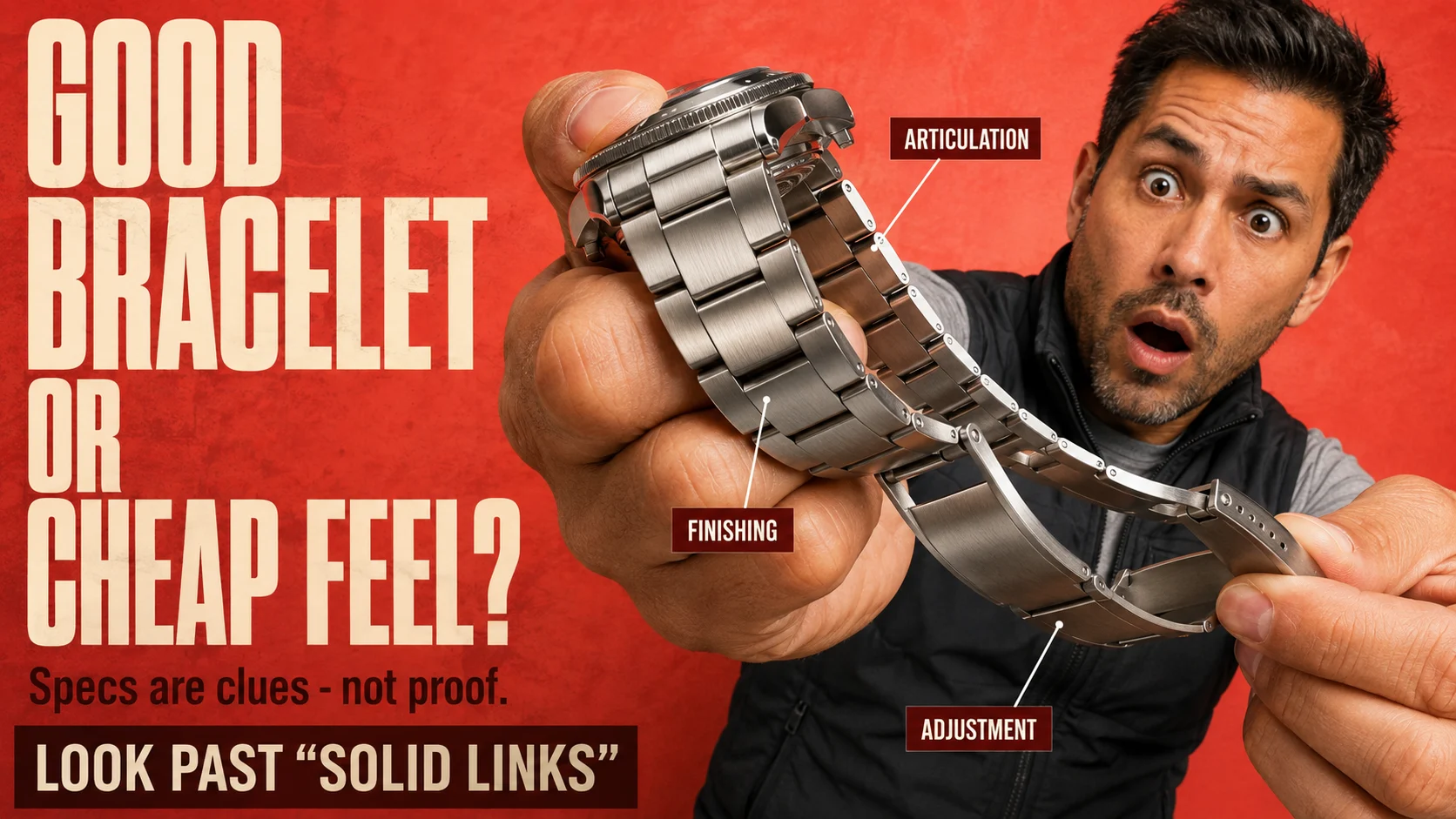
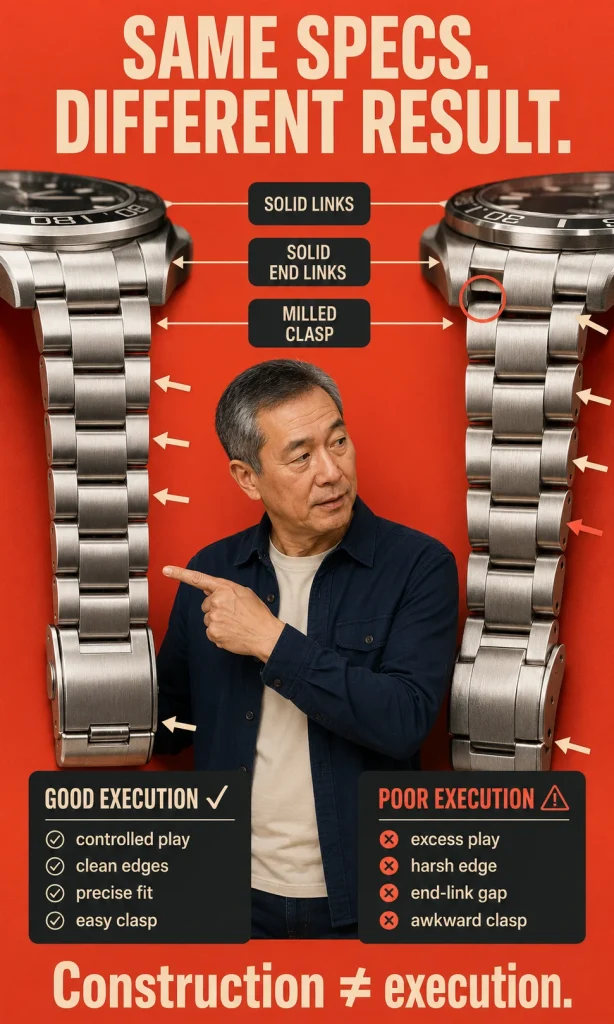
A good watch bracelet cannot be identified from one specification. Solid links, solid end links, 316L steel and a milled clasp are useful positive signs, but none proves that the bracelet has tight tolerances, smooth articulation, comfortable edges or a clasp that feels good in daily use. Before buying, evaluate the bracelet as a complete system: links, case connection, articulation, clasp, adjustment range, finishing and how well its weight matches the watch head.
This matters most when shopping online because two bracelets can look almost identical in product photography yet feel completely different once handled. Current bracelet discussions consistently point toward tolerance, articulation, finishing, clasp feel and adjustment as the qualities users notice immediately on the wrist, while broader watch-bracelet analysis reaches the same conclusion: construction features matter, but execution determines whether they work well together.
| Listing claim | Useful signal | What it does not prove |
|---|---|---|
| Solid links | More substantial construction than thin folded links | Good tolerances, smooth edges, comfort or quiet operation |
| Solid end links | Substantial case-to-bracelet component | A tight fit against the actual case |
| Milled clasp | Machined rather than thin folded construction | Good ergonomics, easy closure or reliable adjustment |
| 316L stainless steel | Identifies the base alloy | Machining quality, surface finishing or link tolerances |
| Screw links | Can make sizing and later servicing convenient | Superior comfort or inherently greater durability |
| On-the-fly adjustment | Excellent potential comfort flexibility | That the rest of the bracelet is well executed |
The Specification Sheet Is Only the Beginning
Bracelet specifications describe construction choices, not the precision with which those choices were executed. A bracelet can have solid links, a solid end link and a milled clasp yet still rattle, articulate poorly, have uncomfortable corners or require awkward alignment before the clasp will close. Conversely, a lighter bracelet using simpler construction can still be comfortable and perfectly appropriate for the watch it supports.
This distinction is important because online watch discussions often treat heavier or more expensive construction as automatically superior. A current technical analysis of bracelet sourcing makes the useful point that construction type alone does not establish stiffness, durability or execution quality; end-link geometry, tolerances and supplier execution still determine the actual result. JeekWatch’s bracelet-construction analysis
Treat specifications as screening signals. They help you decide what deserves a closer look, but photos, video, owner experience and return terms are what tell you whether the product is likely to satisfy you.
What Actually Makes a Bracelet Feel Premium?
A bracelet feels convincing when its many small interfaces behave consistently. Links should articulate naturally without large uncontrolled lateral movement, the end links should meet the case cleanly, the clasp should close without needing careful choreography, and the underside should remain comfortable through ordinary wrist movement. None of those qualities appears in a simple “316L solid bracelet” line on a product page.
Weight contributes to the experience, but density alone is not quality. A substantial bracelet can balance a heavy sports case beautifully, while the same mass attached to a thin watch can feel cumbersome. What matters is whether the bracelet supports the watch head without creating an obvious mismatch between case mass, bracelet taper and clasp size.
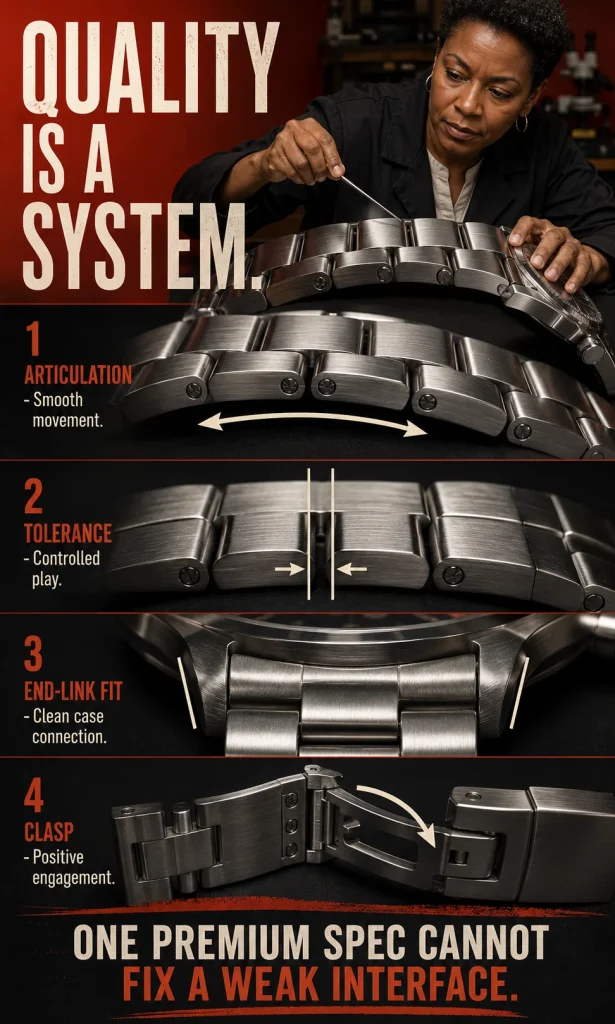
Seven Bracelet Qualities Worth Checking
- Link articulation: Links should bend naturally around a wrist rather than moving like a rigid ladder.
- Lateral tolerance: Some sideways movement is necessary, but excessive play can produce a loose or rattly feel.
- End-link fit: Curved end links should meet the case without conspicuous rocking or unexplained gaps.
- Contact-edge finishing: Underside edges and clasp corners should not scrape or snag.
- Clasp action: Closing and opening should feel deliberate rather than vague, jammed or flimsy.
- Adjustment quality: The bracelet should offer realistic increments for the wrists it is intended to fit.
- Weight distribution: The bracelet and clasp should control the watch head without feeling disproportionately bulky.
Solid Links Are Useful – but They Are Not the Whole Story
A solid link is made as a substantial piece rather than folded from thin sheet material, so it often gives manufacturers more material with which to create precise surfaces and a substantial feel. That is why solid-link construction has become a common expectation once watches move above basic entry-level pricing. The word solid, however, tells you surprisingly little about the clearance between links or how cleanly their edges were finished.
A loosely toleranced solid bracelet can still rattle. It can also feel stiff if the articulation geometry is poor, and a bulky solid link can reduce comfort if the design does not conform well to the wrist. Look at solid links as one part of the evidence rather than a final verdict.
This is especially important because many current affordable watches now advertise solid links as standard equipment. Once that feature becomes common, differences in tolerance, finishing, drape and clasp execution become the factors that separate good bracelets from disappointing ones.
Solid End Links Can Still Fit Badly
Solid end links usually feel more substantial than thin formed components, but they need to match the case correctly. A beautifully machined end link with poor dimensions can rock between the lugs, leave an uneven case gap or sit slightly above or below the intended surface. The issue is therefore not merely whether the end link is hollow or solid, but whether it actually fits the watch.
Product photographs can help here if the manufacturer provides close side and underside views. Look for consistent gaps where the bracelet meets the case, symmetrical seating on both sides and an end-link profile that continues the line of the lugs rather than looking like a generic part pushed into the opening. A single perfect front photograph tells you almost nothing about this interface.
If independent reviewers repeatedly mention end-link movement, clicking or difficulty installing the bracelet, treat those comments as meaningful even when the specification sheet looks excellent. A bracelet is a collection of interfaces, and the case connection is one of the most important.
A Milled Clasp Is Not Automatically a Good Clasp
A milled clasp usually feels more substantial because its principal components are machined rather than folded from thin sheet. That is a legitimate construction upgrade, but it does not guarantee that the buttons return smoothly, the lock engages positively or the clasp is proportioned well for the bracelet. A large, beautifully machined clasp can still dominate a small wrist or become the least comfortable component of the watch.
Look beyond the word milled and examine the closure itself. Does it close without the wearer having to squeeze the side buttons? Does its safety mechanism sit flush? Does the micro-adjustment operate smoothly, and does it provide enough practical range to matter?
Current bracelet guides increasingly highlight clasp and adjustment quality because those are the parts owners touch constantly. A recent dealer-written overview similarly emphasizes that bracelet comfort, security and adjustment can matter more in daily wear than bracelet style alone. the current 5D Watches bracelet overview
Adjustment Range Can Matter More Than Link Construction
A spectacularly finished bracelet becomes frustrating when the wearer cannot find a comfortable size. Full removable links create relatively large adjustment steps, and hidden butterfly clasps often leave little or no conventional micro-adjustment. That can trap a wrist between one configuration that slides and the next that feels too tight.
When shopping online, check whether the bracelet provides:
- half-links;
- conventional clasp micro-adjustment;
- tool-free fine adjustment;
- small removable links;
- an extension mechanism;
- enough removable links for your wrist range.
The broader watch-fit diagnosis explains what happens when circumference, clasp balance and watch-head geometry do not cooperate. For pre-purchase evaluation, adjustment range should be treated as a design specification rather than something you assume a jeweller can always solve later.
Finishing Is Where Online Specifications Become Weak
No specification line can tell you whether link edges have been properly softened, brushing is even or polished transitions remain crisp. Those are execution details, and execution is exactly where two bracelets built from similar materials can feel dramatically different. This is why buyers sometimes receive a watch that looks excellent in professional images but immediately feels cheaper than another watch with nearly identical listed specifications.
Zoom into independent macro photography rather than relying only on manufacturer renders. Look along the sides and undersides of links, around the clasp edges, where polishing meets brushing and around machined openings. Uneven reflections, obvious burrs or inconsistent edge treatment deserve more attention than impressive terms in the specification table.
If a bracelet actually causes abrasion after purchase, the specialist guide to sharp watch-bracelet edges covers that failure separately. The important pre-purchase lesson is that finishing quality cannot be confirmed from alloy and link construction alone.
Articulation and Tolerance Create the “Feel” People Struggle to Describe
The difference between two apparently similar bracelets often becomes obvious when they are picked up from one end and allowed to hang. A well-articulated bracelet usually drapes in a controlled curve, while a stiff design holds unnatural angles and a very loose one can collapse with large sideways movement. Neither stiffness nor looseness alone defines price, but both immediately affect how the bracelet feels.
This is also why videos can be more useful than still photographs. Look for reviewers flexing the bracelet, rotating individual links, shaking it lightly and demonstrating the clasp instead of only showing slow beauty shots on a wrist. The sound and movement often reveal more than polished macro footage.
Do not mistake zero movement for quality. A wearable bracelet needs clearance at its joints, and excessive tightness can make articulation worse; what you want is controlled, consistent movement without obvious slop.
How to Judge Bracelet Quality From Product Photos
Start with images that the seller did not design purely for advertising. User photographs, independent reviews and detailed underside shots often show the areas manufacturers naturally hide behind the watch head or wrist.
Look for These Visual Clues
- Side profile of the links: reveals folded construction, thickness and edge treatment.
- Underside: reveals clasp construction, screws or pins, finishing and hidden sharp corners.
- Case connection: shows end-link fit and whether the bracelet follows the lug shape cleanly.
- Open clasp: shows the actual adjustment mechanism rather than a closed polished surface.
- Fully flexed bracelet: reveals articulation and minimum curvature.
- Macro finish transitions: reveal whether brushing and polishing are cleanly separated.
- Wrist photos from the underside: show clasp bulk and whether it dominates a smaller wrist.
A product listing that gives only a frontal hero photograph and a generic material specification leaves substantial uncertainty. That does not mean the bracelet is poor, but it means you have less evidence and should give more weight to independent reviews and the return policy.
Marketing Terms: What They Really Tell You
| Term | Reason to like it | Question still unanswered |
|---|---|---|
| 316L steel | Common corrosion-resistant watch material | Was it machined and finished well? |
| Solid links | Substantial link construction | How much play and articulation are present? |
| Solid end links | Substantial case connector | Does it fit this case precisely? |
| Milled clasp | More substantial clasp construction | Does it actually close and adjust well? |
| Screw links | Convenient resizing and servicing | Are the screws and threads executed correctly? |
| Quick release | Easy bracelet removal | Does the spring-bar geometry match the watch securely? |
Specifications tell you what has been built. Reviews and handling tell you how well it was built.
Watch Weight Should Be Judged as a System
A heavy bracelet is not automatically premium, and a light bracelet is not automatically cheap. Weight needs to make sense relative to the case, because a heavy watch head on a very light bracelet can feel top-heavy while an unnecessarily massive bracelet can make a moderate watch tiring to wear.
Taper also affects how that mass feels. A bracelet that narrows toward the clasp can preserve substantial links near the watch while reducing bulk beneath the wrist, which is one reason many well-liked sports bracelets use visible taper. Whether you prefer that sensation is personal, but the specification is worth noticing before purchase.
If a review says a bracelet feels “hollow,” “tinny” or “cheap,” look for the actual reason rather than taking the adjective literally. The reviewer may be describing link construction, lateral play, clasp resonance, low weight, sharp finishing or some combination of those characteristics.
The 60-Second Bracelet Check in a Store
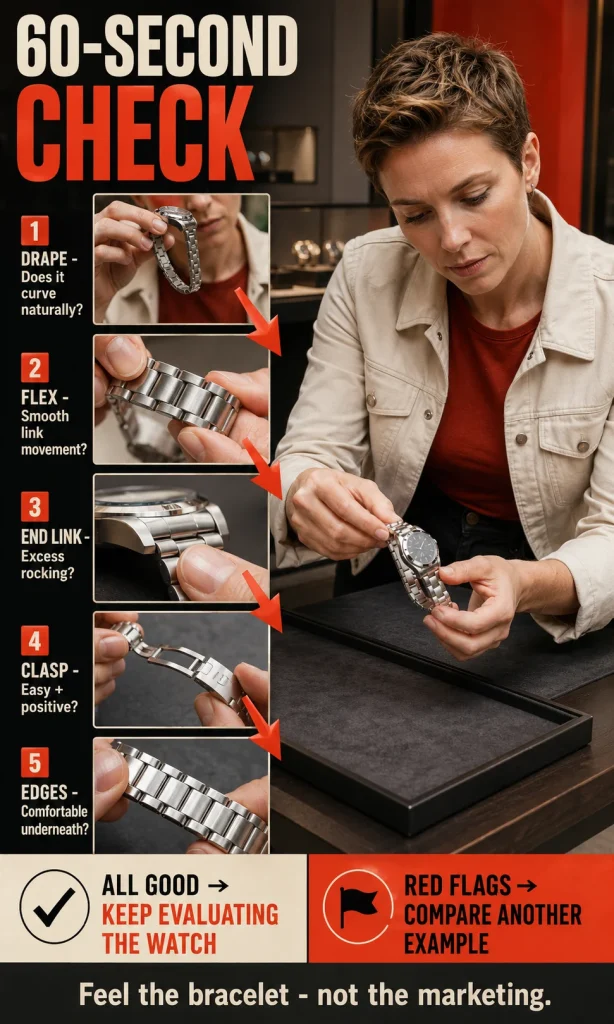
If you can handle the watch before purchasing, a minute is enough to discover problems that product listings hide. Keep the watch over the counter or another padded surface while you do the check, because the objective is evaluation rather than stress testing.
- Pick it up by the watch head. Let the bracelet hang naturally and observe its drape.
- Flex several links. Movement should be smooth and consistent rather than gritty or unusually stiff.
- Move the end links gently. Look for excessive rocking or clicking against the case.
- Open and close the clasp several times. It should engage predictably without careful realignment.
- Feel the underside edges. Look for harsh corners, burrs or raised fasteners.
- Test the adjustment mechanism. Make sure the advertised micro-adjustment is actually practical to use.
- Wear it. Check case balance, clasp bulk, hair pulling and whether the bracelet conforms naturally to your wrist.
Do not judge only by how expensive the watch feels while holding it in one hand. A good bracelet should become less noticeable once properly sized because its job is to support the watch rather than constantly announce its weight.
How to Compare Two Watches When You Can Only Buy Online
Build a small evidence hierarchy instead of trying to convert marketing phrases into certainty.
Strong evidence includes detailed independent video, repeated owner reports about the same model, close photographs of the clasp and end links, a disclosed adjustment mechanism and a return policy that allows you to evaluate fit responsibly.
Moderate evidence includes solid links, solid end links, clasp construction, bracelet taper and stated adjustment range. Those tell you something important about the design, but they cannot show machining tolerance or real wrist feel.
Weak evidence includes words such as premium, luxury-grade, heavy-duty or high-quality steel without supporting construction details. Those phrases are advertising language rather than bracelet specifications.
When a Poor Bracelet Should Change the Purchase Decision
A weak bracelet does not automatically make a good watch a bad purchase. If the watch uses conventional lugs and you already prefer leather, rubber or fabric, you may reasonably treat the bracelet as a secondary accessory and judge the watch head on its own merits. The economics change when the bracelet is proprietary, integrated into the case or accounts for a substantial part of the price.
Think harder before purchasing when the watch has:
- an integrated bracelet with no easy strap alternative;
- unusual end-link geometry;
- a proprietary clasp;
- limited micro-adjustment;
- no half-links despite large removable links;
- repeated reports of sharp edges;
- repeated reports of difficult clasp engagement;
- expensive replacement bracelet pricing.
The broader guide to choosing a women’s watch that actually fits also explains why case and bracelet fit should be evaluated together rather than as separate purchase decisions.
When an Aftermarket Bracelet Is a Sensible Upgrade
An aftermarket bracelet can transform an otherwise excellent watch when the factory bracelet is the weak point. Look for model-specific end links, an appropriate spring-bar system, adjustment features you actually need and credible owner reports showing that the replacement fits the case correctly.
Do not assume that a list of upgrades automatically means better execution. A replacement can advertise solid links, screws and a milled clasp yet introduce difficult installation, poor end-link fit or uncomfortable edges. The same evaluation framework applies to aftermarket hardware as to the bracelet supplied with the watch.
If the bracelet uses security hardware that begins failing after installation, the specialist pages for a bracelet screw that keeps coming loose and a clasp that opens unexpectedly cover those mechanical failures separately.
The Best Bracelet Specification Is Evidence
A manufacturer can tell you alloy, link construction and clasp type. Those are useful, but the missing variable is execution, and execution is why physically similar bracelets can produce completely different reactions when they reach the wrist.
Before buying online, look for solid construction plus evidence of good execution: controlled articulation, clean edges, precise end-link fit, a useful adjustment system and consistent owner feedback about clasp feel. When that evidence is missing, price the uncertainty into the purchase rather than assuming familiar specifications guarantee a familiar experience.
A bracelet should not need to impress you with terminology. It should make the watch easy to wear, easy to adjust and easy to forget about once it is on your wrist.
Frequently Asked Questions
Are solid watch bracelet links always better?
Solid links are generally a positive construction feature and can provide a more substantial feel than thin folded links, but they do not guarantee tight tolerances or good finishing. A poorly executed solid bracelet can still rattle, articulate badly or have sharp contact edges. Judge solid construction together with end-link fit, clasp quality, finishing and adjustment.
Does a milled clasp mean the bracelet is high quality?
A milled clasp is usually a more substantial construction than a basic folded clasp, but machining method alone does not prove good ergonomics or reliable engagement. Check how easily the clasp closes, whether its buttons return properly and whether the adjustment mechanism is useful. A large poorly designed milled clasp can still be uncomfortable.
Does 316L stainless steel mean a watch bracelet is premium?
316L identifies the stainless-steel alloy rather than the manufacturing quality of the bracelet. Two bracelets made from the same alloy can differ dramatically in machining tolerance, edge finishing, link articulation and clasp execution. Treat the alloy as one material specification rather than a quality grade.
Why do some solid watch bracelets still rattle?
A bracelet needs clearance between moving links, and excessive clearance can create lateral movement and noise even when every link is solid. End-link fit and clasp components can also contribute to the sound. Solid construction reduces one possible source of cheap feel but does not eliminate tolerance-related rattle.
How can I judge bracelet quality when buying a watch online?
Use specifications to identify construction, then look for independent video showing bracelet articulation, end-link fit, clasp operation and adjustment. Read several owner reports for the same model and inspect close photographs of the bracelet underside and case connection. When those details are unavailable, a strong return policy becomes part of the buying decision because important bracelet qualities cannot be confirmed from a specification sheet alone.
Is an aftermarket bracelet worth buying?
It can be worthwhile when you like the watch head but dislike the original bracelet and a reputable model-specific replacement improves fit or adjustment. Check end-link compatibility, spring-bar requirements, clasp dimensions and independent owner experience before buying. Aftermarket specifications should be judged with the same skepticism as factory specifications.
Action Checklist
- Read the bracelet specifications, but do not stop there.
- Confirm whether the links and end links are solid or formed.
- Inspect the end-link-to-case interface in close photographs.
- Look for independent video showing the bracelet flexing and hanging.
- Check whether the clasp closes naturally and repeatedly.
- Confirm the actual fine-adjustment system rather than assuming one exists.
- Look for half-links when the bracelet uses relatively large removable links.
- Inspect underside and side-edge finishing.
- Read owner comments specifically about rattle, articulation, hair pulling and clasp feel.
- Consider bracelet taper and clasp size relative to your wrist.
- Treat 316L steel, solid links and a milled clasp as positive clues rather than guarantees.
- Check the return policy before buying a bracelet you cannot handle first.
- Budget for another strap or bracelet if the watch head is excellent but the supplied bracelet is uncertain.
- Be more cautious with integrated bracelets because replacement options are limited.
- In a store, test the bracelet itself rather than judging the watch only from the dial and case.