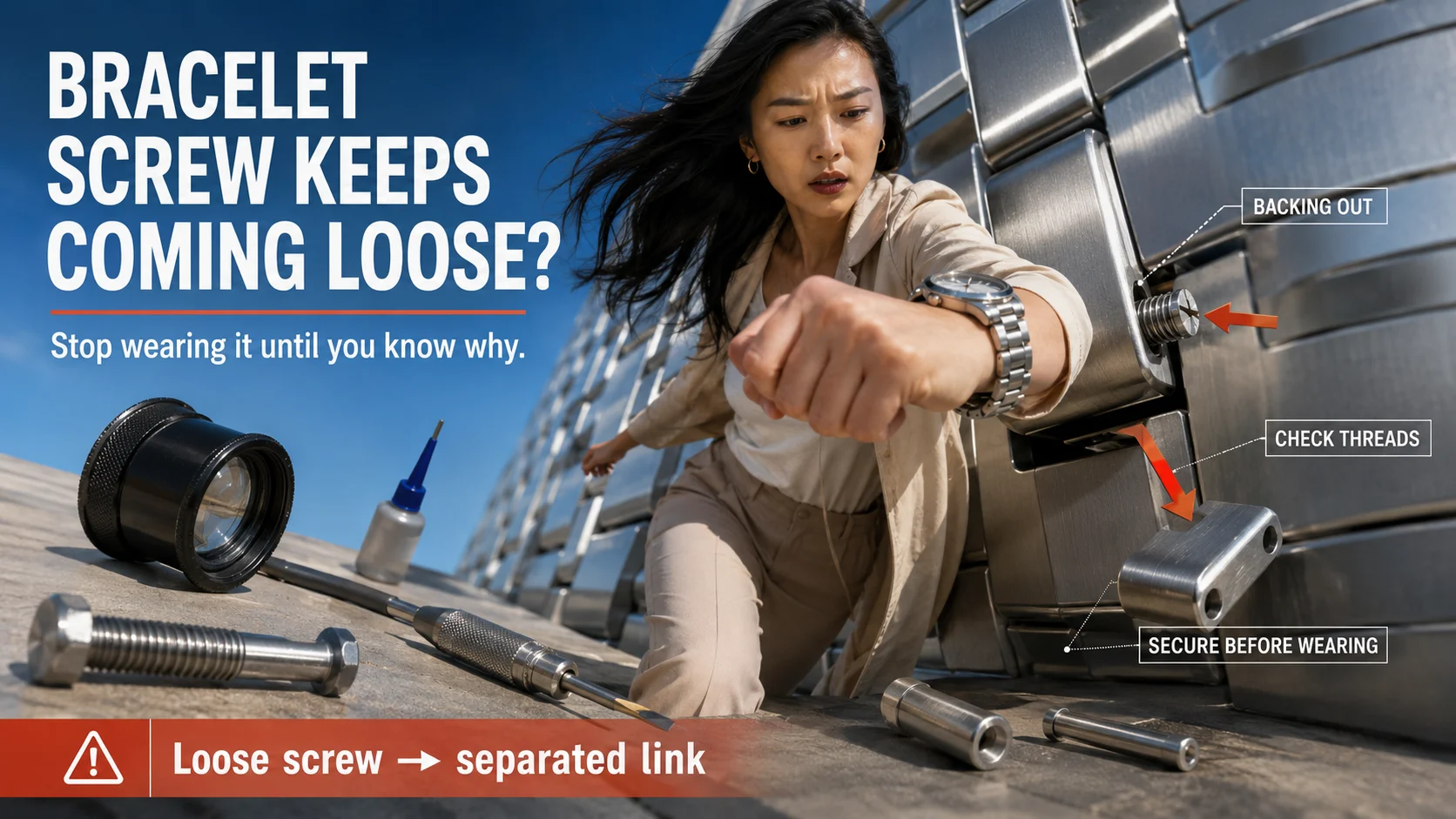
If a watch bracelet screw is visibly backing out, take the watch off until the fastener is secured. Simply tightening the same screw over and over is not a reliable fix when it repeatedly loosens, because the cause may be missing thread retention, contamination, an incorrect screw, worn threads or damage to the bracelet link itself.
A screw that has moved outward far enough can eventually stop retaining the link, allowing the bracelet to separate. That makes this a different problem from an annoying bracelet fit issue: the consequence can be the watch falling onto the floor or being lost before the wearer notices.
| What you see | What it may mean | What to do now |
|---|---|---|
| Screw slightly protruding | Fastener has started backing out | Remove the watch and inspect before wearing it again |
| Screw loosens again after tightening | Retention, contamination, wrong part or damaged thread may be involved | Do not keep repeating the same temporary fix |
| Screw spins without becoming tight | Thread may be stripped or the screw may be incorrect | Stop and have the screw/link inspected |
| Screw head remains proud when fully tightened | Wrong length, obstruction or thread damage is possible | Compare with an untouched matching fastener rather than forcing it |
First Make Sure It Really Is a Screw
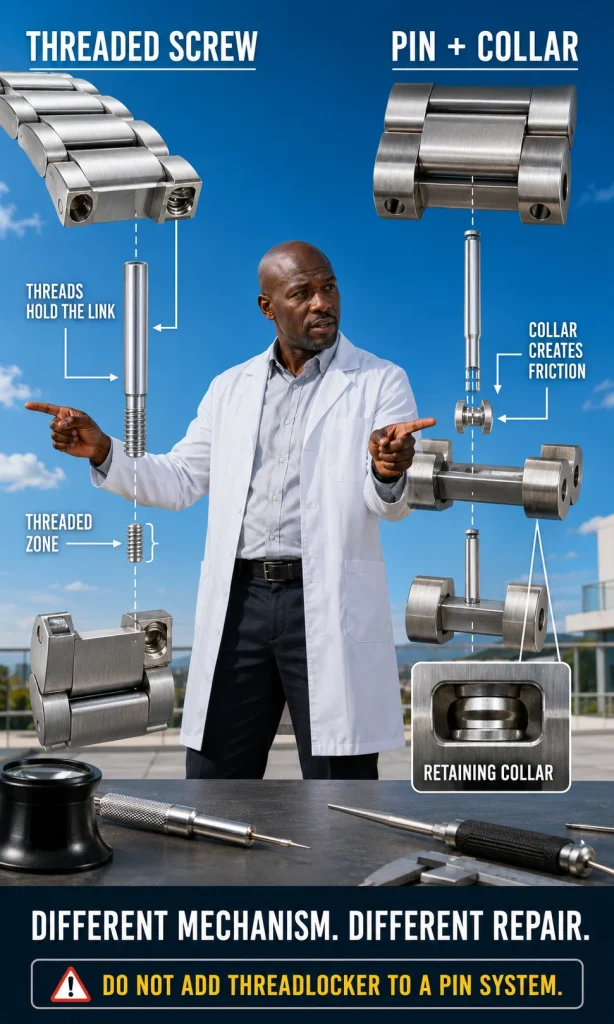
Metal watch bracelets do not all use the same retaining system. Some removable links use threaded screws, some use a screw-bar, some use split friction pins, and others use a pin together with a tiny retaining collar. A product that prevents threaded fasteners from loosening is useless on a friction-pin bracelet and can make the wrong repair considerably harder.
Look closely at an untouched link before disassembling anything. A conventional threaded link screw normally has an identifiable driver slot or head and engages threads at one end, while a pin-and-collar system depends on a tiny sleeve to grip the pin rather than threads. Some bracelets are more complex and use components on both sides, which is another reason not to infer the mechanism from a photograph of an unrelated watch.
Longines’ current bracelet-adjustment guidance illustrates this difference clearly by separating push-pin-and-collar bracelets from screw-bar systems and warning that some bracelet components have model-specific dimensions.
Correct identification matters because the failure modes are different. A split pin can slide because its friction fit has deteriorated, while a screw backs out because the threaded joint is no longer remaining secure. Treating both problems as “loose bracelet links” hides the mechanical distinction that determines the correct fix.
Why Bracelet Screws Back Out
A properly assembled screw joint must maintain enough retention that normal bracelet articulation and everyday vibration do not gradually rotate the fastener loose. Threadlocker is one method of providing that retention on designs where the manufacturer or servicing procedure permits it, although it cannot restore stripped threads or correct a mismatched screw.
Recent owner reports show this issue particularly often after bracelet resizing. That does not prove resizing itself damages bracelets; the more useful clue is that resizing is the point at which the retaining joint has just been disturbed, cleaned, replaced or reassembled. If one screw starts moving outward shortly after link removal, inspect that disturbed joint before assuming the entire bracelet has a design problem.
Another possibility is an incorrect fastener. Bracelet screws that look almost identical can differ in overall length, thread engagement or geometry, and some bracelets use more than one bar length. Longines notes, for example, that some center-link bars can differ by only fractions of a millimeter, which is enough to make casual part mixing a poor idea.
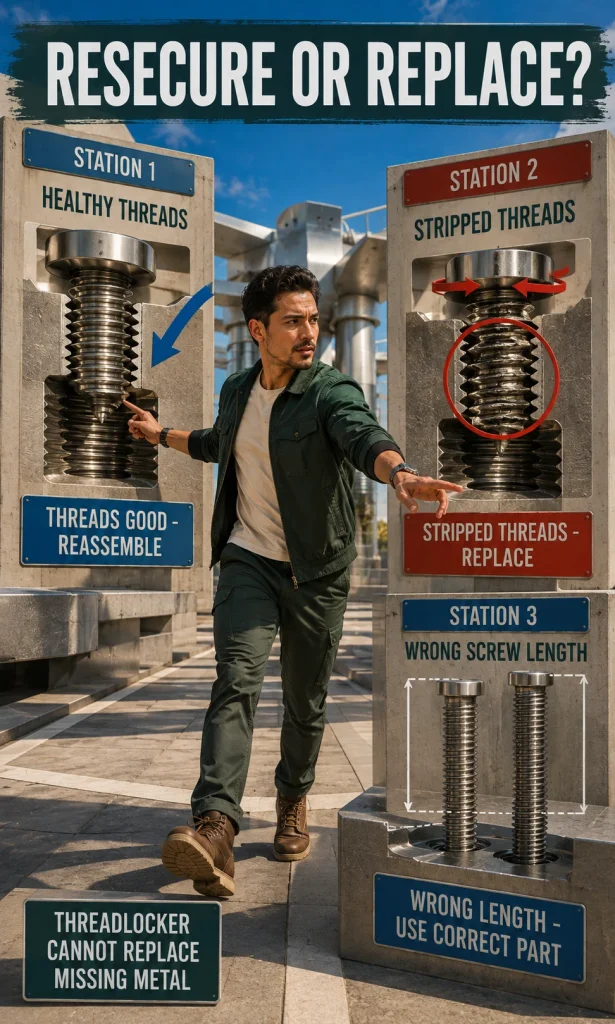
Worn or damaged threads produce a different pattern. A good screw should tighten progressively into a definite seated position; if it continues rotating without becoming secure, has excessive side play or can be pulled outward despite apparently being tight, threadlocker should not be used to disguise the problem. The screw, threaded link or both may require replacement.
Does a Watch Bracelet Screw Need Threadlocker?
Sometimes, but not every bracelet should automatically receive it. The correct answer depends on the bracelet design and manufacturer/service procedure.
A low-strength removable threadlocker is designed to resist loosening caused by shock and vibration while still allowing later removal with ordinary hand tools. Henkel describes LOCTITE 222 specifically as a low-strength threadlocker for small threaded fasteners that require easy disassembly, which explains why this class of product appears frequently in watch-bracelet servicing discussions.
That does not make 222 a universal prescription for every watch. Longines, for example, describes low-strength threadlocker as optional but recommended for certain screw-bar applications on high-impact sports models rather than declaring it mandatory for every bracelet.
The practical rule is:
- Check the manufacturer’s bracelet or service guidance when available.
- Use only a removable low-strength threadlocking product appropriate for the specific fastener when the design calls for it.
- Do not substitute permanent adhesive merely because it is stronger.
- Do not use threadlocker to hide stripped or mismatched threads.
- If an authorized dealer recently resized the bracelet and the fastener is now backing out, give the dealer an opportunity to correct the assembly.
Where Threadlocker Goes Matters
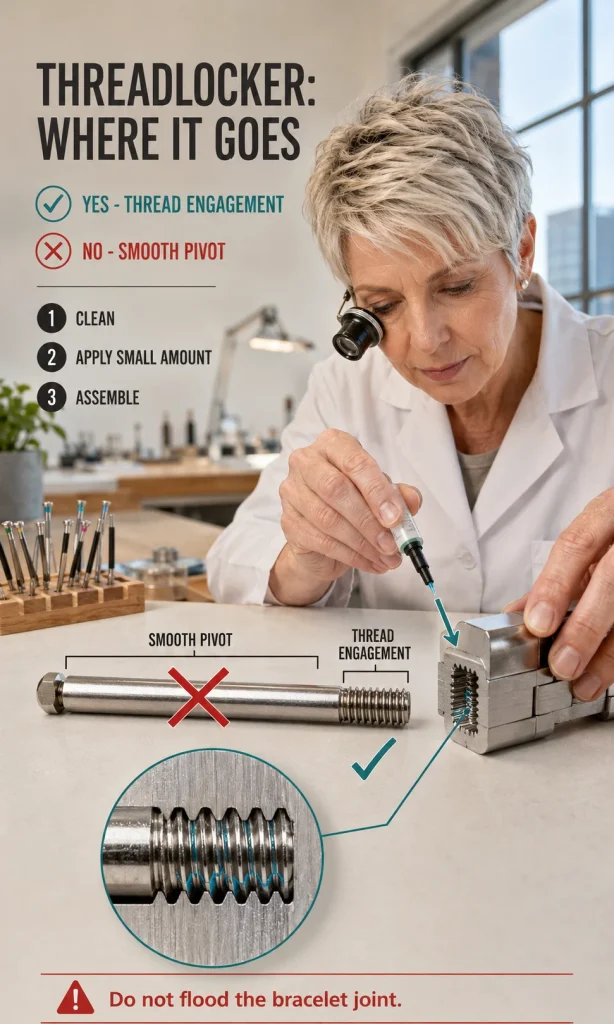
Threadlocker is intended for the thread engagement area, not for coating the entire smooth shaft of a bracelet screw or flooding the articulation between links. Henkel’s technical guidance instructs users to apply the product where the male and female threads engage, and the adhesive cures when confined between close-fitting metal surfaces without air.
That distinction is especially important on bracelet fasteners that have a long smooth section functioning as an axle through the links and a short threaded section at one end. Adhesive on the smooth pivoting area can migrate into places that should articulate freely and can make later servicing unnecessarily difficult.
The threads should also be clean when the specified threadlocker is being used. Henkel recommends cleaning the mating surfaces before assembly because oil, dirt and other contamination can affect curing and performance.
Do not assume that the threadlocker is fully cured the moment the screw feels tight. The LOCTITE 222 technical sheet shows strength developing progressively with cure time and reports its standard cured-property measurements after 24 hours at 22°C. Actual cure behavior depends on substrate, temperature and gap, so follow the product and watch-service instructions rather than treating one universal waiting period as a rule.
Why Tightening the Screw Harder Is Not the Answer
A tiny watch-bracelet screw is not a wheel lug nut. Extra torque cannot repair worn threads, and overtightening can damage the driver slot, deform the fastener or strip the receiving thread.
The screwdriver blade should fill the slot correctly rather than touching only its center. A poorly fitting driver concentrates force into a small portion of the slot and makes cosmetic damage or cam-out more likely before the screw has actually reached the correct seating point.
Current Longines guidance explicitly warns against overtightening screw-bars because stripped threads can result.
The right endpoint is the specified fastening procedure for that bracelet, not “as tight as my fingers can make it.” If the screw reaches an obvious stop and still begins migrating during normal wear, investigate retention and component condition rather than adding more force.
The Fastener May Be the Wrong Length
This is an overlooked cause because a replacement screw can look correct from above while being mechanically wrong.
Check an untouched corresponding link, if the bracelet has one. Compare:
- head diameter
- head thickness
- shaft diameter
- overall length
- threaded length
- thread location
- how far the head sits below or flush with the bracelet surface
If the suspect screw bottoms out before its head reaches the normal position, it may be too long or encountering damaged internal threads. If it tightens unusually far below the surface, it may be too short or belong to another link position.
Do not file or shorten an expensive bracelet fastener simply to make it visually flush unless that is part of an approved repair procedure. A replacement fastener with the correct specification is safer than modifying one whose geometry you do not know.
How to Inspect a Bracelet Screw That Keeps Loosening
Use this sequence rather than repeatedly tightening and wearing the watch:
- Take the watch off. Do not continue wearing a bracelet with a visibly protruding retaining screw.
- Photograph the link before touching it. This records how far the fastener moved and helps if warranty/service is involved.
- Identify the fastening system. Confirm that it is threaded rather than a pin-and-collar or friction pin.
- Check nearby untouched fasteners. Compare screw-head position and component geometry.
- Use the correct driver. The blade should fit the slot closely.
- Inspect the screw. Look for damaged threads, deformation or a chewed driver slot.
- Inspect the receiving thread if accessible. A screw that will not reach a secure stop may indicate link damage.
- Check manufacturer guidance. Determine whether the bracelet procedure calls for removable threadlocker.
- Reassemble only if the parts are sound. A chemical retention product cannot repair missing metal.
- Allow the specified cure period. Do not immediately flex and wear a newly threadlocked joint.
- Reinspect during the first wears. Run a fingertip over the bracelet periodically to detect a screw starting to protrude.
When the Screw Should Be Replaced
Repeated movement after correct reassembly is a strong reason to stop treating the symptom as simple looseness. The screw may have damaged threads, the female thread in the link may be worn, or the fastener may not belong in that link.
Replacement is also preferable when the screwdriver slot has been damaged badly enough that future servicing will be difficult. Continuing to tighten a partially stripped screw can turn an inexpensive fastener replacement into extraction work involving the bracelet link itself.
If a replacement screw also refuses to stay secure, the bracelet link becomes the next suspect. A worn threaded link cannot regain missing material merely because a stronger adhesive is applied.
Should You Use Superglue or Permanent Threadlocker?
Avoid improvising with permanent household adhesives.
Superglue is not designed as a controlled removable fastener-retention system for a serviceable metal watch bracelet. It can migrate into link joints, complicate later removal and still fail to correct the actual problem when thread geometry is damaged.
High-strength threadlockers create a different servicing problem. More retention is not automatically better when the fastener is extremely small and expected to be removable in the future.
Henkel’s reason for classifying 222 as low-strength is precisely that the secured fastener can normally be disassembled with ordinary hand tools.
Use the product class specified for the actual bracelet rather than choosing the strongest adhesive available.
A Loose Screw After Professional Sizing Should Go Back
If an authorized dealer, retailer or watchmaker resized the bracelet and a screw begins backing out soon afterward, contact that service provider before modifying the joint yourself.
The fastener may simply need correct reassembly, but the shop is also in the best position to confirm whether the correct link screw was used and whether the bracelet procedure requires a specific retention compound. On a new or high-value watch, preserving the service history is more useful than winning a five-minute DIY repair.
Document the protruding screw with a close photograph before it is touched. If the bracelet has already separated or the watch has fallen, document the link, screw, clasp and any resulting case damage as well.
Bracelet Screw vs Pin-and-Collar Failure
These two failures look similar from a distance because a metal rod begins protruding from the side of a bracelet. Their fixes should not be mixed.
| Retention system | What holds it | Typical failure clue | Threadlocker? |
|---|---|---|---|
| Threaded screw | Male and female threads | Screw gradually rotates outward | Sometimes, when specified |
| Pin and collar | Pin retained by small friction collar | Pin slides because collar is missing, damaged or misplaced | No – repair the retention system |
| Split/friction pin | Interference/friction fit | Pin no longer grips securely | No – replace or correctly fit the pin |
If your bracelet problem is primarily about the watch sliding, rotating, clasp position or sizing rather than a fastener physically coming out, use the broader watch fit problems guide instead. Fastener security and bracelet fit affect each other, but they are different mechanical jobs and should be diagnosed separately.
When to Stop DIY and Use a Watchmaker
Professional inspection is the better option when:
- the screw spins without tightening;
- the threads look flattened or damaged;
- a correct replacement screw also backs out;
- the bracelet has already separated;
- the receiving link appears damaged;
- the screw head is stripped;
- the fastener is seized;
- the bracelet uses an unfamiliar multi-part system;
- the watch is valuable, new or under warranty;
- you cannot confirm the correct fastener specification.
Be especially cautious with advice telling you to apply extreme heat to an assembled bracelet. Henkel’s industrial technical sheet discusses localized heat as a method for difficult threadlocker disassembly in general industrial fasteners, but that is not a watch-bracelet DIY instruction. An assembled watch contains finishes, seals and components that should not be subjected casually to industrial disassembly temperatures.
A competent watchmaker can identify whether the problem is the screw, receiving link, thread retention or a previously incorrect assembly. That diagnosis is usually more valuable than repeatedly tightening a fastener until the bracelet finally fails.
Frequently Asked Questions
Why does my watch bracelet screw keep coming loose?
A bracelet screw can repeatedly loosen because the joint lacks the retention required by that bracelet, the threads are contaminated or damaged, the screw is incorrect, or the receiving link is worn. Tightening it repeatedly without identifying the cause may only delay another failure. Remove the watch if the screw begins protruding and inspect the fastener before wearing it again.
Should I use Loctite on watch bracelet screws?
Use threadlocker only when it is appropriate for the bracelet and servicing procedure. Low-strength removable threadlockers are designed for small serviceable fasteners, but they cannot repair stripped threads or an incorrect screw. Check manufacturer guidance or ask a qualified watchmaker when the bracelet procedure is uncertain.
Is Loctite 222 suitable for watch bracelet screws?
LOCTITE 222 is a low-strength removable threadlocker designed for small threaded fasteners, which is why it is used in some watch-bracelet servicing situations. Its suitability still depends on the bracelet design and manufacturer procedure. Do not assume that every threaded bracelet requires the same product.
Can a loose watch bracelet screw make the watch fall off?
Yes. If the fastener backs out far enough to stop retaining the bracelet link, that link can separate and the watch can leave the wrist. Take the watch off when a retaining screw is visibly protruding instead of pushing it back in and continuing to wear it.
Why does my bracelet screw spin but never tighten?
Continuous spinning can indicate damaged threads, an incorrect screw or damage to the threaded portion of the bracelet link. Threadlocker should not be used to compensate for missing or stripped thread material. The fastener and link should be inspected and replaced where necessary.
Can I use superglue on a watch bracelet screw?
Superglue is a poor substitute for a controlled removable threadlocking system on a serviceable watch bracelet. It can migrate into the link, complicate future disassembly and still fail to correct damaged threads. Use the bracelet’s specified fastening method instead.
Action Checklist
- Take the watch off if a retaining screw is protruding.
- Photograph the problem before altering it.
- Confirm whether the bracelet uses a screw, screw-bar, friction pin or pin-and-collar.
- Compare the suspect fastener with an untouched matching link.
- Use a correctly fitting screwdriver.
- Check the screw and receiving threads for damage.
- Confirm that the fastener is the correct size and type.
- Use only the manufacturer-appropriate retention method.
- Keep threadlocker on the threaded engagement area rather than coating the whole pivot.
- Do not use stronger adhesive to compensate for damaged threads.
- Allow any approved threadlocker to cure according to its instructions.
- Recheck the fastener during the first wears.
- Return a recently resized bracelet to the dealer/watchmaker if the same screw begins backing out.
- Replace damaged hardware rather than repeatedly tightening it.
- Stop DIY work when the screw spins, strips, seizes or fails again after correct reassembly.