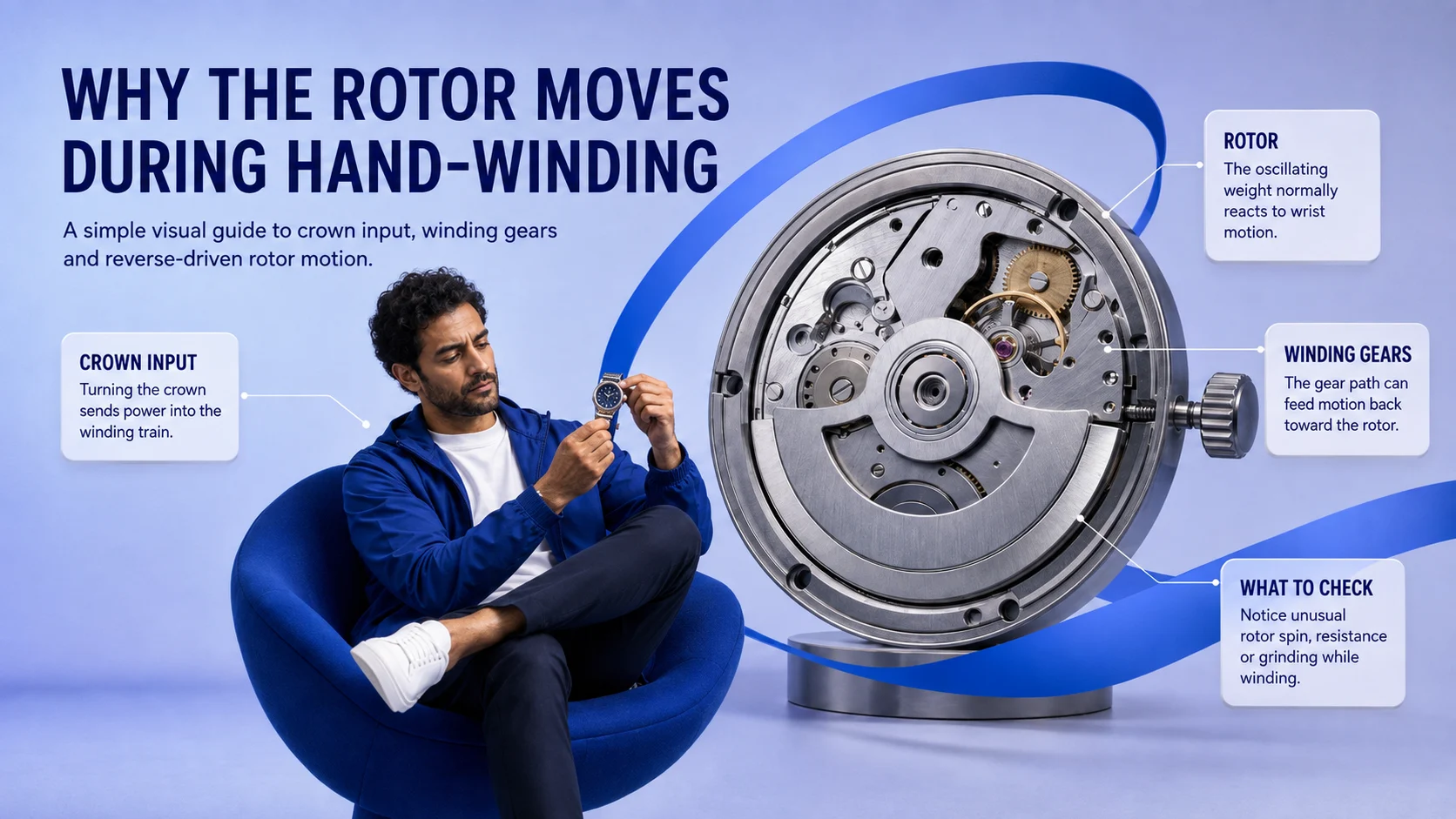
If the rotor inside an automatic watch spins strongly every time you turn the crown, especially when the watch is held flat, the behavior can indicate that part of the automatic winding system is binding instead of allowing manual winding to operate normally. A small rotor movement caused by changing the watch’s orientation is different from a rotor that is clearly being driven around by the crown. If the spinning is accompanied by stiff winding, vibration, scraping or a recent change in behavior, professional inspection is sensible.
The distinction matters because an automatic watch naturally contains a freely moving oscillating weight. Simply tilting or rotating the watch while winding can therefore make the rotor swing under gravity even when nothing is wrong. What deserves attention is a repeatable relationship in which turning the crown makes the rotor rotate, accelerate or shake in step with the winding action.
This phenomenon is often called rotor helicoptering in watch communities. The term describes the rotor visibly or audibly whipping around while the wearer manually winds the watch through the crown. It is a useful description of the symptom, although it is not itself a diagnosis because different automatic movements use different winding architectures.
Recent owner reports show why this distinction causes confusion. Some people notice only a slight rotor movement while winding slowly with the watch held horizontally, while others can feel the entire watch vibrate as the rotor spins rapidly. Those two situations should not automatically receive the same diagnosis because movement design, orientation and the amount of winding resistance matter.
Rotor SignalStudio
See whether your rotor is simply moving with gravity or being driven while you turn the crown. Get a clear diagnostic signal and the safest next step.
 TURN CROWN
WATCH ROTOR RESPONSE
TURN CROWN
WATCH ROTOR RESPONSE
What does the rotor actually do?
Hold the watch as steadily as practical and choose the closest description. Do not force the crown.
What does winding feel and sound like?
The rotor alone is less informative than the rotor plus resistance, vibration, noise, or a change in behavior.
What else has changed?
These clues help separate a winding-system concern from a harmless visual observation.
Watch status and local help
Warranty status changes who should open the watch first.
First Check Whether the Crown Is Actually Driving the Rotor
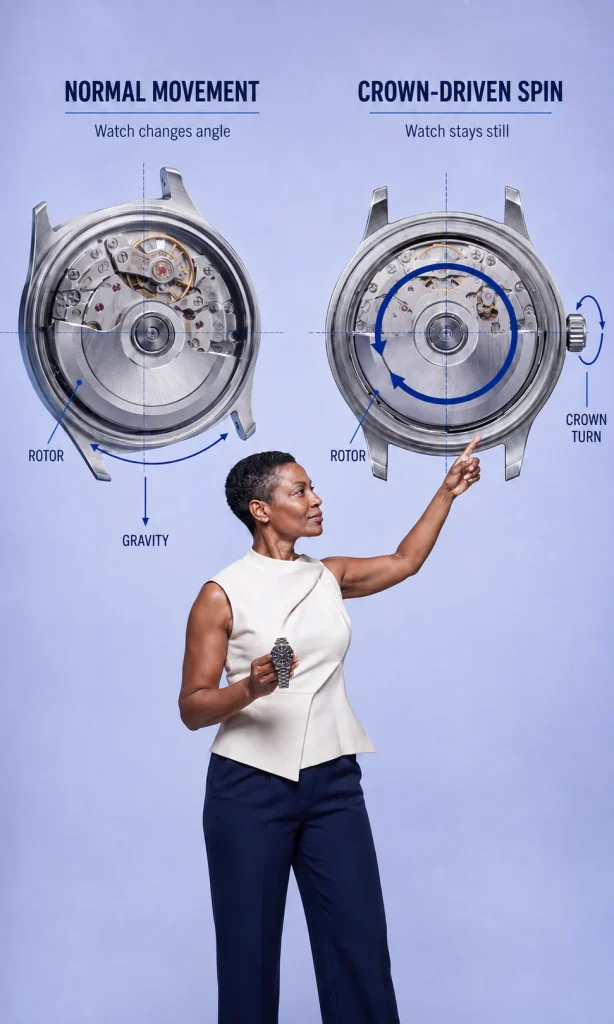
Hold the watch steadily rather than rotating your wrist while you wind it. If possible, observe the rotor through an exhibition caseback while the watch remains in the same orientation, and turn the crown gently at a normal winding pace. The purpose is to separate gravity-driven rotor movement from motion that consistently occurs in response to each crown turn.
Then change the watch’s orientation and repeat the observation without forcing the crown. A rotor that swings when you tilt the watch is performing its normal physical job, while a rotor that repeatedly spins because you are turning the crown suggests that energy is being transmitted through the winding system in a way worth investigating. Orientation can change how obvious the behavior appears, so one test position should not be treated as definitive.
Pay attention to the winding feel at the same time. Smooth crown rotation with only occasional mild rotor movement is less concerning than crown resistance that increases while the rotor begins spinning rapidly. A watch that suddenly behaves differently after months or years of normal winding also deserves more attention than one whose movement-specific behavior has always been present.
The official instructions for the particular caliber should remain the first reference for how that watch is intended to be wound. For example, current Hamilton instructions confirm that many of its automatic movements can be wound manually through the crown, which means normal manual winding should be considered part of intended operation rather than something that automatically harms the movement.
Why Manual Winding and Automatic Winding Are Connected
An automatic movement uses an oscillating weight, commonly called the rotor, to capture wrist movement and transfer that energy toward the mainspring. The automatic winding train needs a mechanism that allows useful rotor motion to wind the watch while managing direction and preventing unwanted mechanical feedback through the rest of the system. The exact architecture varies considerably between movements.
In common Swiss automatic architectures, components such as reversing wheels and reduction wheels sit between the oscillating weight and the rest of the winding system. Current Sellita technical documentation for the SW200-2, for example, separately identifies the reversing wheel, auxiliary reversing wheel, reduction wheel and oscillating weight within its automatic mechanism.
When those parts operate correctly, hand-winding through the crown should not normally behave as though the crown were directly powering a miniature propeller behind the movement. If part of the automatic winding train binds, however, torque can be transmitted toward the rotor instead of being isolated as intended. That can produce the dramatic spinning behavior owners describe as helicoptering.
The precise defective component cannot be identified reliably merely by looking through the caseback. Reversing-wheel problems are commonly discussed with this symptom in ETA-derived and related architectures, but other movement designs can fail differently. A sensible consumer diagnosis therefore stops at identifying abnormal behavior and leaves movement-level disassembly to someone who can inspect the caliber properly.
Slight Rotor Movement Is Not the Same as Helicoptering
A rotor is deliberately free to move, so seeing it change position while you handle the watch is normal. If you wind while holding the watch loosely, even a small change in angle can allow gravity to move the oscillating weight. This can make it appear that the crown caused the motion when the two events merely happened together.
True helicoptering is usually much easier to reproduce. The watch can remain in essentially the same position while crown rotation causes sustained or repeated rotor rotation, and the wearer may hear or feel the resulting movement through the case. Recent repair-community discussions describe this exact symptom alongside seized or problematic reversing wheels.
Movement family also matters. A small amount of rotor response that one caliber tolerates may be unusual for another, which is why internet advice that begins with “all automatics should…” is often unreliable. When the behavior is subtle and the winding remains smooth, comparing it with manufacturer guidance or another known-good example of the same caliber is more useful than comparing it with a completely different watch.
Quick Diagnostic Signs to Observe
Before deciding whether the watch needs attention, observe the complete symptom rather than one movement of the rotor:
- Does the rotor merely shift, or does it make one or more full rotations?
- Does rotor movement happen in step with crown rotation?
- Is the behavior much stronger when the watch is horizontal?
- Has manual winding become noticeably stiff?
- Can you feel the case vibrating while winding?
- Is there scraping, grinding or unusually loud mechanical noise?
- Is the behavior new?
- Is the watch also losing power reserve or stopping unexpectedly?
- Is automatic winding still maintaining the watch during normal wear?
- Is the watch new enough to be covered by warranty?
Why Horizontal Position Can Make the Problem More Obvious
When the watch lies flat, the rotor can rotate around its central axis with relatively little gravitational preference for one position. A fault that transfers winding torque toward the rotor can therefore produce a much more obvious spin than it does when the watch is held vertically. This is why many owners first notice the symptom while winding a watch placed face-up or caseback-up.
A vertical watch behaves differently because gravity pulls the rotor toward the lower side of its path. The same amount of unwanted torque may cause only a small twitch or partial movement instead of a dramatic full rotation. The disappearance of helicoptering when the watch is vertical therefore does not necessarily prove that the movement is healthy.
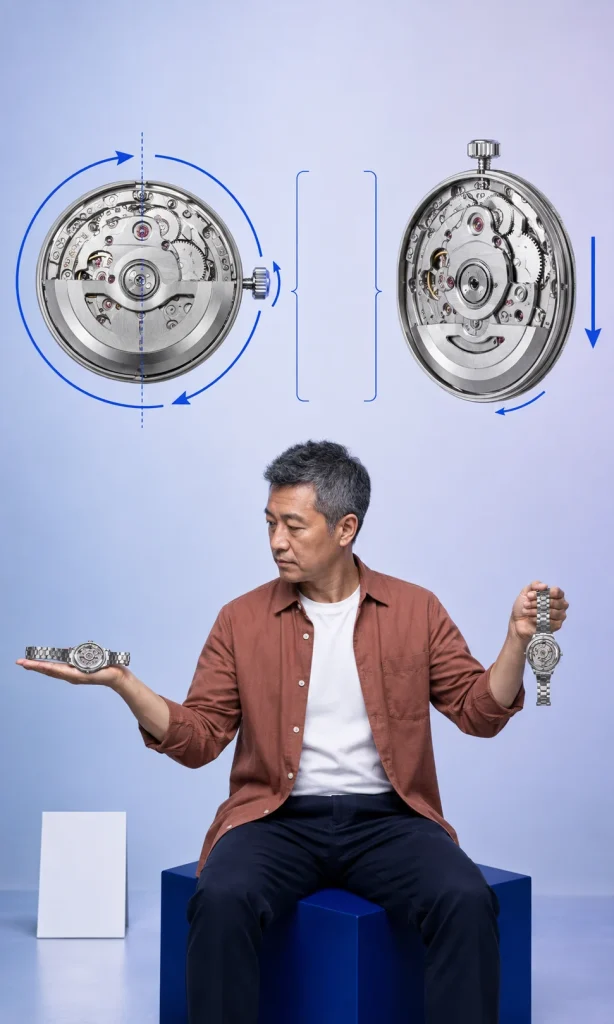
Recent owners have reported exactly this orientation-dependent behavior, including new watches whose rotors moved strongly while hand-winding in a horizontal position but behaved differently when held upright.
A Stiff Crown Plus a Spinning Rotor Is More Concerning
Manual winding should feel consistent for the caliber. Some mechanical movements naturally feel more textured or resistant than others, so there is no universal definition of the perfect crown feel. A sudden increase in resistance, particularly when it occurs at the same time as rotor spinning, provides more useful diagnostic information.
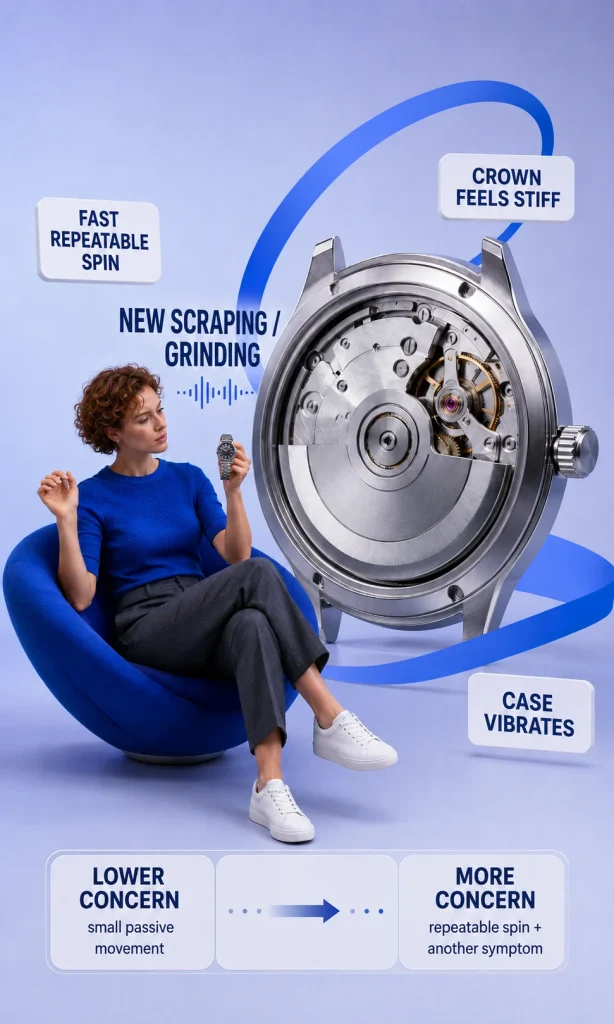
Binding inside the automatic works can make the hand-winding action feel as though you are driving more of the movement than expected. Owners sometimes describe a watch that begins with slightly sticky winding and later progresses to obvious rotor spinning. That progression is more meaningful than a rotor that simply rocks a few degrees as the watch is handled.
Do not respond by turning the crown harder to “free” the mechanism. If abnormal resistance is present, forcing additional rotations provides little diagnostic benefit and may increase stress on parts that already need attention. Stop repeated testing once you have clearly established the behavior.
Can the Watch Still Keep Accurate Time?
Yes. A watch can display this symptom while continuing to keep apparently normal time because the fault may be concentrated in the winding mechanism rather than the escapement that regulates timekeeping. Several owner reports describe watches that were still running accurately despite abnormal rotor behavior during manual winding.
Normal accuracy does not prove that the winding system is healthy. The watch may still obtain energy from wrist motion, or enough manual-winding energy may still reach the mainspring despite the unwanted rotor movement. Accuracy and winding-system condition answer different questions.
Power reserve can provide another clue if it has also changed. If the watch previously remained running through its expected off-wrist period but now stops much sooner, the combination suggests that the winding problem may be affecting how effectively energy reaches or remains in the mainspring. That deserves its own diagnosis rather than assuming the rotor symptom explains every change automatically.
| What you observe | How concerning is it? | Best next step |
|---|---|---|
| Rotor shifts slightly as the watch changes angle | Usually low concern | Hold the watch steady and retest gently |
| Rotor repeatedly turns as the crown turns | Worth investigating | Stop repeated testing and compare with caliber-specific guidance |
| Rotor spins quickly and the case vibrates | High concern for abnormal winding interaction | Arrange professional inspection |
| Rotor spinning plus stiff crown | More concerning | Do not force the crown; use warranty or service support |
| Brand-new watch develops the symptom | Potential warranty issue | Document the behavior and contact the authorized seller or service network |
What Watch “Helicoptering” Usually Means
Helicoptering is an enthusiast term for a rotor that spins conspicuously while the watch is hand-wound. In several widely used automatic architectures, owners and watchmakers associate the symptom with trouble in the reversing system or related automatic-winding components. Recent repair reports continue to document seized reversing-wheel faults producing this behavior.
That does not mean every watch with visible rotor movement needs a replacement reversing wheel. Different calibers route manual and automatic winding differently, and some movement can be produced simply by handling the watch. The important diagnostic distinction is repeatable crown-driven spinning combined with other abnormal signs.
This is also why opening the case solely because someone on a forum named a likely component is usually a poor first move. Correct diagnosis may require examining the automatic bridge, winding train and condition of the relevant components, while opening the watch can also compromise water-resistance assurance or complicate a warranty claim. A consumer article should help you decide whether service is justified, rather than pretending a caseback view can identify the exact failed part.
What If the Watch Is Brand New?
A new automatic watch should not require the owner to accept a clearly abnormal winding symptom simply because the watch still runs. If sustained rotor spinning appears during normal hand-winding, document the behavior before experimenting further. A short video showing the watch held steadily while the crown is gently turned can be useful when describing the issue to the retailer or service center.
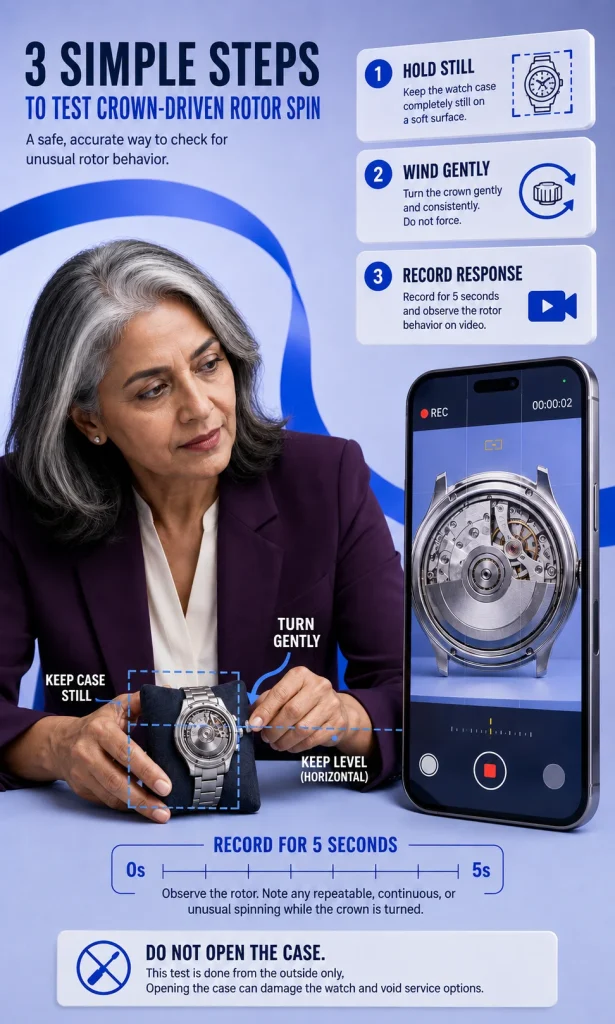
Do not open the case or attempt lubrication on a new watch that may be under warranty. Even if a community discussion points toward a reversing-wheel problem, the sensible ownership decision is to preserve the warranty route and let the manufacturer or authorized service network diagnose the movement. Recent 2026 discussions show owners reporting this behavior on watches only weeks or months old, so age alone does not rule the symptom out.
If the retailer says the behavior is normal, ask whether they can compare your watch with another watch using the same movement. Comparing two identical calibers under the same orientation and winding technique can be far more useful than comparing your watch with an unrelated automatic movement.
Should You Keep Hand-Winding It?
If winding remains smooth and you are only investigating a tiny amount of rotor movement, a short controlled observation is enough. There is little value in winding the watch dozens of times while repeatedly trying to reproduce a suspicious behavior. Once the symptom is clear, additional testing rarely changes the ownership decision.
If the crown has become stiff or the rotor begins spinning rapidly, stop deliberately hand-winding it until the watch is assessed. Automatic winding from ordinary wrist movement may still function, but continuing to force an abnormal manual-winding path is unnecessary. The purpose of troubleshooting is to identify the problem without creating another one.
Owners who use multiple automatic watches sometimes consider keeping them continuously running, but that is a separate decision from repairing a winding fault. The guide to which watches actually need a winder explains that ownership question without treating a winder as a fix for abnormal mechanics.
Do Not Diagnose the Watch From Rotor Noise Alone
An audible rotor is not automatically a faulty rotor. Case material, case thickness, movement construction and rotor-bearing design can make one automatic watch far louder than another, particularly when the wrist is moved quickly. The relevant symptom here is mechanical coupling with crown winding, not simply hearing the rotor during normal wear.
Likewise, a rotor that continues spinning freely after a quick wrist movement is a different phenomenon from helicoptering during crown winding. Some automatic movements permit more free rotor motion in one direction than others. Treat noise, free-spinning and crown-driven spinning as separate observations until there is evidence that they share one cause.
Readers unfamiliar with the difference between quartz, manual mechanical and automatic movements may find the broader guide to different types of watches useful before interpreting movement behavior. Understanding which parts are supposed to move makes unusual behavior much easier to describe accurately.
What a Watchmaker Is Likely to Check
A watchmaker will normally begin by reproducing the symptom rather than replacing parts based solely on an owner’s description. They can compare hand-winding resistance, observe the automatic works and determine whether the rotor is being driven through a part of the winding train that should move more freely. Movement history, recent service and whether the problem occurs in particular orientations can all help narrow the diagnosis.
In ETA-derived and related architectures, reversing wheels frequently appear in technical discussions of helicoptering. Sellita’s SW200-2 technical documentation confirms that reversing components form part of the automatic device alongside the reduction wheel and oscillating weight, although that document should not be interpreted as saying every rotor-spinning fault has one identical cause.
Depending on what inspection reveals, the solution may involve servicing or replacing a problematic winding component rather than performing a complete movement replacement. The exact remedy depends on caliber, parts availability, wear and manufacturer procedures. This is one reason a movement-specific diagnosis is more valuable than a generic home repair recipe.
When You Should Arrange Service
Professional inspection is the sensible choice when rotor spinning is strong, repeatable and clearly linked to crown winding. The case vibrating, the crown becoming unusually resistant, new grinding or scraping sounds, declining power reserve or a recent sudden change strengthen that recommendation. A new watch should normally be routed through its warranty channel before an independent repair is attempted.
For an older watch, the decision also depends on its service history and value. A qualified independent watchmaker may be perfectly appropriate for a common serviceable movement, while manufacturer service may make more sense where proprietary parts, remaining warranty or documentation matter. The symptom tells you that diagnosis is warranted; it does not automatically dictate who must perform the work.
Before You Contact a Watchmaker
Record a few observations first:
- movement or caliber if known
- whether the rotor moves only when the watch is horizontal
- whether it makes partial movements or full rotations
- whether crown resistance has changed
- whether the symptom appeared suddenly
- whether the watch still winds through normal wrist movement
- whether power reserve has changed
- whether accuracy has changed
- whether the watch has been serviced recently
- whether it remains under warranty
- a short video showing the behavior without forceful winding
These details help separate a vague complaint such as “my rotor moves” from a reproducible mechanical symptom.
A Small Movement Can Be Normal – A Driven Spin Is the Important Clue
The rotor inside an automatic watch is supposed to move, and a tiny change of position during handling is not enough to diagnose a fault. What raises concern is an obvious cause-and-effect relationship between crown rotation and sustained rotor rotation, particularly when the winding action also becomes stiff or the entire case vibrates. Movement design still matters, so the same observation should always be interpreted in the context of the specific caliber.
If you cannot tell which behavior you are seeing, do not force the test. Hold the watch steadily, make a brief gentle observation and document what happens. When a new or previously smooth watch clearly begins helicoptering, inspection is a better next step than trying to wind through it.
Frequently Asked Questions
Is it normal for an automatic watch rotor to move when hand-winding?
A small rotor movement can occur because the watch changes orientation while you handle it, so any movement at all is not automatically a fault. More concerning behavior is a rotor that repeatedly or rapidly spins in direct response to turning the crown while the watch remains steady. Movement design differs, so subtle behavior should be checked against the specific caliber before assuming something is broken.
What is rotor helicoptering in an automatic watch?
Rotor helicoptering is the enthusiast term for conspicuous rotor spinning while the watch is manually wound through the crown. In some automatic movement families it is associated with binding or failure in the automatic winding or reversing system. The term describes a symptom rather than identifying the exact damaged component.
Why does my rotor spin only when the watch is flat?
A horizontal rotor can rotate around its axis without gravity pulling it strongly toward one side, which can make unwanted torque much easier to see. Holding the watch vertically may reduce the visible movement even when the underlying interaction remains present. Orientation-dependent spinning is therefore useful diagnostic information but does not by itself identify the cause.
Can a watch keep good time even if the rotor spins while winding?
Yes. The automatic winding system and the regulating system perform different jobs, so an automatic-winding fault can exist while the watch still keeps apparently normal time. Accuracy alone should therefore not be used to dismiss strong rotor helicoptering or abnormal winding resistance.
Should I keep winding an automatic watch if the rotor starts spinning?
Do not repeatedly force the crown simply to test the symptom, especially if winding has become stiff or the case vibrates. A brief gentle observation is usually enough to establish whether the rotor is being driven. Once strong helicoptering is repeatable, professional inspection is more useful than further winding experiments.
Does a spinning rotor mean the reversing wheels are broken?
Reversing-wheel problems are a common explanation for this symptom in some widely used automatic architectures, but the observation alone cannot prove which part has failed. Automatic movements use different designs, and diagnosis requires the specific caliber and its mechanical condition to be considered. Treat reversing wheels as one plausible cause rather than a universal answer.
Should I return a new automatic watch if the rotor spins while winding?
If a new watch shows strong repeatable crown-driven rotor spinning, particularly with stiff winding or vibration, document the symptom and contact the seller or authorized service network. Do not open or lubricate a watch that may still be covered by warranty. The manufacturer can determine whether the behavior is normal for that caliber or whether repair or replacement is appropriate.
Action Checklist
- Hold the watch steadily before deciding that the crown is driving the rotor.
- Compare slight passive movement with sustained rotor rotation.
- Test only gently and briefly.
- Note whether horizontal orientation makes the symptom stronger.
- Pay attention to winding resistance, vibration and abnormal sounds.
- Stop deliberately hand-winding if the crown becomes unusually stiff.
- Check whether power reserve or automatic winding has changed.
- Record a short video if the symptom is repeatable.
- Preserve the warranty route on a new watch.
- Give the watchmaker the caliber and service history if known.
- Avoid opening the case merely to follow a forum diagnosis.
- Treat strong repeatable helicoptering as a reason for inspection rather than something to wind through.