

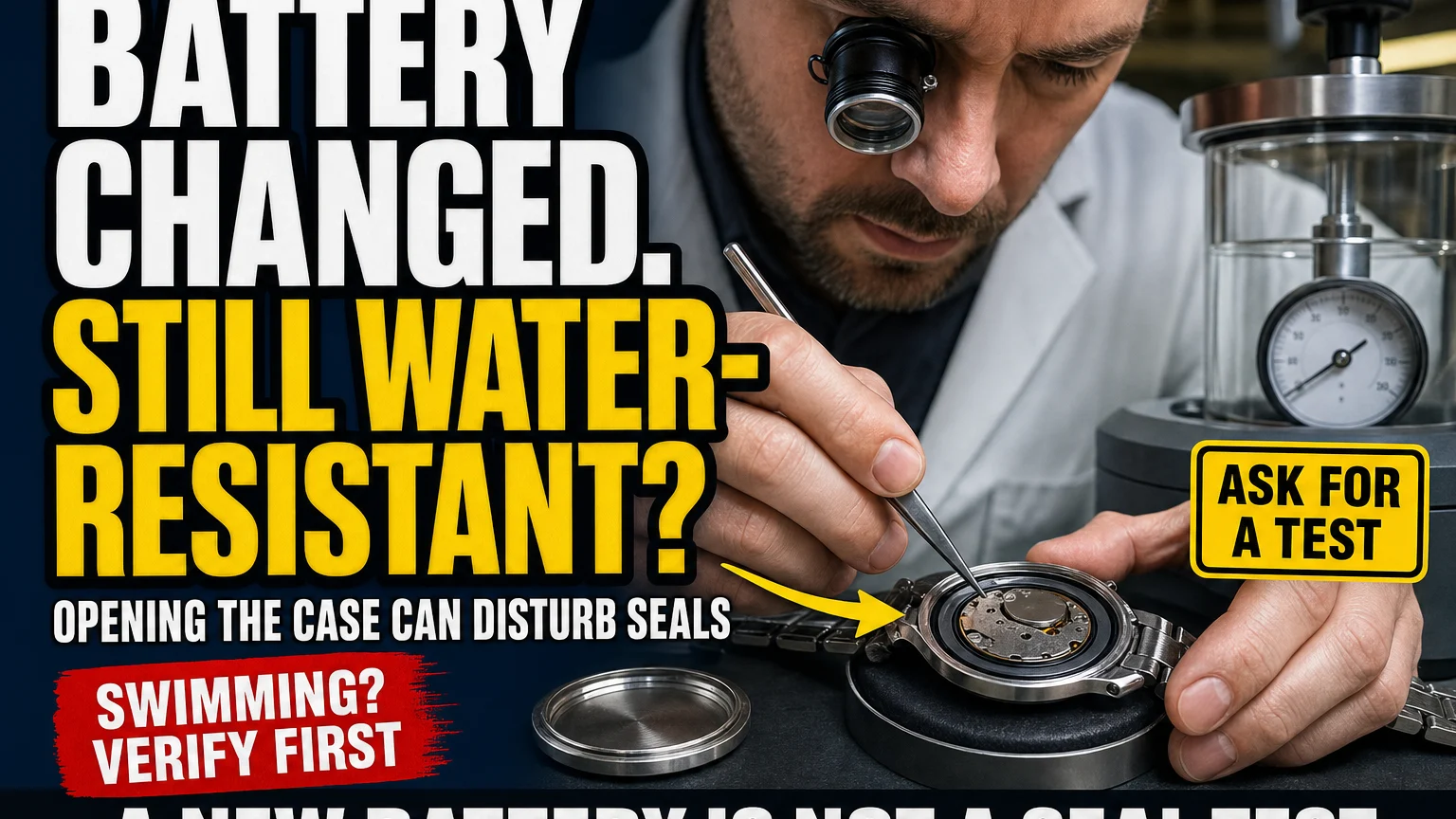
Yes, opening a watch for a battery replacement can affect its water resistance, because the case has to be opened and the sealing system is disturbed or exposed during the work. A correct battery replacement can preserve water resistance, but installing a new battery alone does not verify that the case still seals to its intended level.
If the watch will be used for swimming, regular water exposure or diving, ask for the gaskets to be inspected and for the watch to be pressure-tested after resealing. Seiko’s battery-service guidance specifically recommends a water-resistance test after battery replacement and says watches rated to 10 bar or higher should receive that test whenever the battery is changed, while Citizen’s battery-replacement guidance warns that opening the case back can impair water sealing.
| After Battery Replacement | What I Would Do | Why |
|---|---|---|
| Watch will stay dry | At minimum, make sure the gasket was inspected, correctly seated and the case closed properly. | You may choose not to pay for full verification, but the original rating should not simply be assumed from the dial or case back. |
| Rain, hand washing or frequent splashes | Prefer gasket inspection and a suitable pressure test. | Repeated real-world exposure makes a compromised seal more consequential. |
| Swimming or aquatic use | Have water resistance verified before returning the watch to water. | A seal that appears normal cannot confirm performance under pressure. |
| Diver or high-water-resistance watch | Use an appropriate service facility and follow the manufacturer’s testing requirement. | High ratings are meaningful only when the sealing system can actually meet the required test conditions. |
What Actually Changes When the Case Back Is Opened?
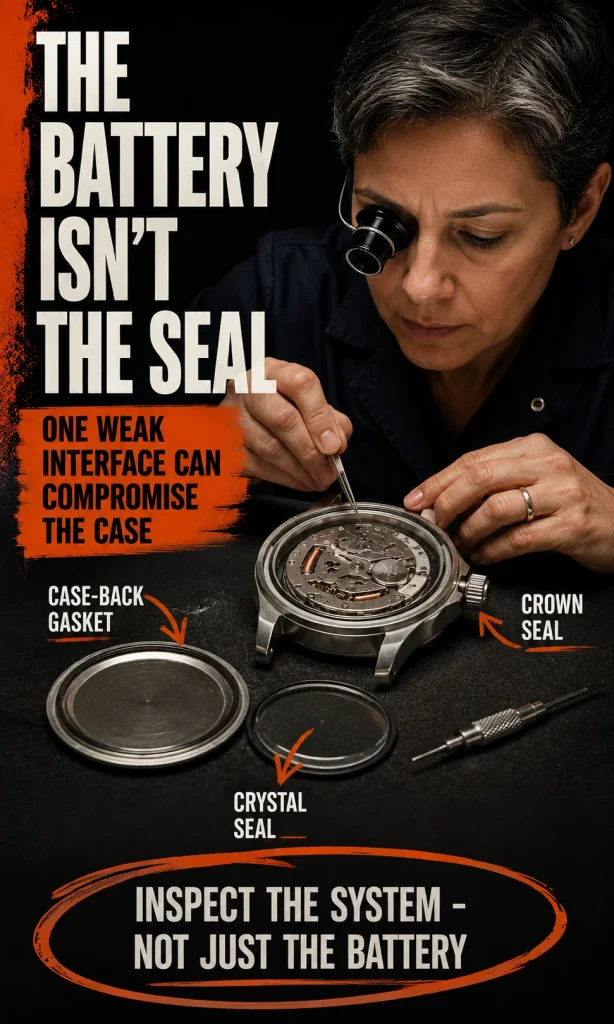
The battery itself does not create water resistance. Sealing comes from the relationship between the case, case back, crystal, crown, pushers where present, and the gaskets or seals fitted around those interfaces. Citizen’s water-resistance maintenance guidance explains that water-resistant watches use gaskets around areas such as the case back, crown and glass, and that those components deteriorate with age and exposure.
Battery replacement requires access to the movement, usually by removing the case back or opening another dedicated battery compartment. That can expose the main seal to dust, distort a dry or brittle gasket, move it out of its groove, reveal damage that was already present, or leave debris between sealing surfaces. A perfectly functioning movement can therefore receive a new battery while the case ends up less resistant to moisture than it was before opening.
The case can also have additional leak paths that a battery change does not directly touch. Crown seals, pusher seals, the crystal gasket and deformation from previous impacts can all affect current water resistance, which is why a case-back gasket that looks acceptable is only one part of the diagnosis.
A New Gasket and a Pressure Test Do Different Jobs
A gasket inspection asks whether a seal appears usable, correctly positioned and free from obvious damage. Replacing a deteriorated gasket addresses a physical component that could leak, but neither visual inspection nor replacement by itself demonstrates how the complete closed case behaves under pressure.
A pressure test performs that second job. ISO 22810 for water-resistant watches establishes requirements and test methods for verifying watch water resistance, while ISO 6425 for divers’ watches covers the more specialized requirements and test methods for diver’s watches.
That distinction gives the reader a useful rule:
- Battery replacement makes the watch run again.
- Gasket inspection or replacement addresses the physical seals.
- Correct resealing closes the case.
- Pressure testing checks whether the closed watch currently maintains the required sealing behavior under the test conditions.
Skipping one step does not necessarily mean the watch will leak immediately, but the steps should not be treated as interchangeable.
Why an Old Water-Resistance Mark Is Not a Current Test Result
The marking on the case describes the watch’s designed water-resistance level under the relevant manufacturing and test conditions. It does not guarantee that an older watch with aged seals, impact damage or a recently opened case still performs exactly as it did when manufactured.
Seiko’s water-resistance care guidance states that water resistance is not permanently guaranteed because gasket ageing and deformation from accidental shock can affect it. Citizen gives similar maintenance guidance and recommends regular seal attention rather than treating water resistance as permanent.
This explains why two identical watches with the same rating can have different real-world sealing condition after years of use. One may have fresh seals and an undamaged case, while the other may have a hardened gasket, damaged crown seal or poorly seated case back.
What Does a Pressure Test Actually Check?

Watchmakers can use different test systems, and the appropriate equipment depends on the watch and the level of resistance being verified. A common dry testing approach subjects the closed watch to controlled air pressure and measures extremely small case deformation or pressure-related changes without placing the watch directly in water.
Wet testing uses pressure and water in a controlled procedure that can help identify where air escapes from a leaking case. It should not be confused with simply dropping an unverified watch into a container of water and waiting to see whether moisture enters.
The critical point for the owner is simpler than the equipment. Ask what level the watch was tested to, whether it passed, and whether that test is appropriate for the type of water exposure you intend.
| Service Step | What It Can Tell You | What It Cannot Tell You Alone |
|---|---|---|
| Visual gasket inspection | Whether the accessible seal appears damaged, brittle, twisted, dirty or poorly seated. | Whether the complete assembled watch passes a pressure test. |
| Gasket replacement | Removes one known aged or damaged sealing component from the equation. | Whether another seal, crown, crystal or case surface leaks. |
| Dry pressure test | Whether the assembled case behaves as sealed under the tester’s specified conditions without deliberately wetting the watch. | The exact leak location in every testing setup. |
| Leak-localization test | Can help the technician identify where a failed case is leaking. | Whether an unrelated movement problem caused the watch to stop. |
When I Would Definitely Request a Pressure Test
Pressure testing becomes more valuable as the consequence of a leak increases. A dress watch that will deliberately remain dry presents a different decision from a quartz diver that will return to regular swimming.
I would prioritize verification when:
- the watch is intended for swimming, snorkeling or diving;
- the watch has a relatively high water-resistance specification that you genuinely rely on;
- the case was opened after years without seal service;
- the original gasket looks hardened, stretched, pinched or damaged;
- the watch has previously suffered an impact near the crystal, crown or case back;
- the crown, pushers or case surfaces already show physical damage;
- you cannot confirm who last opened the case or how it was resealed;
- the watch has sentimental or financial value that makes moisture damage particularly undesirable.
Manufacturer policy can be stricter than a generic workshop recommendation. For example, Seiko’s battery instructions specifically call for testing every time a battery is replaced on watches with 10-bar-or-higher water resistance, while Citizen’s support guidance for high-water-resistance battery watches directs owners toward service facilities equipped to inspect water-resistance performance after replacement.
Does Every Battery Change Require a New Gasket?
There is no useful universal answer that every opened watch always needs every gasket replaced regardless of condition or manufacturer procedure. The correct approach depends on the design, seal condition, age and service instructions for the specific watch.
Some manufacturers take a more prescriptive approach. Citizen states that water-resistant gaskets on watches with replaceable batteries are replaced during battery replacement, and Citizen’s water-resistance maintenance guidance describes gasket ageing as a normal maintenance issue.
A repairer should therefore be able to tell you whether the accessible seal was reused or replaced and why. “It looked fine” is different from “the closed watch subsequently passed the appropriate water-resistance test.”
Can I Change the Battery Myself and Keep the Watch Water Resistant?
Physically replacing a quartz battery can be straightforward on some watches, but maintaining a known water-resistance condition is a different challenge. You need the correct opening method, clean working conditions, correct battery, correct seal placement, an undamaged gasket and appropriate closing procedure, and you still cannot verify water resistance by eyesight alone.
Citizen specifically advises against home battery replacement because opening the case can allow contamination or incomplete water sealing. Some individual watch manuals may provide owner-accessible battery procedures, but those instructions should be followed for that specific model rather than generalized to every quartz watch.
The biggest DIY mistake is assuming that a case back which appears closed must therefore be sealed correctly. A pinched O-ring can be almost invisible from the outside, and microscopic debris on a sealing surface can create a leak path without any dramatic visual clue.
Common Failure Modes After a Poor Battery Change
A poor result is not always obvious the moment the watch is returned. Some failures remain hidden until the case encounters moisture or pressure.
- Pinched gasket: The seal is trapped partly outside its intended groove or compressed unevenly.
- Aged gasket reused: The gasket appears intact but has lost useful elasticity or has become brittle.
- Debris on sealing surface: Dust, hair or other contamination prevents even contact around the case.
- Wrong gasket: A replacement that looks similar may have the wrong profile or dimensions for the case.
- Case back not seated correctly: The back appears closed but is not seated as intended.
- Damaged crown or crystal seal: Replacing the case-back gasket cannot repair an independent leak elsewhere.
- No verification after service: The watch may be sealed correctly, but the owner has no current test confirming that condition.
These failure modes explain why a careful battery service is more than exchanging one coin cell for another.
What Should You Ask the Watch Repairer?
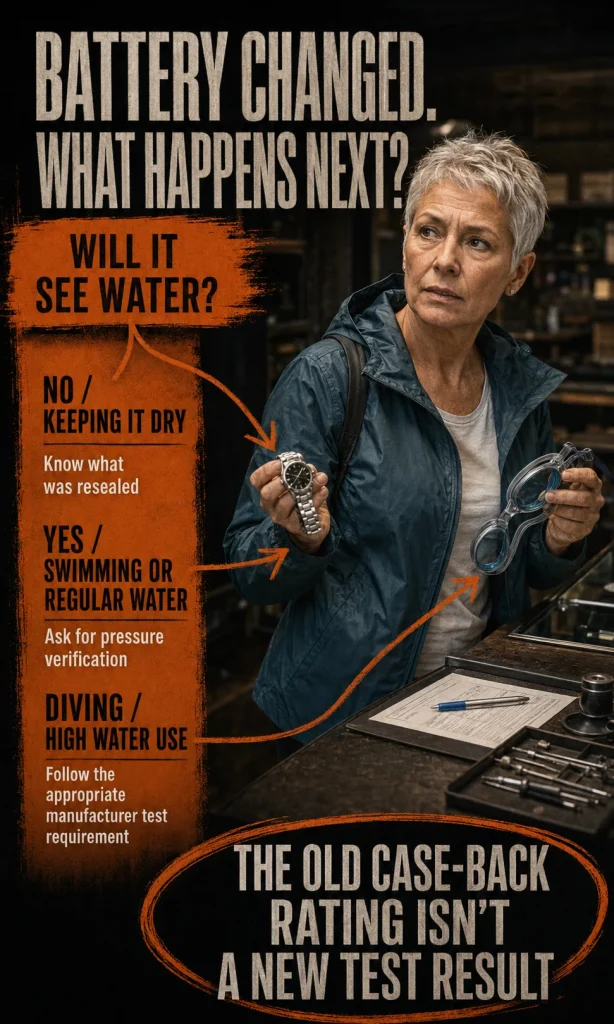
You do not need to know the internal engineering of the tester to ask useful questions. A competent service provider should be able to explain what was inspected, what was replaced and what verification was performed.
Ask:
- Did you inspect the case-back gasket and other accessible seals?
- Was the gasket reused or replaced?
- Was the sealing surface cleaned before the case was closed?
- Was the watch pressure-tested after resealing?
- What test level did it pass?
- Is that result appropriate for how I intend to use the watch?
- If it failed, where is the suspected leak and what needs replacing?
Casio Singapore provides a useful real-world benchmark: its stated battery replacement service includes module current testing, water-pressure testing and gasket replacement rather than treating battery installation as the entire service.
What If the Watch Fails the Pressure Test?
A failed test does not automatically mean the watch is ruined. It means the assembled case did not meet the tested sealing condition and should not be trusted for the intended water exposure until the source is diagnosed and corrected.
The technician may need to inspect the case-back gasket, crown or stem sealing system, crystal gasket, pushers, case surfaces or damage caused by wear and impact. After the likely cause is corrected, the watch should be tested again rather than assuming that replacing one seal solved the entire problem.
Until that happens, keep the watch away from water. The risk is not only immediate movement failure; moisture can also corrode electronic contacts, damage the dial or hands, and create longer-term movement problems.
What If You See Condensation After the Battery Change?
Visible moisture or condensation beneath the crystal should be treated as evidence that moisture may already be inside the case rather than as a harmless cosmetic problem. Stop exposing the watch to water and arrange inspection promptly.
Citizen advises owners to stop using a watch and request repair if water enters because moisture can damage the internal mechanism, electronic components and dial. Citizen’s water-resistance guidance gives the same basic recommendation.
Do not rely on repeated heating, sunlight or other improvised drying methods as a substitute for opening, inspection and proper moisture removal. Drying the visible condensation does not identify or repair the leak path.
Does a Screw-Down Crown Guarantee Water Resistance After Battery Service?
No. A screw-down crown can be an important part of a sealing system, but it cannot compensate for a damaged case-back gasket, crystal seal or another compromised component.
The crown also has its own seals and mechanical condition. A watch with the crown screwed down can still fail a pressure test, while a correctly serviced watch depends on the complete case rather than one visible feature.
Similarly, a high water-resistance number printed on the case back is not proof of the watch’s present condition after years of wear or recent opening. Current condition and current verification matter.
Battery Change vs Water-Resistance Restoration
The useful way to think about the service is as a sequence:
Replace the power source -> inspect the seals -> correct any damaged sealing component -> close the case properly -> verify the completed case when water resistance matters.
That sequence separates the movement problem from the case problem. The battery solves a power issue; the remaining steps protect the environment around the movement.
A workshop that offers a cheap battery replacement without water-resistance verification may still install the battery perfectly. The owner simply needs to understand what has and has not been established before returning the watch to water.
Frequently Asked Questions
Does changing a watch battery make the watch no longer waterproof?
Opening the watch does not automatically destroy its water resistance, but it disturbs or exposes the sealing system and means the previous condition should not simply be assumed. Correct gasket inspection, resealing and appropriate pressure testing can verify the watch after service. If the watch will be used in water, ask what sealing work and testing were performed.
Should the gasket be replaced every time the battery is changed?
Follow the manufacturer procedure and the condition of the specific seal rather than applying one universal rule to every watch. Some manufacturers explicitly replace water-resistant gaskets during battery service, while other service decisions depend on inspection and model requirements. What matters is that the seal is suitable, correctly installed and the completed watch is verified when water resistance is important.
Do I need a pressure test if I never swim with the watch?
The practical value of testing depends on how much you rely on water resistance and the consequence of a leak. Someone deliberately keeping an inexpensive watch dry may accept more uncertainty than someone regularly exposing a valuable watch to rain, washing or water sports. A current pressure test is still the stronger way to verify the closed case rather than assuming the old rating remains unchanged.
Can a watch pass a visual gasket check but still leak?
Yes. A visual inspection can identify obvious damage or poor seating, but the watch may have another leak path at the crown, crystal, pusher or case interface. Pressure testing checks the completed case rather than only the appearance of one accessible gasket.
Can I swim immediately after a normal battery replacement?
If the shop only changed the battery and cannot confirm the sealing condition or water-resistance test, do not assume the original swimming capability has been verified. Ask whether the seals were inspected and whether the completed watch passed an appropriate pressure test. For a diver or a watch routinely used in water, verification is the safer decision.
What should I do if there is condensation under the crystal?
Stop exposing the watch to water and arrange inspection promptly because condensation can indicate moisture inside the case. The movement, dial and electronic components can be damaged by moisture even if the watch continues running. The leak source also needs to be identified before the watch is trusted around water again.
Next Steps
If the battery has already been changed, first find out exactly what the repairer did beyond installing the cell. Ask whether the gasket was inspected or replaced, whether the sealing surfaces were cleaned, and whether a post-service pressure test was completed.
If the watch will return to swimming, diving or frequent water exposure and no suitable test was performed, keep it dry until its sealing condition is verified. The safest question is not “What water-resistance number is printed on my watch?” but “What did this watch actually pass after it was opened and resealed?”