

If your watch clasp opens by itself, stop wearing the watch until you know why it is releasing. A clasp that will not remain securely engaged can let the watch fall without warning, and repeatedly snapping it shut does not fix a worn catch, weak return spring, bent component, trapped debris or an adjustment section that is preventing full closure.
First determine which part is actually opening. A safety flap that pops up while the primary clasp stays locked is a different failure from the main folding clasp releasing completely, and a push-button clasp that never positively engages needs a different diagnosis from a properly locked clasp that later releases when the wrist moves.
| What happens | Check first | Best next action |
|---|---|---|
| Clasp never gives a positive click | Debris, poor alignment, bent catch or incomplete engagement | Inspect off the wrist before wearing again |
| Safety flap opens but main clasp remains shut | Safety-lock retention and contact surfaces | Service or adjust the safety mechanism before relying on it |
| Main clasp releases during ordinary movement | Primary catch, blades, push-button return and clasp alignment | Stop wearing until repaired or replaced |
| Problem started after using an extension or adjustment | Extension or slider may not be fully seated | Return the adjustment component to its fully locked position and retest off-wrist |
| One push button feels soft, slow or stuck | Button return mechanism, contamination or internal wear | Clean externally if appropriate; service if operation remains uneven |
First Identify Which Part of the Clasp Is Failing
A metal bracelet may use a simple folding clasp, a push-button three-fold clasp, a butterfly closure or a clasp with an additional safety lock. Leather and rubber straps can also use single-fold or double-fold deployant mechanisms. These designs look similar when closed, but they do not all rely on the same catches or release mechanisms.
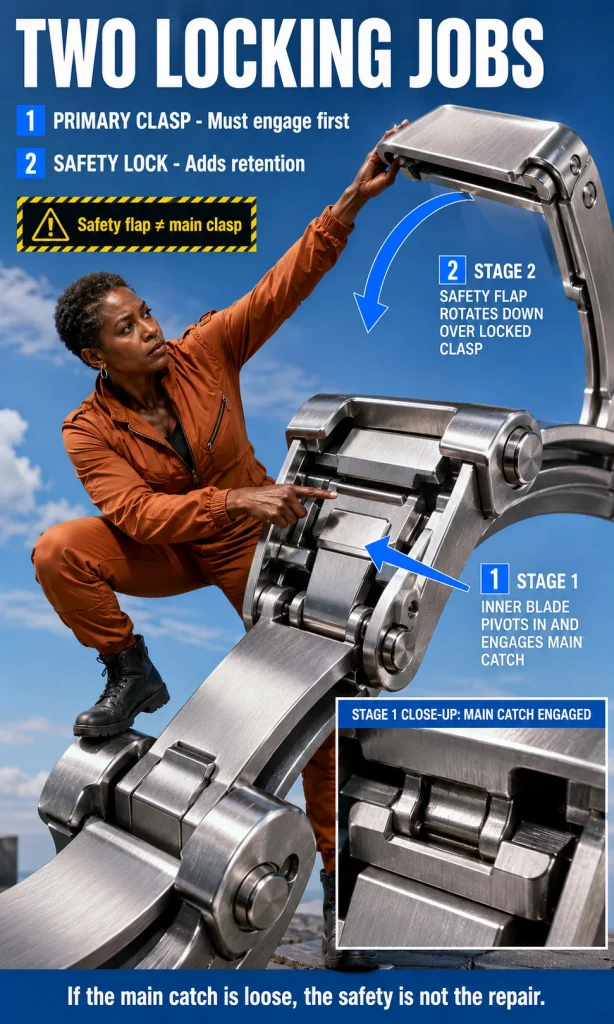
A deployant clasp creates a continuous loop by folding hinged blades underneath the wrist, while a fold-over safety component adds another retention stage over the primary closure. Watchfinder’s guide to watch clasp types explains these common architectures, and Patek Philippe’s description of its folding clasps illustrates why multiple catches or locking stages can be used to increase security.
Identify the exact piece that moves when the failure occurs. If the primary clasp stays closed but its outer safety lock opens, inspect that outer retention mechanism; if both suddenly release, the primary catch deserves priority.
A Clasp Can Look Closed Without Being Fully Engaged
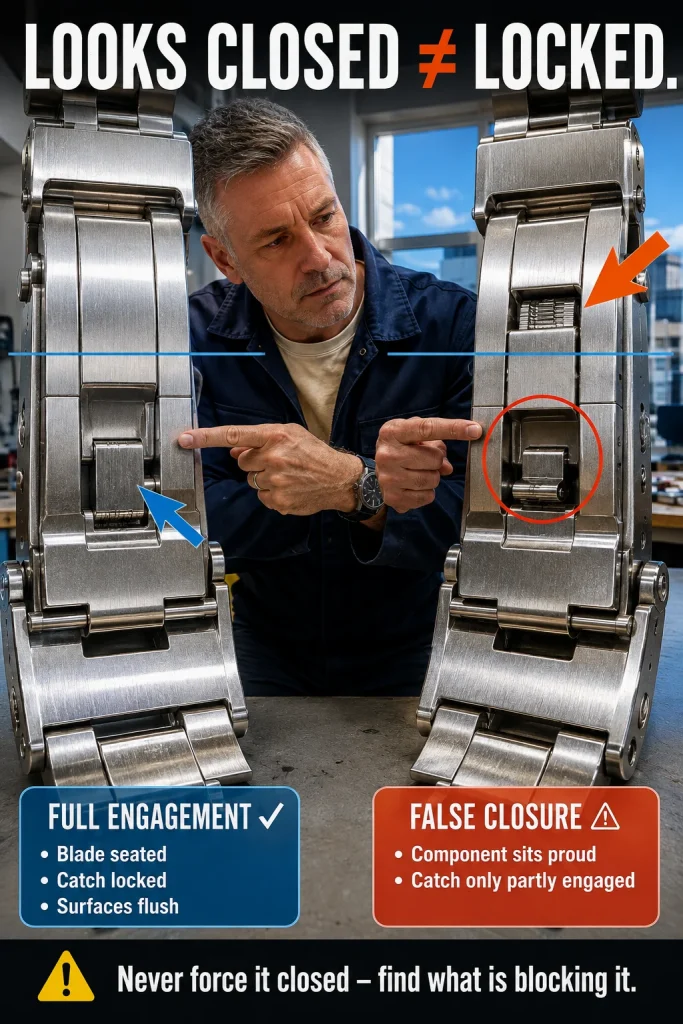
One of the easiest faults to miss is false closure. The clasp appears flat enough to look shut, yet the catch has not moved completely into its locking position.
On some bracelets, an extension or adjustment component that has not returned fully home can interfere with the main clasp. A long-standing specialist Seamaster troubleshooting guide describes precisely this situation: an incorrectly seated diver extension prevents the main clasp from closing completely and can make it pop open unexpectedly.
Do not assume that the cure is to press harder. Open the mechanism, look for something sitting proud, reposition the extension or adjustment section according to the watch’s instructions, and then close the clasp using normal pressure.
Signs the Clasp Is Not Fully Engaging
- The closing sound is softer or less positive than it used to be.
- One side of a butterfly clasp sits slightly higher than the other.
- The clasp can be pulled open without operating the normal release.
- A safety flap closes while the underlying clasp still has visible movement.
- A diver extension or slider remains slightly raised.
- One push button does not return to the same position as the other.
- Closing requires unusually high force.
- The clasp springs open as soon as wrist pressure is applied.
Push Buttons Should Release the Clasp, Not Hold It Half Open
A push-button clasp normally uses its buttons to disengage the retaining catches. Seiko’s current instructions for an adjustable three-fold clasp show that the wearer deliberately presses the push buttons to open the mechanism and then closes the clasp by pressing the buckle frame into the engaged position.
If a button remains partially depressed, returns slowly or feels dramatically different from the button on the other side, the locking parts may not be reaching their normal position. Dirt around the button, deformation or spring wear can all warrant inspection, but the exact internal repair depends on the clasp design.
Avoid spraying general-purpose lubricant into the clasp as a universal fix. A product that makes a sticky button temporarily easier to move can also trap contamination or migrate into areas where it was never intended, while doing nothing about damaged catches.
Dirt Can Prevent a Clasp From Seating Cleanly
Bracelet clasps collect perspiration, skin oil, lint and fine debris because they combine overlapping surfaces with moving components. Accumulation around a catch or hinge can interfere with smooth movement even when the clasp itself is not damaged.
Cleaning is therefore a reasonable early check when the watch and bracelet can safely tolerate the method used. Longines’ current watch-cleaning guidance specifically tells owners to concentrate cleaning around clasp areas while following the watch’s water-resistance requirements.
Do not use aggressive tools to scrape internal catches. A soft brush or appropriate cleaning method can remove contamination, but a clasp that still releases easily after being clean should be treated as a mechanical problem.
Does Bracelet Fit Affect the Clasp?
Fit can change how forces reach the closure. A bracelet worn extremely tight may experience greater tension as the wrist flexes or expands, while an extremely loose watch can move and knock the clasp against surfaces more frequently.
That does not mean every clasp opening problem is simply a sizing problem. If your main symptom is sliding, rotating, clasp position or bracelet balance, use the broader Watch Fit Problems guide; if the closure mechanically releases without the release control being operated, diagnose the clasp itself.
A properly fitting bracelet should not need wrist tension to keep its clasp closed. The locking geometry is supposed to retain the closure independently.
Why a Safety Lock Can Become Loose
A fold-over safety flap is often retained by shaped contact points that snap over part of the underlying clasp. Wear, deformation or loss of the original geometry can make that retention progressively weaker.
A current owner question from 2026 illustrates the real-world symptom well: the safety portion repeatedly opened and felt unusually loose. Community advice often recommends simply bending the component tighter, but that is not a universal repair because clasp materials, surface finishing and catch geometry vary.
Random bending can substitute one problem for another. It can leave the clasp excessively tight, mark polished surfaces or fatigue an already weakened component, so valuable watches are better assessed by someone familiar with the specific clasp.
A Weak or Damaged Primary Catch Is More Serious
If the main clasp itself releases while its safety flap remains properly positioned, treat the problem as more serious than a loose secondary flap. The primary locking surfaces, spring mechanism, push-button catches or folding blades may no longer be maintaining reliable engagement.
Specialist troubleshooting literature has documented weak clasp springs as one possible cause on specific bracelet designs. Chronocentric’s clasp troubleshooting guide should be read as a model-specific example rather than proof that every opening clasp has a failed spring.
The useful diagnostic rule is simpler: if the primary clasp can be opened with pulling force that would never have released it previously, do not trust it on the wrist.
| Clasp architecture | What normally locks it | Useful failure clue |
|---|---|---|
| Simple fold-over | Mechanical catch between folding components | Loss of a crisp snap or easy pull-open |
| Push-button deployant | Catch released deliberately through side buttons | Button sticks, returns unevenly or clasp never fully engages |
| Butterfly | Two folding blades meeting at a central closure | One half sits proud or one side releases first |
| Fold-over + safety lock | Primary clasp plus secondary mechanical lock | Determine whether only the safety or the main clasp is releasing |
Check Nearby Screws and Pins Too
A clasp problem can occasionally originate beside the locking mechanism rather than inside it. Screws or pins joining the clasp to the bracelet can loosen, shift or become damaged and alter the way the closure aligns.
If a threaded fastener is visibly moving outward, that has its own repair logic. Follow the bracelet screw that keeps coming loose guide rather than trying to compensate by adjusting the clasp.
A clasp that has begun sitting crooked after a pin or screw moved should remain off the wrist until the connection is secure. Correct alignment matters because the folding components need to meet as designed.
Test the Clasp Off Your Wrist
Once obvious contamination or incomplete seating has been corrected, test the closure off your wrist first. This lets you verify the mechanical action without risking the watch falling.
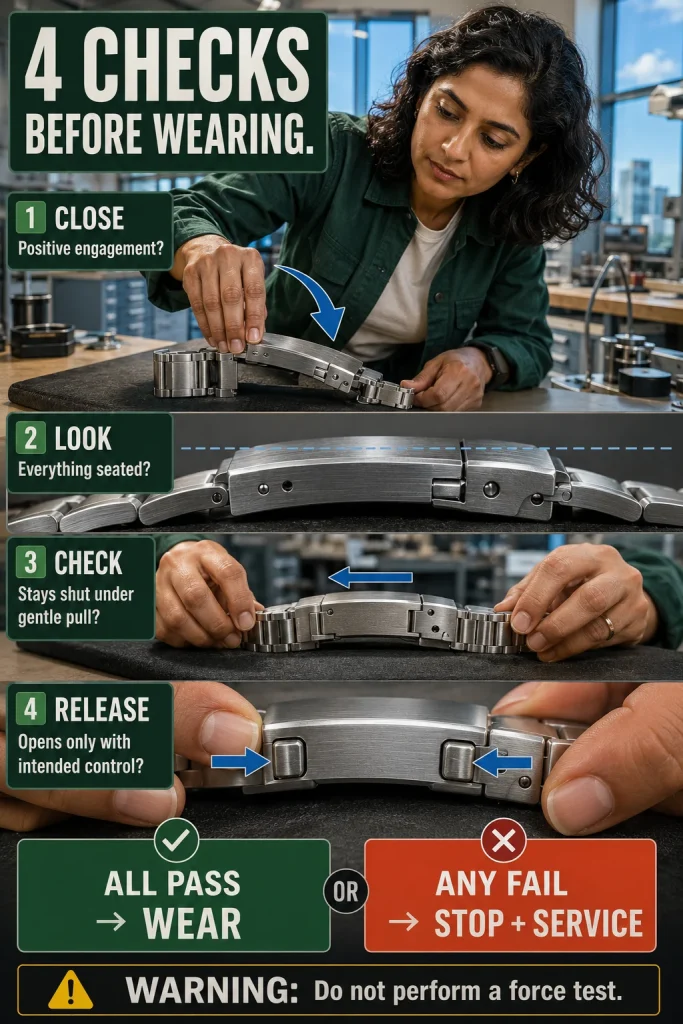
Use this sequence:
- Open the clasp fully. Check that every blade, extension and adjustment component is in its normal position.
- Close the primary clasp normally. Listen and feel for its usual positive engagement.
- Close the safety stage if fitted. It should remain secure independently.
- Inspect from the side. Folding sections should sit as intended rather than remaining visibly proud.
- Operate both push buttons. Their travel and return should feel reasonably consistent.
- Apply a gentle opening load without touching the release. The clasp should not simply pull apart.
- Open it using the intended release. It should release predictably rather than sticking.
- Repeat several times. A clasp that works once and then fails intermittently is still unreliable.
This is a functional check rather than a laboratory load test. Do not try to prove a clasp’s strength by violently pulling on an expensive bracelet.
New Watch? Use the Warranty Route First
A new clasp should not require improvised bending or repeated home adjustment to stay shut. If the watch is within its return or warranty period, record the problem and show the retailer how easily or under what movement the closure releases.
A short video can be particularly useful for an intermittent fault. Film the clasp being closed normally, show that no release button is being pressed, and document the unexpected opening without deliberately abusing the bracelet.
Avoid modifying the clasp before the seller evaluates it. Once metal has been bent or surfaces marked, an otherwise straightforward warranty complaint can become harder to assess.
When Repair Makes Sense
Repair can make sense when the original clasp is structurally sound and a serviceable component has lost adjustment, alignment or spring function. Valuable proprietary clasps are often worth servicing rather than replacing with a generic closure that changes comfort, appearance or originality.
The exact repair should follow the clasp design. A watchmaker may inspect catch geometry, blade alignment, button return, springs, pins, screws and any extension mechanism before deciding whether adjustment or component replacement is appropriate.
This is a better workflow than beginning with one internet trick. “Bend it tighter” is only useful when the diagnosis has already established that controlled reshaping is actually the correct service procedure.
When the Clasp Should Be Replaced
Replacement becomes the stronger decision when structural wear or damage makes dependable retention uncertain. A crack, broken spring component, severely worn catch, badly deformed blade or clasp that repeatedly fails after proper servicing is no longer merely inconvenient.
Consider replacement when:
- the primary catch no longer holds consistently;
- push buttons fail to return correctly after cleaning and inspection;
- metal is cracked or visibly fatigued;
- a safety lock has lost substantial retaining geometry;
- the clasp is badly bent;
- a replacement internal component is unavailable;
- repeated professional adjustment does not restore reliable engagement;
- a generic aftermarket clasp is clearly incompatible with the strap or bracelet.
A replacement should match the required attachment dimensions and strap or bracelet architecture. Security matters more than preserving a failing component simply because it is original.
Frequently Asked Questions
Why does my watch clasp keep opening by itself?
A clasp can open unexpectedly because it is not fully engaging, an adjustment or extension section is interfering with closure, the locking surfaces are worn or bent, the push-button mechanism is not returning properly, or the clasp has developed mechanical damage. Dirt can also interfere with smooth engagement on some closures. Stop wearing the watch until you can reproduce a secure positive closure off the wrist.
Is it safe to wear a watch if the clasp sometimes pops open?
No intermittent opening should be treated as normal if the main closure can release without the intended control being operated. The next accidental opening could allow the watch to fall before you notice. Diagnose or repair the clasp before wearing the watch normally again.
Why does my watch clasp close but not click?
A missing or weak engagement can result from misalignment, contamination, an incompletely seated adjustment component or wear to the locking surfaces. Compare the current closing action with how the clasp previously behaved and inspect whether every folding part sits fully home. If it can be pulled open without the normal release, stop wearing the watch.
Can a dirty watch clasp make it open unexpectedly?
Contamination around moving surfaces can interfere with smooth clasp operation, so appropriate cleaning is a sensible early check. Cleaning will not repair worn, cracked or deformed locking components. If the clasp remains unreliable after it is clean and correctly seated, have the mechanism inspected.
Should I bend a loose watch clasp to make it tighter?
Do not bend clasp components until the specific mechanism and failure have been identified. Controlled reshaping is a legitimate repair on some clasp designs, but random bending can damage finishing, create excessive tension or distort another locking surface. A valuable or unfamiliar clasp is better assessed by a watchmaker.
Should a new watch clasp ever pop open?
A properly closed new clasp should not repeatedly release during normal wear without its release mechanism being operated. Confirm that you are closing every stage correctly, particularly any extension or safety lock. If the problem persists, document it and use the retailer or warranty route instead of modifying the clasp yourself.
Action Checklist
- Take the watch off after an unexplained clasp release.
- Identify whether the safety stage or primary clasp is failing.
- Check extensions, sliders and folding blades for incomplete seating.
- Inspect around the catch and push buttons for contamination.
- Compare both push buttons for normal return.
- Look for bent, cracked or visibly worn clasp components.
- Inspect adjacent screws and pins for movement.
- Test the closure off-wrist several times.
- Do not deliberately overload the clasp during testing.
- Do not randomly bend an expensive clasp.
- Document an intermittent failure with a short video.
- Use warranty support first on a new watch.
- Replace structurally damaged hardware rather than relying on repeated temporary adjustment.
- Do not wear the watch normally until the main clasp remains reliably engaged.