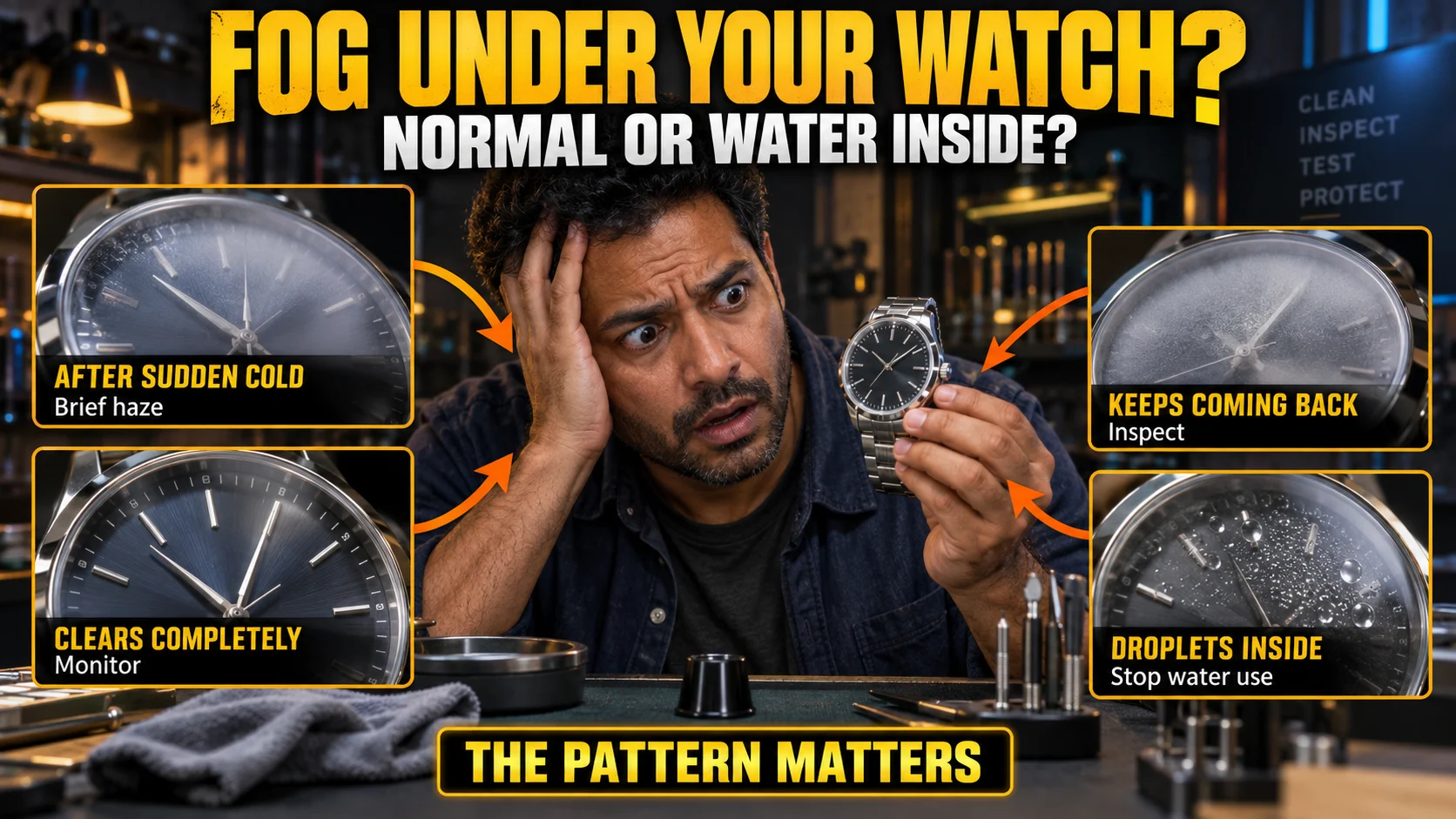
Fog beneath the inside surface of a watch crystal means water vapor is present inside the case, but it does not automatically prove that liquid water has just leaked through a failed seal. A brief haze triggered by a sudden temperature drop can form when humid air already sealed inside the watch reaches its dew point, while fog that lingers, returns repeatedly, forms visible droplets or appears after swimming should be treated much more seriously.
The most useful first distinction is what happens next. CASIO’s official watch-handling guidance says brief inner-surface fog after a sudden drop in temperature may not indicate a problem when it clears relatively quickly, but fog that does not clear or visible moisture inside the glass calls for stopping use and professional inspection. That gives owners a better decision rule than assuming either that every moment of fog is catastrophic or that disappearing fog means the watch is definitely healthy.
| What You See | What It Suggests | What to Do |
|---|---|---|
| Brief haze after a sharp move from warm to cold | Moisture already present in the sealed air can condense on the colder crystal. | Let the watch return to a stable room temperature and watch whether the haze clears completely. |
| Fog keeps returning during ordinary wear | The case may contain more moisture than it should, or sealing performance may have deteriorated. | Keep the watch dry and arrange inspection rather than repeatedly waiting for it to disappear. |
| Visible droplets or persistent moisture | There is enough moisture inside to create a meaningful risk to the dial, movement or electronics. | Stop water exposure and arrange service promptly. |
| Fog appears after swimming, washing or submersion | Treat the event as a possible water-resistance failure even if the fog later disappears. | Do not return the watch to water until its case and seals have been checked. |
First Confirm Whether the Fog Is Actually Inside the Crystal

Condensation on the outside surface can look alarming while being completely ordinary. A cold watch brought into a warm humid room can collect moisture on the exterior just as eyeglasses or a chilled drinking glass can, and that moisture should wipe away directly from the surface.
Use a clean soft cloth and wipe the crystal. If the cloudy area disappears exactly where you wipe, the condensation is external. If the haze remains unchanged beneath the surface, moves with temperature rather than wiping, or appears to sit behind the hands and dial plane, you are dealing with moisture inside the case.
This simple distinction prevents a common diagnostic mistake. Outer condensation tells you about the surrounding air and surface temperature; inner condensation tells you that water vapor is already present inside the watch.
How Can a Sealed Watch Fog Without a New Leak?
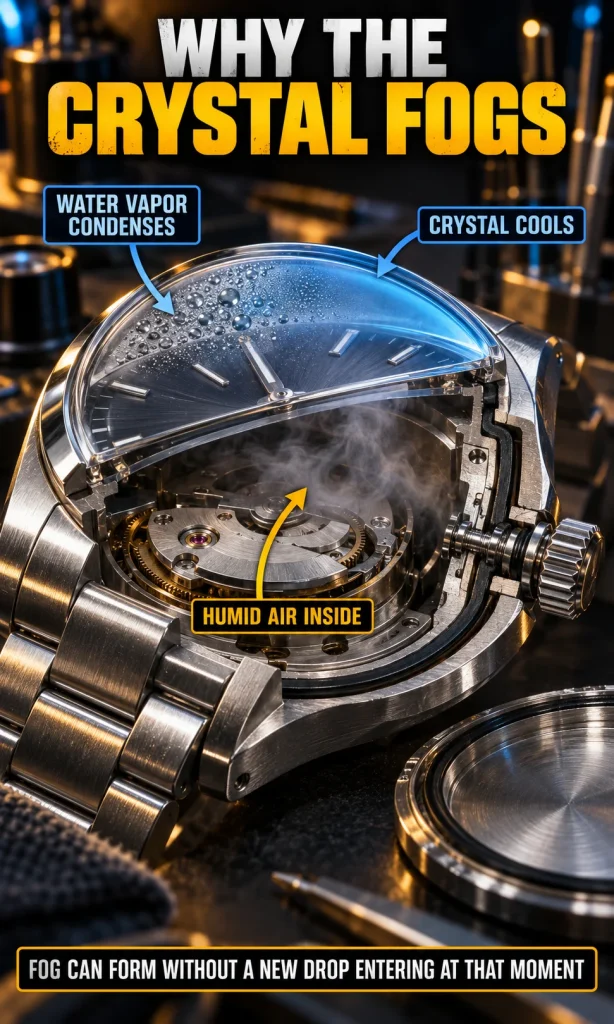
A watch case is not normally assembled around a vacuum. Air exists inside it, and that air can contain some water vapor depending on the humidity present when the case was last closed.
Warm air can hold more water vapor before condensation forms than cooler air. If the crystal cools rapidly enough, its inner surface can fall below the dew point of the trapped air and a thin haze can appear even when no new liquid water has entered at that moment.
This is why the manufacturer distinction matters. CASIO specifically allows for temporary internal glass fogging after sudden temperature drops, while still treating persistent fog or visible internal moisture as a service condition. The diagnostic question is therefore not merely “Did it fog?” but “Under what condition did it fog, how completely did it clear, and does it keep happening?”
When Fogging Should Make You Suspect a Water-Resistance Problem
Water resistance depends on several interfaces rather than one single seal. The case back, crown, crystal, pushers where fitted, gaskets and mating surfaces all contribute to keeping excessive moisture out.
Citizen’s water-resistance maintenance guidance explains that gaskets can lose elasticity or become brittle over time and that scratches, deformation and other case damage can also reduce water resistance. Citizen further advises stopping use and requesting repair if water gets inside or is suspected to be inside.
The following conditions should move the situation away from simple monitoring and toward inspection:
- fogging appears repeatedly without an obvious extreme temperature change;
- the fog lasts noticeably longer than the brief temperature-related episodes the manufacturer describes;
- visible droplets form rather than a light temporary haze;
- moisture appears after swimming, showering, washing or another direct water event;
- condensation started after a battery change, crystal replacement or other case-opening service;
- the crown, pushers or crystal have recently been knocked or damaged;
- stains, corrosion marks or changes to the dial or hands appear;
- the watch begins behaving abnormally after the moisture event.
The important distinction is recurrence and context. A watch that briefly hazes during an unusually sharp temperature transition is not the same diagnostic case as one that repeatedly fogs during ordinary indoor wear.
Why Disappearing Fog Does Not Prove the Problem Is Gone
Condensation can disappear because the crystal warms again and the visible droplets evaporate back into water vapor. That changes the visible state of the moisture; it does not necessarily remove that moisture from the case.
This is why repeated fogging is useful evidence. If the same watch clears indoors and then fogs again whenever the temperature drops, the case may be carrying enough internal humidity to repeatedly cross the dew point under normal conditions.
A disappearing haze therefore answers only one question: the condensed droplets have evaporated. It does not confirm that the seals are healthy, that the inside of the watch is dry enough, or that the case will pass a water-resistance test.
What to Do Immediately When You See Internal Moisture
Start by stopping additional water exposure. Wipe the outside of the watch dry, move it to a stable room-temperature environment and observe whether a light haze clears completely or whether visible moisture remains.
If the watch is wet, do not start operating crowns or pushers simply to “let the moisture out.” Seiko’s handling guidance warns against turning or pulling the crown while the watch is wet because water can enter through the crown area, and the same guidance says long-lasting condensation or droplets inside the watch require prompt service.
A practical action sequence is:
- Confirm the fog is inside. Wipe the outer crystal first so you know which surface is involved.
- Stop further water exposure. Do not test the watch again under a tap or in a bowl of water.
- Avoid operating controls while wet. A crown or pusher seal is less useful if the control is being moved while water is sitting around it.
- Observe whether a light temperature-related haze clears completely. Do this at a stable room temperature rather than repeatedly heating and cooling the watch.
- Treat persistent fog, recurrent fog or droplets as a service condition. The longer excess moisture remains around the movement and dial, the less useful continued observation becomes.
- Do not return the watch to swimming or other deliberate water use until the sealing condition is understood.
The goal is not to panic at the first trace of haze. The goal is to avoid turning a potentially manageable moisture condition into prolonged exposure or a second water-ingress event.
Do Not Use Another Water Test to See Whether It Still Leaks
Owners sometimes respond to fogging by running the watch under water again, immersing it briefly or changing between hot and cold water to reproduce the symptom. That experiment can worsen the exact problem you are trying to diagnose.
If the seal is already compromised, another water exposure can introduce more moisture. If the seal is healthy but the case contains humid air, repeated temperature cycling tells you little about how the watch performs under a proper controlled pressure test.
A watchmaker’s equipment exists because water resistance is better checked under defined conditions than through improvised household experiments. The owner should provide the history – swimming, impact, service, fog behavior – and let the technician determine how to test the case safely.
What About Rice, Silica Gel or a Hair Dryer?
Drying tricks are popular because the visible fog sometimes disappears afterward. The problem is that making the crystal look clear does not identify why the moisture was there, inspect the movement for contamination or establish whether the watch can safely return to water.
Rice is particularly weak as a repair concept because it cannot reseat a gasket, repair a crown tube, restore a crystal seal or verify case pressure. A desiccant can absorb moisture in an appropriate controlled context, but leaving a closed watch beside a drying material does not magically pull all internal moisture through an intact case.
Direct heating is also a poor substitute for diagnosis. Even if warmth makes visible condensation disappear faster, the useful question remains whether excess moisture is still inside and whether the case sealing system needs repair.
Should You Pull the Crown Out to Help the Watch Dry?
This advice appears frequently in forums, but it is too broad to use as a universal instruction. The crown opening is itself one of the watch’s sealing interfaces, and manufacturer guidance warns against operating the crown while the watch is wet.
If a professional deliberately opens the case for drying and inspection, that is different from an owner pulling a wet crown out at home and leaving the watch exposed. A technician can remove the movement if necessary, inspect where moisture reached, clean affected parts and then reseal and test the case.
For the owner, the safer default is simpler: keep the watch dry, stop manipulating controls while wet and arrange inspection when the symptom is persistent or serious.
Why Recent Battery Replacement or Service Matters
A newly opened case changes the diagnostic history. The battery itself has nothing to do with creating water resistance, but opening and closing the case exposes the case-back gasket and sealing surfaces.
If fogging begins shortly after battery service, ask whether the gasket was inspected or replaced and whether the completed watch was pressure-tested. The dedicated watch battery and water-resistance guide explains that battery installation, gasket service and post-service water-resistance verification are separate jobs.
CASIO’s maintenance guidance goes further by stating that a trained technician should inspect water resistance when a battery is replaced. That makes recent case opening an important clue when condensation begins shortly afterward, especially if the watch never fogged under the same conditions before.
Where Water Can Enter a Watch
The case-back gasket gets most of the attention because it is easy to see during battery replacement, but it is not the only possible leak path. Crown seals can age or be damaged, crystal gaskets can deteriorate, pusher assemblies add more interfaces, and case deformation can affect surfaces that once sealed correctly.
A watch can therefore receive a new case-back gasket and still fail a pressure test. That is why replacing the most obvious seal is not equivalent to verifying the entire case.
Citizen’s water-resistance guidance specifically notes that both gasket ageing and physical damage can impair water resistance. A technician needs to evaluate the complete case rather than assuming every leak is the O-ring visible beneath the case back.
| Possible Leak Area | Useful Clue | Professional Check |
|---|---|---|
| Case-back gasket | Fogging begins after battery or case-back service. | Inspect gasket condition, seating and sealing surface. |
| Crown or stem seals | Moisture follows crown use, damage or age. | Inspect crown, stem, tube and seal condition. |
| Crystal gasket or adhesive interface | Fogging follows impact or crystal replacement. | Check crystal seating, gasket and case geometry. |
| Pushers or additional controls | Chronograph or digital watch has several control openings. | Inspect and test the complete case rather than one seal. |
What a Watchmaker Should Check
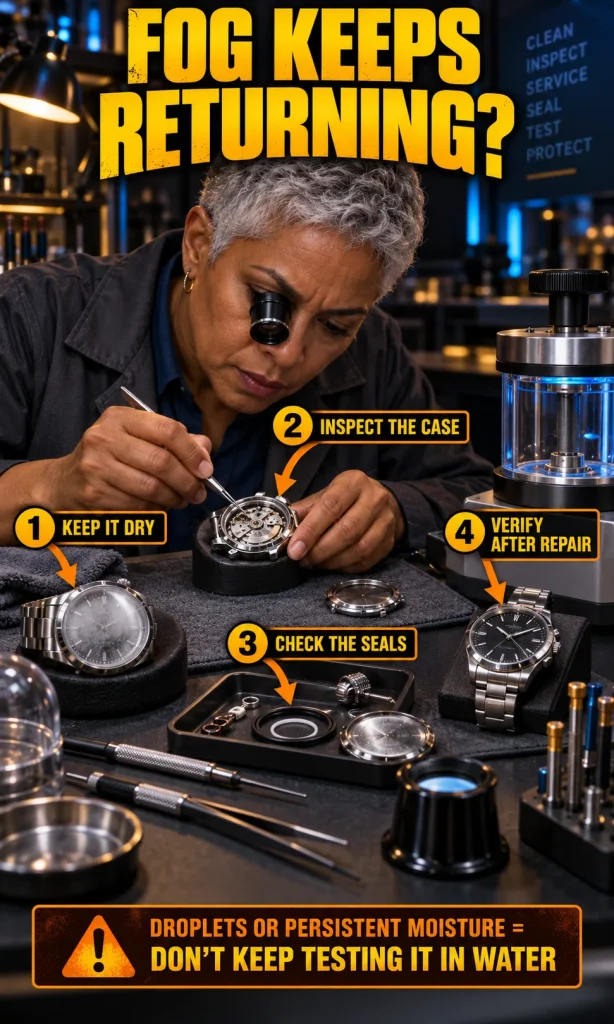
The first job is determining whether excess moisture is still inside and whether it reached components that can corrode or stain. Visible droplets, marks on the dial, rust-colored deposits or abnormal movement behavior can justify more than a simple gasket replacement.
The second job is finding the sealing problem. Depending on the watch, that may involve inspecting the case-back gasket, crown and tube, pushers, crystal interface, case surfaces and any evidence of deformation or prior poor servicing.
The final job is verification. After the case is dried, repaired and resealed, an appropriate water-resistance or pressure test can establish whether the completed case behaves as intended under the test conditions rather than relying on appearance alone.
Can a Watch Fog Even If It Passed a Pressure Test Earlier?
Yes, because water resistance is a condition that can change. Gaskets age, impacts can deform components, crowns and pushers wear, and a later service can open the case again.
Seiko’s watch-care guidance explicitly says water resistance is not permanently guaranteed because gasket ageing and accidental deformation can change it. A test from years ago therefore tells you what the watch did at that time rather than guaranteeing the case indefinitely.
The same reasoning applies after repair. A successful current test provides useful evidence about the present case condition, but ongoing maintenance and sensible water use still matter.
Does the Water-Resistance Rating Tell You Whether Fogging Is Serious?
The printed rating tells you the watch’s designed level of water resistance, not the amount of moisture currently inside it. A highly rated watch can still develop a seal problem, while a watch intended only for limited water exposure can still suffer internal damage if moisture enters.
The rating does affect how much you rely on the seal. If a watch is regularly used for swimming or aquatic activities, verifying the repaired water resistance becomes much more important than it would be for a watch deliberately kept dry.
Do not treat a high number on the case back as permission to ignore condensation. Visible internal moisture is current evidence; the rating is a design specification.
Is Brief Fogging in Cold Weather Ever Acceptable?
Manufacturer guidance says it can be. CASIO states that the inside surface of the glass may fog after a sudden temperature drop and that no problem is indicated when it clears relatively quickly.
The important limitation is that CASIO does not give this as a blanket explanation for all fogging. The same guidance immediately tells owners to stop using the watch and seek service if the fog does not clear or if moisture is visible inside.
That distinction makes the cold-weather question easier to handle. One isolated brief haze after an unusually sharp temperature transition can be monitored; repeated or persistent episodes deserve investigation.
Common Mistakes That Make the Diagnosis Harder
The first mistake is repeatedly recreating the problem with hot and cold water. This adds another uncontrolled water exposure and can make a sealing problem worse.
The second mistake is assuming that clear glass means a dry watch. Condensed water can evaporate back into invisible vapor and remain inside the case.
The third mistake is focusing only on the case-back gasket. Water resistance is the result of several interfaces, and a watch with a new rear gasket can still leak elsewhere.
The fourth mistake is manipulating the crown while the watch is wet. Manufacturer guidance specifically warns against this because water can enter around the control interface.
The fifth mistake is delaying service once actual droplets, persistent fog or repeat moisture have appeared. Moisture damage can progress even while the watch continues keeping time normally.
Frequently Asked Questions
Is condensation inside a watch always a sign of a leak?
Not necessarily. Manufacturer guidance recognizes that brief inner-glass fogging can occur after a sudden temperature drop when humid air already inside the case condenses on the colder crystal. Fog that persists, returns repeatedly, forms droplets or appears after direct water exposure should be treated much more seriously.
Why does my watch fog when I go from warm air into cold air?
The inner crystal can cool below the dew point of the air trapped inside the case, causing some water vapor to condense temporarily. A light haze that clears completely after the watch returns to a stable temperature can fit this pattern. Repeated or long-lasting condensation suggests the internal moisture level or sealing condition deserves inspection.
Should I pull the crown out if there is moisture in the watch?
Do not treat pulling the crown out as a universal home-drying method, especially while the watch is wet. The crown is part of the sealing system, and manufacturer guidance warns against operating it when water is present around the watch. Persistent fog or visible moisture is better handled through professional inspection and controlled drying.
Will rice remove moisture from inside a watch?
Even if the visible haze eventually disappears, rice does not diagnose the leak path, inspect internal components, repair damaged seals or verify water resistance. A watch that repeatedly fogs or contains droplets needs the cause investigated rather than only the visible condensation removed. Keep it dry until the sealing condition is understood.
Can fogging happen after a battery change?
Yes. Battery replacement normally requires opening the case, which exposes the case-back seal and sealing surfaces. If fogging begins after service, ask whether the gasket was inspected or replaced and whether the closed watch was pressure-tested before being returned.
Can the watch still work normally even if moisture is inside?
Yes. A watch can continue keeping time while moisture begins affecting metal surfaces, the dial, hands, movement parts or electronic components. Normal operation therefore does not prove that the moisture is harmless or that the sealing problem has resolved itself.
Can I swim with the watch again after the fog disappears?
Do not assume disappearing fog restored water resistance. If the condensation was persistent, recurrent or followed direct water exposure, keep the watch out of water until its seals and case condition have been checked and the repaired case has been appropriately verified.
Next Steps
If the fog appeared once during an unusually sharp temperature change and then cleared completely, keep the watch dry for now and watch for recurrence under ordinary conditions. If the haze returns repeatedly, lasts, forms droplets or followed swimming or another water event, move from observation to inspection rather than waiting for another cycle.
Tell the watchmaker exactly what happened: whether the watch had recently been opened, whether water exposure occurred, whether the crown or crystal was damaged, and whether the fog clears or repeatedly returns. That history can help distinguish trapped humidity from a more obvious sealing failure and gives the technician a better starting point for inspection and pressure testing.
The key idea is simple: brief temperature-related fogging can sometimes be temporary, but persistent or recurrent internal moisture is evidence worth acting on. Clear glass alone does not prove the inside of the watch is dry or that its water resistance remains intact.